Author Archives: Ijaz Ahmad

I Broke Another Missionary

بِسۡمِ ٱللهِ ٱلرَّحۡمَـٰنِ ٱلرَّحِيمِ ,

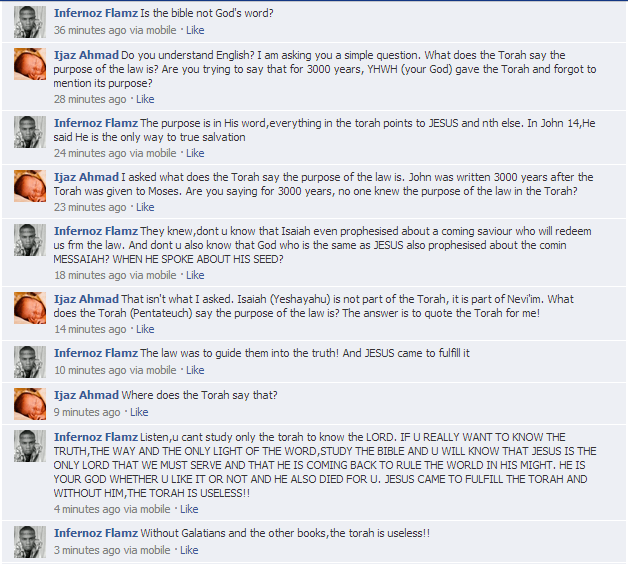
This morning I turned into a missionary’s worse nightmare. I’m sort of like the chap that comes to the car dealership, tests drives the car and it fails on me, I return to test drive another and it fails as well. Thus, it would appear that I’m not good for the dealership business. Similarly, I’m not good for missionaries either. After my initial run this morning, I decided to approach a Christian who has been on my list for sometime. As you will see:

  1. I asked a question that he could not answer.
  2. He knows he had no answer.
  3. So he repeated his wrong answer in hopes I’d stop asking.

Enjoy:

flamztotal


As you would eventually see, his patience finally ran out and he began typing in all caps. Clearly I’ve gotten on his nerves, I guess that whole ‘love your enemy’ mantra doesn’t seem to be working right about now…


flamz3

I’ve been told that the antidote to my questions is a dose of Islam, available everywhere and best of all, free of charge!

wa Allaahu ‘Alam.

A Christian Learns that Muslims do not Succumb to Childish Tactics [Updated!]

بِسۡمِ ٱللهِ ٱلرَّحۡمَـٰنِ ٱلرَّحِيمِ ,

Missionaries have employed a vast variety of tactics to drag the Muslim into debate, solely for the purpose of taking control of the conversation, negating the Muslim’s belief and establishing Christianity as the dominant faith. Many do not understand that this is a reality, they think that these missionaries are innocent minded. However, a missionary on our very own page, despite his explicit arrogance, outed himself in a cry of frustration. He explains that despite all of his manoeuvring to drag me into a submissive position of argument, he’s failed constantly. What he does not understand is that I am no child. Despite being 20, I am familiar with the missionary mentality. Not only that, due to my Islamic upbringing, I also have developed a thick skin and a knack for being patient with confrontational people.

victorfb

He mistakenly assumes that by not being able to capture me in debate, it is due to me backing out. The truth is, he hasn’t been able to capture me in petulant and low level thought arguments because I cut him off at every chance he gets. Essentially, foresight is key and so is socratic thinking. In layman’s terms, I know what arguments he will use and the string of logic which follows, so I negate his premises, thus rendering his argument null and void. Since his argument has been refuted, he’s unable to move forward and thus he’s cut off from preaching to me.

He speaks so candidly, that he even admits to assuming I have a camera in his mind so I can see his thoughts. Surely, this is a sign from Allaah that I’m atleast doing something right. Knowledge is key and in my few years of discussion and dialogue, Christians have few intelligible arguments. I read their texts, studied and understood their reasoning and because of this, I became able to foresee their train of thought and as I have aforementioned, I am now able to shut them down in an elegant and precise manner. He thought that being loud and abrasive would help, but my patience persevered over his stone age tactics. He thought that by insulting my pride, I would have no choice but to respond, what he does not understand is that in Islam we are taught humility and we are humble to all due to our submission to our Lord, Allaah ta ‘aala.

Finally, he says that he tried to portray himself as a liar so that I would jump at the chance to attack and embarrass him, but this too did not work. He does not yet understand that we do not do this to attack, or hate on anyone, but to sincerely guide them to the truth. The missionary mind is very close minded, and this is a rear glimpse into what effective da’wah does to the Missionary. He is unable to think properly, his methods have failed, his arguments have backfired. He’s unable to evoke an emotional response from the Muslim. So what is he to conclude? That I am unlearned and unstable! Funny and ironic as it may be, his own words are testament to my character. I’m not unlearned, nor unstable, I am a Muslim who understands Islam and because of this, I recognize the reality of Christian missionary work, subsequently, I am able to decommission missionaries by doing little and causing them much frustration!

Allaah is indeed the Most Merciful!

Addendum:

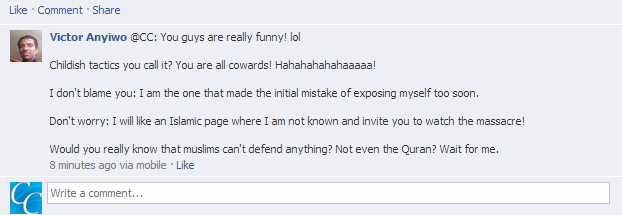
Shortly after this post, our friend Victor decided to comment once more:

victorfb1

This is what I call the emotional self affirmation,  the missionary has now presented himself with a precarious situation. He decides that although he admitted to being deceitful, that he willingly attacked my pride, that he pretended to be ignorant, in the end I am the one who is the coward. To compensate for such a lame argument he added a bout of laughter that really shows his nervous reaction to the mess he’s found himself in. Then he sought to once again, admit that he exposed himself. It’s good that he realised what he’s done, but then he shoots himself in the foot again by explaining more of his method.

He’s decided to go to another Muslim page and ‘perform a massacre’, such violent rhetoric is abhorrent and quite distasteful, certainly Christ did not usher and motivate the disciples by telling them to massacre the Jews! Alas, we must differentiate between the Christians of today and the faithful disciples of Christ. Lastly, he concludes that us Muslims cannot defend anything and then ends with saying we should wait for him. Most certainly we shall wait for him and we will enjoy watching him fumble once more. I think I’ve broken this missionary, thank God there are a couple million more for me to enjoy.

wa Allaahu ‘Alam.

Paul’s Contradictions on Salvation are Vast

بِسۡمِ ٱللهِ ٱلرَّحۡمَـٰنِ ٱلرَّحِيمِ ,

Paul’s gripes with the law are prominent throughout Galatians, Philippians and Romans. The content of most of these Epistles are filled with Paul’s intra-spiritual conflicts on soteriology given his Pharisaical past and Christian future, a battle not only with himself, but with his ‘super-apostle’ counterparts whom he proclaims equity with in authority and rank, yet they have never indicated such spiritual contradictions in their alleged writings[1][2]. To the contrary the ‘super apostles’ seemed to have it all figured out[3]. Paul says in his Epistle to the Philippians where he is boasting of his character[4]:

If someone else thinks they have reasons to put confidence in the flesh, I have more:  circumcised on the eighth day, of the people of Israel, of the tribe of Benjamin, a Hebrew of Hebrews; in regard to the law, a Pharisee;  as for zeal,persecuting the church; as for righteousness based on the law, faultless.

According to the exegetes [5], Paul claims to be faultless, that he had followed the law to the dot. If one follows the law without fault, then they are faultless, without sin. As a sin is to disobey God’s law. Yet, contradictingly, Paul says in another Epistle, this one to the Romans [6]:

We know that the law is spiritual; but I am unspiritual, sold as a slave to sin.

Paul only demonstrates his perpetual confusion, he cannot reconcile his new doctrine of salvation through the Messiah, with that of the law as given by God. For if God gave the law and the law would not save, then God failed, made a mistake in giving the law and had to recompense by giving His son. E.P Sanders’ says on this notion[7]:

Paul here, separates “God’s will” from “what actually happened”. In Paul’s world, the last position is the most surprising: that God failed, that his original intention in giving the law was not achieved.

Why do Christians expect us to follow such a muddled doctrine on salvation? Am I to accept that God failed in His plans for mankind’s salvation? Am I to accept that the apostle God chose to usher in His new faith, himself did not grasp it? Am I to accept that God killed His ‘son’, because God screwed up and needed a quick-save plan? As confusing and problematic Paul’s position is, the doctrine of soteriology in Christianity is far more complicated, for if Paul’s works are the foundation for it, given that it’s already so confusing, shall we expect anything derived of it to be void of such issues? Wishful thinking at its best for out Christian brothers.

wa Allaahu ‘Alam.

[1] – 2 Corinthians 11:5, Bible.
[2] – 2 Corinthians 12:11, Bible.
[3] – James 2:14-16, Bible.
[4] – Philippians 3:4-6, Bible.
[5] – “Philippians 3:6”, Adam Clarke’s Commentary.
[6] – Romans 7:14, Bible.
[7] –  “Paul, the Law and the Jewish People”, by E.P. Sanders, Kindle Edition, Location 1394 – 1395.

Refutation: The Quran on Muslims Entering Hell

بِسۡمِ ٱللهِ ٱلرَّحۡمَـٰنِ ٱلرَّحِيمِ ,

Missionaries often like to claim that the Qur’an says all Muslims will go to hell. There is one Missionary/ Christian polemic who bases a significant portion of his writings on this argument. Sam Shamoun not only things that the Qur’an says this[1][2], he also claims the Qur’an contradicts itself about this particular verse[3], it reads:

And not one of you but shall pass over it: it is for thy Lord an ordinance decreed.

There are two opinions on this verse, namely:

  1. The believers and disbelievers will go across a bridge above the fire, the disbelievers will fall in (thus the bridge is the entry to the fire), and the believers will cross without punishment.
  2. The believers and disbelievers may have to enter the fire, but the believers will walk away without damage, as Abraham [alayhi as salaam] walked away from the fire of Nimrod without any mark, pain, or suffering.

Muslims are also aware that according to Sunni sources [4][5], Muslims who have less good deeds than bad, may be sent to the fire to pay for their sins, upon which they will then be allowed to enter Jannah, there acceptance into heaven dependant upon their levels of ‘Iman:

Then it will be said, ‘O Muhammad, raise your head and speak, for you will be listened to; and ask, for your will be granted (your request); and intercede, for your intercession will be accepted.’ I will say, ‘O Lord, my followers! My followers!’ And then it will be said, ‘Go and take out of Hell (Fire) all those who have faith in their hearts, equal to the weight of a barley grain.’ I will go and do so and return to praise Him with the same praises, and fall down (prostrate) before Him. Then it will be said, ‘O Muhammad, raise your head and speak, for you will be listened to, and ask, for you will be granted (your request); and intercede, for your intercession will be accepted.’ I will say, ‘O Lord, my followers! My followers!’ It will be said, ‘Go and take out of it all those who have faith in their hearts equal to the weight of a small ant or a mustard seed.’ I will go and do so and return to praise Him with the same praises, and fall down in prostration before Him. It will be said, ‘O, Muhammad, raise your head and speak, for you will be listened to, and ask, for you will be granted (your request); and intercede, for your intercession will be accepted.’ I will say, ‘O Lord, my followers!’ Then He will say, ‘Go and take out (all those) in whose hearts there is faith even to the lightest, lightest mustard seed. (Take them) out of the Fire.’ I will go and do so.”‘

From this, we understand that Muslims, even with a mustard’s seed of ‘Iman will be allowed into Jannah due to the intercession of the Prophet Muhammad [sallalahu alayhi wa sallam]. Sam Shamoun however, concludes otherwise:

These traditions demonstrate the plausibility of interpreting 19:71 to mean that every Muslim will enter hell. After all, if Allah allows bad Muslims to enter hell and then come out due to Muhammad’s intercession, then he can also allow good Muslims to enter there as well. More importantly, these hadiths do not necessarily state that Muhammad is interceding simply for bad Muslims.

Unfortunately, Sam logic betrays his arguments. These ahadith demonstrate the opposite of Sam’s claim, you will notice that the ahadith specifically mentions the level of ‘Iman of which those people in the fire possess. What happens to those with a higher level of ‘Iman? The level of ‘Iman for which those Muslims entered the fire, was equal or less than to the first mentioned criteria: a grain of barley, other narrations mention the weight of a dinar. Therefore Sam’s argument is debunked by simply understanding the hadith. Does Sam believe that Muslims will a barley’s grain of faith, are not bad Muslims? Logic contradicts Sam’s claim. Up to this point, what can we conclude?

  1. Some Muslims will not enter hell (the will cross the entrance – the bridge across hell), the fire will not burn them while they cross into heaven.
  2. Some Muslims will enter hell, these are essentially weak Muslims who have sinned, the minimum criteria is considered to have a barley grain’s worth of ‘Iman.

Sam is therefore proposing a gross generalization, in his mind he thinks that if a hadith or ayah says some Muslims go to hell, that it means all Muslims go to hell. He is essentially forcing his understanding upon the sources which directly claim otherwise as I have duly demonstrated. We will now read what some of the commentators of the Qur’an have to say:

Ibn Kathir [6] says in his Tafsir:

Ibn Jarir reported from `Abdullah that he said concerning Allah’s statement,

﴿وَإِن مِّنكُمْ إِلاَّ وَارِدُهَا﴾

(There is not one of you but will pass over it.) “The bridge over Hell is like the sharp edge of a sword. The first group to cross it will pass like a flash of lightning. The second group will pass like the wind. The third group will pass like the fastest horse. The fourth group will pass like the fastest cow. Then, the rest will pass while the angels will be saying, `O Allah save them, save them.’ ” This narration has supporting narrations similar to it from the Prophet in the Two Sahihs and other collections as well. These narrations have been related by Anas, Abu Sa`id, Abu Hurayrah, Jabir and other Companions, may Allah be pleased with them all. Ahmad also recorded that Umm Mubashshar, the wife of Zayd bin Harithah, said, “The Messenger of Allah was in the house of Hafsah when he said,

«لَا يَدْخُلُ النَّارَ أَحَدٌ شَهِدَ بَدْرًا وَالْحُدَيْبِيَّة»

(No one who was present at the battles of Badr and Hudaybiyyah (of the Muslims) will enter into the Hellfire.) Then, Hafsah said, “Doesn’t Allah say,

﴿وَإِن مِّنكُمْ إِلاَّ وَارِدُهَا﴾

(There is not one of you but will pass over it (Hell);) The Messenger of Allah replied by reciting,

﴿ثُمَّ نُنَجِّى الَّذِينَ اتَّقَواْ﴾

(Then We shall save those who had Taqwa.) In the Two Sahihs there is a Hadith reported from Az-Zuhri, from Sa`id from Abu Hurayrah that the Messenger of Allah said,

«لَا يَمُوتُ لِأَحَدٍ مِنَ الْمُسْلِمِينَ ثَلَاثَةٌ مِنَ الْوَلَدِ تَمَسُّهُ النَّارُ إِلَّا تَحِلَّةَ الْقَسَم»

(No one of the Muslims who has had three children, who all died, will be touched by the Hellfire, except for an oath that must be fulfilled.) `Abdur-Rahman bin Zayd bin Aslam commented on Allah’s statement,

﴿وَإِن مِّنكُمْ إِلاَّ وَارِدُهَا﴾

(There is not one of you but will pass over it;) “The passing of the Muslims (over the Hellfire) means their passing over a bridge that is over it. But the passing of the idolators over the Hellfire refers to their admission to the Fire.” As-Suddi reported from Murrah, from Ibn Mas`ud, that he said concerning Allah’s statement,

﴿كَانَ عَلَى رَبِّكَ حَتْماً مَّقْضِيّاً﴾

(this is with your Lord; a Hatman decree.) “An oath that must be fulfilled.” Mujahid said, “Hatman means preordainment.” Ibn Jurayj said the same. Concerning Allah’s statement,

﴿ثُمَّ نُنَجِّى الَّذِينَ اتَّقَواْ﴾

(Then We shall save those who had Taqwa. ) When all of the creatures passed over the Hellfire, and those disbelievers and the disobedient people who are destined to fall into it because of their disobedience, Allah will save the believers and the righteous people from it because of their deeds. Therefore, their passing over the bridge and their speed will be based upon their deeds that they did in this life. Then, the believers who performed major sins will be allowed intercession. The angels, the Prophets and the believers will all intercede. Thus, a large number of the sinners will be allowed to come out of Hell. The fire will have devoured much of their bodies, except the places of prostration on their faces. Their removal from the Hellfire will be due to the faith in their hearts. The first to come out will be he who has the weight of a Dinar of faith in his heart. Then, whoever has the next least amount after him. Then, whoever is next to that after him, and so forth. This will continue until the one who has the tiniest hint of faith in his heart, equal to the weight of an atom. Then, Allah will take out of the Fire whoever said “La ilaha illallah,” even one day of his entire life, even if he never performed any good deed. After this, no one will remain in the Hellfire, except those it is obligatory upon to remain in the Hellfire forever. This has been reported in many authentic Hadiths from the Messenger of Allah.

Mufti Shafi Uthmani [alayhi rahma] says in his Tafsir [7]:

This means that everybody – be he a believer or an infidel – will go across Hell. However, this does not mean that they would go to stay in it; they would only go across it. But even if the word means “entry“, then the pious believers on entry into Hell will feel no discomfort because its fires will cool down and will do no harm to them. Sayyidna Abu Sumayya has related that The Holy Prophet once said that:

“Everybody whether he is a pious man or a sinner will initially enter Hell, but for the pious believers the fire will cool down just as the fire of Namrud cooled down when Sayyidna Ibrahim (A.S) was cast into it. Thereafter, the believers will be taken to Paradise.”

Tanwir al Miqbas min Tafsir Ibn ‘Abbas [8]:

(There is not one of you but shall approach it) there is not a single one of you, to the exclusion of prophets and messengers, save that he will enter it, i.e. hell. (That is a fixed ordinance of your Lord) it is a decree that must necessarily take place.

Author’s comments: This tafsir takes the second view as presented above in Maar’iful Qur’an, that if the believers do enter, no harm will come to them. 

Tafsir al Qurtubi and Tafsir at Tabari were also referenced by Sam Shamoun, but they also hold on to the second opinion as indicated in Tafsir Maar’iful Qur’an. Commenting on these tafsirs, Shaykh Gibril says [9]:

Yes, it is the madhhab of al-Hasan al-Basri, Qatada and a group of the lexicographers, strengthened by certain authentic hadiths, that the “wurud” mentioned in verse 19:71 does not denote “entering” (which is the madhhab of Ibn `Abbas and is related from him and other Companions, yet none of the 23 English translations I consulted dared translate it this way) but either “crossing over”, in order to agree with the hadith of the believers crossing the bridge over hellfire at various speeds, some like light and others slower, or “coming into sight of and approaching”.

Others said the verse refers only to the disbelievers; others said the entering of the believers is not antithetical to their safety from the greater harm therein. The Holy Prophet, upon him blessings and peace, himself explained the verse: “All people shall ‘yariduha’, then they shall be blocked from it by their works”, as narrated in the Musnad of Imam Ahmad and the Sunan of Imam al-Tirmidhi, Allah have mercy on them. The “then” can mean that they enter it first, and it can mean that they come into sight of it only, and Allah knows best.

Al-Qurtubi discussed this in his Tafsir and, more at length, in al-Tadhkira. Shaykh Muhammad al-Amin al-Shinqiti gave a magisterial treatment to this controversial issue in his great Tafsir entitled Adwa’ al-Bayan fi Idah al-Qur’an bil-Qur’an (4:436-443). In his view the Quranic context most frequently provided by other verses mentioning such wurud confirms Ibn `Abbas’s position that the meaning here is “to enter.” At the very least some will enter it, as evinced by the countless authentic hadiths on intercession, by means of which they shall be brought out in droves, and this very verse was used by Ibn `Abbas, Allah be well-pleased with him and his father, as a proof for the doctrine of Ahl al-Sunna against the Khariji Nafi` b. al-Azraq, since Kharijis believe once in, never out. The angels’ dua on that day is: “Allahumma sallim, sallim!” (grant safety) on behalf of the believers, for which we ask here and hereafter.

Summary:

Based on this, we can conclude the following –

  1. Some will cross over the bridge over the fire quickly into heaven.
  2. Some will have difficulty crossing the bridge and may approach the fire where they will not be burned by it.
  3. Some will enter the fire, be burned for a while and based on their level of ‘Iman are removed from it and enter heaven.
  4. Some will enter into it and never leave {disbelievers}.

An Alleged Contradiction:

I’m not sure if Sam Shamoun knows what the word ‘contradiction’ meant, but it is evident from his usage in the aforementioned article that he does not truly understand the meaning of the world. He claims that Qur’an 3:192 means the following:

“According to the Quran, entering the fire is a sign of a person being shamed, humiliated, disgraced by Allah. Since the Quran says that Muslims shall enter hell, this means that Allah has decreed that all Muslims must experience shame, humiliation, and disgrace!

Note the implications here:

  • Entering hell is a sign of disgrace, humiliation and shame.
  • Allah has decreed that all Muslims will enter hell.
  • Therefore, all Muslims will be disgraced, humiliated and shamed by Allah.

Allah obviously delights in humiliating his followers since he has decreed their descent into hell.”

It is strange that he only partially quoted the verse, and unlike the other verses, he did not quote a tafsir/ commentary in this case. The verse actually says [10]:

Our Lord verily whomsoever Thou makest to enter into the Fire, him Thou hast surely humiliated and for the wrong-doers there shall be no helpers.

Rather, the context of the verse is removed by the deceptive misquote by Sam Shamoun (which is expected of him). The entering of the fire as referred to in the above verse, is contextualised by the verse preceding it which reads [11]:

Those who remember Allah when standing, sitting, and on their sides, and contemplate upon the creation of the heavens and the earth (saying:) ‘Lord, You have not created these in falsehood. Exaltations to You! Guard us against the punishment of the Fire

Therefore the context is that those who will enter into the fire for punishment, will be disgraced and humiliated and those who were not entered for punishment, i.e. going over the bridge (recall: the bridge is the entrance as from the bridge you either fall into the fire or cross into heaven), will not be burned from the fire. In fact Sam made a grave error in judgement, he jumped to Qur’an 66:7-8 which reads according to Sam’s article[12]:

“… the Day that God will not permit to be humiliated the Prophet and those who believe with him… Y. Ali”

If he had stuck with a thorough reading of 3:192 and onwards, he would not have need to invent a contradiction, for the verses after it state [13]:

Our Lord, give us what You promised us by Your Messengers, and do not abase us on the Day of Resurrection. You do not break Your promise‘. And indeed their Lord answers them: ‘I do not waste the labor of any that labors among you, male or female you are from each other. And those who emigrated, and were expelled from their houses, those who suffered hurt in My way, and fought, and were killed those I shall surely acquit of their evil deeds, and I shall admit them to Gardens underneath which rivers flow’ A reward from Allah, and Allah with Him is the best reward.

According to the context of the verse, God will surely save them from humiliation by forgiving them of their sins and allowing them to enter into the heaven. Thus they are the people who will cross over the bridge into heaven. If Sam had stuck with the continuing of the verses, he would not have forced his incorrect understanding upon them. Sadly, this is the deception that missionaries like him must employ to appease his Lord. To rework and correct Sam’s argument, the true argument can thus be laid out as such:

  • Entering and being punished by the fires of hell is a sign of disgrace humiliation and shame.
  • Some Muslims will be disgraced because of their evil sins and bad deeds by the punishment of hell.
  • Therefore those evil Muslims will be shamed but eventually forgiven and sent to heaven.

In the second part of this article we will examine the case of Christians and their place in hell according to the Bible.

wa Allaahu ‘Alam.

[1] – “Will All Muslims Go to Hell”, Qur’an Contradiction, Sam Shamoun.
[2] – “The Quran on Muslims Entering Hell”, Sam Shamoun.
[3] – Qur’an 19:71.
[4] – Sahih al Bukhari, Book #93, Hadith #601. Sahih al Muslim (Ibid), Book #1, Hadith #377. Hadith Qudsi #36.
[5] – According to the Interpretation of Shaykh Salih al Munajjid, Islamqa. It is a must read in understanding this topic.
[6] – “Qur’an 19:71-72“, Tafsir Ibn Kathir, by Imam Ibn Kathir [alayhi rahma].
[7] – “Qur’an 19:71“, Tafsir Mar’iful Qur’aan, by Mufti Shafi Uthmani [alayhi rahma].
[8] – “Qur’an 19:71“, Tanwir al Miqbas min Tafsir ibn Abbas, allegedly by Ibn ‘Abbas [radi allahu anhu].
[9] – “Will the Believer Enter the Fire or Just See It?“, Seeker’s Guidance, Shaykh Gibril.
[10] – Qur’an 3:192.
[11] – Qur’an 3:191.
[12] – “The Quran on Muslims Entering Hell”, Sam Shamoun.
[13] – Qur’an 3:194-195.

Wishing ‘Merry Christmas’

بِسۡمِ ٱللهِ ٱلرَّحۡمَـٰنِ ٱلرَّحِيمِ ,

This is no means a fatwa (scholarly edict), but this is an explanation of the reasoning, usage and meaning of the phrase, ‘Merry Christmas‘. The overwhelming majority of scholars have agreed that it is not proper to congratulate the Christians on this celebration as it is an implicit endorsement of their kufr (disbelief).

The term ‘Merry Christmas’ in itself, is meant to be conveyed as, ‘Merry Christ mass’ and is more properly understood as, ‘Happy Celebration of Christ’. Now, we as Muslims have no qualms with celebrating or sending salawat upon our Prophets. Hence after a Prophet’s name is spoken we rejoice and gladly convey our prayers upon them, God’s prayers upon them. We say, ‘alayhi as salaam‘ (May God’s peace be upon him) or ‘alayhi as salaatu wa salaam‘ (May God’s mercy and peace be upon him). When it comes to Christmas however, we must understand several notions about the day and celebration in itself:

  • This is not merely a birthday celebration.
  • This is primarily about a God becoming incarnate.
  • This is secondarily the birth of a God who has no beginning or end, understandably contradictory.

Therefore, when you wish a Christian, ‘Merry Christmas’, as a Muslim you are not celebrating Christ, but you are celebrating the incarnation of God, i.e. God assuming a human form. Thus, it should now be clear why we as Muslims do not endorse such a greeting or pleasantry. It is because this is considered shirk to us Muslims. It is clearly stated in the Catholic Encyclopaedia:

“For the first coming of Our Lord in the flesh [in which He has been begotten], in Bethlehem, took place [25 December, the fourth day] in the reign of Augustus [the forty-second year, and] in the year 5500 [from Adam]. And He suffered in His thirty-third year [25 March, the parasceve, in the eighteenth year of Tiberius Cæsar, during the consulate of Rufus and Rubellio].”

Thus, it is not that Muslims want to be rude, or that we are ill mannered, it is because conveying such a greeting implies that we are embracing the incarnation of Christ and as such, we wholly disagree with such a notion. Even the Catholic Encyclopaedia accepts that gift giving and card giving on this day, or for this season are based on Pagan rituals:

“Pagan customs centering round the January calender gravitated to Christmas. Tiele (Yule and Christmas, London, 1899) has collected many interesting examples. The strenæ (eacute;trennes) of the Roman 1 January (bitterly condemned by Tertullian, de Idol., xiv and x, and by Maximus of Turin, Hom. ciii, de Kal. gentil., in P.L., LVII, 492, etc.) survive as Christmas presents, cards, boxes.”

Therefore, if you are a Muslim and you thought that the scholars were perhaps being a bit too stringent in their rulings, this is not so. The information I have presented is clear and to the point, while you may intend to simply convey pleasantries, the day, its history and its significance in the Christian faith is in complete opposition to the fundamental teachings of tawhid (monotheism), as even the Christians regard it as pagan tradition. In closing, I leave you with an actual fatwa that explains the Islamic ruling on the issue (Darul Fiqh):

Greeting Non Muslims with -MERRY CHRISTMAS? 

Question: Is it ok to say to a colleague at work phrases like merry Christmas or have a nice Christmas party?

Answer:

In the Name of Allah, the Most Gracious, the Most Merciful.

As-salāmu ‘alaykum wa-rahmatullāhi wa-barakātuh.

Imān is the greatest commodity a Muslim possesses. Salvation in this world and especially in the hereafter is dependent on nothing but Imān. A billionaire without Imān will not be spared from the painful punishment despite his millions and billions. A beggar with Imān will have access to the Eternal Gardens of Paradise despite his poverty. Imān is the key.

All the dollars and pounds of the world do not equate to the value of Imān. The price and worth of Imān is greater than all the gold, silver and diamonds put together. Our life revolves around the security of our Imān. Preservation of Imān until one’s last breath is obligatory on us. Imān equivalent to the size of a mustard seed is sufficient to purchase the everlasting gardens of Paradise.

Anything which compromises our Imān or contradicts our Imān is hazardous for us. Other faiths contradict our faith. Showing happiness for another faith’s festival is extremely hazardous. Greeting adherents of other faiths well or happiness in their festivals in essence is verbal acknowledgement, recognition and approval of their festival. The Jurists have stated that there is fear of one losing his Imān if he wishes others well in their festivities.[1]

A Muslim should not forsake his principles and beliefs merely to be friendly. Friendliness and foolishness are two poles apart. Friendliness is to be courteous and well-mannered whilst adhering to one’s belief and principles. Foolishness is to risk one’s belief and principles merely to please or to ‘fit in’ to a society.

Thus, greeting others with any phrase indicating a greeting for the Christmas festival is impermissible.

This does not mean we do not be kind and courteous. We must be kind, caring, loving and compassionate to the whole of creation. The Prophet salallahu alaihi wasallam was an embodiment of compassion. He was a fountain of mercy. We must be friendly with all and not foolish with ourselves.

And Allah Ta’ālā Knows Best

Mufti Faraz

——————————————————————————–

[1] اجتمع المجوس يوم النيروز فقال مسلم خوب رسم نهاده اند أو قال نيك أثرنهاده اند خيف عليه الكفر. (جامع الفصولين ج 2 ص 230 إسلامي كتب خانه)

فتاوى محمودية ج 19 ص 267 إدارة القرآن

For those who would like a video to understand the issue a bit more, here is Shakyh Mumtaz ul Haqq [db] on the issue:

wa Allaahu ‘Alam

Modern Christian Apologetics and Paul’s Methodology

بِسۡمِ ٱللهِ ٱلرَّحۡمَـٰنِ ٱلرَّحِيمِ ,

As of late I must admit to be reading most of the anti-Islamic Christian missionary websites. It is very important that I frequent their latest publications, so that I may acquaint myself with their newest arguments. Interestingly, I haven’t actually ever come across a new argument that an Orientalist Christian historian has not presented before. Thus to me, these websites don’t actually present something new or difficult for me to deconstruct and debunk, often times upon mere reading I can dismiss them as logically equivalent to child’s play.  However, during this time, I’ve run into some problems and I wish to highlight them. Christian apologetics in the 21st century has gone from defending Christianity[1] to attacking Islam. Therefore the very nature of Christian apologetics has drastically undergone a transformation that needs to be understood, commented on, and it is sad to see that not much attention has been given to this untimely change. It is in lieu of this trend, that I have decided to author this short piece, contrasting the methodologies employed by Paul to that of the current Evangelical movement.

The change in missionary tactics has much less to do with defending Christianity from Islamic arguments, but more to do with  presenting the dying Christian faith[2] with a life line. This method of propagating Christianity through demonizing another predominant faith is not new to the religion. Pauline literature presents a prime example as to how early Christians propagated their new faith. Christianity in its earliest stages was not monolithic, various groups competed against each other[3] to become the most dominant and eventually to be dubbed the ‘orthodox Church’. Paul was not a stranger to this competition for dominance and as such, in order to present his brand of Christianity as being the sole authentic heir to Christ’s ministry, his evangelism took a rather radical turn. When a creature is near death or threatened, an adrenaline rush kicks in, thus giving way to the fight or flight response. Christianity has largely taken the flight response (mass apostasy)[4], with most Christians in Europe identifying themselves as culturally Christian, spiritually Atheist. For those who have taken the fight response, their methodology should be dubbed the ‘Pauline Agenda‘, as this is what best describes their modus operandi in today’s world.

E.P Sander’s states concerning Paul’s writings, “In general terms, Paul’s way out of this dilemma was to connect the law with sin and to assign it a negative place in God’s plan of salvation[5]”, he continues by later saying, “But sin grasps the law away from God. It uses it to promote transgression (7:8, 11, 13), and the result is that the law kills (7:10f.). In 7:7-13 the law is still connected to sin, but sin is not attributed to God’s will.[6]” From this, we must understand that Paul’s answer to the early Jews who rejected his message and to that of the Jewish – Christians was to demonize their doctrinal stance on soteriology. In essence, their plan for salvation led to death, it led to sin and to follow this plan led to being rejected from the Kingdom of God. This is most clear when we read the following verses from Romans[7]:

“Those who live according to the flesh have their minds set on what the flesh desires; but those who live in accordance with the Spirit have their minds set on what the Spirit desires. 6 The mind governed by the flesh is death, but the mind governed by the Spirit is life and peace. 7 The mind governed by the flesh is hostile to God; it does not submit to God’s law, nor can it do so. 8 Those who are in the realm of the flesh cannot please God.”

The conclusion to be derived from this, is that when Christianity is threatened from prospering, missionaries evolve their apologetics from defense to that of offense. Just as what Paul did in his writings, so too are evangelical polemecists doing today, they are creating the straw man of a common enemy to which they can propagate their unified message of Christianity against. Therefore in their minds, they are establishing Christianity as some ideology which is intellectual superior, logical and rationally sound. Instead of having to defend their religious doctrine, they create a common enemy which they perceive to be their biggest threat, demonize their enemy as being misguided and dedicate all efforts to attacking this enemy instead of defending their religion. When the enemy responds, they then respond to their enemy’s response, thereby establishing a whole field of data to which they can constantly respond to. What they have therefore done, is placed everyone’s focus on their dialogue with Muslims, while removing focus on their doctrinal deficiencies. In today’s language we label this: sleight of hand. Therefore, when we see Christians today promoting, ‘Dialogue with Muslims’, as opposed to, classes or lectures on their doctrinal conundrums (often dubbed holy mysteries), it is in an effort to establish their faith as superior to the Islamic faith without having to explain Christianity’s doctrinal conflicts, contradictions and illogicality.

Yet, in doing so, the message they have consequently conveyed can nonetheless be described as being wholly self contradicting. Before I proceed with an example, let’s examine Paul’s employing of this method. The use of this tool for Evangelism during his time has also led to confusion of his own personal doctrinal positions. E.P Sanders says[8], “All Paul’s statements cannot be harmonized into a logical whole, but each one can be understood as coming from the application of different of his central convictions to diverse problems.” In other words, while he has dedicated his time to repudiating the positions of the Jews and Jewish-Christians, he has dug himself into a precarious position. His arguments became contradictory and confusing, illogical. Similarly, we find Christian polemecists saying that the Qur’an was copied from the Bible, but at the same time the Qur’an was also copied from Greek philosophers, Jewish historical books and Gnostic writings. Either the Qur’an is a bad copy of the Bible, or it is sourced from the other aforementioned sources. They claim that the Qur’an is not copied but rather written in Syriac as opposed to Arabic, but then they claim the Qur’an was written by Uthman [ra] in Arabic after Muhammad’s [sallahu alayhi wa slaam] death. Their positions cannot be described as being sequitur, for if we were to collect them and present them as holistically sound, we would not be able to do so.

Similarly, they say that the Qur’an was authored by a mad man, yet ignore that Paul himself was plagued with a messenger of Satan while authoring the New Testament Epistles[9]. Another popular argument is that Muhammad [sallalahu alayhi wa sallam] was a murderer and war monger, while they also argue he did not exist at the same time[10]. Clearly they are in confusion, just as Paul was and their arguments cannot be consolidated into a logical whole. Their attacking of Islam is not in response to Muslim da’wah work, but it is a methodology employed to stall the ever increasing apostasy from their religion. Paul was successful in conveying his message to the Greeks who largely accepted him as an authority[11], yet in today’s world, this methodology has largely failed as the modern missionary is finding much problems with the modern Muslim. We are not ignorant of the Bible, and when 20 year old Muslims like myself can run websites and organizations dedicated to exposing their faults, clearly something is amiss. To put this into perspective, Paul’s success was at a time when most Greeks were ignorant of the new Christian faith, most regarded it correctly, as a form of Judaism. While the Jews themselves regarded it as heretical (which is of those whom Paul found little favour with). Edgar J. Godspeed emphasises on Paul’s futility to convert the Jews but the relative ease as to which the Greeks took his message[12]:

“In presenting the Christian gospel to the Greek world, Christian leaders in the first century were more and more embarrassed by the fact that the Jewish people, among whom the new faith had arisen, did not in any large numbers accept it. Christianity seems to have failed in its first campaign. Its first field was obviously the Jewish people among whom it had arisen; Jesus was their Messiah, foretold by their prophets. But his own people had refused him. What did it mean? The prophets had been full of pictures of the redeemed nation. The coming of the Messiah was to release a new program of spiritual glory for Israel. In the cherished messianic drama his appearance was to be the cue for the nation to take the stage. But the nation had not responded. The Christians joyfully accepted the Jewish scriptures as their Bible, but the prophetic program seemed to be breaking down.

Yet Christianity was not failing. It was winning an amazing success, but in the Greek, not in the Jewish, world. Christianity was, in fact, rapidly becoming a Greek religion. But this success of Christianity in the Greek world only increased the difficulty of the problem. It was nothing like what the prophets had said would happen when the Messiah came.”

Similarly, Evangelicals using Paul’s method have not found favour with Muslims, but with wavering Christians. Just as at the time of Paul, while Paul demonized the Jews as being in perpetual sin, he found favour with those outside of the Jewish faith. In modern terms, while Evangelicals demonize Muslims, they find favour with those outside of the Muslim faith. Thus, the Pauline Agenda as I have dubbed it, is clearly being utilized by our missionary friends, the parallels are too explicit to ignore. The Pauline Agenda can be broken down as such:

  1. Make a claim against an opposing religion.
  2. Allow the believers of that religion to respond.
  3. Consume their time and their congregation’s time in responding to the opposing religion’s responses.
  4. Focus on 2 and 3 while presenting a prima facie study of their doctrine to their own congregations.
  5. If doctrinal issues arise, give standard, basic, simplified responses.
  6. If doctrinal issues are taken to deeper levels, label your opponent as being misguided and satanic:
    “The person without the Spirit does not accept the things that come from the Spirit of God but considers them foolishness, and cannot understand them because they are discerned only through the Spirit.“

Evidently, the writing is on the wall, as is explicitly demonstrated with some of the Christian websites today, who are explicitly using this method:

  • Answering Islam.
  • Answering Muslims.
  • Calling Muslims.
  • Ministry to Muslims.

These Christian organizations are not dedicated to defending Christianity, but dedicated to attacking Islam as a last ditch effort of keeping the religion alive. Sadly, the only persons who seem interested in their message are zealot evangelicals who decry and belittle their own scholarship as liberal ignorants while staunchly swearing by the inerrancy of a muddled, interpolated and largely emendated medieval scripture. Due to their arrogant ways, when they do write about Christology, they muster illogical and overtly verbose articles that are easily dismissed and simple to denounce. Case in point, Answering Islam’s articles on the deity of Christ which I have put through simple criticism yet yielded a plethora of successes[13]. It is therefore, in the modern Christian’s best interest to remain in the fight response[14], as engaging in proper intellectual discourse of their doctrine can only lead to apostasy of their Christian brethren, thus they must occupy their congregation with attacking Islam and focus on presenting simple doctrinal teachings to them. Is the Pauline Agenda going to be successful, as it was at the time of Paul? Truthfully speaking, it was not successful at the time of Paul as he failed to convert Jews, similarly the Evangelicals are not making any significant headway into Muslim populations but in response, we Muslims are breeding more websites, da’wah groups and study sessions to refute them. The only reason Christianity spread to the extent it did was due to Constantine’s political influence, military and judicial overview. Some Christians may discredit me for making such a statement, but the Catholic Encyclopaedia states[15]:

“Constantine can rightfully claim the title of Great, for he turned the history of the world into a new course and made Christianity, which until then had suffered bloody persecution, the religion of the State.

It has consequently been asserted that Constantine favoured Christianity merely from political motives, and he has been regarded as an enlightened despot who made use of religion only to advance his policy. He certainly cannot be acquitted of grasping ambition.”

There exists no modern equivalent to Constantine today, the Pauline Agenda will not yield the results that the Evangelicals seek. How they will evolve his methodology is yet to be seen, but as their articles demonstrate, they are dependent on the writings of old and when they do embrace new theories; they cannot defend them save for being labelled inconsistent and self contradictory. In conclusion, while the methods they have employed are not new, the goals are the same, but the means are insufficient. I am unable to see any new content being produced from amongst their apologists and as can be clearly seen by any well read person, they have begun to recycle their old articles, sometimes reposting them while restating a few paragraphs and presenting them as new argumentation. Surely, they are in a sad state of affairs. The writing is on the wall for Christianity.

wa Allaahu ‘Alam.

[1] – The original reading of ‘apologist’ is not to be taken in the modern sense of ‘being sorry’. The etymology renders it as being one who defends his faith/ argument.
[2] – The latest census of religiosity in the UK shows that Christianity has fallen considerably, while Islam has risen significantly.
[3] – Galatians 2:4-5.
[4] – US Evangelicals do not understand the spiritual state of Europe. Many are spiritually atheists, Christianity means nothing to them
[5] – ‘Paul, the Law and the Jewish People’, by E.P Sanders, Kindle Edition: Location 1079-1079.
[6] – Ibid, Location 1215-1215.
[7] – Romans 8:5-8.
[8] – ‘Paul, the Law and the Jewish People’, by E.P Sanders, Kindle Edition: Location 1402-1403.
[9] – 2 Corinthians 12.
[10] – Robert Spencer’s ‘Did Muhammad Exist?‘
[11] – Acts 13:46-48.
[12] – ‘An Introduction to the New Testament’, by Edgar J. Godspeed, ‘Matthew’, page 158 – 159.
[13] – Our codex of responses to Answering Islam’s Sam Shamoun on Christological arguments.
[14] – The Fight or Flight theory explained, as per my usage.
[15] – ‘Constantine the Great’, in the Catholic Encyclopaedia.

Calling Christians Celebrates 1 Year

بِسۡمِ ٱللهِ ٱلرَّحۡمَـٰنِ ٱلرَّحِيمِ ,

Today, December 20th, exactly one year ago, Calling Christians had its inception. I had almost forgot this fact until I curiously checked our WHOIS to ensure that the credit card we used had its personal information removed. In this one year, a lot has happened. The look of the website has changed numerous times, the articles continue to flow covering so many new topics, everyday we have new commenters, our Facebook page is growing, our e-mail following continues to grow, on Twitter we have more followers, etc. With each passing day we see more visitors, an increase in e-mails and more interest in what we write and the message of Islam.

Our audience spans each and every continent, we have a vast non-English speaking following from places like Sweden, Denmark, India and even South Korea. The largest source of viewership is North America followed very closely by European states, Muslim majority countries are the lowest source of viewership which would mean that we are hitting our targets: Christians. It’s almost daily that we get e-mails asking about new Muslim classes, or if we can help a new Muslim seek salvation from their Christian parents, or if we can help a new Muslim in a hostile nation seek protection. Some complain that we often don’t reply to comments on our articles, but that’s because behind the scenes we’re dealing with so many apostate Christians that it becomes a handful! All praise is due to Allaah that we can continue to serve the New Muslim Community.

In the past year, so many Christian authors have found themselves refuted by our articles that they resorted to making videos and dedicating copious amounts of time to ‘respond to us‘, namely James White, Anthony Rogers and even CL Edwards. We’ve even managed to anger Sam Shamoun to the point that he is avoiding mentioning us, for fear he gives us more attention. I’ve had one smashing debate with Anthony, that he got so incensed that he made a video, by stealing from a Muslim website. Due to this, the very Muslim he stole from refuted him and now Anthony is stuck making excuses and promises for a follow up. Brother Qmark, one of our authors has had Anthony hiding his tail between his legs for so long, the quality of scholarship here at CC only serves to demonstrate just how much effect we have on our Evangelical brethren.

Our team is growing constantly, yet we remain completely self sufficient. We’ve acquired funding until 2014, and as time goes on, we’ll continue to make ends meet as we provide more services for the Muslim and Christian communities. I’ll reveal one little unknown fact about Calling Christians. On Christmas of 2011, after 5 days of starting this website we received our highest viewership in a single day until this was later trumped by successive increases. It was really ironic that the website which was dedicated to debunking Christianity, had its highest day of visitor viewership on Christmas, I can never forget that.

Thank you for all the support, we hope and pray that Allaah ta ‘ala allows us to continue inviting Christians to Islam, Ameen.

wa Allaahu Alam,
Br. Ijaz Ahmad – Director of Calling Christians.

How Matthew 27:52-53 Cost Michael Licona His Job

بِسۡمِ ٱللهِ ٱلرَّحۡمَـٰنِ ٱلرَّحِيمِ ,

Michael Licona is one of the 21st century’s most prolific Evangelical Christian debaters. His debate with Dr. Shabir Ally is counted as one of the most influential in apologetics and as one of the most intellectual public displays of Christian-Muslim dialogue. Michael recently debated Br. Yusuf Ismail of IPCI and that was a smash hit for the South African brother and Shaykh Ahmad Deedat’s [db] legendary organization. Matthew 27:51-53 has caused significant missionary problems for the inerrantists. A literal interpretation establishes the text as falling outside of the realm of historicity and figurative interpretation can lead you to be demonized and shunned by the conservative community as a liberal. Sadly, this was the case with Michael Licona. His change of view on this particular passage lit a fire which sparked public outcries, denunciations, character assassinations and so on. Please view Br. Muslim by Choice’s video on the incident:

wa Allaahu ‘Alam.

Refutation: Does Jesus’ Holy Spirit Make Him Divine?

بِسۡمِ ٱللهِ ٱلرَّحۡمَـٰنِ ٱلرَّحِيمِ ,

As it would seem, Chessie Edwards was so incensed by the proverbial spanking he got in relation to his poor study of Christology that he made a video about Christian apostate, Br. Hamza and his article. I’d like to make it known that Islam prohibits mocking of the mentally ill, or mocking of anyone for that matter, but in this case I’m making an excuse for Chessie as he seems to slip in and out of it every once in a while. I watched his video, and sadly I am unable to make up for the time lost. Was his video worth it? Nope.

He spends 37 minutes speaking about his ego, his studies, money donations, mentions the articles a few times, mentions that he was a Muslim etc. The only reason he spent time making a 37 minute video (with special effects and all), is to avoid writing an article where you actually have to use quotations, references, citations. You must understand that this is Chessie’s weak point, he’s not an academic, he doesn’t study, he is at best a Christian for the camera, not a Christian who is able in the field of apologetics. This can be seen by his lacklustre writing skills and his lack of intellectual fortitude via our Rebuttals section. He’s been refuted on this same topic by Christian apostate Br. Hamza in this article, thrashed by me in this article, wholly refuted in this article, demolished in this article, and now he’s finally realised that writing about it any further will cause him severe embarrassment. It’s bothered him so much that after numerous comments left on this website (not a blog), over several weeks, after several written responses, he’s so incensed at being intellectually rounded, that he’s resorted to making a video, and a bad one at that.

Out of those 37 minutes, he does ask a question, and it’s a question which completely refutes himself. He asked, ‘Where do Christians teach this, where does Christianity teach this’? If he had read any of the 5 articles on the subject, he’d have endless resources to utilize. However, because I am a good natured 20 year old, and I understand that Chessie is getting old; I will aid him one final time in his understanding of his religion. Let’s turn to a Patristic whom I quoted earlier, who clearly answers Chessie’s question:

“Nay, but he adds, And that which is born of the Spirit is Spirit,3 because God is spirit,4 and He was born of God:5 this certainly has him in view, the more so if it has also those who believe in him.’ Then if this too applies to him, why not also that other? For you cannot divide them, this to him, the other to the rest of men: for you do not deny the two substances of Christ, that of flesh and that of spirit. But if he possessed flesh no less than spirit, when he makes a statement concerning the condition of the two substances which he bore within himself, he cannot be thought to have made a pronouncement concerning spirit as being his but flesh as not his. Thus, since he was himself by the Spirit of God (and the Spirit is God) born of God, he was also of human flesh and as man conceived and born in the flesh.” – Tertullian, De Carne Christi, 18.

Let’s then turn to the Catholic Church’s Cathechism which teaches what we’ve been saying all along:

I. THE JOINT MISSION OF THE SON AND THE SPIRIT

689 The One whom the Father has sent into our hearts, the Spirit of his Son, is truly God.10 Consubstantial with the Father and the Son, the Spirit is inseparable from them, in both the inner life of the Trinity and his gift of love for the world. In adoring the Holy Trinity, life-giving, consubstantial, and indivisible, the Church’s faith also professes the distinction of persons. When the Father sends his Word, he always sends his Breath. In their joint mission, the Son and the Holy Spirit are distinct but inseparable. To be sure, it is Christ who is seen, the visible image of the invisible God, but it is the Spirit who reveals him.

690 Jesus is Christ, “anointed,” because the Spirit is his anointing, and everything that occurs from the Incarnation on derives from this fullness.11 When Christ is finally glorified,12 he can in turn send the Spirit from his place with the Father to those who believe in him: he communicates to them his glory,13 that is, the Holy Spirit who glorifies him.14 From that time on, this joint mission will be manifested in the children adopted by the Father in the Body of his Son: the mission of the Spirit of adoption is to unite them to Christ and make them live in him:

The notion of anointing suggests . . . that there is no distance between the Son and the Spirit. Indeed, just as between the surface of the body and the anointing with oil neither reason nor sensation recognizes any intermediary, so the contact of the Son with the Spirit is immediate, so that anyone who would make contact with the Son by faith must first encounter the oil by contact. In fact there is no part that is not covered by the Holy Spirit. That is why the confession of the Son’s Lordship is made in the Holy Spirit by those who receive him, the Spirit coming from all sides to those who approach the Son in faith.15

Chessie, now that you have been thoroughly refuted and routed once more, I suggest you get a refund from that Bible school you are attending, clearly you’re wasting your parent’s money and my time.

wa Allaahu ‘Alam.

« Older Entries Recent Entries »