Author Archives: Ijaz Ahmad

Islam is a Religion of Works

بِسۡمِ ٱللهِ ٱلرَّحۡمَـٰنِ ٱلرَّحِيمِ ,

Originally published 21/ 23/ 2013 @ 7:03 PM.
Updated 01/ 04 /2013.

The argument is as follows:

“Islam is a religion of works, rituals, you do works to gain heaven. Christians do works because they already have salvation.”

The response is as follows:

In Islam, there are two requirements for the amal (action/ work) to be valid. Iman (faith in Allaah) and Niya (intention). So if a person does a work not to please Allaah or does a work to please others, without intending it to be for the sake of God, then his action is considered to be corrupted and thus becomes rejected by God. We read this in Jami’ al-Ulum wa al-Hikam ( جامع العلوم و الحکم)by Imam Ibn Rajab Hanbali (‘alayhi rahma). The hadith his sharh is based on, is as follows:

‘Umar b. al-Khattab narrated that the Prophet (S) said: Deeds are [a result] only of the intentions [of the actor], and an individual is [rewarded] only according to that which he intends. Therefore, whosoever has emigrated for the sake of Allah and His messenger, then his emigration was for Allah and His messenger. Whosoever emigrated for the sake of worldly gain, or a woman [whom he desires] to marry, then his emigration is for the sake of that which [moved him] to emigrate.” Narrated by Bukhari and Muslim.

This hadith has only one path to ‘Umar: Yahya b. Sa’id al-Ansari on the authority of Muhammad b. Ibrahim al-Taymi, on the authority of ‘Alqama b. Abi Waqqas al-Laythi, who narrated it from ‘Umar b. al-Khattab. Large numbers of people narrated this hadith on the authority of Yahya b. Sa’id, including Imam Malik, al-Thawri, al-Awza’i, Ibn al-Mubarak, al-Layth b. Sa’d, Hammad b. Zayd, Shu’ba, Ibn ‘Uyayna and others.

Concerning this hadith, he says (translation by Br. Mohammed Fadel):

The first question regarding this hadith is whether it refers to all actions, or only those actions whose validity requires an intention (niyya)? Thus, if it refers only to the former, it would not apply to the customary areas of human life, e.g., eating, drinking, clothes, etc., as well as transactional matters, e.g., fulfilling fiduciary duties and returning misappropriated properties. The other opinion is that the hadith refers to all actions.

(Note: Ibn Rajab attributes the first position to the later scholars whereas the second position he attributes to earlier scholars.)

The first sentence of the hadith, “innama al-a’mal bi-l-niyyat,” is a declaration that the voluntary actions of a person are a consequence only of that person’s purpose to perform the act or bring it into existence (“la taqa’ illa ‘an qasd min al-‘amil huwa sabab ‘amaliha wa wujudiha.“). The second sentence, “wa innama li-kulli imri` ma nawa,”is a declaration of religion’s judgment of the act in question (“ikbar ‘an al-hukm al-shar’i“). Thus, if the intention motivating an act is good, then performance of the act is good and the person receives its reward. As for the corrupt intention, the action it motivates is corrupt, and the person receives punishment. If the intention motivating the act is permissible, then the action is permissible, and the actor receives neither reward nor punishment. Therefore, acts in themselves, their goodness, foulness or neutrality, from the perspective of religion, are judged according to the actor’s intention that caused their existence.

Niyya is used in two senses by the scholars of Islam. The first is to distinguish some acts of worship from others, e.g., salat al-zuhr from salat al-‘asr or to distinguish acts of worship (‘ibadat) from mundane matters (‘adat). This is the primary usage of the term in the books of the fuqaha. The second usage is to distinguish an action that is performed for the sake of Allah, subhanahu wa ta’ala, from an act done for the sake of Allah and others, or just for the sake of other than Allah. This second meaning is that which is intended by the gnostics (‘arifun) in their discussions of sincerity (ikhlas) and related matters. This is the same meaning that is intended by the Pious Ancestors (al-salaf al-salih) when they use the term niyya. Thus, in the Qur`an, the speech of the Prophet (S) and the speech of the Salaf, the term niyya is synonymous, or usually so, with the term desire (irada) and related terms, e.g., ibtigha. The texts of the shar‘ testifying to this usage are too numerous to be cited in this posting, but include such verses as “Among you are those who desire (yurid) the profane world and among you are those who desire (yurid) the next,” and “You desire (turidun) the profit of the profane world but Allah desires [for you] the next,” and “Whosoever desires (yurid) the harvest of the profane world, etc.” and “Whosoever desires (yurid) the immediate [gratification of the profane world], we hasten it to him what We wish to whom We desire,” and “Do not expel those who call out to their Lord in the early morn and in the evening, who are seekers (yuridun) of His face and let not your eyes wander from them out of covetous desire (turid) of the frivolity of the profane world.”

Despite the importance of having a good niyya, and its centrality to Islam, it is among the most difficult things to achieve. Thus, Sufyan al-Thawri is reported to have said, “Nothing is more difficult for me to treat than my intention (niyya) for indeed it turns on me!” Yusuf b. Asbat said, “Purifying one’s intention from corruption is more difficult for persons than lengthy exertion (ijtihad).”

An act that is not done sincerely for the sake of Allah may be divided into parts:

The first is that which is solely for display (riya`) such that its sole motivation is to be seen by others in order to achieve a goal in the profane world, as was the case of the Hypocrites in their performance of prayer, where Allah described them as “When they join prayer, they go lazily [with the purpose] of displaying [themselves] to the people.”

At other times, an action might be partially for the sake of Allah and partially to display one’s self in front of the people.? If the desire to display one’s self arose at the origin of the action, then the action is vain. Imam Ahmad reports that the Prophet (S) said, “When Allah gathers the first [of His creation] and the last [of His creation] for that Day for which there is no doubt, a crier will call out, ‘Whosoever associated with Me another in his actions let him seek his reward from other than Allah, for Allah is the most independent of any association (fa-inna allaha aghna al-sharaka` ‘anal-shirk).”? Al-Nasa`i reported that a man asked the Prophet (S), “What is your opinion of one who fights [in the way of Allah] seeking fame [in the profane world] and reward [from Allah]?” The Prophet (S) replied, “He receives nothing [by way of reward from Allah’.” The Prophet (S) repeated this three times and then said, “Allah accepts no deeds other than those that are performed solely for His sake and by which His face is sought.” This opinion, namely, that if an act is corrupted by any desire to display one’s self (riya`) then that act is rejected, is attributed to many of the Salaf, including, ‘Ubada b. al-Samit, Abu al-Darda`, al-Hasan al-Basri, Sa’id b. al-Musayyib and others.

Therefore acts in Islam by themselves, done with Iman and the proper Niyya, are wholly rejected. If Islam was a religion of mere repetitive – robotic works, then merely doing the work would equate reward but this is clearly not the case. Therefore, the claim that Islam is a religion of works has been duly debunked.

One Muslim scholar states very succinctly:

Sahl Ibn ‘Abdillaah at-Tustaree رحمه الله said,

“The worldly life is ignorance and lifelessness except for knowledge. And all knowledge is a proof against you except for that which is acted upon. And all actions are floating particles of dust (i.e. invalid) except for those done with sincerity (i.e. for the sake of Allaah سبحانه و تعالى). So sincerity is of extreme consequence such that the action becomes complete with it.”

[al-Khateeb al-Baghdadi رحمه الله: Iqtidaa ul-‘Ilm al-‘Amal]

As for the claim that Christians do works as a consequence of their salvation, the following arguments puts this assertion to rest:

  • If works are a consequence of salvation and a person has faith but does no works, is he truly saved?
  • If the above is true (works are a consequence of salvation), then are works required to be saved?
  • If the above is false (works are not required), then why do works count as a surety of salvation?
  • If a person sins, but claims to be saved after having accepted Christ, is this a sign of not being saved?
  • If works are not needed, why are they a consequence of being saved?
  • A person does not have to be saved to do good works, i.e. Muslims do good, Hindus do good, Atheists do good, thus Christianity is not needed to do good – ergo, the premise of needing to be saved to do good is negated.

wa Allaahu ‘Alam.


Refutation: Jesus, Islam, and Atonement for Sin

بِسۡمِ ٱللهِ ٱلرَّحۡمَـٰنِ ٱلرَّحِيمِ ,

On the eve of Christianity’s most treasured period of celebration and praise, we find Christian Apologist David Wood focusing his attention on Islam.  How strange is it, that David would rather spend an occasion so dear to his religion, to talk about another religion? In light of his statements, I present a quick, concise and simple to understand response.

The verses of Qur’aan 6:164 and 17:13-15, do explicitly state that one person would not bear the sin of another. For example, if you steal a car, I will not pay the punishment for your sin of theft. However, according to Qur’aan 16:22-25, if you lead a person to sin then you will be punished for that sin because you’ve misguided that person and misguiding/ tempting a person into sin, is a sin. Say you sell a person that stolen car, you’ve lead that person to purchase a stolen vehicle without them knowing, but it is you who are responsible for selling the vehicle. Thus you bear the sin of stealing the vehicle and selling the vehicle. The one who has purchased it, does not know it is stolen so you will bear the sin of an unlawful transaction.

David Wood doesn’t seem to understand this and sees it as a contradiction, yet the Bible also promotes the belief that tempting a person into sin is sinning, as entering into temptation is a sin:

“Watch and pray that you may not enter into temptation. The spirit indeed is willing, but the flesh is weak.” – Matthew 26:41.

He then jumps to Qur’aan 29:12-13, without providing any context so as to fool the simple minded readers of his facetious blog. According to verse 12, the Quraysh told the Muslims that they should revert to paganism and they the Quraysh, would bear (willingly) the sins of the Muslims. This is substitutionary atonement, where one person pays for the sins of another by substitution. However Allaah rebukes them, rather He says that each will bear his own sin and the Quraysh will bear their sin of misguiding Muslims. Meaning then, the Muslims will bear there own sins and the Quraysh will have the added sin of trying to misguide the Muslims, i.e. tempting them to disbelief. There is again, no contradiction here, it only exists as such in the mind of David Wood.

As for the arguments he presented from the ahadith, I’ve responded to them here in great detail. The short answer being:

HellorNoHell

It’s an argument stolen from Sam Shamoun, nevertheless, the ahadith do not imply (save for a prima facie reading), that a Christian or Jew is substituted for a Muslim in the fires of hell. Rather, for a Muslim and a Christian/ Jew there is each a place for them in heaven or hell. If the Muslim goes to heaven, his place in hell is unfilled, since the Christian/ Jew (due to their kufr – disbelief) is going to hell, then that spot in hell would be occupied by a disbeliever. Nothing in either or hadith, imply that a Christian/ Jew is the substitute for any Muslim, such a case only exists in the drunken rants of David Wood.

Thus, in Islam, you bear your own sin, for you are responsible for what you do. You are also responsible for leading others into sin and will thus bear the sin of misguiding others from the truth. David says he disagrees with this type of theology, therefore I must logically conclude that David does believe he is an adult who needs to be held accountable for his grievous inhibitions and devious deeds. What’s worse is that, since David does not want to feel responsible for his own actions, he wants us to believe that God should bear the burden for our sins. This would have to mean that God is the worse sinner of all, a far cry from being a ‘Holy’ God.

Rather, we as Muslims believe in a ‘Holy God’, not a sinful God and we take full responsibility for our actions, we don’t need to blame others for our mistakes as David would want you to do.

wa Allaahu ‘Alam.

Muslims are the Guardians to Christianity’s Two Holiest Sites

بِسۡمِ ٱللهِ ٱلرَّحۡمَـٰنِ ٱلرَّحِيمِ ,

This may sound strange to most, but Muslims, yes, non-Christians are the custodians to Christianity’s holiest of sites and it has been this way for more than 12 centuries. The International Business Times says:

JERUSALEM — Every Christian knows the holiest places in Christendom are in Jerusalem. The holiest of all, the Church of the Holy Sepulchre, was erected in 325, over the site where it is believed Jesus was crucified, buried and rose from the dead.

Yet, few know that it is a Muslim who opens and closes the only door to this holiest of Christian sites.

In fact, it’s two Muslims: one man from the Joudeh family and another man from the Nuseibeh family, two Jerusalem Palestinian clans who have been the custodians of the entrance to the Holy Sepulchre since the 12th century.

Every morning, at 4:30, Adeeb Joudeh travels from his apartment outside the walls of the Old City to bring the cast-iron key to the church, just as his father and his forebears did before him.

Once there, he entrusts the key — looking like a 12-inch (30-centimeter) long iron wedge — to Wajeeh Nuseibeh, who knocks at the gate to call the priests and the pilgrims who spend the night praying inside. From inside the church, a wooden ladder is passed through a porthole to help him unlock the upper part of the enormous door.

Then, he unlocks the lower one before handing the precious key back to Joudeh. The ritual is reversed every evening at 7:30, after hundreds of tourists and pilgrims have left the church.

During holidays, such as Holy Week, which culminates Sunday with the Christian Easter, the elaborate opening and closing ceremonies take place several times a day.

Why the elaborate ritual? As often happens in Jerusalem, a city holy to several peoples and religions, there are different versions to explain why two Muslim families hold the key to the holiest site in Christendom.

“After the Muslim conquest in 637, the Caliph Omar guaranteed the Archbishop Sophronius that the Christian places of worship would be protected and so entrusted the custodianship to the Nuseibehs, a family who originated in Medina and had had relations with the Prophet Muhammad,” said Nuseibeh, a retired 63-year old electrician, while waiting in a nearby cafe to carry out his duties at the Holy Sepulchre.

“It happened again in 1187, after Saladin ended the Crusader Kingdom of Jerusalem. He chose our family again to look after the peace between the different Eastern and Western Christian confessions, which were at odds over control of the Sepulchre,” he said with a gentle smile, sitting next to his son, Obadah.

To this day, coexistence among the several Christian churches sharing the Holy Sepulchre is a delicate one. Catholic, Greek, Armenian, Coptic, Syriac, and Ethiopian Orthodox monks have resorted to fists more than once to defend their respective denomination’s rights and privileges in the church, as defined in an decree by the Ottoman Empire, known as the Status Quo of 1853.

Such impious brawls between clergy proved Saladin’s prescience 1,000 years ago, when the sultan sealed the second front gate of the church and entrusted control of the remaining entrance to neutral custodians.

The Nuseibehs claim that the Joudehs entered this story only in the 16th century, after the Ottoman Turks gained control of Palestine and decided to charge a second family with the responsibility of guarding the key.

“Yes, we share the responsibility with the Joudehs, and sometimes we argue, as happens in a family,” Nuseibeh said.

Each Maundy Thursday since the end of the 19th century, the two Muslim families give the key to the Holy Sepulchre to the local Franciscan friars, for as long as it takes to walk to the church in a procession and to open the door after the morning liturgies. When those are completed, the friars return the key to the families.

This ceremony, which confirms in practice the validity of the Muslim families’ custodianship, is repeated with the Greek and Armenian communities, on Orthodox Good Friday and Holy Saturday, respectively.

“Right now, I have in my hands the keys to Christendom’s heart. This is a very important moment for us,” said the Rev. Artemio Vitores, the Spanish Franciscan who is the vicar Custodian of the Holy Land, during the Maundy Thursday procession.

“For centuries, Christian pilgrims were denied entry to the church, or had to pay huge sums to pray on the Sepulchre,” he said, all while holding the key.

At the head of the procession, Vitores was flanked on one side by Wajeeh Nusseibeh, his son Obadah and two cousins, all of whom were equally compensated by the friars for their services with the symbolic sum of $60.

On Vitores’ other side were Adeeb Joudeh, wearing an impeccable dark gray suit, and his 19-year-old son Jawad.

For about 20 minutes, Joudeh ceded control of the only existing key to the Holy Sepulchre. While there is another key, it is broken and no longer used. The functioning key is normally kept in a small office attached to the church and is guarded by an employee of the Joudeh family.

“This key has seen Saladin and every generation of my family since 1187. To me, it’s an honor to be in charge of the holiest of Christian places,” Joudeh said, while walking the cobblestoned alley leading to the Holy Sepulchre.

He insisted on showing on his smartphone what he claimed are 165 official decrees confirming the Joudeh family’s role as custodian of the church over the centuries.

“My ancestor who was given the keys was a sheik, a highly respected person, who was not supposed to perform physical labor, such as climbing the ladder to open the gate,” Joudeh explained. “That’s why the Nuseibehs were called in to perform this duty. Unfortunately, they feel still ashamed of being just the doorkeepers.”

At the end of the procession, the key was welcomed by cheerful pilgrims waiting in front of the church.

For a few minutes, everybody stared at the solemn opening of the gate before rushing in.

Moments later, Adeeb Joudeh walked home with his son, as did Wajeeh Nuseibeh. They will come back here, time and again, at the gate of the Holy Sepulchre: two Muslims, coming in peace to bear the key to the heart of Christianity.

What a truly beautiful show of inter-faith harmony that has lasted beyond the borders of time.

wa Allaahu ‘Alam.

2013 Easter-Passover Special!

بِسۡمِ ٱللهِ ٱلرَّحۡمَـٰنِ ٱلرَّحِيمِ ,

Get ready for some major articles to be rolling out over the next few days as we join our Christian brothers and sisters in the season of Easter/ Passover with some hard hitting, doctrine critiquing, doubt inducing questions! Christ’s position as the Passover Sacrifice, is a fundamental belief in Christian Theology (Cf. Soteriology, Christology). His sacrifice is seen as the redeeming act for Christians and their sins. It is essential to research what this sacrifice entails in the Judaic scriptures!

Pregnant Muslim Woman Attacked for Wearing a Hijab

بِسۡمِ ٱللهِ ٱلرَّحۡمَـٰنِ ٱلرَّحِيمِ ,

Shocking news from Canada today, where news of a violent attack on a pregnant Muslim woman has caused outrage and despair throughout the Muslim minority community. Global News (Canada) had this to report:

Toronto police say a male suspect allegedly hit and harassed a pregnant woman on the street because she was wearing a hijab.

Police allege a jogger went out of his way to strike the woman in two separate incidents during the last month (on Yonge Street near Eglington Avenue) in the city’s midtown area.

Const. Wendy Drummond says police believe the woman was not known by the suspect and was targeted because of her head scarf.

Drummond says the suspect also made remarks to the woman on five other occasions, but she did not comment on what was allegedly said.

Shawn Sable, 43, is charged with two counts of assault and one count of criminal harassment.

Drummond says the nature of the comments allegedly made by the suspect lead investigators to believe other people may also have been targeted.

wa Allaahu ‘Alam.

$20 Bucks for a Miracle – Pat Robertson

بِسۡمِ ٱللهِ ٱلرَّحۡمَـٰنِ ٱلرَّحِيمِ ,

Are you starving? Are your kids sick and you don’t have the funds to send them to the doctor/ hospital? Are you homeless? Your salvation is here! If you would like a miracle in your life today, for a measly $20 US your dreams can come through. Join the 700 Club today and for $20 dollars a month, you can have miracles happen to you*!

* – Miracles are not guaranteed if you are (a) Not Christian (b) Christian and not in the 700 Club (c) Christian and in the 700 Club.

Sami Zataari has the full write up here.

wa Allaahu ‘Alam.

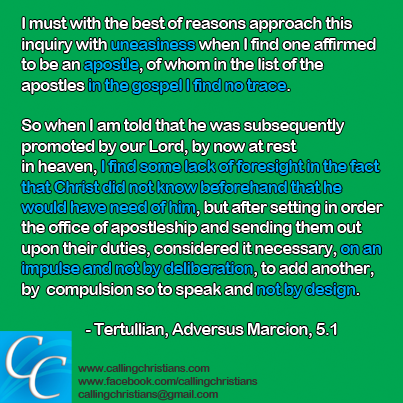
Tertullian Speaks About Paul’s Apostleship

بِسۡمِ ٱللهِ ٱلرَّحۡمَـٰنِ ٱلرَّحِيمِ ,

Tertullian, a Patristic – Early Church Father/ Founding Christian Church Father, had some interesting words to speak about Paul/ Saul of Tarsus. We’ve already dissected Paul’s claims against Jesus’ view on the law, Paul’s concession of being demon possessed, Saul’s stealing of Roman Proconsul’s name of Paulus  and now we examine what one of the earliest Christian Church Founders have to say on Paul’s claim to be an apostle:

cc-2013-tertullianonpaul

You can read the rest of our articles on Paul here.

wa Allaahu ‘Alam.

Women’s Freedom of Choice is Misogynistic

بِسۡمِ ٱللهِ ٱلرَّحۡمَـٰنِ ٱلرَّحِيمِ ,

Something isn’t right in the world when women’s choices are seen as misogynistic. Misogyny is an act defined as hatred towards women. Therefore, how can a woman’s choice be an act against her? This is the conundrum I find myself at odds with. During iERA’s debate with Prof. Krauss, the idea of women choosing to sit in a group by themselves was touted as being against women. Such logic truly boggles the mind.

The idea of women choosing to sit together, with other women whom they know and feel safe with, is apparently so shocking and out of this world, that it’s practically impossible for them to conceive such a thing. Yet that’s not the case. A group of anti-Muslim thugs, supporters of the incest supporting Prof. Krauss, chose to occupy seats where women chose to sit, as opposed to sitting where women who had no qualms with sitting with men were located.

I’m not sure if these atheists truly understood their argument about segregation, that they truly believe that women cannot choose to sit by themselves, without having a male squished directly next to them. This is the purest sense of misogyny. I think that these thugs need to ask themselves a very important question. Is it misogyny for a woman to choose where to sit, or for you males to tell women where they can’t sit and that they can’t sit together?

wa Allaahu ‘Alam.

« Older Entries Recent Entries »