Author Archives: Ijaz Ahmad

Shaykh Ahmad Deedat’s Role in Modern Muslim Apologetics

The legacy of Shaykh Ahmad Deedat is and continues to be undisputed, as it should be. In the post-colonial era where Muslim lands had been subject to metrople rule for centuries, and where Orientalist scholarship had dominated the religious discourse, his voice was a light in an era of darkness. Most believe that by his efforts, the Shaykh effectively kickstarted the modern da’wah and apologetics movement. To this day, his debates are still studied, watched, shared and treasured. His works and efforts stand as a testimony of his contribution, to the extent that some 30 years later, generations of Muslims still stand in awe of his legacy. There are many things we can learn from the example of Shaykh Deedat, but the most important lessons we can derive from his legacy was his willingness to learn, develop new arguments and sincerely study his religion. Shaykh Deedat did not simply stagnate in age old arguments, with every new debate he introduced a better, stronger argument. Similarly, he didn’t repeat the same arguments ad nauseum, he invested his time into studying the scriptures of Islam and Christianity. This is what made him a potent speaker, he brought something new to the table and spent his time perfecting his trade.

I previously mentioned that to this day, many Muslims who are interested in interfaith dialogue and debate, spend their time studying the Shaykh’s debates. While I do agree that there are many good arguments we can derive from the Shaykh’s debates, we should not be over reliant on them. Most of his debates occurred some 20 to 30 years ago. Muslims today, especially young Muslims must understand that Christians have had 30 years to develop responses to his arguments. A cursory search of YouTube will return dozens upon dozens of video responses to the Shaykh’s arguments. In that 30 year period of time, Muslim interfaith argumentation has stagnated. This stagnation wholly contradicts the ethos and legacy of Shaykh Ahmad Deedat. He did not wait or depend upon a few arguments, and he did not give the missionaries time to catch up to him. As he used one argument in one debate, he’d develop a new argument for the next. This is why he was a popular debater, he offered something new, something different, something challenging. Unfortunately, the young debaters of today have no interest in following the Shaykh’s example, they’re more interested in repeating his arguments.

What’s worse is that most young debaters today repeat those arguments without understanding them. That might sound silly, but I’ve repeatedly seen young Muslims be quick to point out apparent contradictions in the Bible and when challenged, they are unable to explain their reasoning. In other words, they know it’s a contradiction because the Shaykh mentioned it but they don’t understand how it’s a contradiction! Shaykh Deedat also spent his time studying his own religion and in many videos we see him spontaneously recalling Qura’nic ayah after Qur’anic ayah. Most young Muslim debaters today read the Bible more than the Qur’an, while being ignorant of the basic tenets of Islamic belief (re: creed; ‘aqeedah). This behaviour betrays the legacy of Shaykh Deedat. Most young Muslims today either misunderstand or rather, neglect to understand what they’re supposed to adopt from the Shaykh’s legacy and this is very upsetting. If Muslim debaters today want to live up to the legacy of Shaykh Deedat and if they want to attain his level of success, then they need to invest more time in studying and less time in vapid argumentation.

The legacy of Shaykh Deedat is one of rigorous study, sincere seeking of knowledge and honest intentions. Anything less, and I can definitely say that they have the wrong motivations.

and Allah knows best.

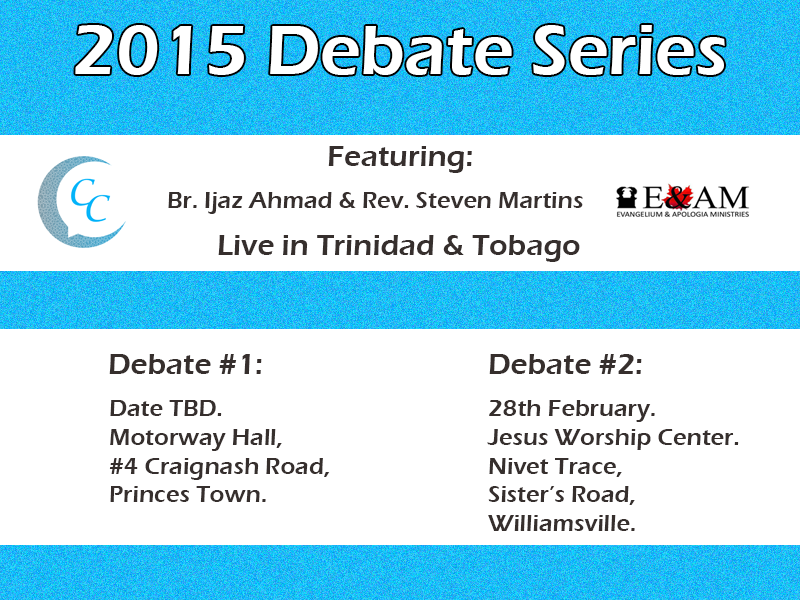
2015 Debate Series with Br. Ijaz Ahmad & Rev. Steven Martins

We’d like to announce a two week debate series carded for next month. Two debates, at two locations, live and on stage in Trinidad and Tobago (WI). The locations are set, while the dates are currently tentative. Both debates will be recorded and uploaded shortly after the events themselves. Within the next two weeks more information will become available, you can keep up to date with the event details for both events via our Facebook page or alternatively via the Evangelium & Apologia Ministries website.

cc-2015-debatestrinidad

More information to be made public soon.

and Allah knows best.

The Gnostic Sources of the Gospel of John

One of the most important books ever written on the Gospel of John, is the Commentary by Rudolf Bultmann. I’ve taken the liberty of transcribing some of his quotes, they are as follows:

cc-2015-johngnosticism

Summarily, he’s arguing that the Gospel of John borrows a lot of Gnostic ideas, beliefs and terminologies. The Manadaeans are described as follows in the Catholic Encyclopedia:

Manichæism is a religion founded by the Persian Mani in the latter half of the third century. It purported to be the true synthesis of all the religious systems then known, and actually consisted of Zoroastrian Dualism, Babylonian folklore, Buddhist ethics, and some small and superficial, additions of Christian elements. As the theory of two eternal principles, good and evil, is predominant in this fusion of ideas and gives color to the whole, Manichæism is classified as a form of religious Dualism. It spread with extraordinary rapidity in both East and West and maintained a sporadic and intermittent existence in the West (Africa, Spain, France, North Italy, the Balkans) for a thousand years, but it flourished mainly in the land of its birth, (Mesopotamia, Babylonia, Turkestan) and even further East in Northern India, Western China, and Tibet, where, c. A.D. 1000, the bulk of the population professed its tenets and where it died out at an uncertain date.


Mandæan (mndaya) is a Babylonian-Aramaic word in dialectic form, meaning: Gnostics, gnostikoí, “those who are good at knowing”. The Hebrew for knowledge md‘ Madda is of the same root and is the noun from which the adjective Mandaya is derived. It is the name adopted by the sect itself, being employed in their sacred books, and is characteristic of their worship of the mnds dhya gnôsis tês doês or “knowledge of life”. Another name also found in their sacred books is that of Sabians (sbya) which means Baptists (sb‘ to baptize in Syriac and Aramaic).


Alternatively, they can be read about in the Encyclopedia Britannica. He presents numerous examples of the resemblance between this pre-Christian religion and early Greek-Christian beliefs found in the Gospel of John and in the writings of the early Patristics (Church Fathers). It is quite apparent that the early Greek Christians borrowed heavily from this pagan religion. Ironically, Christians have for centuries demonized Gnosticism without realising how similar their beliefs truly are. In most of my writings I have consistently referred to Christianity as Graeco-Roman Jewish Syncretism. This belief of mine is shared by many Christian scholars and is known as the Bauer Hypothesis.

This hypothesis holds to the view that early Christianity existed as a plurality of various forms of early Messianic Jewish syncretism with the prevailing religious cultural and spiritual traditions of the varying locales contemporary to the 1st century CE. If you’d like to see more of what Rudolf Bultmann says on the Gospel of John and its borrowing from pre-Christian religions, leave a comment below or share this post on Facebook and other social media websites.

and Allah knows best.


Did the Disciples View Jesus as a Deity?

Introduction

There is no doubt that the disciples of Christ saw him as a man of religious and spiritual authority. It is the status quo to use the statement of Thomas, known as “Doubting Thomas” to illustrate the belief that the disciples viewed Jesus as a deity. In this article, we’re going to employ the same methodology to examine two specific incidents that chronologically follow each other which paints Jesus in a completely human light. The testimony, or rather the alleged testimony of the disciples of Christ in regard to their reactions of Jesus’ statements is perhaps often abused by our evangelical counterparts to enforce the perception of deity. It is in this light, that if we were to use the same line of methodology we’d develop a startling realization due to the disciples’ reactions.

The two incidents we’re going to be examining are those of the “Denial of Peter” and the “Sleeping at the Garden of Gethsemane”. We’ll be basing our study off of Mark 14:31-42, Matthew 26:34-46 and Luke 22:34-47. In summation, in gauging the disciple’s reactions to Christ’s statements, while examining the inter-textual development of the Gospel’s narrating of these incidents, we will then be able to draw an educated understanding of the disciple’s perception of Christ.

Textual Analysis

The synoptic Gospels of Matthew, Mark and Luke have an integrated textual legacy. Modern scholarship agrees that the contents of Mark were used as a source for both Matthew and Luke. Similarly, another plausible source would be the Q Source Material, that is the information not found in Mark but found in both Matthew and Luke. The diagram below illustrates this textual phenomenon:

cc-2015-intertextualegacymmlThe variations in the accounts inter-textually do not present any major conflicts, but we do see a correction due to possible embarrassment in both Matthew and Luke. The text in Mark[1] is as follows:

30 “Truly I tell you,” Jesus answered, “today—yes, tonight—before the rooster crows twice you yourself will disown me three times.”

31 But Peter insisted emphatically, “Even if I have to die with you, I will never disown you.” And all the others said the same.

In this scenario we are presented with a peculiar incident. If we assume Peter believes that Jesus is God, here we witness God telling Peter about something which will happen and Peter denying that God’s knowledge is correct. Peter is in essence, standing before God and telling God that he’s wrong. Yet, he’s not merely telling God that God is wrong, he’s emphatically doing so! The anonymous authors of Matthew and Luke saw this as a problem and so we find this same incident purposely altered. This embarrassing scenario could not have happened if Peter truly believed that Jesus was God, for Jesus is the truth, the way and the life[2]. The incident is then tailored to absolve Peter of his blasphemy and/or to deify Christ; if Peter believed Jesus to be a God then he would not have challenged him.

In the Gospel according to Matthew[3], we read the same incident but with a minor change:

34 “Truly I tell you,” Jesus answered, “this very night, before the rooster crows, you will disown me three times.” 35 But Peter declared, “Even if I have to die with you, I will never disown you.” And all the other disciples said the same.


Peter is no longer emphatically challenging the man whom he believes to be a God. This one alteration of a single word transforms this event. In Mark’s version, it is Peter emphatically challenging God. In Matthew’s version, Peter still challenges Christ, but the context now transforms itself into an emotional retort thus making Peter appear to be submissive to Christ’s words. This however, is still a problem. Peter cannot be challenging God, he cannot be telling Jesus that He is wrong. Luke then, removes Peter’s words altogether[4]:

34 Jesus answered, “I tell you, Peter, before the rooster crows today, you will deny three times that you know me.” 35 Then Jesus asked them, “When I sent you without purse, bag or sandals, did you lack anything?”

Peter’s challenging of God now never happened! Luke completely removes this incident from ever happening. We must also remember that the Gospel According to Luke, begins with the author declaring that he’s producing a truthful, a more accurate, an orderly account of the events of Christ’s mission[5]. Thus, Luke’s account is a correction of the inaccurate information in the other Gospel accounts. This would then lead us to believe that Luke removes this scenario from his Gospel due to its negative and embarrassing implications. If Peter truly believed that Christ was God, he’d never challenge him and definitely not “emphatically” so. In the Greek of the NA 28, we can see the gradual removal of the word, “emphatically” and then the removal of Peter’s response altogether.

In Mark’s Gospel we find the term emphatically[6]:

31ὁ δὲ ἐκπερισσῶς ἐλάλει· ἐὰν δέῃ με συναποθανεῖν σοι, οὐ μή σε ἀπαρνήσομαι. ὡσαύτως δὲ καὶ πάντες ἔλεγον.


In Matthew’s Gospel the term emphatically has been removed[7]:

 35λέγει αὐτῷ ὁ Πέτρος· κἂν δέῃ με σὺν σοὶ ἀποθανεῖν, οὐ μή σε ἀπαρνήσομαι. ὁμοίως καὶ πάντες οἱ μαθηταὶ εἶπαν.

In Luke’s Gospel, the entirety of Peter’s challenging of God is removed altogether[8]:

34ὁ δὲ εἶπεν· λέγω σοι, Πέτρε, οὐ φωνήσει σήμερον ἀλέκτωρ ἕως τρίς με ἀπαρνήσῃ εἰδέναι. 35Καὶ εἶπεν αὐτοῖς· ὅτε ἀπέστειλα ὑμᾶς ἄτερ βαλλαντίου καὶ πήρας καὶ ὑποδημάτων, μή τινος ὑστερήσατε; οἱ δὲ εἶπαν· οὐθενός.

The same pattern of amendment is found regarding the disciples in the Garden of Gethsemane. In Mark 14:32-42, Jesus finds the disciples disobeying him three times. In Matthew 26:36-46, Jesus also finds them disobeying him three times. Yet, in Luke 22:39-46, he finds them once disobeying his command and that’s it. There is no other mention of Jesus returning to find the disciples disobeying God three times, after God had scolded them.

Why then, for a second time does Luke remove entire scenarios of the disciples openly disregarding, disobeying and ignoring Jesus, whom we are expected to believe they viewed as a God?

Gauging the Disciple’s Reactions

We must critically assess Peter’s actions when Jesus informs him that he will deny Him. If Peter viewed Christ as a God, and God is telling Peter what will happen in the future; on what basis can Peter deny God’s knowledge and emphatically reply that God’s wrong? This seems to be quite absurd. There can be no justification for Peter’s challenging of God, to God’s face. The issue here, is that Peter’s not only disagreeing with Jesus whom he believes to be God, but that he’s emphatically insisting that God is wrong. This would not be a problem, had it not been for the other Gospel authors taking issue with this incident. Both Matthew and Luke were surely embarrassed by this scenario. Surely, Peter whom the Church is built upon as Christ himself declared[9], must be submissive to God’s commands. Peter cannot be dismissive, he cannot be seen challenging God to his very face. Thus, this incident is embarrassing because it gives the impression that either Peter does not see Christ as a deity (as Peter would never challenge God) or it gives the impression that the disciples were of absolutely weak or little faith and the Church cannot be built upon unfaithful, unbelieving, sinful persons.

This issue is only exacerbated by the disciples in the Garden of Gethsemane. It is very difficult to accept that the disciples could have God stand before them, live with them, eat with them and then disobey him. Moments before this incident occurs the disciples all profess their love and swear never to abandon or deny Christ as both Mark and Matthew mentioned[10][11]:

31 But Peter insisted emphatically, “Even if I have to die with you, I will never disown you.” And all the others said the same.


35 But Peter declared, “Even if I have to die with you, I will never disown you.” And all the other disciples said the same.

It is highly unbelievable that in the span of a few minutes the disciples would profess their obedience to a man they considered to be God, would then change their minds and disobey him three times even after he scolded them. They essentially all changed their emotions in regard to him in the span of a few minutes. If God stands before you, commands you to do something, then scolds you for not doing it, then as a person of faith, a person of strong faith, you’d do your utmost best to fulfill God’s commands. Yet the disciples do exactly the opposite, they reject God’s commands and seeing that Christ is in need they all went to sleep. A loved one, the Holy of Holies, God Incarnate stands before you, imploring you to do something and we are expected to believe the disciples decided that sleep was more important?

If we were to gauge them by their reactions to Christ’s words and commands, then they clearly seem to be responding to the words of a man and not God. No believer in God would challenge God’s knowledge, no believer in God would listen to God’s commands and then decide to sleep at a time of great importance. If we are to believe that the disciples viewed Jesus as a God, then their reactions teach us the exact opposite, we can quite clearly see they did not have the fear or love of God in them.

Conclusion

By examining the inter-textual legacy of the synoptical Gospels, using the evangelical criteria of embarrassment we find clear textual emendation to absolve the disciple’s humanizing, disobeying, rejecting and disbelieving actions and words in regard to Jesus the Christ. The very reactions of the disciples to Christ’s words give the impression that they did not view him as a deity; this is in large part to their challenging of his statements and in their refusal to obey his requests even during his time of need. This is not what we would expect from men who believed God sat among them, lived with them, ate with them and suffered with them. Instead, we find a human Jesus, one whom the disciples could challenge, could disagree with and a Jesus whom they could disrespect and ignore. The very behaviour of the disciples is akin to the disbelieving Pharisees who rejected the Christ who disobeyed him, ignored him and challenged him (cf. Mark 7, Matthew 15, John 8 etc).

In conclusion, there are two perspectives we can walk away with after having looked at these incidents from several angles. Either the disciples were men weak of faith, who rejected the Christ and whose behaviour emulated that of the Pharisees or the disciples did not view Christ as a deity as demonstrated by their challenging, disobeying and disregarding of Christ’s commands.

and Allah knows best.

Sources:

  1. Gospel According to Mark: 14:30-31 (NIV).
  2. Gospel According to John: 14:6 (NIV).
  3. Gospel According to Matthew: 26:34-35 (NIV).
  4. Gospel According to Luke: 22:34-35 (NIV).
  5. Gospel According to Luke: 1:1-4 (NIV).
  6. Gospel According to Mark: 14:31 (NA 28).
  7. Gospel According to Matthew: 26:35 (NA 28).
  8. Gospel According to Luke: 22:34-35 (NA 28).
  9. Gospel According to Matthew: 16:18 (NIV).
  10. Gospel According to Mark 14:31 (NIV).
  11. Gospel According to Matthew: 26:35 (NIV).


We’re Back!

بسم الله الرحمن الرحيم

As Salaamu ‘Alaykum,

If you’re reading this, it means the Calling Christians website is back online! A few things to note:

  • To return to the “Home Page” click the Calling Christians (blue crescent/ dialogue bubble) Logo at the top of each page.
  • Be sure to check out our “Apologetics” section, it’s filled with a starter on Islamic Apologetics.
  • The FAQS page contains all the articles that aren’t rebuttals, along with all questions and answers.
  • The Resources page is growing slowly but surely, if you’d like a pamphlet done on any subject, please use the Contact Us page!
  • The site is still being updated, so pages will appear and disappear over the next two weeks.

and Allah knows best.

Is Christmas Biblical?

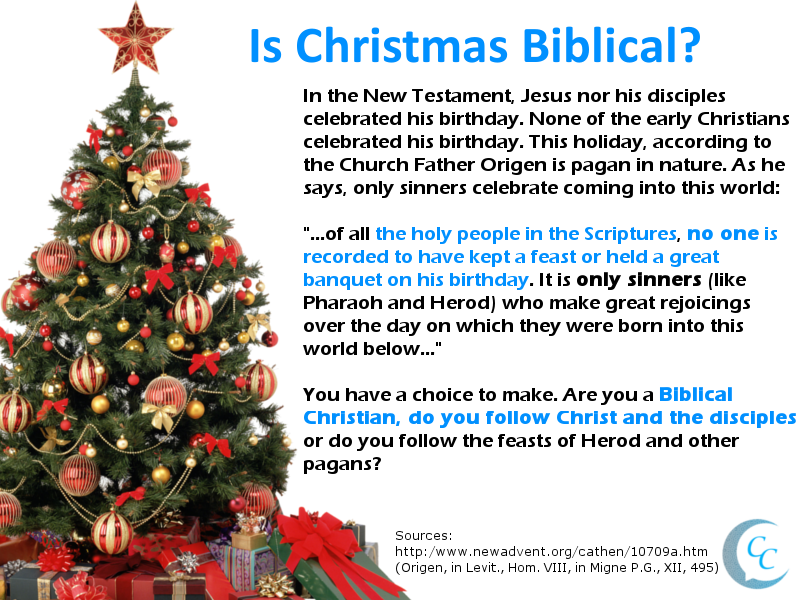
There’s an easy way to convincing Christians that Christmas is a pagan tradition. Just ask any Christian, does the New Testament mention that Christ, his disciples or any of the apostles celebrating Christ’s birthday? It doesn’t. That’s for a good reason, they didn’t. Ask the Christian, are you a Biblical Christian, because if you were, you’d follow the Bible, and if the Bible says nothing of this holiday or celebration, why do you celebrate it? I’ve created this lovely image to share for those willing to initiate that tough conversation with their friends and family members. It’s non-confrontational, relies on the Bible for evidence, refers to a pillar of the early Church and simply asks a question. It doesn’t insult Christians, doesn’t demonize the holiday, it’s just a polite question about the validity of this holiday in light of scripture!

cc-2014-xmas2014


So, are you a Biblical Christian, or not? Let us know in the comments or on our Facebook Page!

and God knows best.

Do Muslims Assume Unitarianism in Discussing the Trinity

Question:

Popular Christian speakers like James White have repeatedly said that Muslims assume Unitarianism when discussing and debating the doctrine of the Trinity. Is this true? What is Unitarianism?

Answer:

Unitarianism, refers to the belief that God exists as one person. This is in contrast to Trinitarianism which teaches that there is one God who exists in three “persons”, all of whom are distinct from the other persons, but co-equal in nature. Unitarianism argues that there is only one person. The most popular believers in this doctrine are those who believe in modalistic monarchianism or monarchianism. Modalism refers to the believe that the one person who is God, moves between varying roles; these roles are the Father, Son and Holy Spirit.

Apologists like James White believe that Muslims argue from the belief of Unitarianism because many Muslim speakers argue against the Trinity by arguing that Jesus who is the Son, is not the Father and thus this is polytheism, not monotheism. Christians would then argue that this proves the Trinity since they do not believe the Son is the Father (that’s Unitarianism), they believe that the Son is a distinct person from the Father and so arguing that they are distinct is already a belief they hold. Therefore, when Muslims do so, they are arguing in futility. This however, does not take the Muslim’s argumentation as a whole. Muslims argue using sequential logic, they start with one point and then from this point argue another second rational point. The second point follows from the first point, thus it is sequential (in a specific order) and sequitur (one point follows from the other point, they are connected to each other. In Discrete Mathematics, a point is referred to as a premise and the symbol used to demonstrate that they are sequitur can either be -> [if this, then that] or <-> [it follows both ways, i.e. vice versa]). I am not saying that James White is the only person to commit this error, but since the questioner mentioned him specifically, and since I am familiar with him having argued as such, I will subsequently refer to him in this article.

The misunderstanding thus begins when Christian apologists isolate one of the premises or arguments, while ignoring the entire logical sequence being drawn out. So what is the Muslim’s entire argument? Trinitarians believe, as previously mentioned that each “person” of the Trinity is co-equal and absolute in their nature (i.e. perfect beings). The Muslim argument demonstrates that they are not equal and as a consequence of this, they are in a hierarchy, since there is a hierarchy and one is weaker than the other it means two of the three are not absolute in their natures and thus not God. A God is defined as a being absolute in its nature, if a God is not, such as if it does not have absolute knowledge (i.e. the knowledge of everything; see Mark 13:32), then it can no longer be considered a God. The Muslim argument, therefore also follows through to the position that this is polytheism, since Christians are deifying three non-equal beings with one absolute being, and two “partners” who are deficient in nature.

In conclusion, the next time a Christian speaker mentions that Muslims assume or argue from a position of Unitarianism, kindly stop them and ask that they listen to the entire argument and not cherry pick isolated premises from a complete argument. If they insist that they are not, kindly ask them to list the premises being postulated by the Muslim sequentially, this should only be four sentences at the very least. If they can’t articulate the Muslim’s argument, then it is clear they do not grasp it. Since they can’t grasp it, this explains why they fail to respond to it and thus have to create red herrings.

and Allah knows best.

Smith’s Paper from Veritas Apologetics Conference

In the recent Veritas Apologetics Conference in which Smith wore the title of a Professor, despite having no such credentials or job title to support it, he presented a paper entitled, “A Critical look at the Newest Historical Research on Islam and the Earliest Qur’anic Manuscripts“.

What’s the keyword here? “Newest”. Which is a problem, since Smith’s paper opens with four references from 1977, 1985, 1991 and 1996. Can someone help me understand what the word newest means in light of his references? I’d greatly appreciate it. Maybe I just don’t see the connection between 1977 and “newest”….

I might make a meme out of this and title it Scholar Smith: Presents Newest Research in 2014, FROM 1977.

and God knows best.

Site Changes

Over the next few weeks, the site will undergo some major changes. This means that it’ll occasionally become inaccessible or that pages and posts might disappear and reappear while new pages and posts will appear. Categories might be removed, some added. More importantly, a good amount of new content inclusive of downloadable pamphlets in English and other languages will be made available. Videos, and more articles will also be made available.

A lot of the old content may not make the cut as the site seeks to go above and beyond the negative personalities we have found ourselves in unnecessary back and forths with. Please be patient as the site continues to grow and expand. Thank you for your support. If you’d like to donate to the site’s efforts, send us a message via our Contact Us form and we’d send you the details to so.

and Allah knows best.

« Older Entries Recent Entries »