
Jesus and the Prostitute
Question:
I have heard that the story of Jesus and the prostitute in John 8:7 is false, Christians claim that it does not affect their beliefs, can you explain this?
Answer:
This section of the Gospel attributed to John is commonly known as the pericope adulterae, it is absent from the best and earliest manuscripts: 66, 75, א, B, L, N, T, W, Δ, Θ, Ψ, 0141, 0211, 33, 565, 1241, 1424*, 2768. It should also be noted that it is calculated to be absent from the lacunae of codices A and C. In other words, it is a fabrication, inserted into Christian scripture. While missionaries may claim that this fabrication does not affect their beliefs, they would be greatly mistaken. There are many ways that this affects their beliefs, and we shall take a look at these reasons now.
To begin with, it shows the fallibility of their ‘scripture’. It demonstrates to us, that their scripture has been corrupted, and that it has the potential to include further corrupted statements. Thus, this directly affects their belief in the sanctity and preservation of their scripture. Some may claim that they were able to find this interpolation and identify it as a fabrication, thus the threat of corruption has been removed. However, this ‘identification’ took some 1500 to 1800 years to occur, clearly the Holy Spirit was sleeping during this time, as the larger world of Christendom believed in and used this passage to the point it became one of the most popular and well known passages of the Bible.
The passages about the adultress bring forward even greater problems. Let’s take a look at it:
When they kept on questioning him, he straightened up and said to them, “Let any one of you who is without sin be the first to throw a stone at her.” – John 8:7.
Allegedly, Jesus argues that he without sin should stone her. Christians believe that Jesus was without sin, so why didn’t Jesus stone her? Either Jesus disobeyed the law of Moses (which he himself/ his father) revealed to the Israelites, or he was with sin and thus failed to meet his own criteria. Either way, this incident raises several disastrous points for the Christian faith. Jesus failed to fulfill the law, he clearly identifies himself as a sinner due to his inaction and it demonstrates to us his ignorance of the law he gave to Moses, as it was never a condition to be sinless for anyone to carry out the punishments stipulated in the Torah.
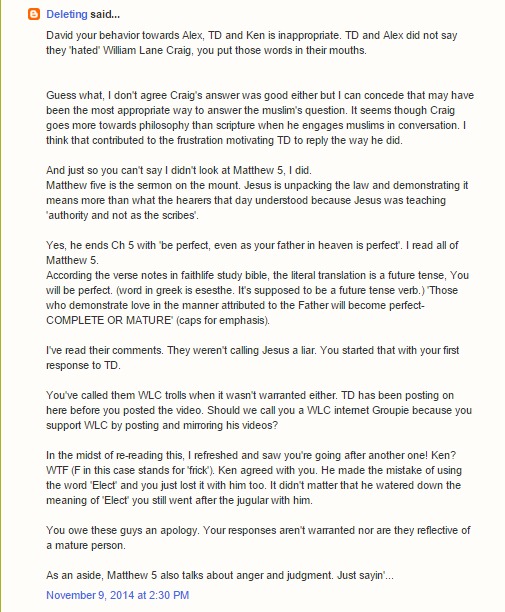
What’s worse, is that Jesus never once condemned the woman for her adultery (or as some believe, prostituting). She was clearly caught in the act, witnesses were available, and Jesus failed to condemn her infidelity. The only time Jesus condemns sexual immorality is in Matthew 5 when speaking about divorce. Thus, it is quite strange that when confronted with a clear case of sexual immorality, Jesus fails to condemn the woman. Rather, he chooses to dispute with religious law, the very law he (if he is a god) gave to the Israelites. Thus, it can be deduced that according to this passage, it was more important to argue about the law than it was to condemn a case of wanton sexual immorality. The Christian concept of Jesus, absolutely fails to address the woman’s gross sin, he is silent about it, he fails to condemn her sin.
In conclusion, this passage is perhaps one of the best gifts to mankind, as it gives us the opportunity to teach Christians about the fallibility of their religion.
and God knows best.






 Calling Christians
You must be logged in to post a comment.