Author Archives: Ijaz Ahmad

Are there Chains of Transmissions for Early Patristic Witnesses?

Question:

A Christian polemicist who previously compared Muslims to a cancer in Europe, and who denied that God inscribed the 10 commandments on tablets to Moses, has claimed that there is a chain of transmission linking the apostles of Jesus to the early Church Fathers. Is this true? How, do we respond to this?

Answer:

There is nothing to respond to. The author of the aforementioned article does not seem to understand the basics of hadith criticism, and reduces the science of hadith criticism to merely throwing some names together and linking them through obscurity. It should be noted that in reading that poor article, the author depends solely on one disciple and solely on one Patristic, with two extremely obscure quotes whose works we no longer have the autographs (originals) for. After several hundred words, the author could not sum his evidences to provide a basis for a single da’eef (weak) chain of transmission. Under hadith criticism, especially that of mustalah or rijal, the hadith sciences would have no other option to regard that claim of a “chain”, as nothing more than hearsay.

Regarding his quotes, Papias and Polycarp are said to have been contemporaries of each other. Eusebius in the 4th century, corrects Papias in his assertion that he knew John the apostle. It is disputed which John that Papias knew. If Papias and Polycarp were contemporaries, and the Christians of the 4th century couldn’t identify which of the four Johns he knew (John the apostle, John the elder, John of Patmos or a John with a combination of any of the previous identities), how can someone 2000 years later claim to make that identification for Papias’ contemporary, Polycarp? Furthermore, it should be noted that Polycarp himself not once quotes or references John the apostle in any of his extant writings, and Iraeneus who in the late second century recorded the claim that Polycarp knew John, heard this in his childhood. There are literally no other sources which can corroborate something that Iraeneus writing in the late second century, claims to have heard in his childhood, much less so from any of the extant writings of Polycarp himself.

The author of the aforementioned article, in a case of pure desperation attempts to quote Ignatius’ work to qualify the claim of early Trinitarian beliefs, whereas it should be known that Ignatius’ works are only survived through Eusebius in the 4th century, with absolutely no verifiable chain of transmission between the two. In other words, it has been demonstrated that the author himself is unfamiliar with the hadith sciences to the point he could not offer a single chain of transmission or the chain’s grading, or a jarh of any of the names mentioned in the overly lengthy article. His sole reliance on one obscure quote without any other witness or comment by Iraeneus himself, demonstrates the desperation of the author to forcibly create an instance of a chain of transmission. In my debate earlier this year, I consulted with a New Testament Professor and a scholar of the hadith sciences to examine the chains of transmission in the early Church. A basic summary of the results of our labour can be found in that debate:

It is clear that the author of the article was not attempting to present a studied argument. Due to the nature of the blog he posted the article to, it can thus be deduced that he was pandering to lay-Christians with no scholastic interest in either Christianity or Islam. I forwarded his article to both the New Testament Professor and hadith scholar I worked with on examining Patristic chains of transmission, and both of them replied quite negatively. Another brother, who discussed this topic with a prominent Christian New Testament scholar and historian, also replied negatively to the claims in the article (not to the article itself). I have not sought permission from any of these persons to reproduce their comments on this website. Should the case arise for me to do so, I will, with great pleasure. However, it is saddening that the Christian author has chosen to align himself with an anti-immigrant polemicist, whose venom Dr. James White in a recent video attempted to dissuade Christians from endorsing. It would then seem, that the author is more interested in pandering to a racist crowd, that conforms to his views, than to do objective, intelligent and honest academic research.

In this article, using a single criteria from the hadith sciences, I demonstrated that the New Testament does not meet the criteria of a da’eef (weak) narration.

In this article, using a single criteria from the hadith sciences, I demonstrated that none of the New Testament literature, can be validated or verified as being from Jesus ‘alayhi as salaam or his apostles, since none of the alleged transmitters can stand up to rijal al hadith.

and Allah knows best.


Does Isaiah 9:6 Ascribe Divinity to Jesus?

Question:

Missionaries claim that Isaiah 9:6 refers to Jesus. They state that this proves he is God. How do we respond to this?

Answer:

Let’s begin by quoting Isaiah 9:6 –

For a child has been born for us;
a son has been given to us.
And the dominion will be on his shoulder,
and his name is called Wonderful Counselor, Mighty God,
Everlasting Father, Prince of Peace.

Missionaries tend to focus on one aspect of the text, the terms “son” and “Mighty God”. However, a quick look at the text proves that this passage does not refer to Jesus. The child has already been born, the verb is in the past tense, “has been born”. Since Jesus had not yet been born, then this disqualifies him from being the subject in the passage. Furthermore, it is said that the child would be called, “everlasting Father”. Since Jesus is the Son, and not the Father, then this passage most certainly does not refer to him.

The missionary might claim that the term, “everlasting Father” is just a description of divine attributes, not meant to be taken literally. In that case, we need to ask, how can that be when you have already interpreted the title “Mighty God”, literally? Either you accept the text as is and interpret all the names figuratively, or you interpret all of them literally. Thus, this verse is not a proof text for the divinity of Jesus. It is a proof text against the divinity of Jesus and most Christians do not read this passage carefully or sensibly.

and Allah knows best.

Nestorianism in Light of Modern Christian Apologetics (Part 2)

In a previous post, I commented on an inter-Christian theological controversy regarding modern Christians and the heresy of Nestorianism. Many Christians were unaware that such a debate existed within their faith today, primarily between the Protestant sects of Lutheranism and Reformed/ Calvinist theology. I had first raised my argument using the study of the philosophy of religion regarding the ontology (nature of being) of the incarnate Christian God during my recent debate with Dr. Tony Costa. Quite a few lay-Christians thought I’d misidentified orthodox Christian beliefs (Dr. Costa and his supporter Anthony Rogers are guilty in this regard), that I as a Muslim did not understand Christian beliefs and as such my claim was based out of ignorance. Rather, through my subsequent posts a number of Christians have come to realise that I had actually raised an argument that Christian theologians themselves had raised, it was in fact the lay-Christians who were ignorant of their own modern day Christological controversies. In his erudite work on Systematic Theology, Louis Berkhof wrote:

1. UP TO THE NINETEENTH CENTURY. The Reformation did not bring any great changes in the doctrine of the person of Christ. Both the Church of Rome and the Churches’ of the Reformation subscribed to the doctrine of Christ as it was formulated by the Council of Chalcedon. Their important and deep-seated differences lay elsewhere. There is one peculiarity of Lutheran Christology that deserves special mention. Luther’s doctrine of the physical presence of Christ in the Lord’s supper led to the characteristically Lutheran view of the communicatio idiomatum, to the effect “that each of Christ’s natures permeates the other (perichoresis), and that His humanity participates in the attributes of His divinity.” It is held that the attributes of omnipotence, omniscience, and omnipresence were communicated to the human nature of Christ at the time of the incarnation.

Even prominent Calvinist theologian RC Sproul wrote in, “What Is the Trinity?”:

I have Lutheran friends, and I always refer to them as “my monophysite friends.” They refer to me as their “Nestorian friend,” but I always say, No, I don’t separate the two natures, I just distinguish them.”

It’s not an argument or claim invented by myself, it’s quite a well known common argument that many Protestant and Eastern Orthodox Christian sects regard Calvinists as Nestorians. It is not difficult to see why. I tried to convey an argument that lay-Christians would be able to understand during my debate with Dr. Costa, but I will have to use a little bit of mathematics to better illustrate my point. The heresy of Nestorianism, entails that despite Christ having two natures, they are distinguished from each other to the point that Jesus becomes two Persons. Jesus with a divine nature and Jesus with a human nature. Surely in Islam, this enters the realm of polytheism. For the time being, let’s express how Reformed/ Calvinistic Theology about Jesus’s Hypostatic Union is Nestorian.

  • Jesus is a Person.
  • Jesus has a Divine Nature.
  • Jesus has a Human Nature.
  • Jesus = {Divine Nature, Human Nature}

If we were to say that Jesus suffered, does that mean the Person of Jesus with two natures suffered? Calvinists would readily say yes, but they would then additionally say, as James White has claimed, that only the human nature suffered. Thus, logically speaking it is a contradiction in thinking.

  • Jesus the Person with a Divine and Human Nature suffered.
  • Jesus the Person’s Divine Nature did not suffer.
  • Jesus the Person’s Human Nature did suffer.

Thus, this in effect breaks Jesus up into two Persons. They speak of Jesus in terms of only his human nature and of Jesus in terms of only his divine nature. Hence, regardless of their cries of orthodoxy, their ideas concerning the nature of Christ are inherently self-defeating and self-contradicting, thus eliciting charges of advocating the Nestorian heresy. In conclusion, as we have seen, Christians themselves did not know of these inter-Christian debates. That’s why I raised the argument in the first place. To bring attention to a problem that only their scholars seem to argue about, I merely wanted to demonstrate that Christians after 2000 years fundamentally disagree about the nature of God and cannot reconcile the God-man doctrine about Christ.

Why wrestle with confusion, when the solution is simply, there is no God but Allah….

and Allah knows best.

Sam Shamoun and Matt Slick’s Heretical Beliefs Outed By Anthony Rogers (Updated)

As expected, Anthony Rogers is now in damage control. Last night I posted an article indicating that most Christian polemicists do not care about their theology, using their very own words. In that article, I included a discussion with Anthony where he declared that a specific belief contradicted Christian orthodoxy. I immediately pointed out that two of his colleagues, Sam Shamoun and Matt Slick, openly use (to defend Christianity), believe in and promote this doctrine.

cc-2015-ar-insane

Realising that he had just called his close associates heretics, he quickly turned the discussion to a typo I had made in spelling a Latin phrase. True to form, he later himself made a typo in spelling that same phrase, but as an adult, unlike the mentally inchoate Rogers, I chose not to spend several minutes writing three paragraphs about an obvious spelling error. I insisted that he address the issue that a belief he claimed ‘contradicted orthodoxy’, was believed in and promoted by his fellow Christian colleagues. After having duly embarrassed himself by having a rabid rant over a typo and declaring his friends heretics, he quickly left the conversation. In trying to do some damage control after my article had gone public, he’s posted some of the conversation and strangely enough, continued his fixation with the typo.

So, let’s have some fun. What did Rogers say?

However, Tony Costa does not believe in this doctrine of the “communicatio idiomatum” (nota bene: the Latin word is ‘idiomatum,’ not ‘idiomatium’), and that doctrine is not taught in but rather is contradicted by the orthodox definition of the incarnation authoritatively set down in the Chalcedonian Creed (q.v. “inconfusedly,” and “the distinction of natures being by no means taken away by the union, but rather THE CHARACTERISTICS OF EACH NATURE BEING PRESERVED…”).

According to Rogers, the doctrine of the ‘communicatio idiomatum’, ‘is contradicted by the orthodox definition of the incarnation’. This doctrine, contradicts orthodoxy. This is otherwise known as….heresy! A belief that goes against, or contradicts orthodoxy is heretical. A person who believes in heresies is a heretic. Simple so far? Yes, but maybe not for Rogers.

If a person believes in a doctrine that contradicts orthodox beliefs, they are heretical. Simple.

Do Sam Shamoun and Matt Slick believe in this doctrine, promote it, or use it to defend Christian beliefs about the incarnation? Yes, they do. In this article, Sam Shamoun uses it to defend the incarnation. Similarly, in this article, Matt Slick promotes this doctrine and considers it orthodoxy. All in all, Rogers called a belief heretical, and his colleagues, believe, share and promote that heretical belief, thus making them heretics.

Well done Rogers.

Updated:

Rogers updated his blog post with continued ad hominem attacks, while continuing to demonstrate his inability to understand the consequences of his own statements, and his disability of knowing how to spell.

1. Rogers as an adult, thinks that making a typo in a YouTube comment means I can’t spell a word.

2. Rogers as an adult, also later made a typo in spelling the same Latin phrase.

3. To absolve himself of abject embarrassment, of #1 and #2, he later argued, that although his spelling of the Latin was wrong, in the English it ‘still meant the same thing’. If you made a typo in the Latin, you got the Latin wrong. I think that’s common sense, not so for Anthony (nota bene: spelling ‘social’ in Spanish as ‘socials’, even if  ‘socials’ is a word in a completely different language like English, does not make the wrong spelling in Spanish correct. It’s still wrong in Spanish.) Thus, it’s apropos that Rogers would conflate the two.

4. Rogers tries to excuse himself of referring to Sam and Slick as heretics, by claiming he was responding to ‘my’ definition of communicatio idiomatum. Yet, this is not what his very comments said, to quote him:

…that doctrine is not taught in but rather is contradicted by the orthodox definition of the incarnation authoritatively set down in the Chalcedonian Creed…

No two ways about it. Rogers has been caught out. Trying to lie isn’t going to help him now.

5. Rogers continues to be deceitful, placing words in my mouth, claiming that I have taught that Jesus’s attributes were ‘mashed together like a sausage’, it would be honest of him to not place words in my mouth to suit his audience and Christian needs, but is Rogers the kind of man we can expect that from? No, he isn’t.

6. It’s cute that he thinks I don’t know what the doctrine teaches. However, as have been noted by his crass comments, uneducated claims and ad hominem attacks, it would clearly seem as if he has not acquainted himself with any modern work of Systematic Theology. One of note, is by Louis Berkhof who writes:

1. UP TO THE NINETEENTH CENTURY. The Reformation did not bring any great changes in the doctrine of the person of Christ. Both the Church of Rome and the Churches’ of the Reformation subscribed to the doctrine of Christ as it was formulated by the Council of Chalcedon. Their important and deep-seated differences lay elsewhere. There is one peculiarity of Lutheran Christology that deserves special mention. Luther’s doctrine of the physical presence of Christ in the Lord’s supper led to the characteristically Lutheran view of the communicatio idiomatum, to the effect “that each of Christ’s natures permeates the other (perichoresis), and that His humanity participates in the attributes of His divinity.” It is held that the attributes of omnipotence, omniscience, and omnipresence were communicated to the human nature of Christ at the time of the incarnation.

Thus, it’s not a case of me interpreting Christian beliefs wrongly. Rather, it’s a case of Rogers not being educated about what Christians other than himself, believe.

Will Rogers publicly correct himself after putting words in my mouth? No, he most definitely will not.

Will Rogers publicly correct himself for misspelling a Latin phrase important to Christology? No, only his typos are typos, mines are somehow, intentional.

Will Rogers concede that what he’s labelled as characteristically “my interpretation” of Christian beliefs, is actually a belief of Christians “other than himself”? He won’t, even with the quote given above.

Will Rogers take down his post now that he’s been absolutely refuted? Definitely not.

Do I have further time to waste on Rogers? Nope.

(What’s strange is that Rogers, along with speaking with the Holy Spirit, Sam and Slick, somehow believes I interpreted Slick’s belief in the communicatio idiomatum. I merely referenced the article and asked Rogers if he agreed with Slick’s belief. Somehow, Rogers takes asking a question about his belief, as interpreting Slick’s. Dishonest? Quite so.)

and God knows best.

Do Christian Apologists Care About Theology?

Many in the inter-faith dialogue community would be surprised to know that most Christian apologists and polemicists do not care about theology. In fact, most of them ban, delete and criticize Christians who try to discuss inter-Christian theological matters. For the purposes of this article, I’m referring to Protestant Christians, since they tend to be the ones engaging most with Muslims. Theology necessarily deals with the doctrines about God, the nature of God, what salvation is, who is saved, and how one should use scripture. These are topics that a necessary for every faithful and devout Christian to have studied. Yet, most Christian apologists and polemicists are agnostic when it comes to declaring their beliefs. Most Protestant Christians fall under Arminian or Calvinist beliefs. The differences between being one or the other are vast, how one is saved, predestination, freewill, redemption, atonement and grace are all disputed between these two doctrines. Believing one or the other, often leads to accusations of apostasy and heresy. So where do Christian polemicists like Sam Shamoun and David Wood fall on these important beliefs?

Sam Shamoun

cc-2015-ss-calvinism

Sam doesn’t care whether his explanation of scripture goes against important creeds and doctrines based on the Bible. To him, important doctrines do not matter. So what if an explanation he gives contradicts an important Biblical creed? In his words, so be it!

David Wood

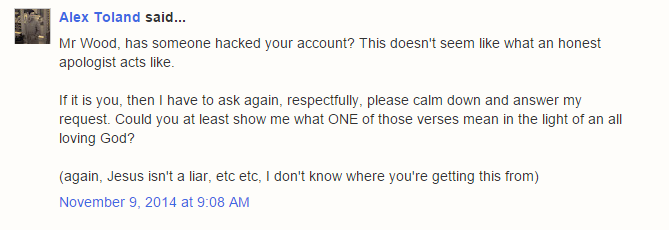
David gets really angry when Christians try to discuss important and necessary topics about Christian beliefs about salvation, he does not identify with either Arminian theology or Calvinist theology, he flutters somewhere in between and is an agnostic when it comes to his theology. During one discussion about the nature of God’s love, he expressed his rage inducing anger on fellow Christians, reacting rabidly towards them:

cc-2015-dw-calvinism

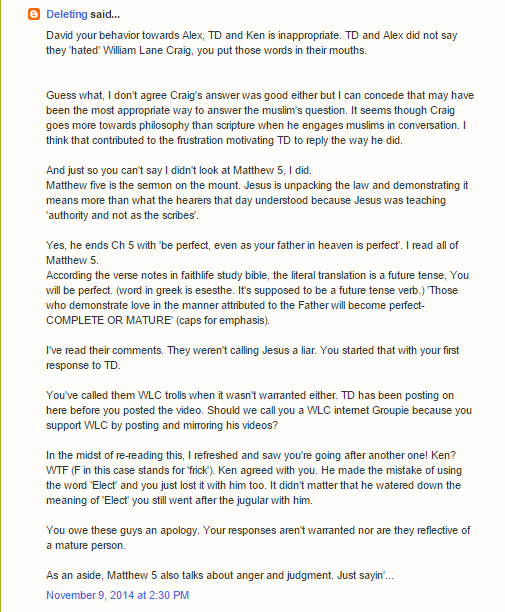
Another devout Christian was shocked at David’s disregard for an honest and heartfelt discussion between fellow Christians on the nature of God’s love in Christianity:

cc-2015-dw-calvinism3

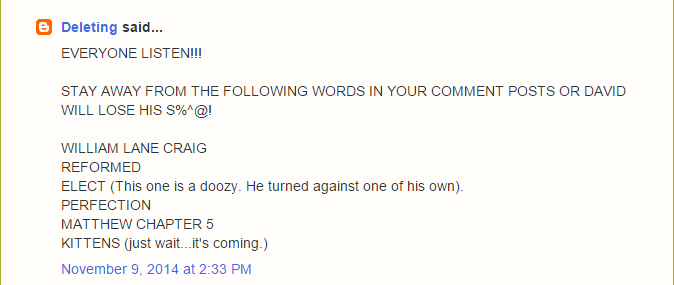
What were the topics David did not want Christians discussing with him? Christian theology, election (how you are saved by God, is it predetermined or not), the perfection of God…..

cc-2015-dw-calvinism2

What was David’s response to all of this?

cc-2015-dw-calvinism4

Distract them with Islam! You can only speak to David about Islam! Don’t you dare try to discuss Christian theology, especially salvation and the nature of God, you can only discuss Islam! According to David, his theology concerning the nature of God, salvation, scripture, is all determined by, “the only side I take on this issue is the opposite of whoever is trying to disrupt a conversation…“. So just like Sam Shamoun, David doesn’t care about Christian theology, he flip flops between essential creeds that determine the nature of God and how you are saved, based on whoever he’s arguing with. He doesn’t care about Christian theology, he just prefers distracting Christians with Islam.

Matt Slick, Anthony Rogers, Sam Shamoun and Tony Costa

Recently Anthony went bobbing for apples and drowned in three inches of water. He decided to criticize some of the arguments I used in my debate with Tony Costa. Unfortunately for him, he ended up declaring the beliefs of Shamoun and Slick to be heretical. Regarding my arguments, he realised my arguments were based upon the Christology (what a Christian believes about the nature of Jesus) of his friends, and not on his own personal Christology. This led to the revelation that the beliefs of his Christian apologist friends were heretical. Anthony proclaimed:

However, Tony Costa does not believe in this doctrine of the “communicatio idiomatum” (nota bene: the Latin word is ‘idiomatum,’ not ‘idiomatium’), and that doctrine is not taught in but rather is contradicted by the orthodox definition of the incarnation authoritatively set down in the Chalcedonian Creed (q.v. “inconfusedly,” and “the distinction of natures being by no means taken away by the union, but rather THE CHARACTERISTICS OF EACH NATURE BEING PRESERVED…”).

What’s that? The doctrine of ‘communicatio idiomatum’ is a contradiction of orthodoxy? That makes it heretical to believe in. Yet guess who believes in and defends Christianity using a doctrine that Anthony considers to be…..”contradicting orthodoxy”? His very friends, Sam Shamoun and Matt Slick!

Sam Shamoun uses the doctrine to defend the dual nature of Christ against Muslim objections: Click this link.

Matt Slick who operates CARM and is often featured alongside Sam and Wood on ABN/ Trinity TV also promotes and believes in this doctrine: Click this link.

What did Anthony do when he realised my arguments in the debate with Tony Costa was based on the Christology of his friends? He decided to correct a typo in one of my sentences by dedicating three paragraphs and two comments on YouTube about it. Yet, I persisted, he had made an error. He had wrongly criticized me, and at the same time had claimed that the beliefs of Sam and Matt contradicted orthodoxy, thus declaring them heretics. As expected, realising his error, he quickly left the conversation. The entirety of which can be read here.

Update 4/11/15:

Anthony was kind enough to post the conversation for me. Here’s the link to the images. For some reason he edited out the last two comments of the conversation, and chose not to link directly to the source as I did. As can be noted, when caught out, he resulted to arguing about a single typo. Such is the level of polemics he chooses to engage in, and of which I will not lower myself to.

James White

He’s considered to be one of the leading Calvinist apologists today. Debating Catholics, Jehovas Witnesses, Arminians and more. Yet, when it comes to his very own Christian friends like Sam and Wood, he fails to correct them. Fails to teach them. He’d readily criticize a Muslim for speaking incorrectly about Christian theology, yet he abjectly fails when it comes to educating fellow Christian apologists about central creeds and beliefs necessary for their salvation. It would be interesting to see if White would be consistent this time around. Here we have Shamoun and Wood openly disregarding Calvinist theology. These are statements made in the public domain.

Surely then, White, as a staunch defender of Calvinist theology would not stand for this. Given that he can condemn literally almost every other Christian sect that disagrees with Calvinist theology, it should be expected that he would also in like, publicly reprimand Shamoun and Wood for their gross misconduct regarding core theological beliefs. However, this is unlikely. White would not dare criticize the theology of Shamoun or Wood, regardless of how critical they are of Calvinist theology. If a Muslim had criticized Calvinist theology, we could have expected a 2 hour long Dividing Line episode on their lack of consistency. Such is the standard that White holds himself and his faith up to.

Conclusion

So where does this leave us? These polemicists do not care about Christianity. Studying and defending Christian theology is not important to them. Believing in heretical beliefs is of no importance. They go to extreme odds to prevent discussion about inter-Christian theological differences. The next time a Christian interacts with Sam, Wood, Rogers and Slick, ask them, do you care about your theology? Do they care that none of their Christologies are compatible, that they each differ about the very nature of God and the means of salvation in Christianity? Do they care? The answer is an unequivocal, no.

and God knows best.

Are Anti-Immigrant Christian Movements Biblical?

Most ‘right-wing’, ‘conservative’, anti-immigrant movements are spearheaded by what one would consider to be devout Christians. It is to these Christians that I pen this article. Have you honestly considered your actions? Here is an important point to consider.

cc-2015-christianspediga

Christians Attending PEDIGA March

Jesus himself was a refugee.

Mary, Joseph and Jesus were refugees:

When they had gone, an angel of the Lord appeared to Joseph in a dream. “Get up,” he said, “take the child and his mother and escape to Egypt. Stay there until I tell you, for Herod is going to search for the child to kill him.” – Matthew 2:13.

Jesus himself during his ministry fled persecution and crossed the Jordan:

Again they tried to seize him, but he escaped their grasp. Then Jesus went back across the Jordan to the place where John had been baptizing in the early days. There he stayed, and many people came to him. They said, “Though John never performed a sign, all that John said about this man was true.” And in that place many believed in Jesus. – John 10:39-42.

If you truly believe in the Kingdom of God, should bearing the burden of poor refugees shatter that belief? Of what use is a Kingdom of God, if the poor and destitute, cannot find homage or receive their daily bread?

“Blessed are the poor in spirit, for theirs is the kingdom of heaven. – Matthew 5:3.

If bearing the burden of those who are poor, fleeing terror and have different beliefs and cultures, is seen as a problem for you, could you truly say you are a believer in the Kingdom of God, a believer who trusts in the love and mercy of God?

We are therefore Christ’s ambassadors, as though God were making his appeal through us. We implore you on Christ’s behalf: Be reconciled to God. – 2 Corinthians 5:20.

For as the Qur’an declares:

“…and you will certainly find the nearest in friendship to those who believe (to be) those who say: We are Christians; this is because there are priests and monks among them and because they do not behave proudly.” – Qur’an 5:82.

and God knows best.

Nestorianism in Light of Modern Christian Apologetics (Part 1)

In an earlier article entitled, “Should Christians Appeal to Jesus’s Human Nature to Explain God’s Ignorance or Fallibility?“, I concluded that doing so is to use the heresy of Nestorianism. To demonstrate this, I quoted an example from James White’s The Forgotten Trinity:

“Crucifixion is only meaningful with reference to his human nature (you cannot crucify the divine nature). When Paul speaks of the crucifixion of the Lord of glory, he is speaking of Christ as one person with two natures.” – White, James R. (1998-11-01). Forgotten Trinity, The (p. 160). Baker Publishing Group. Kindle Edition.

Most recently, in my debate with Tony Costa, “Was Jesus the Son of God or Only the Prophet of God?“, I also raised this argument. In response, Tony argued that I didn’t understand what Nestorianism was. In light of this, I began to realise that the more popular Christian apologists did not seem to be aware of what the Church Fathers had written about Nestorianism in light of the doctrine of the ‘communication between the two natures’. Thus, in this short article I’d like to refer both of the aforementioned apologists, to The Anathemas of Cyril of Alexandria which was accepted in the Council of Ephesus (431 CE). He writes:

4. If any one distributes between two characters [προ′σωπα] or persons [υ‘ ποστα′ σεις] the expressions used about Christ in the gospels, etc. … applying some to the man, conceived of separately, apart from the Word, … others exclusively to the Word …, let him be anathema.1

The full text reads:

4. If anyone distributes between the two persons or hypostases the expressions used either in the gospels or in the apostolic writings, whether they are used by the holy writers of Christ or by him about himself, and ascribes some to him as to a man, thought of separately from the Word from God, and others, as befitting God, to him as to the Word from God the Father, let him be anathema.2

Thus, the position that both of these apologists hold to, that they can apply some expressions of Christ (suffering, dying, hunger) to singly his human nature and others singly befitting God, is considered to be Nestorianism. The consequences of which, both of these apologists could be labelled as heretics and anathematized from the Christian faith according to the Church Father Cyril of Alexandria.

Note: Here is a Christian who apostated from Reformed Theology, and has debated James White’s colleague Turretin: click here for the apostate’s exposition on Reformed Theology’s similarities of Noestorian beliefs, and here for the debate. Thus, it seems as if I have inadvertently stumbled upon an inter-Christian debate, leading to the same conclusions I have been arguing all along. 

and God knows best.

Sources:

  1. Bettenson, Henry. Documents of the Christian Church. 3rd ed. London: Oxford UP, 1999. 51. Print.
  2. “Twelve Anathemas Proposed by Cyril and Accepted by the Council of Ephesus.” Twelve Anathemas. Web. 31 Oct. 2015.

Can the Incarnation of Christ Be Explained by Multiple Personality Disorder?

It is interesting to note that modern Christian philosophers, in seeking to make sense of the doctrine of the Incarnation of Christ, have seen it appropriate to speak of their ‘God’ as one with a multiple personality disorder. One such philosopher, Thomas V. Morris writes:

And then there are numerous, powerful, partial analogies available in the literature dealing with human cases of multiple personality. In many such cases, there seem to be different centers or spheres of consciousness standing in an asymmetric accessing relation to an overarching or executive self, and ultimately belonging to one person. Of course, human cases of multiple personality involve severe dysfunction and undesirable traits starkly disanalogous to anything we want to acknowledge in the Incarnation. But this just helps us to see where the specific limits of this sort of analogy lie. There are also certain phenomena having to do with hypnosis, brain commissurotomy, self-deception and akrasia, or weakness of will, in which there seem to be operative different levels or spheres of awareness, information retention and processing, or, in general, mentality which are, in important metaphysical ways, analogous to what the two-minds view recognizes in the case of the Incarnation.1

He goes on to state:

Again, it must be stressed that the negative aspects of these extraordinary, worldly cases of multiple mentality are not meant at all to characterize the Incarnation, and in fact can be argued decisively not to cloud Christ’s case in the least. These are only partial analogies, which provide us with some imaginative grip on the two-minds picture. One of the best analogies may be provided by the claim of twentieth-century psychologists that every normal human being partakes of a variety of levels of mentality. Consider for example the very simple distinction of the conscious human mind, the seat of occurrent awareness, from the unconscious mind. In most standard accounts of such a distinction, the unconscious mind stands to the conscious mind in much the same relation that the two-minds view sees between the divine and human minds in the case of Christ. God the Son, on this picture, took on every normal level or sphere of human mentality, but enjoyed the extra depth as well of his properly divine mindedness.2

In another work, he also spoke about this analogy:

As a matter of fact, in some cases of multiple personality, there exists one personality with apparently full and direct knowledge of the experiences had, information gathered, and actions initiated by one or more other personalities, a sort of knowledge which is not had by any other personality concerning it. In other words, there seem to exist asymmetric accessing relations in such cases, interestingly though of course not perfectly parallel to the sort of relation claimed by the two-minds view to hold between the divine and human minds of Christ.

Does the two-minds view then present the Incarnation as a case of split personality on the part of the son of God? And if so, should not the recognition of this alone suffice for a rejection of of the view as an unworthy, demeaning characterization of Christ? Does what initially can appear to serve as a partial explication of orthodoxy end up amounting to no more than a gross impiety?

First of all, the reference to some phenomena of multiple personality here is intended only to provide a partial for some of what the two-minds view claims to be true in the case of Christ. It is no more than to have the limited but, I hope, helpful function of providing some understanding of, and imaginative grip on, the central elements of the two-mind view. It thus is intended to serve the same function as the computer analogy, the dream analogy, and the reference to the classical distinction between the conscious and unconscious, or subconscious mind. It is not intended to be a complete modelling of the noetic features of the Incarnation.3

Is this an isolated author, whose use of multiple personality disorder to explain the Incarnation been condemned? No. In fact, Thomas Morris stands among Christianity’s current greatest apologists. Morris has been published alongside Christian apologists and scholars such as William Lane Craig, J. P. Moreland, Peter Forrest, Peter van Inwagen, Brian Leftow, Richard Cross, Jeffrey E. Brower, Michael C. Rea, Craig A. Evans, Stephen T. Davis, Daniel Howard-Snyder, Marilyn McCord Adams, Eleonore Stump, Richard Swinburne, David Lewis, Steven L. Porter and Philip L. Quinn4.

There is no doubt that most lay-Christians would find offense with such an analogy, yet these same lay-Christians would readily use the works of many of the aforementioned Christian scholars who have seen no issue with using this mental illness as an analogy to explain the Incarnation. Many of whom have defended and used the multiple personality disorder analogy themselves. If the most educated of Christians scholars and apologists have to resort to using a mental illness to explain Christian doctrine, what does that tell us about the state of modern Christianity?

and God knows best.

Sources:

  1. Morris, Thomas V. Our Idea of God: An Introduction to Philosophical Theology. Downers Grove, Ill.: InterVarsity, 1991. 170-171. Print.
  2. Ibid.
  3. Morris, Thomas V. The Logic of God Incarnate. Ithaca, N.Y.: Cornell UP, 1986. 106-107. Print.
  4. Rea, Michael. Oxford Readings in Philosophical Theology Volume 1 : Trinity, Incarnation, and Atonement. Vol. 1. Oxford UP, USA, 2009. Print.

Response to Hill’s and Baez’s Defense of Ravi Zacharias’ Fraud by Steve Baughman

The following is a guest post by Steve Baughman, otherwise known as the Friendly Banjo Atheist on YouTube. Steve was the first person to bring to the public’s awareness, the issue of Ravi Zacharias’ false academic credentials. To catch up to speed, check this article here. Since Steve’s initial video about Ravi’s fraud, there have been a lot of ‘excuses’ offered in the name of defending Ravi by those close to or working on behalf of his ministry. In this exclusive article, Steve responds to some of these defensive arguments and demonstrates without a doubt that Ravi has personally benefited from the use of fraudulent academic credentials. Perhaps though, what is most troublesome, is that Christians have chosen to defend Ravi, rather than calling upon him to be truthful and honest. Does this mean that Christians are willing to commit fraud, so as long as it benefits their faith?


STEVE BAUGHMAN RESPONDS TO NICK HILL AND PROFESSOR BEAU BAEZ

NICK HILL’S DEFENSE OF RAVI ZACHARIAS

Nick Hill’s defense of his former Christian apologetics teacher is full of facts.  Almost all of them are irrelevant, and what is left is misleading, false or downright bizarre.

The first point misleads. Ravi Zacharias does not stand accused of specifically claiming to have a PhD. The accusation is that hepresents himself as one who has earned a PhD when he has not.  For the specifics of Mr. Zacharias’ “Dr. Zacharias” behavior, see my reply to Professor Beau Baez below.

Nick Hill’s second is bizarre.  The complaint against Mr. Zacharias is that nowhere at his RZIM.org bio does he disclose that his doctorates are “honorary.”  Mr. Hill thinks this no problem.  If we want to know if the doctorates are real or honorary, all we have to do is “google the titles and where he received them” and we can see that these schools do not offer academic doctorates. Thus, we would be able to deduce that Mr. Zacharias’ degrees are honorary.

One wonders how Mr. Hill can be serious that, in lieu of Mr. Zacharias simply putting the word “honorary” in his bio, we are to spend hours researching and visiting the websites of each school to see if they offer academic doctorates of the kinds Mr. Zacharias was awarded.  I say “hours” because Mr. Zacharias does not list the names of the schools that gave him these doctorates, so we would first have to find that out somehow.

Third, and falsely, Mr. Hill tells us that during his sabbatical Mr. Zacharias “was supervised by a Cambridge scholar Dr. Jeremy Begbie.”  Mr. Hill should know, however, that Dr. Begebie did not begin teaching at Cambridge until 1993, three years after Mr. Zacharias was his student at Ridley Hall.  This information is publicly available at Dr. Begbie’s Duke University profile.

https://divinity.duke.edu/sites/divinity.duke.edu/files/documents/cv/BegbieCV-0714.pdf

In his defense of Ravi Zacharias Nick Hill presents us with a fine example of the absurd and sometimes fact-adverse depths to which devotees of Ravi Zacharias will descend in defense of their guru.

PROFESSOR BEAU BAEZ’S DEFENSE OF RAVI ZACHARIAS

Law Professor Beau Baez does not fare much better.  He offers five defenses of Mr. Zacharias. Each one is very easily dispatched.

First, Mr. Zacharias should not be held accountable when others loosely refer to him as “Dr. Zacharias.” 

This is a straw man.  The problem is that Mr. Zacharias actively promotes himself as “Dr. Zacharias.”  We see it at his website, at his YouTube posts, in the jacket of his autobiography, and it seems that he even instructs his secretary to call him “Dr.” (When I called his office to speak to him, his personal secretary answered “Dr. Zacharias office.”  You can too. (770) 449-6766. Ask to be put thru to Mr. Zacharias’ office.)

Second, it is not uncommon for people to call themselves “Dr.” based solely on honorary degrees.

The problem for Mr. Zacharias is that Mr. Zacharias uses the title “Dr.”in academic settings where it is very likely to cause some people (probably many) to believe he has earned an academic doctorate. It is undisputed that this is an ethically controversial practice,

It is undisputed that more people will falsely believe he has a PhD if he calls himself “Dr. Zacharias” than if he calls himself “Mr. Zacharias,”

Mr. Zacharias does not disclose at his website that the doctorate degrees are honorary,

The only conceivable benefit of using the “Dr.” title and failing to disclose the honorary nature of the degrees is that it bolsters Mr. Zacharias’ public image by leading many to think he has a PhD,

and

The potential to mislead can be greatly reduced by simply adding the word “honorary” to his bio and refraining from using the controversial title.

Perhaps most noteworthy is the fact that even one of the institutions that gave Mr. Zacharias an honorary doctorate does not approve of the practice.  In response to my inquiry, Asbury University informed me that, “As a general rule, Asbury University — which utilizes Associated Press style as its foundation — does not refer to a recipient of an honorary doctorate issued by the University as “Dr.”

Knowing the controversial nature of the practice and its potential to mislead, Mr. Zacharias continues to hold himself out to the world as “Dr. Ravi Zacharias.”

Third, Prof. Baez says “when I saw the degrees that he listed on his website I immediately recognized them as honorary degrees. I see no reason to list the obviousness [sic] nature of the degrees–he was not hiding anything.”

This is truly odd.  Mr. Zacharias’s website says

“He has been honored with the conferring of six doctoral degrees, including a Doctor of Laws and a Doctor of Sacred Theology.”

That’s it!  How was Prof. Baez able to “immediately recognize these as honorary degrees” when four of them are not even named?  And how did he know that there was not a real doctorate amongst them?

If one Googles “Doctor of Sacred Theology” and “Doctor of Laws” one immediately learns that these are often demanding academic degrees in both the United Kingdom and the United States (the two countries where Mr. Zacharias spends most of his time).

These are not “immediately recognizable” as honorary degrees.

Now, in fairness to Prof. Baez, he has indicated to me in correspondence that “When I see that many doctorate degrees I immediately conclude that they are honorary degrees. Two earned doctorate degrees is fairly unusual, let alone anything beyond that. ”

But this argument is also odd. Prof. Baez assumes it to be common knowledge that “conferring of six doctoral degrees” means they areall honorary.  But why does he assume this?

A casual investigator trying to ascertain Mr. Zacharias’ actual credentials might find that Allam Iqbal holds 17 PhDs from top universities, and that Viva Luxme has earned 15!

http://answerscdn.com/Q/What_is_the_most_Ph.Ds_one_person_has_ever_earned

I do not know if this is information or misinformation.  But that comes up when one searches.  And it gives the lie to Prof. Baez’s apparent assumption that we are all like him and “immediately recognize” that “conferring of six doctoral degrees” means that all were honorary.

What conceivable reason could Ravi Zacharias, or his people, have for not simply adding the word “honorary” to his bio, other than to mislead?

Fourth, Prof. Baez tells us that “it is possible that Ravi was unaware of the loose affiliation Ridley now has with Cambridge University.”

By way of brief background, Ravi Zacharias has very thin academic credentials. He has a Master’s Degree in Divinity and no academic publications to his credit. The crown jewel of his academic bio is the claim, which he has loudly made for the past 25 years, that he was once a “Visiting Scholar at Cambridge University.”  Without that claim he is just another circuit rider with a preacher’s degree and a load of political connections.

I investigated and found the Cambridge claim to be false.  The true fact is that in 1990 Mr. Zacharias did a sabbatical at a relatively unknown place called Ridley Hall, which was affiliated with Cambridge, and that while at Ridley he “attended” some classes at Cambridge.  Cambridge University confirmed that Mr. Zacharias was never a visiting scholar at Cambridge University.

I then informed Mr. Zacharias of my intent to go public with this information if he could not explain himself. Several days later he withdrew the “Visiting Scholar at Cambridge University” claim from his website bio.

Prof. Baez now asks us to believe that perhaps Mr. Zacharias was confused and honestly thought that being on sabbatical at Ridley Hall and attending classes at Cambridge University entitled him to claim that he was a “visiting scholar at Cambridge University.”

This is very charitable to Mr. Zacharias. But why should we assume “good faith” on Mr. Zacharias’ part here? We may acknowledge the affiliation between Ridley Hall and Cambridge University just as we may acknowledge the affiliation between, say, Babson College and M.I.T.  The fact remains that any Babson student who claims to have been a “visiting scholar at M.I.T.” merely by virtue of that affiliation and attending some classes at M.I.T. would be subject to academic discipline for C.V. fraud.

To make matters worse, I was not the first to raise the Cambridge problem with Mr. Zacharias.

I have a devout Christian colleague who several years ago developed suspicions about Mr. Zacharias’ Cambridge claim.  He informs me that he made several inquiries of Mr. Zacharias’ ministry about the matter and eventually RZIM stopped replying. My colleague then stopped pursuing the matter.

I must also note that Mr. Zacharias’ supervisor at Ridley Hall, Dr. Jeremy Begbie, makes a very clear distinction in his C.V. between his duties at Cambridge and his duties at Ridley Hall.

https://divinity.duke.edu/sites/divinity.duke.edu/files/documents/cv/BegbieCV-0714.pdf

Should we not expect similar integrity and clarity of understanding from Mr. Zacharias?  After all, this was an impressive claim to be making. Are we to believe that Mr. Zacharias just never noticed its falsity until a banjo playing atheist on the Internet threatened to expose him?

Finally, Prof. Baez notes that “From what I understand, as soon as any question was raised about his credentials he quickly clarified them on his website.”

That is not quite accurate.  Mr. Zacharias did remove the false Cambridge claim.  But he continues to refer to himself as “Dr. Zacharias” in his videos and at his website, where the word “honorary” remains tellingly absent.

Prof. Baez asks us to be charitable and to not impute ill motives to Mr. Zacharias.  We can agree that charity is a good policy.  But it cannot be disputed that what we see with Mr. Zacharias on the “Dr. Zacharias” issue is (at very best!) a willingness to construe an ethical gray area in a way most conducive to his public image.  It also cannot be disputed that his practice of calling himself “Dr. Zacharias” is more likely to mislead large numbers of people than “Mr. Zacharias” would. But he chooses to do it anyway.

Such a demonstrated preference for public image over truth makes it more likely that on the “visiting scholar at Cambridge University” claim Ravi Zacharias simply chose to mislead the public because it made him look good and he thought he could get away with it.  And he did, for 25 years.

All interested in making inquiry directly of Mr. Zacharias’ press secretary may contact Ruth RuthMalhotra, RZIM Public Relations, Email:pr@rzim.org   Phone: (770) 449-6766

———————————

Steve Baughman is an attorney and banjo teacher in San Francisco.  He is known on YouTube as The Friendly Banjo Atheist who first exposed the misleading claims Ravi Zacharias made about his credentials.  Mr. Baughman first contacted Mr. Zacharias’ ministry with his concerns in May, 2015. All references to Mr. Zacharias’ website are as of 10/27/15.

Steve can be reached through his Friendly Banjo Atheist channel at YouTube or by email at FriendlyBanjoAtheist (at) gmail  (dot) you-know- what.

Facsimile Editions of Early Qur’an Manuscripts: A Survey

Our Brother Ahmed Shaker’s post on Early Qur’anic Manuscripts has been published on the IQSA blog. Check it out.

iqsaweb's avatarInternational Qur'anic Studies Association

by Ahmed Shaker*

There are numerous Qur’an manuscripts, complete and partial, dating from the first century A.H. onward. Although there is no official count of Qur’an manuscripts in existence today, Muhammad Mustafa Al-A‘zami (2003) estimates the number at about 250,000. They may be found in mosques, museums, libraries, and institutions all over the world. In the past century, several early manuscripts have been published in facsimile editions, which reproduce as closely as possible the texts in their original manuscript forms, and may be purchased from specialized centers like IRCICA or borrowed from university libraries. Facsimile editions offer researchers in Qur’anic studies and Arabic paleography easy—if indirect—access to early Qur’an manuscripts.

The following is a concise chronological survey of select facsimile editions of early Qur’an manuscripts, including original title, date of publication, and—when possible—an estimated percentage of the total text of the Qur’an represented in the manuscript/facsimile.

1- Coran coufique de…

View original post 650 more words

« Older Entries Recent Entries »