Tag Archives: islam

Refutation: Can I trust that Islam will get me into Heaven?

Bismillahir Rahmanir Raheem
بِسۡمِ ٱللهِ ٱلرَّحۡمَـٰنِ ٱلرَّحِيمِ ,

Response to: Can I trust that Islam will get me into Heaven?
By: C.L. Edwards from Calling Muslims website.

It is always interesting to read how Extremist Christians, anti-Muslims think. One such person is the propagandist Mr. Edwards. One of his more recent attacks against Islam, sponsored by his inanity rests on the topic of Salvation. Let’s take a look at what he says:

Most Muslims believe they will enter Jannah(Islamic heaven) based on their confession of the Shahadah(Statement of Faith) and doing good deeds, like Praying, giving Zakat(Charity) etc. Most Muslims fill some assurance they will make it into Jannah despite knowing they sin just like every other human being, because of their status of being Muslims. But consider these facts taken from authentic Islamic sources.

What is quite funny is that Mr. Edwards begins his intellectually fraudulent discourse by appealing to the fallacy of hasty generalization, and then he quite expectedly, rests his assertion upon not a single citation, to show atleast some majority of Muslims believe what he asserts. It is a common problem for persons who are wholly uneducated in Islam to understand the vast topic of Salvation within the faith. To begin with, Muslims do not believe that “despite sinning”, that we gain heaven. We believe that through repenting for our sins and through God’s mercy that He will grant us Jannah (Paradise):

Our Lord, and make us Muslims [in submission] to You and from our descendants a Muslim nation [in submission] to You. And show us our rites and accept our repentance. Indeed, You are the Accepting of repentance, the Merciful. – Suratul Baqarah (2) : 128.

Except for those who repent and correct themselves and make evident [what they concealed]. Those – I will accept their repentance, and I am the Accepting of repentance, the Merciful. – Suratul Baqarah (2) : 160.

What’s even more embarrassing for him, is that the Qur’aan also clearly states that Allaah does not accept those sinners who do not repent from their evils, for they would be punished:

And that repentance is not of those who constantly commit sins, and when death approaches one of them, he says, “I repent now”, nor of those who die as disbelievers; for them, We have kept prepared a painful punishment. – Suratul Baqarah (4) : 18.

So Mr. Edward’s assertion is contradicted by the Qur’aan which clearly states that only those who sincerely repent gain His mercy of Jannah and those who sin and do not repent are to be painfully/ severely punished. He then goes on to say:

Yet he doesn’t tell them forcertain that if they do good works they will be forgiven.

After quoting Suratul Hujurat (49) : 14 about an ayat of hypocrites, Mr. Edwards continued to display his ignorance of Islamic theology. The problem here is that he is saying, Muhammad {saw} doesn’t guarantees these people heaven (as from the context of the ayah), because he (Muhammad {saw}) wasn’t sure of his own salvation. While that is an entire topic by itself, his interpretation is wrong. The proper theological exegesis (interpretation) of this ayat is that Muhammad {saw} is addressing munafiqeen (hypocrites), thus their doing of good works is hypocritical, therefore it will not avail them in the least:

The ignorant said, “We have accepted faith”; say, (O dear Prophet Mohammed – peace and blessings be upon him), “You have surely not accepted faith, but you should say ‘We have submitted’, for faith has not yet entered your hearts; and if you obey* Allah and His Noble Messenger, He will not reduce the reward of any of your deeds; indeed Allah is Oft Forgiving, Most Merciful.” (* By accepting faith and then obeying the commands). – Suratul Hujurat (49) : 14.
“According to Imam Bahgawi, this verse was revealed in connection with the Tribe of Banu Asad. A few members of that tribe came up to Prophet Muhammad {saw} in Madinah during a severe drought. These people were not sincere believers. They had expressed their Islam merely to demand help from the Muslim Sadaqat funds. As they were not believers in the real sense of the word, they were unaware of Islamic injunctions and manners. They spread filth and excrement on the streets of Madinah.” – Tafsir Maar’iful Qur’aan, page 148.   

He then forwards his ill fated premise based on his clearly laughable eisegesis (intellectually fraudulent interpretation), by ignoring the context of the ayah (hypocrites and their actions), he mistakenly (due to ignorance) attributes it to a hadith where it is said:

…..He (Muhammad {saw}) said, “As to him, by Allah, death has overtaken him, and I hope the best for him. By Allah, though I am the Apostle of Allah, yet I do not know what Allah will do to me,”….. – Sahih al Bukhari : Volume 5 : Book 58 : Hadith 266.

He then on the same note goes on to make some statements of the same understanding:

……So we see that one may consider themselves Muslim, even a believer(Mumin) but you have no objective way of really knowing if you truly are in Allah’s eyes, at least until you die and are resurrected. Not even Muhammad himself could be sure what his fate would be……

To begin with, the hadith in Sahih Al Bukhari is not referring to whether or not Muhammad {saw} will be granted Jannah as he himself says he would cross the Pulsiraat (the bridge between being judged and the gates of Jannah) first:

Allah will call them, and As-Sirat (a bridge) will be laid across Hell and I (Muhammad) shall be the first amongst the Apostles to cross it with my followers. – Sahih al Bukhari : Book 12 : Hadith 770.

As for the statement that He does not know what the Lord of the Worlds (Allaah) will do to him, then I do not see the problem with the statement, it is referring to the ‘Ilm ul Ghayb (Knowledge of the Unseen):

“Say: “None in the heavens and the earth knows the Ghaib (Unseen) except Allaah, nor can they perceive when they shall be resurrected” – Suratul Naml (27) : 65.

“And with Him are the keys of the Ghayb (all that is hidden), none knows them but He. And He knows whatever there is in the land and in the sea; not a leaf falls, but He knows it. There is not a grain in the darkness of the earth nor anything fresh or dry, but is written in a Clear Record” – Suratul An’aam (6) : 59.

Even this is confirmed in the Bible, that God knows, or God’s knowledge is not equal to man’s knowledge:

“No one knows about that day or hour, not even the angels in heaven, nor the Son, but only the Father.” – Bible: Matthew 24 : 36.

Mr. Edward’s arguments are so completely devoid of any logical reasoning, I consider it child’s play to have to write this rebuttal. I am deeply discontented with his challenge, a simple reading of the Qur’aan dispels all of his arguments and knowledge of some of the most common ahadith are enough to lay his inanity to rest, however let’s see more of what this propagandist has to offer:

“Here is more conclusive proof that no matter how hard you believe or how many good deeds you strive to do for Allah, He may decided to over ride what you have done and damn you to Hell anyway! Please read this authentic hadeeth that says, its your destiny not your faith or works that determine your end in Islam. “

What was his conclusive proof? A hadith that says that a good man can do evil, and in the end go to hell, whereas an evil man can do good and then go to heaven:

“Abdullah (b. Mas’ud) reported that Allah’s Messenger (may peace be upon him) who is the most truthful (of the human beings) and his being truthful (is a fact) said: Verily your creation is on this wise. The constituents of one of you are collected for forty days in his mother’s womb in the form of blood, after which it becomes a clot of blood in another period of forty days. Then it becomes a lump of flesh and forty days later Allah sends His angel to it with instructions concerning four things, so the angel writes down his livelihood, his death, his deeds, his fortune and misfortune. By Him, besides Whom there is no god, that one amongst you acts like the people deserving Paradise until between him and Paradise there remains but the distance of a cubit, when suddenly the writing of destiny overcomes him and he begins to act like the denizens of Hell and thus enters Hell, and another one acts in the way of the denizens of Hell, until there remains between him and Hell a distance of a cubit that the writing of destiny overcomes him and then he begins to act like the people of Paradise and enters Paradise.” – Sahih Muslim : Book 33 : Hadith 6390.

God is all knowing, therefore God knows what a person’s life is destined to be, part of being all knowing, is to know the past (to us), present (to us) and future (t0 us). However God knows the past, present and future. Therefore God will know what will happen to persons. A man may be a believer and then up becoming a disbeliever (acting like the people of the fire). It makes perfect sense, this has nothing to do with God removing ‘aql (free will) from man and damning them to hell. It has to do with God knowing what will happen to these two sets of people, one may start as a believer and end up as a disbeliever and vice versa.

Mr. Edwards then returns with his deceits once more:

“……but Islam teaches that everyone will enter Hell Fire, not just non-Muslims.”

You can pretty much predict the ayat he would use:

” Not one of you there is, but he shall go down to IT; that for thy Lord is a thing decreed, determined.” – Mr. Edward’s interpretation of Suratul Maryam (19) : 71.

What does “go down to it” even mean? They ayah is referring to the Siraat or the Bridge which one would have to cross over to go to Jannah, as referenced above:

Allah will call them, and As-Sirat (a bridge) will be laid across Hell and I (Muhammad) shall be the first amongst the Apostles to cross it with my followers. – Sahih al Bukhari : Book 12 : Hadith 770.

Which is why the ayah really says:

“Not one of you but will pass over it: this is, with thy Lord, a Decree which must be accomplished.” – Suratul Maryam (19) : 71.
وَإِنْ مِنْكُمْ إِلَّا وَارِ‌دُهَا ۚ كَانَ عَلَىٰ رَ‌بِّكَ حَتْمًا مَقْضِيًّا

Look at the difference between his statement, and what the Qur’aan actually says, for him to fight against Islam, as the Christian he is, he had to reinterpret the ayah and reject the real meaning! Perhaps he can show us where in the Arabic which I provided above it says everyone will enter hell. The challenge stands Mr. Edwards. What’s funny is how over enthusiastic he became after he incorrectly quoted the ayah:

“Did you catch that? Everyone will go down into “it”  and the context tells you the “it” that is being discussed is Hell.”

Somehow I have a very strong notion that he will not be able to defend his errors when confronted with them. It is clear as day that he has emendated (changed for the purpose of bettering his argument) the interpretation and English text of the Qur’aan. It is indeed a shameful plunge into the realms of intellectual dishonesty that this Extremist Christian Polemic has ended up within.

He then goes on to state:

“Islam offers no sure way of ever saving yourself, no assurance of salvation, because even if you think you really believe and have done goods, you can not know for sure until you die and are resurrected and find out if you get rescued out of Hell.”

Actually, the very second page (Chapter 2) of the Qur’aan would like to differ, how funny is it that the refutation for his statement comes from the second Surah of the Qur’aan? The very first 5 lines (ayat) are the answer to his question:

“This is the Book; in it is guidance sure, without doubt, to those who fear Allah; Who believe in the Unseen, are steadfast in prayer, and spend out of what We have provided for them; And who believe in the Revelation sent to thee, and sent before thy time, and (in their hearts) have the assurance of the Hereafter. They are on (true) guidance, from their Lord, and it is these who will prosper. – Suratul Baqarah (2) : 2 – 5.

He then goes on to further contradict Islamic sources:

“And your Shaykh, your Imam, not even Muhammad himself can save you.”

Whereas the hadith says:

“The Messenger or Allah (may peace be upon him) observed: So they would come to me and I would ask the permission of my Lord and it would be granted to me, and when I would see Him, I would fall down in prostration, and He (Allah) would leave me thus as long as He would wish, and then it would be said: O Muhammad, raise your head, say and you would be heard; ask and it would be granted; intercede and intercession would be accepted.” – Sahih Muslim : Book 1 : Hadith 373.

He has been fully refuted, as usual, he ends his posts with erratic, misconstrued and illogical posts from the Bible, specifically about Jesus being the source of salvation for their sins, this has been previously responded to in this article.

Can Mr. Edwards respond in an academic manner to this post or shall he Call Muslims yet not be able to answer them?
wa Allaahu Alam.
[and God knows best].
Calling Christians Now Live!

Bismillahir Rahmanir Raheem
بِسۡمِ ٱللهِ ٱلرَّحۡمَـٰنِ ٱلرَّحِيمِ ,

I would love to announce the launch of CALLINGCHRISTIANS.COM . For sometime now this former blog on theology has grown from a few hits per day to nearing 10,000 10,000+ unique views. With the success of the numerous articles, debates and dialogues that have occurred through our da’wah, it was decided that we should dutifully expand our operations (that means more articles, debates, contradictions, rebuttals!). We will continue with our modus operandi of debating, dialoguing and discussing theology in light of Islam. We ask that you support us and share our articles, videos and debates insha Allaah (God Willing).

To see a list of recent changes made from blog to full blown website, click here.

What’s to Come:

  • Testimonials page (both Muslim and Non-Muslim interviews!)
    [Update: Testimonials being written by respective authors, soon to be posted!]
  • Rebuttals page.
    [Update: Already rebutted a few ignorant anti-Islamists, will place into a single page soon.]
  • Articles Section.
    [Update: Quite a number of articles written, will place into a single page soon.]

Please feel free to contact us on our progress, articles, debates by clicking here.
and Allaah [God] knows best.

Atheism: Belief in the Inconsistent.

Bismillahir Rahmanir Raheem
بِسۡمِ ٱللهِ ٱلرَّحۡمَـٰنِ ٱلرَّحِيمِ ,

In light of modern militant atheism, let’s take a logical, analytical and methodological approach towards understanding their position for the purpose of coming to a common understanding to develop our da’wah. To begin with, we must first comprehend what atheism is and is not, that is to define it.

Theism – the belief (ism) in a God (theos).
Atheism – the disbelief in (a) God(s) or the negation (denial) of belief in (a) God(s).

The “a” is a negation of the statement, just as would find in:

Gnostic – a knower.
Agnostic – one who does not know.

It is as this point I’d like to introduce the basis for atheism, the cardinal belief of the atheist:

“God(s) do(es) not exist, because their exists no evidence for this (these) God(s).”

The typical response to such a statement, is usually to create arguments, premises, statements that in someway try to present God or the existence of God as a logical position. This is problematic because the statement of the atheist is by innate nature, inherently flawed. That is to say, their position is flawed, the question is flawed, so the answer will definitely have flaws. Therefore, the response to such a statement should not be an attempt to refute it, as the atheist has already concluded their position:

(If) there is no proof for God => (then, this implies that) God does not exist.

This is called a logical implication, taking the form (if) A (then) => B.

The proper response to such a statement, should be to question their “if”. What does this atheist mean, by “evidence”?

Do they mean philosophical? Super natural? Empirical? All of the above?

Usually, atheists have to create philosophical arguments to defend their empirical reasoning. Meaning, the evidence they seek is empirical. Empirical evidences is defined as that which can be seen, touched, heard, smelled and tasted. More or less, it has to be something which one can directly interact with, in a physical sense.

At this point, as a Muslim, I have to categorically dismiss such a notion of God. This atheist, believes in the disbelief of a God that Islam neither condones nor promotes. Muslims believe in Allaah, who is more or less described as being a non-physical, incomparable being, of which we cannot comprehend, because this Allaah is unlike anything we know and our minds can only generate concepts which are relative to what we see, hear, touch, smell and taste because we as humans function by these mechanical attributes in this world. So the atheist, is disbelieving in a concept of God that we as Muslims also hold to be irrational.

I am not condoning the belief of the atheist, but it is as this occasion, we can begin to understand what form our da’wah has to take towards them. Let them know, that their concept of God, is greatly flawed and thus their arguments towards such a God we wholly reject.

They may then pose the question, if God is all seeing, should God not have 1000 eyes?

Taking my advice from above, why should God need eyes to see? Eyes are built to function in this world, for which we are limited in numerous ways. The eyes of the Christian God only saw the Israelite kingdoms while being tempted by Satan. In this regard, we accept that human vision is greatly limited, which ever being has a human eye, cannot be all seeing, or in this regard, all knowing, as the eye is not meant to function as such.

So then the question presents itself, if you don’t know the nature of this God, how can you know that this God exists. If God is not a physical being, then what is God? How would one be assured that what you don’t see, feel, hear, taste or smell, exists?

I’d like to say that that’s also an inherently flawed question, which we will answer by using the age old method of proof by contradiction through analytical deduction by way of conversing their statements through an analogy:

“How do we know that Alexander the Great (insert any historical figure here) existed?”

None of us, have ever touched, seen, heard, smelled or tasted Alexander. So the erroneous concept of the onus on being on theists to present such a case to suit empiricist concepts is out of the window. If you believe that a historical figure existed without fulfilling the above criteria, then you cannot demand that the only evidence to prove God’s existence should be that which you also cannot use to substantiate your belief.

So what do we rely on to confirm that Alexander the Great existed? Why, the historical record of historians, reliant upon numerous narrations of his conquests, victories and losses. The vast amount of testification to this person’s existence or any other historical person’s existence, really depends upon the mass flow of historical information from the people at his time and after his time, attesting to his existence. Therefore, with that logic, we must also confirm that God exists, just as the reasoning for Alexander’s existence is used to confirm his. The testification of thousands at their specific time in existence to God’s works throughout our history, is testament to His existence. We simply use the same method that we used to substantiate the existence of Kingdom’s, historical figures, or events.

If the atheist presupposes that we cannot use the same method, then we must question their objective integrity. Are they questioning to understand, or questioning to display their character flaw of hypocrisy? What is good for you, is it not also good for me?

wa Allaahu Alam.

Prophetic Cure: The Fly’s Cure

Bismillahir Rahmanir Raheem
بِسۡمِ ٱللهِ ٱلرَّحۡمَـٰنِ ٱلرَّحِيمِ ,

Prophet Mohammad (peace be upon him) said: “If a fly falls down to your vessel, drown it then remove it, for one of its wings has the ailment and the other has the cure,”

The surface of flies is the last place you would expect to find antibiotics, yet that is exactly where a team of Australian researchers is concentrating their efforts.

Working on the theory that flies must have remarkable antimicrobial defences to survive rotting dung, meat and fruit, the team at the Department of Biological Sciences , Macquarie University, set out to identify those antibacterial properties manifesting at different stages of a fly’s development.

“Our research is a small part of a global research effort for new antibiotics, but we are looking where we believe no-one has looked before,” said Ms Joanne Clarke, who presented the group’s findings at the Australian Society for Microbiology Conference  in Melbourne this week. The project is part of her PhD thesis.

The scientists tested four different species of fly: a house fly, a sheep blowfly, a vinegar fruit fly and the control, a Queensland fruit fly which lays its eggs in fresh fruit. These larvae do not need as much antibacterial compound because they do not come into contact with as much bacteria.

Flies go through the life stages of larvae and pupae before becoming adults. In the pupae stage, the fly is encased in a protective casing and does not feed. “We predicted they would not produce many antibiotics,” said Ms Clarke.

They did not. However the larvae all showed antibacterial properties (except that of the Queensland fruit fly control).

As did all the adult fly species, including the Queensland fruit fly (which at this point requires antibacterial protection because it has contact with other flies and is mobile).

Such properties were present on the fly surface in all four species, although antibacterial properties occur in the gut as well. “You find activity in both places,” said Ms Clarke.

“The reason we concentrated on the surface is because it is a simpler extraction.”

The antibiotic material is extracted by drowning the flies in ethanol, then running the mixture through a filter to obtain the crude extract.

When this was placed in a solution with various bacteria including E.coli, Golden Staph, Candida (a yeast) and a common hospital pathogen, antibiotic action was observed every time.

“We are now trying to identify the specific antibacterial compounds,” said Ms Clarke. Ultimately these will be chemically synthesised.

Because the compounds are not from bacteria, any genes conferring resistance to them may not be as easily transferred into pathogens. It is hoped this new form of antibiotics will have a longer effective therapeutic life.

http://www.abc.net.au/science/articles/2002/10/01/689400.htm

wa Allaahu Alam.

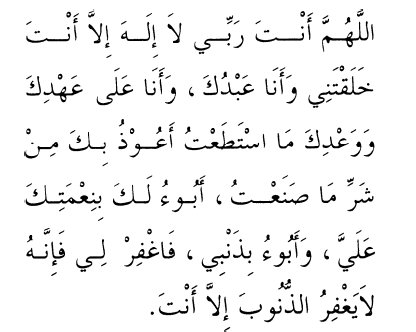
Sayyidul Istighfar

Bismillahir Rahmanir Raheem,

بِسۡمِ ٱللهِ ٱلرَّحۡمَـٰنِ ٱلرَّحِيمِ ,


Transliteration:
`Allahumma Anta Rabbi, la ilaha illa Anta, khalaqtani wa ana `abduka, wa ana `ala `ahdika wa wa`dika mastata`tu, a`udhu bika min sharri ma sana`tu, abu’u laka bini`matika `alayya, wa abu’u bidhanbi faghfir li, fa innahu la yaghfirudh-dhunuba illa Anta.


Translation:

O Allah, You are my Lord, there is none worthy of worship but You. You created me and I am Your slave. I keep Your covenant, and my pledge to You so far as i am able. I seek refuge in You from the evil of what I have done. I admit to Your blessings upon me, and I admit to my misdeeds. Forgive me, For there is none who may forgive sins but You.


wa Allahu Alam

[Updated]: A Basic Video Guide to Salaah [Hanafi Madhab]

Bismillahir Rahmanir Raheem,

بِسۡمِ ٱللهِ ٱلرَّحۡمَـٰنِ ٱلرَّحِيمِ ,

For a detailed read on all the daleel used for the Hanafi Method of Salaah (in great detail) , see this book by Shaykh Abu Yusuf Riyadhul Haqq (db).

[UPDATE]: Here is a picture, step by step guide with audio instructions that is also very simple to follow: Click Here.

wa Allahu Alam.

Was the Qur’an Mistaken on Mary’s Role in Christianity?

Bismillahir Rahmanir Raheem,

بِسۡمِ ٱللهِ ٱلرَّحۡمَـٰنِ ٱلرَّحِيمِ ,


While studying the topic of the “Immaculate” conception of Mary (the Mother of the Jesus), I came across a really contentious quote. Before I show the quote, I’d like us first to read this interpretation of an ayah of the Qur’aan[1]:


5:116

And when Allah saith: O Jesus, son of Mary! Didst thou say unto mankind: Take me and my mother for two gods beside Allah? he saith: Be glorified! It was not mine to utter that to which I had no right. If I had ever said it, then Thou wouldst have known it. Thou knowest what is in my mind, and I know not what is in Thy Mind. Lo! Thou, only Thou, art the Knower of Things Hidden?


Usually, this ayah is misinterpreted by both Muslims (laymen) and Christians (laymen and scholars). Theoretically speaking the argument against this ayah is that no group of “real” Christians believe in Mary to be a God, or have God-like attributes.


I’d now like you to see what I have found:


The salutation of the angel Gabriel — chaire kecharitomene, Hail, full of grace (Luke 1:28) indicates a unique abundance of grace, a supernatural, godlike state of soul, which finds its explanation only in the Immaculate Conception of Mary. But the term kecharitomene (full of grace) serves only as an illustration, not as a proof of the dogma.[2]


God like state of soul? This is sufficient evidence to state that the Qur’aan’s claim is not only valid, but absolutely prophetical in it’s statement. I’d like to add another quote to support the Qur’aan’s claims, to further support it’s statement:


she was created in a condition more sublime and glorious than all other natures.[3]


and one more for the fun of it:


To St. Ephraem she was as innocent as Eve before her fall, a virgin most estranged from every stain of sin, more holy than the Seraphim, the sealed fountain of the Holy Ghost, the pure seed of God, ever in body and in mind intact and immaculate.[4]


Insha Allah (God willing) this is sufficient evidence to calm the quarrelsome nature of the Christians who deny this fact, based upon the writings of the Church Fathers. As much as you hate Islam, the truth is before you and the Qur’aan is indeed among the signs (ayat) of Allah (swt).


Citations:

1. http://www.quranexplorer.com/quran?Sura=5&FromVerse=116&ToVerse=116&Script=Usmani&Reciter=Mishari-Rashid&Translation=Eng-Pickthal-Audio&TajweedRules=Off&Zoom=5.2


2. Holweck, Frederick. “Immaculate Conception.” The Catholic Encyclopedia. Vol. 7. New York: Robert Appleton Company, 1910. 17 Feb. 2011 <http://www.newadvent.org/cathen/07674d.htm>.


3. Theodorus of Jerusalem in Mansi, XII, 1140.


4. Carmina Nisibena.


wa Allahu Alam.

Edgar J. Godspeed on the Success of the Early Church

Bismillahir Rahmanir Raheem,
بِسۡمِ ٱللهِ ٱلرَّحۡمَـٰنِ ٱلرَّحِيمِ ,

“Yet Christianity was not failing. It was winning an amazing success, but in the Greek, not in the Jewish, world. Christianity was, in fact, rapidly becoming a Greek religion. But this success of Christianity in the Greek world only increased the difficulty of the problem. It was nothing like what the prophets had said would happen when the Messiah came.

Paul had seen this difficulty and grappled with it in Romans, chapters 9-11. He cherished the hope that eventually the Jewish people would turn and accept their own Messiah. But in the years that had since passed matters had gone steadily the other way.”

An Introduction to the New Testament – Edgar J. Godspeed; pages 159 and 160, “Matthew”.

Jesus vs Paul: I said nothing in secret.

Bismillahir Rahmanir Raheem,
بِسۡمِ ٱللهِ ٱلرَّحۡمَـٰنِ ٱلرَّحِيمِ ,

Often times, the Epistles of Paul, make references to scripture (whether canonical or not) and claims God said it. In this case, their God, being Yeshua, otherwise known as Isa al Masih alayhi as salaam to the Muslims.

Jesus allegedly said:

“I have spoken openly to the world,” Jesus replied. “I always taught in synagogues or at the temple, where all the Jews come together. I said nothing in secret.

[1]

Yet, if this is true, then Paul, is making a claim against Jesus:

,In the same way, the Lord commanded that those who proclaim the gospel should get their living by the gospel.

[2]

Therefore the question arises, if Jesus commanded this and in understanding he said nothing in secret, considering 2 Timothy 3:16’s statement that, “All Scripture is God-breathed”, where exactly did Jesus ever utter such a statement in the New Testament?

The challenge is quite simple:

  • Jesus says, he said nothing in secret.
  • His statement is supported by gospel which says, all scripture is from God.
  • Paul makes a claim that Jesus said something.

We arrive at a problem. If Paul’s source is a secret, then we arrive at a dilemma.
Either Jesus in John 18:20,
and, or not all scripture is God breathed as per 2 Timothy 3:16,
and, or Paul lied on both scripture and Jesus.

Therefore the challenge is quite simple, to prove the above statements false, any one single Christ has to show, where Jesus said unequivocally these words in the New Testament Gospels:

those who proclaim the gospel should get their living by the gospel.”

As, I, Br. Ejaaz A., always reiterates, I place my trust in Allah {swt} solely and He has already answered such a claim:

Therefore woe be unto those who write the Scripture with their hands and then say, “This is from Allah,” that they may purchase a small gain therewith. Woe unto them for that their hands have written, and woe unto them for that they earn thereby.

فَوَيۡلٌ۬ لِّلَّذِينَ يَكۡتُبُونَ ٱلۡكِتَـٰبَ بِأَيۡدِيہِمۡ ثُمَّ يَقُولُونَ هَـٰذَا مِنۡ عِندِ ٱللَّهِ لِيَشۡتَرُواْ بِهِۦ ثَمَنً۬ا قَلِيلاً۬‌ۖ فَوَيۡلٌ۬ لَّهُم مِّمَّا ڪَتَبَتۡ أَيۡدِيهِمۡ وَوَيۡلٌ۬ لَّهُم مِّمَّا يَكۡسِبُونَ

[3]

Objections to what has been stated.

1. Jesus said the same thing in Luke 10:7,

Stay in that house, eating and drinking whatever they give you, for the worker deserves his wages. Do not move around from house to house.

Well the answer is quite simple, this is quoting Luke, who was a companion of Paul, whom one can read in vast detail as being the companion of Paul [4]. Paul’s Epistles are believed to be initially spread from the year 50 AD (beginning with 1 Thessalonian), yet, Luke’s gospel is cited as being as much as 12 years later by John A.T. Robinson, Anglican dean of chapel and lecturer in theology at Trinity College, Cambridge. Therefore, the argument is baseless that Paul is citing Luke, if the Gospel of Luke was written after the Pauline Epistles.

2. Paul quotes 1 Timothy 5:17-18 in 1 Corinthians 9:14, same answer as above,

1 Timothy is one of the three epistles known collectively as the pastorals (1 Timothy, 2 Timothy, and Titus). Christians {albeit, uneducated in scriptural history}, claim they were written at the same time with or after Pauline Epistles. This is a false notion:

Norman Perrin summarises four reasons that have lead critical scholarship to regard the pastorals as inauthentic (The New Testament: An Introduction, pp. 264-5):

Vocabulary. While statistics are not always as meaningful as they may seem, of 848 words (excluding proper names) found in the Pastorals, 306 are not in the remainder of the Pauline corpus, even including the deutero-Pauline 2 Thessalonians, Colossians, and Ephesians. Of these 306 words, 175 do not occur elsewhere in the New Testament, while 211 are part of the general vocabulary of Christian writers of the second century. Indeed, the vocabulary of the Pastorals is closer to that of popular Hellenistic philosophy than it is to the vocabulary of Paul or the deutero-Pauline letters. Furthermore, the Pastorals use Pauline words ina non-Pauline sense: dikaios in Paul means “righteous” and here means “upright”; pistis, “faith,” has become “the body of Christian faith”; and so on.

Literary style. Paul writes a characteristically dynamic Greek, with dramatic arguments, emotional outbursts, and the introduction of real or imaginary opponents and partners in dialogue. The Pastorals are in a quiet meditative style, far more characteristic of Hebrews or 1 Peter, or even of literary Hellenistic Greek in general, than of the Corinthian correspondence or of Romans, to say nothing of Galatians.

The situation of the apostle implied in the letters. Paul’s situation as envisaged in the Pastorals can in no way be fitted into any reconstruction of Paul’s life and work as we know it from the other letters or can deduce it from the Acts of the Apostles. If Paul wrote these letters, then he must have been released from his first Roman imprisonment and have traveled in the West. But such meager tradition as we have seems to be more a deduction of what must have happened from his plans as detailed in Romans than a reflection of known historical reality.

The letters as reflecting the characteristics of emergent Catholocism. The arguments presented above are forceful, but a last consideration is overwhelming, namely that, together with 2 Peter, the Pastorals are of all the texts in the New Testament the most distinctive representatives of the emphases of emergent Catholocism. The apostle Paul could no more have written the Pastorals than the apostle Peter could have written 2 Peter.

[5]

3. It’s a paraphrase. Verbatim quotes are not what is being indicated here, so it’s pointless to ask for one.

This again, is an unlearned response as even the passage says it’s a direct quote, the Greek even indicates this:

Does Paul have to say it is a verbatim quote for us to acknowledge it as such? Did you read the quote cited?

“In the same way, the Lord commanded”

In the what? The “οὕτω” way, meaning?

“in this way (referring to what precedes or follows): – after that, after (in) this manner, as, even (so)”

In “οὕτω” way, he “διατάσσω”, meaning?

“arrange thoroughly, that is, (specifically) institute, prescribe, etc.: – appoint, command, give, (set in) order, ordain.”

Jesus specifically, gave this order, in the same way, as Paul is narrating it. This is to display the liturgical transmission of narratives about Jesus from the disciples. So even the verse, expresses what I have expressed and answers you quite clearly.

wa Allahu Alam.

[1] – John 18:20, NIV Bible Translation,
http://www.biblegateway.com/passage/?search=John+18%3A20&version=NIV

[2] – 1 Corinthians 9:14, NRSV Bible Translation,
http://bible.oremus.org/?passage=1Corinthians+9

[3] – Qur’aan, Surah 2, Ayah 79,
http://www.quranexplorer.com/quran?Sura=2&FromVerse=79&ToVerse=79&Script=Usmani&Reciter=Mishari-Rashid&Translation=Eng-Pickthal-Audio&TajweedRules=Off&Zoom=5.2

[4] – http://www.newadvent.org/cathen/09420a.htm

[5] – Norman Perrin, The New Testament: An Introduction, pp. 264-5.

[Updated] Aisha (raa) Marriage to the Prophet Muhammad {saw} of Islam.

Bismillahir Rahmanir Raheem
بِسۡمِ ٱللهِ ٱلرَّحۡمَـٰنِ ٱلرَّحِيمِ ,

A simple answer to a Judaic – Christian attack on the truth of Al Islam

To begin with, two facts must be established. Aisha (ra) was:

  • Six (6) years of age when the marriage contract was done.
  • Nine (9) years of age when the marriage was consummated.

We can establish this information, from a hadith, narrated by, Aisha (ra) herself:

Narrated ‘Aisha (ra):

that the Prophet married her when she was six years old and he consummated his marriage when she was nine years old, and then she remained with him for nine years (i.e., till his death).[1]

It is important to state who the narrator of this hadith is. It is directly from the lips of Aisha (ra). The person at the very heart of this great debate.

It is best to enter into the following sets of information with an objective mind. Removing all bias and applying proper academic principles to the information that is about to bestowed upon you, the reader. Take note that all quotes are cited. This has been done so that you can do research yourself and see the reality of the situation, rather than depending on hearsay. In order to proper understand the validity and purpose of the marriage we must first ask ourselves some very basic questions:

  • Who are the people that we should focus the research on?
  • Where did they live?
  • What kind of society did they have?
  • When was this society in existence?
  • Why did they do this marriage?

These five (5) questions form the basis of our research which employs critical thinking. Critical thinking can be summarized as:

Critical thinking is the intellectually disciplined process of actively and skillfully conceptualizing, applying, analyzing, synthesizing, and/or evaluating information gathered from, or generated by, observation, experience, reflection, reasoning, or communication as a guide to belief and action. In its exemplary form, it is based on universal intellectual values that transcend subject matter divisions: clarity, accuracy, precision, consistency, relevance, sound evidence, good reasons, depth, breadth and fairness. [2]

Therefore we must ask ourselves, what field of study, which by using critical thinking, can we seek to answer the five (5) questions listed above? The answer is anthropology. What is anthropology you might ask?

Anthropology is the study of humans, past and present. To understand the full sweep and complexity of cultures across all of human history, anthropology draws and builds upon knowledge from the social and biological sciences as well as the humanities and physical sciences. A central concern of anthropologists is the application of knowledge to the solution of human problems. Historically, anthropologists […………] have been trained in one of four areas: sociocultural anthropology, biological/physical anthropology, archaeology, and linguistics. Anthropologists often integrate the perspectives of several of these areas into their research, teaching, and professional lives.[3]

To summarize, we’ll look at this issue from a biological/ physical anthropological perspective and a sociocultural perspective. I’ve also added the dimension of secular law into the equation so that the subject matter’s relevance in our times can be properly digested.

(1) Anthropology –  Biological/ Physical.
(2) Anthropology –  Sociocultural.
(3) Secular law.

Biological/ Physical Anthropology.

The first major issue commonly associated with this marriage, is that Aisha (ra) is commonly referred to as a child, prepubescent, a girl. This draws into the plot that this was a child marriage. Yet, are these adjectives properly being applied to the person of Aisha (ra)? We must then ask, what is a child? A child is one who has not entered into the age of sexual maturation (the age at which one is able to begin sexual reproduction).[4]

A child is defined as:
child (chīld)
n. pl. chil·dren (chĭl’drən)

1. A person between birth and puberty.
2. A person who has not attained maturity or the age of legal majority.
3. An unborn infant; a fetus.
4. An infant; a baby.

Aisha (ra) reached this age, thus she was not a child nor prepubescent.

“Puberty is the stage of life during which you become biologically and sexually mature. It is the entry into adolescence, a period of tremendous changes in the body, emotions, attitude, values, intellect and relationships. This is the transition from the world of the child that gives way to the world of the adult.”[5]

So the question asks itself, did Muhammad (saw) consummate the marriage when her menses began?

Narrated ‘Aisha {ra}: (the wife of the Prophet) I had seen my parents following Islam since I attained the age of puberty. Not a day passed but the Prophet visited us, both in the mornings and evenings. My father Abii Bakr thought of building a mosque in the courtyard of his house and he did so. He used to pray and recite the Qur’an in it. The pagan women and their children used to stand by him and look at him with surprise. Abu Bakr was a soft hearted person and could not help weeping while reciting the Quran. The chiefs of the Quraish pagans became afraid of that (i.e. that their children and women might be affected by the recitation of Quran).”[6]

What to the scholars of Islam also say on the age of marriage?

The fact that it is permissible to marry a young girl does not mean that it is permissible to have intercourse with her; rather that should not be done until she is able for it. For that reason the Prophet (peace and blessings of Allaah be upon him) delayed the consummation of his marriage to ‘Aa’ishah. Al-Nawawi said: With regard to the wedding-party of a young married girl at the time of consummating the marriage, if the husband and the guardian of the girl agree upon something that will not cause harm to the young girl, then that may be done. If they disagree, then Ahmad and Abu ‘Ubayd say that one a girl reaches the age of nine then the marriage may be consummated even without her consent, but that does not apply in the case of who is younger. Maalik, al-Shaafa’i and Abu Haneefah said: the marriage may be consummated when the girl is able for intercourse, which varies from one girl to another, so no age limit can be set. This is the correct view. There is nothing in the hadeeth of ‘Aa’ishah to set an age limit, or to forbid that in the case of a girl who is able for it before the age of nine, or to allow it in the case of a girl who is not able for it and has reached the age of nine. Al-Dawoodi said: ‘Aa’ishah (may Allaah be pleased with her) was reached physical maturity (at the time when her marriage was consummated).[7]

Therefore in terms of a biological stand point, if we were to accept scientific principles (upon which our “modern” society operates), we must conclude that she was not a child, not prepubescent nor physically immature.

Sociocultural Anthropology.

In Semitic cultures, the age at which one is suitable for marriage begins with sexual maturation. For Jews, the boys have the Bar Mitzvah, indicated by puberty (sexual maturation). The Muslims judge the woman, by menstrual cycle, with sexual maturation, one earns the ability to have a menstrual cycle, also referred to as menses. This was the standard way to tell a girl from a woman, the known world has used this standard for ages, dating back to the most primitive of cultures. They judged a woman by her individual characteristic of having her menses which signalled adulthood.

Almost all primitive cultures pay attention to puberty and marriage rituals, although there is a general tendency to pay more attention to the puberty rites of males than of females. Because puberty and marriage symbolize the fact that children are acquiring adult roles, most primitive cultures consider the rituals surrounding these events very important. Puberty rituals are often accompanied with ceremonial circumcision or some other operation on the male genitals. Female circumcision is less common, although it occurs in several cultures. Female puberty rites are more often related to the commencement of the menstrual cycle in young girls.[8]

We can further see this historical fact, present in freely and easily available Jewish literature:

The Age of Maturity.

The Rabbis, however, reckoned the age of maturity from the time when the first signs of puberty appear (Nid. 52a), and estimated that these signs come, with women, about the beginning of the thirteenth year, and about the beginning of the fourteenth year with men. From this period one was regarded as an adult and as responsible for one’s actions to the laws of the community. In the case of females, the rabbinic law recognized several distinct stages: those of the “ḳeṭannah,” from the age of three to the age of twelve and one day; the “na’arah,” the six months following that period; and the “bogeret,” from the expiration of these six months. In the case of males, distinction was made in general only between the period preceding the age of thirteen and one day and that following it, although, as will be seen below, other stages were occasionally recognized.

The attainment of the age of majority, however, did not of itself render one an adult; the prescribed age and the symptoms of puberty together were necessary to establish the majority of a person. If there were no signs of puberty at the age of majority (i.e., at the beginning of the thirteenth year in a female and at the beginning of the fourteenth in a male) the person retained the status of a minor until the age of twenty. If after that period signs of impotence developed, thus explaining the absence of the signs of puberty, the person was admitted to the status of an adult; if such signs did not develop, the person remained in the status of a minor until the age of thirty-five years and one day—the greater part of the time allotted to man on earth (comp. Ps. xc. 10). In the case of a woman, the bearing of children was regarded as sufficient to establish her majority (Yeb. 12b; Maimonides, “Yad,” Ishut, ii. 9; comp. “Maggid Mishneh” and “Leḥem Mishneh” ad loc.; for the whole subject see Nid. v. 3-8; vi. 1, 11-12; “Yad,” l.c. ch. ii.).

Marriage of Minors.

The ḳeṭannah might be given in marriage by her father, and the marriage was valid, necessitating a formal divorce if separation was desired. Her earnings and her findings, also, belonged to her father, and he could annul her vows and accept a divorce for her (Nid. 47a; Ket. 46b). In the absence of her father, her mother or her brothers might contract a marriage for her, but such a marriage might be annulled by her without any formality before she reached the age of maturity (see Mi’un). Illegitimate intercourse with her carried with it the regular punishment for the transgressor, although she could not be punished (Nid. 44b). The na’arah, however, although still under the control of her father (Ḳid. 41a), was considered a responsible person; her vows were valid (Nid. 45b). The bogeret was regarded as entirely independent of her father’s will and was looked upon as an adult in all respects (Nid. 47a).

The Rabbis recognized in males a stage similar to that of the ḳeṭannah. A boy nine years of age was regarded as being of a nubile age, so that if he had illegitimate intercourse with a woman forbidden to him she would be liable to punishment, although he could not be punished until he reached the age of maturity—thirteen years and one day (Nid. 44a). His marriage, however, was not valid (Ḳid. 50b; “Yad,” l.c. iv. 7), although he could acquire a “yebamah” through intercourse (Nid. 45a; B. B. 156b). A stage similar to that of the na’arah was recognized by the Rabbis in the case of the rebellious son (Deut. xxi. 18-21). The period during which one might become liable to the punishment inflicted upon the rebellious son was extended to include the three months (six months in Yer. Sanh. viii. 1) immediately succeeding the age of maturity (Sanh. 69a). After a boy had reached the age of maturity he was regarded a responsible person in all ritualand criminal matters, and the court inflicted punishment upon him for any transgressions. The Rabbis entertained the belief that heavenly punishment was not visited for sins committed before the age of twenty (Shab. 89b; comp. B. B. 121b; Maḥzor vitry, ed. Hurwitz, p. 550; Ḥakam Ẓebi, Responsa, § 49; but comp. “Sefer Ḥasidim,” ed. Wistinetski, § 16, where the opinion is expressed that the heavenly punishment does not depend on age but on the intelligence of the transgressor; see also Asher ben Jehiel, Responsa, xvi. 1).[9]

Secular Law.

Secular law states that all girls become women at a legally fixed age. Although biologically absurd, the concept behind this is related to a filed of politico-economic studies termed “adult suffrage”. Adult suffrage essentially guarantees under a sovereign nationa’s legislative system, that at a particular fixed age, members of society earn certain rights, one such being that of voting. It may also refer to a citizen’s right to legally have a driver’s permit, have an identification permit, earn the authority to sign contracts with institutions etc. While I could go more into adult suffrage, that topic escapes the purpose of this article. However, I do encourage you, the reader to continue investigations into that subject matter. Secular law can state that females become legal or earn adult suffrage when they are 18, 16, or in some cases, like France, at the age of 14. Usually the age of sexual consent is commonly associated with the age of adult suffrage.

The Purpose of the Marriage:

1 – He saw a dream about marrying her. It is proven in al-Bukhaari from the hadeeth of ‘Aa’ishah (may Allaah be pleased with her) that the Prophet (peace and blessings of Allaah be upon him) said to her: “You were shown to me twice in a dream. I saw that you were wrapped in a piece of silk, and it was said, ‘This is your wife.’ I uncovered her and saw that it was you. I said, ‘If this is from Allaah then it will come to pass.’” (Narrated by al-Bukhaari, no. 3682). As to whether this is a prophetic vision as it appears to be, or a regular dream that may be subject to interpretation, there was a difference of opinion among the scholars, as mentioned by al-Haafiz in Fath al-Baari, 9/181.

2 – The characteristics of intelligence and smartness that the Prophet (peace and blessings of Allaah be upon him) had noticed in ‘Aa’ishah even as a small child, so he wanted to marry her so that she would be more able than others to transmit reports of what he did and said. In fact, as stated above, she was a reference point for the Sahaabah (may Allaah be pleased with them) with regard to their affairs and rulings.

3 – The love of the Prophet (peace and blessings of Allaah be upon him) for her father Abu Bakr (may Allaah be pleased with him), and the persecution that Abu Bakr (may Allaah be pleased with him) had suffered for the sake of the call of truth, which he bore with patience. He was the strongest of people in faith and the most sincere in certain faith, after the Prophets.

It may be noted that among his wives were those who were young and old, the daughter of his sworn enemy, the daughter of his closest friend. One of them occupied herself with raising orphans, another distinguished herself from others by fasting and praying qiyaam a great deal… They represented all kinds of people, through whom the Messenger of Allaah (peace and blessings of Allaah be upon him) was able to set out a way for the Muslims showing how to deal properly with all kinds of people. [See al-Seerah al-Nabawiyyah fi Daw’ al-Masaadir al-Asliyyah, p. 711].[10]

– Hope this answers the issue.

wa Allahu Alam.

[1] – Sahih Bukhari :: Book 7 [Wedlock, Marriage, Nikah] :: Volume 62 :: Hadith 64.

[2] – http://www.criticalthinking.org/aboutCT/define_critical_thinking.cfm

[3] – http://www.aaanet.org/about/WhatisAnthropology.cfm

[4] – http://www.thefreedictionary.com/child

[5] –  http://www.ifsha.org/yp/puberty.htm

[6] – Sahih Bukhari :: Book 1 :: Volume 8 :: Hadith 465

[7] – http://islamqa.com/en/ref/22442/age%20of%20consent

[8] – “An Overview of the World’s Religions” – http://www.theology.edu/relig02.htm

[9] – http://www.jewishencyclopedia.com/view.jsp?artid=91&letter=M&search=age+of+maturity#ixzz0u6JujGf1

[10] – Excerpt from: [ Zaad al-Ma’aad, 1/106; By Imam Ibn al Qayyim al Jawziyyah]

« Older Entries Recent Entries »