Samuel Green’s Biblical Conundrum
Not his best moment…..


Since then, he’s been unable to respond. Is this another case of a Muslim knowing the Bible better than a Pastor? You decide.
and God knows best.

Search
Not his best moment…..
Since then, he’s been unable to respond. Is this another case of a Muslim knowing the Bible better than a Pastor? You decide.
and God knows best.
Edit: Delayed to 14th or 15th due to unforeseen circumstances.
My paper critiquing Jay Smith’s allegations and claims in his recent debate with Dr. Shabir Ally, entitled, “The Bible or the Qur’an: Which is the Word of God?“, will be published tomorrow via a PDF on both Scribd and Google Drive. I cannot at this moment give a specific time when the paper would be published, but barring any sudden and unexpected incidents I expect it to be published during the course of tomorrow. At present, the only hindrance to the publishing of the document would be a translation I’m awaiting of a French work that is otherwise not available in English. Considering the inclusion of the French quote’s data as a peripheral to the cause of the paper, when it is made available to me, I shall append it in due course. Following the publishing of my paper, another paper by another Muslim speaker would be subsequently published on a similar theme but more in depth concerning a specific work referenced during the debate. While my response is a point by point rebuttal to Jay’s allegations, this coming work is an overtly critical analysis of an academic work that was mentioned but not really used during the debate. I have not worked in conjunction with this other Muslim speaker, but we have exchanged sources during the course of our writing.
Perhaps what is most interesting is the silly claim that because I have not published any works on this site which include the literature of Deroche or Walid Saleh, it then means that I did not know of them before the debate with Jay hence the lengthy duration of time it took for me to prepare the paper. The assumption or rather the assertion is that I was unfamiliar with their works completely. This is an absurdly baseless allegation. There are many works I read on a daily basis which I do not quote or reference on this site or in my debates, but of which I post to my private Facebook account or which I use in personal correspondence in response to questions. Case in point, I have dug through my personal Facebook timeline, to dig up this post by me on August 4th, 2014:
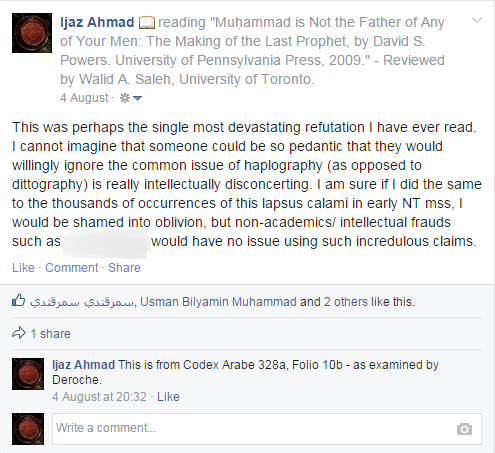
This is one of the many examples on which I’ve commented on either of these men’s works. I’ve blurred out the name of the evangelical missionary apologist I was condemning in this post which in retrospect was unfair of me and not of proper decorum. For those who are my Facebook friend, you’d be able to see this post on my timeline which I’ve re-posted today so that we all can access it in an easy manner. I have stated before and I will state this again, the only impediment in regard to my writing of the paper has been my health which has been on a steady decline for some two years now via a chronic illness to which no medical institution has been able to adequately decipher. A state of health which most missionaries and apologists are well aware of. Following the publishing of the paper, a video response will accompany it in the coming weeks which at this time I cannot give a definitive date for.
and Allaah knows best.
I’m not exactly sure if I’ve lost my sanity or if I’m misunderstanding something. Let’s take a look at this group’s definition:
If I’m reading this correctly, this is a group created for the purpose of Muslim and Christian Discussion. Just to ensure I’m understanding this, I checked the group’s “about” definition:
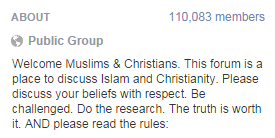
I was a bit surprised while scrolling through my newsfeed to see the following:
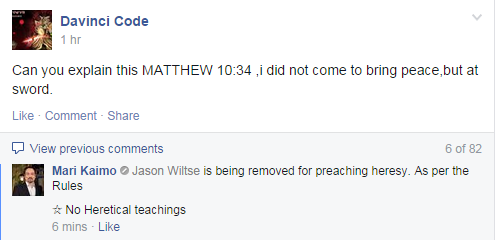
An Anglo-Christian person being removed for heresy, in a group which its purpose is to discuss religious belief…..that’s….odd? So I decided to look a bit closer:
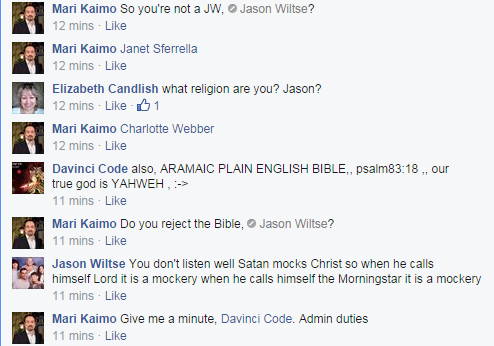
Mari Kaimo wastes no time, if you reject the Bible – you’re a heretic, which is odd in a group that is dedicated to Christian and Muslim dialogue. It suddenly made sense why I could find at most 1 or 2 active Muslims commenting in the group. They’ve been banning Muslims in a Christian-Muslim religious dialogue group because to them, Muslim beliefs were heretical.

Surely, this “Preacher” and friend of Shamoun would know that in a dialogue group about religion, there would be users who practised different religions in all their forms and differences. Surely? I guess not:

Where is this leading…?
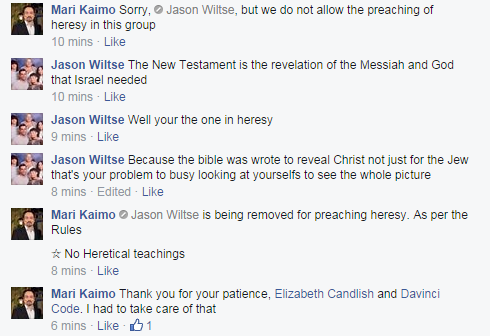
I had just one reaction, this just sums it up entirely:

I’ve seen some pretty ridiculous things in my life. This is by far, one of the single most absurd things I have ever had the displeasure of witnessing. I probably stared at my screen for a few minutes, in sheer awe at the line of reasoning being played out in front of me. To recap….., this is a group created for the purpose of inter-faith dialogue and discussion. However, if you practise a religion which Christianity (as believed in by Mari Kaimo) disagrees with, you’re going to be kicked out/ removed. Surely, there are smarter people out there in the world. I’ve said it once before and I’ll say it again, this guy is a walking, talking, breathing contradiction inside and out. I pray that this is bad sarcasm at work, there is nothing, no excuse that can allow anyone to rationalize the absurdity of such a situation. If this is anything to go by, I thank God that these are the Christian Apologists and Missionaries that currently lead the Christian faith. They have made our job of conveying Islam so much easier. With people like these, there is no question as to why so many Christians quite literally get frustrated and leave the faith. I feel embarrassed for the Christian community because of this guy, in no way does this person represent a religion with 2000 years worth of study behind it.
and God surely, very surely, knows best.
Introduction
Luke 23:34 is perhaps one of the most interesting verses in the New Testament narrative of Jesus, the son of Mary’s alleged crucifixion. It reads as follows[1]:
Jesus said, “Father, forgive them, for they do not know what they are doing.”[c] And they divided up his clothes by casting lots.
Our interest is primarily focused upon the prayer[2] of Jesus. The questions which are being asked are, why is Jesus praying for these men’s forgiveness? What purpose does it convey? What does it achieve? These questions need to be asked, as Jesus’ prayer in this case, occurs before his eventual death on the cross which is supposed to have ushered in a new covenant with God, a new doctrine of salvation. His death and resurrection which establishes itself as the pillar upholding the veracity and validity of the Christian faith as declared by Paul of Tarsus:
And if Christ has not been raised, our preaching is useless and so is your faith.[3]
Summarily, we are seeking to establish the reasoning for this prayer of forgiveness, in regard to its timing of the slaying of the lamb[4] for the forgiveness of the sins of the world[5], inclusive of those of the Jews and Romans who were no doubt instrumental in the events leading to the crucifixion event.
New Testament Textual Criticism of Luke 23:34
It would be inane to discuss the consequences of the verse in question at length, before establishing its place in the New Testament canon. Most would be unaware that this verse’s place in the canon is one of disputation and doubt. It would be of note to mention that the verse is recorded in the following versions of the English Print Editions of the New Testament [6]:
It had become necessary to list the instances of its presence in the English translations, as it is the language in which this article is being written. It was also necessary, so as to demonstrate its undoubted and frequent presence in the most accessible New Testament print editions in the English language. A noted citation in the NIV[7] translation reads as follows:
c. Luke 23:34 Some early manuscripts do not have this sentence.
Its presence in most translations is due to the verse’s presence in the modern critical editions of the Greek New Testament. As of this writing, it remains in the critical editions as is demonstrated by the Nestle-Aland 28th Greek New Testament[8]:
ὁ δὲ Ἰησοῦς ἔλεγεν· πάτερ, ἄφες αὐτοῖς, οὐ γὰρ οἴδασιν τί ποιοῦσιν. διαμεριζόμενοι δὲ τὰ ἱμάτια αὐτοῦ ἔβαλον κλήρους.
Codex Aleph (א- Sinaiticus) does contain this verse[9], although atleast one of its suggested scribes or editors is thought to have edited or corrected the verse in question[10]. However Codices B (Vaticanus) and D (Bezae) do not contain this verse[11], thus explaining the citation in the NIV translation. At the time of this writing, I do not have access to the apparatus of the Nestle Aland 28th Edition Greek New Testament, therefore I was unable to attain the reasons or sources it outlines for the inclusion of the verse. However, in reading the erudite work of Bruce Metzger and Bart Ehrman, we note that it states the following in regard to its intentional omission in other codices[12]:
…an omission that makes particular sense if Jesus is understood to be asking God to forgive the Jews responsible for his crucifixion.
Their understanding of the omission is in the context of Jewish-Christian relations, more specifically, anti-Jewish Christian scribes within the first centuries of Christianity and the consequential promulgation of their views in Christian literature. The omission was meant to remove the view that Jesus the Christ had prayed for the forgiveness of the Jews for their role in his crucifixion[13]. There is also a Textual Critical maxim, which reads as follows: “lectio difficilior potior” – the more difficult/nonsensical reading is more evidential. Given that their is a possibility of intentional omission, then their is great possibility it was included in the earlier copies of the Gospel.
Having explored its place in the canon and the evidences for its inclusion, there is now no doubt that at the time of this writing, New Testament Textual Critics adhere to its inclusion despite its omission from two important early sources.
The Prayer in Light of the New Covenant & its Soteriological Plan
The traditional Christian soteriological belief in this doctrine of salvation by the Christ’s crucifixion can be understood in the following quote[14]:
Christ upon the cross, is gracious like Christ upon the throne. Though he was in the greatest struggle and agony, yet he had pity for a poor penitent. By this act of grace we are to understand that Jesus Christ died to open the kingdom of heaven to all penitent, obedient believers.
With his sacrifice, the gates of heaven were opened to the world[15]. The Gospel accounts inform us that Jesus the Christ a priori knew that he had to be crucified, we read:
And he said, “The Son of Man must suffer many things and be rejected by the elders, the chief priests and the teachers of the law, and he must be killed and on the third day be raised to life.”[16]
The Son of Man will go as it has been decreed. But woe to that man who betrays him!”[17]
‘The Son of Man must be delivered over to the hands of sinners, be crucified and on the third day be raised again.’ ”[18]
The Son of Man will go just as it is written about him. But woe to that man who betrays the Son of Man! It would be better for him if he had not been born.”[19]
Since it is established in the narrative, as ascertained from the verses listed previously that his eventual crucifixion and death would lead to the payment of the sins of the world, then it is a strange occurrence that the Christ would pray for someone’s forgiveness. If he knew his death was imminent and with that, forgiveness would be brought upon the world, why would he beseech the Father for the forgiveness of others? Perhaps an analogy can demonstrate the peculiarity and absurdity of this event. It is as if I had a letter in my possession. Knowing that I’m about to use a photocopying machine to duplicate that letter, just before I use the photocopier, I choose to handwrite the letter on a sheet of blank paper and then photocopy the original letter. It’s redundant, anachronistic, futile. Jesus undoubtedly knows that the entire world, inclusive of those men before him; that he is about to pay for their sins, yet he prays to the Father just before his death that their sins should be forgiven. Regardless of someone’s theological, philosophical or personal views, the oddity of this occurrence is striking.
Such an understanding is noted by the exegete Matthew Henry, for he states[20]:
As soon as Christ was fastened to the cross, he prayed for those who crucified him. The great thing he died to purchase and procure for us, is the forgiveness of sin.
In essence, he prayed for the same thing that his death would achieve. Some might postulate that this is a sign of Jesus’ mercy and love for mankind, as is held by Stier et al; we read from the Pulpit Commentary the following[21]:
Then, as always, thinking of others, he utters this prayer, uttering it, too, as Stier well observes, with the same consciousness which had been formerly expressed, “Father, I know that thou hearest me always.” “His intercession has this for its ground, though in meekness it is not expressed: ‘Father, I will that thou forgive them.”
While such an apologetic exegesis would placate some, I do not find it to be sensible. For, if Jesus the Christ, who is also the Son; a deity capable of forgiving sin as is claimed from Luke 7:48[22], then why did the Son simply not forgive the sins of the world, or the sins of the Roman and Jewish persecutors? He clearly had the ability to do so, the authority to do so, so why would the Son choose not to do this? Instead, the Son as we are led to believe, chooses to beseech the Father! This prayer therefore leads to an even greater problem, (it implies) subordination and hierarchy within the Trinitarian dogma. Beliefs tantamount to heresy when tested against the proto-orthodoxical Nicaean creed[23], which establishes the Son as co-equal to God[24]:
Such is the genuine doctrine of Arius. Using Greek terms, it denies that the Son is of one essence, nature, or substance with God; He is not consubstantial (homoousios) with the Father, and therefore not like Him, or equal in dignity, or co-eternal, or within the real sphere of Deity.
Jesus the Christ, otherwise known to Christendom as the Son, had the ability to forgive sins, he did not need to request that the Father do this. If he prayed out of love, mercy, grace and compassion for the forgiveness of the sins of the Roman and Jewish persecutors, then why did he not use this love, mercy and grace to absolve them of their sins? He is in essence, praying for something he could already grant them, therefore this excuse is redundant and unremarkable, in clear contradiction of this fanciful idea of proposed love, mercy, grace and compassion.
Did They Need to be Forgiven?
Whether the prayer was uttered in reference to the Jews, the Romans, or some combination of those peoples; did they need to be forgiven? Forgiving them would readily imply that their actions were sinful, criminal, morally wrong. However as we are well aware, and as I have previously stated, the sacrificing of a sacrificial lamb is the purpose[25] of Christ’s earthly mission. This prayer for forgiveness would then have us believe that the sacrifice was morally wrong according to Jesus himself! The significance of such a prayer is now very telling, it is detrimental to the sacrificial imagery steadily enforced throughout the New Testament and as referenced previously[26]. Christians do not believe that Christ’s sacrifice was sinful or wrong, it is the very foundation of their faith as we had read from the Apostle Paul[27]!
We are at an unfortunate dilemma, Christ’s prayer now seems to be undermining the very pillars of proto-orthodox Christian belief. If it was God’s will that the world be saved from their sins by the hands of the Romans and Jews, then it is absurd that we should consider the persons responsible for the crucifixion as sinful individuals. Rather, if the Christian world is to be consistent with their beliefs, these men should be celebrated, just as the cross is celebrated. However, if it is the case that Jesus considered his persecutors that led to his crucifixion as criminals, as murderers, then the possibility of Jesus’ death being labeled as a crime and an injustice done to him is significantly more appropriate and honest. Such a view would be in blatant violation of the Christian world view on salvation. Perhaps what is more troubling is the position of those who perform the Passover sacrifice, we read the following[28]:
“Get rid of the old yeast, so that you may be a new unleavened batch—as you really are. For Christ, our Passover lamb, has been sacrificed.”
If Jesus the Christ is to be considered the sacrificial lamb, then those who perform the sacrifice for Passover have been atoned of their sins as is clearly stipulated in the Pentateuch[29]:
For the life of a creature is in the blood, and I have given it to you to make atonement for yourselves on the altar; it is the blood that makes atonement for one’s life.
If we are to believe that Luke 23:34 is in relation to the Jews, then Jesus’ prayer of forgiveness for them is troubling, for it would then imply that the very God of the Jews, did not know that the sacrificing of the Passover lamb was not a crime, but an act of atonement for the Jews.
Conclusion
There are very few cases in which we can understand the purpose of this prayer. One scenario is that Jesus did not expect his death to open the gates of forgiveness and that he did not have the ability to forgive sins by his own will and authority, therefore his prayer to God was one in sincerity. However, if he did know that his eventual death would lead to the world’s forgiveness and that he had the ability to forgive sins without any sacrifice, then his prayer to God seems out of place and problematic to the narrative, rendering his prayer to be completely redundant and meaningless.
Another case in which we can perhaps derive some closure on the issue, is that if Jesus was in fact the sacrificial Passover lamb, then his prayer for forgiveness for the Jews, would mean that he either did not know the laws of the Pentateuch, or that he did not consider himself to be a sacrificial Passover lamb; the latter belief would then render Paul a liar and would cause the Christian faith to be false as per his declaration in 1 Corinthians 15:14. The former argument would then have us believe that Jesus could not be a deity as he is ignorant of the very law which he would have instructed the Jews himself.
Whichever way the prayer is examined, as I have aptly demonstrated it is of grave detriment to the Christian faith and without a doubt its place in the Biblical canon is of service to those who which to prove that Jesus the Son of Mary, is not and has never been a deity.
and Allaah knows best.
Sources (APA Style):
[1] – Holy Bible, New International Version®, NIV®. (2011). Luke 23:34. Retrieved from http://www.biblegateway.com/passage/?search=Luke%2023&version=NIV
[2] – Concise Commentary on the Whole Bible by Matthew Henry. (2003). Luke 23:34. Retrieved from http://biblehub.com/commentaries/mhc/luke/23.htm
[3] – Holy Bible, New International Version®, NIV®. (2011). 1 Corinthians 15:14. Retrieved from http://www.biblegateway.com/passage/?search=1+corinthians+15%3A14&version=NIV
[4] – Holy Bible, New International Version®, NIV®. (2011). Revelation 5:12. Retrieved from http://www.biblegateway.com/passage/?search=Revelation+5%3A12&version=NIV
[5] – Holy Bible, New International Version®, NIV®. (2011). John 3:16. Retrieved
from http://www.biblegateway.com/passage/?search=John+3%3A16&version=NIV
[6] – Bible Hub’s Parallel Verses. (2014). Luke 23:34. Retrieved from http://biblehub.com/luke/23-34.htm
[7] – See: [1]
Note: The Pulpit Commentary, Ibid, relates the same conclusion as I have written:
” These words are missing in some of the oldest authorities. They are found, however, in the majority of the most ancient manuscripts and in the most trustworthy of the old versions, and are undoubtedly genuine.”
[8] – Nestle-Aland Novum Testamentum Graece. (2013). Luke 23:34. Retrieved
from http://www.nestle-aland.com/en/read-na28-online/text/bibeltext/lesen/stelle/52/230001/239999/
[9] – Codex Sinaiticus. (2009). Luke 23:34. Retrieved
from http://codexsinaiticus.org/en/manuscript.aspx?book=35&chapter=23&lid=en&side=r&verse=34&zoomSlider=0
[10] – Ibid. See the transcription notes, Editor cb2.
[11] – Cambridge Bible for Schools and Colleges. (1891). Luke 23:34. Retrieved from http://biblehub.com/commentaries/cambridge/luke/23.htm
[12] – Ehrman, B., & Metzger, B. (Eds.). (2005). The Text of the New Testament: Its Transmission, Corruption and Restoration (4th ed.). New York, NY: Oxford University Press.
[13] – Ibid.
[14] – See: [2]
[15] – See: [5]
[16] – Holy Bible, New International Version®, NIV®. (2011). Luke 9:22. Retrieved
from http://www.biblegateway.com/passage/?search=Luke+9%3A22&version=NIV
[17] – Holy Bible, New International Version®, NIV®. (2011). Luke 22:22. Retrieved
from http://www.biblegateway.com/passage/?search=Luke+22%3A22&version=NIV
[18] – Holy Bible, New International Version®, NIV®. (2011). Luke 24:7. Retrieved
from http://www.biblegateway.com/passage/?search=Luke+24%3A7&version=NIV
[19] – Holy Bible, New International Version®, NIV®. (2011). Matthew 26:24. Retrieved
from http://www.biblegateway.com/passage/?search=Matthew+26%3A24&version=NIV
[20] – See: [2]
[21] – The Pulpit Commentary. (2010). Luke 23:34. Retrieved from http://biblehub.com/commentaries/pulpit/luke/23.htm
[22] – Holy Bible, New International Version®, NIV®. (2011). Luke 7:48. Retrieved
from http://www.biblegateway.com/passage/?search=luke+7%3A48&version=NIV
[23] – The Nicaean Creed. (n.d.). The Nicaean Creed. Retrieved from http://www.creeds.net/ancient/nicene.htm
[24] – Barry, W. (1907). Arianism. The Catholic Encyclopedia. New York: Robert Appleton Company. Retrieved June 11, 2014 from New Advent: http://www.newadvent.org/cathen/01707c.htm
[25] – See: [16], [17], [18], [19]
[26] – See: [4]
[27] – See: [3]
[28] – Holy Bible, New International Version®, NIV®. (2011). 1 Corinthians 5:7. Retrieved
from http://www.biblegateway.com/passage/?search=1%20Corinthians%205:7&version=NIV
[29] – Holy Bible, New International Version®, NIV®. (2011). Leviticus 17:11. Retrieved
from http://www.biblegateway.com/passage/?search=Leviticus%2017:11&version=NIV
While perusing Paltalk, I came across a room entitled, “The Trinity and the King James Bible“, the moment I entered Sam Shamoun spotted me and I grabbed my phone and recorded him whining and complaining that I got him into hot water with James White. After whining for 21 seconds, as an Administrator of the room, he bounces me (kicks me out of it). Christians who support him need to ask, if he isn’t afraid of discussing what he says, why does he run away and prevent discussions from occurring? Why does he only choose to argue with Muslims who aren’t as educated in the field of theology as we are? Here’s the recording, you can here him whining and then bouncing me (the ping sound):
and God knows best.
Quick announcement:
Br. Yahya Snow of the Facts About Islam, and I, Br. Ijaz Ahmad have decided to unite in our efforts to respond to missionary attacks on Islam. The Muslim community can look forward to greater collaborative efforts, articles, videos and more in the weeks to come. It is our pleasure to serve the Muslim community.
and Allaah knows best.
I’ve been asked by several persons who listened to the webcast of Dividing Line to give a few comments on my thoughts of the events which occurred during the show. Personally, I don’t have much to say about the discussion, but I’m willing to give a little background and explain a few details.
Sheikh Awal is currently in Trinidad and Tobago, my home country. He’s here to give a few workshops and lectures. I met him on Wednesday night, which was unplanned to be honest until a chance call earlier in the day. In the end, I got a chance interview with him. It’s about 7 minutes long and we didn’t have time to discuss much, so he summarized for the public consumption, the events which led up to the cancellation of his debate with James White.
I posted the interview and sometime Thursday evening, I got an email from James indicating he’d be playing the interview on his show and declaring debate challenges to the both of us. It was at that time I decided to call in. James has a very unfortunate habit of discussing persons without them being present. Case in point, he argues against Shaykh Deedat quite often. That’s an easy argument, the Shaykh is dead, he can no longer respond thus James can argue what he wants, how he wants – he won’t be getting a response from Shaykh Deedat. That’s obviously something I find quite distasteful, quite incredulous. In calling in, I decided I would speak my mind as clearly as I could on this aspect of James’ ministerial methodology.
I called the Dividing Line twice, the first time it was to indicate to Richard (of AO Min) that I would be calling in after the interview had aired to discuss with James his disagreements. I called again when I realised James was taking a bit too long to get to the crux of the interview, and waited about 7 minutes until my credit on my phone was depleted. Richard called me back and said they’d put me live when James was ready to have me on. Doubts occurred as the hour mark drew close, for if his show runs for one hour, how could they have me on it after their airing time was complete? Fortunately they called me on the hour’s mark and that’s when our chat began.
James’ speaking methodology is different to mines. I’m often laid back and non-confrontational, but James is the opposite. He’s a dominating speaker, a confident speaker. In order to match his tone, his approach and his accusations, I also had to attempt to dominate the conversation and steer it in a mutually beneficial direction, as opposed to James speaking over me. That worked brilliantly, as in the end, I got my say in and even got him to bring Shamoun on the air for a solid few minutes of heated one on one discussion and debate. What really pleased me though was their inability to get me to discredit any of my comrades, namely Br. Snow and Br. Awal. Conversely, James ensured that he distanced himself from the antics of Wood and Shamoun, even criticising them on air – hopefully Br. Snow will produce clips of this for his YouTube channel to aid in our back and forths with Shamoun and company.
What I was most content with, was being able to get Sheikh Awal’s debate published within one day of the interview. This was the goal and praise be to God, it was achieved in a timely manner, without much difficulty. In the end though, I possibly also got a free book out of it, as James agreed to send me a copy of his book, “The Forgotten Trinity”. However, he has failed to reply to my email in my request for an update in receiving this book. I’ll consider it for now that he is busy and as such, he’ll eventually reply to it and send me the book which I’ve been unable to access otherwise as I’d honestly like to read it.
I’d like to thank James for setting everything up and I look forward to our debate in London. Thanks for watching/ listening to the discussion, I hope that good comes from these inter-faith dialogues. Here’s the link to the show, I call in about the hour mark.
and God knows best.
In an email received a few minutes ago, James White of Alpha and Omega Ministries has indicated his intention to issue a debate challenge (one to Sheikh Awal and another to myself) in today’s edition of his religious talk commentary radio show, the Dividing Line. He’s also posted a pre-show statement on his website:

The crux of the matter is quite clear. Regardless of what last minute cover up and face saving James has to do later today, the fact remains that the original and unedited debate has not been provided to Sheikh Awal. If it has taken this long for the debate to be provided to Sheikh Awal, then any response by James should be taken with a grain of salt. It seems that he’s only willing to defend his actions and to discuss the contentious issues surrounding the event when his integrity is called into question. Whereas when he demeaned the character of the erudite da’ee, Sheikh Awal, he, did not respond in a like manner – Alhamdulillah (praise be to God).
It is with great interest that I will listen to this evening’s program and should the debate challenge be issued by James, I will give an appropriate response in a timely manner.
I do hope that James does have a better excuse than “Sheikh Awal is lying about me”, this evening, because as it stands, he has not yet provided the raw audio-video of the debate to Sheikh Awal, despite his numerous requests.
and Allaah knows best.
I’m not sure how many Christians would be willing to agree with Pastor Samuel Green’s view that humans can perform actions which God has not willed into existence or permitted. In essence, the Pastor is teaching that human will, overpowers God’s will. Do Christians agree with the Pastor’s message that humans are greater than the Christian God?

If the creation of God, can overcome the will of their Creator, then as humans – we are more powerful than the weak Christian God. This is not a polemical claim, this is based on the doctrinal statements of Pastor Green.
and Allaah knows best.
Discussion between myself and Pastor Samuel Green:
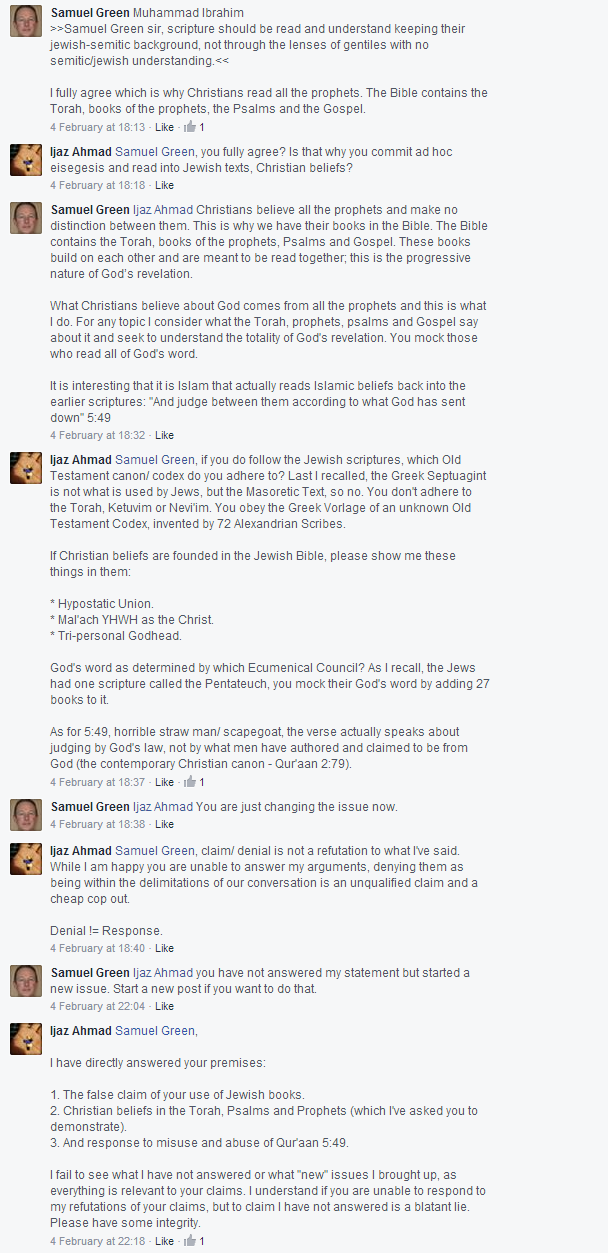
Pastor Green Caught Lying
Pastor Green as seen here is unable to demonstrate evidences for a claim he repeats ad nauseum. The Pastor in his attempts to discredit Islam, claims adherence to the messages of the Jewish Prophets, however, the case which has been made by me is, if he is indeed adhering to their message – where is the evidence for this?
As can clearly be seen, Jewish Orthodox beliefs as rooted in the Torah, Psalms and Prophets do not preach what the heretical and apostate Jewish sect of proto-orthodox Christianity teaches. Therefore, the Torah, Prophets and Psalms are not only in disagreement with Pastor Green’s message, they inadvertently disprove the Christian faith’s claims of beliefs rooted in the Jewish scriptures.
and Allaah knows best.
 Calling Christians
You must be logged in to post a comment.