Tag Archives: Ijaz Ahmad

Tom Holland’s Conversation Regarding the Birmingham Manuscripts

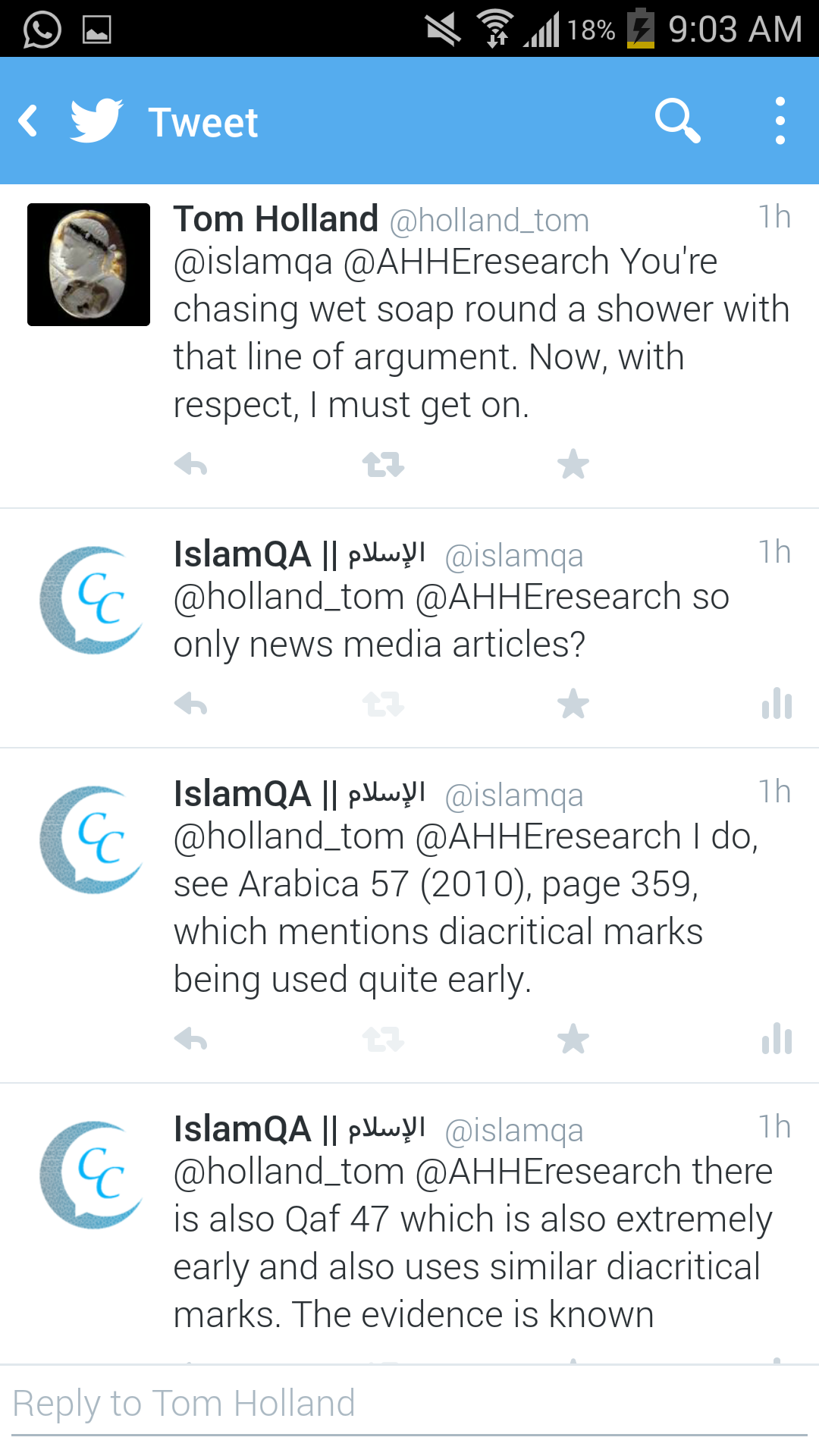
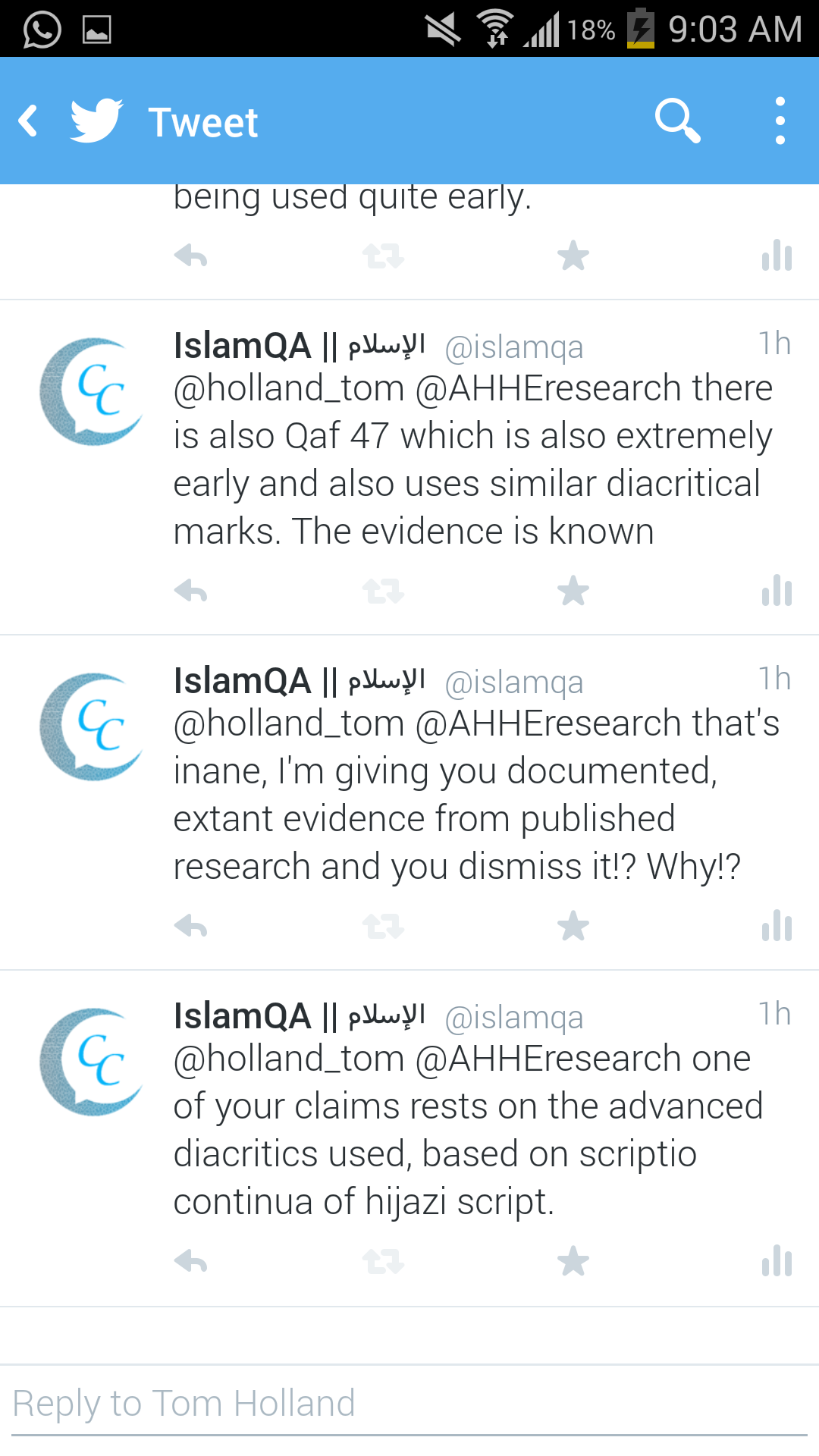
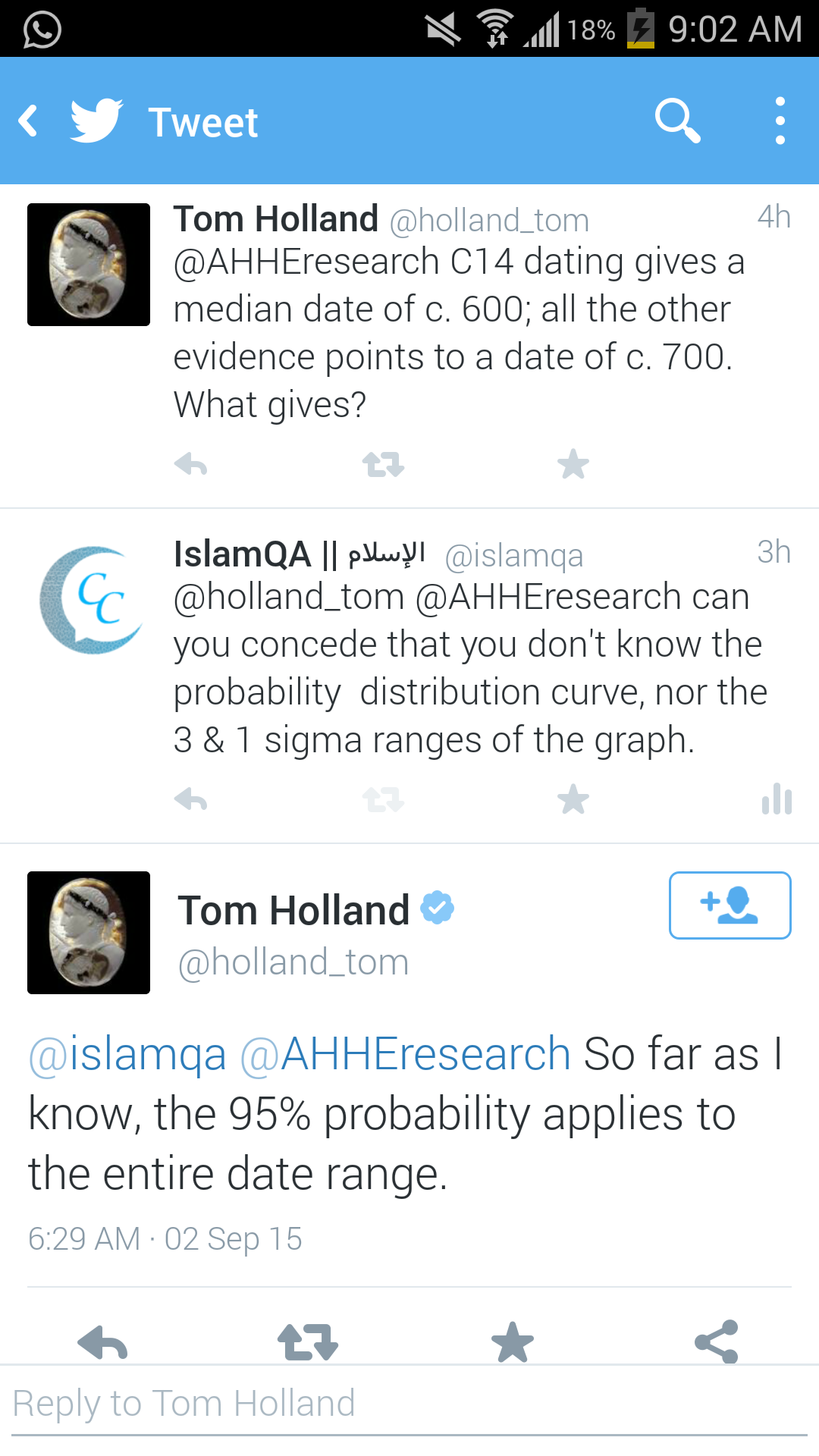
Most people are aware that Tom Holland is a historian, most people are also aware that he is not a palaeographer, nor a papyrologist, nor has he studied Arabic codicology. Therefore, finding him being referenced as an academic source regarding the Birmingham manuscripts was extremely strange. I decided to tweet Tom and get some answers. 
wpid-screenshot_2015-09-02-09-02-25.png

wpid-screenshot_2015-09-02-09-02-33.png

wpid-screenshot_2015-09-02-09-02-40.png

wpid-screenshot_2015-09-02-09-02-49.png

wpid-screenshot_2015-09-02-09-03-00.png

wpid-screenshot_2015-09-02-09-03-08.png

wpid-screenshot_2015-09-02-09-03-17.png

wpid-screenshot_2015-09-02-09-03-24.png

I recognize that some people may not be able to follow the conversation. So here is a simple run down of the conversation:

  • Have you seen the probability distribution curve with any of the sigma ranges? His answer was no, he was not aware of any graph. This is strange because you can only know how the date ranges work if you’ve seen the graph, if you haven’t, then where did he get his “analysis” from?
  • I asked, if he didn’t see the curve, how was he able to give an analysis. His answer was, “(based) on the information Birmingham University have publicly made available”. The problem here is that the only information regarding the dating that they have made publicly available is merely mentioning the date range, no scientific data regarding the analysis of the C14 was made public. In other words, he had no sources and did not consult any scientific data to arrive at his conclusion. I immediately pointed this out to him.
  • I then asked, if not based on actual C14 data, what did he base his analysis on? He proceeded to state, “even on the latest date, the script reflects a sophisticated scribal culture that does not accord with it”. To which I replied that we do have early manuscripts with diacritical markings.
  • He asked me for evidence of this, and so I gave him one citation and before I could proceed, he chose to end the conversation at that point in time.

So what have we learned? Tom Holland is not a specialist in this field. He did not consult any actual data to arrive at his publicly claimed conclusions. He is not aware of how manuscripts are carbon dated, nor is he aware of modern studies on Arabic palaeography and codicology. In other words, his opinion is akin to asking any random person off of the street to give their analysis of highly specialized scientific data.

Interestingly in July of this year, Tom actually held the opposite view, that the manuscripts validated the traditional teaching about its codification:

Tom Holland, the author of “In the Shadow of the Sword,” which charts the origins of Islam, said the discovery in Birmingham bolstered scholarly conclusions that the Quran attained something close to its final form during Muhammad’s lifetime. He said the fragments did not resolve the controversial questions of where, why and how the manuscript was compiled, or how its various suras, or chapters, came to be combined in a single volume. – NYT.

You can read the full conversation on Twitter, here. As we say in cricket, Tom, learn to bat in your own crease.

and God knows best.

Debate Release: What is the True Faith of Jesus’ Disciples – Br. Ijaz vs Rev. Steven Martins

We’re happy to announce that the first debate between myself and Rev. Steven has been published online. The topic, “What is the True Faith of Jesus’ Disciples?,” featured a lot of discussion on the early Christology of the proto-orthodox Christian tradition. There was also discussion on the New Testament manuscript tradition however the Reverend chose not to pursue that course of argument (I had with me several papyrological studies on hand but the debate did not follow that path). The claim that the disciples were eyewitnesses or the authors of the NT textual tradition was deeply discussed and the Reverend makes quite the statement during the debate, “it’s all hypothetical!,” which then led to some even more interesting remarks.

I focused on the chains of transmission as claimed by Church tradition, and examined them in light of the deutero-canonical traditions, the results would surprise many. I also compared and contrasted several “claims” by the early Church fathers as to from whom they took their testimony from about Christ, which led to quite a major contradiction given Papias’ witness. All in all, this was an extremely enjoyable debate and the audio is 100% clear. Again, I’d like to thank Br. Haseeb from IBN for the recording, Br. Asad (of Motorway Hall) and the MYTT for hosting the event, Br. Nazam for stitching the video together and then uploading to his channel, Pastor Kris for moderating the event and especially Rev. Steven for being my gracious interlocutor. The event was extremely well attended and I must thank the community for their participation.

Enjoy the recording!

and Allah knows best.


Missionary Mishap: Missionary Talks to Jesus – Will Help Us Solve the Bible’s Textual Problems

wpid-2015-01-21-19.08.10.png.png

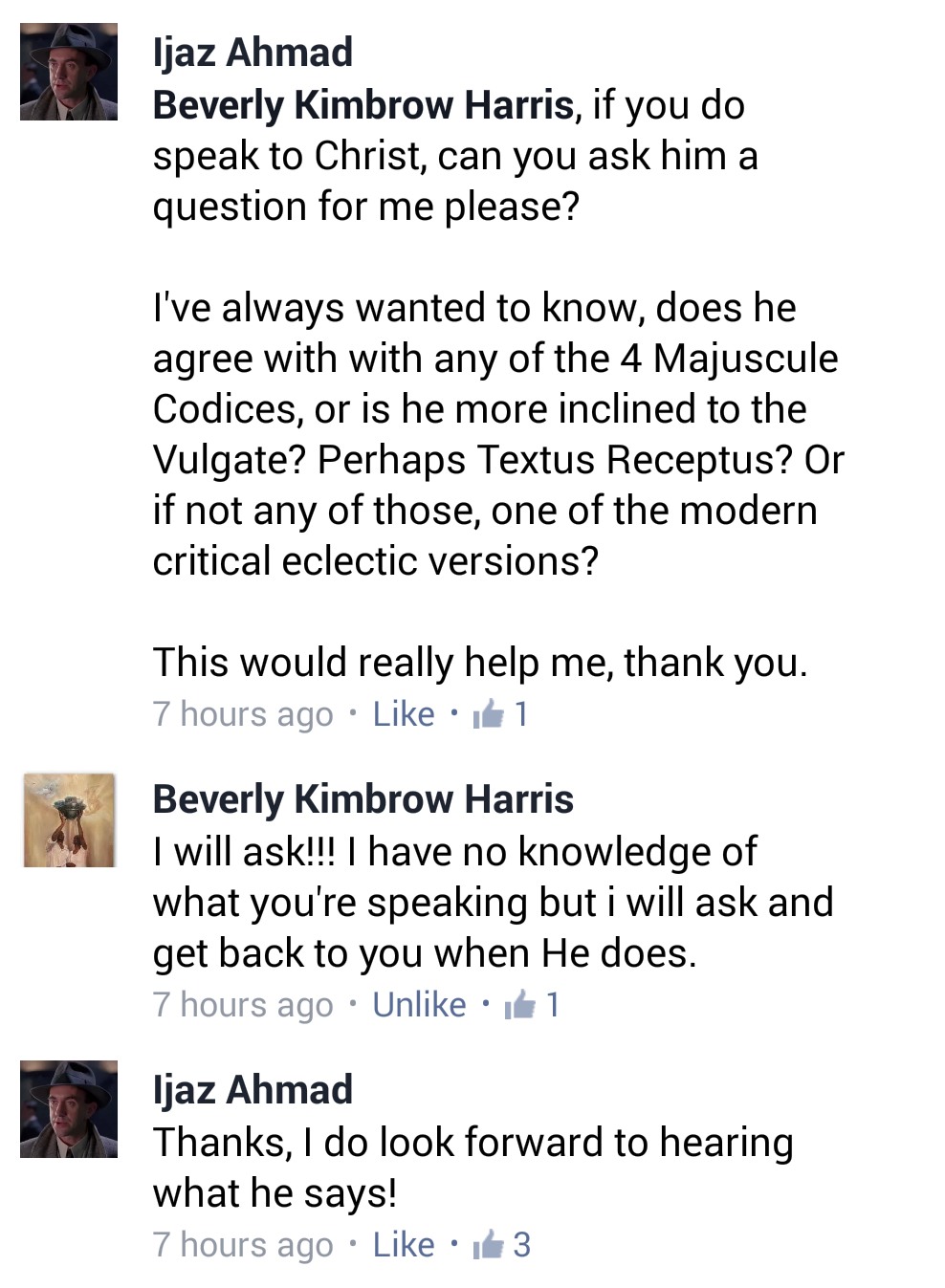
So, I meet this lady who says she talks to Jesus all the time! I decide to ask for her expertise since she has a direct line to the one guy that can help us solve our textual challenges with the New Testament. She says she’ll ask him about it. What are the chances I should expect a reply?

Note: For those pedantic types, I meant the Latin Vulgate and the later “Greek Textus Receptus”. The Latin is not the same as the Greek.

and Allah knows best!

Release: A Critical Analysis of Jay Smith’s Mistakes About the Qur’an [Update]

Update: I have been made aware that some persons are unable to access the paper via Scribd, you can therefore click this link and download the PDF directly: Response to Jay Smith’s Mistakes.

All Praise is due to Allah alone. The paper has undergone some minor changes, which are listed in the paper under the title of, “Structure of the Paper”. A formatting error for some headers were corrected, especially for Appendix B.

and Allah knows best.

Originally Published: 12/11/14, 6:46 a.m.

Review: Ehrman Blog

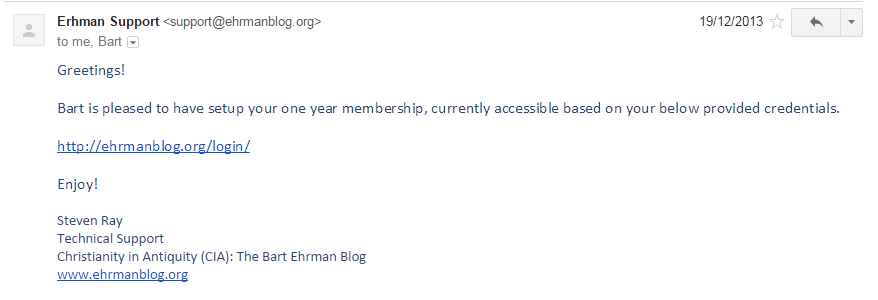
Last year, I had the fortune of being gifted by Dr. Ehrman, a free 1 year subscription to his blog. After spending 11 months on the blog, I think it’s time to give my experience and thoughts on it.

cc-2014-ehrmanblog


Dr. Ehrman’s blog focuses on Christianity in Antiquity, specifically New Testament Textual Criticism, early Christian doctrines, and he often comments on Christianity in pop culture, whether that be any new manuscript finds or the yearly Jesus had a wife claim. This treasure chest of content is simply spectacular. I particularly enjoyed his re-posting of his debates and his added commentary on them, the extra information provided is not only insightful, it’s added value to an already informative and extensive array of debates. Articles are posted often, very often. Some may be short, but a vast majority of his posts are expository in nature, in which he spares no expense in enlightening the reader. They’re just the right size to keep someone interested, but not long enough to be seen as tedious.

One of the greater benefits of the blog, is the ability to discuss, disagree and even argue with Dr. Ehrman! He replies to most comments and entertains disagreements, which has proven to be quite a valuable experience to have witnessed. Although his schedule is quite busy, for a person interested in New Testament Textual Criticism, he spends a lot of time explaining his yearly schedule, his research methodology, the criticisms leveled against his conclusions, and so, this allows someone new to the field or just interested in it, to develop a holistic understanding of his works. This is as opposed to merely labeling him an anti-Christ liberal as many of our evangelical inerrantist colleagues do, thus discarding his research as propaganda.

The monetary cost to access the website is very minimal, please note all costs listed below are subject to change on the website and are valid as of 16.11.14, the currency in use is USD:

  • $3.95/month for trial membership;
  • $7.95 for three months;
  • $24.95 for a year.

So, is it worth it? For the Muslim lay man, it probably is if you’re super interested in the field but if you’re just dipping your toes into da’wah, then I can’t see it being too useful. For someone who’s read most of his works and interested in his views, his research and his methodology, then I think it’s a minimal expense that would benefit you greatly. As for myself, I was very grateful for the opportunity afforded to me by Dr. Ehrman and I definitely do believe I’ll be taking a full year’s membership.

and God knows best.

Facebook Milestone Reached!

الحمد لله,

As we dawn upon the 3rd anniversary of this website, I’m proud to announce that today we’ve reached a fantastic Facebook Milestone. We now have 7000+ likes! Through Facebook, our articles have reached many thousands of people on a monthly basis. It’s no easy feat to gather 7000 likes, especially for a website as small and unknown as ours. We’ve spent exactly $0 on advertising on Facebook and have gained these likes organically. I’d like to take this opportunity to thank all of those who have supported this website, whether it is liking an article, sharing a post or reading our research, your support has been simply amazing! If you haven’t liked us on Facebook as yet, click here to do so. On a regular basis exclusive content is posted to our Facebook page, so if you haven’t been following us for sometime, take this opportunity to do so and be kept in the loop on the latest inter-faith dialogue scene!
cc-2014-fb7000


and Allah knows best.

Samuel Green Changes Views on the Bible

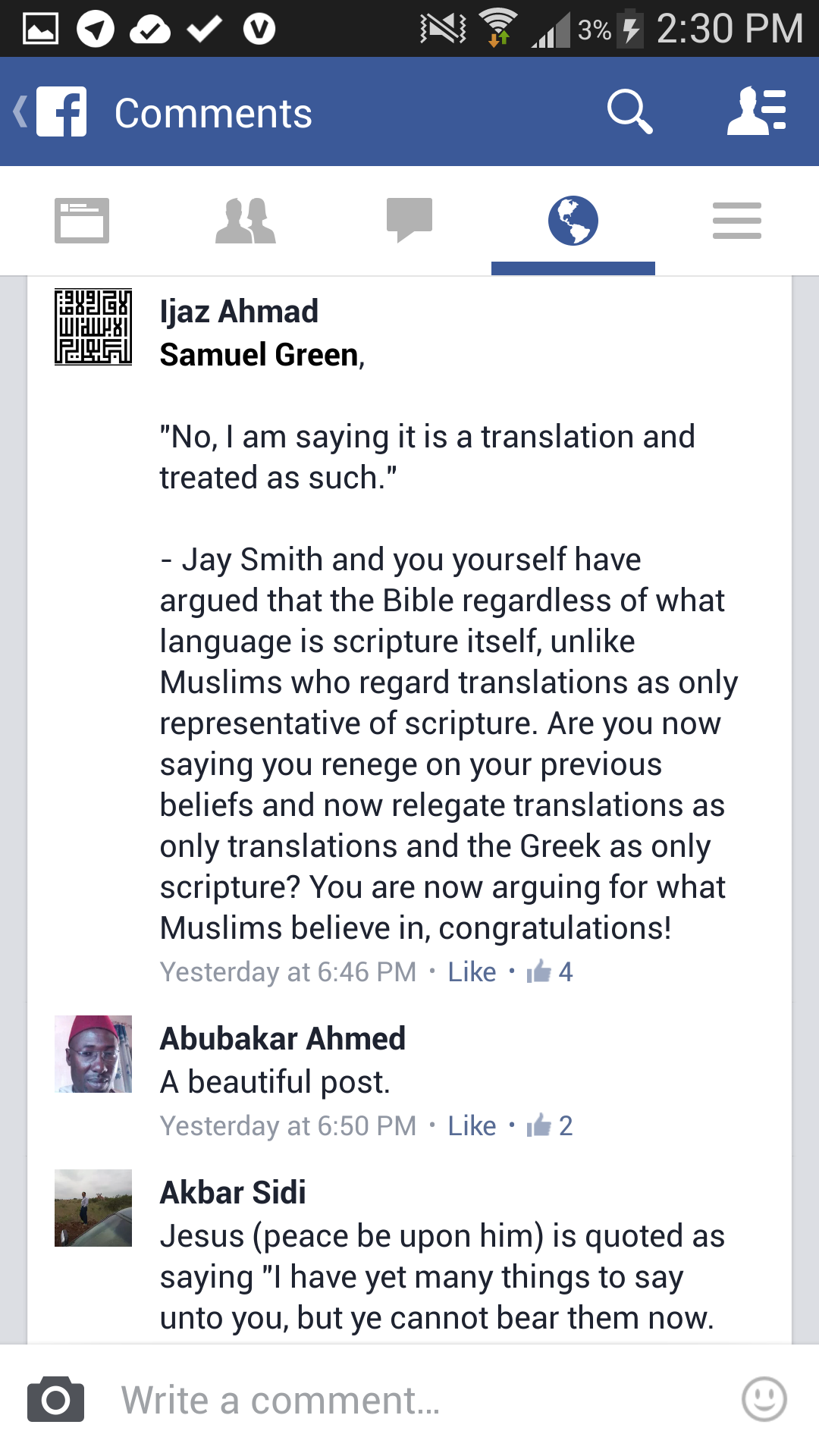
Muslims have always been clear on the status of the Qur’an and Qur’anic translations. The Qur’an is scripture only in the Arabic language, translations of the Qur’an into other languages are only representations of the Qur’an, they are representations of scripture but not scripture in and of themselves. As such, a Muslim’s salaah or prayer is only valid if one recites the Qur’an in Arabic, the original language in which it was revealed. A Muslim fully understands that the English translation of the Qur’an can be wrong, as a translation depends on the understanding of the translator. Therefore, a translation is representative of someone’s understanding of the Qur’an from its original language to a different language. Whereas the Qur’an itself in Arabic is as God has revealed it. This is why, when missionaries criticise the Qur’an, they immediately go to the English translation which best suits their understanding as opposed to the primary text of the Qur’an in Arabic. Christians have boasted that the Bible is a scripture regardless of what language it is in. The New Testament originally written in Greek, is equally scripture alongside an English or Chinese translation. Whereas, for a Muslim, the Qur’an in Arabic is scripture and the Qur’an in English is a representation or interpretation of the scripture, they are not equal.

This however, may no longer be the case with Pastor Samuel Green. Posed with a question concerning a Syriac version of the New Testament, instead of defending it as scripture, he discarded the Syriac version as merely a translation which is not the same as the original. Pastor Samuel, has indeed now accepted the Muslim belief that only the original is scripture and the translation is not! I was very surprised to see him using this view, knowing that I have never heard him say this before.

wpid-screenshot_2014-11-10-14-30-32.png

wpid-screenshot_2014-11-10-14-30-42.png

wpid-screenshot_2014-11-10-14-30-49.png

wpid-screenshot_2014-11-10-14-30-56.png

For once, we Muslims can agree with the Pastor. Translations should be treated as translations and scripture treated as scripture!

and Allah knows best!


Samuel Green’s Angry

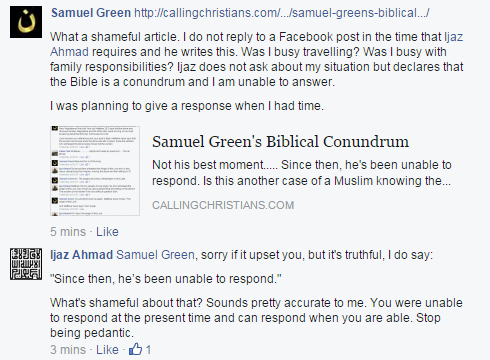
Seems like Samuel Green’s angry at me for the article published yesterday. When he saw it, he posted this comment:

cc-2014-angrygreen

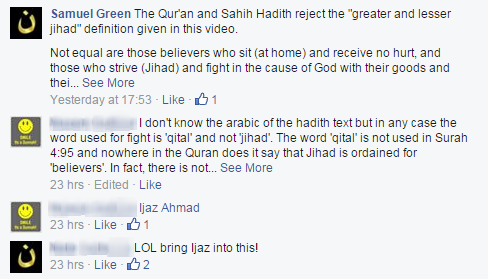
I mean, that excuse would work, but yesterday he was involved in another conversation with me (names blurred out for privacy):

cc-2014-angrygreen2

So his excuse is that he was too busy to respond, but ends up in a lengthy discussion with me and others the very same day that he alleges he was busy on? I chose to confront him on that, how could you be too busy  yesterday to respond if you were also arguing with me yesterday?

cc-2014-angrygreen1


After being caught out, he decided to call me a slanderer. Although I’m not sure if he knows what that word means. I said he was unable to respond, he says he was also unable to respond. So I’m not sure where the slander is. This is like the time he got angry at me for asking him to qualify one of his claims, he promised to respond to me, and almost a year later he hasn’t. Will he remember to respond this time, or is he going to repeat his lack of finishing discussions when he’s caught out? You’re better than that Samuel, cheer up mate!

and God knows best.


« Older Entries Recent Entries »