Morris Sadek: Missing in Action

Bismillahir Rahmanir Raheem
بِسۡمِ ٱللهِ ٱلرَّحۡمَـٰنِ ٱلرَّحِيمِ ,

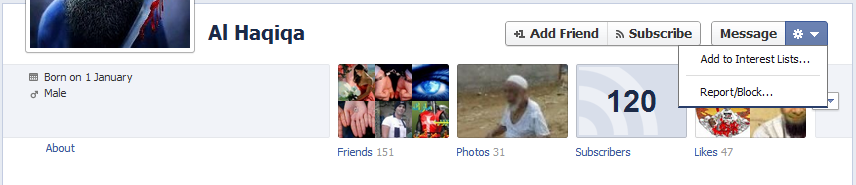
After breaking the news about Morris Sadek’s perverted videos earlier today, following the tragic attacks on the American envoy in Libya, it seems as if our efforts have paid off. Morris still had his Facebook page, other Facebook alias “Haqiqa” and his Facebook group (with insulting images) operational as of this morning (12/09/2012), however a routine check later todaytoday surprised us as it seems Morris has now retracted on his ‘brazen attack against Islam‘. Meaning then, his page for the most part, has gone off line:

Even though Morris has demonized Islam, mocked Islam, cursed Islam and worked on a $5 Million dollar film (of 13 minutes long) to abuse Islam, we still pray and hope for his safety. We understand that via his group on Facebook he has been promoting these anti-Islamic ideas for a number of years, he touts himself as a ‘defender of human rights’. It seems today his luck has run out and his insults took on more weight than he expected. Whatever the case may be, after posting his Facebook details and contact information (via Youtube), his page now seems to be offline, although his other account “Haqiqqa” is still active! All journalists who would like to contact him, may do so until he pulls that one offline as well!

wa Allaahu Alam,
and God knows best.

The Muslim Response to Libyan Deaths About Anti-Islamic Video

Bismillahir Rahmanir Raheem
بِسۡمِ ٱللهِ ٱلرَّحۡمَـٰنِ ٱلرَّحِيمِ ,

Shaykh Yasir Qadhi had this to say via his Facebook Page:

Clerics and leaders who instigate Muslims to ‘defend the honor of the Prophet (saw)’ by attacking people who have nothing to do with insulting his honor, actually disrespect the memory of our Prophet (saw).

Yes, the movie was disgusting, but I’m sure the happiest person today is the person who made it, because his goal of smearing the Muslims has succeeded.

For how long will we tolerate such stupidity?

I strong encourage everyone to read what Ustadh Abu Eesa has written about this:
http://www.1stethical.com/2012/09/12/forget-about-not-in-my-name-but-think-of-your-own-name/

Ustadh Abu Eesa’s article can be read here, although you can still read what he had to say below:

Although contrary to popular belief, it isn’t through some incredible display of patience, forgiveness or even ambivalence that the majority of us in the West don’t respond with anger to inflammatory and abusive attacks via media/video/cartoons/whatever upon the Prophet Muhammad (upon whom be peace).

It’s actually because we just don’t find out about these things (I spend half my day reading about news and topical issues and I never heard a whisper about any video) due to the fact that they are often the work of a tiny number of sick bigots who most people utterly ignore. And why wouldn’t we ignore them? We’re talking about comparing mighty Prophets and irritating bugs. “The mountains are never shaken by the wind,” especially when it comes out of the backsides of such racist, xenophobic individuals. That was, until, you turn on the news channels to see Muslims in their own countries perhaps not feeling the same way about their own “mountains” of faith and belief, which seem to be rocked to the core every time a non-Muslim opens his or her mouth.

The Prophets of God particularly Muhammad and Jesus (may peace be upon them) have always been under a continual barrage of attacks and insults from the beginning of them being sent to mankind, to especially such times as now where the world operates on new levels with respect to “free speech”. Such insults are part and parcel of the price we pay in living in such democracies, and no we’re not happy about it but we certainly cannot accept the outrageous actions of those who would respond with wanton violence and murder against those who are utterly innocent or indeed those who are living under the protection of the Muslims regardless of their own personal and political beliefs.

Let me be clear: I do not condemn the atrocities such as the murder of the American Ambassador to Libya so that it makes the lives of Muslims in the West that bit easier, and to avoid revenge attacks on us or because it is the politically correct thing to do. No, absolutely not.

I condemn it because the religion of Islam doesn’t allow such an action. Common sense and a call to revise sensibilities clearly have failed with such people. So we have to focus on the only thing that might speak out to them: their religion. These militiamen have not just insulted themselves, but they’ve insulted their Prophet, the same Prophet who stated authentically and unequivocally,“Whoever kills a person who is granted protection by the Muslims shall not smell the fragrance of Paradise even though its fragrance can be smelt from a distance of forty years of travelling.”

In another narration the Prophet Muhammad (upon whom be peace) authentically stated that the Muslim who killed such a person had “betrayed God’s covenant” i.e. that he had broken his covenant and committed treason.

Let there be no doubt whatsoever in any Muslim’s mind: a non-Muslim entering upon a visa is under the protection of the Muslims, by Islamic law, by state law, and by international law. Indeed even a person residing under the country without a visa and simply believing that he is as protected as any other citizen would be, is under that same legal protection. And as for a member of a diplomatic corps? These individuals are afforded the very highest level of protection, security and guarantee from the Muslims. An attack on such embassy and diplomatic staff is completely and utterly prohibited.

It is embarrassing for me to have to write such a childishly obvious statement when it comes to murder but these are the times we live in. It is even more unbelievable that any practising Muslimshould not reflect on this before they act on their anger. Yet with the amount of ignorance we see these days from “practising” Muslims, we are sadly no longer shocked to read the sad headlines as we are seeing today of more destruction, murder and chaos all on Islam’s tab.

Forget the PR reasons. Forget the PC reasons. Forget common sense. Forget the fact that Muslims are now seen internationally to be as pathetic as the ignorant racist bigots who initiate such situations – actually, more pathetic. Forget the fact that the Muslims live 2nd rate lives in their own countries. Forget the other priorities.

Just don’t forget this: these responses of violence and chaos have nothing to do with Islam and for that, shame upon you for trying to claim it as such. May God forgive you. To any non-Muslims reading this, please forgive us for the actions of the murderers for they indeed know not.

Similar sentiments have been expressed by Br. Ibn Percy in his article here.Please share this article with your friends, whether Muslim or non-Muslim to demonstrate that we as Muslims wholly condemn the murder of any innocent persons and such actions are far removed from the religion of Islam. Today a demonstration in Libya was held against the killings:


You can view the many images here via the group’s Facebook page.

wa Allaahu Alam,
and Allaah knows best.

[Updated] Huffington Post: Morris Sadek’s Video Made by Israeli – American, Jew: Sam Bacile

Bismillahir Rahmanir Raheem
بِسۡمِ ٱللهِ ٱلرَّحۡمَـٰنِ ٱلرَّحِيمِ ,

[UPDATED: x4]: New information from various news sources seem to indicate that Sam’s identity is most likely fraudulent. Why someone would be making such crazy accusations on such an internationally sensitive issue is beyond me. See CBS News’The Atlantic News’ and Entertainment Weekly’s latest reports on the newest developments.

[UPDATED: x3]: Sam Bacile continues to be pin pointed as the main culprit behind sparking the violence, see NBC News. Egypt’s government has aimed to take legal action against the film, see Reuters. Afghanistan has banned Youtube, temporarily because the film is now being downloaded and uploaded back to the website, see The Australian News. The Global Post has an insightful article, documenting the condemnation of the attacks by the Libyan and Egyptian people, the attacks are being blamed on a fringe of extremist groups.

[UPDATED: x2]: Sam Bacile continues to be pin pointed as the main culprit behind sparking the violence, see NBC News. Egypt’s government has aimed to take legal action against the film, see Reuters. Afghanistan has banned Youtube, temporarily because the film is now being downloaded and uploaded back to the website, see The Australian News. The Global Post has an insightful article, documenting the condemnation of the attacks by the Libyan and Egyptian people, the attacks are being blamed on a fringe of extremist groups.

[UPDATED]: Various scholars, lecturers and Islamic personalities have come out in condemnation of the killings and violent protests. You can read their statements here.

Following our report on Morris Sadek (located here) and our call to action for the video to be removed (located here), new information has arisen that Sam Bacile, an Israeli – American colluded with Morris Sadek to have the video made. The report from the Huffington Post states:

Speaking by phone Tuesday from an undisclosed location, writer and director Sam Bacile remained defiant, saying Islam is a cancer and that the 56-year-old intended his film to be a provocative political statement condemning the religion.

“This is a political movie,” said Bacile. “The U.S. lost a lot of money and a lot of people in wars in Iraq and Afghanistan, but we’re fighting with ideas.”

Bacile, a California real estate developer who identifies himself as an Israeli Jew, said he believes the movie will help his native land by exposing Islam’s flaws to the world.

“Islam is a cancer, period,” he said repeatedly, his solemn voice thickly accented.

The two-hour movie, “Innocence of Muslims,” cost $5 million to make and was financed with the help of more than 100 Jewish donors, said Bacile, who wrote and directed it.

You can read the full article on Sam Bacile, the anti-Muslim, American Jew, here. The video is still up on his channel and can be reported by following these steps for removal:

1. Click this link to report the page.

2. Follow step 2 from our earlier tutorial.

3. Replace http://www.youtube.com/user/haqiqa111  with http://www.youtube.com/channel/UC4DjVszAn4GAyzgsjtkJONg

4. Follow step 4 from our earlier tutorial,by clicking any 5 videos you wish to report (more specifically, the two trailers about the movie would be best).

5. Scroll down after the videos and you’d see the option to “Block User“, this is optional and up to you. Under that you will see “Additional Notes*“, copy and paste the following text into that box:

Hate speech that has caused international protests and 4 deaths thus far. Condemned by Coptic and Muslim organizations worldwide and also by the Secretary of State, Hilary Clinton:

http://worldnews.nbcnews.com/_news/2012/09/11/13807579-american-killed-in-libya-during-protests-about-prophet-muhammad-video#.UFAgo4vIgT8.twitter

http://www.huffingtonpost.com/2012/09/12/sam-bacile-in-hiding_n_1876044.html

Finally, press “Submit” and you’re done!

wa Allaahu Alam,
and God knows best.

[Live Updates: x3] A Call to Action: Morris Sadek’s/ Sam Bacile’s Hate Videos + Facebook Pages!

Bismillahir Rahmanir Raheem
بِسۡمِ ٱللهِ ٱلرَّحۡمَـٰنِ ٱلرَّحِيمِ ,

[UPDATED: x4]: New information from various news sources seem to indicate that Sam’s identity is most likely fraudulent. Why someone would be making such crazy accusations on such an internationally sensitive issue is beyond me. See CBS News’, The Atlantic News’ and Entertainment Weekly’s latest reports on the newest developments.

[UPDATED: x3]: Sam Bacile continues to be pin pointed as the main culprit behind sparking the violence, see NBC News. Egypt’s government has aimed to take legal action against the film, see Reuters. Afghanistan has banned Youtube, temporarily because the film is now being downloaded and uploaded back to the website, see The Australian News. The Global Post has an insightful article, documenting the condemnation of the attacks by the Libyan and Egyptian people, the attacks are being blamed on a fringe of extremist groups.

[UPDATED: x2]: Various scholars, lecturers and Islamic personalities have come out in condemnation of the killings and violent protests. You can read their statements here.

[UPDATED]: New information released, indicates that the film was produced and directed by Sam Bacile, an Israeli – American Jew, who was funded by 100 Jewish supporters. The Huffington Post has released an article detailing an interview with Sam Bacile. You can read about it via our website as well in this article. The video can still be seen on his Youtube channel. The steps to report that video have been added to this post.

Help us remove the hateful, Islamophobic videos that Egyptian Christian (expat), Morris Sadek has posted to Youtube, as well as his Facebook group and two Facebook profiles which he uses to mock and attack Islam. If you do not know who Morris Sadek is or what he has done, please visit this link. Morris Sadek has invited international condemnation from Muslims, the Coptic Church, Coptic Expat Organizations and by Hilary Clinton (US Secretary of State), you can visit this link for more information (NBC NEWS) or this link as well (BBC NEWS). The actual video has been removed from his Youtube channel, however equally as disturbing and insulting videos, remain on his channel and have been there for almost a year! His Youtube channel’s link is given below.

YOUTUBE:

You can report the videos on Youtube by clicking this link and by using the following instructions (click ANY image for a clearer picture):

1. You will be taken to this page by clicking the above link, you will check the box which says, “Hate Speech Against a Protected Group“.

2. The following list will appear on the screen, where you will check the box which says, “Religious Affiliation (examples: Muslims, Christians)“.

3. The following message will appear on the screen, automatically you should see this link:

 http://www.youtube.com/user/haqiqa111 

If you don’t see that link, you may copy and paste it.

Click “continue“.

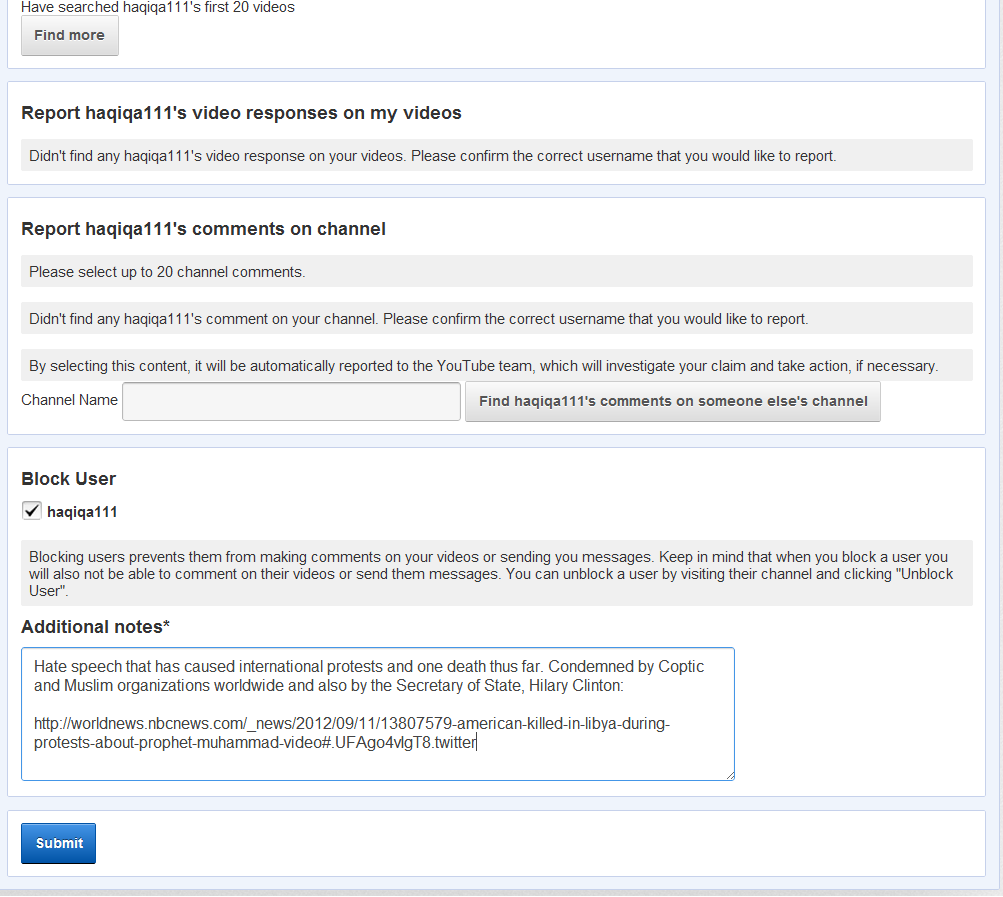
4. This long list of options will come up, but all you have to do is scroll down until you see, “Report haqiqa111’s Videos“. Then check the boxes of the videos you’d like to report (any 5 will do, for demonstration sake, we’ve checked the first 5 videos).

5. Scroll down after the videos and you’d see the option to “Block User“, this is optional and up to you. Under that you will see “Additional Notes*“, copy and paste the following text into that box:

Hate speech that has caused international protests and one death thus far. Condemned by Coptic and Muslim organizations worldwide and also by the Secretary of State, Hilary Clinton:

http://worldnews.nbcnews.com/_news/2012/09/11/13807579-american-killed-in-libya-during-protests-about-prophet-muhammad-video#.UFAgo4vIgT8.twitter

Finally, press “Submit” and you’re done!

FACEBOOK:

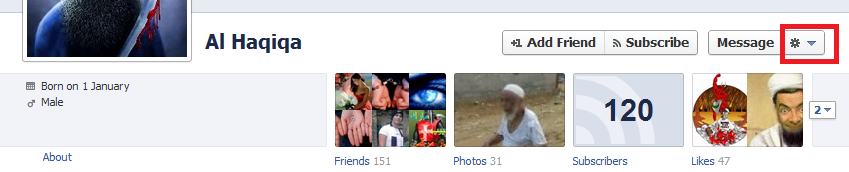
Go to this link and his profile page will load.

1. In the top right corner you’ll see this gear (see inside the red box), click it:

2. Once clicked, this little menu will appear on your screen. Select, “Report/ Block“:

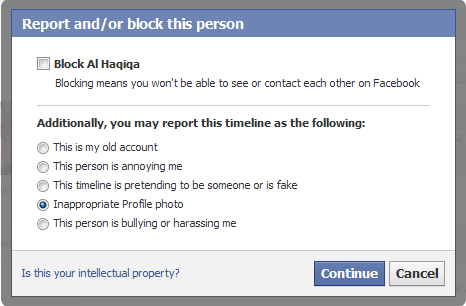
3. Another screen will appear, select, “Inappropriate Profile Photo“. Then click, “Continue“.

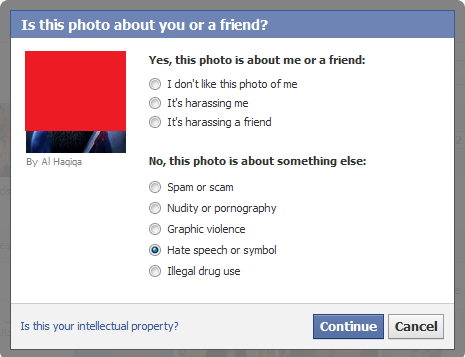
4. Another screen will appear, select, “Hate Speech or Symbol“. Then click, “Continue“.

5. Another screen will appear, select, “Report to Facebook“. Then click, “Continue“.

6. Lastly, you’ll get this confirmation page, click, “OK” and you’re done!

That’s all for now! If you’ve reached this far, Allhamdulillah that this person’s attacks have disturbed you (and rightly so) to the point you’ve finished these long steps to have them removed. May Allaah guide him and may Allaah allow reward all those who participated in reporting against this man’s evil actions.

Note: Calling Christians does not endorse the violent protests or killings as a result of these hate videos. Our response has been to respectfully apply for the removal of the videos, hence our above tutorial.

wa Allaahu Alam,
and Allaah knows best!

Riots Over Video About Muhammad [saws]

Bismillahir Rahmanir Raheem
بِسۡمِ ٱللهِ ٱلرَّحۡمَـٰنِ ٱلرَّحِيمِ ,

The man in this photo is Morris Sadek, you can visit his personal Facebook profile here. He’s been making the news (see here) for a recent video in which it is said:

The video, clips of which are online, shows a portrayal of the prophet having sex and calling for massacres, the AP reported.

Protests have broken out in Egypt and Libya, I expect further protests worldwide as well. We may see Afghanistan and Pakistan erupt in protests as is what occurred when Terry Jones attacked the Qur’an. I want you to look at the photo of this uneducated coward and remember it. He hides behind his computer and produces videos insulting Muhammad [saws], in several of his poorly produced videos, he portrays the mercy of mankind as an uneducated caveman! News of his videos seems to have only come about recently as other videos, with far worse hate propaganda seem to go back atleast a year. So desperate was this man to insult Muhammad [saws] that he even became allies with hate Pastor, Terry Jones:


So horrible are his videos that even the Coptic Church has condemned them:

An Egyptian state website carried a statement by Egypt’s Coptic Orthodox church condemning what it said were moves by some Christian Copts living abroad “to finance the production of a film insulting Prophet Mohammad.”

Medhat Klada, a representative of Coptic Christian organizations in Europe, said Sadek’s views are not representative of expatriate Copts.

“He is an extremist … We don’t go down this road. He has incited the people (in Egypt) against Copts,” he said, speaking from Switzerland. “We refuse any attacks on religions because of a moral position.”

This is the state of Christianity today, they have to stoop low, they cannot engage in dialogue any longer. All they know to do now is hate Islam and Muslims and this is a product of their archaic, barbaric ideology. He also happens to run a Facebook group which contains cartoons of bearded men having intercourse with goats and other animals. There were many other pictures with insults to Islam, calls to fight Muslims and other forms of hate speech and propaganda. We hope that justice is served and that the videos are removed.

wa Allaahu Alam,
and Allaah knows best!


9/11: 11 Years Later

Bismillahir Rahmanir Raheem
بِسۡمِ ٱللهِ ٱلرَّحۡمَـٰنِ ٱلرَّحِيمِ ,

Note: This is an opinion piece by Br. Ijaz Ahmad and is not intended to represent the views of Calling Christians.

Today marks eleven years since the 9/11 terror attacks and what a turbulent eleven years its been. Before we get into the heat of things, I’d like to say that the 9/11 terror attacks was an attack on persons of all creeds, races and religions. The WTC had no specific religion, or race, the compounds attacked contained a plethora of persons, including Muslims. This attack should not be labelled, an American tragedy, a Christian tragedy, a Republican tragedy, but it should be labelled as a global tragedy. The whole world to this day, continues to feel the ramifications, the consequences of that ghastly event. Of the 2, 753 victims, let’s remind our right wing friends of the Muslims who also perished on that day:

Many seem to think that this was an attack by the Muslim world on the Western world, more so on America. The problem is that whether you believe that 19 Muslim men could orchestrate such a sophisticated attack despite the FBI and CIA, both knowing and tracking such persons, is beside the point. Or the fact that the 9/11 commission was fixed and great amounts of information was not taken into consideration, but ignored and discarded, thus creating the wrong conclusion as indicated by Senator John Farmer, see – [1], [2], is also not the crux of the issue. The real problem rests on blaming more than 1 Billion persons for the acts of 19 men. The American government has made this mistake before, directly after the Pearl Harbour attack (of which controversy also surrounds, see [1], [2], [3]), Japanese citizens were rounded up and placed in concentration camps, see – [1], [2], [3]. Yet, what did those Japanese citizens ever do to be put in concentration camps? The Nazis were clearly not the only ones who thought that camps were needed. So vindictive was the American government that they even bombed civilian populations to the extent that there were 275, 000 causalities (deaths and injuries, see [1]). This pattern has re-emerged with devastating effects. As a cause of 9/11, the American government has since contributed to or directly caused the following:

  • An illegal invasion and occupation of Afghanistan, see –  [1], [2], [3].
  • An illegal invasion and occupation of Iraq, see – [1], [2], [3], [4].
  • Initiated a proxy war by drones in Pakistan, see – [1], [2], [3], [4], [5].
  • Initiated a proxy war by drones in Afghanistan, see [1], [2], [3].
  • Bombed civilian populations in Afghanistan, see [1], [2], [3], [4].
  • Bombed civilian populations in Iraq, see – [1], [2], [3], [4].
  • Bombed civilian populations in Pakistan , see – [1], [2], [3].
  • Bombed civilian populations in Libya, see – [1], [2], [3], [4].
  • Armed unstable non-FSA rebels in Syria, see – [1], [2], [3], [4].
  • Provided military aid which resulted in the siege of Gaza, see – [1], [2], [3], [4].
  • Provided military aid which resulted in the murder of 1, 600 Palestinians, see – [1], [2], [3], [4].
  • Provided military aid which resulted in the Georgia – Russian war, see – [1], [2], [3], [4].
  • Enabled the Patriot Act to spy on citizens, see – [1], [2], [3], [4].
  • Illegally detained and tortured persons without any reason, see – [1], [2], [3], [4].
  • Waterboarded unarmed civilians, see – [1], [2], [3], [4].
  • Kidnapped unarmed civilians, see – [1], [2], [3], [4].
  • Murdered US citizens (a Father and Son), see – [1], [2], [3], [4].
  • Provided Hosni Mubarak with aid, used against his own populace, see – [1], [2], [3], [4].
  • Contracted mass murder squads in Iraq, see – [1], [2], [3], [4].
  • Contracted mass murder squads in Pakistan, see – [1], [2], [3], [4].
  • Illegally murdered Saddam Hussein, see – [1], [2], [3], [4].
  • Attempted to control the internet via SOPA and PIPA, see – [1], [2], [3], [4].
  • Sunk into $16.02 Trillion Dollars in National Debt, see – [1], [2], [3].
  • Almost defaulted the American economy, see – [1], [2], [3].
  • Greatest financial crisis since the Great Depression, see – [1], [2], [3].
  • Installed puppet leaders in Afghanistan who embezzled millions, if not billions, see – [1], [2], [3], [4].
  • Installed puppet leaders in Iraq who embezzled millions, if not billions, see – [1][2], [3][4].

Just as how the Japanese were stigmatized for something they themselves had not done, so are Muslims in America being targeted – see [1], [2], [3], [4], [5]. The stigma even extends to children, see – [1] and Sikhs (because they wear turbans as Muslims do), see – [1]. Suddenly building a Masjid (the Muslim place of worship) is seen as a threat, see – [1], [2], although the threat’s non-existent, see – [1]. Being a Muslim politician is suddenly wrong, see – [1], and speaking out against governmental abuse gets you detained, see – [1]. Millions have died in Iraq and Afghanistan, see – [1], due to Bush’s ‘Crusade’, see – [1], even troops were supplied with Bible verses on their guns, see – [1], Bibles were even handed out by troops, see – [1]. Is this a war on terror or a war of terror? How can you continue to kill millions of Muslims in revenge for something they did not do? It’s time to wake up and understand, this isn’t a war on terrorism but a war on freedom. Whether you’re American, Arab or otherwise, we must not let the acts of a few irrational hegemonic politicians deter us from attempting to build bonds and heal. I say enough is enough, too much blood has been spilt, terrorists may have done one 9/11, but American/ NATO troops have mimicked and multiplied that figure far beyond our wildest fears.

wa Allaahu Alam,
and Allaah knows best.


The Obvious Theological Biases driving Gospel of Mark!

Exposing the concerted motives behind the two endings of the gospel 

Question Mark

Introduction 

The Gospel of Mark is purportedly the oldest gospel now present in the New Testament. On one hand where it enjoys the antiquity, on other hand, it intrigues Bible students too! In this paper we are concerned with one such perplexing issue related with the gospel and a fundamental Christian doctrine.

Gospel of Mark, unlike any other gospel, has two endings to it – as weird as it sounds – in one version it ends at Chapter 16, Verse 8, however, in another version it continues thereafter to end at verse 20. Various Bibles now in print often provide both the endings with sufficient notifications on the issue. For instance, The Good News Edition marginalizes/brackets verses 9 through 20 which we would be referring to as extraneous-verses throughout this paper.

Christians generally explain the matter as manuscript differences. However, is the issue so straight forward? When we tried to look into the matter a little closely, it turned out to be that it was not merely an issue of manuscripts! There were ponderous, controversial doctrinal issues hovering around the two narratives. Thus, in this paper we would address the objectives behind otherwise innocent looking two endings of Mark’s gospel(s) (1.).


The two endings


In this section we would briefly paraphrase the two endings which we have in gospel of Mark today.


Longer/Extraneous ending (Mark 16:9-20)

In this version, Jesus (peace be upon him) appears to his disciples after his alleged resurrection from death and commands them various things:


After Jesus rose from death early on Sunday, he appeared first to Mary Magdalene, from whom he had driven out seven demons. She went and told his companions. They were mourning and crying; and when they heard her say that Jesus was alive and that she had seen him, they did not believe her. After this, Jesus appeared in a different manner to two of them while they were on their way to the country. They returned and told the others, but these would not believe it. (Mark 16: 9-13)


For various passionate Christians this ending of the gospel is very sensational since in this account, upon (alleged) resurrection, Jesus (peace be upon him) appears and informs his disciples that they would be able to achieve extraordinary feats:


“Last of all, Jesus appeared to the eleven disciples as they were eating. He scolded them, because they did not have faith and because they were too stubborn to believe those who had seen him alive.

Believers will be given the power to perform miracles: they will drive out demons in my name; they will speak in strange tongues; if they pick up snakes or drink any poison, they will not be harmed; they will place their hands on sick people, and these will get well.” (Mark 16: 14, 17-18)


[Friendly Appeal: We strongly request our “believing” friends at ‘answering-islam’ not to try handling vipers or drink the venom of rattlers.]


After addressing the disciples thereafter, Jesus (peace be upon him) is portrayed to have been lifted to the heaven:


After the Lord Jesus had talked with them, he was taken up to heaven and sat at the right side of God. The disciples went and preached everywhere, and the Lord worked with them and proved that their preaching was true by the miracles that were performed. (Mark 16: 19-20)

Here the longer version ends. So this longer version, in general terms, is more or less similar to the other gospel accounts except the sensational blessings for the believers. So far so good!


Shorter ending (Mark 16:1-8)

In the shorter version of the gospel however, Jesus’ (peace be upon him) female disciples, who also served him as his masseuse on occasions, from Galilee and Bethany hurries to the tomb on early Sunday morning to massage Jesus’ (peace be upon him) alleged corpse once again.


However, upon visiting the tomb, abnormally, they find a man already present inside it; although the tomb was sealed by a massive stone!


This mysterious man informs them that Jesus (peace be upon him) is no more in the tomb since he has been raised. He also commanded them to inform to other apostles especially Peter that, as planned, Jesus (peace be upon him) has been raised from the tomb:


Very early on Sunday morning, at sunrise, they went to the tomb. On the way they said to one another, “Who will roll away the stone for us from the entrance to the tomb?” (It was a very large stone.) Then they looked up and saw that the stone had already been rolled back. (SEE 16:3) So they entered the tomb, where they saw a young man sitting at the right, wearing a white robe—and they were alarmed. “Don’t be alarmed,” he said. “I know you are looking for Jesus of Nazareth, who was crucified. He is not here—he has been raised! Look, here is the place where he was placed. Now go and give this message to his disciples, including Peter: ‘He is going to Galilee ahead of you; there you will see him, just as he told you.’ “(Mark 16: 2-7)


However, the biblical “disciples” of Jesus (peace be upon him) acted contradictorily to run away from the tomb; moreover, they did not inform to any other apostle that Jesus (peace be upon him) has been raised!


So they went out and ran from the tomb, distressed and terrified. They said nothing to anyone, because they were afraid. (Mark 16:8)

Just at this point, the shorter version of Mark’s gospel ends!

At this junction of the paper, we could feel that something fishy was transpiring in the pages of the so-called “Injeel”. Before we dig further into the issue, it is relatively important to know about the authenticity of the two narratives.

Authenticity of the two endings


According to biblical scholarship, the first or shorter narration of the gospel is foundonly in oldest and best Markan manuscripts:


…the last twelve verses of Mark, in which Jesus appears to his disciples after the resurrection, telling them to preach the gospel to all the nations and indicating that those who believe in him will speak in strange tongues, handle snakes, and drink poison without feeling its effects. But this amazing and startling ending is not found in the oldest and best manuscripts of Mark.Instead, these manuscripts end at Mark 16:8, where the women at Jesus’ tomb are told that he has been raised, are instructed to inform Peter, but then flee the tomb and say nothing to anyone, “for they were afraid.” And that is the end of the story. (Bart Ehrman, Lost Christianities, p. 78)


We will talk about the authenticity of the longer, extraneous-version soon but at this instant let us assume that the so-called Holy “Ghost” did inspire the writer (whoever s/he was) with the extraneous-verses. With that said, let us do some inquiry into the two differing endings.


Notice that the “best” and the “oldest” manuscript did not had the extra-verses (9 through 20). On the foregoing, we propose the following queries:


1)      Why the extra “verses” were not present in the “oldest” and “best” manuscript?

2)      Does the presence of extraneous-verses in later manuscripts imply that they were “inspired” to younger writer(s)?

3)      Subsequently, we ask: why were the extraneous-verses not inspired to earlier author(s)?


The truth of the matter is that the appended extraneous-verses are inauthentic and forged in the name of Mark. Biblical authority is almost unanimous about it. The introduction to gospel of Mark has the following to say:


The two endings of the Gospel, which are enclosed in brackets, are generally regarded as written by someone other than the author of Mark. (The Gospel according to Mark, Introduction, Good News Edition, p. 44)


Consequently, if the extraneous-verses were inauthentic then why were they forged in the first place? Why were they inserted into “God’s words”? Like any other forging, these counterfeit “verses” served basically two fundamental Paulineobjectives:

 Objective 1: To confirm that Jesus (peace be upon him) was indeed resurrected.

Objective 2: To further corroborate that Jesus (peace be upon him) was raised.

The two objectives look very similar on the face of it, however, the there are subtle but very important difference between them; we would explore them in the passages to follow to finally see how important it was for the Pauline Christianity to achieve these objectives and how menacing it could have been for Pauline Christianity if the extraneous-verses were absent.

Objective 1: To confirm that Jesus (peace be upon him) was indeed resurrected


Remember that in the shorter version of Mark it was the mysterious man in the tomb apprising the ladies that Jesus (peace be upon him) has risen. In other words the ladies were not firsthand, eye witnesses of the resurrected Jesus (peace be upon him).


The unknown identity of the informing man in the tomb; lack of firsthand eyewitness account for resurrected Jesus (peace be upon him) – these were enough ground to reduce the veracity of Jesus’ (peace be upon him) resurrection which in turn had negative repercussions on his (alleged) death and would have in turn undermined the (alleged) crucifixion as well!


Therefore, to fill the obvious gaps, Bible redactors conveniently added the extraneous-verses and attributed them to God. So now we have the longer version in which Jesus (peace be upon him) is being witnessed by several of his disciples after his resurrection – problem was immediately solved!


However, the redactors supposedly working under the influence of Holy “Ghost” did an utterly gauche job when they out of need appended extraneous-verses. Initial Mark – the shorter version – ended with ladies not witnessing resurrected Jesus (peace be upon him) in the tomb. In fact the preternatural men inside the tomb exhorted them that resurrected Jesus (peace be upon him) would be witnessed on-road to Galilee:


So they entered the tomb, where they saw a young man sitting at the right, wearing a white robe—and they were alarmed. “Don’t be alarmed,” he said. “I know you are looking for Jesus of Nazareth, who was crucified. He is not here—he has been raised! Look, here is the place where he was placed. Now go and give this message to his disciples, including Peter: ‘He is going to Galilee ahead of you; there you will see him, just as he told you.‘ “(Mark 16: 5-7)


However, contradictorily, (appended) verse 9 stated that the ladies did witness Jesus (peace be upon him) on Sunday – his resurrection day:


After Jesus rose from death early on Sunday, he appeared first to Mary Magdalene, from whom he had driven out seven demons. (Mark 16:9)


The presumably “resurrected” Jesus (peace be upon him) did not meet Mary Magdalene on Galilee highway but at very close proximity of the tomb, in fact, at the entrance of the tomb itself.


Mary stood crying outside the tomb. While she was still crying, she bent over and looked in the tomb and saw two angels there dressed in white, sitting where the body of Jesus had been, one at the head and the other at the feet. “Woman, why are you crying?” they asked her. She answered, “They have taken my Lord away, and I do not know where they have put him!” Then she turned around and saw Jesus standing there; but she did not know that it was Jesus. “Woman, why are you crying?” Jesus asked her. “Who is it that you are looking for?” She thought he was the gardener, so she said to him, “If you took him away, sir, tell me where you have put him, and I will go and get him.” Jesus said to her, “Mary!” She turned toward him and said in Hebrew, “Rabboni!” (This means “Teacher.”) (John 20:11-16)


On the foregoing, it can be conclusively asserted that the appended “verse(s)” do not fit snugly to the flow of the chapter (Mark 16) and therefore it incurs sufficient proofs on its human production. No surprise, gospel manuscript authority D.C. Parker notes as follows:


It has been pointed out that verse 9 sits very uneasily with verses 1-8. There is no resumption of the theme of fear and silence in verse 8, and Mary Magdalene is introduced afresh in verse 9, as though she were not already on stage.” (D.C.Parker, The Living Text of the Gospels (1997), p.138)]


The very fact that verse 9 sits “very uneasily”with verses 1-8 alludes that it has been extrapolated. This extrapolation also paved path for the gospels to be written in future; as such none of the younger gospels committed the mistake of not providing eyewitnesses accounts of Jesus’ (peace be upon him) resurrection! (Don’t we learn from our past mistakes?)

But one important query still lingers that why were the Bible redactors and compilers (corrupters?) so keen on adding the extraneous-verses of Jesus’ (peace be upon him) post resurrection personal interaction with his disciples? Why was it not enough when verses 1 through 8 informed that Jesus (peace be upon him) was raised?  The answer of this query takes us to the next analysis of next objective.


Objective 2: To further corroborate that Jesus (peace be upon him) was raised

As already mentioned, verses 1 through 8 did inform under God’s “inspiration” that Jesus (peace be upon him) had been (allegedly) resurrected yet there was need forfurther corroboration to resurrection phenomenon. This was so because thebelieving disciples of Jesus (peace be upon him) were in no mood to believe the resurrection news of Jesus (peace be upon him) from their own colleagues,vicariously:


He is not here; he has been raised. Remember what he said to you while he was in Galilee: ‘The Son of Man must be handed over to sinners, be crucified, and three days later rise to life.’ “Then the women remembered his words, returned from the tomb, and told all these things to the eleven disciples and all the rest. The women were Mary Magdalene, Joanna, and Mary the mother of James; they and the other women with them told these things to the apostles.But the apostles thought that what the women said was NONSENSE, and they did not believe them. But Peter got up and ran to the tomb; he bent down and saw the grave cloths but nothing else. Then he went back home amazed at what had happened. (Luke 24:6-12)


They returned and told the others, but these would not believe it. (Luke 16:13)


The disbelief of the disciples led Jesus (peace be upon him) to scold them:


Last of all, Jesus appeared to the eleven disciples as they were eating. He scolded them, because they did not have faith and because they were too stubborn to believe those who had seen him alive. He said to them, “Go throughout the whole world and preach the gospel to all people.  (Mark 16: 14-15)

And,

And we had hoped that he would be the one who was going to set Israel free! Besides all that, this is now the third day since it happened. Some of the women of our group surprised us; they went at dawn to the tomb, but could not find his body. They came back saying they had seen a vision of angels who told them that he is alive. Some of our group went to the tomb and found it exactly as the women had said, but they did not see him.” Then Jesus said to them, “How foolish you are, how slow you are to believe everything the prophets said!Was it not necessary for the Messiah to suffer these things and then to enter his glory?” And Jesus explained to them what was said about himself in all the Scriptures, beginning with the books of Moses and the writings of all the prophets. (Luke 24:21-27)

“Apostle” Thomas, the “My-Lord-My-God” fellow, put an even stringent condition to believe in the resurrection. He would not have believed unless he would put his fingers through Jesus’ (peace be upon him) wounds!


One of the twelve disciples, Thomas (called the Twin), was not with them when Jesus came. So the other disciples told him, “We have seen the Lord!” Thomas said to them, “Unless I see the scars of the nails in his hands and put my finger on those scars and my hand in his side, I will not believe.” (John 20: 24-25)


We need to wait here for a moment to think why were the “loyal” disciples of Jesus (peace be upon him) had so much difficulty in accepting his resurrection (?).


Notice that there is one similarity in Luke’s account of disbelieving disciples and in John’s account of disbelieving Thomas. In both the narratives the audience was bereaved of firsthand experience. In Lukan narrative it was the ladies who gavesecondhand information about resurrection to the other disciples and in John’s account, it was the other disciples giving vicarious information to Thomas!

On the foregoing, it can be deduced that disciples tangibly wanted to see and experience Jesus (peace be upon him) to believe in his resurrection. D.C. Parker asserts the same:


“…that the disciples did not believe (neither source has such a reference), and that when Jesus does appear, he rebukes ‘their unbelief and hardness of heart’. It is only when they see and speak with Jesus that they believe.(D.C.Parker, The Living Text of the Gospels (1997),p.140)


However, this exact condition of firsthand experience was missing in Mark’s shorter version! None of the disciples, including the ladies at the site (tomb), had firsthand experience; which in turn implies that they hitherto had no belief in resurrection of Jesus (peace be upon him)!


In order words, had Mark’s gospel ended at verse 8 it would have established beyond doubts that none of the disciples ever believed in the resurrection of Jesus (peace be upon him); which in turn would have casted sufficient doubt on the death of Jesus (peace be upon him); which in turn would have rendered crucifixion and Christianity to be dubious!


Nevertheless, since Paul’s epistles, which predated Mark’s gospel, had already set “orthodox doctrine” that without resurrection there was Christianity (1 Corinthians 15:14), this left the “custodians” of the so-called “Injeel” to append Mark’s “incomplete” and doctrinally menacing shorter account with verses tailor made to fit in succinctly with Paul’s theology. Now, as expected, disciples were portrayed to have had firsthand experience of the “risen” Jesus (peace be upon him)!

All this fast and loose was done to render credit to the alleged crucifixion (and resurrection) which, otherwise, even first of all gospels and Christians doubts!

In fact Parker takes a step forward to expose the truth that the additions were made in the gospel to tailor it according to particular (Pauline) agenda:

“This aside, the full contents of verses 9—20 provide a programme which, when interpreted in a certain way, is extremely congenial to a particular kind of conservative Christianity. Conversely, those who argue that these verses are spurious might be charged by their opponents with a hidden ‘liberalising’ motive.

And,

The Long Ending is best read as a cento or pastiche of material gathered from the other Gospels and from other sources, slanted towards a particular interpretation. This may be demonstrated by going through it verse by verse. Verses 15-16: In Matthew 28.19 the disciples are commanded ‘Go therefore and make disciples of all nations, baptizing them in the name of the Father and of the Son and of the Holy Spirit.’ The same pair of verbs, ‘preach’/’baptise5, is found here. The main idea here (beliefs-baptism—salvation) may be seen as a development of what is found in the New Testament (see Acts 16.31 and 33; 1 Peter 3·2ΐ)”. (D.C.Parker, The Living Text of the Gospels (1997),pp.103-131, p.140)


Not merely did Parker assert that the extraneous-verses have strong doctrinal biases but he even recognizes the sources which fathered theses “verses”. He points out that other gospels and epistles laid the framework for the extraneous-verses. This in itself raises several questions on the textual integrity of the New Testament.


The later/younger gospels had narratives for firsthand experience of Jesus’ (peace be upon him) resurrection quite in line with Pauline theology. Thus it was not too difficult to mould the odd one out – gospel of Mark – so that its “Long ending is best read as a cento or pastiche of material gathered from other Gospels and from other sources, slanted towards a particular interpretation”.


In the wake of the above sleight maneuverings, well known author Kenneth Cragg claims the following:

“There is condensation and editing, there is choice production and witness.The Gospels have come through the mind of the church behind the authors. They represent experience and history.” (Kenneth Cragg, The Call of the Minaret, p. 277)

Respectful resource Encyclopedia Brittanica has a similar note to chime:

“Yet, as a matter of FACTEVERY BOOK of the New Testament, with the exception of the four great Epistles o St. Paul is at present more or less the subject of controversy and interpolations (inserted verses) are asserted even in these.” (Encyclopedia Brittanica, 12th Edition, Vol. 3, p.643)


Also remember that Paul’s various epistles primarily stressing on the (alleged) resurrection of Jesus (peace be upon him) and consequent salvation thereby were already available and in circulation among various Christian churches all around the area yet Mark did not include confirmed firsthand resurrection phenomenon in his “gospel”. This concerns whether Mark believed in the resurrection of Christ (peace be upon him); whether resurrection incident was a mass phenomenon; whether resurrection was indispensible part of Christianity, if so, Mark would have never missed to mention it especially given the unbelieving attitude of the “believers” and direct guidance from “divine” Holy “Ghost”. On this note, Bible Professor Dr. A. Meyer (2.) makes a rather justified assertion:


“If by ‘Christianity’  we understand faith in Jesus Christ as the heavenly son of God, who did not belong to Earthly humanity, but who lived in the divine likeness and glory, who came down  from heaven to earth, who entered humanity and took upon himself a human form through a virgin, that he might make propitiation for men’s sins by his own blood on the cross, who was them awakened  from death and raised to God as the Lord of his own people, who believe in him, who hears their prayers, guards and leads them, who shall come again to judge the world, who will cast down all the foes of God, and will bring his people with him unto the house of heavenly light so that they may become like his glorified body – if this is Christianity, the[n] such a Christianity was founded by Paul and not by Jesus.” (Meyer, Jesus or Paul, p. 122)


Finally, and very importantly, as if stating distinctly on the subject in hand – the (alleged) resurrection of Jesus (peace be upon him) – the group of scholars at the “Jesus Seminar” claim that death, resurrection and vicarious atonement are mythical roles attributed falsely to historical Jesus (peace be upon him):


“Biblical scholars and theologians alike have learned to distinguish the Jesus of history from the Christ of faith. It has been a painful lesson for both the church and scholarship. The distinction between the two figures is the difference between a historical person who lived in a particular time and place and a figure who has been assigned a mythical role, in which he descends from heaven to rescue mankind and, of course, eventually return there.” (Jesus Seminar, Robert W. Funk and Roy W. Hoover (translators and eds.), The Five Gospels (1993), pp.533-537)

Conclusion


According to the methodology of the best and earliest Christians – the “apostles” themselves –  they were not supposed to believe in the resurrection of Jesus (peace be upon him) unless they themselves had a firsthand witness of it.


Now, as per best and earliest version of the oldest of all gospels – the gospel of Mark – not a single disciple ever had firsthand witness of Jesus’ (peace be upon him) purported resurrection phenomenon. This expressly implied that none of the earliest Christians ever believed in the (alleged) resurrection.


However, such a Jesus (peace be upon him) tradition emanating from oldest gospel itself contradicted Pauline theology which predated it and dominated Christianity. Therefore, a concerted effort was required to add an appendix to “God’s inspiration” itself. (Of course, this fast and loose had its own gauche limitations.) And this is exactly we wanted to prove that although gospel of Mark is not specifically an “inspiration” identified by Qur’an yet even it was not spared of tampering. Menmodified it to suit their sectarian belief (3.).


Indeed God spoke the truth in this regard:


Then woe to those who write the Book with their own hands, and then say:”This is from Allah,” to traffic with it for miserable price!- Woe to them for what their hands do write, and for the gain they make thereby.(Qur’an 2:79, Yusuf Ali’s Quran Translation)


If such is the state of affairs with the gospel(s) then, as a non – Christian, we feel it is extremely dangerous to venture our souls and eternal salvation in the so-called “Injeel” purported by missionaries.   

Notes:

  • All biblical text taken from Good News Edition.

Footnote:

 (1.) Mark has not just authored the “canonical” gospel. There have been other gospels around like the “Secret Gospel of Mark” which is also authoritatively attributed to him by scholars.

 (2.) He is Professor of Theology at Zurich University

(3.) What we now know as “orthodox” Christianity was not the only form of Christianity in the incipient days of the churches. Many Christian groups did not endorse Paul or his coined doctrines. Whereas some rejected him as a corruptor of religion of Jewish patriarchs while others hardly believed in the death and resurrection of Jesus (peace be upon him) let alone the salvation, if any, it entailed.

How to Apostatize Christians Using the Bible

Bismillahir Rahmanir Raheem
بِسۡمِ ٱللهِ ٱلرَّحۡمَـٰنِ ٱلرَّحِيمِ ,

There’s a very simple method I use to make Christians:

  1. Apostate.
  2. Be cursed by God by their own God.
  3. Doomed to eternity in hell by their own God.

All according to the Bible, believe it or not! The method is simple and is Biblically sound, the result of its usage being that Christians are knocked out of their senses (or back into if they’re the zealous types!), or they freak out and have a perpetual meltdown (which isn’t pretty, but it is amusing). Without further delay here is the method:

Step 1: The Question.

Simply ask the Christian, “Do you know what the word Islam means?”, when they response, let them know that the word Islam means, “a way of life through which one gains peace and success through submitting to God“. Let them know that you’re not asking them what they think Islam is, as that might give some ill intended responses (insults), rather ask them if they know the literal definition for the word “Islam” and then give them the meaning above.

Step 2: The Challenge.

In this step, we ask the Christian, “Do you think I can find the term defined for Islam, in the Bible?”, at this point they’d scoff at the idea that you can find the meaning of the word “Islam” in the Bible. Remember, they believe “Islam” was created by our Prophet Muhammad [saws], but we believe that this ideology was present even with the angels (as they always submit to Allaah) and with the first man, Adam [as]. Therefore they don’t think that we can find the word “Islam” in the Bible. Remind them what Islam means.

Step 3: The Proposition.

Most Christians are taught not to make oaths are swear by God. However you should show the Christian this verse:

”  all who swear by God will glory in him, while the mouths of liars will be silenced.” – Psalm 63:11.

Propose to the Christian this argument, “Can you swear by God that the term defined as Islam cannot be in the Bible“?, then say to them, “so are you a liar who God shall silence or do you choose the glory of God and swear by Him?”, the Christian at this point is forced to abide by this verse and swear in the name of God. If they don’t do so, then you can stop with the method here and simply remind them that they are disbelieving in their own scripture. If they do take up the challenge, then continue.

Step 4: The Definition of Islam is in the Bible.

Using our definition above for ‘Islam’, which is the standard definition, we therefore read in Job 22:21 the following:

““Submit to God and be at peace with Him; in this way prosperity will come to you.”

Step 5: Apostasy and Hell.

At this point remind the Christian that they swore by God’s Holy and Divine name, that the term as defined for ‘Islam’ could not be in the Bible and they swore falsely. Let them know that they now stand condemned by their God:

“Above all, my brothers and sisters, do not swear—not by heaven or by earth or by anything else. All you need to say is a simple “Yes” or “No.” Otherwise you will be condemned.” – James 5:12.

To make it worse, also remind them that since the Holy Spirit is God and they swore falsely by God, that they’ve now been condemned to eternal hell and earned the unforgivable sin:

“And everyone who speaks a word against the Son of Man will be forgiven, but anyone who blasphemes against the Holy Spirit will not be forgiven.” – Luke 12:10.

And so I tell you, every kind of sin and slander can be forgiven, but blasphemy against the Spirit will not be forgiven. Anyone who speaks a word against the Son of Man will be forgiven, but anyone who speaks against the Holy Spirit will not be forgiven, either in this age or in the age to come.” – Matthew 12:31-32.

“but whoever blasphemes against the Holy Spirit will never be forgiven; they are guilty of an eternal sin.” – Mark 3:29.

Finally, remind them that they’ve done the unforgivable sin twice, since the Holy Spirit is the one from whom the Bible comes and they denied a portion of the Bible by saying the definition could not be found in it:

“The person without the Spirit does not accept the things that come from the Spirit of God but considers them foolishness, and cannot understand them because they are discerned only through the Spirit.” –  1 Corinthians 2:14.

“All Scripture is God-breathed and is useful for teaching, rebuking, correcting and training in righteousness,” – 2 Timothy 3:16.

Have fun, but not too much fun with this method!

wa Allaahu Alam,
and Allaah knows best.

‘We Lost the Name of God’ – Christians & Jews

Bismillahir Rahmanir Raheem
بِسۡمِ ٱللهِ ٱلرَّحۡمَـٰنِ ٱلرَّحِيمِ ,

While authoring this article, I came across an odd admission from the famous Christian exegete, Adam Clarke. In his commentary on 2 Corinthians 12, he states:

The Jews thought that the Divine name, the Tetragrammaton Yehovah, should not be uttered, and that it is absolutely unlawful to pronounce it; indeed they say that the true pronunciation is utterly lost, and cannot be recovered without an express revelation. Not one of them, to the present day, ever attempts to utter it; and, when they meet with it in their reading, always supply its place with Adonai, Lord. It is probable that the apostle refers to some communication concerning the Divine nature and the Divine economy, of which he was only to make a general use in his preaching and writing. No doubt that what he learned at this time formed the basis of all his doctrines.

Cicero terms God illud inexprimible, that inexpressible Being. And Hermes calls him: The ineffable, the unspeakable, and that which is to be pronounced in silence. We cannot have views too exalted of the majesty of God; and the less frequently we pronounce his name, the more reverence shall we feel for his nature. It is said of Mr. Boyle that he never pronounced the name of God without either taking off his hat or making a bow. Leaving out profane swearers, blasphemers, and such like open-faced servants of Satan, it is distressing to hear many well intentioned people making unscripturally free with this sacred name.

So kids, what lesson shall we learn today?

  • Jews lost the name of God.
  • God never gave His chosen people His name after they lost it.
  • The name can only be discovered through revelation (which is now impossible as Jews consider all revelation to have stopped).
  • How can Christians call God’s name, if they got the divinity of YHWH from Jews? So whose name are they actually calling upon?
  • Christians believe God is an inexpressible being, although they believe He is a man.
  • God is ineffable, although they consider Him to be a man and can describe that man pretty well, as well as they constantly call him by his name (which is by definition, too sacred/ holy to be spoken):
    1. Too great or extreme to be expressed or described in words: “ineffable beauty”.
    2. Too sacred to be uttered.
  • Christians should use God’s name less frequently, so as to revere His nature. That means screaming Jesus at us infidels isn’t the right thing to be doing, folks!

I read many absurd things, but then again, I do read the Bible everyday so I should be accustomed to these strange (gharib) things by now, but for some reason these occurrences of abject ineptitude by the faithful of “Jesus“, never seem to get old. Someone really has to sit me down and explain how you can lose God’s name which He revealed to an entire nation of people.

wa Allaahu Alam.
and God knows best.

Bible: Inspired Incoherencies Part 2

Bismillahir Rahmanir Raheem
بِسۡمِ ٱللهِ ٱلرَّحۡمَـٰنِ ٱلرَّحِيمِ ,

In Part 1, we examined the textual nature of the New Testament, along with some examples of the incoherencies within. The understanding that God’s revelation cannot be inconsistent was developed through multiple evidences and at this point, one should realise that the Bible as we know it, is very dynamic. In this article, we’ll be looking at the ramifications of Paul’s writings versus an entire Book in the New Testament. Meaning then, that there exists a major inspired incoherency, note, I’m using the term, ‘inspired’ here, very loosely. Our journey today begins in the Epistle to Corinth, specifically, in the 2nd Epistle, Chapter 12, we read:

I know a man in Christ who fourteen years ago was caught up to the third heaven. Whether it was in the body or out of the body I do not know—God knows.  And I know that this man—whether in the body or apart from the body I do not know, but God knows—  was caught up to paradise and heard inexpressible things, things that no one is permitted to tell. – Verses 2 – 4.

Paul’s epistles were authored between 50 AD (beginning with 1st Thessalonians) and 65 AD (his death). As opposed to the New Testament Gospels which were largely authored between 70 AD (if we take into consideration the Q theory) and progressed until 125 AD (Papyrus 52). The dating of the Pastorials and the Personal Revelation of John (The Book of Revelation), has spurious dating and therefore would require a dedicated article to convey a holistic understanding of those texts, for now, let’s continue examining our current topic at hand. With the information given, it is then understood that Paul’s epistles were clearly completed before the development of the New Testament Synoptic Gospels began. We also have to take into consideration that manuscripts were not as quickly transmitted as they are today. Often times a manuscript would be written by a single scribe (usually the author himself) and delivered where it was read and kept safely. Unlike in today’s world where something can be copied in a matter of seconds, to be able to write, let alone read and spell was a significant skill set that a majority of the world did not possess. One must understand that textual transmission is relatively new to the world, as opposed to thousands of years of liturgical transmission (i.e. oral and aural). With that in mind, at the time of the Pauline letters (circa 1st century CE), the main method of transmitting data was primarily liturgical. Therefore with the advent of manuscripts, instead of making instant copies to distribute, the manuscripts would often be read out to persons, and perhaps when it became feasible (depending on the importance of said manuscript), a scribe would copy it meticulously.

Paul’s letters are often, generally classified into two types, as is testament by the manuscripts we possess today. Paul or his scribes would write a letter and address it to a Church in a particular city, cities or none at all. His letters were therefore either either direct (individual) or chain (circular). Direct letters would be directly specified to one named Church, e.g. 1st Thessalonians, as opposed to a letter where it was not directed to any Church, the title being left blank, later to be filled in by a scribe at that city, these are called circular letters. One example of a circular letter would be the Epistle to the Ephesians. For a more indepth understanding of the textual nature of a circular epistle, see the following excerpt from Reformed (Calvinist) Theologian Louis Berkhof:

Now if we examine the internal evidence, we find that it certainly favors the idea that this Epistle was not intended for the Ephesian church exclusively, for (1) It contains no references to the peculiar circumstances of the Ephesian church, but might be addressed to any of the churches founded by Paul. (2) There are no salutations in it from Paul or his companions to any one in the Ephesian church. (3) The Epistle contemplates only heathen Christians. while the church at Ephesus was composed of both Jews and Gentiles, 2:11, 12; 4:17; 5: 8. (4) To these proofs is sometimes added that 1: 15 and 3: 2 make it appear as if Paul and his readers were not acquainted with each other; but this is not necessarily implied in these passages.

In all probability the words ἐν ̓Εφέσῳ were not originally in the text. But now the question naturally arises, how we must interpret the following words τοῖς ἁγίοις τοῖς οὖσιν και πιστοῖς; etc. Several suggestions have been made. Some would read: “The saints who are really such ;” others: “the saints existing and faithful in Jesus Christ ;” still others: “the saints who are also faithful.” But none of these interpretations is satistactory: the first two are hardly grammatical; and the last one implies that there are also saints who are not faithful, and that the Epistle was written for a certain select view. Probably the hypothesis first suggested by Ussher is correct, that a blank was originally left after τοῖς οὖσιν, and that Tychicus or someone else was to make several copies of this Epistle and to fill in the blank with the name of the church to which each copy was to be sent. The fact that the church of Ephesus was the most prominent of the churches for which it was intended, will account for the insertion of the words ἐν ̓Εφέσῳ in transcribing the letter, and for the universal tradition regarding its destination. Most likely, therefore, this was a circular letter, sent to several churches in Asia, such as those of Ephesus, Laodicea, Hierapolis, e. a. Probably it is identical with the Epistle ἐκ Λαοδικίας, Col. 4:16.

At this point, one should be able to understand the dubious nature of the transmission of earlier New Testament manuscripts. Our next point of discussion, logically, should be to understand how this historical lesson on the transmission of the aforementioned manuscripts plays into the quote from 2nd Corinthians. However, before we do so, a point must be noted: God by definition is all knowing, for example, God can’t claim to be all knowing and at the same time, not know something (that is to be ignorant). As previously mentioned in Part 1, there is a verse which mentions this specific quality about God:

For God is not a God of confusion but of peace. As in all the churches of the saints. – Bible : 1 Corinthians (14) : 33.

It is quite ironic that Paul states this, as he is at fault for possibly one of the bigger theological contradictions that we’re about to see. Recall Paul’s statements:

I know a man in Christ who fourteen years ago was caught up to the third heaven. Whether it was in the body or out of the body I do not know—God knows.  And I know that this man—whether in the body or apart from the body I do not know, but God knows—  was caught up to paradise and heard inexpressible things, things that no one is permitted to tell. – Bible : 2 Corinthians 12 : 2 – 4.

How is all of this relevant? What is the point I’m trying to make?

The fact of the matter is that, the Personal Revelation of John (the Book of Revelation) draws on what John (not the John from the Gospel of John, but John of Patmos), allegedly heard/ saw from Jesus the Christ. It so happens that what Paul tells us he is unable to say, that he is not permitted to tell, that John of Patmos a few decades later (based on the more plausible Domitianic date of 95 AD),  writes about those same things. Yes, Paul says it is unlawful to mention the inexpressible things about paradise and then we have John of Patmos, tell us those very ‘inexpressible things’, to the extent that John’s personal revelation makes it into the New Testament as canonical scripture. To properly understand this, let’s examine what John Gill, in his exposition says on this issue:

heard unspeakable words, which it is not lawful for a man to utter; to instance in particular things, which be then either saw or heard, as some have done, is bold and daring; as that he saw the divine Being with the eyes of his understanding, the several angelic forms, thrones, dominions, principalities, and powers, and the glory and beauty of the souls of departed saints; and heard the harmonious music of each of these happy creatures; had a view of the book of life, and was shown the order and method of divine predestination; was let into the mystery of the calling of the Gentiles, and the change that will be on living saints, and heard the whole account of the dispensation of things, in the church of Christ to the end of the world: the things were unspeakable, never yet related, and so not to be known: they were such things which the apostle himself, when out of the rapture, might have but very inadequate ideas of, and such as he was not able to put into proper words and language to be understood by others; and which as he heard them not from a mere man, but from the Lord, so no mere man was able to utter them, none but he of whom he had heard them: and besides, whatever conceptions the apostle might have of them himself, and how capable soever he was of expressing them; yet they were not fit and proper to be told in the present state of things, being no part of the counsel of God relating to man’s salvation, the whole of which he faithfully declares; and yet were necessary to be heard by him, in order to establish his faith in the Gospel, to animate him in his ministry, and fortify his mind against all the afflictions, reproaches, and persecutions, he was to meet with for the sake of Christ. The phrase seems to be the same with (wrmal rvpa ya) , “it is impossible to say it”; and of such like secret things in paradise, or the world of souls, the Jews say that

“they are hidden, and which (hbytkb twlel Mywar Mnya) , “are not fit to produce in writing“;”and so these were such as were not lawful to speak out, (glwssaiv) (anyrwpinaiv) , “with human tongues”, as Justin Martyr says {z}; they were not in such sense “unspeakable”, as not to be expressed by any; for they were expressed either by Christ himself, who was glorified in human nature, whom the apostle might now see and hear, or by some angel or angels, or they could not have been heard by the apostle as they were; but they were such as before never been spoken to any mortal man, and so could never have been spoken by any; and though they had been spoken to a mortal man, yet they could not be spoke by him to others; for though when he heard them, his human soul, for that present time, might conceive and take in much of the nature and meaning of them, yet they were such as he could not express by words, and represent to others by speech after the vision was over, and especially at this distance: not that it was sinful to have done it, if he could have done it; or that the things themselves were of such a nature, that it would have been criminal to have rehearsed them; but rather that it was impossible to do it, at least fully, since they might greatly regard the glory of the divine Being, and the worship paid him by the heavenly inhabitants: or could it be done in any tolerable manner, it might not be altogether convenient and proper in the present state of things; since the worship of the upper world lying in praise without prayer, might not be so fit to be related, lest it should be imitated by saints on earth: and seeing what the apostle heard was ineffable, and not to be spoken by himself; no credit is to be given to those spurious things called the Revelation and Ascension of Saint Paul, in which the author or authors of them pretend to tell us what these things were.

Therefore the entire Book of Revelation, which almost exclusively deals with unseen events in both heaven and earth, was not to be spoken about. Even Paul did not write it, yet today millions of Christians have it in their possession, information which according to Paul are “things that no one is permitted to tell“. If no one is permitted to speak about those events seen and heard in heaven, then why is it in the Christian Bible? Doesn’t that seem odd to….anyone? In the very first chapter of the Book of Revelation (John of Patmos’ personal revelation) we read of unseen things that no one was permitted to tell (events in heaven):

12 I turned around to see the voice that was speaking to me. And when I turned I saw seven golden lampstands,13 and among the lampstands was someone like a son of man, dressed in a robe reaching down to his feet and with a golden sash around his chest. 14 The hair on his head was white like wool, as white as snow, and his eyes were like blazing fire. 15 His feet were like bronze glowing in a furnace, and his voice was like the sound of rushing waters.16 In his right hand he held seven stars, and coming out of his mouth was a sharp, double-edged sword. His face was like the sun shining in all its brilliance.17 When I saw him, I fell at his feet as though dead. Then he placed his right hand on me and said: “Do not be afraid.I am the First and the Last. 18 I am the Living One; I was dead, and now look, I am alive for ever and ever! And I hold the keys of death and Hades.

This leaves us with several conclusions:

  1. Paul lied as God allowed the Book of Revelation to be written, thought of as scripture and widely produced for roughly 1800 years.
  2. God lied and told Paul he was not permitted to write it, but then let’s some unknown John on a remote island write it.
  3. Both 1 and 2 are wrong and the Personal Revelation of John (the Book of Revelation) is an interpolation, a fraud and should be removed from the Biblical canon, as it had been before, see:

    The Alogi, about A.D. 200, a sect so called because of their rejection of the logos-doctrine, denied the authenticity of the Apocalypse, assigning it to Cerinthus (Epiphanius, LI, ff, 33; cf. Irenaeus,Against Heresies III.11.9). Caius, a presbyter in Rome, of about the same time, holds a similar opinion. Eusebius quotes his words taken from his Disputation: “But Cerinthus by means ofrevelations which he pretended were written by a great Apostle falsely pretended to wonderful things, asserting that after the resurrection there would be an earthly kingdom” (Church HistoryIII.28). The most formidable antagonist of the authority of the Apocalypse is Dionysius, Bishop ofAlexandria, disciple of Origen. He is not opposed to the supposition that Cerinthus is the writer of the Apocalypse. “For”, he says, “this is the doctrine of Cerinthus, that there will be an earthly reign of Christ, and as he was a lover of the body he dreamed that he would revel in the gratification of the sensual appetite”. He himself did not adopt the view that Cerinthus was the writer. He regarded the Apocalypse as the work of an inspired man but not of an Apostle (Eusebius, Church HistoryVII.25). During the fourth and fifth centuries the tendency to exclude the Apocalypse from the list of sacred books continued to increase in the Syro-Palestinian churches. Eusebius expresses no definite opinion. He contents himself with the statement: “The Apocalypse is by some accepted among the canonical books but by others rejected” (Church History III.25). St. Cyril of Jerusalemdoes not name it among the canonical books (Catechesis IV.33-36); nor does it occur on the list of the Synod of Laodicea, or on that of Gregory of Nazianzus. Perhaps the most telling argument against the apostolic authorship of the book is its omission from the Peshito, the Syrian Vulgate. But although the authorities giving evidence against the authenticity of the Apocalypse deserve full consideration they cannot annul or impair the older and unanimous testimony of the churches. The opinion of its opponents, moreover, was not free from bias. From the manner in which Dionysiusargued the question, it is evident that he thought the book dangerous as occasioning crude and sensual notions concerning the resurrection. In the West the Church persevered in its tradition ofapostolic authorship. St. Jerome alone seemed to have been influenced by the doubts of the East. – The Catholic Encyclopedia, Book of Revelation.

These inconsistencies never seem to end, in Part 1 we dealt with verses and chapters being contradictory, this time we’re dealing with an entire Book. The inconsistent nature of the Bible therefore has been demonstrated among verses, chapters and books, thereby constituting the Bible itself as an inconsistent, ‘scripture‘.

Further Reading:

wa Allaahu Alam,
and Allaah knows best.

« Older Entries Recent Entries »