Christian and Against Immigration?

بِسۡمِ ٱللهِ ٱلرَّحۡمَـٰنِ ٱلرَّحِيمِ ,

I always chuckle when right wing Missionary zealots like David Wood, Pamela Geller and Robert Spencer spew their garbage about immigration. Remember kids, ‘America is for Americans!‘, ‘Say NO! to Immigration!‘, ‘ACT! for America‘, let’s just forget that it was African slaves who built your nation, let’s also forget that the original Americans were and still are, American Indians. Let’s forget that the South was divided between Mexicans and the French (in Louisiana), or those damned Irish and Italian immigrants during America’s industrial boom didn’t exist. Let’s forget to quote what the Bible says about immigration, even though we claim to be Christians.   See, I’m not a hypocrite, I recognize that America was built on the blood, sweat and tears of the immigrated peoples. So what does the Bible say about allowing immigration?

“‘When a foreigner resides among you in your land, do not mistreat them. 34 The foreigner residing among you must be treated as your native-born. Love them as yourself…….37 “‘Keep all my decrees and all my laws and follow them. I am the Lord.’” – Bible, Leviticus 19:33-34, 37.

Don’t defend your racism, superiority complex, hate and myopic world view by ignoring what your scripture says. I’m calling you right winger’s out. If you are a Christian and you hate immigrants, you may have a thing or two to take up with that God you worship.

wa Allaahu ‘Alam.

Refutation: Easter Story Found in Quran

بِسۡمِ ٱللهِ ٱلرَّحۡمَـٰنِ ٱلرَّحِيمِ ,

This is a response to Answering Islam’s Oksar on, “Easter Story Found in Quran“.

  1. Introduction.
  2. The Qur’aan on the Death and Resurrection of Jesus.
  3. When did Jesus Die According to the Qur’aan?
  4. Why Did Jesus Have to Die?
  5. Conclusion.

Introduction

Oskar deceptively tries to utilize shadh (solitary) opinions from one translator’s understanding of the Qur’aan and pretends as if one person’s opinion overrides that of all the other centuries of Islamic scholarship. Cherry picking to say the very least. Unfortunately for Oskar, his writing was not very convincing, to the point that the only portion of the Easter story he found was maybe the word ‘death’, but not exactly because as he concedes it doesn’t mean ‘death’. In realising his futility he then jumped to the Bible for help which really is inconsistent writing since the topic led me to believe that the arguments were presented from the Qur’aan. Strange guy this Oskar.

Read more

Missionary Mishaps: Iblis the Angel!?

بِسۡمِ ٱللهِ ٱلرَّحۡمَـٰنِ ٱلرَّحِيمِ ,

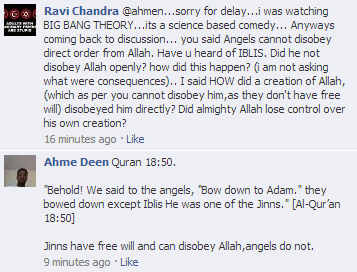
It’s often seen as a ‘contradiction’ that an angel (angels have no freewill in Islamic theology), Iblis (may Allaah’s curses be upon him) was able to disobey God as is recorded in the Qur’aan. The reality is however, that Iblis (may Allaah’s curses be upon him) was counted as an angel because he only did acts that the angels would do, so great was his outward piety. However, the Qur’aan mentions that he is a Jinn (a being with freewill), and this he was able to disobey God, something an angel in Islam can’t do. A brother who’s a part of a group I occasionally have discussions in, had this experience:

cc-2013-ahmedjinn

If only the missionary had read more of the Qur’aan.

wa Allaahu ‘Alam.

Dr. James Tabor: Gospel of Mark’s Ending is “Patently Bogus” and “Patently False”

The “Strange” Ending of the Gospel of Mark and Why It Makes All the Difference


by James Tabor


And they went out and fled from the tomb, for trembling and astonishment had seized them, and they said nothing.

Most general Bible readers have the mistaken impression that Matthew, the opening book of the New Testament, must be our first and earliest Gospel, with Mark, Luke, and John following. The assumption is that this order of the gospels is a chronological one, when in fact it is a theological one. Scholars and historians are almost universally agreed that Mark is our earliest gospel–by several decades, and this insight turns out to have profound implications for our understanding of the “Jesus story” and how it was passed down to us in our New Testament gospel traditions.

The problem with the gospel of Mark for the final editors of the New Testament was that it was grossly deficient. First it is significantly shorter than the other gospels–with only 16 chapters compared to Matthew (28), Luke (24), and John (21). But more important is how Mark begins his gospel and how he ends it.

He has no account of the virgin birth of Jesus–or for that matter, any birth of Jesus at all. In fact, Joseph, husband of Mary is never named in Mark’s gospel at all–and Jesus his called a “son of Mary, see my previous post on this here. But even more significant is Mark’s strange ending. He has no appearances of Jesus following the visit of the women on Easter morning to the empty tomb!

Like the other three gospels Mark recounts the visit of Mary Magdalene and her companions to the tomb of Jesus early Sunday morning. Upon arriving they find the blocking stone at the entrance of the tomb removed and a young man–notice–not an angel–tells them:

“Do not be alarmed. You seek Jesus of Nazareth, who was crucified. He has risen; he is not here. See the place where they laid him. But go, tell his disciples and Peter that he is going before you to Galilee. There you will see him, just as he told you.” And they went out and fled from the tomb, for trembling and astonishment had seized them, and they said nothing (Mark 16:6-8)

And there the gospel simply ends!

Mark gives no accounts of anyone seeing Jesus as Matthew, Luke, and John later report. In fact, according to Mark, any future epiphanies or “sightings” of Jesus will be in the north, in Galilee,not in Jerusalem.

This original ending of Mark was viewed by later Christians as so deficient that not only was Mark placed second in order in the New Testament, but various endings were added by editors and copyists in some manuscripts to try to remedy things. The longest concocted ending, which became Mark 16:9-19, became so treasured that it was included in the King James Version of the Bible, favored for the past 500 years by Protestants, as well as translations of the Latin Vulgate, used by Catholics. This meant that for countless millions of Christians it became sacred scripture–but it is patently bogus. You might check whatever Bible you use and see if the following verses are included–the chances are good they they will be, since the Church, by and large, found Mark’s original ending so lacking. Here is that forged ending of Mark:

Now when he rose early on the first day of the week, he appeared first to Mary Magdalene, from whom he had cast out seven demons. She went and told those who had been with him, as they mourned and wept. But when they heard that he was alive and had been seen by her, they would not believe it. After these things he appeared in another form to two of them, as they were walking into the country. And they went back and told the rest, but they did not believe them. Afterward he appeared to the eleven themselves as they were reclining at table, and he rebuked them for their unbelief and hardness of heart, because they had not believed those who saw him after he had risen. And he said to them, “Go into all the world and proclaim the gospel to the whole creation. Whoever believes and is baptized will be saved, but whoever does not believe will be condemned. And these signs will accompany those who believe: in my name they will cast out demons; they will speak in new tongues; they will pick up serpents with their hands; and if they drink any deadly poison, it will not hurt them; they will lay their hands on the sick, and they will recover. So then the Lord Jesus, after he had spoken to them, was taken up into heaven and sat down at the right hand of God. And they went out and preached everywhere, while the Lord worked with them and confirmed the message by accompanying signs.

Even though this ending is patently false, people loved it and to this day conservative Christians regularly denounce “liberal” scholars who point out this forgery, charing that they are trying to destroy “God’s word.”

The evidence is clear. This ending is not found in our earliest and most reliable Greek copies of Mark.[1] Clement of Alexandria and Origen (early 3rd century) show no knowledge of the existence of these verses; furthermore Eusebius and Jerome attest that the passage was absent from almost all Greek copies of Mark known to them. The language and style of the Greek is clearly not Markan, and it is pretty evident that what the forger did was take sections of the endings of Matthew, Luke, and John (marked respectively in red, blue, and purple above) and simply create a “proper” ending.

Even though this longer ending became the preferred one, there are two other endings, one short and the second an expansion of the longer ending, that also show up in various manuscripts:

[I] But they reported briefly to Peter and those with him all that they had been told. And after these things Jesus himself sent out through them, from east to west, the sacred and imperishable proclamation of eternal salvation.

[II] This age of lawlessness and unbelief is under Satan, who does not allow the truth and power of God to prevail over the unclean things of the spirits [or, does not allow what lies under the unclean spirits to understand the truth and power of God]. Therefore reveal your righteousness now’ – thus they spoke to Christ. And Christ replied to them, ‘The term of years of Satan’s power has been fulfilled, but other terrible things draw near. And for those who have sinned I was handed over to death, that they may return to the truth and sin no more, in order that they may inherit the spiritual and incorruptible glory of righteousness that is in heaven.

I trust that the self-evident spuriousness of these additions is obvious to even the most pious readers. One might in fact hope that Christians who are zealous for the “inspired Word of God” would insist that all three of these bogus endings be recognized for what they are–forgeries.

So that said, what about the original ending of Mark? Its implications are rather astounding for Christian origins. I have dealt with this issue more generally in my post, “What Really Happened on Easter Morning,” that sets the stage for the following implications.

1. Since Mark is our earliest gospel, written according to most scholars around the time of the destruction of Jerusalem by the Romans in 70 CE, or perhaps in the decade before, we have strong textual evidence that the first generation of Jesus followers were perfectly fine with a gospel account that recounted no appearances of Jesus. We have to assume that the author of Mark’s gospel did not consider his account deficient in the least and he was either passing on, or faithfull promoting, what he considered to be the authentic gospel. What most Christians do when they think about Easter is ignore Mark. Since Mark knows nothing of any appearances of Jesus as a resuscitated corpse in Jerusalem, walking about, eating, and showing his wounds, as recounted by Matthew, Luke, and John, those stories are simply allowed to “fill in” for his assumed deficiency. In other words, no one allows Mark to have a voice. What he lacks, ironically, serves to marginalize and mute him!

2. Alternatively, if we decide to listen to Mark, who is our first gospel witness, what we learn is rather amazing. In Mark, the last night of Jesus’ life, he had told his intimate followers following their meal, “But after I am raised up, I will go before you to Galilee” (Mark 14:28). What Mark believes is that Jesus has been “lifted up” or “raised up” to the right hand of God and that the disciples would “see” him in Galilee. Mark knows of no accounts of people encountering the revived corpse of Jesus, wounds and all, walking around Jerusalem. His tradition is that the disciples experienced their epiphanies of Jesus once they returned to Galilee after the eight day Passover festival and had returned to their fishing in despair. This is precisely what we find in the Gospel of Peter, where Peter says:

Now it was the final day of the Unleavened Bread; and many went out returning to their home since the feast was over. But we twelve disciples of the Lord were weeping and sorrowful; and each one, sorrowful because of what had come to pass, departed to his home. But I, Simon Peter, and my brother Andrew, having taken our nets, went off to the sea. And there was with us Levi of Alphaeus whom the Lord …

You can read more about this fascinating “lost” Gospel of Peter here, but this ending, where the text happens to break off, is most revealing. What we see here is precisely parallel to Mark. The disciples returned to their homes in Galilee in despair, resuming their occupations, and only then did they experience “sightings” of Jesus. Strangely, this tradition shows up in an appended ending to the gospel of John–chapter 21, where a group of disciples are back to their fishing, and Matthew knows the tradition of a strange encounter on a designated mountain in Galilee, where some of the eleven apostles even doubt what they are seeing (Matthew 28:16-17).

The faith that Mark reflects, namely that Jesus has been “raised up” or lifted up to heaven, is precisely parallel to that of Paul–who is the earliest witness to this understanding of Jesus’ resurrection. You can read my full exposition of Paul’s understanding “the heavenly glorified Christ,” whom he claims to encounter, here. And notably, he parallels his own visionary experience to that of Peter, James, and the rest of the apostles. What this means is that when Paul wrote, in the 50s CE, this was the resurrection faith of the early followers of Jesus! Since Matthew, Luke, and John come so much later, and clearly reflect the period after 70 CE when all of the first witnesses were dead–including Peter, Paul, and James the brother of Jesus, they are clearly 2nd generation traditions and should not be given priority.

Mark begins his account with the line “The Gospel of Jesus Christ the Son of God” (Mark 1:1). Clearly for him, what he subsequently writes is that “Gospel,” not a deficient version thereof that needs to be supplemented or “fixed” with later alternative traditions about Jesus appearing in a resuscitated body Easter weekend in Jerusalem.

Finally, what we recently discovered in the Talpiot tomb under the condominium building, not 200 feet from the “Jesus family” tomb, offers a powerful testimony to this same kind of early Christian faith in Jesus’ resurrection. On one of the ossuaries, or bone boxes in this tomb, is a four line Greek inscription which I have translated as: I Wondrous Yehovah lift up–lift up! And this is next to a second ossuary representing the “sign of Jonah” with a large fish expelling the head of a human stick figure, recalling the story of Jonah. In that text Jonah sees himself as having passed into the gates of Sheol or death, from which he utters a prayer of salvation from the belly of the fish: “O Yehovah my God, you lifted up my life from the Pit!” (Jonah 2:6). It is a rare thing when our textual evidence seems to either reflect or correspond to the material evidence and I believe in the case of the two Talpiot tombs, and the early resurrection faith reflected in Paul and Mark, that is precisely what we have.[2] That this latest archaeological evidence corresponds so closely to Mark and Paul, our first witnesses to the earliest Christian understanding of Jesus’ resurrection, I find to be most striking.

  1. “The last twelve verses of the commonly received text of Mark are absent from the two oldest Greek manuscripts (א and B), 20 from the Old Latin codex Bobiensis, the Sinaitic Syriac manuscript, about one hundred Armenian manuscripts, 21 and the two oldest Georgian manuscripts (written a.d. 897 and a.d. 913)” Bruce Metzger, A Textual Commentary on the Greek New Testament, 2nd edition []
  2. We offer a full exposition of these important discoveries in our recent book, The Jesus DiscoveryThe book is a complete discussion of both Talpiot tombs with full documentation, with full chapters on Mary Magdalene, Paul, the James ossuary, DNA tests, and much more. You can read my preliminary report on these latest “Jonah” related findings at the web site Bible & Interpretation, here, and a good account of the controversy here. During March and April, 2012 I also wrote a dozen or more posts on this blog responding to the academic discussions, see below under “Archives” and you can browse the posts by month. []


End of Dr. Tabor’s post.

Notes:

  • Emphasize wherever not matching with original, is ours.


                                                                     Post Script           

Question Mark


There is a lot of vital information that Dr. Tabor has pointed out. Notice the following:


  1.  “Later” Christians found Mark’s gospel to be deficient consequently it was placed second in the New Testament canonization of gospels along with suitable appendix. This undoubtedly indicates that (i) “earliest” Christians – the Markan community – did not consider the gospel to be “deficient” in need of any “fixation”. For them the evangelist – supposedly Mark – was providing the “Good News” of Jesus (p) (c.f. Mark 1:1). (ii) The process of canonization was very subjective. It was left to the theological experiences of later Christians, and not the texts themselves, to decide upon the canonization.


  1. Dr. Tabor provides two reasons for the “concocted” ending of the gospel to be “patently false” and “patently bogus”: (i) Earliest gospel – the gospel of Mark – which does not has the post-crucifixion appearance of Jesus (peace be upon him) will have precedence of antiquity on her counterpart gospels (Matthew, Luke, John) which do have post crucifixion sightings of Jesus (peace be upon him). So, the additional ending to the gospel is “forgery”. (ii) Hundreds of best and earliest manuscripts do not include the fabricated ending as attested by multiple “orthodox” fathers.


  1. Dr. Tabor’s choice of word for Jesus’ (peace be upon him) post-crucifixion appearance is very intriguing. Notice on multiple occasions he has used “resuscitated” body than resurrected body! This alludes that Jesus (peace be upon him) would have “appeared” to be dead in the wake of his crucifixion (compare Qur’an 4:157), when in reality he was only senseless and later his body was “resuscitated” to strength. This further implies that Jesus (peace be upon him) did not die and thus, probably, Dr. Tabor did not choose the word “resurrected”. Modern Muslim theologians like Dr. Shabbir Ally do endorse the theory of resuscitation in their exegesis of Qur’an 4:157.


Related Readings:

The Obvious Theological Biases Driving Gospel of Mark

Missionary Mishaps: Surgery is a Sin

بِسۡمِ ٱللهِ ٱلرَّحۡمَـٰنِ ٱلرَّحِيمِ ,

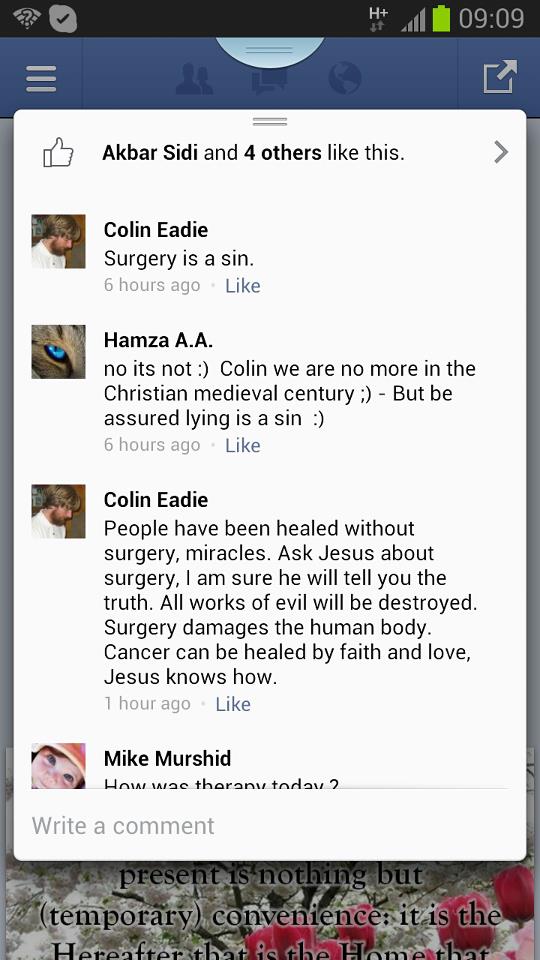
I’ve seen these missionaries say lots of stupid things in my time. This however, has to be one of the worst things I’ve ever seen a missionary state.

cc-2013-faithhealing

When I look at the world today and think to myself, “how have things gotten this bad?“, there’s always a missionary to answer that question for me. This discussion happened on our resident ex-Christian, Br. Hamza’s facebook page.

wa Allaahu ‘Alam.

Missionary Mishaps: Hate Thy Neighbour

بِسۡمِ ٱللهِ ٱلرَّحۡمَـٰنِ ٱلرَّحِيمِ ,

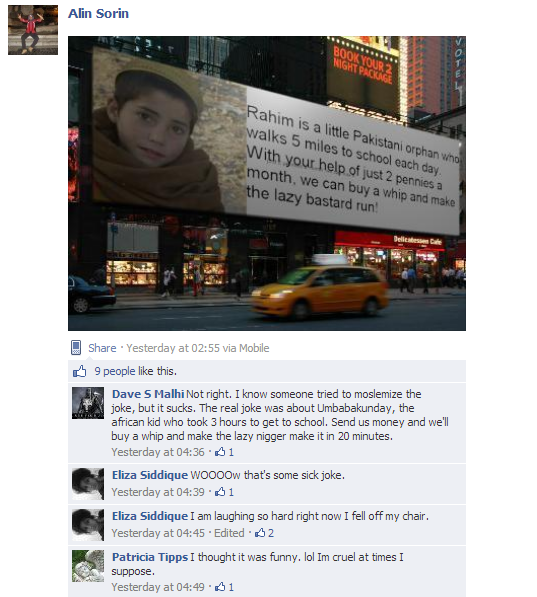
When Missionaries spurred on by David Wood and Robert Spencer’s rhetoric are allowed to reign free on discussion groups, they reveal their true natures by becoming hateful, spiteful, abusive and racist. As Muslims, we condemn this behaviour. They try to mock Muslims by attaching Muslim names to their profiles and then by preaching hate against Muslims and as seen in this photo, Muslim children. We’d like to thank David Wood especially for encouraging folks of this type for their behaviour.

Warning: Some of the language used is shocking.

cc-2013-whipboy


May Allaah guide these people.

wa Allaahu ‘Alam.

Who Heard the Prayer of Gethsemane?

Who heard the prayer in Gethsemane?

Reading through the Gospels according to Matthew, Mark, Luke and John, Jesus’ prayer in Gethsemane’s Garden struck my attention. A prayer which showed unwillingness and submission from the son to the father, but what struck me the most was the confusion of who heard the prayer and how was it recorded in three of the four above gospels?

After the last supper Jesus predicts Judas’ betrayal as well as Peter’s denial. Jesus takes his disciples and goes to Gethsemane. He requests from his disciples to stay while he goes further away to pray taking with him only Peter, James and John in which he then asks them to keep watch as he moves further away from them in order to pray as he felt sorrowful and troubled.

Matthew 26
36 Then Jesus went with his disciples to a place called Gethsemane, and he said to them, “Sit here while I go over there and pray.” 37 He took Peter and the two sons of Zebedee along with him, and he began to be sorrowful and troubled. 38 Then he said to them, “My soul is overwhelmed with sorrow to the point of death. Stay here and keep watch with me.” 39 Going a little farther, he fell with his face to the ground and prayed, “My Father, if it is possible, may this cup be taken from me. Yet not as I will, but as you will.”

Mark 14
32 They went to a place called Gethsemane, and Jesus said to his disciples, “Sit here while I pray.” 33 He took Peter, James and John along with him, and he began to be deeply distressed and troubled. 34 “My soul is overwhelmed with sorrow to the point of death,” he said to them. “Stay here and keep watch.” 35 Going a little farther, he fell to the ground and prayed that if possible the hour might pass from him. 36 “Abba, Father,” he said, “everything is possible for you. Take this cup from me. Yet not what I will, but what you will.”

What was the distance Jesus moved away from the disciples (Peter, James and John)? The Gospel of Luke provides us with an estimation.

Luke 22
39 Jesus went out as usual to the Mount of Olives, and his disciples followed him. 40 On reaching the place, he said to them, “Pray that you will not fall into temptation.” 41 HE WITHDREW ABOUT A STONE’S THROW BEYOND THEM, knelt down and prayed, 42 “Father, if you are willing, take this cup from me; yet not my will, but yours be done.” 43 An angel from heaven appeared to him and strengthened him. 44 And being in anguish, he prayed more earnestly, and his sweat was like drops of blood falling to the ground.

For further clarification let’s look at Gill’s Exposition of the Entire Bible

And he was withdrawn from them, That is, from the three disciples, Peter, James, and John, whom he took along with him, leaving the rest at some further distance; and from these he removed,  about a stone’s cast; fifty, or sixty feet(1) from the place where they were:

and kneeled down and prayed; the following prayer.

Fifty to sixty is between 15.24 to 18.288 meters

Having noticed that Jesus distanced himself from the disciples and remained in solitude praying (where he could not be heard) taking breaks to check on his disciples only to find them fallen asleep.

Matthew 26
40 Then he returned to his disciples and found them sleeping. “Couldn’t you men keep watch with me for one hour?” he asked Peter. 41 “Watch and pray so that you will not fall into temptation. The spirit is willing, but the flesh is weak.”42 He went away a second time and prayed, “My Father, if it is not possible for this cup to be taken away unless I drink it, may your will be done.”43 When he came back, he again found them sleeping, because their eyes were heavy. 44 So he left them and went away once more and prayed the third time, saying the same thing.45 Then he returned to the disciples and said to them, “Are you still sleeping and resting? Look, the hour has come, and the Son of Man is delivered into the hands of sinners. 46 Rise! Let us go! Here comes my betrayer!”

Mark 14
37 Then he returned to his disciples and found them sleeping. “Simon,” he said to Peter, “are you asleep? Couldn’t you keep watch for one hour? 38 Watch and pray so that you will not fall into temptation. The spirit is willing, but the flesh is weak.” 39 Once more he went away and prayed the same thing. 40 When he came back, he again found them sleeping, because their eyes were heavy. They did not know what to say to him. 41 Returning the third time, he said to them, “Are you still sleeping a:? Enough! The hour has come. Look, the Son of Man is delivered into the hands of sinners. 42 Rise! Let us go! Here comes my betrayer!”

Luke 22
45 When he rose from prayer and went back to the disciples, he found them asleep, exhausted from sorrow. 46 “Why are you sleeping?” he asked them. “Get up and pray so that you will not fall into temptation.”

In conclusion, as the disciples were distanced away from Jesus and since they were constantly falling asleep, the question we ask again is who heard Jesus’ prayer and how were they recorded into the Bible? Interestingly the Gospel according to John does not mention specifically what took place in the prayer and simply states the following:

John 18
18 When he had finished praying, Jesus left with his disciples and crossed the Kidron Valley. On the other side there was a garden, and he and his disciples went into it.

Missionary Mishaps: Another One Bites the Dust

بِسۡمِ ٱللهِ ٱلرَّحۡمَـٰنِ ٱلرَّحِيمِ ,

Many missionaries flock to our Facebook page in an effort to ‘guide’ us to the ‘truth of Christianity’. To their detriment, they find themselves in discussions which break their delusion and of which send them hurtling towards a manifest realization about the faulty foundations of the mind numbing modern Christian religion. This is perhaps a sad demise for a missionary who gave the impression that he was determined, yet as we’ve seen, it is difficult for these missionaries to have any impact upon educated Muslims:

cc-2013-missionaryexplodes


wa Allaahu ‘Alam.

Second Child Death from Christian ‘Faith Healing Couple’

بِسۡمِ ٱللهِ ٱلرَّحۡمَـٰنِ ٱلرَّحِيمِ ,

Once again, a child has to pay the price for over zealous Christian behaviour. For far too long, the Christian right has drilled a literal study of the Bible into the hearts and minds of the fickle and feeble minded believers. We’ve been misfed the archaic and fraudulent narrative of the purported Gospel of Mark’s Great Commission:

14 Later He appeared to the eleven as they sat at the table; and He rebuked their unbelief and hardness of heart, because they did not believe those who had seen Him after He had risen. 15 And He said to them, “Go into all the world and preach the gospel to every creature. 16 He who believes and is baptized will be saved; but he who does not believe will be condemned. 17 And these signs will follow those who believe: In My name they will cast out demons; they will speak with new tongues;18 they will take up serpents; and if they drink anything deadly, it will by no means hurt them; they will lay hands on the sick, and they will recover.” – Mark 16:14-18.

For the second time in a row, a Christian couple has refused medical treatment for their ailing child, which has resulted in the death of their second child. NBC News (Philadelphia) reports:

A couple that was sentenced to probation after their 2-year-old died in 2009 from pneumonia have had another child die.

Herbert and Catherine Schaible, fundamentalist Christians who believe in the power of prayer ahead of modern medicine, recently had their 8-month-old son die, according to Philadelphia Police spokeswoman Jillian Russell. It wasn’t clear when the child died, or the cause of death, but the death hasn’t been ruled suspicious, Russell said. The child was taken to a funeral home by an as yet unknown individual and the undertaker alerted police, Russell said.

During their trial, the Schaibles’ lawyers said the parents were targeted because their fundamentalist Christian beliefs espouse faith healing.

It is quite unfortunate that this has happened once more. This should serve as a wake up call that Christian scholars should do right by their studies and remove these man-made verses from their ‘scripture’, so as to avoid the murder of innocent children due to an interpolated man made dogmatic theological farce.

wa Allaahu ‘Alam.

Did Jesus (p) abolish Jewish Kosher?

Did Jesus (p) abolish Jewish Kosher?

Question Mark

Introduction


It is highly probable that the Christian next-door is into an all-inclusive dietary practice. S/he would not be scrupulous with the foods being consumed as Jew (or a Muslim) would be. It is almost considered lawful to consume food items which are prohibited in the Bible. Sadly enough, many Christians try to prove their position from the Bible itself! In fact some Bible versions have taken it for granted that Jesus (peace be upon him) allowed every food for them rescinding Mosaic Laws! One such incident happened at this very blog when a Christian used biblical passages to support his view.

Therefore, we have decided to take a close look into the matter if it is really permissible that a Christian consume any food that s/he like even those forbidden in the Bible. We would consider one of the most famous of the New Testament passage herein.


The Jesus (p) Yardstick


The Jews to this date scrupulously observe what is called as the “Kosher”. Kosher is basically the Jewish dietary law. The practice of Kosher does get its support from the Bible. Consider the following passage for instance:


Whatsoever goeth upon the belly, and whatsoever goeth upon all four, or whatsoever hath more feet among all creeping things that creep upon the earth, them ye shall not eat; for they are an abomination. Ye shall not make yourselves abominable with any creeping thing that creepeth, neither shall ye make yourselves unclean with them, that ye should be defiled thereby.  For I am the LORD your God: ye shall therefore sanctify yourselves, and ye shall be holy; for I am holy: neither shall ye defile yourselves with any manner of creeping thing that creepeth upon the earth. For I am the LORD that bringeth you up out of the land of Egypt, to be your God: ye shall therefore be holy, for I am holy. This is the law of the beasts, and of the fowl, and of every living creature that moveth in the waters, and of every creature that creepeth upon the earth: To make a difference between the unclean and the clean, and between the beast that may be eaten and the beast that may not be eaten.  (Leviticus 11:42-47, King James Version)


Jesus (peace be upon him) for the known fact that he was a “Jew” must have observed the dietary Law. In fact, not just “dietary” Law, Jesus (peace be upon him) wanted to surpass every Pharisee and Scribe of his time by observing all the Laws of the Old Testament:


Think not that I am come to destroy the law, or the prophets: I am not come to destroy, but to fulfil. For verily I say unto you, Till heaven and earth pass, one jot or one tittle shall in no wise pass from the law, till all be fulfilled. Whosoever therefore shall break one of these least commandments, and shall teach men so, he shall be called the least in the kingdom of heaven: but whosoever shall do and teach them, the same shall be called great in the kingdom of heaven. For I say unto you, That except your righteousness shall exceed the righteousness of the scribes and Pharisees, ye shall in no case enter into the kingdom of heaven. (Matthew 5:17-20, King James Version)


Did Jesus (p) allow all kinds of food?


On the foregoing it is hard to assume that Jesus (peace be upon him) would have allowed dietary practices against God’s Laws! Then what did Jesus (peace be upon him) mean when he said,


There is nothing from without a man, that entering into him can defile him: but the things which come out of him, those are they that defile the man. (Mark 7:15, King James Version)


Apparently it seems like Jesus (peace be upon him) allowed consumption of all foods irrespective of the Old Testament rulings on them. In fact the Good News Edition of the Bible has already construed Jesus’ (peace be upon him) statement as permission for every kind of food. In between verse 19 and 20, Good News Editions brackets the following declaration:


In saying this, Jesus declared that all foods are fit to be eaten


Nevertheless, a closer look into the passage reveals that Jesus (peace be upon him) never intended to allow all foods lawful for his disciples. It is vitally important to understand the setup and context which led to Jesus’ (peace be upon him) statement:


Chapter 7 begins with Pharisees and doctors of the Law in a dispute with Jesus (peace be upon him). For the Pharisees, Jesus’ (peace be upon him) disciples were not up to the mark as far as observing the rituals were concerned. The Pharisees were particularly upset with the disciples not ritually cleaning their hands before eating food:


Some Pharisees and teachers of the Law who had come from Jerusalem gathered round Jesus. They noticed that some of his disciples were eating their food with hands which were ritually unclean – that is, they had not washed them in the way the Pharisees said people should” (Mark 7:1-2)


For the Pharisees it was important to wash hands ritually since they inherited it from their forefathers (c.f. Mark 7:3). However, Jesus (peace be upon him) had other views. For him the act (of cleaning hands) was mere show of hypocrisy devoid of any sincere God-consciousness:


Jesus answered them, “How right Isaiah was when he prophesied about you! You are hypocrites, just as he wrote: These people, says God, honor me with their words, but their heart is really far away from me….” (Mark 7:6)


Jesus (peace be upon him) also recognized that the ritual of washing hands before eating was a man-made innovation which was never part of God’s Laws:


It is no use for them to worship me, because they teach man-made rules as though they were God’s laws!’ “You put aside God’s command and obey the teachings of men”” (Mark 7:7-8)


It is not difficult to understand the perspectives of Pharisees and Jesus (peace be upon him). While the Pharisees would act as sticklers, ironically, not to God’s Laws but to mere mundane innovations, Jesus (peace be upon him), on the other hand, would not only denounce any innovation in God’s religion but he also would strive for spirituality and God-consciousness even in the rituals. It was under this context that Jesus said,


Listen to me, all of you, and understand. There is nothing that goes into a person from the outside which can make him ritually unclean. Rather, it is what comes out of a person that makes him unclean” (Mark 7: 14-15)


Consider the construction of Jesus’ (peace be upon him) statement in the first place: If Jesus’ (peace be upon him) intent would have been merely to allow all foods permissible for his disciples then he would not probably had started his statement with a strong exhortation to “listen” him carefully and “understand”. Obviously there was much more to be understood than what would apparently appear from his words. Through such a cautious expression, Jesus (peace be upon him) wanted his disciples to be careful to second part of his statement where he alarms his audience from the evils that “comes out of a person that makes him unclean”.


As obvious as it is, Jesus (peace be upon him) definitely shifted the focus from mere man-made formalities to higher acts of spirituality. For him, the need of the hour was not bickering over “rituals” and systems but inner uprightness. In fact, Jesus (peace be upon him) explicitly chided the Pharisees, in the same context, merely a few statements earlier, towards their moral degradation in the name of observing “rituals”:


And Jesus continued, “You have a clever way of rejecting God’s law in order to uphold your own teaching. For Moses commanded, ‘Respect your father and your mother,’ and, ‘Whoever curses his father or his mother is to be put to death.’ But you teach that if a person has something he could use to help his father or mother, but says, ‘This is Corban’ (which means, it belongs to God), he is excused from helping his father or mother. In this way the teaching you pass on to others cancels out the word of God. And there are many other things like this that you do”” (Mark 7:9-13)


Understand that for Jesus (peace be upon him) the Pharisees were not qualified to be talking about ritual niceties when they had devised ways how they could be excused from helping their own aging parents! For Jesus (peace be upon him) the demand of ritual cleaning was as folly as the excuse of the “Corban”, let alone the fact that the ritual it was an innovation. In this context, therefore, when Jesus (peace be upon him) stated that nothing that goes in defiles a person, then Jesus (peace be upon him) was not really talking about permissibility of foods as he was concerned about refuting the snares of Pharisees.


We can further appreciate that (i) Jesus (peace be upon him) did not construct his statement more obviously as “nothing that a person eats”; rather he said “nothing that goes into a person”! This is more than just a hint that Jesus (peace be upon him) was not really concerned about food here. Furthermore, (ii) Jesus (peace be upon him) is comparing food (goes in) and actions (comes out), or at least talking about both of them simultaneously, when both are quite disparate! These should help us interpret Jesus (peace be upon him) correctly that he was not as much concerned and discussing food and its rulings as he was vexed with the inner corruption of the same Pharisees advocating their (man-made) rituals. This understanding is further corroborated by the fact that where Jesus (peace be upon him) devotes only a verse (v.19) for things going into a person, he devotes four verses (vv. 20-23) into explaining about the evils emanating out of men.


Being Consistent


We expect persisting Christians to argue that Jesus (peace be upon him) allowed all foods since it does not enter into the heart – where intentions for actions emanate – rather it goes straight into the stomach where it is digested and is done with:


You are no more intelligent than the others,” Jesus said to them. “Don’t you understand? Nothing that goes into a person from outside can really make him unclean, because it does not go into his heart but into his stomach and then goes on out of the body.”(Mark 7: 19)


Obviously the reasoning is very narrow and does not accommodate the context. Furthermore, such an argument is awfully inconsistent with the food offered to idols since, of surety, they also do not enter the heart but go to stomach and yet Christians are forbidden to eat them:


It is my opinion,” James went on, “that we should not trouble the Gentiles who are turning to God. Instead, we should write a letter telling them not to eat any food that is ritually unclean because it has been offered to idols;” (Acts 15: 19-20)


Much like the Pharisees, James is also concerned with “ritual uncleanness”. If Jesus (peace be upon him) has declared that “nothing” going in defiles men then James should not be concerned about the food offered at idol altars especially when James and every other Christian believer knows that every eatable is in reality created by the living God and not dead idols. Consequently, Christians should consistently obey Jesus (peace be upon him) and eat the food offered to idols as, “because it does not go into his heart but into his stomach and then goes on out of the body.


Paul was also against eating food offered to idols:


Consider the people of Israel: those who eat what is offered in sacrifice share in the altar’s service to God. Do I imply, then, that an idol or the food offered to it really amounts to anything? No! What I am saying is that what is sacrificed on pagan altars is offered to demons, not to God. And I do not want you to be partners with demons. You cannot drink from the Lord’s cup and also from the cup of demons; you cannot eat at the Lord’s table and also at the table of demons. Or do we want to make the Lord jealous? Do we think that we are stronger than he? (1 Corinthians 10: 18-22)


If food is just-food without any scruples of God-consciousness since they merely have to enter stomach and not heart then why is Paul so concerned about food offered to idols! If, “Nothing that goes into a person from outside can really make him unclean” then why is it an issue whether the food is offered at the altar of God or “demon”? Similarly, how does one become a partner of demon when Jesus (peace be upon him) declared the “outside” food cannot really make him “unclean”?


On the same line of reasoning, if that “what comes out of a person that makes him unclean” (Mark 7:20) and the (Christian) believers have become pure in their association with Christ (peace be upon him) then how come anything constitute “the cup of demons”.


These queries are irreconcilable if we continue to misinterpret Jesus’ (peace be upon him) statement merely to satisfy our eating appetites.


Conclusion


Therefore, it seems that Jesus’ (peace be upon him) expression is more about moral sanctity of men than rulings on foods. In fact, we do not find any real reason why Jesus (peace be upon him) need to discuss food-rulings at all since (i) Jews were abreast of Mosaic commandments already and Jesus (peace be upon him) had initially upheld every facet of the Laws. And (ii) there is no hint that Jesus (peace be upon him) ever ate food which was condemned as defiling by the Laws. Add to it that Jesus (peace be upon him) considered the act of ritually washing hands as mere innovation. Consequently, a mere innovation could not possibly decide cleaning/defiling of men and thus Jesus (peace be upon him) could say that nothing going “in” without this man-made ritual cleansing could defile men as an expression to debunk innovations in the religion! Furthermore, if Jesus (peace be upon him) is (mis) understood for permitting “any” food then, consistently, even food offered to idols would become lawful! This obviously is a problem.


On the foregoing, if we are to be careful towards the text and sincere towards the speaker, especially when he himself is not around to explain the imports, then we would have to accept that Jesus (peace be upon him) did not really gave permission to the Christians to choose dietary at their free will.


Notes:


  • Unless otherwise mentioned, all biblical texts taken from the Good News Edition.


« Older Entries Recent Entries »