Why do babies cry at birth? Hadith criticism answered

The Hadith under discussion is as follows:

قَالَ أَبُو هُرَيْرَةَ ـ رضى الله عنه ـ سَمِعْتُ رَسُولَ اللَّهِ صلى الله عليه وسلم يَقُولُ ‏”‏ مَا مِنْ بَنِي آدَمَ مَوْلُودٌ إِلاَّ يَمَسُّهُ الشَّيْطَانُ حِينَ يُولَدُ، فَيَسْتَهِلُّ صَارِخًا مِنْ مَسِّ الشَّيْطَانِ، غَيْرَ مَرْيَمَ وَابْنِهَا ‏”‏‏.‏ ثُمَّ يَقُولُ أَبُو هُرَيْرَةَ ‏{‏وَإِنِّي أُعِيذُهَا بِكَ وَذُرِّيَّتَهَا مِنَ الشَّيْطَانِ الرَّجِيمِ ‏}

Narrated Said bin Al-Musaiyab: Abu Huraira said, “I heard Allah’s Apostle saying, ‘There is none born among the off-spring of Adam, but Satan touches it. A child therefore, cries loudly at the time of birth because of the touch of Satan, except Mary and her child.” Then Abu Huraira recited: “And I seek refuge with You for her and for her offspring from the outcast Satan” (Qur’an 3.36)[1] Read more

How Do I Help Christians Understand Why Calling God “Father” is Wrong?

Question:

As a Muslim, how do I explain that calling God Father is actually wrong, and not something respectable to do?

Answer:

Use the synonym of “Daddy” instead. Christians are quick to call God, Father to demonstrate their personal relationship with the Creator. To have them understand that their relationship is farcical, ask them if they’d consider referring to him as “Daddy”, have them say the Lord’s Prayer using “Daddy”:

“O Daddy who art in heaven….”

In response to this, many Christians have said calling God, Daddy, is:

  • cringe worthy
  • unnatural
  • odd
  • strange
  • funny
  • disrespectful
  • heretical
  • disorderly
  • blasphemy
  • informal
  • non-Biblical
  • offensive

Indicate to them, that as Muslims we agree, referring to God as “Daddy”, is all of those things and more. I’ve found this method very useful in having them understand just how dreadful it is to call God “Father”. We can even give them something to think about by mentioning that, as a Son of the Father, if your relationship were strong with him, just as any other son – you should be able to call him Daddy, if not – then you should question your relationship with Him.

and God knows best.

Stumping an Evangelist

A week ago, I gained a significant insight into the mind of James White – the Christian speaker. He had a discussion with himself on the Qur’aan and its understanding of the Jews and Christians. You can listen to the program here. How the Qur’aan approaches the beliefs of the Jews and Christians, the corruption of their scripture and several other matters were discussed, but it’s something that James mentioned that really enlightened to me to his approach towards apologetics in relations to Islam. Click here and listen for the next two minutes of James’ dialogue. James is reading aloud a response I sent to a group email in which he was involved. To summarize James’ belief:

  • The author of the Qur’aan is ignorant about Christian beliefs because the author says wrong things about Christian beliefs.

Let’s take for example the claim that the Qur’aan gets the Trinity wrong, 5:116 says:

And [beware the Day] when Allah will say, “O Jesus, Son of Mary, did you say to the people, ‘Take me and my mother as deities besides Allah?'”

This is one of his common claims, but we must ask ourselves something that he doesn’t. Does the Qur’aan state that this is the Christian Trinity? It doesn’t. There are only two things that this verse states: (1) Christians took Jesus to be a God, (2) Christians took Mary to be a God. So how exactly does the Qur’aan misrepresent the Trinity in this verse? It’s obvious that James begins his argument by assuming what this verse says, isolating it, and then reading into it what he wants to claim, and then he “bravely” argues against this claim – his own claim. Let’s take another example, he says the Qur’aan again misrepresents the Trinitarian formula in the following verse, 5:73 which says:

They have certainly disbelieved who say, “Allah is the third of three.” And there is no god except one God.

His argument is that Christians do not believe that God is one of Three, therefore the Qur’aan errs in regard to common Christian belief. However, the Qur’aan here – without dispute, gets the Trinity correct. God – the Father (Allaah), is one of three. We must then ask, how could the Qur’aan get it wrong, if it gets it right? The Qur’aan can only be “wrong“, if Christians did not believe that each person of the Godhead was a God, is James saying that he believes otherwise? He repeats this argument in a debate he had in South Africa with Br. Bux, and that concerned me because he claims to let scripture speak for itself, when his own actions demonstrate otherwise.

Now, these are minor examples of his ineptitude and dishonesty, but in reference to my email – he’s indicated something far more insidious than I could have known. See, I made the claim that the Qur’aan doesn’t only speak about one specific set of Christians. James’ position/ angle when claiming that the Qur’aan gets Christian beliefs wrong is based on the fact that he expects the Qur’aan to mention one type of Christian beliefs only – his own. So that would be Trinitarian – Calvinist – Baptist -Christian theology. That means the Qur’aan must only speak about one sect and that it can only speak about one sect of Christianity, his sect. I challenged this by saying that this was a silly claim, why does the Qur’aan have to speak about one sect’s beliefs only?

His response to that was to ask, “Hmmm……Ummm…..(that particular work well known in early Church history), are you really going to try to defend the idea that the Qur’aan accurately represents a catalogue of variant Christian beliefs?” That statement is golden, he’s essentially type casting the Qur’aan’s approach to Christianity and that it should only represent his version of Orthodox Christianity and it should not speak about the beliefs of the Christian world.

James' Face of Confusion

James’ Face of Confusion

In response to James’ question, I ask, are you really going to try and defend that idea that the Qur’aan is supposed to only speak about one type of Christianity? For academic sake, the Qur’aan mentions that some Christians took Mary to be a deity, there are two prominent sects of Christianity that did this, the Collyridians and the Roman Catholics. If James is fair and objective, honest – he should concede that the Qur’aan is referencing the beliefs of more than one Christian sect from this claim about Mary alone. From this, when I heard James’ skepticism to my claim that the Qur’aan mentions the belief of the Christian world and not the beliefs of one sect – the one he happens to belong to, I then realised just how myopic and misguided his approach was, it’s merely polemical. I call upon James to demonstrate why the Qur’aan should only speak or mention the beliefs of one sect of the hundreds of Christian sects that exist. What makes Trinitarian Calvinist Baptist Christian beliefs so special, that a book from God can only focus on one heresy and not other heresies which defile a Prophet of God and his mother?

It’s now inescapable that every time I hear James applaud his level of study, that the image above (unedited in anyway) comes to my mind. The very fact that he approaches the statements of the Qur’aan by using eisegesis and cherry picking, demonstrates for me, his great ineptitude at being a formal scholar, an erudite, a consistent man.

and God knows best.

Sour Grapes: One Missionary’s Lesson in Futility

It’s been just over more than a year since I debated CL Edwards on the topic, “Jesus the Christ: Man, God or Both?“, however for my opponent it would seem as if the debate is fresh out of the oven – given his constant attempts at trying to right his wrongs during that debate. CL Edwards is at it again. The debate did not go well for him – in fact, if he’s willing to let me post what he said to me in private after the debate to me about his performance, it’d pretty much explain to the public why he has a fixation on constantly referring to our now more than a year old debate. The post I’m responding to was published last month – fortunately (?) it wasn’t brought to my attention until today, simply because no one I know, or no one in our community of inter-religious debate and dialogue frequents his website. So for this, I apologize for my late response. He says and I quote:

Also I think it is relevant since the person who helped Ahmad form his argument in the debate…

See, CL is still trying to find excuses for why my arguments caught him off guard, so his obvious theory is that someone helped me formulate my arguments for my debate with him. That however, is not the case. As the person who CL is attempting to appeal to, cc-2013-cledwardswould gladly agree that he did not help me formulate any of my arguments, he simply did a review after my debate with CL Edwards and assessed both of our performances. In fact, there is essentially no one who can lay credence to the claim that they have formulated any of my arguments for a debate for me. I do my own study, my own research and write my own arguments. I’ve actually made it a personal goal of mine to approach each debate without using another person’s methodology or approach. This is why, when persons view my debates from last year, especially between that of the one with Edwards and the other with Green, my scope of argumentation is vast in their disparity. I can’t speak for my opponent, yet from what I do recall of the debate with Edwards is that nothing he presented was new and he did not approach the topic as I did. In answering the question of whether Christ was man, God or both, he simply referred to New Testament verses to propagate his argument.

I chose a completely different route. My methodology involved using the socio-historical method while referencing contemporary cultural and exegetical approaches to the literature and events of that time period. Clearly one route is overdone, while the other is a great bit more advanced and objective, something my opponent did not know how to react to. So yes, I do understand why Edwards is so eager to imagine that someone decades younger than him, can approach a debate with a more academic foundation, as opposed to merely parroting arguments which are hundreds of years old. What is touching however, is his prayer for me:

we pray for Ijaz to be spiritually reborn and come to the knowledge of the Gospel of Christ like millions of other Muslims have.

It is my wish to express to Edwards a sincere thank you for his prayer. I’d like to inform him though, that because I have come to the knowledge of the Gospel of Christ, it is for that precise reason that I and those millions of other Muslims – knowingly and openly reject his Graeco-Roman Syncretic Jewish faith. He went on to pose a question to me:

Note about this debate: to this day Ijaz has never given an answer to the question I asked him in the Q&A part towards the end. That question was does he know of any earlier source for the life, and teachings of Jesus and his disciples from the first century that predates the NT Bible?

At this point, I’m gladly willing to entertain his question and respond to it. His question presumes that the New Testament Gospels (can’t be Pastorials or Epistles since they don’t recall the life of Christ) are first century documents. This however is wrong, the New Testament Gospels are empirically speaking, wholly second century. The oldest extant MS is that of P52 which is from 125 CE and is not radio-carbon dated, it is paleologically dated and it is because of this very reason that it can date anywhere from 125 CE to the latter period of the second century. Of course, I do not expect a first year seminary pupil to know the ins and outs of textual critic debates on paleological and philological dating disputes. It is therefore without a doubt, that I can safely respond to his question by saying that there are no currently known extant sources about Jesus’ life and teachings within the first century. He goes on to state:

I asked that because the bases of my argument was the New Testament accounts of Jesus are the earliest most attested sources on his life and doctrine from his own followers.

I do believe he meant “basis” and not bases, it should also go without saying that the basis of his argument is a presumption, an assumption. In order for his argument to be foundationally sound, he needs to first prove that these assumptions are valid. We know for a fact that the Gospel accounts are not the earliest sources on his life – the informal oral Jesus tradition is. We also know that they are not from his own followers, but from later authors. Again, his argument reads as if he’s opened up an Evangelical booklet positing century old assumptions and presenting them to be indisputable facts – the evidence completely disagrees. He continues:

Why would be discard it for the Qurans account of Jesus that came 600 plus years after the fact? If you take Ijaz’s argument in this debate and apply it to the Quran and hadith we wouldn’t accept what the Quran says about Jesus.

Given that the only complete extant MSS of the Gospels are during the 4th and 5th centuries, through the 4 great Uncial codices, if time is a factor, then the argument of time also gives us a reason to reject the testimony of the extant vorlage Gospel texts. I can even be a bit menacing and state that the New Testament of today was published only recently, an eclectic account based on conjectural emendation by Biblical societies – see the NA 28 and UBS 4, both from the 21st century and the likes of which are non-existent in any MS tradition from the time of the Qur’aan or before it. Given what I’ve stated , my argument doesn’t affect the accounts about Christ in the Muslim scripture and hadeeth collections.

In closing, it’s been one year later and despite Edwards attending a seminary – he’s still unable to discuss the topic of Jesus’ historicity in the Gospels in an educated and academic manner. Sure, his Evangelical reasoning may impress the feeble minded individuals he surrounds himself with, but here in the real world – his inability to grow out of that intellectually stunting mold is quite distasteful and most certainly worrying.

and God knows best.


Evangelical Hegemony on Religious Dialogue

Christian Evangelicals in an attempt to discredit the dialogue between two scholars, namely Dr. Ally and Dr. Crossan have been enforcing some very odd, if not extreme arguments against the speakers. In their vain attempts, they have used the example of Ahmadi/ Qadiani opportunist turned Evangelical Ultra Conservative Christian speaker, Nabeel Qureishi. Their argument is presented as such:

  • Dr. Crossan has heretical beliefs according to Evangelicals.
  • Nabeel is to Islam, what Dr. Crossan is to Christianity.

However, this is an appeal to the fallacy of false equivocation. The decision to have Dr. Crossan share a stage with Dr. Ally was not due to Dr. Crossan’s beliefs, but due to his scholastic credentials – which far outweighs that of his detractors. The comparison with Nabeel is a bit simple minded, if not juvenile. Nabeel was not qualified in any Islamic science, not one. He was not a Mufti, Mawlana, Qadhi, Mufasir, Muhadith, he was qualified in not a single Islamic field of study. His authority to speak on Islam as given to him by the Evangelical community is merely due to a title of, “ex-Muslim” and not due to his lack of Islamic scholastic credentials. Whereas with Dr. Crossan, his list of well attested and erudite scholastic credentials is significant. This is possibly the first time that Dr. Ally will be on stage with a Christian scholar with such a grand background of scholarly qualification, study and research. Therefore, while the Evangelicals are running around screaming bloody murder, basing their Ministerial authority on titles and lack of study, we – the Muslim community have our arms wide open in accepting dialogue with those whose credentials stand first and beliefs after.

I was a bit appalled though, to find one Christian colleague of mine, defending the above logic, by claiming that Nabeel – despite his heretical beliefs was still more qualified to speak on Islam than Dr. Crossan is on Christianity because Nabeel affirmed the 6 articles of faith and the 5 pillars of Islam. This only goes to demonstrate the weak understanding of Islam that both the Ahmadis/ Qadianis have along with the Evangelical community. Before we even get to the articles of faith and the pillars of Islam, the first criteria of belief is Tawheed and then the Khatm Nubuwwat of Muhammad (peace be upon him). Since Ahmadis deny the latter, they therefore do not qualify to be labelled as Muslims according to orthodox beliefs. Even if we examine the articles of faith – included in it is the belief in the Prophets and the belief that Muhammad (peace be upon him) is the last Prophet – something Ahmadis/ Qadianis vehemently deny. What is a bit ironic is that the young apologist who claimed such a defense originated from Nabeel’s previous correspondences with him, concerning his “orthodoxy” in Islam, demonstrated through such an argument that Nabeel was firmly ignorant on what the 6 articles of faith are, or what they entailed.

In another twist of events, it seems as if the Christian colleague of mines decided to label Dr. Crossan as a de-facto atheist. So not only has the Evangelical community decided to give authority to Nabeel because of a label he once wore with no scholarly credentials behind him (in regards to Islam), they’ve taken away authority from one educated scholar not due to his credentials but due to a title they’ve typecasted him into. To me, that is not only a double standard and self defeating – it is quite unfortunate to see that this is the level with which the Evangelical Christian movement must stoop to, in order to prevent healthy and scholastic inter-faith dialogue. As our teachers have taught us, damnant non quod intelligunt – they condemn what they do not understand.

and God knows best.

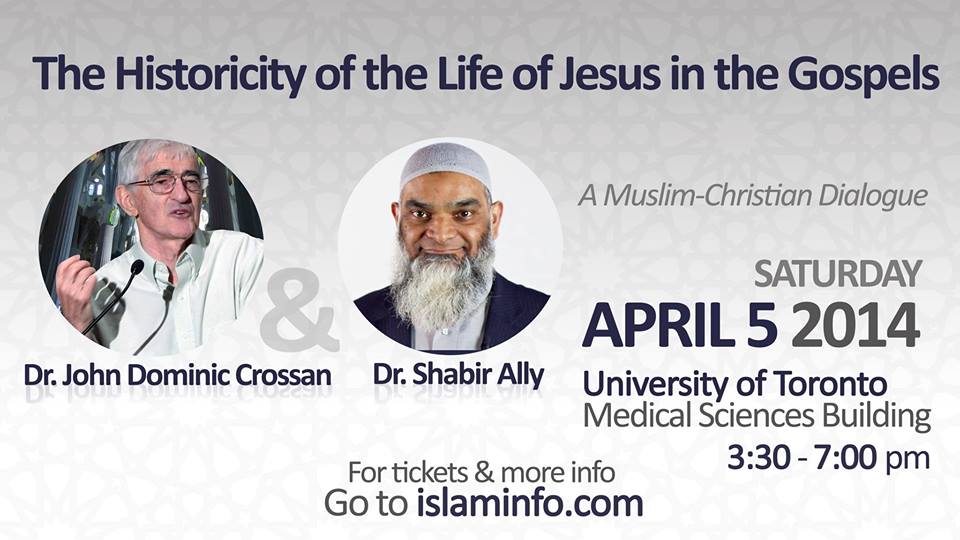
Dr. Shabir Ally & Dr. John Dominic Crossan Event

It is with great enthusiasm that I am looking forward to the dialogue between two erudite and honest religious scholars of our age on the Historicity of Jesus’ life in the Gospels.

cc-2014-shabirally-crossandialogue


You can find updates for the event and the live stream link (offered for free) via: Ally and Crossan Dialogue Website. More information can also be found via the event’s Facebook page, see here, while tickets can be purchased here.

I will be live tweeting the event via my Twitter account, and if time permits, offering a post-dialogue summary.

and God knows best.

Shaykh Muhammad Mustafa al ‘Azami Speaks on the Orientalist Agenda

Prominent and erudite scholar, Shaykh Muhammad Mustafa al ‘Azami (damat barakatahum) has spoken recently on the misappropriation of Islamic knowledge and beliefs by Oriental and Christian “scholarship”. Case in point, see my last post on Samuel Green using an Oriental-Colonial era ethnic slur to describe Muslims or James White’s Dividing Line program where he referred to Tafsir ibn Katheer as “one of the earliest commentaries on the Qur’aan“, this coming from two individuals who have written and “studied” extensively about Islam. Shaykh al ‘Azami says:

A leading Islamic scholar, and a winner of the King Faisal International Prize for Islamic Studies, has slammed orientalists in the West for spreading false information about the religion. Muhammad Mustafa Azmi, who specializes in Hadith studies, said: “Their false and misleading works are now called research but have no valid arguments.”

“Nowadays their voices are louder than others; they are read and heard all over the world. All their misleading work is called research and even some groups of educated Muslims are influenced by them,” he said. He urged Islamic teachers to preach righteousness and truth. Azmi is best known for his critical investigation of the theories of orientalists Ignác Goldziher, David Margoliouth and Joseph Schacht and is currently a professor emeritus at King Saud University. “If we had followed the Qur’an and Hadith in our education, the misleading gossip of the enemies of Islam would not have influenced many of us.”

Azmi is the first person to computerize the Hadith in the Arabic language, was an associate professor at Umm Al-Qura university, visiting scholar at the University of Michigan, and visiting fellow at St. Cross College, Oxford. Much of his work has focused on correcting the inadequacies of Western scholarship on Hadith literature, especially highlighting the fact that there was already intense literary activity involving Hadiths during the lifetime of Prophet Muhammad (peace be upon him).

You can read the full article here.

Pastor Samuel Green Insults and Abuses Muslims

I am quite ashamed that a Christian Pastor such as Samuel Green would publicly refer to persons by slurs given to them by Orientalists and Colonialists. It is quite well known that the term “Mohammedan”, is a slur to refer to a Muslim. The first Christian to refer to Muslims as such was John of Damascus who believed Islam to be a heretical sect of Christianity. Other Christian sects were named after their founders, Basilideans, Marcionites, Arians, etc.


cc-2014-samuelgreen-insults


This term was very prominently used as a Colonial era slur by Orientalists against Muslims. Now that academia has moved beyond denigrating people by names and titles which do not befit them, it seems that the Christian Church is some 14 centuries behind the times. I informed him several times that Muslims refer to themselves as Muslims and their religion is Islam, however he saw it fit to address us, as “Mohammedans” who follow, “Mohammedanism“. He has defended himself by saying it’s in all the works he’s read and they all refer to Muslims by this derogatory term. Unfortunately, this would indicate that he is learning about Islam from books authored by Oriental Christian scholars and not from any modern day text that don’t refer to Africans, Hispanics, Jews, or any other ethnic group with titles by which the Christian faith may agree with.

We encourage the Pastor to kick our of his faith, this ethnic and racist mindset, instilled in him by his faith in Christ.

and God knows best.

Does the Qur’aan say that the Bible has been Corrupted?

To begin answering this question, we need to establish our foundational point. The Bible for our purposes is the Old Testament and the New Testament. There is a claim by missionaries that the Qur’aan does not state that the Bible has been corrupted, or if it does, and we’re speaking in terms of Qur’aan 2:79, that since verse 67 mentions Moses and the Israelites, then it is solely referring to the Old Testament. However, this interpretation foregoes the astuteness of the Qur’aan and it’s intricate understanding of historic Abrahamic theology. Let’s look at Qur’aan 2:79:

So woe to those who write the “scripture” with their own hands, then say, “This is from Allah,” in order to exchange it for a small price. Woe to them for what their hands have written and woe to them for what they earn.

There is no doubt that verse 67 is speaking of the Jews and so in verses 77 – 79, the Qur’aan mentions how the Old Testament was developed and how it became scripture for them. In the case of the Old Testament, some might say, “but we have the Dead Sea Scrolls”. It’s true, we have them from 300 BCE, Moses is from 1600 – 1300 BCE. So the Old Testament a Christian is pointing to for evidence is some 1300 hundred years after Moses with no links or connection to him. To make it worst, the people of Qumran (the authors of the DSS) were excluded from the larger Jewish community and settled by the Dead Sea, choosing a life away from the rest of the Jewish peoples. We have no Greek Septuagint which the Christians were fond of saying the Jews used, during the time of Christ. What we do have are partial codices from the 4th century CE onwards using Codex Sinaiticus. It should also be noted that Jews do not use the Septuagint but use the Masoretic Text (MST) from 1008 CE, found in Codex Leningrad. Therefore when the Qur’aan says the Old Testament is corrupted, it means that the Jews wrote something and then claimed it to be from Allaah. It does not mean the Torah from Allaah was corrupted. Considering that the Torah was completely lost three times in history: Antiochus’ rule, Nebuchadnezzar’s invasion and during the reign of Josiah son of Amos for over 28 years (2 Kings 22 records this), then without a doubt we have enough knowledge to confirm the Jews have corrupted the Torah.

On the other hand, is the New Testament corrupted? Does verse 79 also refer to the Christians? I posit that it does. The Qur’aan places this verse as it is speaking about the acts of the Jewish peoples towards their scripture. Without any doubt, the very first Christians were first and foremost Jews. They never considered themselves to be part of another faith or religion. They were, for all intents and purposes – Jews who had accepted their promised Messiah. Today some Christians still preserve this belief by referring to themselves as Messianic Jews, instead of using the title of a Christian. Given that the first Christians were essentially Jews, just when a schism appeared to declare the Jewish followers of Jesus to be of an entirely different faith, that of Christianity – is up for debate and discussion. However, to me, it is clear from this verse and no Christian can say otherwise, that the first Christians were Messianic Jews and thus, if one wants to be historically accurate, the Injeel as the Qur’aan calls it, has not been corrupted. The literature which was written and then began to be referred to as scripture was the New Testament. Historical evidence dictates that the New Testament began as authoritative writings and later on, through the use of them by the early Church Fathers (Patristics), some 100 years or so after Christ and through two significant Ecumenical (Unity) Councils (393 CE and 397 CE, Carthage, Modern day Tunisia), these authoritative writings climbed the ladder of the Catholic Christian Church, to become scripture as inspired by God.

and Allaah ta ‘aala knows best.


« Older Entries Recent Entries »