Missionary Mishap: Missionary Civil War

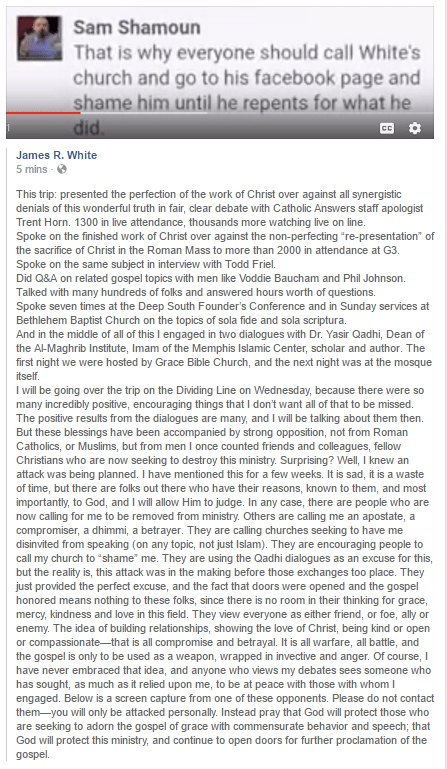
An all out Missionary Civil War is the best way to describe the fallout between a large group of Christian anti-Islamic speakers. Some of it has been covered by Br. Paul here. To make sense of it, please see the following post by Dr. James White:

cc-2017-jw-callsoutshamoun

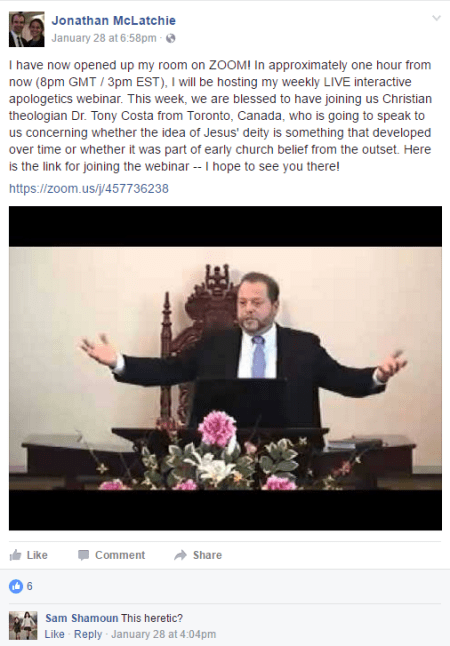
Similarly, both Jonathan McLatchie and his colleague Sam have called out Tony Costa as a heretic:

cc-2017-tc-hereticsayssam

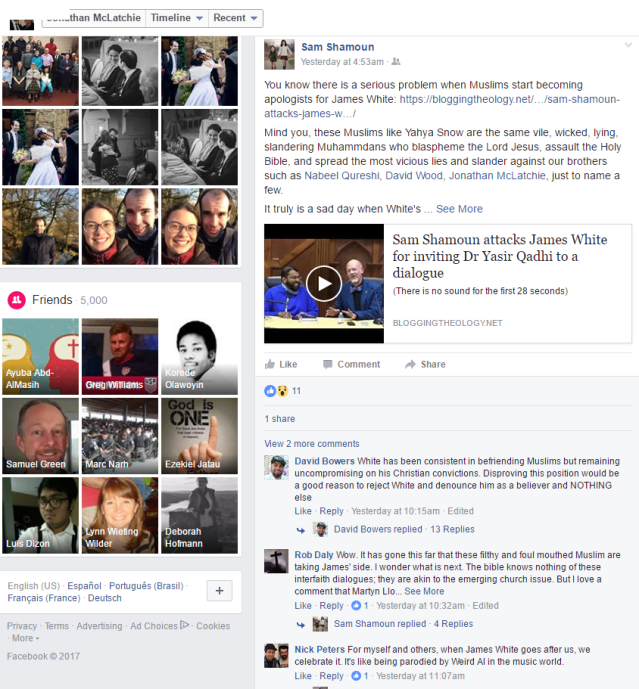
As of this posting, Jonathan McLatchie has not rebuked, nor removed the comment of his colleague referring to Tony Costa as a heretic. In the same breath, both Jonathan and his colleague have been critical of Dr. White over the last few days, with Jonathan having approved posts on his Facebook timeline denigrating and attacking Dr. White:

cc-2017-ss-insultwhiteonjmfb

Not only has Jonathan approved his colleagues post attacking Dr. White, we should also be reminded of him not correcting or disagreeing with his colleague Sam, about Tony Costa being a heretic. Shortly before the attacks on Dr. White and Costa by Jonathan and his colleague Sam, there was a falling out between the both of them. Sam had referred to three Christian debaters as being the top polemicists when it came to Islam. Jonathan was not mentioned in that listing of the top 3. It is only after Muslims pointed out the obvious snubbing of Jonathan, was his name eventually added to a later post attacking our Br. Yahya Snow.

The timeline of events can be understood as follows:

  1. Sam Shamoun attacks Dr. White because Dr. White refuted and rejected Robert Morey’s hatred of Muslims and of wanting to destroy the Kabah in Makkah. – December 17th, 2016.
  2. Dr. James White has dialogue with Dr. Yasir Qadhi. – January 24th, 2017.
  3. Sam Shamoun disagrees with Dr. James White on having Dr. Qadhi in a Church. – January 24th, 2017.
  4. Sam Shamoun proceeded to make several posts disagreeing with Dr. White, leading to some of Sam’s friends and followers calling the Churches hosting Dr. White’s events trying to get them cancelled. – January 27th, 2017.
  5. Sam Shamoun calls for a debate against Dr. White, and lists a top 3 of Christian apologists who he recommends as good on “refuting Islam”. – January 27th, 2017.
  6. Jonathan McLatchie approves Sam Shamoun’s comment referring to Tony Costa as a heretic. – January 28th, 2017.
  7. Jonathan McLatchie approves tag and post by Sam on his timeline on Facebook attacking Dr. James White. – January 29th, 2017.
  8. Muslims point out that Sam Shamoun excluded Jonathan from his list of Christians who are good in “refuting” Islam.
  9. Sam Shamoun finally gives Jonathan the attention he needs and mentions him on Facebook, Jonathan meanwhile leaves the posts attacking Dr. White and Tony Costa. – January 29th, 2017.
  10. Dr. James White makes a post directly calling out Sam Shamoun and his colleagues. – January 30th, 2017.
  11. Sam Shamoun in response to Dr. White, posts articles from Catholic apologists who openly dislike and hate Dr. White. – January 30th, 2017.
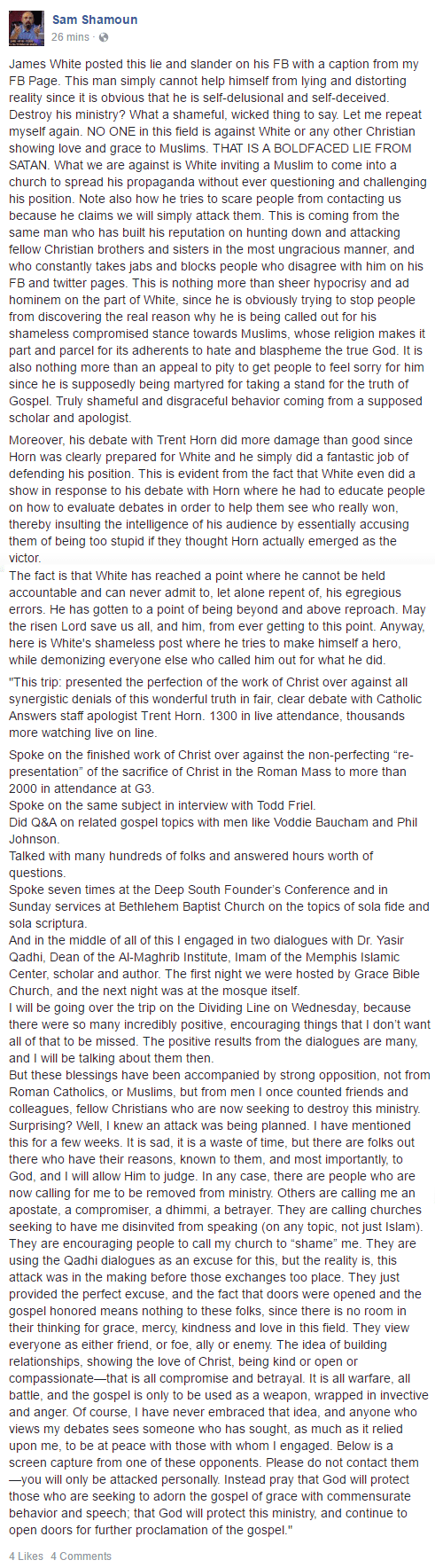
  12. Sam Shamoun’s latest response is as follows:

cc-2017-ss-responsetowhite

This is just the tip of the iceberg, behind the scenes there have been frantic emails and messages exchanged between many of the names mentioned above. Conversations, plans, tactics, agreements, all aimed at each other by Christian “apologists”. In the days to come, we’ll see how this mishap plays out. More to come.

and Allah knows best.


Mythmaking of Early Christian History by Eusebius

Question:

A lot of what we know about the early Church comes from Eusebius, is he a reliable source of information?

Answer:

In his work, Praeparatio  Evangelica (Preparation for the Gospel), Book 12, Chapter 31 is titled as follows:

“That it will be necessary sometimes to use falsehood as a remedy for the benefit of those who require such a mode of treatment.”

Eusebius makes it clear that Christians have to necessarily lie, use falsehoods for the propagation of the Gospel message. It is therefore quite difficult to trust someone who is seen as a historian who openly argues that as a Christian, it is necessary for him to use falsehoods. This is not a teaching that is hidden away or poorly translated, this is someone making it absolutely clear that lying is necessary when it comes to the Gospel message. Chapter 31 reads as follows:

“But even if the case were not such as our argument has now proved it to be, if a lawgiver, who is to be of ever so little use, could have ventured to tell any falsehood at all to the young for their good, is there any falsehood that he could have told more beneficial than this, and better able to make them all do everything that is just, not by compulsion but willingly?”

Eusebius is referencing a Platonic argument from Plato’s Laws. This argument essentially means that it’s okay to lie, it’s okay to hold a false belief, if in the end the lie benefits someone morally. An example of this is to teach the Gospel message and even if the Gospel message is false, invented, a myth, by believing in this lie, someone may stop being promiscuous. They may stop stealing due to their belief in a false Gospel message. The person does not know the Gospel message is false, they believe it to be true, and so despite unknowingly believing in a false teaching, they still morally benefit in the end.

Plato’s Laws

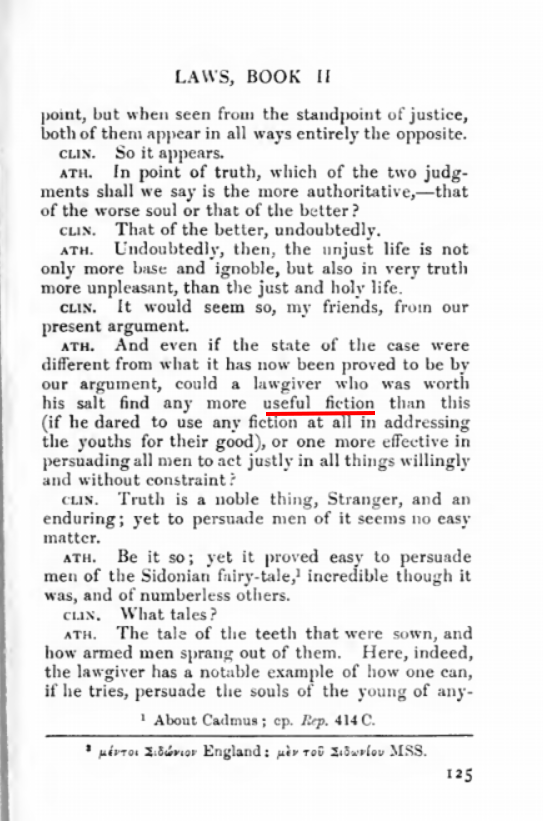
Eusebius is referencing the following argument from Plato found in Plato’s Laws (translated by R.G. Bury 1926):
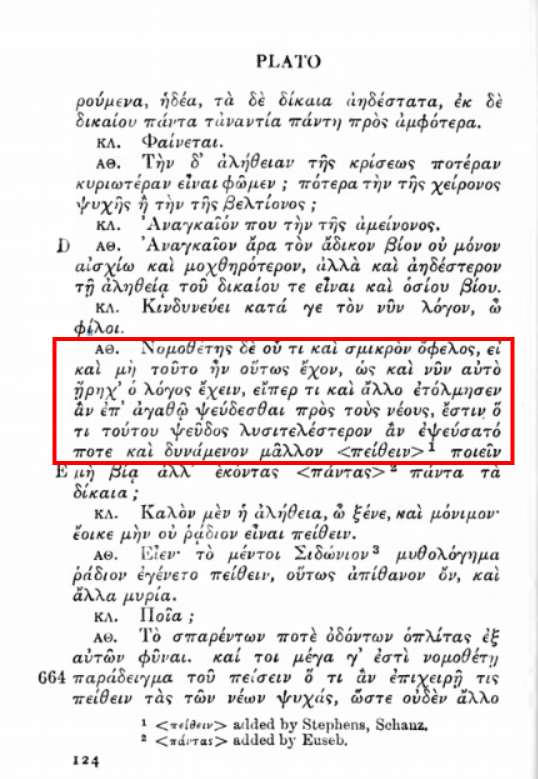
cc-2017-faq-platoslaws

The Greek phrase we need to focus on is, “ἀγαθῷ ψεύδεσθαι” (agatho pseudesthai):
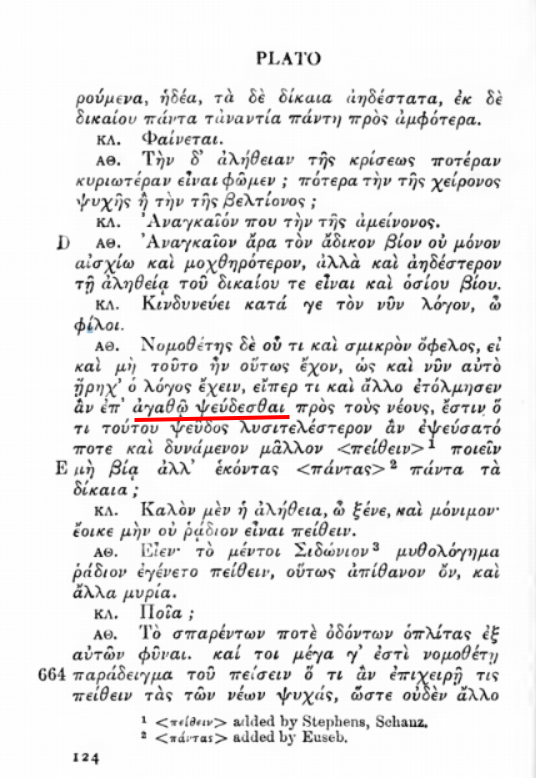
cc-2017-faq-platoslaws1

Which he translates as follows, “useful fiction”:

cc-2017-faq-platoslaws2

cc-2017-faq-platoslaws3

Plato puts forth the idea of “ἀγαθῷ ψεύδεσθαι”, or as translated, “useful fiction”. Eusebius then borrows this idea and applies it to Christianity, with the conclusion being that it is necessary to lie  as a Christian because even if the belief is false, a useful fiction, in the end a person is morally better off due to believing in that lie. As he (Eusebius) argues, “is there any falsehood that he could have told more beneficial than this“.

Christian Apologists on Eusebius’s Controversial Argument

In “The Case for the Resurrection of Jesus”, by Gary Habermas and Michael Licona, they offer a re-contextualizing of what Eusebius said. Their argument can be summarized as claiming that Eusebius’s use of the phrase, “ἀγαθῷ ψεύδεσθαι” (useful fiction, falsehood, lie), does not mean what the text says. They begin by saying on page 275:

“It may be helpful to look at the Greek employed. The word used by Plato is pseudos, which typically means a lie or imitation”.

They acknowledge that the standard use and meaning of the word, “ψεύδεσθαι”, is one of dishonesty. After establishing the normal use of the word, they attempt to argue that Eusebius (in quoting Plato), meant to argue for a “good lie”.

“However, Plato’s context and the passage may justify a nuance for the following reasons: (1) Plato uses the term, “good lie” (agatho pseudesthai), eliminating harmful intent.”

They continue:

“One translator renders the term as “useful fiction,” instead of “falsehood” (Plato in Twelve Volumes, 12 vols, R.G. Bury, trans.[Cambridge, Mass.: Harvard University Press, 1914-1935], 10.125).”

The leaps in reasoning they make are quite ridiculous to say the very least. A good lie, is still a lie. Though the intent may not be harmful, to say that it is necessary to use fiction and falsehoods to achieve some moral goal, does not preclude the fact that he argues that it is necessary, required, obligatory to use falsehoods to convince people of the Gospel message. For some odd reason, they found it important to mention that one translator uses the term “useful fiction” instead of “falsehood”. I’m not sure why they found that this difference in translation needed to be mentioned as the end result is still that Eusebius argued for the necessity of fiction and falsehoods within the Christian faith.

Usage of “ψεύδεσθαι” (fiction, lie, falsehood) in the New Testament

There are some 12 occurrences of this word in various forms throughout the New Testament, every instance of which uses it in the context of dishonesty:

  • Matthew 5:11, “…against you falsely, for my sake.”
  • Acts 5:3, “…your heart to lie to the Holy…”
  • Acts 5:4, “…in your heart? You have not lied to men…”
  • Romans 9:1, “… in Christ, I am not lying, my conscience…”
  • 2 Corinthians 11:31, “…God, I lie not.”
  • Colossians 3:9, ” Do not lie to one another…”
  • 1 Timothy 2:7, “…the truth, I am not lying) as a teacher…”
  • Hebrews 6:18, “…for God to lie, we who have taken refuge…”
  • James 3:14, “…do boast against and lie against the…”
  • 1 John 1:6, “… in the darkness, we lie and do not practice…”
  • Revelation 3:9, “…that they are Jews and are not, but lie— I will make…”

Thus, the normative use of the term in the New Testament literature, agrees with the aforementioned conclusion that it refers to dishonesty, falsehood and lying.

Conclusion

From having read both Plato’s use of the argument and Eusebius’s copying and appropriating of it, the end result is that:

  1. It is a necessity to use falsehoods to spread the Gospel message,
  2. because it is better to believe in a falsehood that makes you morally pure,
  3. than to live and behave unjustly.

Even if Eusebius had good intentions, he still considered it a necessity to lie about Christianity to win converts, for him, the ends justify the means. It would therefore be difficult to believe that his writings are historically accurate and objective. His representations of competing groups of Christian sects may not be impartial, and there is no way to validate his version of early Christianity.

and God knows best.


Missionary Mishap: Seeing Jesus Challenge

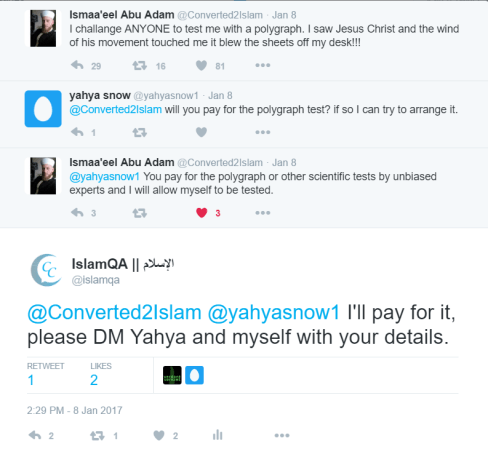
On January 8th (2017), Neil Littlejohn, or as he is fondly called by his friends and family, Colin made it known that he had a vision of Jesus:

cc-2017-mm-neil

He challenged anyone, quite literally, anyone to have him tested with a polygraph to verify that he wasn’t deluded or lying. Unfortunately, it’s been almost a week later and after offering to pay for both a polygraph test and a psychological evaluation, Colin (or Neil, or whatever identity he assumes today) has failed to take up the offer, after having put out the challenge himself.

cc-2017-mm-neil1

Has Colin/ Neil realised he was deluded and now does not want to expose himself by being tested? The challenge still stands, and so does our acceptance of the challenge. We await his response, if he ever decides to give one. However the chances of him accepting are slim, he knows he’s lying. Only time will tell.

and God knows best.

Not All Muslims are Terrorists, But All Terrorists Are Muslims

In my debate review of, “Is Islam a Threat to Modern Society,” I provided citations to prove the above assertion incorrect. To further my response, I would like to provide a complementary quote from Chris Hedges:

The Afghans, the Iraqis, the Yemenis, the Pakistanis, and the Somalis know what American military forces do. They do not need to read WikiLeaks. It is we who remain ignorant. Our terror is delivered daily to the wretched of the earth with industrial weapons. But to us, it is invisible. We do not stand over the decapitated body and eviscerated bodies left behind on city and village streets by our missiles, drones and fighter jets.

We do not listen to the wails and shrieks of parents embracing the shattered bodies of their children. We do not see the survivors of air attacks bury their mothers, fathers, brothers, and sisters. We are not conscious of the long night of collective humiliation, repression, and powerlessness that characterizes existence in Israel’s occupied territories, Iraq, and Afghanistan.

We do not see the boiling anger that war and injustice turn into a cauldron of hate over time. We are not aware of this very natural lust for revenge against those who carry out or symbolize this oppression. We see only the final pyrotechnics of terror, the shocking moments when the rage erupts into an inchoate fury and the murder of innocents. And willfully uninformed, we do not understand our own complicity. We self-righteously condemn the killers as subhuman savages who deserve more of the violence that created them.

This is a recipe for endless terror.

He continues:

Manning, by providing a window into the truth, opened up the possibility of redemption. She offered hope for a new relationship with the Muslim world, one based on compassion and honesty, on the rule of law, rather than on the cold brutality of industrial warfare. But by refusing to heed the truth that Manning laid before us, by ignoring the crimes committed daily in our name, we not only continue to swell the ranks of our enemies but put the lives of our citizens in greater jeopardy.

Manning showed us through the documents she released to WikiLeaks what all Iraqis know. They have endured hundreds of rapes and murders, along with systematic torture by the military and police of the puppet government we installed. None of the atrocities from the leaked videos and documents were investigated. Manning provided the data showing that between 2004 and 2009 there were at least 109,032 “violent deaths” in Iraq, including those of 66,081 civilians, and that coalition troops were responsible for at least 195 unreported civilian deaths.

In the “Collateral Murder” video, she allowed us to watch as a US helicopter attacked unarmed civilians in Baghdad and as a US Army tank then crushed one of the wounded lying on the street. The actions of the US military in this one video alone, as law professor Marjorie Cohn has pointed out, violate Article 85 of the First Protocol of the Geneva Conventions, which prohibits the targeting of civilians; Common Article 3 of the Geneva Conventions, which requires that the wounded be treated; and Article 17 of the First Protocol, which permits civilians to rescue and care for the wounded without being harmed.

These quotes were taken from Chris Hedges’s, Wages of Rebellion, pages 186-188.

and God knows best.

The New Testament Today

The New Testament Today – What is it? Where did it come from? Can we rely on it?

These questions and more are answered, as our journey into 2017 begins. Let this year, be a year of guidance for our Christian brothers and sisters.

YouTube Mirror if above Facebook video is not available.

Thanks to Dr. Chris Claus for inspiring this video and this series of videos that will be coming out on various pages, YouTube channels and Islamic TV channels shortly.


Missionary Mishap: Neil Littlejohn’s Liberation

Neil Littlejohn known as Collin, is “celebrating” his liberation from Islam while wearing Islamic clothing, keeping an Islamic style beard and an Islamic name. Quite the “liberation”! Though, while he reduces this year, 2016 to be the year of liberation from Islam, he seems to have forgotten that he changed his religion three (3) times in one year, the year of 2016:

cc-2016-nl-liberationtweet

Or that he changed his faith over 6 times in the last decade or so. Awkward!

and God knows best!

« Older Entries Recent Entries »