Islam and Revisionists
A few words, from a very wise man……
 and Allah knows best.

Search
A few words, from a very wise man……
and Allah knows best.
We’ll begin by responding to Jay Smith’s ridiculous email, most of which was plagiarized from Spencer’s Jihad Watch article, which is silly in and of itself. So, in responding to Smith’s email entitled, “Are Bart Ehrman’s Views on the Birmingham Fragments Correct?,” the following are my corrections of his lies and deceits:
1. Sahih al Bukhari 6:509 and 510 do not mention anything about canonizing the Qur’an or about corruption. Both hadiths mention the “fear” of corruption happening, but not the actual corruption of anything:
“…and I am afraid that more heavy casualties may take place among the Qurra’ on other battlefields…”
Therefore, the imagined claims of a yet to be canonized scripture cannot be qualified given anyone’s actual reading of either of these narrations. It then must be asked of you and not of Dr. Ehrman, if you yourself actually know the traditional story of the Qur’an’s preservation.
You mention that since these manuscripts date before the time of ‘Uthman’s alleged rescension, that this must mean they are corrupted. To the contrary, only manuscripts which were not authorized (read as modern “to be published”) were brought into conformity with the “rasm” (read as orthography) of the Prophetic tradition. The fact that the text of Mingana Arabica 1572a agrees with our modern text, clearly contradicts your assertion that it must be “examples of those very corrupted manuscripts” (a term, not found in either of the narrations you referenced).
You then proceeded to copy paste Spencer’s woeful argument that the stories mentioned in Surah 18 must have been written later, therefore the dating must be wrong. In the real world, we do not conform our theories to evidences, rather we let the evidences work for, or against our theories. In this case, it is called “proof by contradiction”, in that both you and Spencer seem unable to grasp the reality that the manuscript has been properly dated and that its text is in conformity with the traditional story of preservation. This does not mean the datings are wrong, it means your timeline of perceived development of the text is wrong. In other words, the proof of the datings, contradicts your claims, ergo you’ve been proven to be wrong.
2. For a person who has studied Islam and the Qur’an for over 20 years, you are severely uneducated when it comes to Islam and the Qur’an. You made the absurd assertion, and let me quote you here, that:
“The Qur’an, unlike the Biblical documents, was never written on papyrus….”
Jay……, Jay………, Jay. I don’t know what to say, except that not only are you wrong, you’re very wrong and at this point you’re just embarrassing yourself. Take a look at this wonderful manuscript of the Qur’an, from the 1st century AH, written in Hijazi, that’s written on….papyrus! Given that you “professionally study the Qur’an”, it esacpes me how one of the only major news stories of 2014 concerning the Qur’an would slip by you.
You went on to argue:
“So where are those four complete Qur’anic manuscripts, all from 650 AD, all of which should be identical, without any manuscript variants? A folio or two discovered here and there (Birmingham and Tubingen) do not the Qur’an make.”
I think he means codices and not manuscripts, because if he means manuscripts, then yes we do have several folios of complete manuscripts of the Qur’an that pre-date 650 CE. What manuscripts would that be? Well it would be the four from Birmingham, that’s just one example off the top of my head that would be extremely relevant to the very topic at hand! Also, as pointed out in my paper to you, we do have 100% of the Qur’an from within the 1st century of hijrah. So, to the contrary, yes, a folio or two does add up when you end up with 100% of the text you were aiming to find.
You went on to argue:
“What’s more, Ehrman seems to suggest that these two folios, dated early, thus validate the entire Qur’an as being early. Using that criteria, would he be willing to accept that the 2nd century Bodimer Papyrus and the John Rylands fragments now validate all 27 books of the New Testament? Of course he won’t, and neither do we.”
Well that isn’t Dr. Ehrman’s argument, and although we do have the entire text from within the first century of hijrah, your argument is still bad. Why is it bad? Mostly because, if we quote the Dr., his assertion, and let me quote him here (something you were unable and unwilling to do for obvious reasons), was to say the following:
“My historical question is this. If these pages of the Qur’an do indeed show that the text of the Qur’an is virtually the same in, say 630-40 CE as it is in 1630-40 as it is in 2015, that would suggest that Muslims are indeed correct that at least in some circles (it would obviously be impossible to prove that it was true in *all* circles), scribes of the Qur’an simply didn’t change it. The made sure they copied it the same, every time, word for word.”
“And so back to my question. If Muslim scholars over the centuries – from the very beginning – made dead sure that when they copied their sacred text they didn’t change anything, why didn’t Christian scribes do the same thing???”
All he’s saying is that what was copied, would somewhat prove that it was copied correctly. I’m looking for where he does not say, “these pages of the Qur’an” and where he says “entire Qur’an”, and well, I can’t find it. Essentially, what Smith did, was open his mouth, make up something, argue against that made up statement and then cheer himself for winning an argument that he himself made. It’s just embarrassing and depressing.
3. Smith claims that the 4 folios (pages) do contain variants when compared with the Qur’an of today. To the contrary, the manuscript contains 0 variants (orthography aside). What it does contain are two words that the scribe changed from the reading of Ibn Masud, and Isa b. Amr and Al-Thahak b. Muzahim on lines 13 and 30, to the reading of ‘Uthman. Therefore, the manuscript, in its state as left by the scribe does conform to the Qur’an of today. Even if the scribe had preferred the reading of one word (واشدد), it is from the Qira’at of the Prophet (ﷺ) through Ibn Masud, or if the scribe had preferred the reading of the other word (طاوى) through Isa b. Amr and Al-Thahak b. Muzahim, it is also from the Qira’at, both of which are from the Qur’an. Therefore, by all measurements, there are no variants except for the notable difference in use of the letter “alif” which is due to orthographic development.
4. Smith claims that BBC sensationalized the story by leaving out the mention that the original scribe chose to conform to the ‘Uthmani recitation in two words. Since this is an autographic text and the scribe chose to write the text according to the ‘Uthmani rasm, then it is not a variant, as it already agrees with the modern text. If the scribe had chosen to keep the two different words (one due to use of an ‘alif), it would still conform as it is from the Qira’at of the Prophet (ﷺ), which the textual critic Alba of Birmingham University also mentions.
5. Smith refers to intentional changes to conform to the published edition from his friend’s Dan’s thesis, which I tore apart as being unqualified in my paper here. Not only does Dan confuse the orthography of the Arabic language with “intentional” changes, he seemed unable to find the most basic variants that belonged to the Qira’at. Most of his paper focused on him being unable to find the variants in the Qira’at literature, yet somehow I was able to find several and without much time.
6. Smith refers to orthographic differences as “scribal errors”. I suggest he reads any book on language development or of textual criticism. Lapsus calami, or scribal errors, do not include orthographic development. If that were the case, almost all medieval NT manuscripts would then have to be considered erratic en toto because of the shift of majuscule scriptio continua to miniscule polytonic. In other words, not only is he wrong, he spent 20 years not understanding the basics of textual criticism, for someone the age of all his years of study to correct him on it (me).
7. Lastly, Smith argues that Muslims have no complete manuscript of the Qur’an:
“…it is striking that we cannot find any complete manuscripts of the Qur’an at all from any of the vast area they dominated.”
I suggest he Google’s the term manuscript. The very folios we are looking at right now from Birmingham do contain a manuscript (folio, leaf, page) that has no lacunae (Smith, this term means gaps or missing data), the recto and verso of Mingana Arabica 1572a which contains Surah 20, is complete. You’re free to see the scans yourself, which I am sure you are able to access, as I have been. You’re free to point out to me, which lines from 1 to 40 on the manuscript are incomplete. At that point, when you realise you were wrong, feel free to contact me and I’ll forgive you and pray for you.
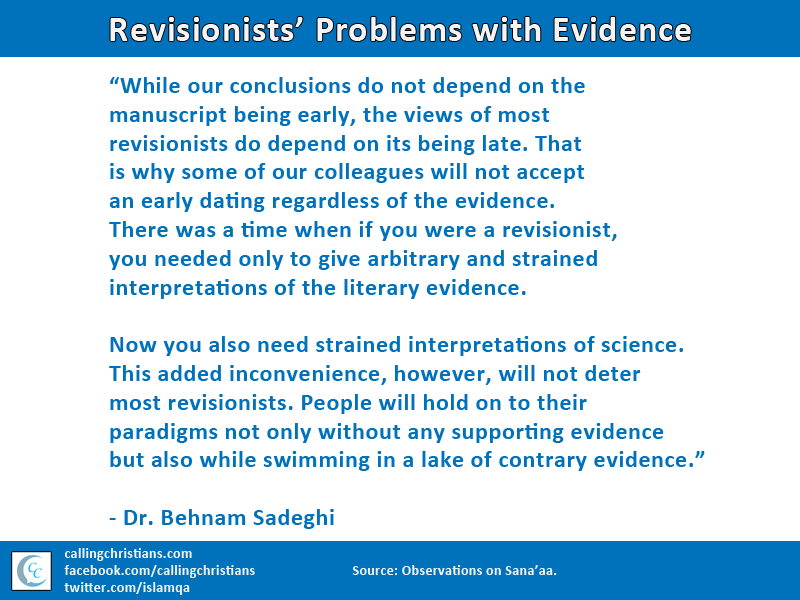
Spencer mentioned in his Jihad Watch article that the manuscripts from Birmingham cannot be dated so early due to the use of diacritical marks. However as Sadeghi has pointed out, this is a feature also from the Sana’aa C1 text:
“Surprisingly, the lower script on occasion appears to use what are possibly diacritics, in the form of perfectly round dots, to signify short vowel marks (and possibly elided alifs, i.e. hamzat al-waṣl). These dots are in the same ink as the rest of the lower writing and do not appear to have been added later.” – Arabica 57 (2010), page 359.
Why is this of significance? Well, because according to his latest datings, as linked to us by Goudarzi himself (Dr. Sadeghi’s research partner), Dr. Sadeghi dates Sana’aa C1 to the first half of the first century hijrah, the same as our Birmingham manuscripts. The same can also be found, in Qaf 47, which is also dated to the same time as our Birmingham manuscripts. In other words, Spencer is not a textual critic and as it stands, these non-Muslim textual critics seem to be in unanimous agreement about the early datings of several folios and their use of diacritical marks in the early hijazi script. Ergo, Spencer is wrong.
As a closing point, I’ve dealt with Spencer and Smith’s ridiculous claims and for the fun of it, I’ve decided to include my favourite Qadiani-Trinitarian into the mix. Nabeel, you cannot count, nor can you read. I’m sorry if you feel insulted by this, but you posted something wrong in public and it is my job to correct you when you slip up. Which these days, seems to be quite often.
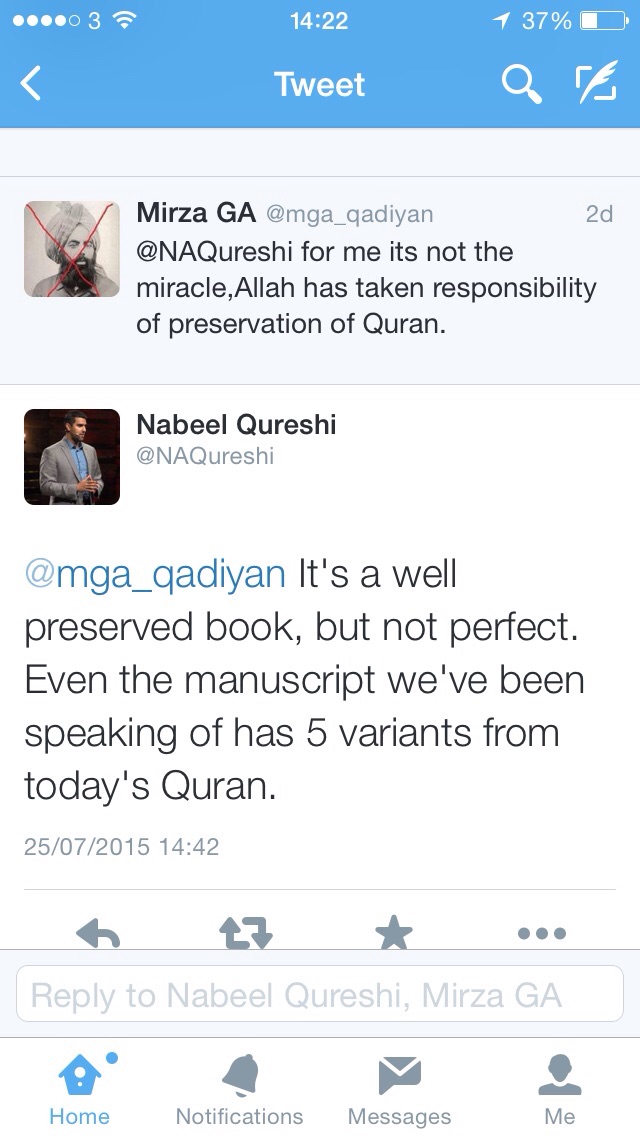
The same goes to you as it did to Smith. There are no variants in the manuscript. None. Except, if we are to be pedantic, that there are changes the original scribe made, then at the very least we can stretch to say there are two “variants”. How 2 = 5, I do not know. Hopefully, once you solve the mystery of the Trinity, you can help me solve how 0 = 5 or, for the sake of argument, how 2 = 5. I’m afraid your logic does not follow with me, and I am pretty bad at math.
Addendum:
Br. محمد بن شمس الدين has done a nice comparison image of the folios for us and he has also created a handy image, explaining what some of the symbols and numbers mean (source).

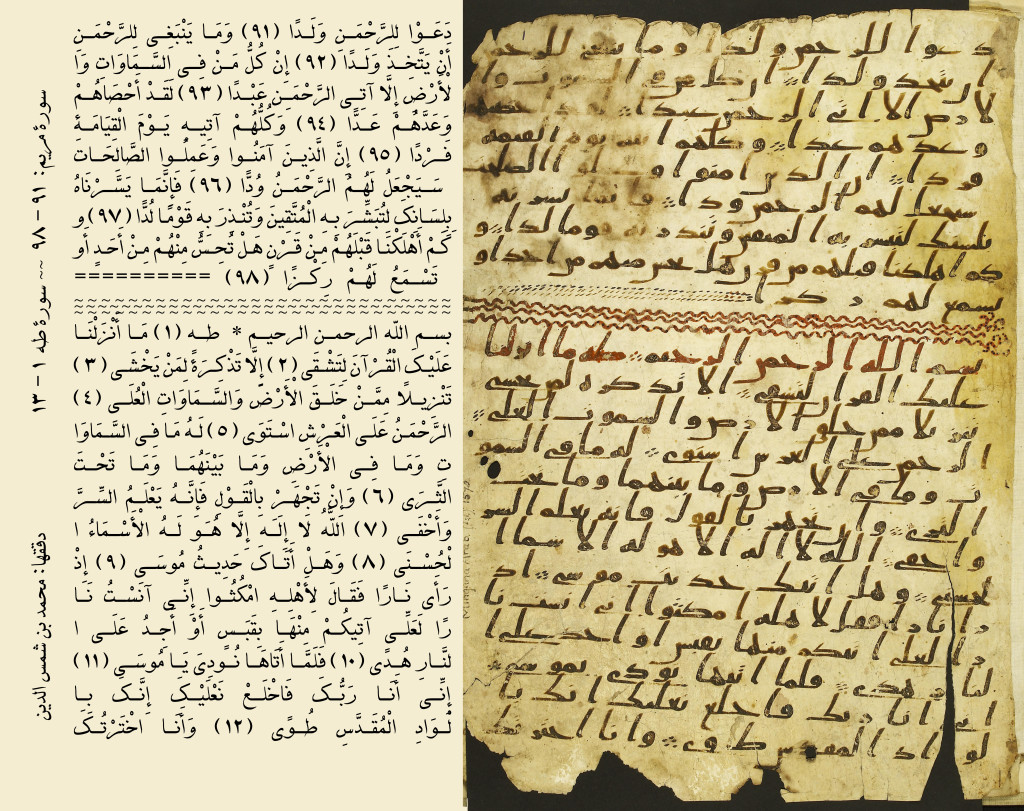
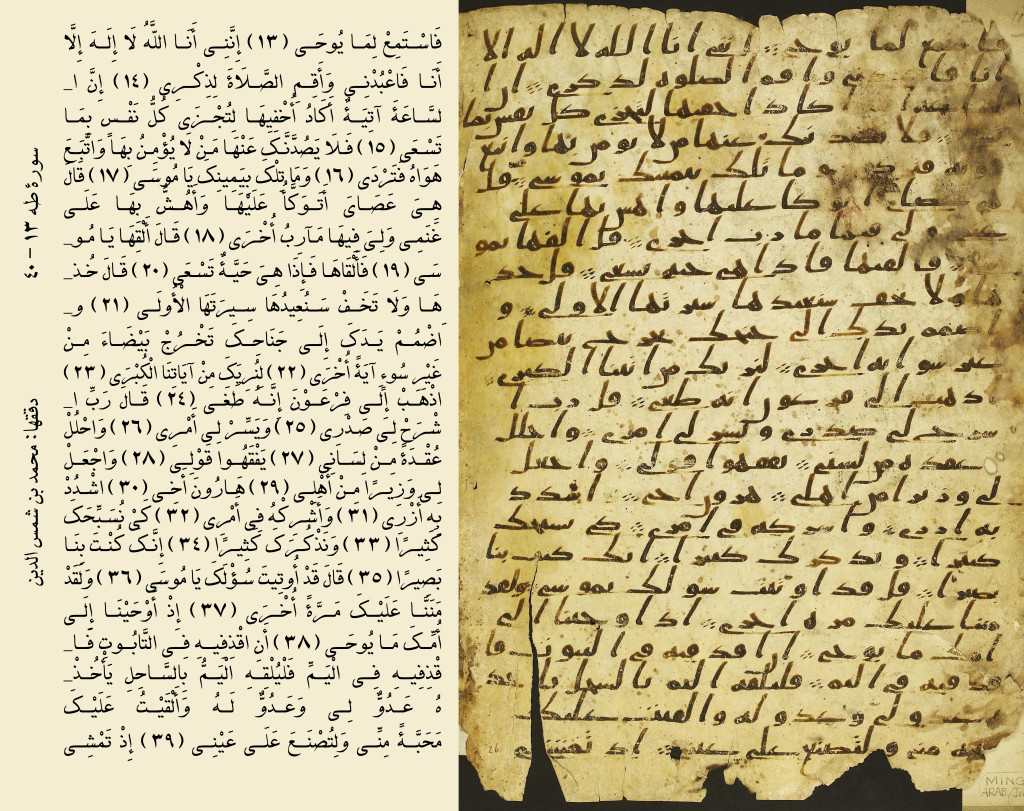
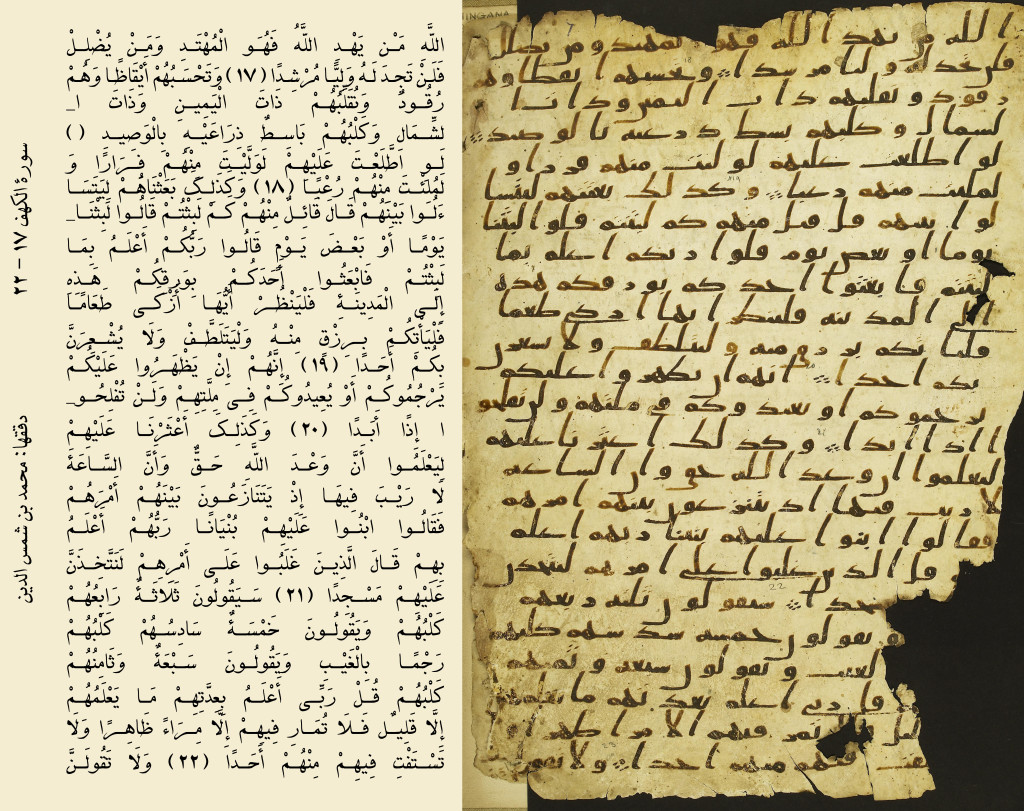

Lastly, another brother has created a PDF responding to each possible variant claim (mostly orthographic and from the qira’at) that any missionary can bring forth as an argument of “changes”. He has given me permission to publish it at my will. I will do so accordingly. It is in English and explains the Arabic quite succinctly.
and God knows best.
You won’t find mention of him in any Orientalist University or Orientalist published worked, but among the scholars of the Qur’an, he is perhaps one of the greatest to have ever lived. Today, he has passed away and with him, a wealth of knowledge which has been disseminated to thousands of Muslims globally. Shaykh Luhafi was one of the greatest scholars of the Qur’an, having specialized in the 10 Qira’at:
Shaykh Shukrī read the Ten Qira’āt in the way of Shātibiyya and Durra with Shaykh Yūsuf Abū Dayl, may Allah be pleased with him, and received the ijāza from Shaykh Abū al-Hasan al-Kurdī (d. 2009), may Allah be pleased with him. He also received the ijāza of the Ten Qira’at in the way of Shātibiyya and Durra from Shaykh Kurayyim Rājih, may Allah preserve him. He memorized the entire Qur’ān with Shaykh ‘Izz al-Dīn al-’Irqsūsī, may Allah be pleased with him, and was given the ijāza of the riwāya of Hafs from ‘Āsim.
In 1966 CE (1385 H) he began preparing his book titled Tu fat al-‘Asr fī ‘Ilm al-Qira’āt al-Mutawātirat al-Ashr. In the book he mentioned the ten Qurrā’ and their respective narrators and the variations in the recitations.
The Qur’an says:
إِنَّا نَحْنُ نَزَّلْنَا الذِّكْرَ وَإِنَّا لَهُ لَحَافِظُونَ
Indeed, it is We who sent down the Qur’an and indeed, We will be its guardian.
By Allah, Shaykh al Luhafi was one of the means through which the Qur’an was preserved. Yet, we will not see a single mention of his work, his teaching or his scholastic capabilities by any Orientalist school or publication, only those familiar with the great scholars of Islam in Damascus would know of and take knowledge from this man. We can read Deroche, but Deroche does not compare and cannot be compared to the giant that is Shakh Luhafi.
At this time of mourning we say:
إِنَّا لِلَّـهِ وَإِنَّا إِلَيْهِ رَاجِعُونَ
To read more about Shaykh Luhafi and his life, see this link.
and Allah knows best.
Louay Fatoohi is an internationally renowned scholar of religious studies, and he’s just announced that for two days only: Thursday 16th July and Friday 16th July 2015 until Midnight Pacific Standard Time (on the 16th), four of his books are available for free on Amazon Kindle! Amazon Kindle books can be read on smartphones (iOS and Android), tablets (iOS and Android), PC (Windows) and Mac (OS X) computers. Get the Apps for those devices for free here.
The Mystery of Israel in Ancient Egypt: The Exodus in the Qur’an, the Old Testament, Archaeological Finds, and Historical Sources.
The Mystery of the Crucifixion: The Attempt to Kill Jesus in the Qur’an, the New Testament, and Historical Sources.
The Mystery of the Messiah: The Messiahship of Jesus in the Qur’an, New Testament, Old Testament, and Other Sources.
Jihad in the Qur’an (Third Edition): The Truth from the Source.
Pick them up while you can.
As Salaam ‘Alaykum wa As Salaamu ‘Ala Man Ittaba al Huda,
There is currently a backlog of emails and messages in the Calling Christians inbox. While we do wish we had the time to be able respond to all of these messages, we are unable at the moment, to cater to the needs of the thousands of you that engage with us frequently. As such, for the moment we are asking that you remain patient with us and at the most, expect a one month delay in replies from our question and answer service.
In mid July, when the month of Ramadan has been completed, we intend to make a few changes and several announcements regarding new additions to our team. We apologize for the delay in service. Thank you for your continued patience.
Regards,
Br. Ijaz.
A few well put together arguments on the lack of the Gospel of John’s historicity.

Ask a Trinitarian for evidence of the divinity of Jesus and they will undoubtedly direct you to Gospel of John. In a previous article we saw how any such evidence put forward from this Gospel is ambiguous at best and often taken out of context or misinterpreted. Remove the Gospel of John from the New Testament equation and there is very little left in the Trinitarian’s armoury to appeal to for evidence of the divinity of Jesus. If you take away this Gospel, any Biblical foundation for the Trinity, ambiguous or otherwise, comes crashing down. So from a Trinitarian’s perspective the stakes for the Gospel of John are very high. This article is going to show that the Gospel of John is not a reliable historical account of the life and teachings of Jesus:
1. Lack of early evidence.
Dating the Gospel of John is no easy task. For a…
View original post 6,004 more words
Sam Shamoun’s “infinetly Better” Leprosy
Sam Shamoun’s hatred for Islam leads him to a leprosy stricken heart
Introduction
After reading one of Shamoun’s latest critique, we were convinced that Shamoun hasn’t got anything substantial to write against Islam and thus, in his desperation, he often comes up “articles” which are either outright humorous and/or ill-thought of. The latest one under question is his article where in he has biasedly compared the characters of Mohammad (peace be upon him) and Jesus (peace be upon him) around the ailment of leprosy.
Shamoun quoted a few hadith where the Prophet (peace be upon him) reportedly said, “one should run away from the leper as one runs away from a lion ” and “I seek refuge in Thee from leprosy ”. And since New Testament has recorded a handful of incidents where Jesus (peace be upon him) reportedly cured lepers, Shamoun concluded that, “Contrast this with Jesus Christ who, not only came into contact with lepers, but also inherently possessed the divine ability to miraculously and instantaneously heal them” and “Here is a case where Jesus actually touched a leper and healed them”.
It is not diffcult to realize where Shamoun is moving. He wants us to realize that where on one hand Prophet (peace be upon him) adviced his followers to run away from a leper, Jesus (peace be upon him) “Jesus actually touched a leper and healed them”! Thus somehow proving to Shamoun that “Jesus is infinitely Better And Greater than Muhammad”! But does this really prove anything that Jesus (peace be upon him) is any better or “greater” than Prophet (peace be upon him) just because he cured a few lepers here and there. We would be analyzing it in this article.
The Setup
To understand the words and deeds of both the prophets (peace be upon them) we need to understand the capacity in which both the Qur’an and New Testament present the subject proponents.
Unlike most of New Testament which is centered around the life and deeds of Jesus (peace be upon him), sometimes emphasizing, on other occassions extra-emphasizing and extra embellishing and on other occassions outright concocting words and deeds imputed to Jesus (peace be upon him), Qur’an is not a book about and around Mohammad (peace be upon him). And so you would not find Islamic text/s trumpeting miracles of Prophet (peace be upon him) as does New Testament; Qur’an is a book about The Ever-Living, not about a mortal nailed on cross!
Furthermore, since New Testament is a human handy work, Jesus (peace be upon him) authors had no restrictions at all to project him principally as a miracle working, first century, Palestinian! No wonder he roams around areas in Palestine and almost everywhere he is shown as performing miracles. Qur’an and its depiction of Mohammad (peace be upon him) is different: it does not show him to be a miracle working wizard! On the contrary, Qur’an states that Prophet (peace be upon him) was not even a guardian over his community, let alone any miracle worker!:
“Therefore do thou give admonition, for thou art one to admonish. Thou art not one to manage (men’s) affairs. But if any turn away and reject Allah,- Allah will punish him with a mighty Punishment, For to Us will be their return; Then it will be for Us to call them to account.” (Qur’an 88:20-26)
“…We made thee not one to watch over their doings, nor art thou set over them to dispose of their affairs.” (Qur’an 6:107)
“…I am not (set) over you to arrange your affairs.” (Quran 10:108)
These Qur’anic verses clearly set the tone that the Prophet (peace be upon him) need not perform leprosy cures to prove his bona fide or his “Better and Greater” status than anybody else for that matter.
Having said this, unlike Shamoun and other Islamophobes, we are absolutely at peace with the fact that Jesus (peace be upon him) healed lepers and other sufferers. Nevertheless, that does not imply that the Prophet (peace be upon him) never healed any ailment. Consider the following instances of the Prophet’s (peace be upon him) miraculous healings:
“I was beside Allah’s Prophet in the battle of Uhd…In the course of this, Qatada bin an-Nu’man [one of the Companions] was hit by an arror, and one of his eyeballs poked out. God’s Prophet, with his auspicious blessed hand, placed the eyeball back in its socket. The eye healed at once, as if nothing had happened to it, and became even better than the other one.
Reported in Bukhari (810-870) and Muslim (817-875), two authentic hadith compilations named after their compilers, it is stated that Prophet Muhammad, peace be upon him, had appointed his cousin, Ali ibn Abi Talib, as the flag-holder at the Battle of Khaybar; however, Ali had been suffering severely from a painful eye condition. The Prophet applied his healing saliva to his [Ali’s] eyes, and at that moment, the pain ceased and his eyesight became much better.” (Source)
Abdullah ibn Ateek broke his leg and Muhammad healed it by wiping his hand over it. Abdullah said it was as if nothing had happened to it! The person who witnessed the miracle was another companion, Bara’ ibn Azib (Saheeh Al-Bukhari) (Source)
Prophet (peace be upon him) and Leprosy
If Prophet (peace be upon him) did miraculously heal sufferers then what was the import of his statements with regards to leprosy as quoted by Shamoun! Here they are reproduced once again:
“one should run away from the leper as one runs away from a lion ”
“I seek refuge in Thee from leprosy ”
It is important to understand the context of the statments. We are talking about first century Islamic era when leprosy was still an incurable, contagious and deadly disease. And therefore, the first of Prophet’s (peace be upon him) statement is nothing more than a pragmatic expression for the act of quarantining the leper. When you know that medically there isn’t a solution available at the time to cure leprosy then you would but naturally and practically advice your near ones to shun interaction with the infected person especially when the ailment is contagious; in other words –, “run away from the leper”. And so we see that the stress of the prophetic statement is more on educating masses for quarantining leprosy for the sake of saving others than outcasting leper or expressing the inability or unwillingness to miraculously cure one! This is further elucidated when the subject prophetic narratives are read in conjunction with other similar Hadith narrations (which Shamoun would dare not do to in insincerity!):
“A healthy man should not be brought near a sick person” [Abu Dawud, Ahmad, Ibn majah, Ahmad and Al-Bayhaqi] (Source)
Now if Shamoun construes the Prophet’s (peace be upon him) basic, practical and medically acclaimed act of shunning/quarantining contagious diseases as him being “fallible human being since, like the rest, he had no authority to heal lepers.” then he is only exposing his desparation to somehow attack the personality of Prophet (peace be upon him) without taking into account the situation and sense in which the Prophet (peace be upon him) uttered those words.
And as far as Prophet (peace be upon him) seeking refuge in Allah (SWT) from leprosy is considered and Shamoun’s conclusion that “…Nor did he have the ability protect himself from contracting this infectious skin disease” then Shamoun is yet to understand that it in Islamic belief no inidivual, no matter who s/he is, does not possess any authority against anything/anybody except that which is granted by Allah(SWT). And thus, the Prophet’s (peace be upon him) seeking refuge in Allah (SWT) from leprosy further establishes the Islamic monotheism and a fact that in Islam only Allah (SWT) is worthy of worship and has authority over leprosy; not even the Prophet (peace be upon him).
Shamoun’s Problem
But we can understand why Shamoun faces hard time understanding these basic constructs; it is because he hails from the cultic background that narrates him all sorts of whimsical folk lores and mere legends wherein the handkerchiefs and togs of Paul and apparitions of Peter cure people, seemingly surpassing the feats accomplished by their master – Jesus (peace be upon him):
God was performing unusual miracles through Paul. Even handkerchiefs and aprons he had used were taken to the sick, and their diseases were driven away, and the evil spirits would go out of them. (Acts 19:11-12)
As a result of what the apostles were doing, sick people were carried out into the streets and placed on beds and mats so that at least Peter’s shadow might fall on some of them as he 3passed by. (Acts 5:15)
The fables of wonder-working bits of Paul and the legends of miraculous spooks of Peter obviously sets high and whimsical expectation in Shamoun and, consequently, whenever he would juxtapose these with the sincere admittance of the Prophet (peace be upon him) that he seeks refuge in Allah (SWT) from the dreaded ailment of Leprosy, Shamoun would always incorrectly and hastily come to conclusion that “More evidence that Jesus is infinitely Better And Greater than Muhammad”
End Notes:
All emphasize, wherever not matching with original, is ours.
Unless otherwise mentioned, all Qur’an text taken from Yusuf Ali translation.
Unless otherwise mentioned, all biblical text taken from Good News Translation.
A fantastic encyclopedic-like examination of Trinitarian “proof texts” in the Bible.

In a previous article we looked at ways in which the Bible disproves the Trinity. This article is going to cover the most common verses that Trinitarians use to support their belief of Jesus being divine. Each claim is followed by one or more refutations. Please note that this article will be continuously updated insha’Allah (God Willing) with new refutations as I come across them.
This is the methodology that I recommend to follow: Trinitarians tend to use unclear verses which can be interpreted in multiple ways in order to try and prove the divinity of Jesus. But as you will see from the list below, such verses often have multiple other plausible interpretations which do not necessitate the divinity of Jesus. Therefore in order to correctly understand the Bible, we need to rely on the clear parts of Scripture to explain any unclear parts of Scripture, otherwise people can play games with…
View original post 10,884 more words

Br. Ijaz Ahmad faced off in a lively and entertaining debate with Reverend Steven Martins on the topic of the true faith of Jesus’ disciples. This debate featured discussion on first century Christology, first to third century Patrology studies, form criticism of the New Testament Gospels, palaeography of the early New Testament manuscripts, oral criticism of both the Gospel and Patristic traditions. Click this link to be carried to the full debate video!
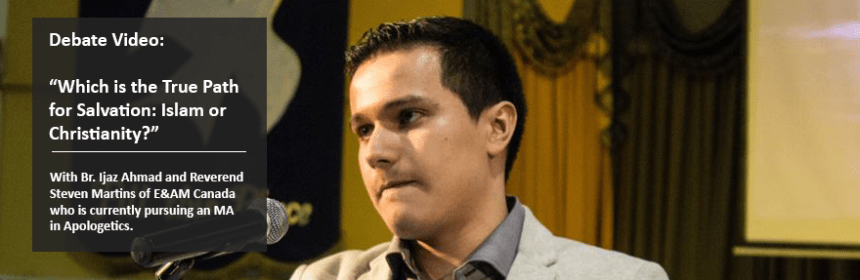
Br. Ijaz Ahmad and Reverend Steven Martins of E&AM Canada debate on the true path for salvation. In this debate, discussion focused on the errancy of the doctrine of salvation through faith and grace, the manipulating and editing of passages from the Hebrew Testament by Paul (his amanuenses or homonymous authors), the continuous message of Moses, Abraham, David, Solomon and Muhammad (peace be upon them all) that the law gives life, is not a burden and that sin can be forgiven without need for God to die. Click this link to watch the video!

 Calling Christians
You must be logged in to post a comment.