Category Archives: Muslim and Non-Muslim Dialogue

Christians Have Blasphemy Laws Too

Bismillahir Rahmanir Raheem
بِسۡمِ ٱللهِ ٱلرَّحۡمَـٰنِ ٱلرَّحِيمِ ,

Lately, there has been a lot of grandstanding by our Christian counterparts about blasphemy laws in Muslim countries. They seem to forget that they too have blasphemy laws that are still in use to this day. As it turns out, it was used this week against a former Christian, who ran a Facebook group about his apostasy. The Huffington Post reports:

A 27-year-old man has been arrested by Greek police  for what the authorities called “malicious blasphemy,” according to a HuffPost translation of a press release. Police allege that the man managed a Facebook page that lampooned the deceased Eastern Orthodox monk Elder Paisios , a widely popular religious figure, using the name “Gerontas (Elder) Pastitsios.” Pastitsios is a Greek pasta dish, and the page parodied the monk and his work in the vein of Pastafarianism, a lighthearted, satirical movement that promotes irreligion. In a screen shot of the group’s Facebook page, which now appears to have been removed from the social network, Elder Paisios is shown with a plate of pastitsios .

The Business Insider News website, has secured a translation of the police press release on the issue:

24-09-2012: H Cyber Crime Unit arrested 27-year old domestic for malicious blasphemy and kathyvrisi religions via Facebook
Athens, 24 September 2012

PRESS RELEASE

H Cyber Crime Unit arrested 27-year old domestic for malicious blasphemy and religious kathyvrisi through Facebook

The 27 year old managed page on Facebook with profane and abusive content for Elder Paisios and Orthodox Christianity

From Cyber Crime file formed Flagrant process against domestic 27 years old, who is accused of blasphemy and malicious kathyvrisi religions known through social networking sites Facebook.

More specifically, the Cyber Crime spotted recently in the famous social networking site Facebook, with data page ( http://www.facebook.com / gerontas.pastitsios ), which contained blasphemies and insults against Elder Paisios and Orthodox Christianity.

While the profane and blasphemous content of this page, the Cyber Crime has received thousands of e-complaints coming from residents of different countries around the world.

From police digital survey, conducted in conducting preliminary investigation calibrated logs (logfiles) and electronic trail of administrator – user page issue.

Then Friday (21-09-2012) morning team of specialist officers Cyber Crime held a proper inquiry, presence Prosecutors at his home at 27 years old Psachna Evia.

During the investigation found and confiscated a laptop computer (laptop). On the ground in this autopsy found that a computer administrator page in question was the 27 year old, who was arrested and the file that was formed against him led to Attorney Athens.

Recalled that, in such cases, citizens can contact the Cyber Crime, the following contact details.

Here are the blasphemy laws according to the Greek constitution which criminalizes insults against the Christian Church:

Article 198 – Malicious Blasphemy

1. One who publicly and maliciously and by any means swears blasphemes God shall be punished by imprisonment for not more than two years.

2. Except for cases under paragraph 1, one who by blasphemy publicly manifests a lack of respect for the divinity, shall be punished by jailing for not more that six months or by pecuniary penalty of not more than 3,000 euros.

Article 199 – Blasphemy Concerning Religions

One who publicly and maliciously and by any means blasphemes the Eastern Orthodox Church of Christ or any other religion tolerated in Greece shall be punished by imprisonment for not more than two years.

Waiting for the outcry of ‘creeping Christianity‘ or ‘freedom marches‘ against the ‘barbarism of Christianity‘ because of their ‘blaspheme laws‘ which are ‘archaic‘. Pretty sure you won’t see this piece of news on Jihad Watch or Answering Muslims.

wa Allaahu Alam,
and Allaah knows best.

Debate: Br. Zakir Hussein vs James White [Video]

Bismillahir Rahmanir Raheem
بِسۡمِ ٱللهِ ٱلرَّحۡمَـٰنِ ٱلرَّحِيمِ ,

Do check out my initial review of the debate here.

Br. Zakir did a wonderful job, this was his first debate in such a capacity and performed really well. Entertaining, informative and  important to both religions. A bit disappointed with James and his mistakes, expected better from a so called, ‘seasoned veteran’, nonetheless, it’s worth the watch.

wa Allaahu Alam,
and Allaah knows best.

Codex Sana’a and the Qur’an

Bismillahir Rahmanir Raheem
بِسۡمِ ٱللهِ ٱلرَّحۡمَـٰنِ ٱلرَّحِيمِ ,

There have been numerous articles, books, lectures given on the topic of the Sana’a MSS (manuscripts), but they always seem to fall short of explaining the reality of the manuscripts. What does the existence of the manuscripts mean for the Muslim and Christian community? Does it truly prove that the Qur’an has been ‘corrupted’? How reliable are the findings? Insha Allaah (God willing), I seek to answer a few of these questions and more, while aiding in the understanding of the manuscript tradition (Ulum al Qur’an, Textual Criticism) in light of the Sana’a codex.

An Introduction to the Sana’a Codex:

A codex is simply a ‘collection‘, so the Sana’a codex is the ‘collection of manuscripts from Sana’a, Yemen‘. The Sana’a manuscripts were discovered accidentally, the event is actually, quite famous history:

The manuscripts, thought to be the oldest surviving copies of the Koran, were discovered in the ancient Great Mosque of Sa’na in 1972, when the building was being restored after heavy rainfall, hidden in the loft in a bundle of old parchment and paper documents. They were nearly thrown away by the builders, but were spotted by Qadhi Isma’il al-Akwa, then president of the Yemeni Antiquities Authority, who saw their importance and sought international assistance to preserve and examine them.

From thereon, the services of Dr. Gerd Puin had been consulted:

Al-Akwa managed to interest Puin, who was visiting Yemen for research purposes in 1979. Puin in turn persuaded the German government to organise and fund a restoration project. The restoration revealed that some of the parchment pages dated from the seventh and eighth centuries, the crucial first two centuries of Islam, from which very few manuscripts have survived.

Dr. Gerd Puin’s Findings and Conclusions:

Puin noticed minor textual variations, unconventional ordering of the chapters (surahs), as well as rare styles of orthography. Then he noticed that the sheets were palimpsests – manuscripts with versions written even earlier that had been washed off or erased. These findings led Dr Puin to assert that the Koran had undergone a textual evolution. In other words, the copy of the Koran that we have is not the one believed to have been revealed to the prophet. – [1]

Understanding the Findings and Conclusions:

It is far too easy to condemn (if you’re Muslim) or support (if you’re non-Muslim) something when it’s aiding or detracting from your cause/ belief. For the Muslim, these findings are supposed to prove the Qur’an is corrupted and thus their word of God is false, to the Christian missionary, this is finally their opportunity after many failed attempts to prove that the Qur’an is not the original word of God, an argument made popular by Muslims against Christendom for several centuries. Yet, do the findings really reflect these views? For the learned, we’d answer with an emphatic “no“. Let’s examine what the findings state and then put them into context:

  • Minor textual variations.
  • Unconventional orderings of Chatpers/ Surahs.
  • Rare styles of Orthography.

Yet, before we examine the three main points above, there is a key argument that we’ve ignored, and now I’d like to bring it to light. The topic of ‘palimpsests‘.

Palimpsests and the Qur’an:

A palimpsest can be defined as, “a parchment or the like from which writing has been partially or completely erased to make room for another text. – [2]”, usually this is the missionary’s main argument when using the historicity of the Sana’a codex. They assert that because the manuscripts show that there was a ‘previous text’ before which was removed and then the current text written, the conclusion has to be that errors were made, and then emendations (alterations to text for improvement) were made, hence the current version of the Qur’an is an update from the imperfect older version as is seen in the Answering Islam article, “The End of the Qur’an as Muslims Know It“, and Faith Freedom’s,  “Ancient Qur’anic Manuscripts of Sana’a and Divine Downfall“.

However, this argument can only be blamed on abject desperation and a severe lack of education in the field of textual criticism. The world, for a vast amount of its history relied upon liturgical (oral – speaking and aural – listening) transmission of data and information. The use of texts as a primary form of transmitting data, that is, textual transmission did not become standard in the late 15th century with the advent of the printing press:

Printing with movable type had existed in East Asia at least since 1377 when the Jikji, an abbreviated title of a Korean Buddhist document was printed in Korea during the Goryeo Dynasty, however, the invention had not spread to Europe where everything people read still had to be copied by hand or printed from wood blocks carved by hand. In about 1440, the German goldsmith, Johannes Gutenberg, developed a movable type. Gutenberg made separate pieces of metal type for each character to be printed. With movable type, a printer could quickly make many copies of a book. The same pieces of type could be used again and again, to print many different books.

Printing soon became the first means of mass communication. It put more knowledge in the hands of more people faster and more cheaply than ever before. As a result, reading and writing spread widely and rapidly. – [3]

Similarly, this author goes into a bit more detail as to the development of texts (books) as a primary form of communication and mass media:

Nonetheless, books were hardly considered a mass medium because very few copies existed. Until the middle of the fifteenth century, most books were hand-copied, often times my monks. Such books were expensive and very few people could read or write. As a result, only religious orders, the ruling elite, and some wealthy merchants ever saw or owned one.

Probably the most important milestone in the development of mass communication came in 1456 with the invention of the printing press and movable type. In Mainz, Germany, Johannes Gutenberg paved the way for the reproduction of books for  the masses … – [4]

Thus the use and reuse of manuscripts was common, as Dr. Bruce Metzger and Dr. Bart Ehrman indicate with this following excerpt:

In times of economic depression, when the cost of vellum increased, the parchment of an older manuscript would be used over again. The original writing was scraped and washed off, the surface resmoothed, and the new literary material written on the salvaged material. Such a book was called a palimpsest (which means “rescraped,”). One of the half-dozen or so most important parchment manuscripts of the New Testament is such a palimpsest; its name is Codex Ephraemi rescriptus. Written in the fifth century, it was erased in the twelfth century and many of the sheets rewritten with the text of a Greek translation of treatises or sermons by St. Ephraem, a Syrian Church father of the fourth century. By applying certain chemical reagents and using an ultraviolet-ray lamp, scholars have been able to read much of the almost obliterated underwriting, although the task of deciphering it is most trying to the eyes. In A.D. 692, the Council of Trullo (also called the Quinisext Council) issued a canon (no. 68) condemning the practice of using parchment from manuscripts of the Scriptures for other purposes. Despite the canon and the penalty of excommunication for one year, the practice must have continued, for of the 310 majuscule manuscripts of the New Testament known today, 68 are palimpsests. – [5]

As I stated previously, only someone ignorant of manuscripts and their study can assert the claim that palimpsests means that a text is invalid, corrupted and emendated. While this can be the case, and I’m not saying it can’t, it is more likely that due to the cost and availability of fresh writing material, many opted to wash over and rewrite on the same manuscripts. If we take the missionary argument that the existence of a palimpsest proves the corruption of the Qur’an, then the Bible must be overwhelmingly corrupted as one major manuscript and 68 others (as documented above) fall pray to this practise. Clearly the beat the missionary is marching to will come to an abrupt halt with such information.

Palimpsests: Textual Variants and Orthography of the Qur’an:

Palimpsests for the Qur’an are extremely rare, with only one other codex known to contain them [6]. The scriptio inferior text, is the text that was washed and then written over, in the case of the Sana’a manuscripts, the scriptio inferior were never the same as the scriptio superior (the newly written text) – [7]. This would have to lead one to belief that the manuscripts were washed and rewritten to accommodate a rewriting of the texts for preservation (verses) as is testament by the Sothbey 1993 and Stanford 2007 folios where the original writing contained 30 verses, spanning 2:191-223, after the washing, the verses found on that same manuscript were lessened to 20 verses, from 2:265 to 2:286, thus accommodating an overall rewriting of the texts for preservation.  

                                                     Sana’a Manuscripts
After Wash    Before Wash                                  Source:
2:265 – 2:271 2:191 – 2:196 Sotheby’s 1993 / Stanford 2007, recto
2:271 – 2:277 2:197 – 2:205 Sotheby’s 1993 / Stanford 2007, verso
2:277 – 2:282 2:206 – 2:217 Sotheby’s 1993 / Stanford 2007, recto
2:282 – 2:286 2:217 – 2:223 Sotheby’s 1993 / Stanford 2007, verso

Some may question why there was a rewriting of the text, and this is a fair but common question. Texts are usually rewritten to reflect the standardization of a language, as is testament also in the Greek language (orthographical development, i.e liturgical transcribing):

Ancient scribes, when writing Greek, ordinarily left no spaces between words or sentences (this kind of writing is called scriptio continua), and until about the eighth century punctuation was used only sporadically. At times, of course, the meaning of a sentence would be ambiguous because the division into words was uncertain. In English, for example, GODISNOWHERE will be read with totally different meanings by an atheist and by a theist (“God is nowhere” and “God is now here”).

Furthermore, it should not be supposed that scriptio continua presented exceptional difficulties in reading, for apparently it was customary in antiquity to read aloud, even when one was alone. Thus, despite the absence of spaces between words, by pronouncing to oneself what was read, syllable by syllable, one soon became used to reading scriptio continua. – [8]

Similarly in the Arabic language it was common for one tribe or city to speak one way, but write another, yet both having the same pronunciation:

Some tribes would pronounce the word  حتی (hatta) as عتی (‘atta), and صراط (sirat) as سراط (sirat), etc., and this was the root cause of many of the known variants in recitation. Similarly the letters ا, و, ي have the dual function of consonant and vowel, as in Latin. The question of how early Arab writers and copyists used these three letters requires special attention. Their methods, though puzzling to us now, were straightforward enough to them. – [9]

Something which we can also identify with in the English language:

The Boy of Bilson: or, A True Discovery of the late notorious Impostures of certaine Romish Priests in their pretended Exorcisme, or expulsion of the Divell out of a young boy, named William Perry, sonne of Thomas Perry of Bilson,in the country of Stafford,Yeoman. Upon which occasion, hereunto is permitted A briefe Theological Discourse, by way of Caution, for the more easie discerning of such Romish spirits; and iudging of their false pretences, both in this and the like Practices. – [10]

The following words may have seemed odd to you, but they were the earliest transcribing of the orthographical development of the English language:

  • certaine – certain
  • exorcisme – exorcism
  • divell – devil
  • sonne – son
  • briefe – brief
  • easie – easy
  • iudging – judging

No one would dare say that rewriting certaine as certain is a corruption of the text, nor would rewriting divell as devil be considered corruption. These however are attempts at preserving a text as the language itself becomes standardized. As it would seem, the Sana’a manuscripts record the orthographical standardization of the transcribing of the Arabic language. In other words, the Qur’an has not been altered or corrupted, but preserved in its original tongue and to do so would have been to preserve the text by transcribing it accurately. This understanding can also be found in the hadith of Anas bin Malik (may Allaah be pleased with him) who has narrated, “‘Uthman [ra] then ordered Zaid bin Thabit, ‘Abdullah bin AzZubair, Said bin Al-As and ‘AbdurRahman bin Harith bin Hisham [raa] to rewrite the manuscripts in perfect copies. ‘Uthman said to the three Quraishi men, “In case you disagree with Zaid bin Thabit on any point in the Qur’an, then write it in the dialect of Quraish, the Qur’an was revealed in their tongue.” They did so, and when they had written many copies, ‘Uthman returned the original manuscripts to Hafsa.” [11]

The Qur’an (literally: The Recitation) when being transcribed was transcribed according to the vernacular of some scribes from throughout Arabia, therefore Uthman [ra], ordered the scribes to write the Qur’an by transcribing it, according to the tongue (liturgical transmission) of its original revelation: the Qurayshi Dialect. Therefore any such palimpsest of the Qur’an which demonstrates orthographical variants or textual variants is due to the Arabic of the Qur’an being transcribed from its mother dialect. This can be seen in other places where the use of alif as a vowel is absent yet pronounced, see the following example:

Spelling in Uthman’s [ra] Mushaf (2:9):

ومايخدعون

Actual Pronounciation:

ومايخادعون

It might seem odd that there is a text and you pronounce it differently as to how you read it, but this is the nature of Semitic languages, for referencing, here’s a screenshot of the Al Jazeera News Website (Arabic version, 23 – 09 – 2012), here you will see no vowels, yet when Arabs read the text, they’re able to comprehend and understand it, they’re able speak aloud what the text says even if there are no vowels present:

If it still seems odd, or highly suspicious, here’s a quote from JewFAQ on the matter, “Like most early Semitic alphabetic writing systems, the alefbet has no vowels. People who are fluent in the language do not need vowels to read Hebrew, and most things written in Hebrew in Israel are written without vowels. – [12]”. Therefore to put this particular claim of ‘textual variants/ orthographical differences’ to rest, it is extremely normal to see this in almost all languages (as shown: Greek, Hebrew, Arabic and English all share this) as they are developing from liturgical transmission to textual transmission and this process is deemed, ‘transcribing‘.

We can also see this in English, with the writing of short vowels, but their pronunciation is that of long vowels:

  • Cake is pronounced as ‘caaake’ a long ‘a’ sound, yet one ‘a’ is written.
  • Home is pronounced as ‘hooome’, a long, double ‘o’ sound, i.e. oo is pronounced, yet one ‘o’ is written.

For more examples, such as these, see the ‘American English Pronunciation of Long Vowel Sounds‘.

Ordering of Surahs/ Chapters:

Variances in the ordering of Surahs, i.e. Baqarah then Fatihah, do not affect the textual transmission of the Qur’an in the least. The Qur’an is not ordered chronologically, alphabetically, numerically or topically. The order of the Surahs differed in only 3 of 35,000 manuscripts – [13] and can be due to a myriad of reasons, whoever stacked the papyri into the Masjid’s roof could have been reading those manuscripts and stacked them without replacing them into order, similarly, if a missionary were to open a used stack of playing cards and found a 3 of clubs and then a 6 of hearts directly after, would he claim that the person intentionally placed the cards in that order? There are a hundred reasons why the cards would be in that order, similarly no one should claim to know why in 35,000 manuscripts, only 3 were out of order. Perhaps there was a person who was studying that set, reading that set, or learning to write that set, hence they were put aside and thus taken out of order. Unless the claimant has direct evidence as to why 3 of 35,000 was not in their usual order, they are doing nothing more than making wild guesses.

Conclusion:

The existence of the Sana’a Manuscripts do not lend any credence to the claim that the Qur’an is corrupted. Rather the existence of these manuscript – palimpsests, demonstrate the textual integrity of the Qur’an and the grammatico-historical validity of the ahadith which verify the transcribing of the tongue of the Quraysh into a mushaf (text), for which we Muslims still use to this day:

نَّا نَحْنُ نَزَّلْنَا الذِّكْرَ وَإِنَّا لَهُ لَحَافِظُونَ

We have, without doubt, sent down the Message; and We will assuredly guard it (from corruption). – Al Hijr (15:9).

wa Allaahu ‘Alam,
and Allaah knows best.

Further Reading:

Sources:

  1. Dr. Gerd Puin and Querying the Koran – Guardian Newspaper [UK].
  2. Palimpsest – Definition.
  3. History of the Printing Press.
  4. Journalism and Mass Communication – Volume 1, History and Development of Mass Communication , Laurie Thomas Lee, Sections 2 “Books” and 2.1 “The Printing Press”.
  5. Dr. Bruce Metzger and Dr. Bart Ehrman, “The Text of the New Testament: Its Transmission, Corruption, and Restoration”, pp 21 – 22, 4th Ed.
  6. K. Small & E. Puin, “UNESCO CD of San’a MSS. Part 3: Qur’an Palimpsests, And Unique Qur’an Illustrations”, Manuscripta Orientalia, 2007, Volume 13, Number 2, pp. 63-70.
  7. Manuscript Table, Islamic Awareness: Sana’a MSS.
  8. Dr. Bruce Metzger and Dr. Bart Ehrman, “The Text of the New Testament: Its Transmission, Corruption, and Restoration”, pp 21 – 22, 4th Ed.
  9. Shaykh Mustafa Muhammad al ‘Azami, “The History of the Qur’anic text from Revelation to Compilation”, page 130 – 131.
  10. Ibid.
  11. Sahih al Bukhari, Book 61: Virtues of the Qur’an, Hadith: 510.
  12. The Hebrew Alphabet (read: AlifBet), Jew FAQ.
  13. Does Dr. Gerd Puin’s Research Prove that the Qur’an has been Revised? – Br. Hamza of iERA.

Australian Roman Catholic Church Admits to Major Child Sex Abuse

Bismillahir Rahmanir Raheem
بِسۡمِ ٱللهِ ٱلرَّحۡمَـٰنِ ٱلرَّحِيمِ ,

A revealing tale of sex abuse in the Australian Roman Catholic Church, has been making waves today. Apparently this abuse stems as far as the 1930’s! The Raw Story reports:

The Catholic Church in one Australian state has revealed that at least 620 children have been abused by its clergy since the 1930s, sparking a fresh call Saturday for an independent inquiry.

The Catholic Church in Victoria revealed the number in a submission to a state parliamentary hearing on Friday but said the instances of abuse reported had fallen dramatically from the “appalling” numbers of the 1960s and 1970s.

“It is shameful and shocking that this abuse, with its dramatic impact on those who were abused and their families, was committed by Catholic priests, religious and church workers,” Melbourne Archbishop Denis Hart said.

Rights groups however, according to this BBC report, believe the number of molested and abused children by the Church clergy number closer to over 10,000 victims in one county alone:

In a statement, Archbishop Hart said it was important to be open “about the horrific abuse that has occurred in Victoria and elsewhere”.

“We look to this inquiry to assist the healing of those who have been abused, to examine the broad context of the church’s response, especially over the last 16 years, and to make recommendations to enhance the care for victims and preventative measures that are now in place,” the statement said.

Campaign groups say that many cases of abuse have gone unreported, and they believe the true number of victims is closer to 10,000 in Victoria alone.

Abuse of children by Roman Catholic priests has been a major issue in Australia recent years.

Islamophobes on the other hand, claim Islam to permit paedophilia, yet I haven’t seen a single news report indicating almost 90 years of abuse to over 10,000 kids in one county/ district in any country. These people need to take their blinders off and realise they are projecting their guilt unto Muslims, so that they can avoid facing reality, that they belong to the world’s single handedly largest paedophile endorsed religious institution.

wa Allaahu Alam,
and Allaah knows best.

Zakir Hussain Baptises James White

Bismillahir Rahmanir Raheem
بِسۡمِ ٱللهِ ٱلرَّحۡمَـٰنِ ٱلرَّحِيمِ ,

Well, that didn’t take long! The day after James White’s debate with Br. Zakir Hussain (details here, audio stream here, or right click ‘save as’ to download here), James released an article conceding to his clear ineptitude, inability to respond to well founded research and lack of basic comprehension skills. By basic I mean not being able to find a word and correctly identify its meaning, even after having used a computer to search for it (even though he’s a self claimed expert on the Greek language). I really must question not only his basic comprehension skills, but his lazy and hypocritical attitude as well. Yet, before I do so, let’s examine his statements:

First, having quoted John 1:1 in Greek a few thousand times in my life, I think I ended up trying out for a spot on the TBN team at one point last night, but without an interpreter. My apologies.

Ask a 3 year old Muslim to recite 7 ayat from Surah Fatihah and they would be able to do so with perfect pronunciation (tajweed), which I can demonstrate as being possible here and here, ask James White to repeat something he’s done several thousand times and he can’t. What’s worse is that James White even released a video condemning Shaykh Ahmad Deedat for not pronouncing the Greek of John 1:1 correctly, but James himself could not do so. In the video, he says:

Ahmad Deedat’s comments on John 1:1 were inaccurate and incorrect, you will remember that I documented that he didn’t even have the proper Greek terms…..he was actually unable to handle the Greek language, he claimed to be able to do so…..I’m not sure how you are able to properly understand his (Deedat’s arguments) upon not being able to read the language…..in the process he demonstrates that he (the person in the video, not Deedat) cannot read Greek…..he doesn’t known the difference between a v and a nu , he regularly mispronounces the words and he (the person in the video, not Deedat) just does not know the language.

Unfortunately for James, it seems as if his hypocrisy has shown through his facade of using the Greek language. If he can produce a 9 minute video condemning Shaykh Ahmad Deedat (who never formally studied Greek), as opposed to James claiming to have studied Greek and using one verse’s Greek ‘a few thousand times‘, that either means James has to produce a video condemning himself while retracting the video about Shaykh Ahmad Deedat, or James has to concede that he is largely uneducated in this field. This isn’t a situation of ‘either or’, but a situation of ‘and’. Mr. White’s pretentious use of the Greek language was also exposed by myself earlier in this earlier post. What’s worse is that he can’t read Greek by himself, as James has stated that he needs an interpreter as he wrote himself (as seen above).

 Anyway, Zakir was talking at the speed of sound in the rebuttal period (as my notes show) and it was next to impossible to keep up with the references as they flew by.

James was unable to keep up with the vast amounts of information that Br. Zakir used in his presentation, not only was James unable to match his level of research, or keep up with Br. Zakir’s arguments, James later concedes that he intentionally refused (much like a petulant child) to respond to several of the brother’s arguments. Let’s examine James’ inability to properly search for a word, he writes and I quote:

At one point he raised the issue of the Matthean reference to the prophecy (2:23) about the Nazarene. I did a quick search on my computer looking for the right reference and…got the wrong one in my haste.

As opposed to this baby who can actually use an iPhone to search for a song (you can see the baby scrolling through a list and then selecting what it wants; something which James seems unable to do!):

It’s really embarrassing to note that this man is supposed to be, keyword: ‘supposed’ to be, an intellectual of the Christian religion, a representative of their faith and he’s unable to do something for which he condemns others for. Reminds me very much of Matthew 7:1-5:

“Do not judge, or you too will be judged. For in the same way you judge others, you will be judged, and with the measure you use, it will be measured to you.“Why do you look at the speck of sawdust in your brother’s eye and pay no attention to the plank in your own eye? How can you say to your brother, ‘Let me take the speck out of your eye,’ when all the time there is a plank in your own eye? You hypocrite, first take the plank out of your own eye, and then you will see clearly to remove the speck from your brother’s eye.

Sad to say this James, but this is one time you’re going to have to face the music. James then goes on to say this:

 I did a quick search on my computer looking for the right reference and…got the wrong one in my haste. Oh, I got “branch” alright, but I wrote down the reference below what I wanted in the search list, Isaiah 14:19. My apologies. I didn’t have time to read but a single line, saw “rejected branch,” and scribbled it down.

At this point, you must be questioning James’ rationale. James searches for a word, turns out to be the wrong one, he sees a word/ phrase that looks similar to what he wanted to use and decides to give up on academic standards and just ‘wings it’, his reasoning can be seen as the equivalent to another popular right wing nut, Bill O Reilly! See his rant here:

James then ends that portion of the article with this statement:

 I will set up a donation fund for some prescription mid-range reading glasses.

James, I think you need more than glasses. There are many vocational schools that can help you with your comprehension problem, but as for your integrity and dignity, I can offer you nothing but a broom to sweep the fragments of them off of the floor (I’m sort of cheap, get the scoop yourself).

James then decided to use the age old tactic of anti-intellectual argumentation, by generalizing his opponent’s argument and then belittling his generalization:

Finally, I did not get into the issue of the wavy hair and light skin because, as anyone can see, that kind of description could have been applied to any number of the Muslims attending the debate that night, and even some of the Christians.

This is a problem, as James betrays his own methodology of searching for prophecies of Jesus the Christ in the Jewish Tanach. For example, to witness James’ double standards, in this debate with Br. Shabbir Ali, James refers to the physical description of Christ as a ‘key prophecy’, which allegedly foretold of his ‘coming’. However, apparently when a Muslim uses the same methodology of referring to a ‘physical description’, it’s belittled by James. Why can’t the argument James sources from Deuteronomy also be applied to any of the other Jewish Messiahs? Why his God? Is that not confirmation bias? James has once again betrayed any form of dignity. He continues:

the only real issue is whether the term machamad is actually the name of Muhammad. I obviously argue that such a connection is absurd.

On the same note, David is not Dawud, Echad is not Ahad, Abraham is not Ibrahim, Moses is not Musa, Iyov is not Ayub, Ketuvim is not Kutub, Miriam is not Maryam, of course, such relations are just ‘absurd’, and have nothing to do with two Semitic languages mirroring each other! He continues (to his own peril):

Utilizing verbal roots in this fashion can be used to prove anything, as I have noted already by finding both Shabir Ally and Zakir Hussain in the Old Testament using the same methodology.

Apparently James find such a method quite silly, yet ask him what Shemot (Exodus 3:14) is supposed to mean (note: it’s a series of verbs: ‘ehyeh asher ehyeh’ – I will be who I will be – future perfect tense) and that’s supposed to mean Ego Emi (a present tense statement), referring to Christ’s deity. As opposed to an actual name being used, as is clearly demonstrated above. James then concedes to making more mistakes, it just doesn’t get any better for him:

 But I did want to note two things for the sake of accuracy once again. First, at least two people have mentioned to me that I was in error on an ABN show regarding the root H M D in either Arabic or Hebrew, and I may have been, I haven’t taken the time to go back and try to find the comments.

After being corrected by two persons, and after making grievous mistakes and spreading misinformation on live TV, James still did not review his statements, nor did he try to find what was wrong with his presentation, yet he admits to using the same incorrect information during his debate:

 I do recall doing a program on a particular video on YouTube (well, we quoted material from it anyway)

In ending, James’ article is nothing short of a direct result of being baptised by Br. Zakir. The term ‘baptised’ simply means to be ‘whelmed’ that is, ‘overwhelmed’ (see Strong’s Greek Lexicon: G907, ‘βαπτίζω‘). James White, was baptised into conceding that he was misinformed, deceitful and that he demonstrated clear cut pseudo-intellectualism. Br. Zakir most certainly did excellent to evoke such emotions from James White. Please do check out his debate, you will not be disappointed.

wa Allaahu Alam,
and Allaah knows best.

Was Jesus Crucified? Sami vs White

Bismillahir Rahmanir Raheem
بِسۡمِ ٱللهِ ٱلرَّحۡمَـٰنِ ٱلرَّحِيمِ ,

Today’s event details can be found here, via the MDI Facebook invite, or here via their Events page:

MDI international speaker, Sami Zaatari debates visting american speaker, Dr James White (Calvinist Scholar) on the historical and theological arguments for truth behind the alleged crucifiction of Jesus.

Debate is hosted by Trinity Road Chapel, in South London.

Date: 19 Sep 2012
Place: Trinity Road Chapel – Trinity Road Chapel, 205 Trinity Rd, London Borough of Wandsworth, London SW17 7HW
Email: Comms@muslimdebate.co.uk

The event would be recorded and uploaded soon, insha Allaah. Br. Sami has our support and du’as, he is very proficient and well versed in this area of discourse and has many years of experience dealing with ignorant Christian missionaries, especially James White. We look forward to Br. Sami’s impending success, insha Allaah (God willing).

wa Allaahu Alam,
and God knows best.

Bart Ehrman: Bias and Presuppositions Concerning Death + Resurrection of Christ

Bismillahir Rahmanir Raheem
بِسۡمِ ٱللهِ ٱلرَّحۡمَـٰنِ ٱلرَّحِيمِ ,

Bart Ehrman explains during a debate, why his criticism of the historicity of the claim of Jesus’ resurrection is more than valid and qualified. That being, in opposition to the biased Christian view of already believing and trying to then qualify their belief. A short, but interesting and intellectually stimulating clip:

wa Allaahu Alam,
and God knows best.

A Challenge to Christians

Bismillahir Rahmanir Raheem
بِسۡمِ ٱللهِ ٱلرَّحۡمَـٰنِ ٱلرَّحِيمِ ,

The  latest mantra of our Missionary Christians friends, of which they have taken much pride in stating, is the following:

 The Qur’an is the most violent book in history!

That’s a very distasteful statement, not only does it generalize the Qur’an, it’s also quite hypocritical and dishonest. You see, the Bible has much more violent passages (as it is a generally larger book as well) than the Qur’an and it’s indeed, much more graphic. However, in response to our missionary friends, I offer one passage. It is with this passage, that I challenge any Christian to find an equitable passage or greater (in severity) in the Qur’an:

However, in the cities of the nations the Lord your God is giving you as an inheritance, do not leave alive anything that breathes. – Deuteronomy 20:16.

The challenge is therefore, quite simple. If the Qur’an contains a passage on equal footing with Deuteronomy 20:16, or worse, let me know! Otherwise, our Christian friends would have no choice but to concede that their book is the most violent.

wa Allaahu Alam,
and God knows best.

Shaykh Muhammad al Yaqoubi’s Challenge to Terry Jones

Bismillahir Rahmanir Raheem
بِسۡمِ ٱللهِ ٱلرَّحۡمَـٰنِ ٱلرَّحِيمِ ,

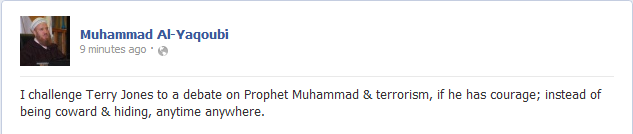
Sayyidi, Shaykh Muhammad Abul Huda al Yaqoubi al Hassani from Damascus in Syria, has moments ago released a public challenge to Pastor Terry Jones about Sayyidina Muhammad [saw]!


You can read the challenge here, via the Shaykh’s official Facebook account, or if you are Terry Jones (or a member of his Islamophobic organization), feel free to let the Shaykh know of your response via his website, ‘Sacred Knowledge‘. This is not a challenge by any da’ee, or any young Imam, this is a fully acknowledged, international heavyweight in the deen of Islam. I am certain that Terry Jones will never respond to his challenge. You can read a full biography of the Shaykh here, or an excerpt below:

He is an authority in the science of Hadith; his asanid (chains of transmission) are of the highest amongst scholars of our time. Students and scholars visit him in Syria or when he travels, to hear the masalsalat and take ijaza in narration of Hadith. In his efforts to revive the tradition of Hadith recitals, he has taught al-Muwatta of Imam Malik, Sahih al-Bukhari, Sahih al-Muslim, Sunan Abi Dawud, Jami’ al-Tirmidhi and he intends to finish all the main six books of Hadith in the coming terms insha’Allah.

He has travelled extensively and participated in conferences, delivered lectures and taught intensive programmes. Additionally, he has delivered Friday speeches in Lebanon, Egypt, Jordan, Kuwait, Saudi Arabia, Algeria, Pakistan, Denmark, Finland, Sweden, Norway, Switzerland, Germany, France, Spain, Canada, the United States, Indonesia, Singapore, South Africa, Morocco and the UK. Over a thousand people have embraced Islam at his hands and many have repented after listening to him. He is a scion of the prophetic household, a torch bearer in this time and a charismatic public speaker in both Arabic and English.

wa Allaahu Alam,
and Allaah knows best!

« Older Entries Recent Entries »