Category Archives: Muslim and Non-Muslim Dialogue

A Lesson on Rationalism

Currently reading this wonderful book when I came across the following passages and thought them to be valuable for the promotion of reading and its importance:

“The reader must come armed, in a serious state of intellectual readiness. This is not easy because he comes to the text alone. In reading, one’s responses are isolated, one’s intellect thrown back on its own resources. To be confronted by the cold abstractions of printed sentences is to look upon language bare, without the assistance of either beauty or community. Thus, reading is by its nature a serious business. It is also, of course, an essentially rational activity.

From Erasmus in the sixteenth century to Elizabeth Eisenstein in the twentieth, almost every scholar who has grappled with the question of what reading does to one’s habits of mind has concluded that the process encourages rationality; that the sequential, propositional character of the written word fosters what Walter Ong calls the “analytic management of knowledge.” To engage the written word means to follow a line of thought, which requires considerable powers of classifying, inference-making and reasoning.

It means to uncover lies, confusions, and overgeneralizations, to detect abuses of logic and common sense. It also means to weigh ideas, to compare and contrast assertions, to connect one generalization to another. To accomplish this, one must achieve a certain distance from the words themselves, which is, in fact, encouraged by the isolated and impersonal text. That is why a good reader does not cheer an apt sentence or pause to applaud even an inspired paragraph. Analytic thought is too busy for that, and too detached.”

– “Amusing Ourselves to Death”, Neil Postman, pages 50 – 51.

and Allah knows best.

Paul’s Stolen Name


It is common knowledge or should be common knowledge that Paul’s former name was Saul. Being a Jew, Paul had a Jewish name before his conversion. The day Saul changed his name to Paul is quite peculiar, if not outright absurd to say the least. In the 13th Chapter of Acts, many strange incidents occurred:

They traveled through the whole island until they came to Paphos. There they met a Jewish sorcerer and false prophet named Bar-Jesus,  who was an attendant of the proconsul, Sergius Paulus. The proconsul, an intelligent man, sent for Barnabas and Saul because he wanted to hear the word of God. But Elymas the sorcerer (for that is what his name means) opposed them and tried to turn the proconsul from the faith. Then Saul, who was also called Paul, filled with the Holy Spirit, looked straight at Elymas and said,  “You are a child of the devil and an enemy of everything that is right! You are full of all kinds of deceit and trickery. Will you never stop perverting the right ways of the Lord?

As it turns out Saul met the son of Jesus (Bar-Jesus) and Sergius Paulus. What happens next is quite unbelievable. After Saul meets Sergius Paulus, Saul’s name is then introduced in Acts as being Paul. Let’s break this down for some understanding:

  • Saul is a Jew who converts to Christianity after having a magical/ demonic experience on the road to Damascus.
  • After sometime, Saul and Barnabus travel to Cyprus to preach Saul’s new religion.
  • Saul meets a Roman General, a “Proconsul”, named Sergius Paulus or for short, “Paul” – verse  7.
  • Saul’s name then is for the first time in Acts, introduced as Paulus or for short, “Paul” – verse 9.

Strong’s Greek Lexicon, comments on the name of “Paul” by saying:

Paul or Paulus = “small or little”

  1. Paul was the most famous of the apostles and wrote a good part of the NT, the 14 Pauline epistles
  2. Paulus was a deputy or pro-consul of Cyprus and is said to be a prudent man, in the management of affairs, as a governor

According to famed Christian scholar and exegete, Adam Clarke, he says:

This is the first time the name Paul occurs, and the last time in which this apostle is called Saul, as his common or general name.

Another famed exegete, James Coffman of the Coffman Commentaries on the Bible, in his exposition of Acts 13:9, quotes J.W. Conybear’s analysis of the verse and makes the following comment:

Conybeare said, “We cannot believe it accidental that the words `who is also called Paul’ occur at this particular point.” He made the deduction that the conversion of Sergius Paulus brought the name Paul to the surface and precipitated the use of it.

Therefore, our conclusion has to be that Paul copied the name of Sergius Paulus, as the coincidences are too great and obvious, to simply be a name that Saul assumed for himself. As such, even Christian scholars such as J.W. Conybeare and John Gill (as quoted above) admit that Saul’s usage of the name Paul is due to his meeting with Roman General, Sergius Paulus. What are we supposed to understand from Paul’s stealing of another person’s name, especially of a man who had a Jewish magician/ sorcerer as his aide and teacher:

The fact of Bar-Jesus’ having been a Jew suggests that Sergius Paulus had made inquiry into the beliefs of the Jews and may therefore be presumed to have had some knowledge of the sacred Scriptures. As MacGreggor admitted, “there would be nothing extraordinary in a Roman official having a Jewish teacher in his house.” – Ibid.

This concession by Christian scholarship casts a shady aura upon Paul, sorry, Saul of Tarsus. For what reason he copied the person’s name, or began using it exclusively after meeting his namesake, is unknown, but most interesting indeed.

wa Allaahu ‘Alam.


  • Note: Originally published on Oct. 19th, 2012. 14:45. 
  • Fixed error referencing John Gill instead of James Burton Coffman.
  • Error noted by users flightjam and defendchrist.

The Problem of Luke 23:34

Introduction

Luke 23:34 is perhaps one of the most interesting verses in the New Testament narrative of Jesus, the son of Mary’s alleged crucifixion. It reads as follows[1]:

Jesus said, “Father, forgive them, for they do not know what they are doing.”[c] And they divided up his clothes by casting lots.

Our interest is primarily focused upon the prayer[2] of Jesus. The questions which are being asked are, why is Jesus praying for these men’s forgiveness? What purpose does it convey? What does it achieve? These questions need to be asked, as Jesus’ prayer in this case, occurs before his eventual death on the cross which is supposed to have ushered in a new covenant with God, a new doctrine of salvation. His death and resurrection which establishes itself as the pillar upholding the veracity and validity of the Christian faith as declared by Paul of Tarsus:

And if Christ has not been raised, our preaching is useless and so is your faith.[3]

Summarily, we are seeking to establish the reasoning for this prayer of forgiveness, in regard to its timing of the slaying of the lamb[4] for the forgiveness of the sins of the world[5], inclusive of those of the Jews and Romans who were no doubt instrumental in the events leading to the crucifixion event.

New Testament Textual Criticism of Luke 23:34

It would be inane to discuss the consequences of the verse in question at length, before establishing its place in the New Testament canon. Most would be unaware that this verse’s place in the canon is one of disputation and doubt. It would be of note to mention that the verse is recorded in the following versions of the English Print Editions of the New Testament [6]:

  • New International Version
  • New Living Translation
  • English Standard Version
  • New American Standard Bible
  • King James Bible
  • Holman Christian Standard Bible
  • International Standard Version
  • NET Bible
  • Aramaic Bible in Plain English
  • GOD’S WORD® Translation
  • Jubilee Bible 2000
  • King James 2000 Bible
  • American King James Version
  • American Standard Version
  • Douay-Rheims Bible
  • Darby Bible Translation
  • English Revised Version
  • Webster’s Bible Translation
  • Weymouth New Testament
  • World English Bible
  • Young’s Literal Translation

It had become necessary to list the instances of its presence in the English translations, as it is the language in which this article is being written. It was also necessary, so as to demonstrate its undoubted and frequent presence in the most accessible New Testament print editions in the English language. A noted citation in the NIV[7] translation reads as follows:

c. Luke 23:34 Some early manuscripts do not have this sentence.

Its presence in most translations is due to the verse’s presence in the modern critical editions of the Greek New Testament. As of this writing, it remains in the critical editions as is demonstrated by the Nestle-Aland 28th Greek New Testament[8]:

ὁ δὲ Ἰησοῦς ἔλεγεν· πάτερ, ἄφες αὐτοῖς, οὐ γὰρ οἴδασιν τί ποιοῦσιν. διαμεριζόμενοι δὲ τὰ ἱμάτια αὐτοῦ ἔβαλον κλήρους.

Codex Aleph  (א- Sinaiticus) does contain this verse[9], although atleast one of its suggested scribes or editors is thought to have edited or corrected the verse in question[10]. However Codices B (Vaticanus) and D (Bezae) do not contain this verse[11], thus explaining the citation in the NIV translation. At the time of this writing, I do not have access to the apparatus of the Nestle Aland 28th Edition Greek New Testament, therefore I was unable to attain the reasons or sources it outlines for the inclusion of the verse. However, in reading the erudite work of Bruce Metzger and Bart Ehrman, we note that it states the following in regard to its intentional omission in other codices[12]:

…an omission that makes particular sense if Jesus is understood to be asking God to forgive the Jews responsible for his crucifixion.

Their understanding of the omission is in the context of Jewish-Christian relations, more specifically, anti-Jewish Christian scribes within the first centuries of Christianity and the consequential promulgation of their views in Christian literature. The omission was meant to remove the view that Jesus the Christ had prayed for the forgiveness of the Jews for their role in his crucifixion[13]. There is also a Textual Critical maxim, which reads as follows: “lectio difficilior potior” – the more difficult/nonsensical reading is more evidential. Given that their is a possibility of intentional omission, then their is great possibility it was included in the earlier copies of the Gospel.

Having explored its place in the canon and the evidences for its inclusion, there is now no doubt that at the time of this writing, New Testament Textual Critics adhere to its inclusion despite its omission from two important early sources.

The Prayer in Light of the New Covenant & its Soteriological Plan

The traditional Christian soteriological belief in this doctrine of salvation by the Christ’s crucifixion can be understood in the following quote[14]:

Christ upon the cross, is gracious like Christ upon the throne. Though he was in the greatest struggle and agony, yet he had pity for a poor penitent. By this act of grace we are to understand that Jesus Christ died to open the kingdom of heaven to all penitent, obedient believers.

With his sacrifice, the gates of heaven were opened to the world[15]. The Gospel accounts inform us that Jesus the Christ a priori knew that he had to be crucified, we read:

And he said, “The Son of Man must suffer many things and be rejected by the elders, the chief priests and the teachers of the law, and he must be killed and on the third day be raised to life.”[16]

The Son of Man will go as it has been decreed. But woe to that man who betrays him!”[17]

‘The Son of Man must be delivered over to the hands of sinners, be crucified and on the third day be raised again.’ ”[18]

The Son of Man will go just as it is written about him. But woe to that man who betrays the Son of Man! It would be better for him if he had not been born.”[19]

Since it is established in the narrative, as ascertained from the verses listed previously that his eventual crucifixion and death would lead to the payment of the sins of the world, then it is a strange occurrence that the Christ would pray for someone’s forgiveness. If he knew his death was imminent and with that, forgiveness would be brought upon the world, why would he beseech the Father for the forgiveness of others? Perhaps an analogy can demonstrate the peculiarity and absurdity of this event. It is as if I had a letter in my possession. Knowing that I’m about to use a photocopying machine to duplicate that letter, just before I use the photocopier, I choose to handwrite the letter on a sheet of blank paper and then photocopy the original letter. It’s redundant, anachronistic, futile. Jesus undoubtedly knows that the entire world, inclusive of those men before him; that he is about to pay for their sins, yet he prays to the Father just before his death that their sins should be forgiven. Regardless of someone’s theological, philosophical or personal views, the oddity of this occurrence is striking.

Such an understanding is noted by the exegete Matthew Henry, for he states[20]:

As soon as Christ was fastened to the cross, he prayed for those who crucified him. The great thing he died to purchase and procure for us, is the forgiveness of sin.

In essence, he prayed for the same thing that his death would achieve. Some might postulate that this is a sign of Jesus’ mercy and love for mankind, as is held by Stier et al; we read from the Pulpit Commentary the following[21]:

Then, as always, thinking of others, he utters this prayer, uttering it, too, as Stier well observes, with the same consciousness which had been formerly expressed, “Father, I know that thou hearest me always.” “His intercession has this for its ground, though in meekness it is not expressed: ‘Father, I will that thou forgive them.”

While such an apologetic exegesis would placate some, I do not find it to be sensible. For, if Jesus the Christ, who is also the Son; a deity capable of forgiving sin as is claimed from Luke 7:48[22], then why did the Son simply not forgive the sins of the world, or the sins of the Roman and Jewish persecutors? He clearly had the ability to do so, the authority to do so, so why would the Son choose not to do this? Instead, the Son as we are led to believe, chooses to beseech the Father! This prayer therefore leads to an even greater problem, (it implies) subordination and hierarchy within the Trinitarian dogma. Beliefs tantamount to heresy when tested against the proto-orthodoxical Nicaean creed[23], which establishes the Son as co-equal to God[24]:

Such is the genuine doctrine of Arius. Using Greek terms, it denies that the Son is of one essence, nature, or substance with God; He is not consubstantial (homoousios) with the Father, and therefore not like Him, or equal in dignity, or co-eternal, or within the real sphere of Deity.

Jesus the Christ, otherwise known to Christendom as the Son, had the ability to forgive sins, he did not need to request that the Father do this. If he prayed out of love, mercy, grace and compassion for the forgiveness of the sins of the Roman and Jewish persecutors, then why did he not use this love, mercy and grace to absolve them of their sins? He is in essence, praying for something he could already grant them, therefore this excuse is redundant and unremarkable, in clear contradiction of this fanciful idea of proposed love, mercy, grace and compassion.

Did They Need to be Forgiven?

Whether the prayer was uttered in reference to the Jews, the Romans, or some combination of those peoples; did they need to be forgiven? Forgiving them would readily imply that their actions were sinful, criminal, morally wrong. However as we are well aware, and as I have previously stated, the sacrificing of a sacrificial lamb is the purpose[25] of Christ’s earthly mission. This prayer for forgiveness would then have us believe that the sacrifice was morally wrong according to Jesus himself! The significance of such a prayer is now very telling, it is detrimental to the sacrificial imagery steadily enforced throughout the New Testament and as referenced previously[26]. Christians do not believe that Christ’s sacrifice was sinful or wrong, it is the very foundation of their faith as we had read from the Apostle Paul[27]!

We are at an unfortunate dilemma, Christ’s prayer now seems to be undermining the very pillars of proto-orthodox Christian belief. If it was God’s will that the world be saved from their sins by the hands of the Romans and Jews, then it is absurd that we should consider the persons responsible for the crucifixion as sinful individuals. Rather, if the Christian world is to be consistent with their beliefs, these men should be celebrated, just as the cross is celebrated. However, if it is the case that Jesus considered his persecutors that led to his crucifixion as criminals, as murderers, then the possibility of Jesus’ death being labeled as a crime and an injustice done to him is significantly more appropriate and honest. Such a view would be in blatant violation of the Christian world view on salvation. Perhaps what is more troubling is the position of those who perform the Passover sacrifice, we read the following[28]:

“Get rid of the old yeast, so that you may be a new unleavened batch—as you really are. For Christ, our Passover lamb, has been sacrificed.”

If Jesus the Christ is to be considered the sacrificial lamb, then those who perform the sacrifice for Passover have been atoned of their sins as is clearly stipulated in the Pentateuch[29]:

For the life of a creature is in the blood, and I have given it to you to make atonement for yourselves on the altar; it is the blood that makes atonement for one’s life.

If we are to believe that Luke 23:34 is in relation to the Jews, then Jesus’ prayer of forgiveness for them is troubling, for it would then imply that the very God of the Jews, did not know that the sacrificing of the Passover lamb was not a crime, but an act of atonement for the Jews.

Conclusion

There are very few cases in which we can understand the purpose of this prayer. One scenario is that Jesus did not expect his death to open the gates of forgiveness and that he did not have the ability to forgive sins by his own will and authority, therefore his prayer to God was one in sincerity. However, if he did know that his eventual death would lead to the world’s forgiveness and that he had the ability to forgive sins without any sacrifice, then his prayer to God seems out of place and problematic to the narrative, rendering his prayer to be completely redundant and meaningless.

Another case in which we can perhaps derive some closure on the issue, is that if Jesus was in fact the sacrificial Passover lamb, then his prayer for forgiveness for the Jews, would mean that he either did not know the laws of the Pentateuch, or that he did not consider himself to be a sacrificial Passover lamb; the latter belief would then render Paul a liar and would cause the Christian faith to be false as per his declaration in 1 Corinthians 15:14.  The former argument would then have us believe that Jesus could not be a deity as he is ignorant of the very law which he would have instructed the Jews himself.

Whichever way the prayer is examined, as I have aptly demonstrated it is of grave detriment to the Christian faith and without a doubt its place in the Biblical canon is of service to those who which to prove that Jesus the Son of Mary, is not and has never been a deity.

and Allaah knows best.

Sources (APA Style):

[1] –  Holy Bible, New International Version®, NIV®. (2011). Luke 23:34. Retrieved from http://www.biblegateway.com/passage/?search=Luke%2023&version=NIV

[2] – Concise Commentary on the Whole Bible by Matthew Henry. (2003). Luke 23:34. Retrieved from http://biblehub.com/commentaries/mhc/luke/23.htm

[3] – Holy Bible, New International Version®, NIV®. (2011). 1 Corinthians 15:14. Retrieved from http://www.biblegateway.com/passage/?search=1+corinthians+15%3A14&version=NIV

[4] – Holy Bible, New International Version®, NIV®. (2011). Revelation 5:12. Retrieved from http://www.biblegateway.com/passage/?search=Revelation+5%3A12&version=NIV

[5] – Holy Bible, New International Version®, NIV®. (2011). John 3:16. Retrieved
from http://www.biblegateway.com/passage/?search=John+3%3A16&version=NIV

[6] – Bible Hub’s Parallel Verses. (2014). Luke 23:34. Retrieved from http://biblehub.com/luke/23-34.htm

[7] – See: [1]

Note: The Pulpit Commentary, Ibid, relates the same conclusion as I have written:

” These words are missing in some of the oldest authorities. They are found, however, in the majority of the most ancient manuscripts and in the most trustworthy of the old versions, and are undoubtedly genuine.”

[8] – Nestle-Aland Novum Testamentum Graece. (2013). Luke 23:34. Retrieved
from http://www.nestle-aland.com/en/read-na28-online/text/bibeltext/lesen/stelle/52/230001/239999/

[9] – Codex Sinaiticus. (2009). Luke 23:34. Retrieved
from  http://codexsinaiticus.org/en/manuscript.aspx?book=35&chapter=23&lid=en&side=r&verse=34&zoomSlider=0

[10] – Ibid. See the transcription notes, Editor cb2.

[11] – Cambridge Bible for Schools and Colleges. (1891). Luke 23:34. Retrieved from http://biblehub.com/commentaries/cambridge/luke/23.htm

[12] – Ehrman, B., & Metzger, B. (Eds.). (2005). The Text of the New Testament: Its Transmission, Corruption and Restoration (4th ed.). New York, NY: Oxford University Press.

[13] – Ibid.

[14] – See: [2]

[15] – See: [5]

[16] – Holy Bible, New International Version®, NIV®. (2011). Luke 9:22. Retrieved
from http://www.biblegateway.com/passage/?search=Luke+9%3A22&version=NIV

[17] – Holy Bible, New International Version®, NIV®. (2011). Luke 22:22. Retrieved
from http://www.biblegateway.com/passage/?search=Luke+22%3A22&version=NIV

[18] – Holy Bible, New International Version®, NIV®. (2011). Luke 24:7. Retrieved
from http://www.biblegateway.com/passage/?search=Luke+24%3A7&version=NIV

[19] – Holy Bible, New International Version®, NIV®. (2011). Matthew 26:24. Retrieved
from http://www.biblegateway.com/passage/?search=Matthew+26%3A24&version=NIV

[20] – See: [2]

[21] – The Pulpit Commentary. (2010). Luke 23:34. Retrieved from http://biblehub.com/commentaries/pulpit/luke/23.htm

[22] – Holy Bible, New International Version®, NIV®. (2011). Luke 7:48. Retrieved
from http://www.biblegateway.com/passage/?search=luke+7%3A48&version=NIV

[23] – The Nicaean Creed. (n.d.). The Nicaean Creed. Retrieved from http://www.creeds.net/ancient/nicene.htm

[24] – Barry, W. (1907). Arianism. The Catholic Encyclopedia. New York: Robert Appleton Company. Retrieved June 11, 2014 from New Advent: http://www.newadvent.org/cathen/01707c.htm

[25] – See: [16], [17], [18], [19]

[26] – See: [4]

[27] – See: [3]

[28] – Holy Bible, New International Version®, NIV®. (2011). 1 Corinthians 5:7. Retrieved
from http://www.biblegateway.com/passage/?search=1%20Corinthians%205:7&version=NIV

[29] – Holy Bible, New International Version®, NIV®. (2011). Leviticus 17:11. Retrieved
from http://www.biblegateway.com/passage/?search=Leviticus%2017:11&version=NIV


James White Lied to his Audience, Fails to Fulfill his Offer

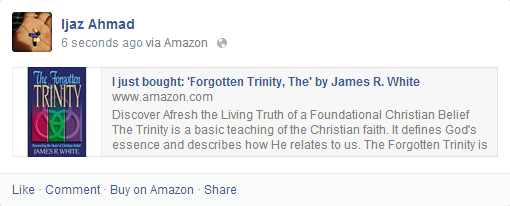
As most would know, at the end of my discussion with James on his Dividing Line program, he offered me a copy of his book, “The Forgotten Trinity”. After emailing him (numerous times) and failing to receive a single response, I have bought the book myself. It would seem that James was very happy to deceive his audience by pretending to send me a copy of his book, his attempt at extending a hand towards interfaith dialogue was nothing more than a charade to boost his ego.

cc-2014-jameswhite-amazon

I have already read one chapter of the book provided by a colleague from Beirut, Lebanon. Fortunately, I’ve also had the pleasure of reading another book on explaining the Trinity, “What is the Trinity“, by RC Sproul. It’s free at the moment, so go grab the Kindle version! In comparing the two books, James’ diatribe is overtly verbose – this generally happens when a person struggles to explain the topic under discussion. Admittedly, the Trinity is a problematic theological invention, therefore we should expect it to be difficult to explain. I’ve written on RC Sproul’s book here. He happens to be excellent at explaining the development and creation of the Trinity, he states:

“The concept of the Trinity has emerged as a touchstone of truth, a non-negotiable article of Christian orthodoxy. However, it has been a source of controversy throughout church history, and there remains much confusion about it to this day, with many people misunderstanding it in very serious ways.”

This is direct and straight to the point. We Muslims agree that it’s a controversial belief, that Christians remain confused about it and that Christians misunderstand the central belief of Christian theology in very serious ways. It’s a great book for Muslims willing to see how Christians understand and misunderstand the Trinity, it’s a very candid book that can help us give da’wah to Christians from a more studied position.

I’d like to thank James White for demonstrating that he deals in bad faith, cannot hold to his word and unfortunately, he saw it appropriate to lie to his congregation without any hesitation. A fine example of Christian scholarship.

and God knows best.

The Pauline Problem

Paul has always been a controversial figure in the Christian faith. Some scholars like Dr. Tabor and Prof. Eisenman have identified Paul as the HaKohen Harasa, the “Wicked Priest” as is recorded in the Dead Sea scrolls. Proto-Orthodox Christians believed he was an Apostle of God, and thus a central and authoritative figure of the Christian faith. Islam’s view of Paul is largely negative, most viewing him as a corrupter of the faith of Jesus the Son of Mary, a similar belief to that of the views attributed to the authors of the Dead Sea Scrolls, the people of Qumran.

The Disciples of Jesus

The problem of Paul though, begins with the problems of the disciples. We must understand that the disciples were the ones chosen by God to accompany the Christ in his mission throughout the lands of Palestine. Richard Newton writes in his book, “The Life of Jesus for the Young“, he states the following, “It was necessary for these men to be chosen.” These men were chosen to accompany the Christ, so that they could have learned from him, seen his ways, studied from his teachings and from then on, to continue the work that the Christ had started. It is recorded in Matthew 10:5-6, the following commands of Jesus the Christ:

“These twelve Jesus sent out with the following instructions: “Do not go among the Gentiles or enter any town of the Samaritans. 6 Go rather to the lost sheep of Israel.”

This command is very important, Jesus the Christ is delimiting the disciples on the scope of their missionary work. He directs them to absolutely convey the message he preaches, to the sheep of Israel. To further confirm this message of being sent to only the twelve tribes of Israel, we read from Matthew 15:21-28:

“21 Leaving that place, Jesus withdrew to the region of Tyre and Sidon. 22 A Canaanite woman from that vicinity came to him, crying out, “Lord, Son of David, have mercy on me! My daughter is demon-possessed and suffering terribly.” 23 Jesus did not answer a word. So his disciples came to him and urged him, “Send her away, for she keeps crying out after us.” 24 He answered, “I was sent only to the lost sheep of Israel.” 25 The woman came and knelt before him. “Lord, help me!” she said. 26 He replied, “It is not right to take the children’s bread and toss it to the dogs.” 27 “Yes it is, Lord,” she said. “Even the dogs eat the crumbs that fall from their master’s table.” 28 Then Jesus said to her, “Woman, you have great faith! Your request is granted.” And her daughter was healed at that moment.”

There are many things to be learnt from here, but the most important are:

  • Jesus reiterates the scope of his preaching, that is, to the sheep of Israel.
  • The curing of the Canaanite woman’s daughter is an exception to the rule and not the rule in itself.
  • The disciples witnessed this incident and learnt from it

This passage is unfortunately misrepresented by many Christians to demonstrate that Christ’s message was for all peoples, as in the example above he cures a Canaanite girl. The problem for those who interpret this passage in such a way, is that Jesus did not state that this was his new philosophy, he reiterates, emphasizes only a few verses before that he was sent only to the lost sheep of Israel. His curing of this woman’s daughter, is an exception to the rule and not a rule in itself. This is often difficult for Christians to digest. Jesus explicitly states who he was sent for, and him doing an act contrary to his own teachings would label him a liar. Surely, the Christ is not a liar, he still retained the belief that he was only sent for the lost sheep of Israel, after curing this Canaanite girl. There is no passage in which he goes off after this incident and preaches to the gentiles, therefore this incident was an exception to the rule and not the rule in itself. It is important to note that the disciples witnessed this, we need to hold this point in mind for now, as it will correlate with what we read further on.

These disciples were chosen by the Christ, to teach God’s message as instructed by the Christ. They were to carry on after him, or carry the message in whichever city or town he directed them to.

The Dilemma

If the disciples were specifically chosen by the Christ to spread the message given to him by God, then the Christian faith would have us believe that either Christ or God, whoever chose these men, made a gross and negligent error. The image painted of the disciples in the Gospels and the Pauline Epistles is one of great ineptitude, hypocrisy, lying, forgetfulness and ignorance. Here are a few examples of the incapability of these men to understand the Christ. How could they teach his message, yet alone preserve it, if they were unable to even understand it?

Jesus turned and said to Peter, “Get behind me, Satan! You are a stumbling block to me; you do not have in mind the concerns of God, but merely human concerns.” – Matthew 16:23

But when Jesus turned and looked at his disciples, he rebuked Peter. “Get behind me, Satan!” he said. “You do not have in mind the concerns of God, but merely human concerns.” – Mark 8:33

This incident is of great concern. Peter is the one upon whom the Church was to be built (Matthew 16:18), the Christ says to Peter a few verses before referring to him as Satan, “the gates of Hades will not overcome it.” How absurd is such an incident! Within the space of 5 verses, Satanic influences will never overcome Peter, but a few verses down and the Christ is directly referring to Peter as Satanic. What message are we to take from this? We continue to read:

“23 Then he got into the boat and his disciples followed him. 24 Suddenly a furious storm came up on the lake, so that the waves swept over the boat. But Jesus was sleeping. 25 The disciples went and woke him, saying, “Lord, save us! We’re going to drown!” 26 He replied, “You of little faith, why are you so afraid?” Then he got up and rebuked the winds and the waves, and it was completely calm.” – Matthew 8:23-26

The disciples are of weak and of little faith. Somehow having a God-man in front of them was not enough to convince them of his power, at this point in time they clearly were concerned about their well being, if they had the belief that Jesus was a deity, then they would not have been concerned in the least. To the contrary, they awoke him when they found their lives and his life to be endangered, Jesus then rebukes them for their little faith. A question needs to be asked here, in what regard was their faith, little? If they believed he was a God, then either awake or asleep, he would be all knowing and would protect them. If they believed in him as a messenger of God, a human, then waking him to invoke the mercy of God would save them from the perilous waters. Therefore since they woke him to make him aware of the dangerous weather, then it clearly implies they did not view him as a deity. He rebukes them in this case because they should have been aware that God would protect him and his disciples, for God is always in control of the earth. If we do take this verse in the Christian sense though, it becomes problematic as it renders the disciples as people of little faith despite the deity among them. Continuing, we read in Luke 9:46-50:

46 An argument started among the disciples as to which of them would be the greatest. 47 Jesus, knowing their thoughts, took a little child and had him stand beside him. 48 Then he said to them, “Whoever welcomes this little child in my name welcomes me; and whoever welcomes me welcomes the one who sent me. For it is the one who is least among you all who is the greatest.” 49 “Master,” said John, “we saw someone driving out demons in your name and we tried to stop him, because he is not one of us.” 50 “Do not stop him,” Jesus said, “for whoever is not against you is for you.”

This paints the disciples as people seeking fame, greatness, without regard for serving God and being humble in their servitude. The Christ though, says something towards the end of the passage that reflects awfully on Paul, “for whoever is not against you is for you“. Either way, this passage demonstrates great moral faults with the disciples and their behaviour. We read in another passage from the Gospel attributed to John, in John 21:20-22:

 “20 Peter turned and saw that the disciple whom Jesus loved was following them. (This was the one who had leaned back against Jesus at the supper and had said, “Lord, who is going to betray you?”) 21 When Peter saw him, he asked, “Lord, what about him?” 22 Jesus answered, “If I want him to remain alive until I return, what is that to you? You must follow me.” 23 Because of this, the rumor spread among the believers that this disciple would not die. But Jesus did not say that he would not die; he only said, “If I want him to remain alive until I return, what is that to you?””

In this incident, the disciples are not only jealous of each other, they completely misunderstand what Jesus is trying to teach them. It would also seem that a scribe has commented on this by trying to explain why the disciples were mistaken and what they should have understood from Christ’s words, versus what they understood. Another negative picture of the disciples is shown here, in Matthew 26:40-46:

“Then he returned to his disciples and found them sleeping. “Couldn’t you men keep watch with me for one hour?” he asked Peter. 41 “Watch and pray so that you will not fall into temptation. The spirit is willing, but the flesh is weak.” 42 He went away a second time and prayed, “My Father, if it is not possible for this cup to be taken away unless I drink it, may your will be done.” 43 When he came back, he again found them sleeping, because their eyes were heavy. 44 So he left them and went away once more and prayed the third time, saying the same thing. 45 Then he returned to the disciples and said to them, “Are you still sleeping and resting? Look, the hour has come, and the Son of Man is delivered into the hands of sinners. 46 Rise! Let us go! Here comes my betrayer!””

These passages illustrate for us, even more weakness in faith from the disciples. They willingly disobey the Christ, they refuse to follow his instructions and they chose to sleep rather than pray for the Christ. This is at the end of Christ’s ministry, if they expected Jesus to die soon or to be crucified, then one would expect them to be up all night in prayer, seeking protection for their teacher. However, they clearly are not willing to do so and the Christ being tortured to death is of little concern, as opposed to a comfortable sleep.

The Arrival of Paul

Paul’s epistles were authored somewhere between 47 CE and 65 CE. This is some 14 years after the time of Christ. Between 33 CE and 47 CE, we would expect many of the Jews to be told of their works and their teachings, etc. In fact, the Jews of Jerusalem and in many towns and cities were beginning to accept Jesus as the Messiah, they sat with and learned from the disciples:

“11 When Cephas came to Antioch, I opposed him to his face, because he stood condemned. 12 For before certain men came from James, he used to eat with the Gentiles. But when they arrived, he began to draw back and separate himself from the Gentiles because he was afraid of those who belonged to the circumcision group. 13 The other Jews joined him in his hypocrisy, so that by their hypocrisy even Barnabas was led astray. 14 When I saw that they were not acting in line with the truth of the gospel, I said to Cephas in front of them all, “You are a Jew, yet you live like a Gentile and not like a Jew. How is it, then, that you force Gentiles to follow Jewish customs? 15 “We who are Jews by birth and not sinful Gentiles 16 know that a person is not justified by the works of the law, but by faith in Jesus Christ. So we, too, have put our faith in Christ Jesus that we may be justified by faith in[d] Christ and not by the works of the law, because by the works of the law no one will be justified.” – Galatians 2:11-16.

We will return to this passage shortly. There is something important to be pointed out, 14 years since Jesus’ ascension, the disciples continued to preach solely to the lost sheep of Israel and made their base of operations, Jerusalem. Paul disagrees with them on many issues, and insults them, referring to them as hypocrites who are condemned by the law. There are a few facts that need to be stated:

  • Paul’s works preceded the Gospels.
  • Paul’s ministry to the Gentiles far outnumbered the congregation of the Jews following the teachings of the Christ.

This is important, because it then allows us to understand that in order for Paul to have gained authority in the Church, he would have to denigrate the disciples and create the impression that they were not true to Christ. Surely, Paul’s animosity and hate for the disciples, manifested itself into the Gospel accounts which later corroborated/ confirmed the views of Paul in their descriptions of the disciples as inept, ignorant and weak in faith. Paul’s rise to authority in the Church is based upon the inaction and misguidance of the disciples of Christ. This would undoubtedly have to mean that either God or Christ made the wrong decision on choosing 12 disciples to convey God’s message as for 14 years they failed to do so and were hypocrites, and of little faith. In order for Christians to believe that Paul rebuked them for not conveying God’s true message, Christians must believe that the disciples were disobedient and failed to properly teach the Christ’s message, and that they were hiding the true message of preaching to all peoples and not just to the people of Israel.

Earlier, I had quoted Luke 9:50, which said,  “for whoever is not against you is for you“. Since Paul was against the disciples and their teachings, then it would mean that he was not commissioned by God. The litmus test is clear. If God instructed a person to continue teaching the message of the Christ, then their teachings would be in accordance with the disciples. However, if this person was not instructed by God, then it would mean they would find faults and issues with the teachings of the disciples. In fact, in Galatians 1:-9 we read:

“6 I am astonished that you are so quickly deserting the one who called you to live in the grace of Christ and are turning to a different gospel— 7 which is really no gospel at all. Evidently some people are throwing you into confusion and are trying to pervert the gospel of Christ. 8 But even if we or an angel from heaven should preach a gospel other than the one we preached to you, let them be under God’s curse! 9 As we have already said, so now I say again: If anybody is preaching to you a gospel other than what you accepted, let them be under God’s curse!”

According to this passage, the disciples and students of the disciples are preaching a fundamentally variant Gospel, in contradiction to Paul’s Gospel. He even claims that the disciples whom he would later confront as hypocrites and claim them to be condemned, were trying to pervert the Gospel of the Christ! Therefore the negative images portrayed of the disciples by the unknown Gospel authors stems from the negative connotations of them as taught by Paul in his bid to win authority over them and over the Gospel of Christ. Paul clearly states that he was a deluded individual, under the command of a Messenger of Satan, we read from 2 Corinthians 12:6 the following:

“6 Even if I should choose to boast, I would not be a fool, because I would be speaking the truth. But I refrain, so no one will think more of me than is warranted by what I do or say, 7 or because of these surpassingly great revelations. Therefore, in order to keep me from becoming conceited, I was given a thorn in my flesh, a messenger of Satan, to torment me.”

Paul believes boasting about himself was not sinful, and would not make him a fool because the authority given to him allegedly by Christ was truthful! Then he admits he was given a Messenger of Satan to torment him, he clearly sounds like a deluded individual, something he later confirms by saying:

“11 For this reason God sends them a powerful delusion so that they will believe the lie” – 2 Thessalonians 2:11

Putting these two statements of Paul together, we can thereby understand that God did send him a delusion/ Messenger of Satan and Paul believed that he was an apostle and given authority! Despite the fact that he failed the litmus test above, in his opposition to the disciples and his own confessions, Christians still continue to believe him, over the words of Christ and the disciples.

The Destruction of the Message of the Christ

After discrediting the disciples and spreading his version of the Gospel to the gentiles, Paul went on to revel in his leadership of them. In Acts 9:15-16 we read the following:

““Go! This man is my chosen instrument to proclaim my name to the Gentiles and their kings and to the people of Israel. 16 I will show him how much he must suffer for my name.””

How odd is this proclamation? God already chose 12 worthy persons to convey his message to the children of Israel, people He believed were competent and reliable to spread the message of Christ, the Gospel. However, as we read here, God made a mistake and entrusted the message of Christ with people who were corrupting it, hiding it and not spreading it to the rest of the world, that being the gentiles. So 14 years later, God decides to choose a man known for opposing the beliefs of the Christians (something he didn’t change as he went on to denigrate the teachings of the disciples), to then share his own interpretation of Christ’s message with the gentiles.

The Unfortunate Conclusion

In his entire lifetime, Jesus the Christ focused on spreading and teaching his message to the sheep of Israel. He commanded his disciples to do the same. Christians would have us believe that God made a mistake in choosing the disciples, that they corrupted Jesus Gospel and preached something contrary to it, and that despite Jesus restricting his teachings to the sheep of Israel, he was actually supposed to preach to everyone.

I choose to believe that Christ did not lie in his teachings and that he fulfilled God’s commands, and that the disciples chosen were competent, honest, faithful and sincere men, I do not believe that Christ made a mistake and forgot who his message was for, and I certainly do not believe that the disciples were idiots, uneducated, misunderstanding, lazy and ignorant men who hid and corrupted the message of Christ.

It is with this having been said, that I declare Paul to be a problem to the Gospel of Christ, as he degrades the Christ and his specifically chosen disciples.

and God knows best.

Sam Shamoun Runs Away Again!

While perusing Paltalk, I came across a room entitled, “The Trinity and the King James Bible“, the moment I entered Sam Shamoun spotted me and I grabbed my phone and recorded him whining and complaining that I got him into hot water with James White. After whining for 21 seconds, as an Administrator of the room, he bounces me (kicks me out of it). Christians who support him need to ask, if he isn’t afraid of discussing what he says, why does he run away and prevent discussions from occurring? Why does he only choose to argue with Muslims who aren’t as educated in the field of theology as we are? Here’s the recording, you can here him whining and then bouncing me (the ping sound):

and God knows best.

David Wood’s New Publicity Stunt Contextualized

Remember kids, David loves you. He loves you so much, that when 200 kids are put in harms way and the buzz word Muslim is mentioned, he’s going to offer help. However, if a couple thousand Sudanese Christians are being killed over a 6 month period, it’s not a problem. When Lord Resistance Soldier’s, a Christian terrorist group goes on murdering and rape rampages, it isn’t poor David’s problem. After all, those Christians only kidnapped around 50, 000 kids, what publicity is he going to get for a stunt like that?

cc-2014-davidwood-bokoharam


and God knows best.

Do Muslims Worship the Black Stone/ Kabaah?

Question:

Why do Muslims bow down to a rock and circulate it? Do Muslims worship a rock/ Kabaah?

Answer:

Muslims do not worship a rock or the building which houses the rock, the Ka’baah. This is a common misconception and is mostly due to the misunderstanding of the purpose of the Ka’baah, primarily by Christians. To give a similitude, the function of the Temple/ Wailing Wall in Jerusalem for Jews during prayer, is similar to the purpose and function of the Ka’baah in Islam.

The Qiblah (قِبَلَ) is the “direction of prayer“, as is illustrated in Qur’aan 2:142. In the same way that the Jewish, “direction of prayer/ way of the prayer“, is known as, Derek (דֶּ֤רֶךְ), as is illustrated in 1 Kings 8:48. Muslims and Jews both have a “Qiblah/ Derek”, which they face as a “direction in prayer“. Neither Muslims nor Jews worship the Qiblah/ Derek which would be the Ka’baah and the Temple respectively. These structures are merely a point of reference from which Muslims and Jews use as their basis for convening their prayers. It should be noted that there is no Qur’aanic verse or Hadeeth which commands Muslims to worship the Ka’baah, therefore the worshiping of the Ka’baah is not included in Islamic belief.

The notion that Muslims worship the Ka’baah stems from a polemical attack against Islam by early Christians. Therefore for all intents and purposes, the belief that Muslims worship a stone structure is derived from Christians and not from the Islamic faith! In the event that Christians find it odd that both Muslims and Jews have a “direction of prayer“, and insist that it is paganism, they should be introduced to the following verses of the Old Testament:

“And he set up an altar there and called it “God, the God of Israel.” – Genesis 33:20.

“Moses built an altar and called it The Lord is my Banner.” – Exodus 17:15.

In these examples, a physical object is actually being referred to as a God. This is at complete odds with Islamic monotheism, which does not consider the Ka’baah to be a God, or to be referred to as a God. Therefore the belief of Christians that Muslims worship the Ka’baah or refer to the Ka’baah as God, is really an attempt to mask that belief which is found in their own Bible! The very charge they falsely accuse Islam of, is found in their own scriptures.

and Allaah knows best.

Does Acts 7:59 Demonstrate that Jesus is God?

Question:

In Acts 7:59, it clearly says that Jesus is being prayed to, since you only pray to God, then this demonstrates that Jesus is God. What is your response to this?

Answer:

Unfortunately, this is a translational difference only found in the NIV, which illustrates the extent to which Christians attempt to transform Christ into a deity.

The verse is rendered as, ““While they were stoning him, Stephen prayed, “Lord Jesus, receive my spirit.”“, NIV version. However the term, “prayed” is very odd in this context as it means “called out to”, or “called”, see its sister usage in Acts 11:13, which reads as is follows, “He told us how he had seen an angel appear in his house and say, ‘Send to Joppa for Simon who is called Peter.” If the term, ” ἐπικαλούμενον“, was used consistently, then Acts 11:13 is supposed to have read:

“Send to Joppa for Simon who is prayed (ἐπικαλούμενον) Peter”.

Since that isn’t the case and most translations place ” ἐπικαλούμενον” as some variation of “call“, to call, is called, etc, it’s a bit odd when Christians use Acts 7:59 to prove that Christ was prayed to based on a distinct translation which isn’t shared by much of the lexical Christian community in other variant translations such as in the KJV, NAS or in the Biblos Interlinear Bible.

One would have to ask, is calling someone akin to worship? In that case Christians should really not have telephones, cellphones, Skype, Viber etc.

and God knows best.


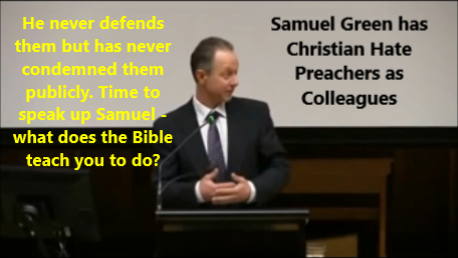
Pastor Samuel Green Will Not Defend Hate-Preaching Colleagues

Recently Nabeel Qureshi declined to defend David Wood‘s Islamophobia. The scholarly Ali Ataie has denounced David Wood in no uncertain terms. We have learnt James White through his conversation with Ijaz Ahmad of Calling Christians has rebuked Sam Shamoun for his tone and abusive comments. We know Negeen Mayel left David Wood and denounced him as self-radicalised. We also know that David Wood’s friend, a professional in psychology, has said this about Sam Shamoun in the past:

Sam is straight bi-polar with narcissistic personality traits.

Is there anybody with any credibility willing to defend these two Islamophobic Christian hate-preachers? It doesn’t seem so. Quite telling!


Well let’s put it to another test in the form of Samuel Green. Samuel Green is a pastor. You’d think a pastor would not support the abuse and hate-preaching of Shamoun and Wood.

Recently, Sam Shamoun upon reading this post for some inexplicable reason sent a group hate email directed to myself and his fellow Christian (Minoria). Amongst the addressees of this malicious email was pastor Samuel Green. Now, I have spoken to pastor Samuel Green in the past and highlighted the anti-Christian actions of David Wood and Sam Shamoun. Guess what? Pastor Samuel Green has NEVER defended them. That’s quite telling, don’t you think?

Pastor Samuel Green was witness to an email insulting myself and a Christian who goes by the name of Minoria. The email by Shamoun contained insults against Islam. I shall not reproduce the email but those interested can contact pastor Samuel Green to verify such a hate email was sent.

I will allow pastor Samuel Green 5 days to decide whether he condones such emailing by David Wood and Sam Shamoun. From my experience with pastor Samuel Green his silence is quite deafening – whenever he cannot support something he remains silent. I predict silence.

Christian Islamophobes, how do you get these folk to stop embarrassing themselves and their church? You stop giving them money!

Surely you would rather give money to starving children in Africa than to a couple of internet Christian hate-preachers who don’t seem to have real jobs.

Oh another thing, these two characters don’t even seem to be versed in Christianity so why in the world are Islamophobic Christians giving them money over starving children in Africa?

Here are the two Christian hate preachers opposing Biblical teachings:

The irony is, Sam’s abuse comments also contained the claim of myself seeking his/’their’ attention. Which is interesting considering I received this comment offering me advice:

Great Job brother Yahya, Sam is desperate asking for the attention, because his apologist career is dying and he knows that very well. He has no academic credentials, So he is so desperate for the spotlight. Leave him, Let his apologist career die.

It’s ironic the bloke tries to use me to revive his career and grab a few crumbs of attention. 2/3/4 years ago (however long ago it was!) he was crying out for attention, he got it from me. The result? Well the result is a ton of videos disseminated over the internet showing him to be a dishonest, unscholarly and unworthy man – not to mention all those blog posts.

And let’s not forget Shamoun promising to continue to spam my blog. A promise that he seems to be tiring from.

Of course, I don’t for one minute expect Nabeel, Samuel or even James to come out and support the hate preaching and abuse by Dave and Sam. You’re all alone boys. Nobody with an ounce of rationalism, sincerity and knowledge of the Bible will support you per se.

I call you away from Islamophobia. Think about it, when mental health professionals are opining that you may be ‘bi-polar’ you should recognise Isamophobia is doing nothing for your character development. Sure, you may have a few dollars in the bank account from the gullible and equally hateful Islamophobes on the net but are you really going to continue selling your characters and mental health for a few dollars?

Get a job guys. Trust me, you feel better once you get out there with the rest of the normal folk.

Related:

Nabeel Qureshi questioned on hate

Ask James White to say ‘Hey Sam this internet apologetics thing is a disaster’

The bloke wants to ‘obliterate’ Bassam Zawadi

David Wood – self radicalised?

Ijaz Ahmad on Anthony Rogers

Email: yahyasnow@yahoo.co.uk

« Older Entries Recent Entries »