Earlier this year, a popular Muslim YouTube channel featuring hundreds of debates and inter-faith discussions was taken down by YouTube due to copyright strikes. However, Br. Marwan’s channel has been resurrected and the situation has been sorted. We’d like to welcome back Br. Marwan and we are once more very happy to have such a large collection of videos back online. May Allaah reward the brother for his hard work. Click here to go to his channel!
A friend and financial supporter of Sam Shamoun, David Wood and Anthony Rogers, sends hate mail:
“And the servants of the Most Merciful are those who walk upon the earth easily, and when the ignorant address them [harshly], they say [words of] peace” – Qur’an 25:63.
Christians (non-Muslims) and some Muslims find the Qur’aan (in English) to be disjunct. It does not follow through with one persistent topic throughout a Surah (Chapter) or throughout several Surahs in succession. It seems to jump from one topic to another without fluidity, why is this?
Answer:
Note: (This post is not about translation issues but rather about the typography we should expect from a book from God.)
I have previously remarked somewhat on a this topic in the article, “Why Didn’t Allah Send the Qur’aan in a Universal Language?” We can begin to understand the nature of the typography (form/ art/ style of writing) of the Qur’aan by using the example of a commonly known book, the Bible. Anyone who picks up the Bible and reads it, immediately understands what he’s reading. The narrative reads like any other story would, the knowledge it is presenting to you is easily digestible. You can read it to an elderly man, and to a young child and they’ll be able to follow the narrative without difficulty. Let’s say we’re reading the Gospel attributed to Matthew. It’s about a man who has this lineage and he does these things with these people at these places. Thus, there is no difficulty in reading it and therefore understanding what the Gospel of Matthew is trying to convey is a simple matter.
The ease of understanding of the narrative is a direct reflection of the knowledge, skill and ability that the author possesses. What this means therefore, is that the author and the reader are on the same level of knowledge, skill and ability. If you can pick up a piece of literature and find no difficulty in understanding what it attempts to convey or express, then the literature has nothing to offer you, it is of the same level of knowledge that the reader possesses. However, let’s say a child opens a University textbook on neuroscience and begins to read, he’s going to have many problems. Most likely, he’s going to encounter terms, statements, descriptions, language devices, formulas that the child has never met before. The child would struggle to read such a textbook and that is because the knowledge, skill and ability of the author is far greater and more advanced than that of the child. Therefore the child has to climb the stairs of knowledge to attain understanding and to thereby make sense of what the textbook is presenting.
The same can be said of a book from God. What do we expect such a book to convey? If it’s a book from God, and we assume in this scenario that the deity of said book is all knowing, then we must expect the book to be at a higher level than us. In other words, we have to stretch our intellectual capabilities and skills to develop the requisite (required) knowledge to understand the book from God. This is a simple, yet significant difference between the Bible and the Qur’aan. If we continue with our example of the Gospel attributed to Matthew, what this means for us, is that the author was as simple minded and knowledgeable as you and I are. We don’t have to stretch our intellect, develop our cognitive abilities to reach the level of knowledge needed to understand what the author is trying to convey. This therefore, clearly indicates to us that the Gospel is a human work, a human production and not from a being of higher knowledge. Whereas with the Qur’aan, it can be difficult to translate something accurately that uses terms, phrases, knowledge of a higher intellectual spectrum. It becomes difficult to express its intricacies and complexities because it possesses and conveys ideas and narratives of a higher intellect than that of ours. This is a hallmark of a message from God, its complexity demonstrates that it is not from a simple minded human. Consider the case of the following child’s bedtime story:
Did you struggle to read it? Of course not, well not unless you are between the ages of 1 year and 2 years old. That was simple to read. Nothing complex, unfamiliar, difficult, educational, informative, critically intensive or tedious. It’s a story for a simple mind, by a simple mind, the author cannot express complex emotions and ideas or theories in such a limited vocabulary and typography, it’s quite limiting. To the contrary, the Qur’aan is like a University textbook, it requires ability, knowledge and skill to read it, because it presents knowledge, beyond that of a human, it contains knowledge we would expect a deity to possess; knowledge expressed in a form distinct from human forms of expression. In this way, the “author” of the Qur’aan, can express significantly greater information because its typography is of a higher intellectual nature. It therefore reflects, the knowledge, skills and ability of a higher being as opposed to a simple minded one.
To the person who therefore says that the Qur’aan in difficult to follow in its fluidity, then this is not due to the Qur’aan’s fault. This is a fault of the reader, who does not possess the requisite knowledge, skills and ability to approach the message of the Qur’aan. We should be reminded that the English translations are meant to merely represent what the text is trying to say on an apparent level and not necessarily generated to express the complete ideas and teachings of the “author”. In the same way one has to have a certain level of knowledge, skill and ability to study a University textbook on neuroscience, we should then understand that one needs to possess a certain level of intellectual competency to comprehend the Qur’aan. The Qur’aan is not a simple book, it is from a higher being, an all knowing deity that is conveying some message to us, and if we can afford the time needed to study human works of higher intellect, then we can more than dedicate the same time and effort needed to study the Qur’aan. Anything less should be considered as laziness and complacency, not that of sincerity.
If one wishes to read more on this topic, an excellent book which examines epistemological typography is, “How to Read a Book”, by Mortimer J. Adler.
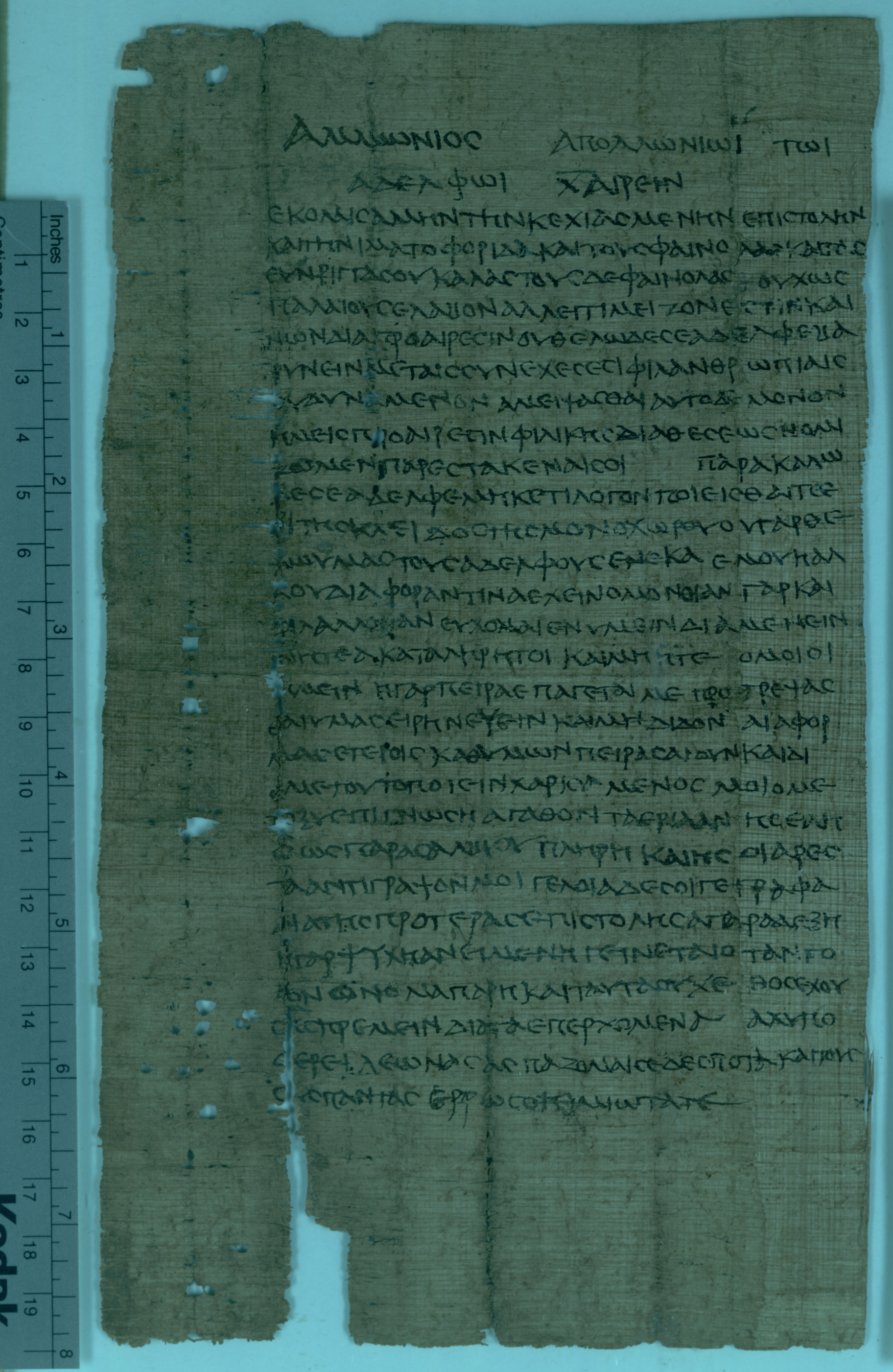
I had a bit of a strange incident in the twilight of yesterday’s morning. See, I had ventured into a Christian dialogue/ debate room and proceeded to ask a nonchalant question on the importance or lack thereof, of an early Christian letter: Oxyrhynchus 3057. This is what the manuscript looks like[1]:
Its transcription and translation reads as follows[2]:
Ammonios to Apollonios his brother greeting. I received the crossed letter and the portmanteau and the cloak and (l. 5) your good reeds. I received the cloaks not as old but as better than new because of your intention. I do not want you, brother, to weigh me down with continuous philanthropy, not being able to repay, but we suppose we only (l. 10) offer to you the intention of friendly disposition. I exhort you, brother, no longer to concern yourself with the key of the single room. For I do not want you, the brethren, on account of me or (l. 15) another to have any difference. For I pray that oneness of mind and mutual concord remain among you so that you are free from gossip and you are not like us. For the trial leads me to impel you to peace and not to give (l. 20) a starting point to others against you. And so attempt to do this for me, favoring me, which in the meantime you will recognize as good. Write to me if the wool you received from Silvanus in full measure is pleasing to you. I wrote ridiculous things to you in a (l. 25) former epistle, which you should disregard. For my soul becomes careless whenever your name is present, and this though it has no habit to rest on account of the things that are happening, but it [soul] endures. I, Leonas, greet you, master, and (l. 30) all your people. Farewell, most honored friend. (back) To Apollonius, son of Apollo(?) surveyer, brother.
The manuscript is dated to be from the late first century, to early second century CE. What happened next took me a bit by surprise. A missionary of some sort responded to my question and stated that the manuscript in question contained several important passages from the Gospel accounts. If you read the above transcription and translation, not a single sentence is related to, or from any Gospel account in the New Testament, or otherwise. I found his claim to be quite, odd. I took the initiative and asked him if he knew that for certain or if he just Googled it, and merely read one of the results as a response to my question. He did reply honestly and confirmed that he did Google for an answer and read one of the resulting articles, thereby making him uncertain that his response was accurate.
This however, was not the strangest statement he was to make. Our conversation progressed for sometime until he asked me a question in relation to the Muslim understanding of Surah 4, Verse 157. My response involved the dating of Papyri 52, which I mentioned was the earliest extant manuscript of any of the four Gospels. To this, he was surprised and he subsequently proceeded to validate my statement by again, searching via Google. When I realised that he doubted what I had said about Papyri 52, I then realised the discussion was useless, as he was most certainly uninformed about the most basic information about New Testament manuscripts. I have to admit though, that since I’ve begun to ask questions about textual criticism and New Testament development, many polemical and missionary Christians have all attempted to respond to me in a plethora of ways. A significant majority of those had no idea what they were talking about, and it’s been quite a thrill listening to many of these individuals tell me of the extant manuscripts of the disciples which were written in the first century, in the 40’s, 50’s and 60’s. I’ve found though, that once I introduce them to textual criticism and inform them of their wrong understanding, they’d become quite hostile and begin to make crass remarks about my person.
Perhaps, what I’m trying to say after having had all of these strange experiences with many polemical and missionary Christians, is that while I do value the time I spend with them, I’m quickly realising that a majority of lay Christians are uninformed about their scripture, its history, development and preservation. Nothing though, can beat the expression on their faces when they learn that Textus Receptus (which the KJV Bible is based upon) was codified and published by a humanist, Desiderius Erasmus, a disbeliever in the Christian God. Oh, what a sight that is to behold.
[2] – “Is P.OXY. XLII 3057 The Earliest Christian Letter”, by Licoln H. Blumell, Early Christian Manuscripts: Examples of Applied Method and Approach, Edited by Thomas J. Kraus & Tobias Nicklas (Boston: 2010).
Pharisaical, from the term Pharisee, refers to someone who engages in practicing or advocating strict observance of external forms and ceremonies of religion or conduct, without regard to the spirit of the religion[1]. There are unfortunately many Muslims who follow Islamic teachings and jurisprudence without understanding the scope and purpose of such teachings. This generally means that they adhere to Islamic jurisprudence, henceforth known as fiqh, but that they don’t understand the principles offiqh, henceforth known as Usool al Fiqh. For a general understanding of what fiqh is and how it functions within the Islamic belief system, Mufti Ebrahim Desai states[2]:
Among the torch bearers of true knowledge and guidance after the illustrious Sahaaba (Radhiallahu Anhum) were the four famous Imaams of Fiqh who possessed deep understanding of the Shari’ah. They extracted the fundamental rules and principles of Shari’ah in the light of the Qur’aan and Hadith and thereby extracted many Shar’ee rulings. The fundamental rules and principles are known as Usool-al-Fiqh and the laws extracted therefrom are known as Fiqh.
In responding to a question on certain fiqhi practises, Mufti Yaseen gives us another angle of understanding what Usool al Fiqh is, he states[3]:
Not every single detail of Shari’ah must be explicitly expressed or declared in the Qur’an and Sunnah. Sometimes, rulings are derived from indications, and implications of verses or ahaadith. For this reason, a whole science, known as Usool al-Fiqh is established in order for a Scholar to recognise and identify the correct sources of Islamic Law and methods to deduce rulings from those sources. Some rulings are deduced from Dalaalat al-Nass, Ibaarat al-Nass, Ishaarat al-Nass, and Iqtidhaa al-Nass.
Therefore, it is inappropriate for the lay Muslim to develop an understanding of the laws in Islam, by merely extracting information from the hadeeth corpus and the Qur’aan. In Islam, the only persons who are qualified to do so are those studied in the science of fiqh, previously mentioned as Usool al Fiqh. Shaykh Zahir Mahmood, a prominent scholar based in the UK, corrects a misconception of one of the laws in Islam as it pertains to women, and demonstrates the great danger that can occur if lay Muslims follow their own eisegtical conclusions and not the valid teachings from the scholars, he states[4]:
Without belittling anyone or anyone’s question, I need to respond to a question which was posted under my previous post. The post was about the Saudi sister who was stabbed and people just walked passed her without helping. I have deleted the persons post so you will not be able to ascertain who it is.
The question was “should a person touch a Non Mahram to save her.” The issue of concern is the lack of basic Islamic knowledge, every Muslim should know the answer to this. Next time you see a non Mahram dying on the street are you going to ring the local Mufti for a fatwa before you help her/he.
The answer it not only permissible it is an obligation.
May Allah guide us all to the straight path.
For those who are critical of Islam and who base their criticism on the perceived laws of Islam, it is my intention to have proven that the practises of some Muslims as it pertains to women, betrays the principles of Islamic Jurisprudence, and that the scholars have recognized this problem and are working to guide the misguided lay men. Therefore such criticism is invalid against Islam, but valid against those who misapply Islamic teachings due to their own ignorance.
When missionaries debate us, they claim that the God of the Torah is the same God of the New Testament. Jews say that their God is very different from the Jewish concept of God, since Jews believe in monotheism and the Christians believe in the Trinity, how are we to respond to the Christians?
Answer:
It should be noted that there are vast soteriological (salvation), and doctrinal (creedal, ‘aqeedah) differences and disagreements about God between the Jewish faith and the Christian faith. For an indepth discussion on the numerous differences, please see the following lecture by Rabbi Michael Skobac. This lecture will provide you with many examples from which you can illustrate and subsequently prove your argument:
Now that we have firmly established that Jews disagree with the statement that their concept of God is the same as that of the Christian concept, we can now take a historical examination of the early Christian church and its views on the very same topic. Marcion of Pontus was the founder of an early Christian movement, dated to be between the period of 140 CE and 160 CE. This movement, named after him, the “Marcionites” were said to have believed that the God of the Old Testament was a violent, hateful, vengeful and evil God, while the God of the New Testament was one of love, grace and mercy. Marcion therefore taught that the God of the Old Testament was not the same God of the New Testament, thereby concluding that the God of the Old Testament was a quasi-deity, known as a “demiurgus” to the Greeks. We read from the Panarion, an early Christian work which documented the beliefs of the various Jewish and Christian sects, it says of Marcion and Marcionites[1]:
Marcionites. Marcion of Pontus was the son of a bishop, but he seduced a virgin and went into exile because he was excommunicated by his own father. (2) Arriving at Rome he asked for penance from the < elders > of the time. Since he could not get it he grew angry and taught doctrines contrary to the faith by introducing three first principles, a good, a just and an evil, and saying that the New Testament is foreign to the Old, and to the One who spoke in it.
The Catholic Encyclopedia expands on this and states[2]:
We must distinguish between the doctrine of Marcion himself and that of his followers. Marcion was no Gnostic dreamer. He wanted a Christianity untrammeled and undefiled by association with Judaism. Christianity was the New Covenant pure and simple. Abstract questions on the origin of evil or on the essence of the Godhead interested him little, but the Old Testament was a scandal to the faithful and a stumbling-block to the refined and intellectual gentiles by its crudity and cruelty, and the Old Testament had to be set aside. The two great obstacles in his way he removed by drastic measures. He had to account for the existence of the Old Testament and he accounted for it by postulating a secondary deity, a demiurgus, who was god, in a sense, but not the supreme God; he was just, rigidly just, he had his good qualities, but he was not the good god, who was Father of Our Lord Jesus Christ.
Even if we were to disregard these evidences, we can use a Christian teaching known as “Progressive Revelation“, to prove that the Jewish concept of God is distinct from that of the Christian God. We read two definitions of this doctrinal teaching:
The things that God revealed to humanity were not all given at once. His revelation was given in stages……Progressive revelation means that God did not unfold His entire plan to humanity in the Book of Genesis or, for that matter, in the entire Old Testament. The Old Testament revelation, though accurate, is incomplete. The fullness of certain teachings cannot be found in the Old Testament. – [3]
Progressive revelation is the teaching that God has revealed himself and his will through the Scriptures with an increasing clarity as more and more of the Scriptures were written. In other words, the later the writing the more information is given. Therefore, God reveals knowledge in a progressive and increasing manner throughout the Bible from the earliest time to later time. This makes perfect sense since we know that not everything God revealed to us was revealed right away. – [4]
Summarily, this doctrinal teaching is meant to convey the belief that with each new revelation, God reveals more of His nature to us. Therefore, the nature of the God of the Old Testament is different and distinct to that of the New Testament because the God of the New Testament has had more of His nature revealed to us. An easy example is the Jewish God known as Elohiym which is in a plural form but is used to refer to one God, not many. With the advent of the New Testament, God allegedly revealed that Elohiym was used because God consisted of three persons united in one. This would mean, that at the time of the revelation of the Old Testament, Jews would have believed that God was solely one, and at the time of the inspiration of the New Testament, Christians would have believed that God consisted of three persons united united in one. Therefore, if we compared the two natures of the Gods at the time of their revelation/ inspiration, the Christians would be forced to admit that they would seem like two different deities because the teaching of their respective natures are at odds with each other. The JewsForJudaism response to Christian arguments that Elohiym means three persons united in one deity, is presented as follows:
“In form the word is a Hebrew plural noun; but it connotes the plurality of excellence or intensity, rather than distinctively of number. It is expressive of supreme or absolute exaltation and power. Elohim, as understood and used in the restored Church or Jesus Christ, is the name-title of God the Eternal Father. . . .”. This understanding of the word is quite different from that of Smith’s who, in his ignorance of the Hebrew language, rendered ‘Elohim, in Genesis 1:1, as a plural. Scripture teaches us that ‘Elohim, which is the plural of majesty, is used not only in reference to God, but also for angels (divine beings) and human authorities of high stature in society. This can be clearly seen, for example, from the following usage. Manoach, the father of Samson (Judges 13:22), after seeing “an angel of the Lord,” said: “We shall surely die for we have seen ‘elohim.” Concerning human authority, we read in Exodus 22:8: “Both parties shall come before the ‘elohim [“judges”], and whom the ‘elohim [“judges”] shall condemn, he shall pay double to his neighbor.” It is, therefore, ludicrous to infer from ‘elohim, in the first verse of Genesis, the existence of a plurality of gods. Where is the plurality of persons when a single angel, referred to as ‘elohim, visited Manoach? How can the Mormon Church explain the words of the woman to Saul when, upon seeing Samuel, she explained: “I see ‘elohim coming out of the earth” (1 Samuel 28:13)? Although ‘elohim is followed by the verb in the plural, it refers to only a single individual as is clearly seen from verse 14: “And he said to her: ‘What is his appearance?’ And she said: ‘An old man is coming up; and he is wrapped in a robe.’” Thus, even with a plural verb this noun may still refer to a single individual.
If the truth of the doctrine of a plurality of gods depends in any measure on the plurality in form of the noun ‘Elohim, the use of ‘Eloha, the singular of the noun, within the same context, most decidedly disproves it. The underlying reason for the grammatically plural form ‘Elohim is to indicate the all-inclusiveness of God’s authority as possessing every conceivable attribute of power. – [5]
Trinitarian Christians maintain that Genesis 1:26 and Genesis 11:7 are prooftexts of an alleged tri-unity god, but this claim is erroneous. The inference that “Let us make man in our image” (Genesis 1:26) refers to the plurality of God is refuted by the subsequent verse, which relates the creation of man to a singular God, “And God created man in His image” (Genesis 1:27). In this verse the Hebrew verb “created” appears in the singular form. If “let us make man” indicates a numerical plurality, it would be followed in the NEXT verse by, “And they created man in their image.” Obviously, the plural form is used in the same way as in the divine appellation ‘Elohim, to indicate the all-inclusiveness of God’s attributes of authority and power, the plurality of majesty. It is customary for one in authority to speak of himself as if he were a plurality. Hence, Absalom said to Ahithophel, “Give your counsel what we shall do” (2 Samuel 16:20). The context shows that he was seeking advice for himself’ yet he refers to himself as “we” (see also Ezra 4:16-19).
A misconception similar to that concerning Genesis 1:27 is held by trinitarian Christians with reference to the verse, “Come, let us go down, and there confound their language” (Genesis 11:7). Here, too, the confounding of the language is related in verse 9 to God alone, “. . . because the Lord did there confound the language of all the earth.” In this verse the Hebrew verb “did” appears in the singular form. Also, the descent is credited in verse 5 to the Lord alone, “And the Lord came down to see the city and the tower.” In this verse the Hebrew verb “came down” appears in the singular form. If a doctrine of plurality of persons is to be based on the grammatical form of words, the frequent interchanging of the singular and the plural should vitiate such an attempt as being without foundation or merit. We may safely conclude that the Bible refutes most emphatically every opinion, which deviates from the concept of an indivisible unity of God. – [6]
In conclusion, there are two main evidences we may use to demonstrate that the God of the Old Testament is not the same as the God of the New Testament. Early Christians such as the Marcionites held such a belief, and the Christian doctrine of progressive revelation teaches that the nature of God was believed to be one way and then later on known to be different and distinct from that earlier nature. These conclusively prove, without a doubt, that the Christian concept of God’s nature is and continues to be open to development. The question which the Christian has to answer is, ‘Given the doctrine of Progressive Revelation, what if God later reveals He is Five Persons United in One, would that mean the Trinity is false or that the Jewish belief in one God was also false?’
Sources:
[1] – “Marcion/ Marcionites“, the Panarion by Epiphanius of Salamis. Anacephalaeosis III, page 228. Bold emphasis is ours.
[2] – “Marcionites“, the Catholic Encyclopedia (New York: Robert Appleton Company. 1910). Bold emphasis is ours.
Some Christians have asked me, how did your Prophet salalllaahu ‘alayhi wa salam visit Masjid al Aqsa, if the Masjid did not exist at his time and was actually built after his time?
Answer:
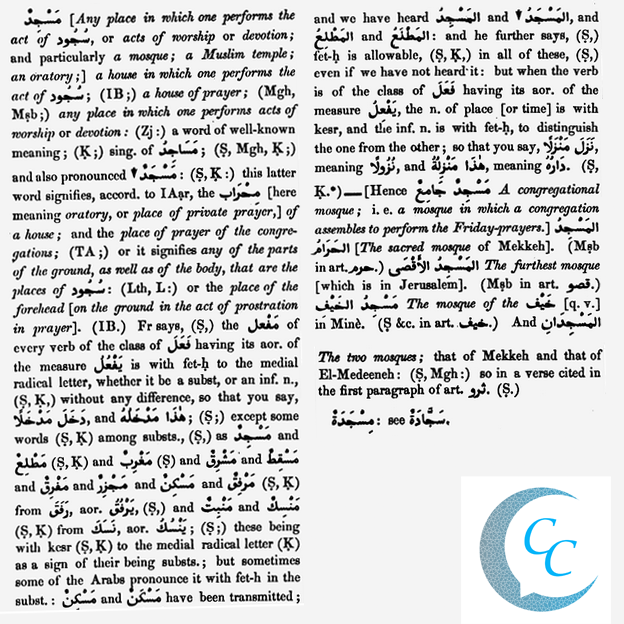
The Christian is assuming that a Masjid (سجود) is a structure or building with four walls and a roof. This is incorrect thinking, as a Masjid is a place where sujood (سجود), where prostration occurs. See the following quote taken from Lane’s Lexicon[1]:
Therefore, as we can see, there is no need for a physical building to be present for an area to be considered a Masjid. Summarily, any place in which sujood/ prostration is done can be called a Masjid. This is also similar to the word Church (ἐκκλησίαν), which merely means the place of an “assembly or congregation”[2], and not particularly four walls, a roof and a bell tower. The individual who brings forward such an argument would therefore have to be greatly ignorant of Islam, and is merely seeking to conjure a straw man argument (a fallacious argument) by attempting to present an anachronistic error in Islamic teachings.
Sources:
[1] – Arabic-English Lexicon by Edward William Lane (London: Willams & Norgate 1863), “سجود”, page 1308.
“Devout Muslims bow down to the Kaaba five times per day, and when they take the pilgrimage to Mecca, they try to kiss the Black Stone. These practices are sheer paganism, but they are essential to Islam.”
What does he consider Jews making pilgrimage to the Wailing Wall, kissing and bowing to it?
What does he consider Christians bowing and kissing crosses?
Unlike in either Judaism or Islam where each faith shares the common concept of a qiblah/ derek, which is a direction of prayer and not worship of an object, this distinction loses its way among Christians due to their inability to understand either Jewish belief or Islamic belief; such a belief is Christianity part and parcel of Christian belief and thinking. If the act of bowing towards an object is paganism, then what does he consider bowing to crosses, or even images of Jesus, or better yet – to Jesus himself – a creation of God?
Last night I ended up having a quasi-discussion with a friend of Pastor Green on his Facebook timeline and what an experience it turned out to be! It was clear to me from the onset that the person had a bit of difficulty understanding the discussion. Knowledge is a very important tool for developing one’s understanding of the world we live in, and is essential for matters of faith and belief. It is very common for me to read, and encourage others to read two great works by Muslim scholars on knowledge in Islam. Namely, “Kitab al ‘Ilm“, by Imam al Ghazali (رحمه الله), and “Instruction of the Student: The Method of Learning“, by Imam al Zarnuji (رحمه الله). Another book, but from a non-Muslim which I and many scholars have found profitable is, “How to Read a Book“, by Mortimer J. Adler; a fantastic exposition on the importance of reading, while providing helpful lessons in developing the skill of reading. Lastly, there are two principles with which I have found to be profitable for every conversation or dialogue I engage in. The first is that of “disce aut discede“, which translates into meaning, “learn or leave”. What this phrase communicates, is that whenever you engage in some act of learning you should always be willing to learn, and if not then you should leave that engagement for it does not increase your knowledge or understanding. The second is that of, “damnant quod non intelligunt“, which translates into meaning, “they condemn what they do not understand”. Naturally, a person who is uneducated about a particular topic with which they disagree with you on, tends to condemn your position without having an understanding of their own position, or yours.
Having learned these two principles, I tend to leave a discussion where I find the person to be uneducated about the topic under discussion. I entered into this discussion with the person named Luke to see where it would lead. He claimed he was a friend with many textual critics, that he’s studied the science, and that he is very familiar with the various schools of thought within the textual criticism community. So, I set a litmus test for him, is he pretending to have knowledge he doesn’t have? I wrote a few lines on the philological problems with the Johannine Prologue. I then waited for his response. Strangely enough, his next two comments on the topic caught me a bit off guard – I was shocked to be honest. He read, philological to be philosophical and then proceeded to write several paragraphs on how both James White and William Lane Craig were philosophical textual critics. I cried with laughter, I really did not know how to respond to something so wrong, but yet so ingenious. Not only did this confirm that he had no idea what he was talking about, the very fact that he invented a new field and attributed it to several Christian speakers was beyond phenomenal. You simply cannot pay for entertainment like this. I think the problem he had, was assuming that because I was a Muslim, the only things I knew of textual criticism were from reading books by Bart Ehrman, therefore he expected me to regurgitate Bart’s views. When that didn’t happen, he proceeded to disagree with everything I stated. Not because I was wrong, but because it put him in an awkward position for a Muslim to know more about the origins of his scripture, than he knew and its very common to see people become desperate when their religion is being discussed. Yet, before he did this, he did something even more incredulous. He accused me of plagiarism. Why did he do this? Well, I had posted a quote from a journal, in response he said I was simply copy pasting, despite me having explained what the consequences of this study meant. He derided me in numerous comments, when he realised that I actually had access to the journal, he just threw out the insult of being a plagiarist. What reasoning did he use? He said, I didn’t engage with the evidences of the topic under discussion. So, as a counter, I asked him, aren’t you posting quotes from the internet without having engaged with the evidences? Especially when the journal’s author from whom he took his quote both disagreed with his view, and the author had first hand experience with the evidences? So by his own logic, wouldn’t that make him a plagiarist? Apparently he took great insult at this, so he began to insult the Prophet (صلي الله عليه وسلم) in response to my rhetorical questions. This unfortunately is not the first time that this has happened. In countless discussions with polemical Christians, when they’re unable to cope with difficult questions, they tend to be become very angered and unfortunately try to derail the dialogue by insulting Islam or something related to our beliefs. This behaviour and its solution is spoken of in the Qur’aan by Allaah, He says:
وَقَدْ نَزَّلَ عَلَيْكُمْ فِي الْكِتَابِ أَنْ إِذَا سَمِعْتُمْ آيَاتِ اللَّـهِ يُكْفَرُ بِهَا وَيُسْتَهْزَأُ بِهَا فَلَا تَقْعُدُوا مَعَهُمْ حَتَّىٰ يَخُوضُوا فِي حَدِيثٍ غَيْرِهِ ۚإِنَّكُمْ إِذًا مِّثْلُهُمْ And it has already come down to you in the Book that when you hear the verses of Allah [recited], they are denied [by them] and ridiculed; so do not sit with them until they enter into another conversation. – Qur’aan 4:140.
Da’wah has its limits. Humans also have limits, whether it be with our knowledge or our ability to communicate and convey our beliefs accurately. Therefore, as responsible Muslims, we should know when to leave a conversation or when to acknowledge that it’s useless to debate a topic with someone who has no knowledge of the topic itself. I’ve been privy to hundreds of debates whether in person, or over the internet, and its become very saddening to see that if these persons who were debating had to do so without Google at their fingertips, they would have nothing to contribute in a discussion. Their knowledge is really based on how quick they would be able to search the internet for responses to questions posed to them. This reminds me of an experience I had with a young militant atheist named Shiva. On Facebook he had no issue criticising religion, fortunately we attended the same University so I asked him to meet in school and have a personal, face to face discussion on religion with me. He declined. He then arranged a meeting with one of my Muslim friends who isn’t that familiar with anti-religious polemics and how to respond to them, therefore he agreed to meet the person, but when the time came for the meeting, he’d have me show up instead. The look on the face of the young atheist at my presence was one of pure astonishment. As Allaah as my witness, and as my friend would gladly testify, the young atheist had nothing to say about Islam at this meeting. In fact, for almost all of the questions raised, his response was either that he did not know, or that he did not understand what the questions were about.
That was such an eye opening experience that from that day, that I now choose to engage in face to face debate more, as opposed to online discussion. To the young da’ees who are beginning to engage with non-Muslims about Islam, I encourage you to read the books I’ve mentioned, and should you be unable to find them, head over to our contact us page and I’ll send you a PDF copy. Before engaging in any debate or dialogue or discussion on theological differences whether it be with Christians, Jews, Atheists or even Hindus, you need to develop an intellectual foundation, a knowledge base from which you can then progress to studying the topics frequented in inter-faith discourse. Understanding the nature of knowledge, its uses, its mediums and its limits is very important for becoming an honest and sincere seeker of knowledge. How can you learn, without knowing how to learn? How can you disagree, without first knowing what you’re disagreeing about? In conclusion, we should always be open to recognizing someone’s limits and your own limits, in regard to your knowledge of Islam and other topics. Should you find someone unable to honestly discuss a topic, leave that topic or the discussion. Should you find that you are unfamiliar with a topic, leave that discussion and study it before speaking, lest you speak without knowledge and unknowingly earn the punishment of Allaah for speaking wrongly of Islam. One of the things I’m happy to have done, is to graduate from having a cursory understanding of some topics, to having indepth, well studied, well taught understanding. If you truly value discussing inter-faith topics, then you should do the responsible thing and study before speaking, and if you fail to do so, then ask yourself one question. Are you doing this for Allaah, or are you doing this for you? and Allaah knows best.









 Calling Christians

You must be logged in to post a comment.