Category Archives: FAQS

The rivals of Paul who were followers of Jesus

2 Corinthians 11:4 provides a clue to the existence of a powerful rival group that opposed Pauline Christianity

by Ibn Anwar BHsc (Hons), MCollT

The text of 2 Corinthians 11:4 reads as follows:

“For if someone comes and proclaims another Jesus than the one we proclaimed, or if you receive a different spirit from the one you received, or if you accept a different gospel from the one you accepted, you put up with it readily enough.”

From this verse, we may glean that there was at least one group that was prominent enough to receive Paul’s attention and compel him to spend ink on it that was teaching a different Jesus and a different gospel than what Paul was teaching as James Dunn writes, “Similarly in 2 Cor. 11.4 the “other Jesus” preached could refer to a differently interpreted Jesus tradition.” [1]Though little detail is given concerning this group, we may reasonably speculate about their fundamental beliefs that disconcerted Paul by looking at the content of the context of 2 Corinthians 11:4, with particular focus on what points that Paul emphasise therein.

In Paul’s letter to the Corinthians, one of his primary concerns is with the crucifixion of Jesus, the belief that Jesus suffered and died as a sin offering. As James Dunn writes, “The most distinctive emphasis of Paul’s preaching on Jesus, however, was on Jesus’ crucifixion… in 1 Cor. 2.2 Paul recalls how ‘I decided to know nothing among you except Jesus Christ, and him crucified. For in Cor. 15:2 he recalls the message he had preached to the Corinthians, including the message that ‘Christ died for our sins…” [2] From the emphasis Paul puts on this theme, we may discern that those mentioned in 2 Corinthians 11:4 may well have opposed this belief that Paul was propagating. To this effect, commenting on the phrase “another Jesus” in 2 Corinthians 11:4 the scholar Colin Kruse writes:

“It may well be that in their preaching Paul’s opponents stressed the power and glory of Christ to the virtual exclusion of the fact that he had also known weakness, humiliation, persecution, suffering and death. Paul preached Christ crucified as Lord, so a proclamation like that outlined above would seem to him to be the preaching of another Jesus.” [3]

This means that anyone who did not preach that Christ was crucified as Lord, that he suffered humiliation, persecution, suffering and ultimately death on the cross were antithetical to Paul’s ministry and were therefore preaching another Jesus.

David Garland who is Dean of George W. Truett Theological Seminary at Baylor University, likewise, writes:

“Another Jesus” refers to a different interpretation of Jesus that is not congruent with with the facts of Jesus’ life and death. Paul’s emphasis in 13:4, that Christ was “crucified in weakness,” suggests the possibility that the rivals presented a Jesus who was not “weak, suffering and humiliated.” They may talk about Christ, but Christ crucified is not the heart of their gospel nor does it influence the way they live.” [4]

From the above, we learn that this group gave no importance to the crucifixion of Jesus and it was certainly not part of their fundamental beliefs.

Michael Gorman however, tells us that this group’s teachings may well have amounted to the repudiation of the crucifixion rather than a mere disinterested detachment. They in fact abandoned the belief in the crucified Christ.

“What is very likely, however, is that Paul saw a massive incongruence between their gospel and their lifestyle (since for Paul an apostle was his or her message, and vice versa), between a message of Christ’s death for sin (s) and a preoccupation with powerful manifestations of the Spirit. Is this grounds for a charge of heresey? Yes, it is, at least for Paul, if it amounts to the repudiation of the cross as both the foundation and the form of life in Christ… to abandon the crucified Christ and the God-given Spirit of cruciformity is to offer another gospel.” [5]

The scholarly understanding that this group that Paul regarded as preaching another Jesus and another gospel disassociated themselves from the “suffering servant” image of Jesus that is so prominent in the Pauline portrayal of Jesus’ purpose and ministry seems to be across the board. Their detachment from any theological significance given to the cross seems to be one of their hallmarks. The massive New Jerusalem Biblical commentary comments:

“4. This is perhaps the most important clue in the quest for the identity of Paul’s opponents: if someone comes : his adversaries were from outside Corinth (3:1, 10:14-16), preaches a Jesus other than the one we preached. The sudden switch from “Christ” ( 10:1,5,7,14; 11:2,3) gives Jesus a special significance; the emphasis is on his earthly existence. Since the intruders claimed to “belong to Christ,” they must have shared the tendency of the “spirit-people” to downgrade the importance of Christ’s humanity, which was displayed in service, suffering, and death…

The Judaizers (3:3) preached a different gospel (Gal. 1:6-9). Since Paul’s ministry was a “ministry of the Spirit” (3:8) and of freedom (3:17), his opponents must have given their allegiance to a different spirit, viz., that of the new covenant, which they understood in a way that Paul could not accept (see comment on 3:6). The Judaizers would have shared common ground with the “spirit-people” (-> 1 Corinthians , 49:18) insofar as the wisdom tradition of the latter was rooted in the law.” [6]

From the above, we may discern, as we did from preceding scholarly references that this group of preachers had no interest in the suffering and alleged death and Jesus. Additionally, O’Connor tells us that they had a firm belief in the importance of the law in direct opposition to Paul who primarily concerned himself with “freeing” people from the “bondage” of the law through his version of Christ’s ministry.

Jan Lambrecht gives us an even greater insight as to the identity of this opponents of Paul who uniquely opposed him in his fundamental beliefs: the crucifixion and the law.

“Let us listen to what Paul himself says. The most pertinent text is 2 Corinthians 11:22-23a: “Are they Hebrews? So am I. Are they Israelites? So am I. Are they descendants of Abraham? So am I. Are they servants of Christ? – I am talking as out of my mind – I am more.” For Paul these people are decidedly Jewish Christians, even ministers of Christ.” [7]

From the above we see that Paul himself in the immediate context of 2 Corinthians 11:4 identifies these individuals as Jewish Christians. And though he labels them “Satan”, “deceivers”, and “false apostles”, he is unable to forthrightly deny them as real ministers or servants of Christ. He sees himself as a better servant (“I am more”) but this necessarily implies that he sees them as equally servants of Christ but of lower status and inferior. Lambrecht continues:

“The opponents were probably not very numerous. It is, we think, is not completely impossible that there were connections between them  and the Jerusalem authorities (see our discussion of 10:12-18), nor, as most scholars hold, is it absolutely certain that they were wholly from Paul’s opponents in Galatia, those who compelled the Gentile Christians to live like Jews (Gal 2:14; see our discussion of 2 Cor 10:4-6; cf. Gal 1:7-9).” [8]

The above tells us that there is possibility that this group had links to the Jerusalem Church which was headed and lead by the direct apostles of Jesus and it also tells us that their movement was quite widespread as it is possible that the opposition Paul faced from opponents in Galatia were the same people as they had similar traits to those who went to Corinth to challenge Paul. This group was in fact quite successful in their ministry, at least in the early days, prior to the victory of Pauline Christianity over all others, pulling many, even the Gentiles, to their fold:

“Many Christians of Corinth must taken sides with the intruders and detached themselves from Paul, at least during a certain period of time. Second Corinthians shows us a Paul who, above all, wants to win them back.” [9]

The People’s New Testament Commentary by New Testament scholars Eugene Boring and Fred Craddock provides an even better overview of this group, what they believed and why Paul opposed them so.

11:4 Another Jesusspiritgospel: These may be only general descriptions of the false message and ministry of the rival apostles, or in Paul’s mind they may have had specific content. “Another Jesus” has been understood in several ways:

1. The opponents may have emphasized the life and teachings of the earthly Jesus, whom Paul had not known. The details of Jesus’ earthly life did not play a role in Paul’s own gospel, which focused on the act of God in the whole Christ event, not on stories about and sayings of the earthly Jesus.

2. The opponents may have contrasted the exalted heavenly Christ and the purely human Jesus, one who could be disdained and even cursed (see on 1 Cor. 12:3). If so, it means that before their arrival in Corinth some Corinthians already leaned toward this view which the new missionaries elaborated and exploited.

3. Since Paul places their Christology in contrast to his own, which emphasizes the vulnarability and weakness of the crucified Christ (see 1 Cor. 1:18-2:5; 2 Cor. 13:4; Phil. 2:5-11), they may have emphasized the power of the miracle-working “divine man” Jesus, a view that had no place in Paul’s own understanding. It may be that they saw the power at work in Jesus’ life as continued in their own powerful ministry, just as Paul saw the self-giving of a victimized and crucified Jesus as continued in his ministry. Neither group saw a way of combining the pictures of Jesus the divinelike miracle worker and the Jesus who died a human death on the cross. Paul chose the weakness of the crucified Jesus as the power of God; they chose the power of the miracle-working of Jesus as representing the power of God. [10]

This group then had access to stories concerning Jesus and his words during his ministry while Paul did not. They also had difficulty allowing Jesus to be the victim of some curse and exalted Jesus over above Paul’s victimized Jesus model. They adopted Jesus’ deeds of miracle as important to the person of Jesus and completely abandoned any attachments to the crucifixion while Paul fixates himself on the crucifixion to the subtraction of all else. Even though Paul identifies them as “false apostles” as we have seen above and even called them ministers of Satan (contradicting himself as we illustrated that he couldn’t help but recognise that they were ministers of Christ), Boring and Craddock write, “Though Paul considers them false, they were probably sincere Christian leaders whose differences with the Pauline mission were so great they considered him a false apostle, a danger to the churches, whose converts had to be “corrected.” ” [11]

In the foregoing discussion we have seen the many shades of colour of this mysterious and nameless group found in 2 Corinthians 11:4. Although we may never know exactly what they believed and who they were in precise terms (unless some new early manuscripts that document their existence and beliefs are unearthed), we have gleaned from Paul’s own writing, as we have done above, what they may very well have believed. In all likelihood, this was a group that completely detached themselves from the alleged crucifixion of Jesus and emphasised the earthly ministry of Jesus. This was probably the utter most sticking point that irked Paul so much to the extent that he labels them not only false apostles but the servants of Satan himself. The rift between Paul and this group must have been quite significant and their beliefs must have greatly agitated Paul for he would not have been so harsh in the epithets that he affords them which he affords to none of his other numerous opponents elsewhere. Despite Paul’s meanderings about their supposed distasteful behaviour that were incongruent to the gospel they were preaching, which is something that we cannot confirm as there are absolutely no independent corroborating eyewitnesses to justify Paul’s appraisal regarding this, what is evidently clear is that his theology of the cross was completely disregarded by this group and this was probably the unpardonable sin that led Paul to identify them as servants of Satan. This removes the Christian apologetics critique on Islam that it brought something new when it put doubt on the crucifixion of Jesus by seemingly denying that it actually took place. It would appear that denial of the crucifixion and/or any importance attached to it was in vogue even at the time of Paul. This then corroborates the Qur’anic crucifixion narrative as historical rather than merely mythical.

Notes:

[1] Dunn, J. D. G. (1998). The Theology of Paul the Apostle. Grand Rapids, Michigan: William B. Eerdmans Publishing Company. p. 196

[2] Dunn, J. D. G. (2009). Christianity in the Making, Volume 2: Beginning from Jerusalem. Grand Rapids, Michigan: William B. Eerdmans Publishing Company. p. 576

[3] Kruse, C. (1987). The Second Epistle of Paul to the Corinthians: An Introduction and Commentary. Grand Rapids, Michigan: William B. Eerdmans Publishing Company. p. 184

[4] Garland, D. E. (1999). The New American Commentary: An Exegetical and Theological Exposition of the Holy Scripture, 2 Corinthians. Nashville, Tennessee: B & H Publishing Group. p. 464

[5] Gorman, M. J. (2004). Apostle of the Crucified Lord: A Theological Introduction to Paul and his Letters. Grand Rapids, Michigan: William B Eerdmans Publishing Company. p. 322

[6] O’Connor, J. M. (1990). 2 Corinthians. In Raymond E. Brown (Ed.), The New Jerome Biblical Commentary. New Jersey: Prentice Hall. pp. 826-827

[7] Lambrecht, J. (1998). Second Corinthians. In Daniel J. Harrington (Ed.), Sacra Pagina Series. Collegeville, Minnesota: The Liturgical Press. p. 7

[8] Ibid.

[9] Ibid.

[10] Boring, M. E. & Craddock, F. B. (2010). The People’s New Testament Commentary. Louisville, Kentucky: Westminster John Knox Press. p. 570

[11] Ibid. p. 571

Does Angel Gabriel Choking the Prophet Mean He Is Not an Angel?

Question:

Missionaries argue that an angel would not choke someone or be violent, and so the “angel” that Muslims believe to be Gabriel was actually a demon. Some claim this was a demon parading as an angel because of this act of choking. What can we say to them?

Answer:

You can advise them to study their Bible(s) more often. If acting violent means that an Angel is actually a demon, or that the one being hurt by the Angel is evil, what happens to the story of the Angel (of the Lord) wrestling with Jacob (Israel)? The main story is found in Genesis 32:22-31, however the story itself is referenced in Hosea 12:4 and clarifies with whom Jacob (Israel) wrestled with:

Yes, he wrestled with the angel and prevailed; He wept and sought His favor. He found Him at Bethel And there He spoke with us,

Following the missionaries’ logic, it would either mean that the Angel (of the Lord) was evil and demonic, that Jacob (Israel) – the Father of the Twelve Tribes was evil and demonic or that both of them were evil and demonic. Irrespective of which choice they choose, the argument negates a major aspect of their faith. That in itself discredits the argument. Even if we were to forego this one major incident, there are many instances where angels were violent in the Bible, one significant example of that is as follows:

Then the angel of the Lord went out and put to death a hundred and eighty-five thousand in the Assyrian camp. When the people got up the next morning—there were all the dead bodies! – Isaiah 37:36.

Thus, this is not a very good argument and it would benefit the Muslim to encounter a missionary using it, as it can allow us to invite them to Islam. Thank you for your question.

and Allah knows best.


Is the Canonization of the NT a Divine Proof?

Question:

Missionaries often claim that the canon of the New Testament was not decided by a Council, and that its authors were guided by God. They also claim that since a Council was not needed and that all of Christendom accepted the books, it is a divine proof from God that Christianity is the truth. How do we respond to this?

Answer:

This is factually incorrect. The proto-orthodox Church whose canon of scripture later came to be known as the New Testament, did in fact have two Ecumenical (Unity) Councils regarding the canon of their scripture. The Councils of Carthage in 393 and 397 CE respectively, are historically considered to be when the Church ‘confirmed’ the canon. Most Christians seem to be unaware of these Councils and so make this claim that the canon was not decided by any Council, and so the emergence of their scripture is a divine truth. Even if we were to forego these two Councils, this is in itself a poor argument. This argument, is in essence stating that a divine truth does not need a Council to determine beliefs.

However, Christianity’s history is replete with Ecumenical Councils regarding the very basic tenets of their faith, most notably those of Nicaea, Constantinople and Chalcedon. Thus, if the lack of Councils demonstrate divine truth then the very existence of the aforementioned Councils discount Christianity’s most foundational beliefs as divine truths. As absurd as this argument may seem, I myself have experienced it firsthand. I recall an incident some years ago with a group of Jehovas Witnesses came to preach to us and we had a discussion regarding errors in the New Testament. One Elder quipped that the canon was determined by God, and that no human chose their canon. To say the least, that discussion did not last very long once they learned of Carthage.

Interestingly, Islam did not need any Councils to determine our beliefs. Thus, if a missionary was consistent, the lack of Councils in Islamic history to determine our beliefs is an evidence of the divine truth of Islam. This argument actually discounts Christianity as a divine truth and establishes Islam as the truth. Yet, given that so many missionaries use this argument one does have to wonder if they truly ponder what they’re saying before they say it. It’s truly quite a peculiar argument that seems to be extremely common. Unfortunately it’s also quite a bad one.

and God knows best.


Since the Qur’an Is 600 Years After Jesus – Is It An Unreliable Witness?

Question:

Christians often argue that since the Qur’an is 600 years after Jesus, it is a less reliable witness than the New Testament. How do we respond to this?

Answer:

Consistency is key here, and the response is quite simple. The Christian accepts the first five books of the Old Testament which are usually attributed to Moses (عليه السلام). Yet, these books contain histories ranging from hundreds of years to thousands of years before Moses (عليه السلام) is alleged to have written them. Some Christians consider the accounts in Genesis 1 regarding the creation of the universe to be a historical account. Others consider it to be a phenomenological rendition of the creation of the universe. Either way, Christians accept these accounts as accurate despite the distance (disparity) between the time of Moses (عليه السلام) and that of the creation of the universe.

Consistency is key. Moses (عليه السلام) lived several generations removed from that of Noah (عليه السلام). Yet Christians accept and view the account of Noah (عليه السلام) in the Old Testament as a historical witness. The account of Noah (عليه السلام) is far more than 600 years between himself and Moses (عليه السلام) , yet Christians do not doubt an iota of what the Old Testament says. If we apply the scales of consistency regarding this topic, it would be seen that Christians do not adhere to a sensible methodology for judging what is and what is not historical. Theologically speaking,  when it comes to matters of revelation, time is irrelevant. Since God is all knowing,  it can be inferred that when He inspired Moses or Muhammad (عليه السلام) to write about the past, then it is assumed that what they wrote was historically accurate.

If missionaries applied the same criteria to their scriptures, they’d have to deny them as well as declare them as being historically inaccurate due to the gaps of time between the events themselves and the later authorship which recounted them. It should also stand to reason that not all accounts closest to an incident would be accurate, and that there exists the possibility of a later writing based on a stronger oral tradition. In such a case, the closest account may be inaccurate but the later writing could be more accurate. In conclusion, this is a very poor argument and it is an excellent example of poor thought processes.

Edit:

This answer is only in response to the argument of time being used, that is, the number of years between Muhammad (peace be upon him) and Jesus (‘alayhi as salam). It isn’t about whether Muslims consider the New Testament historical, or if Christians consider the Qur’an historical, or whether the histories of either writing corresponds with each other. This answer is only in response to the argument by Christians that 600 years is a factor in accepting or rejecting history.

and God knows best.

Who Wrote the Gospels?

Note: The following is an article by Br. Andrew Livingston, the authorship of the Gospels. Br. Andrew’s writings can be found at taqwamagazine.com. In this article, Br. Andrew takes an honest and critical look at the traditional assertions about the identities of the Gospel authors.

REGARDING THE AUTHORSHIP OF THE GOSPELS 
by Andrew Livingston

Upon seeing brother Ijaz’s debate with Tony Costa you may have gotten a sense of déjà vu. Are you beginning to get the feeling that on every single debate topic Christian apologists have precisely one opening statement that gets perpetually repeated by any number of people? As though there’s only one set of arguments to go around and therefore they must be very carefully guarded and preserved? I certainly have.

More than anything, there is one line of argumentation and one only for Christians trying to demonstrate that The Bible is more accurate than The Qur’an. Namely, they will keep on repeating—to the point where I wouldn’t be surprised to someday see one of their faces actually, literally turn blue—that The Qur’an was written six hundred years after The New Testament. If you’re not immediately struck by the sheer surreality of their reasoning, let me show you how William Lane Craig put this argument, and that should make it clear.

“Which would you trust: a collection of documents written during the first generation after the events, while the eyewitnesses were still alive, or a book written six hundred years later by a man who had no independent source of historical information? Why, to even ask the question is to answer it.” [1]

What independent source of historical information?? What on earth is he talking about??? Evidently Craig pictures Muhammad (P) sitting down at a desk in some fancy study and poring over ancient equivalents of Strong’s Concordance and the Encyclopedia Britannica, as he painstakingly pieces together historical chronicles via extensive research. That was never the idea, and Craig and Costa and their ilk very well know it. The claim The Qur’an makes for itself is that it’s a prophetic revelation. Either this claim is true or it is false. If it’s true, it won’t matter if the book came six trillion years after any of the events it describes. God (praise Him) does not forget. And if the claim is false, that’s because the belief that it’s a prophetic revelation is itself false, not because Muhammad failed at a task he wasn’t attempting in the first place. Either way this “six hundred years” talk is total, utter nonsense.

The more fitting analogy would be to compare The Qur’an not to the Gospels but to a book like Joel or Hosea. Let me put it this way. Hosea 12:4 tells us that it was an angel who wrestled with Jacob (P) in his tent. Nowhere in the original account of Genesis 32:24-30 is that specified. If anything the Genesis text seems to contradict Hosea, depicting Jacob as encountering God Himself. One way or another it contains no reference to an angel. So how could the author of Hosea, who was writing so many generations later, presume to say that he knew what happened? What independent source of historical information was he using when he wrote this belated document? Do you see now how ridiculous that sounds?

No, they’ll never see. Not Christian apologists. And I think I know why. To get into this fully would require an entirely separate essay but it suffices to explain that the assertion you’re hearing isn’t actually the assertion they have in mind: no, you have to read between the lines to find that. You see, buried beneath all of this endless harping on “early sources” is a hidden premise which, for no reason at all, we’re expected to take for granted is true. I’m referring to the belief in the traditional authorship of the gospels. If memory serves, in the aforementioned debate Costa spent his entire opening statement repeating himself ad nauseum about the relative dates of our scriptures—and then offhandedly snuck in the phrase “from the eyewitnesses” during his rebuttals. He had not devoted a single syllable of his opening statement to arguing for the Gospels’ traditional authorship; he would not offer a syllable later on. Rather, we’re automatically expected to understand, without even being told let alone convinced, that Matthew was truly written by Matthew, John by John, et cetera.

It’s not like the Gospels’ titles come from the original authors any more than the chapter and verse divisions do. Those titles are a matter of guesswork or tradition. The idea of apostolic authorship and apostolic witness seems to be rooted largely in the words of Saint Papias:

“Mark, having become the interpreter of Peter, wrote down accurately, though not in order, whatsoever he remembered of the things said or done by Christ. For he neither heard the Lord nor followed him, but afterward, as I said, he followed Peter, who adapted his teaching to the needs of his hearers, but with no intention of giving a connected account of the Lord’s discourses, so that Mark committed no error while he thus wrote some things as he remembered them. For he was careful of one thing, not to omit any of the things which he had heard, and not to state any of them falsely…Then Matthew wrote the oracles in the Hebrew language, and every one interpreted them as he was able.” [2]

At the very least Papias wasn’t talking about the same book we now call “The Gospel According to Matthew”. Rather, he was referring to a sayings Gospel (think the book of Proverbs, only this one is the proverbs of Jesus) written in Hebrew, whereas our book of Matthew is the opposite of that. It’s a narrative in Greek. Would you be surprised to find that that such misattribution applies to the other three Gospels as well? The fact of the matter is, nobody knows who wrote any of the four Gospels, just like nobody knows who wrote the book of Hebrews. What we do know is that the book of Mark came first, Matthew and Luke use Mark for source material, and John came last. And that whoever wrote Luke also wrote Acts. That’s about it.

Let us begin with John. The whole basis for its alleged Johannine authorship rests on a single verse:

“This is the disciple who is testifying to these things and has written them, and we know that his testimony is true.” (Chapter 21, verse 24) [3]

Because the traditional identity of this “disciple whom Jesus loved” is John the apostle, John therefore is supposed to be the author of the Gospel. Yet you’ll notice that the above verse doesn’t read, “This is the disciple who is sitting here writing this.” Rather, it tells us, “WE know that HIS testimony is true.” What we’re actually told here is that the author of this Gospel is using the beloved disciple as a source of information. He has this other account sitting in front of him, which he takes to have been written by the beloved disciple, and he’s basing his own text on what it contains. How do we know that he was correct about the identity of his source? That he was getting material from an authentic apostolic writing?

It’s quite a mystery who this beloved disciple is even supposed to be. Harold Attridge proposed that he may be not so much an actual historical figure as a literary device. You see, when we read through John we become faced with this maddening mystery. The most important or noticeable person in the whole book (apart from Jesus) is frustratingly anonymous. And so to figure it out we’ll go back and read the Gospel again…and again…and again. Until the actual theology or message of the book starts to catch our attention through repetition. [4]

But the important thing is that John 21:24 and its claim to apostolic witness probably weren’t present in the original version of the text. They are the result of an interpolation. “Holman Illustrated Bible Dictionary” tells us:

“John originally may have ended with 20:30-31. In the ‘epilogue’ (21) we are told of the restoration of Peter and the prediction of his death. The rumor that John was not to die before the second coming is also refuted.” [5]

Let me unpack this for you. Let’s look at the last two sentences of chapter 20:

“Now Jesus did many other signs in the presence of his disciples, which are not written in this book. But these are written so that you may come to believe that Jesus is the Messiah, the Son of God, and that through believing you may have life in his name.”

Be honest with yourself: how hard is it to imagine that being the last two sentences of the book itself? Come on, you can practically hear a “THE END” (or as they would have put it back then, “Amen”). And yet the book continues right on like nothing happened. For a whole chapter, no less. And it’s in this obviously tacked-on chapter that we find the claim of apostolic witness. Just before which the text reads as follows.

“Jesus said to [Peter], ‘Feed my sheep. Very truly, I tell you, when you were younger, you used to fasten your own belt and to go wherever you wished. But when you grow old, you will stretch out your hands, and someone else will fasten a belt around you and take you where you do not wish to go.’ (He said this to indicate the kind of death by which he would glorify God.) After this he said to him, ‘Follow me.’ Peter turned and saw the disciple whom Jesus loved following them…When Peter saw him, he said to Jesus, ‘Lord, what about him?’ Jesus said to him, ‘If it is my will that he remain until I come, what is that to you? Follow me!’ So the rumor spread in the community that this disciple would not die. Yet Jesus did not say to him that he would not die, but, ‘If it is my will that he remain until I come, what is that to you?’”

Now consider that passage along with these two:

“[Jesus] said to [the apostles], ‘Truly I tell you, there are some standing here who will not taste death until they see that the kingdom of God has come with power.’” (Mark 9:1)

“[Jesus said to the apostles:] When they persecute you in one town, flee to the next; for truly I tell you, you will not have gone through all the towns of Israel before the Son of Man comes.” (Matthew 10:23)

And so we can see that John 21 is partly intended to debunk previous Gospel tradition. We’re told that Jesus never actually claimed that one of his apostles would still be alive come Judgment Day: rather, what he did say was misunderstood, and the whole thing snowballed from there. Take note, reader! The Bible itself is acknowledging that parts of it—regarding Jesus, no less—are based on a distortion of the facts. [6]

But the important thing is that John 21 seems to come from somebody who lived and wrote after the apostles’ time—if only by a little bit, and as far as he himself knew. So unless that radioactive satellite from “Night of the Living Dead” was somehow involved it would seem that the book of John was not actually written by John—or any apostle.

What of the Synoptics? As it turns out, the authors of Matthew and Luke were unmistakably using Mark as their main source. Indeed, the influence of Mark can be seen even in the smallest details. If three authors all independently tell the same stories, each of their accounts being based on a different person’s eyewitness testimony, you’d expect there to be a lot of similarity in the narratives—but you would not expect to find just as much similarity in the actual writing itself. The way that everything gets described—the way that it’s worded. And yet that is often what we’ll find. Even parenthetical asides sometimes have verbatim agreement from Gospel to Gospel. That is to say, on several occasions the author of Mark will jot down a little incidental note, and should you turn to Matthew or Luke you’ll find the remark reproduced along with the rest of the story. For example compare these two passages from the Olivet Discourse:

“…When you see the desolating sacrilege standing in the holy place, as was spoken of by the prophet Daniel (let the reader understand), then those in Judea must flee to the mountains…” (Matthew 24:15-16)

“…When you see the desolating sacrilege set up where it ought not to be (let the reader understand), then those in Judea must flee to the mountains.” (Mark 13:14)

Ask yourself where the author of Matthew got the words “let the reader understand”. What, did he just so happen to write precisely the same note to his readers, in precisely the same place, using precisely the same wording? No, obviously he was copying from the text of Mark. The same applies to this passage from Luke:

“Some Sadducees, those who say there is no resurrection, came to [Jesus] and asked him a question…” (Chapter 20, verses 27-28)

Compare it to the following verse from Mark:

“Some Sadducees, who say there is no resurrection, came to him and asked him a question…” (Chapter 12, verse 18)

Did both authors just so happen to mention the Sadducees’ beliefs, in the same place, and using the same wording?

Let me clarify that I’m not accusing anyone of academic dishonesty. As modern day westerners our concept of plagiarism is fairly different from that of a first-century Palestinian. With that said, the copying itself is undeniable. The authors of Matthew and Luke were using the text of Mark. [7]

But wait a minute! How do we know that it isn’t the other way around? How do we know that it wasn’t the author of Mark who drew on Matthew and Luke? Well, Bart Ehrman has explained that very well:

“Suppose you number the stories that are found jointly in Matthew, Mark, and Luke. They occur, say, in the sequence of: 1, 2, 3, 4, 5, 6. And then you give letters to the passages found in Matthew and Luke but not in Mark: A, B, C, D, E. What is striking is that the numbered stories are usually in the same sequence of Matthew and Luke. But the lettered stories are usually NOT in the same sequence in Matthew and Luke. So (this is an illustration: it’s not a statement of what you actually find), Matthew’s Gospel is organized from the following combination of materials: 1, A, B, 2, 3, 4, C, 5, D, 6, E. But Luke’s is organized 1, 2, C, A, 3, E, 4, B, 5, 6, D. The only materials in the same sequence between Matthew and Luke are the ones found in Mark. How could this be?

The best explanation is that Matthew and Luke each used Mark as one of their sources, and also had a different source…that they ‘plugged into’ the narrative framework of Mark at different places. That is to say, not having any indication from Mark’s Gospel where traditions like the Lord’s prayer or the Beatitudes would have fit into the life of Jesus, each author put them in wherever he saw fit. Almost never, though, did these passages go in at the same places. This curiosity of sequence can scarcely be explained if Mark were not one of the sources for Matthew and Luke.” [8]

And what of the book of Mark? Now that is a quandary. Since this time we’re looking at the world’s earliest surviving narrative Gospel, it’s much harder to puzzle out who its author could have been. Because what are you going to compare Mark to? We’ve hit rock bottom. Well, as it so happens there’s already an article here on the site which you may find helpful:

https://callingchristians.com/2015/05/23/the-markan-gospels-systematic-development-in-light-of-miracle-sets/

Apparently people who believe in apostolic authorship also find the situation problematic, because they seem to have gotten desperate. You see, no matter what Bible commentary you consult, the main argument for Markan authorship (indeed, pretty much the only argument) will be the same every time. They’ll tell you that the passage about the naked man fleeing Jesus’s arrestors (chapter 14, verses 43-52) is Mark’s humble way of identifying himself. Yeah, I don’t buy it either.

Father Nicolas King has explained that no western writer seems to have used that argument before the year 1927. [9] I certainly do find a pattern when I search through countless Bible commentaries. Most every commentary written after the early twentieth century will claim that the naked Gethsemane man was Mark himself and that this fact somehow indicates Markan authorship. (They’ll point you to Acts 12:12.) And most every commentary written before the early twentieth century will offer little speculation, or else the speculation will be unexciting. Take, for instance, the mid-1700s exegete John Gill:

“Some think this was John, the beloved disciple, and the youngest of the disciples; others, that it was James, the brother of our Lord; but he does not seem to be any of the disciples of Christ, since he is manifestly distinguished from them, who all forsook him and fled: some have thought, that he was a young man of the house, where Christ and his disciples ate their passover; who had followed him to the garden, and still followed him, to see what would be the issue of things: but it seems most likely, that he was one that lived in an house in Gethsemane, or in or near the garden; who being awaked out of sleep with the noise of a band of soldiers, and others with them, leaped out of bed, and ran out in his shirt, and followed after them, to know what was the matter.” [10]

So in other words, he was just some guy. Why is that hard to believe?

Let me put it this way. Now I want you to stop and ponder the following question for thirty seconds at least.

Is there any good reason why a Gospel written by Matthew wouldn’t be a first-person narrative? You know, “Jesus came to me and asked me my name. I said, ‘Matthew.’” Well, why wouldn’t it be written that way? Seriously, give it a good thirty seconds.

Throughout the Gospels-and-Acts collection there are only a few passages in which stories get told in the first person—told, that is, by someone who talks like he was actually there. And not a single one of these passages is a story about Jesus. They’re all in Acts. Read chapter 20 of Acts and observe how abruptly and haphazardly the text switches back and forth between the first and third person.

The author of Luke and Acts had said:

“Since many have undertaken to set down an orderly account of the events that have been fulfilled among us, just as they were handed on to us by those who from the beginning were eyewitnesses and servants of the word, I too decided, after investigating everything carefully from the very first, to write an orderly account…” (Luke 1:1-3)

So this author was getting his info partly from eyewitnesses (or people he believed were eyewitnesses) and partly from preachers or what not. Seeing as there are only a few first-person passages it would appear that the great majority of the Luke-Acts text does not fall into the “eyewitness” category.

Nor does so much as a single passage anywhere in the Gospels.

But God knows best.

NOTES:

[1] From his opening statement in the Bill Craig-Shabir Ally debate, “Who Is the Real Jesus?”

[2] Church History 3:39:15-16.

Obtained via newadvent.org. Accessed Tuesday, November 24th, 2015.

[3] All biblical quotations come from the New Revised Standard version (and through the use of biblegateway.com).

[4] From “The Gospel of John: Lazarus”, one of Harold Attridge’s dialogues with David Bartlett in the course videos at Yale’s Youtube page.

https://www.youtube.com/watch?v=yzOvM6E-8-0

Accessed Tuesday, November 24th, 2015.

[5] “Holman Illustrated Bible Dictionary”, page 935. General editors: Chad Brand, Charles Draper, Archie England. 2003 Holman Bible Publishers.

[6] See also Mark 8:27-28. And compare Mark 14:55-59 to John 2:18-22.

[7] For more info watch this James McGrath lecture on the Synoptic Problem:

https://www.youtube.com/watch?v=BbMBjrRijJs

[8] “Did Matthew Copy Luke or Luke Matthew?” at Bart Ehrman’s blog.

http://ehrmanblog.org/did-matthew-copy-luke-or-luke-matthew/

Accessed Tuesday, November 24th, 2015.

I hope it’s not wrong of me to publicly quote text from behind the paywall.

[9] From “Mark: The Strangest Gospel”, a speech by Father Nicholas King to the Ecumenical Chaplaincy at the University of York on January 25th, 2012.  https://www.youtube.com/watch?v=3pOL422Ttww

Accessed Tuesday, November 24th, 2015.

[10] “Gill’s Exposition of the Entire Bible”, commentary on Mark 14:51. As obtained via biblehub.com.

Is ‘Isa a fake name of Jesus invented by Islam?

Refuting the falsehood that ‘Isa is not the real name of Jesus

by Ibn Anwar, BHSc (Hons.), MCollT

     In my rather long experience in engaging with Christians, they have often questioned the validity of identifying Jesus with the Qur’anic name that is given to him: ‘Isa (عيسى). They would argue that Arab Christians have long identified this individual that we today generally know as Jesus as Yasu’ (يسوع) and so there is no historical basis for the name ‘Isa. In this brief article we shall examine the validity or lack thereof of the Islamic usage of the term ‘Isa as the historical name of the son of Mary who lived some 2000 years ago in Palestine.

Before we begin looking at the various names that are attributed to the son of Mary, we should have a little grasp of the historical context within which the son of Mary lived, with particular focus on the language that was used, at the time in the son of Mary’s locality and what his own native language would have been. We now know for certain that the language used by Jesus and those around him in Palestine was Aramaic. This fact is attested by the Catholic theologian Lucien Deiss who writes, “Jesus’ mother tongue was Aramaic.” [1] Similarly,Robert H. Stein writes, “Gustav Dalman at the turn of the century clearly demonstrated that the native tongue of Jesus was Aramaic.” [2] And Sang-ll Lee makes it rather unequivocal that, “…the consensus of modern New Testament scholars…Jesus spoke Aramaic as his matrix language.” [3] We have thus established that the language that was used by Jesus and his local compatriots was in fact Aramaic (or sometimes called Syriac).

A pertinent question that may follow from the above elucidation would thus be, “What was the name of Jesus in Aramaic?” And from this question we may certify whether the Arabic name ‘Isa has any historical validity or not. Before we answer this question however, we may well ask, “Where did the name Jesus come from?” How is this a relevant and valid question? Well for starters, when Jesus lived in Galilee, Palestine the letter ‘J’ that we are so familiar with in our Roman alphabet did not exist. In the time of Jesus, the local dialect that was spoken, that is, the language of the common folk was Aramaic and we cannot stress this enough. Hebrew on the other hand was the language of the learned elite that was used by the Pharisees for learning and liturgical purposes. So in Hebrew, Jesus’ name would have been Yeshua or Yehoshua (ישוע or יהושע) and this was then rendered into Iesus (Ἰησοῦς) in Greek as the New Testament authors, who spoke Greek, started writing about Jesus. This then was borrowed into Latin and much later, when English became the more prominent language that eventually replaced Latin, the term Iesus (or in its genitive form Iesu e.g. initium evangeli Iesu Christi Filii Dei in Mark 1:1) took the form of Jesus. From this short historical account of the formation of the name Jesus, we may say that there is a rather huge gap between the original name of Jesus with the much later invention of his name, that is, Jesus in English.

A lingering question still remains: What was his original name in Aramaic? There are two answers to this question.  In Eastern Aramaic, the name used for Jesus was ‘Ishho whilst in Western Aramaic, his name was Yeshu. This fact is attested by the 11th Edition of the Encyclopedia Brittanica which states, “One very tangible difference appears in the fact that the name Jesus was by the East Syrians written and pronounced Isho`, by the West Syrians Yeshu.” [4] From a quick inspection of the pronunciation of either ‘Ishho’ or ‘Yeshu’, one may get a good sense of understanding behind the historical background of the Arabic word used for Jesus, ‘Isa. Citing the Qur’anic exegetes al-Baydawi and al-Razi, Geoffrey Parrinder writes, “He said that it was an arabized form of Ishu’, probably meaning the Syriac Yeshu’. Razi said that it was from Yasu’ and this is what the Syrians say.” [5] I should note that Parrinder may have given somewhat faulty information here because al-Baydawi was most probably referring to the Eastern Aramaic, ‘Ishho’ and was not confusing it with the Western Aramaic, ‘Yeshu’. Nevertheless, it would seem that whether we prefer Baydawi’s interpretation or al-Razi’s both concur that the origin of ‘Isa is Aramaic (Syriac), the original language of Jesus. Parrinder goes on further to provide some rather interesting information, that he takes from Arthur Jeffrey’s ‘The Foreign Vocabulary of the Qur’an’, about the existence of Nestorian Christians in southern Syria and Arabia, and specifically a monastery in southern Syria, which as early as 571 AD, bore the name ‘Isaniya, ‘of the followers of Jesus’. [6] If we carefully scrutinise the spelling of the Arabic ‘Isa and run a linguistic comparison to its ancestor Ishho, we can see how the former has in fact come out of the latter. Leaving aside linguistic technicalities, a simple glance at the two confirms how similar they are in both appearance and pronunciation. Whilst the Arab Christians have chosen to adopt the Western pronunciation of Jesus’ name, it appears the Qur’an took the liberty to retain the Eastern model. Attesting to this fact, Neal Robinson writes, “The peculiar spelling of ‘Isa still remains something of an enigma but the most plausible explanation is that it is derived from Isho, the Syriac name for Jesus.” [7] Likewise, the scholar Sidney Griffith writes, “Of the many explanations for the form of jesus’ name as it appears in the Qur’an, the most reasonable one from this writer’s point of view is that it reflects an Arabic speaker’s spelling of what he hears in an Arabic articulation of the common East Syrian form of the name: Isho’.” [8] Similarly, Honorary Professor of Missiology at Utrecht University, Jan A. B. Jongeneel writes, “The Qur’an refers to Jesus as ‘Isa al-Masih. This Arabic expression appears to have originated from the Nestorian Syriac, Isho Mshiha.” [9] 

From the foregoing discussion, we may establish the following positions: Firstly, the popular name Jesus that is used widely around the world today is thoroughly divorced from the son of Mary’s original name in his original language. In fact, it is derived from the Greek, Iesus, which itself is rather unsemitic. This is rightly pointed out by Parrinder who states, “The final ‘s’ of the Greek and European words for Jesus is quite unsemitic.” [10] Secondly, as we have established that Jesus was not in fact Jesus’ original name, it would be folly for any Christian who uses this name resolutely without any compunction in their Bibles, liturgical practises in church etc. to denounce Muslims from using the Arabic model of his name which is ‘Isa and we have seen above that this has its origins in the original name of Jesus in his original language. We may thus safely conclude that the name ‘Isa in Arabic is indeed a valid name that correctly reflects the original Aramaic name of the historical son of Mary from Galilee, Palestine. And more than that, it also leads us to the interesting fact that the Qur’an that was given to the unlettered Prophet Muhammad, by God above, has an uncanny insight into the historical Jesus. This is yet another miracle of the Qur’an that further proves its divine origin and nullifies claims of its detractors that it is man made.

Notes:

[1] Deiss, L. (1996). Joseph, Mary, Jesus (Medeleine Beaumont, Trans.). Collegeville, Minnesota: The Liturgical Press. p. 8

[2] Stein, R. H. (1994). The Method and Message of Jesus’ Teachings. Louisville, Kentucky: Westminster John Knox Press. p. 4

[3] Sang-Il Lee (2012). Jesus and Gospel Traditions in Bilingual Context: A Study in the Interdirectionality of Language. p. 342

[4] The Encyclopaedia Brittanica (1911), 11th Edition. Cambridge, England: University Press.; See also footnote 8, Against Marcion I. in St. Ephraim’s Prose Refutations of Mani, Marcion, and Bardaisan.

[5] Parrinder, G. (1965). Jesus in the Qur’an. Russel Square, London: Faber and Faber. p. 17

[6] Ibid.

[7] Robinson, N. (1991). Christ in Islam and Christianity. London: Macmillan Press LTD. p. 17

[8] Griffith, S. H. (2013). The Bible in Arabic: The Scriptures of “the People of the Book” in the Language of Islam. Princeton, New Jersey: Princeton University Press. p. 84 Fn. 64

[9] Jongeneel, J. A. B. (1989). Jesus Christ in World History: His Presence and Representation in Cyclical and Linear Settings. Frankfurt: Peter Lang Internationaler Verlag der Wissenschaften. p. 128

[10] Parrinder, G. Op. Cit.

Three Reasons Why Christians Should Not Celebrate Christmas

Tis the season to be jolly, but should Christians hold this holiday in such high esteem? In this article, we look at three reasons why Christians should reject celebrating Christmas –

merry

1. The Earliest Christians  Didn’t Celebrate Christmas

As shocking as it might seem, the earliest Christians – including the apostles and disciples of Christ, had no such celebration. The early Church Fathers Iraenaeus and Tertullian omit any mention of it from their list of Christian feasts. The Church Father Origen argues that only sinners celebrate their birthdays. Furthermore, the early Christian apologist Arnobius ridiculed the pagan Graeco-Romans for celebrating the ‘birth’ of their gods.

Notoriously absent from any of the four gospel accounts is the mention of a yearly celebration of Jesus’s birth. During Jesus’s ministry, no such celebration is ever recorded. During the formative years of the Church, as recorded in the Acts of the Apostles, no such celebration is ever mentioned. One needs to ask, if such a celebration was essential to the Christian faith, wouldn’t Christ, his mother, his apostles and disciples have mentioned it? Whether Catholic or Protestant, Christian tradition does not record any yearly celebration or feast of Jesus’s birth in the Bible, nor is there any record of any yearly celebration or feast of Jesus’s birth in the early Church tradition until the 3rd century CE.

When mention of this celebration did occur, the dates listed were the 20th of May, the 19th or 20th of April and the 28th of March. Even if one wanted to celebrate the birth of Christ due to some late Church tradition, it would not be held in December. So, if you’re a Catholic or adhere to the doctrine of Sola Scriptura, it’s going to be quite difficult to claim that Christmas is an essential Christian feast that merits the Christian faith. According to all historical records, Christmas is a later development, far removed from the time of Christ and early Christian apologists ridiculed the pagans for celebrating the ‘birth’ of their pagan gods.[1]

2. Christians Once Banned Christmas and Condemned it as a Heretical Festival

Citing a lack of ‘Biblical Justification’ and its ‘derivation from the Catholic tradition’, Protestant Christians in England banned Christmas in 1644. In further condemnation of the festival, the English’s Long Parliament in June 1647 passed an ordinance confirming the abolition of the feast of Christmas. Protestant Christians in England considered Christmas Trees, decorations and Christmas foods to be unholy pagan rituals.[2] Across the Atlantic, Christians in America soon followed suit. Christmas was banned in Boston from 1659 to 1681, and it did not become a legal holiday in the New England until 1856.[3]

sadsanta

3. Christmas in a Christian Perspective

The festival now known as ‘Christmas’ is derived from the Old English phrase Cristes Maesse, first noted in 1038 CE.[4] While the first use of Christmas Trees – the Evergreen Fir Trees, was adopted from the pagan usage of them for decorating their homes during the winter solstice. Similarly, it is documented that pagans also used them for decorating their temples during the festival of Saturnalia. The first documented use of the Christmas Tree was in the cities of Tallinn in Estonia (1441 CE) and Riga in Latvia (15010 CE).[5]

Taking into consideration the previous evidences – there was no yearly celebration of Christ’s birth recorded to be done by Christ, his family, the apostles or the disciples. No mention of a yearly celebration of Christ’s birth by the early Church, and early renunciations of this practise as a pagan festival by at least one noted Christian apologist. The dates for Christ’s birth are not only historically uncertain, none of the recorded date coincide with the month of December. The festival itself was banned by Christian nations, with those prohibitions being based on a lack of scriptural evidence and an acute similarity to pagan festivals.

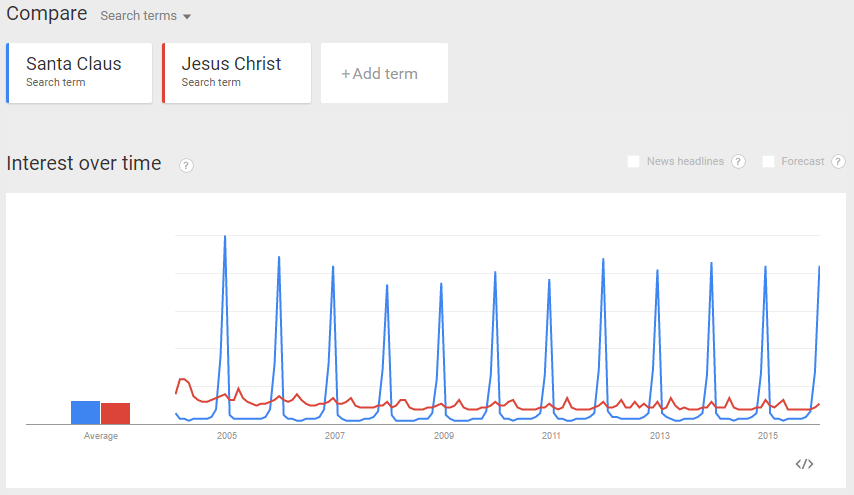
Christmas itself is not, and has not been for a long time about the nativity or Jesus. The most famous character during the Christmas season is Santa Claus. Worldwide search trends since 2004 record Santa Claus being the dominant search term, exponentially outpacing Jesus Christ on a year to year basis during the Christmas Season by a factor of 7:

cc-2015-santavsjesus

Commercialization. Holiday sales account for at least 1/5th or ~20% of retail industry’s sales in the US. The holiday season accounts for more sales than Mother’s Day, Father’s Day, Valentine’s Day, Halloween, Easter, and St. Patrick’s Day combined.

cc-2015-christmassales

Notably, the only time Jesus is said to have reacted violently, is recorded in the Gospels when money changers were using the Temple as a marketplace. In essence, people were using something holy for commercial means, not unlike what we find with the commercialization of the Christ-mass season today. A cursory reading of Matthew 21:12-13 or of John 2:14-17 makes it absolutely clear that the commercialization of Jesus’s name is something of great disrepute.

All in all, Christmas is not about Jesus. It’s not essential to the Christian faith and it’s not a practise found in the early Christian tradition. Christians who practise Christmas today are practising a festival that took hundreds of years to develop, a festival which adopted pagan practises, a festival which has no Biblical basis, a festival that is more about retail sales and Santa Claus than it is about the person of Jesus the Christ.

Christians have an important decision to make. Either you go against the grain and reject this pagan-commercialized syncretic holiday or adopt a non-Biblical modern commercial holiday:

Aggravation is better than merriment
because a sad face may lead to a glad heart.
4 The wise heart is in the house that mourns,
but the foolish heart is in the house that rejoices.
5 It is better to obey the reprimand of the wise
than to listen to the song of fools,
6 because the fool’s merriment
is like nettles crackling under a kettle.
That too is pointless.

– Ecclesiastes 7:3-6.

and God knows best.

Sources:

1 – Martindale, Cyril Charles. “Christmas.” The Catholic Encyclopedia. Vol. 3. New York: Robert Appleton Company, 1908. 24 Dec. 2015 <http://www.newadvent.org/cathen/03724b.htm&gt;.

2 – Burton-Hill, Clemency. “When Christmas Carols Were Banned.” BBC. BBC, 19 Dec. 2014. Web. 24 Dec. 2015. <http://www.bbc.com/culture/story/20141219-when-christmas-carols-were-banned&gt;.

3 – Melina, Remy. “The Surprising Truth: Christians Once Banned Christmas.” LiveScience. TechMedia Network, 14 Dec. 2010. Web. 24 Dec. 2015. <http://www.livescience.com/32891-why-was-christmas-banned-in-america-.html&gt;.

4Ibid – 1.

5 – “The History of Christmas Trees on Whychristmas?com.” The History of Christmas Trees. Web. 24 Dec. 2015.<http://www.whychristmas.com/customs/trees.shtml&gt;.

Encountering Christian Apostates

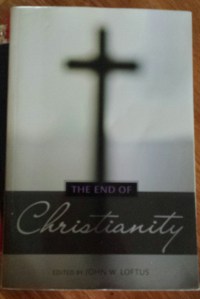
Trinidad & Tobago’s majority religious demographic is that of Christianity.20151215_151024-1.jpg Earlier this year I received a number of books from Dr. Shabir Ally, and had decided to read some of these books while on campus at one of our Universities. The book I chose to start with was John Loftus’ The End of Christianity. I hadn’t considered the reaction I would receive from walking around with a book of that title, I did receive reactions and those reactions are not what I expected them to be.

It started in class, I had taken out the book to read because I was either bored or had finished an in-class assignment early. A classmate who I knew to be Christian asked me to see the book. In that moment, I wondered if the book’s title had upset the person. They took the book, read the cover, checked the table of contents and even flipped through the book, skimming as they went along. The classmate asked me what I thought of the book, I answered quite honestly (I’m paraphrasing here): it’s new atheist dribble, but it has some nice points I hadn’t thought of as yet.

They weren’t offended, they were interested in the book. That was just the first encounter, over the course of the next 3 months, I met students throughout the campus that not only wanted to skim through the book, but many of them wanted to borrow it. This had taken me by surprise. The positive reactions from so many of my Christian colleagues had me wondering what was going on. Why would they react so positively to a book that critiqued their faith? I knew that my generation was less conservative than the previous generations. I knew that more young adults were less religious than those found in previous generations, but had this decrease in religiousity been more than I thought it to have been? As it turns out, while most of the young adults my age came from Christian families, most of them no longer considered themselves Christian. Not only were young adults apostating from Christianity, they were interested in exploring other religions, while taking an active role in leading their peers out of Christianity.

This book sparked more conversations than I am able to recall, this book gave my peers the opportunity to speak out and renounce Christianity. I never could have imagined that merely carrying a book around by this title would have this much of an effect on the people around me. What this experience taught me, was that many young adults are desperate to leave Christianity, they want to reject Christianity, they are tired of the message of the Cross and of its ineffectual teachings. These last few months gave me the opportunity of a lifetime, it opened my eyes and allowed me to reach out and apostate many Christians. At most, it took 4 conversations for me to bring someone out of Christianity. Most of the people that engaged me in discussion abandoned Christianity during the first conversation! They were just waiting for someone to reach out and agree with them, to give them the motivation to abandon the message of the Cross. This year, a simple book cover allowed me to bring many young adults out of Christianity and get them interested in Islam. While the book itself has a few interesting arguments, its overly wordy and most of its essays are okay at best.

and Allah knows best.

Jesus and the Prostitute

Question:

I have heard that the story of Jesus and the prostitute in John 8:7 is false, Christians claim that it does not affect their beliefs, can you explain this?

Answer:

This section of the Gospel attributed to John is commonly known as the pericope adulterae, it is absent from the best and earliest manuscripts: 66, 75, א, B, L, N, T, W, Δ, Θ, Ψ, 0141, 0211, 33, 565, 1241, 1424*, 2768. It should also be noted that it is calculated to be absent from the lacunae of codices A and C. In other words, it is a fabrication, inserted into Christian scripture. While missionaries may claim that this fabrication does not affect their beliefs, they would be greatly mistaken. There are many ways that this affects their beliefs, and we shall take a look at these reasons now.

To begin with, it shows the fallibility of their ‘scripture’. It demonstrates to us, that their scripture has been corrupted, and that it has the potential to include further corrupted statements. Thus, this directly affects their belief in the sanctity and preservation of their scripture. Some may claim that they were able to find this interpolation and identify it as a fabrication, thus the threat of corruption has been removed. However, this ‘identification’ took some 1500 to 1800 years to occur, clearly the Holy Spirit was sleeping during this time, as the larger world of Christendom believed in and used this passage to the point it became one of the most popular and well known passages of the Bible.

The passages about the adultress bring forward even greater problems. Let’s take a look at it:

When they kept on questioning him, he straightened up and said to them, “Let any one of you who is without sin be the first to throw a stone at her.” – John 8:7.

Allegedly, Jesus argues that he without sin should stone her. Christians believe that Jesus was without sin, so why didn’t Jesus stone her? Either Jesus disobeyed the law of Moses (which he himself/ his father) revealed to the Israelites, or he was with sin and thus failed to meet his own criteria. Either way, this incident raises several disastrous points for the Christian faith. Jesus failed to fulfill the law, he clearly identifies himself as a sinner due to his inaction and it demonstrates to us his ignorance of the law he gave to Moses, as it was never a condition to be sinless for anyone to carry out the punishments stipulated in the Torah.

What’s worse, is that Jesus never once condemned the woman for her adultery (or as some believe, prostituting). She was clearly caught in the act, witnesses were available, and Jesus failed to condemn her infidelity. The only time Jesus condemns sexual immorality is in Matthew 5 when speaking about divorce. Thus, it is quite strange that when confronted with a clear case of sexual immorality, Jesus fails to condemn the woman. Rather, he chooses to dispute with religious law, the very law he (if he is a god) gave to the Israelites. Thus, it can be deduced that according to this passage, it was more important to argue about the law than it was to condemn a case of wanton sexual immorality. The Christian concept of Jesus, absolutely fails to address the woman’s gross sin, he is silent about it, he fails to condemn her sin.

In conclusion, this passage is perhaps one of the best gifts to mankind, as it gives us the opportunity to teach Christians about the fallibility of their religion.

and God knows best.

Are there Chains of Transmissions for Early Patristic Witnesses?

Question:

A Christian polemicist who previously compared Muslims to a cancer in Europe, and who denied that God inscribed the 10 commandments on tablets to Moses, has claimed that there is a chain of transmission linking the apostles of Jesus to the early Church Fathers. Is this true? How, do we respond to this?

Answer:

There is nothing to respond to. The author of the aforementioned article does not seem to understand the basics of hadith criticism, and reduces the science of hadith criticism to merely throwing some names together and linking them through obscurity. It should be noted that in reading that poor article, the author depends solely on one disciple and solely on one Patristic, with two extremely obscure quotes whose works we no longer have the autographs (originals) for. After several hundred words, the author could not sum his evidences to provide a basis for a single da’eef (weak) chain of transmission. Under hadith criticism, especially that of mustalah or rijal, the hadith sciences would have no other option to regard that claim of a “chain”, as nothing more than hearsay.

Regarding his quotes, Papias and Polycarp are said to have been contemporaries of each other. Eusebius in the 4th century, corrects Papias in his assertion that he knew John the apostle. It is disputed which John that Papias knew. If Papias and Polycarp were contemporaries, and the Christians of the 4th century couldn’t identify which of the four Johns he knew (John the apostle, John the elder, John of Patmos or a John with a combination of any of the previous identities), how can someone 2000 years later claim to make that identification for Papias’ contemporary, Polycarp? Furthermore, it should be noted that Polycarp himself not once quotes or references John the apostle in any of his extant writings, and Iraeneus who in the late second century recorded the claim that Polycarp knew John, heard this in his childhood. There are literally no other sources which can corroborate something that Iraeneus writing in the late second century, claims to have heard in his childhood, much less so from any of the extant writings of Polycarp himself.

The author of the aforementioned article, in a case of pure desperation attempts to quote Ignatius’ work to qualify the claim of early Trinitarian beliefs, whereas it should be known that Ignatius’ works are only survived through Eusebius in the 4th century, with absolutely no verifiable chain of transmission between the two. In other words, it has been demonstrated that the author himself is unfamiliar with the hadith sciences to the point he could not offer a single chain of transmission or the chain’s grading, or a jarh of any of the names mentioned in the overly lengthy article. His sole reliance on one obscure quote without any other witness or comment by Iraeneus himself, demonstrates the desperation of the author to forcibly create an instance of a chain of transmission. In my debate earlier this year, I consulted with a New Testament Professor and a scholar of the hadith sciences to examine the chains of transmission in the early Church. A basic summary of the results of our labour can be found in that debate:

It is clear that the author of the article was not attempting to present a studied argument. Due to the nature of the blog he posted the article to, it can thus be deduced that he was pandering to lay-Christians with no scholastic interest in either Christianity or Islam. I forwarded his article to both the New Testament Professor and hadith scholar I worked with on examining Patristic chains of transmission, and both of them replied quite negatively. Another brother, who discussed this topic with a prominent Christian New Testament scholar and historian, also replied negatively to the claims in the article (not to the article itself). I have not sought permission from any of these persons to reproduce their comments on this website. Should the case arise for me to do so, I will, with great pleasure. However, it is saddening that the Christian author has chosen to align himself with an anti-immigrant polemicist, whose venom Dr. James White in a recent video attempted to dissuade Christians from endorsing. It would then seem, that the author is more interested in pandering to a racist crowd, that conforms to his views, than to do objective, intelligent and honest academic research.

In this article, using a single criteria from the hadith sciences, I demonstrated that the New Testament does not meet the criteria of a da’eef (weak) narration.

In this article, using a single criteria from the hadith sciences, I demonstrated that none of the New Testament literature, can be validated or verified as being from Jesus ‘alayhi as salaam or his apostles, since none of the alleged transmitters can stand up to rijal al hadith.

and Allah knows best.


« Older Entries Recent Entries »