Category Archives: FAQS

Clarification by Wallace on Using Patristic Witnesses to Re-Construct the New Testament

Many evangelical Christian apologists use an argument attributed to the Executive Director of the Center for the Study of New Testament Manuscripts, which goes as follows:

We can almost completely restore the New Testament off of the early church fathers alone.

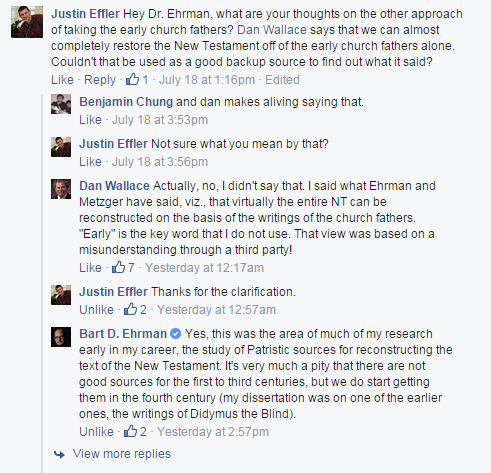
This argument posits that based on the writings of the early Church Fathers (Patristics), in their quotations, we can use those quotations of the New Testament to reconstruct the entire New Testament. However, as Dr. Dan Wallace clarifies, this is not a claim he makes, and he specifically qualifies that although such a reconstruction can be done, it cannot be done using the early Patristics:

cc-2015-wallaceonpatristictc

As Dr. Ehrman points out, this cannot be done using the early Patristic writings (1st to 3rd centuries). Unfortunately, this is quite a popular argument used by Christian apologists, and it’s long overdue that either Dr. Wallace or Dr. Ehrman corrected lay Christians on their use and abuse of alleged arguments by scholars.

and God knows best.

Comparison: Scribes of The Qur’an vs Scribes of the New Testament (Part 2)

Last week we took a cursory look at the known scribes of the Qur’an, in comparison with the known scribes of the New Testament. This week, we’re going to venture a little deeper into understanding why the identity of the authors and scribes (amanuenses and copyists) is of concern to the modern reader. Unlike the Qur’an, the veracity of the New Testament is based on the claim that it is from eyewitnesses:

For almost seventeen hundred years, Christians regarded the four canonical Gospels as being, among other things, records of what actually happened. Divine inspiration seemed to guarantee historical veracity, as did the belief that the purported authors of those Gospels, Matthew, Mark, Luke, and John, were either eyewitnesses or friends of eyewitnesses.[1]

It is therefore touted as a historical work, based on the witness of contemporaneous sources. However, both early sources and later sources agreed throughout Church history that the New Testament was ahistorical in many cases and as one Church Father would put it, based on “material falsehood”:

Even more clear-eyed was Origen, who in the third century anticipated modern criticism by candidly observing that at “many points” the four Gospels “do not agree.” He inferred that their truth cannot reside in “the material letter:” The Evangelists “sometimes altered things which, from the eye of history, occurred otherwise.” They could “speak of something thing that happened in one place as if it had happened in another, or of what happened at a certain time as if it had happened at another time,” and they introduced “into what was spoken in a certain way some changes of their own.” “The spiritual truth was often preserved, one might say, in the material falsehood.”[2]

The issue of scribes altering original works is not alien to the New Testament itself. A warning in Revelation 22, the last book of the Bible was placed there to very specifically warn scribes from altering the work, the author(s) of this work then, at the very least were aware of the fate that had befallen other Christian works of that time and prayed that this would not happen to their own:

“I warn everyone who hears the words of the prophecy of this scroll: If anyone adds anything to them, God will add to that person the plagues described in this scroll. And if anyone takes words away from this scroll of prophecy, God will take away from that person any share in the tree of life and in the Holy City, which are described in this scroll.”[3]

For those who argue that this book was written early, this quote demonstrates that at the time it was written scribes were altering works at such a scale of worry that the author(s) had to invoke a curse and warn them from altering their own work! Commenting on this passage, Phillip Comfort states:

“Since writers in antiquity were well aware that their books could be changed by scribes in successive copies, they made these warnings. Undoubtedly, they knew that there would be unintentional mistakes, which come through the course of making manuscripts. What they were hoping to protect against was intentional alteration of the writing.”[4]

What kind of intentional changes do we find in the New Testament manuscript tradition?

“Those who study the text and the history of its transmission realize that most of the substantive changes were made in the interest of “improving” the text. Various scribes were motivated to make changes in the text for the sake of harmonizing Gospel accounts, eliminating difficult doctrinal statements, and/or adding accounts from oral tradition.”[5]

“Whereas readers do this gap-filling in their imaginations only, scribes sometimes took the liberty to fill the unwritten gaps with written words. In other words, some scribes went beyond just imagining how the gaps should be filled and actually filled them. The historical evidence shows that each scribe who made a text created a new written text. Although there are many factors that could have contributed to the making of this new text, one major factor is that the text constantly demands the reader to fill in the gaps. During the reading process, the reader must concretize the gaps by using his or her imagination to give substance to textual omission and/or indefiniteness. Since this substantiation is a subjective and creative act, the concretization will assume many variations for different readers.”[6]

“Metzger considered the early Western text to be the work of a reviser “who was obviously a meticulous and well-informed scholar, [who] eliminated seams and gaps and added historical, biographical, and geographical details. Apparently the reviser did his work at an early date, before the text of Acts had come to be generally regarded as a sacred text that must be preserved inviolate.”[7]

“More often than not, the editors of the UBS/NA text considered the Alexandrian text, as the shorter text, to have preserved the original wording in Acts. My view is that in nearly every instance where the D-text stands alone (against other witnesses—especially the Alexandrian), it is a case of the Western scribe functioning as a reviser who enhanced the text with redactional fillers. This reviser must have been a well-informed scholar, who had a penchant for adding historical, biographical, and geographical details (as noted by Metzger). More than anything, he was intent on filling in gaps in the narrative by adding circumstantial details. Furthermore, he shaped the text to favor the Gentiles over the Jews, to promote Paul’s apostolic mission, and to heighten the activity of the Holy Spirit in the work of the apostles.”[8]

In Uloom al Hadeeth or the Science of Hadeeth, criticism of a transmitter is necessary for validating or verifying the information they are transmitting. This type of criticism is known as Rijal al Hadeeth, in which the character of the transmitter is examined. One might wonder, how detailed is this science in Islam? The following text should clarify the extent to which our methodology goes in order to validate information on a transmitter:

“A man bore witness in the presence of `Umar ibn al-Khattaab -radiyallaahu `anhu, so `Umar said to him: “I do not know you, and it does not harm you that I do not know you, but bring someone who does know you.”

So a man said: ‘I know him, O Chief of the Believers.’
He said: “What do you know of him.”

He said: ‘Uprightness.’
He said: “Is he your closest neighbour; so that you know about his night and his day, and his comings and goings?”

He said: ‘No.’

He said: “So have you had (monetary) dealings with him involving dirhams and deenars, which will indicate his piety?”

He said: ‘No.’

He said: “Then has he been your companion upon a journey which could indicate to you his good character?”

He said: ‘No.’

He said: “Then you do not know him.”

Then he said to the man: “Bring me someone who knows you.”[9]

Such a detailed criticism of any transmitter (whether orally or textually) in early Christianity has never been done, nor had such a science been developed in the Christian tradition. Rather, the most critical methodology of verifying information in the Christian tradition has been one of assumption. Rather than critically examining the characters of scribes, and transmitters, it is assumed that the earliest witnesses would have corrected misinformation from being shared:

“The primary reason is that the writers (or their immediate successors) were alive at the time and therefore could challenge any significant, unauthorized alterations. As long as eyewitnesses such as John or Peter were alive, who would dare change any of the Gospel accounts in any significant manner? Any one among the Twelve could have testified against any falsification.”[10]

We’ve already seen just how unreliable the early scribes were, and now that we know that there was no methodology to verify early transmitting of information, how can we be certain that if we assume the disciples were around, that they would be able to correct and thus stop misinformation from spreading? We cannot be certain of this, in fact, this assumption is erroneous given that the very Gospels themselves which are alleged to have been written during the time of the 12 disciples can’t even get the origin of Jesus meeting some of his most important disciples correct! In the origin story of the disciple Phillip, Jesus meets Philip in the city of Bethsaida. This is anachronistic, as Bethsaida only became a city after the ministry of Jesus ended. Therefore when Jesus met Philip in Bethsaida, it was considered a village. The Gospel of Mark in 8:23 correctly identifies it as a village (Greek: kome), but John in 1:44 refers to it as a city (Greek: polis). Considering that three disciples, Philip, Andrew and Peter were from Bethsaida, then how is it possible that all three of them let such a minor detail in one of the twelve’s origin stories be incorrect?

So that’s a minor detail, what about the origin stories for both Peter and Andrew?

In Matthew 4:18, Jesus meets Peter and Andrew on the seashore while fishing with nets. At that time the poorer fishermen did not have boats and so they would cast nets from the shoreline and catch whatever they could have. Just three verses later in 21 – 22, Jesus meets James and John with their father, who unlike Peter and Andrew, have a boat and are mending their nets. So Jesus in 5 verses, meets four of his most prominent disciples. In Mark 1:16 – 20, he tells us the same story in Matthew, but with a big difference, the third man in the boat when Jesus meets James and John for the first time is a hired servant and not their father, thus showing their wealth in comparison with Peter and Andrew. He makes the distinction between their places in society more noticeable.

In Luke though, it’s a different story. Jesus when he first comes to Capernaum, goes to Peter’s house and cures his mother in law (Luke 4:38). Then later, he stumbles across Peter on the shore of the lake, but they have a boat and he finds Peter mending a net, not using it to fish, a different story from Matthew. Jesus then proceeds to embark on Peter’s boat, perform a miracle in the lake and it is then that James and John notices the miracle and joins Peter. Again, this contradicts both Matthew and Mark’s story in which Peter, Andrew and Jesus while walking on the shoreline, spots James and John, then they leave their boat and follow Jesus on the shore. Have you noticed Luke never mentions Andrew? That’s a problem because in John’s account, Andrew met Jesus when Jesus was at the River Jordan with John the Baptist. Then Andrew finds Peter and takes him to meet Jesus (John 1:39-42). Then they go to Galilee in the region of Bethsaida. No mention of meeting on a boat, by a boat, because of a boat, or because of fishing, a completely different narrative. Definitely no mention of either James or John, the sons of Zebedee.

All four Gospels, have contradictions, errors and in some cases, a completely different narrative regarding the origin of Jesus meeting four of his twelve disciples. As we read earlier, according to Christian scholarship, if the disciples were alive they would have corrected any falsification, as we have just seen, either the disciples were complicit in falsifying information or the Gospel stories as we currently possess them were not verified by the disciples themselves. In fact, the reason that we cannot critically assess the character of any of the early transmitters in Christianity, or its disciples is because we know so little about them. Take for example, the rock on which Jesus is alleged to have built his Church, the disciple Peter, the most important disciple. What do we know about Peter?

“It is one of the inscrutable ironies of Christianity’s humble beginnings that we know so little about Jesus of Nazareth’s leading disciple— the one identified in the Gospel of Matthew as the “rock” on whom Jesus would build his church, listed in later Christian tradition as Rome’s first bishop, and one of its two apostolic martyrs at the hands of Emperor Nero. But who was this man, and what happened to him? Any conventional quest for a “historical Peter” runs into the ground rather swiftly.”[11]

“Yet they remain remarkably vague or silent about many of the things we would like to know about this apostle’s origin, character, missionary career, and death. Why would these sources show such a lack of interest in the fate of such a prominent apostle? This can only leave the modern reader frustrated and mystified. The historical Peter himself left virtually nothing in writing, and even less of archaeological interest— whether in his native Galilee, in Jerusalem or Caesarea, in Antioch or Corinth.”[12]

“Among the numerous extant writings in his name, there are of course two short and remarkably different letters of uncertain date and origin in the NT. Beyond that, we have a bewildering range of apocryphal sources, styled as written by or about him, dating from the second through (at least) the sixth century. The authenticity of these documents remains contested among scholars of diverse critical presuppositions. On perusing the scholarly secondary literature, it seems hard to dispel the impression that the vast majority of leading specialists on both sides of the Atlantic now regard neither of the NT’s two Petrine letters as coming from Peter’s own pen.”[13]

It is amazing that Christians would like to tell us what the disciples believed about Jesus, but the reality is that they themselves do not know much, if anything about Peter. Moreso, not only do they know nothing about Peter, they have very little to tell us about the origins, or ends of any of the disciples. Therefore, when Christians claim that the New Testament is based on eyewitness testimony and that the New Testament is historically accurate, on what basis are they making these claims? The early Church had no methodology for verifying and validating information made about Jesus, the one theory Christian scholarship offered about the disciples correcting information did not stand up to scrutiny, historically we know nothing about the earliest witnesses, therefore by every criteria they claim to stand on, the New Testament fails every one of them.

In contrast to the disaster that is the Christian transmission of information, the sciences of Uloom al Hadeeth and Uloom al Qur’an, are far more detailed and critical of transmitters. More critical, than any methodology ever offered by the Christian tradition. It is often claimed that our hadeeth corpus is on par with the New Testament’s authenticity, but as demonstrated last week, this cannot be the case. Pursuant to this, if one of the sub-sciences of Uloom al Hadeeth, Rijal al Hadeeth, is more demanding and critical than any methodology ever used in Christian scholastic history to validate or verify the New Testament, then it stands to reason that our weakest narrations from the hadeeth corpus are more authentic, valid and historically viable than the entire New Testament.

and Allah knows best.

Sources:

  1. Allison, Dale C., Jr.. The Historical Christ and the Theological Jesus (Kindle Locations 32-34). Kindle Edition.
  2. Allison, Dale C., Jr.. The Historical Christ and the Theological Jesus (Kindle Locations 42-46). Kindle Edition.
  3. Unknown. The Book of Revelation, 22:18-19. NIV 2011.
  4. Comfort, Phillip (2010-07-19). Encountering the Manuscripts (Kindle Locations 6833-6835). B&H Publishing. Kindle Edition.
  5. Comfort, Phillip (2010-07-19). Encountering the Manuscripts (Kindle Locations 6890-6892). B&H Publishing. Kindle Edition.
  6. Comfort, Phillip (2010-07-19). Encountering the Manuscripts (Kindle Locations 8023-8028). B&H Publishing. Kindle Edition.
  7. Comfort, Phillip (2010-07-19). Encountering the Manuscripts (Kindle Locations 8691-8694). B&H Publishing. Kindle Edition.
  8. Comfort, Phillip (2010-07-19). Encountering the Manuscripts (Kindle Locations 8702-8708). B&H Publishing. Kindle Edition.
  9. Reported by al-Bayhaqee and others, and it was declared to be ‘saheeh’ (authentic) by Ibnus-Sakan, and our Shaykh (Muhammad Naasiruddeen al-Albaanee) agreed; and refer to ’al-Irwaa’ no. 2637. As recommended by the blog’s owner, Br. Omar.
  10. Comfort, Phillip (2010-07-19). Encountering the Manuscripts (Kindle Locations 6801-6803). B&H Publishing. Kindle Edition.
  11. Bockmuehl, Markus (2012-11-01). Simon Peter in Scripture and Memory: The New Testament Apostle in the Early Church (p. 3). Baker Publishing Group. Kindle Edition.
  12. Bockmuehl, Markus (2012-11-01). Simon Peter in Scripture and Memory: The New Testament Apostle in the Early Church (p. 3). Baker Publishing Group. Kindle Edition.
  13. Bockmuehl, Markus (2012-11-01). Simon Peter in Scripture and Memory: The New Testament Apostle in the Early Church (p. 4). Baker Publishing Group. Kindle Edition.

Comparison: Scribes of the Qur’an vs Scribes of the New Testament (Part 1)

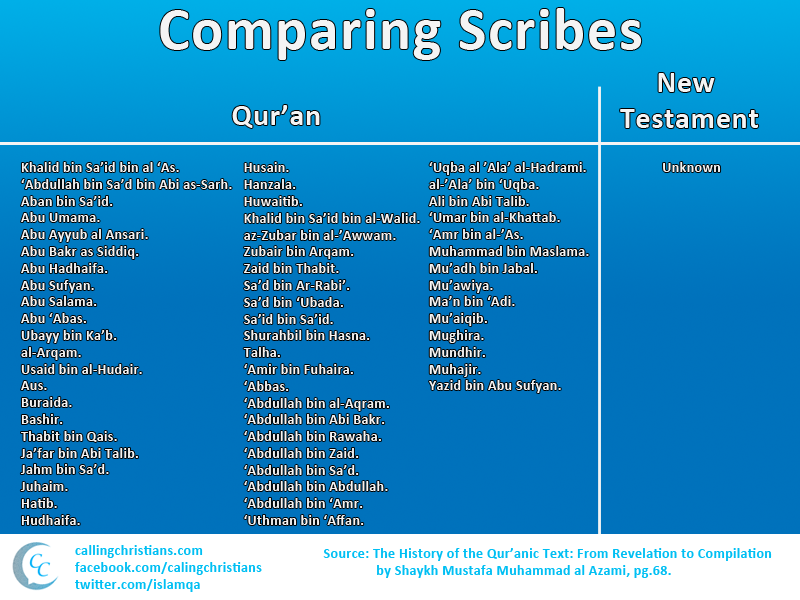
A quick comparison on the identities of the scribes of the Qur’an and the scribe(s) of the New Testament. Quite the disparity!

cc-2015-qscribesvsntscribes

Click to Enlarge

The list of names of the Qur’anic scribes was transcribed from Shaykh Muhammad Mustafa al Azami’s work on the Qur’an’s preservation[1]. To understand why the New Testament has unknown scribes, it should be noted that Irenaeus in 185 CE, was the first to name the authors of the New Testament gospels[2][3]. Prior to this, no name was attached to them and none of their authors were known. Moreover, since none of their authors were known, we know of none of their scribes. Comparisons are usually made between the hadith corpus and that of the New Testament. However, this is the fallacy of false equivalency, as the conditions for establishing a narration as da’eef, or weak is not met by the New Testament literature:

The Riwaayah of an unknown person is not acceptable because if his name is not known then his Haal (condition) cannot be defined (as to whether he is reliable or not). The Saheeh (correct) verdict is that a Mubham (unknown) Raawi cannot be declared as Aadil (reliable).[4]

On this basis, at the very least, the New Testament does not compare to a single weakly graded tradition from the hadith corpus.

Note: Yazid ibn Abi Sufyan (d. 640 CE), is not to be confused with Yazid ibn Mu’awiyah (d. 683 CE), they are two different persons.

and Allah knows best.

Sources:

  1. Al Azami, Muhammad Mustafa. The History of the Qur’ānic Text: From Revelation to Compilation : A Comparative Study with the Old and New Testaments. Leicester: UK Islamic Academy, 2003. 68. Print.
  2. Ehrman, Bart. “The Gospels Are Finally Named! Irenaeus of Lyons.” The Gospels Are Finally Named! Irenaeus of Lyons. – Christianity in Antiquity (CIA): The Bart Ehrman Blog. 18 Nov. 2014. Web. 3 July 2015.
  3. Irenaeus, Saint. Adversus Haereses. Vol. 3. Print.
  4. Al Asqalani, Ibn Hajr. Nukhbat Al-Fikar Fī Muṣṭalaḥ Ahl Al Athar. 62. Print.

The Markan Gospel’s Systematic Development in Light of Miracle Sets

Traditionally speaking, Christian apologists have always appealed to the Gospel ascribed to Mark’s haphazard narrative inconsistencies (in regard to the narratives of the synoptics) as a proof of its early authorship being attested by Papias, as recorded in Eusebius’ Church History:

“This also the presbyter said: Mark, having become the interpreter of Peter, wrote down accurately, though not in order, whatsoever he remembered of the things said or done by Christ. For he neither heard the Lord nor followed him, but afterward, as I said, he followed Peter, who adapted his teaching to the needs of his hearers, but with no intention of giving a connected account of the Lord’s discourses, so that Mark committed no error while he thus wrote some things as he remembered them. For he was careful of one thing, not to omit any of the things which he had heard, and not to state any of them falsely. These things are related by Papias concerning Mark.” – 3.39.15.

However, using narrative criticism, we are able to examine the patterns of literary development as envisaged by the Markan author. Thus, as we will see, the Markan Gospel cannot be considered disorderly, but should be considered as a work of systematic literary development. Whatever work Papias was referring to, has not remained with us (not a single papyri of the Markan Gospel exists earlier than the mid to late 3rd century), or what later Christians (such as Eusebius) identified with earlier Christians (Papias) is mistaken and as such, should be taken as mere anachronistic apologetic revisionism. As the “Church” began to develop, so did its history, especially in regard to its origins. This might seem odd to some, but we need to remember that as the various early Christian communities began to coalesce, a homogenous “universal” or Catholic history of the “true” Church began to manifest itself, what we refer to today as the proto-orthodox Church.

Jaroslav Pelikan says in the Christian Tradition Vol 1:

“There is a sense in which the very notion of tradition seems inconsistent with the idea of history as a movement and change. For tradition is thought to be ancient, hallowed by age, unchanged since it was first established once upon a time. It does not have a history, since history implies the appearance at a certain point in time, of that which had not been there before.

According to the Ecclesiastical History of Eusebius, orthodox Christian doctrine did not really have a history, having been true eternally and taught primitively; only heresy had a history, having arisen at particular times and through the innovations of particular teachers Roman Catholics polemics has frequently contrasted the variations of Protestantism with the stable and unchanging doctrine of Roman Catholicism.

It seems that theologians have been willing to trace the history of doctrines and doctrinal systems which they found to be in error, but that the normative tradition had to be protected from the relativity of having a history or being, in any decisive sense, the product of a history.” – pp. 7 – 8.

Many Christian scholars on early Christian traditions, agree that Church history tends to be generative as opposed to retentive (as is often claimed):

“At the same time, such individual memories also typically come to be calibrated in relation to an emerging communal consensus— either reactively or, more often, in convergence with it. Memory of this sort is of course highly episodic, lumpy, and often somewhat formulaic— characteristics to which even eyewitnesses are hardly immune. And it can often be generative of meaning, rather than merely retentive.” – Markus Bockmuehl, Simon Peter in Scripture and Memory: The New Testament Apostle in the Early Church (pp. 11-12).

So, while the quote attributed by Eusebius to Papias may be more of a generated communal teaching which later manifested itself in Church tradition, can we truly say that the Gospel ascribed to Mark is the work of a scribe hastily writing down an orator’s recounting, as opposed to a work of systematic literary development? The answer is no. There are two sets of miracle stories in the Markan Gospel that follow a specific pattern, that bear witness to an intentional development of the Christ’s image in comparison with the Messianic archetype prevalent throughout Judaic literature.

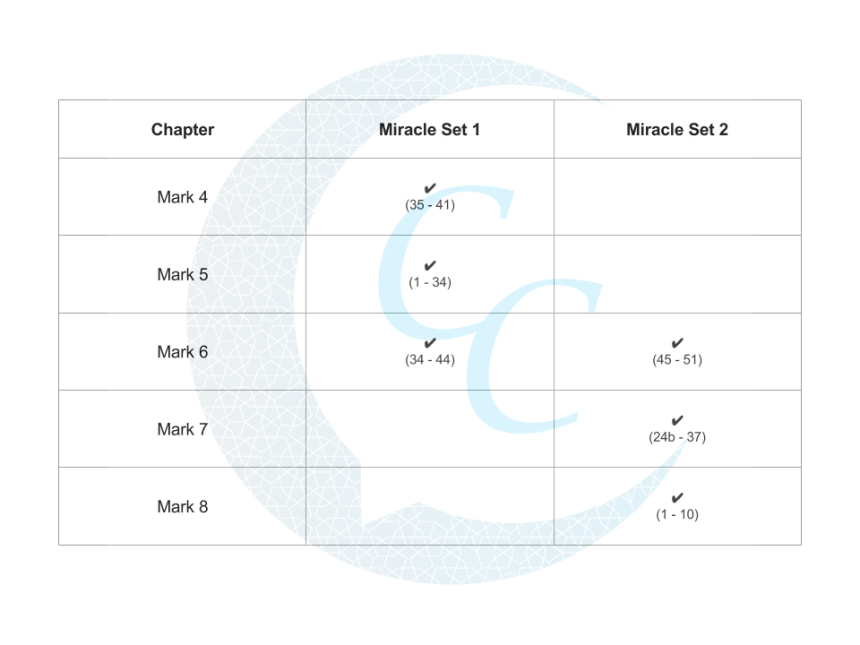
Markan Miracle Sets 2

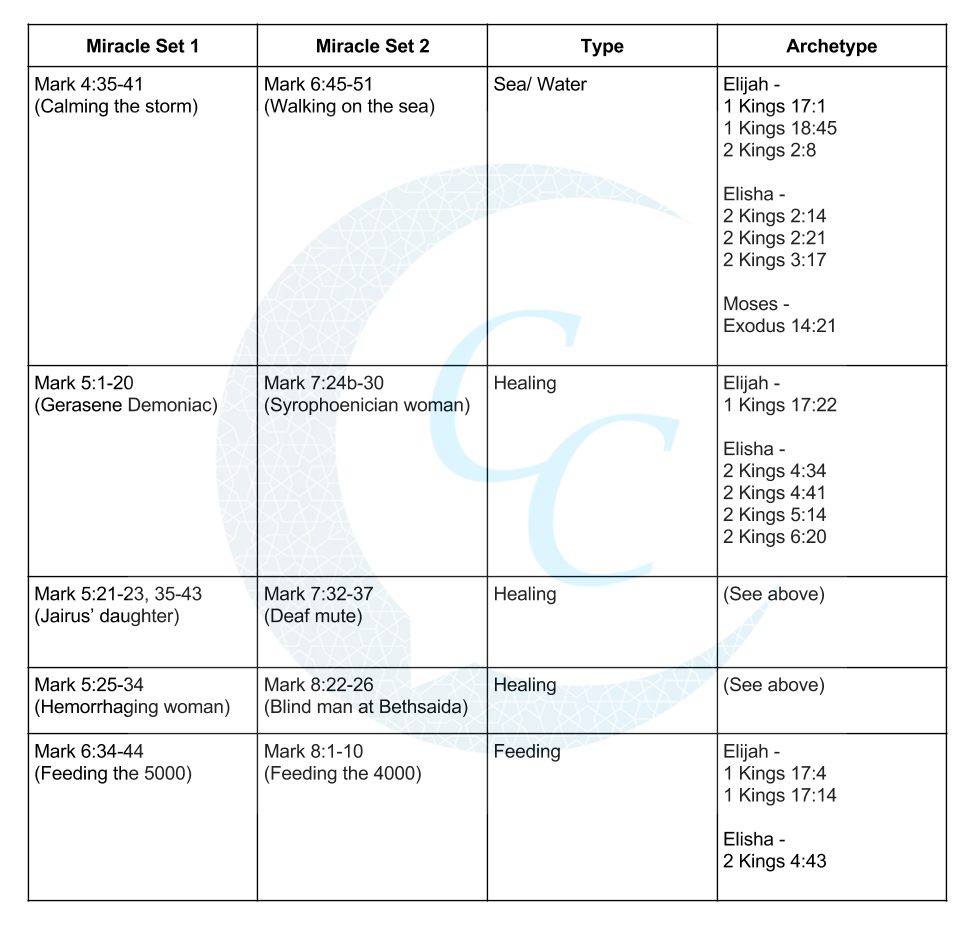
As we can see from this simple break down, the miracle stories are equally divided into two sets. Each set has the same pattern and form of miracles: one sea/ water – three healings – one mass feeding. Both sets of miracles, also occur within six successive chapters, with the first set ending and the second set beginning within the same chapter and within one verse of each other. These are not and cannot be coincidences, or disordered in any way. They are quite specific in pattern and form, the ordering of these miracle stories are intentional and systematic. Further analysis shows, that the author derived these miracle stories from earlier Jewish Messianic types, who were to guide their people in times of great turmoil:

Markan Miracle Sets

Thus, the intention of ordering and mentioning these specific miracles attributed to Christ, was done with the purpose of painting Christ in the same image and stature as that of Moses, Elijah and Elisha. In fact, the author who developed these miracle sets, does include specific mention of Jesus being like, or being Elijah within the same chapters:

Others said, “He is Elijah.” And still others claimed, “He is a prophet, like one of the prophets of long ago.” – Mark 6:15.

They replied, “Some say John the Baptist; others say Elijah; and still others, one of the prophets.” – Mark 8:28.

Therefore, it should be concluded from reading the Gospel ascribed to Mark, that this piece of literature has undergone intentional development, with specific goals in mind to paint Christ in light of earlier Messianic archetypal figures. The narratives are in order, for the purpose the author intended to achieve, and as such, we can understand that it is the case that either Papias’ statement refers to some other piece of literature, or that the Gospel of Mark has undergone significant systematic literary development with a Jewish audience in mind and as such, is no longer in its original form.

and God knows best.

Where does Jesus say I am NOT God in the Qur’an?

Question:

Muslims often like to ask where did Jesus claim to be God in the Bible, to prove that he isn’t God. Some Christians have decided to ask us, “where does Jesus say he is not God in the Qur’an?,” they are trying use our own argument against us. How can we respond to this?

Answer:

Unfortunately for the Christian, Jesus in the Qur’an rejects that he ever claimed to be God, therefore asking this question as a counter-argument is not very smart to say the least. In Qur’an 5:116, it is stated:

“And [beware the Day] when Allah will say, “O Jesus, Son of Mary, did you say to the people, ‘Take me and my mother as gods besides Allah?’” He will say, “Exalted are You! It was not for me to say that to which I have no right. If I had said it, You would have known it. You know what is within myself, and I do not know what is within Yourself. Indeed, it is You who is Knower of the unseen.”

If a missionary uses this argument, and they’re serious about it, I’d personally find someone smarter to talk to.

and Allah knows best.

Nabeel Qureishi on Tawhid

Nabeel of RZIM and I had a discussion on Twitter about one of his claims during his debate with Dr. Shabir that the word “tawheed/ tawhid” was not found in the hadith corpus. I pointed him to this (source – Saheeh hadith):

دَّثَنَا هَنَّادٌ، حَدَّثَنَا أَبُو مُعَاوِيَةَ، عَنِ الأَعْمَشِ، عَنْ أَبِي سُفْيَانَ، عَنْ جَابِرٍ، قَالَ قَالَ رَسُولُ اللَّهِ صلى الله عليه وسلم ‏ “‏ يُعَذَّبُ نَاسٌ مِنْ أَهْلِ التَّوْحِيدِ فِي النَّارِ حَتَّى يَكُونُوا فِيهَا حُمَمًا ثُمَّ تُدْرِكُهُمُ الرَّحْمَةُ فَيُخْرَجُونَ وَيُطْرَحُونَ عَلَى أَبْوَابِ الْجَنَّةِ ‏.‏ قَالَ فَيَرُشُّ عَلَيْهِمْ أَهْلُ الْجَنَّةِ الْمَاءَ فَيَنْبُتُونَ كَمَا يَنْبُتُ الْغُثَاءُ فِي حِمَالَةِ السَّيْلِ ثُمَّ يَدْخُلُونَ الْجَنَّةَ ‏”‏ ‏.‏ قَالَ هَذَا حَدِيثٌ حَسَنٌ صَحِيحٌ وَقَدْ رُوِيَ مِنْ غَيْرِ وَجْهٍ عَنْ جَابِرٍ ‏.‏

Jabir narrated that the Messenger of Allah (s.a.w) said:

“Some of the people of Tawhid will be punished in the Fire until they are coals. Then the Mercy (of Allah) will reach them, they will be taken out and tossed at the doors of Paradise.” He said: ” The people of Paradise will pour water over them, and they will sprout as the debris carried by the flood sprouts, then they will enter Paradise.
What was interesting, is that Nabeel gave this reply (source):
wpid-2015-04-10-21.20.42.png.png
I learned something from this experience. Nabeel does not know what the word Tawheed/ Tawhid in Arabic looks like, so here it is:
توحيد‎
As a former Qadiani/ Ahmadi, it does not surprise me that the one word fundamental to Muslim ‘aqeedah (doctrine/ creed), is a word he doesn’t know. At least this incident explains to us the extent to which his “Islamic” education reached.
cc-2015-nabeelqureishi
He just had a debate on the Trinity and Tawheed, and he didn’t even know what Tawheed looked like in the Arabic language, a word that is practically in every Muslim book on creed. I’m not sure what’s worse, that he didn’t know or that because he didn’t know, he made erratic claims that now can no longer be substantiated. I’m sorry Nabeel, there is no excuse for this level of ignorance, especially when you’re debating these topics in an academic setting. Thank you for demonstrating to the Muslim world, the extent of your Islamic knowledge. You’ve done an amazing job. And God knows best.

Christian Militants Fighting in Ukraine: Protestant Churches vs Orthodox

A recent video by Vice news, purports to show Christian militants fighting each other over sectarian beliefs in Ukraine. Russian Orthodox militants versus that of Protestant militants. Very interesting that not a single Christian leader has come out to condemn these Christian militants who claim to kill in the name of Christ.

A Christian militant at 8:43 in the video says:

Reporter: What is this building?


Militant: This building used to be a Baptist sect.


Reporter: What happened to them?


Militant: I don’t know, when the war started they disappeared. I guess they left. There is only one faith, Orthodoxy. I am Orthodox. It was left to us by our ancestors and the Baptists are schismatics. It’s American propaganda. Which fills the head of our people, the Russians, the Slavs, which results in what you see now, the war.


Reporter: Will you allow them to return?


Militant: Personally I wouldn’t let them come back. Not the Baptists, not the Evangelists, not the Catholics, not the Greek Catholics. None of them. Because I took up arms so that we could have an Orthodox State.

The DPR’s Deputy PM said at 14:41 in the video:

The issue could be forced eviction, but it’s possible that the issue was that the Protestants for the most part do not support us.

At 15:00 in the video, the interview continued:

Reporter: How important is the Orthodox Church to the DPR and to you?


DPR Dept. PM: It’s very important. According to the ideology we are building, we would very much like to maximally integrate the Orthodox Church into areas that concern morals, in areas that concern family values, and so on. If the Church has more direct influence – Let’s say the state even makes the Church a part of the state in certain areas. Orthodoxy is one of the foundations of our statehood….

We have yet to see a single Christian leader condemn this violence in the name of the Christian faith. Baptists such as James White, or apologists such as David Wood, Sam Shamoun, Walid Shoebat, or even Islamophobes such as Pamela Geller or Robert Spencer. They all usually have a lot to say when Muslims are involved, but they are eerily silent when it comes to Christian on Christian terrorism and militancy.

and Allah knows best.

A Quick Comparison of Satan in Christianity and Islam

In comparing Christian literature and Islamic literature in regard to Satan, there appears to be a clear dichotomy as to how each faith treats Satan in relation to both God and man. As it would seem, Islam lessens the stature of Satan, demeans him whereas Christianity elevates him to quite a lofty status. To most, this wouldn’t be noticeable but when the Islamic view and the Christian view of Satan is considered, the outcome can be quite disturbing.

Satan in Islam

Who is Satan a rival to in Islam? As the Qur’an teaches, he is a rival to mankind, to humans not to God:

“O mankind! Eat of that which is lawful and good on the earth, and follow not the footsteps of Satan. Verily, he is to you an open enemy.” – 2:168.

Satan is subordinate to God. Who is the all powerful deity that is Lord over all Creation? Allah is. He has no rivals, He is Lord of everything in creation (الْعَالَمِينَ):

“All praise is to Allah, the Lord Of The Creation.” – 1:2.

Does sin restrict God’s mercy in Islam? No, God forgives all sins.

Say, “O My servants who have transgressed against themselves [by sinning], do not despair of the mercy of Allah. Indeed, Allah forgives all sins. Indeed, it is He who is the Forgiving, the Merciful.” – 39:53.

Satan in Christianity

Who is Satan a rival to in Christianity? As the Bible teaches, he is a rival to God:

“Then Jesus was led up by the Spirit into the wilderness to be tempted by the devil.” – Matthew 4:1.

In this episode in the wilderness and on the mount, Satan has the ability to directly tempt Jesus, directly challenge him and the power to take Jesus wherever he wills:

“Jesus answered him, “It is also written: ‘Do not put the Lord your God to the test.’” Again, the devil took him to a very high mountain and showed him all the kingdoms of the world and their splendor.” – Matthew 4:7-8.

Here we have Jesus who Christians claim to be God, telling Satan not to put him to test and what does Satan do? He puts Jesus or God, to test. Not only that, Satan then proceeds to take Jesus or God from one place to another thus demonstrating his power and will are on par with Jesus’/ God’s.

Is the God of Christianity, Lord of all Creation? It isn’t. The God of Christianity has a rival in the Lord of this world, who is Satan:

“(Satan) In their case the god of this world has blinded the minds of the unbelievers, to keep them from seeing the light of the gospel of the glory of Christ, who is the image of God.” – 2 Corinthians 4:4.

Does sin restrict God’s mercy in Christianity?

“but whoever blasphemes against the Holy Spirit will never be forgiven; they are guilty of an eternal sin.” – Mark 3:29.

Conclusion

As one can see in Christianity, Satan is the rival to God. He rivals God on His Lordship (power, stature, ability) and the sin which Satan spreads (blasphemy) cannot be forgiven by God, He (God) is restricted by Satan’s spreading of sin. Whereas in Islam, Satan cannot rival God, he is a rival to mankind. Only God is the true Lord of all creation, nothing is equal in power, stature or ability to Him (God) and He can forgive all sins, regardless of whom Satan misguides. Satan is subordinate to Allah (God), whereas in Christianity this is not the case. Therefore, it stands to reason that Christianity elevates Satan to a pedestal whereas Islam declares him lowly in God’s sight, subordinate to God.

and Allah knows best.

Qur’anic Error in 4:157 – Did the Jews Claim to have Killed the Messiah?

Question:

Does the Qur’an make an error when it says the Jews claimed to have killed the Messiah in Surah 4 Verse 157?

Answer:

No, it does not make an error. According to Matthew 27:22, the Jews chose to have Jesus killed:

“What shall I do, then, with Jesus who is called the Messiah?”Pilate asked.They all answered, “Crucify him!”

Pontius Pilate then washes his hands of the decision and places the guilt upon the Jews which they wholeheartedly accepted in verses 23 – 25:

But they shouted all the louder, “Crucify him!” When Pilate saw that he was getting nowhere, but that instead an uproar was starting, he took water and washed his hands in front of the crowd. “I am innocent of this man’s blood,” he said. “It is your responsibility!” All the people answered, “His blood is on us and on our children!”

When missionaries ask such a question, it only goes to demonstrate that they are wholly unfamiliar and unlearned with the Gospel narrative about Jesus’ alleged death.

and God knows best.

« Older Entries Recent Entries »