Category Archives: Bible

New Testament Inconsistency: The Secrets of the Kingdom of Heaven

Matthew 13 presents a very peculiar problem for Christianity, in verse 10-11 it says:

The disciples came to him and asked, “Why do you speak to the people in parables?” He replied, “Because the knowledge of the secrets of the kingdom of heaven has been given to you, but not to them.”

From this, we learn that the masses were not able to understand Jesus when he spoke, apparently only those who were given the secrets of the kingdom of heaven would be able to understand what Jesus was saying. Who was given that knowledge? Just the twelve disciples. Therefore, according to the New Testament, Jesus went around preaching unintelligible sermons to masses of people (cf. Matthew 13:2, John 6:60), when the only people who could have possibly understood him were only the twelve because they possessed the “secret knowledge”. This however, is a compounded problem, as the secret knowledge (of the kingdom of heaven) that unlocked Jesus’ unintelligible sermons, didn’t seem to work. On more than one occasion the disciples had to stop Jesus and ask him to speak intelligibly to them:

“The disciples did not understand any of this. Its meaning was hidden from them, and they did not know what he was talking about.” – Luke 18:34.

So let’s recap. Jesus speaks unintelligibly to the masses. Of the masses, 12 disciples have the “secret knowledge (of the kingdom of heaven)” which would enable them and only them to understand what Jesus was saying. Of these twelve, none of them understood what Jesus was saying according to Luke 18:34, because the meaning of what Jesus was saying was hidden from them. What this means is that Jesus did a lot of talking to a lot of people and no one was able to understand what he was saying. To explain this Monthy Python-esque scenario, I’ve developed a parable of my own:

Sam is a wealthy king. He called his entire kingdom together and said to the large crowd before him, that behind that door there was a million gold coins. He then invited the crowd to open the door. The crowd rushed to the door and tried opening it. The door was locked! Sam approached his close friends and said, “to unlock the door you need a secret key, I will give each of you a secret key so you may enter the room with a million goal coins!” What Sam did not tell them, was that they keys were fake and would not work. Sam’s friends ran to the door and each of them tried their keys, none of the keys were able to open the door. David, one of Sam’s friends returns to him and says that the keys are not unlocking the door. Sam the wealthy king is surprised, and tells them that he has given the keys for the door and it is their fault the keys are not working.

Then imagine that 2000 years later there were still people claiming to have that key, with the door still remaining forever locked. That’s exactly the scenario we are left with. What’s the use of giving them secret knowledge that’s supposed to explain what he’s been saying all along, when the knowledge is still hidden from them? You might be saying to yourself, this doesn’t sound right, there must be an explanation. Well, no less than 2 chapters later in Matthew 15:15-16 we read:

“Peter said to Him, “Explain the parable to us.” Jesus said, “Are you still lacking in understanding also?”

In this case, Jesus of all people seems to be surprised that the secret knowledge he gave them (cf. Matthew 13:10-11, Luke 8:9-10), which he then hid from them (Luke 18:34), leaves them still unable to understand what he’s saying. In other words, Jesus is surprised they still don’t understand him, even though he is the one that hid its meaning from them.

and God knows best.
The Markan Gospel’s Systematic Development in Light of Miracle Sets

Traditionally speaking, Christian apologists have always appealed to the Gospel ascribed to Mark’s haphazard narrative inconsistencies (in regard to the narratives of the synoptics) as a proof of its early authorship being attested by Papias, as recorded in Eusebius’ Church History:

“This also the presbyter said: Mark, having become the interpreter of Peter, wrote down accurately, though not in order, whatsoever he remembered of the things said or done by Christ. For he neither heard the Lord nor followed him, but afterward, as I said, he followed Peter, who adapted his teaching to the needs of his hearers, but with no intention of giving a connected account of the Lord’s discourses, so that Mark committed no error while he thus wrote some things as he remembered them. For he was careful of one thing, not to omit any of the things which he had heard, and not to state any of them falsely. These things are related by Papias concerning Mark.” – 3.39.15.

However, using narrative criticism, we are able to examine the patterns of literary development as envisaged by the Markan author. Thus, as we will see, the Markan Gospel cannot be considered disorderly, but should be considered as a work of systematic literary development. Whatever work Papias was referring to, has not remained with us (not a single papyri of the Markan Gospel exists earlier than the mid to late 3rd century), or what later Christians (such as Eusebius) identified with earlier Christians (Papias) is mistaken and as such, should be taken as mere anachronistic apologetic revisionism. As the “Church” began to develop, so did its history, especially in regard to its origins. This might seem odd to some, but we need to remember that as the various early Christian communities began to coalesce, a homogenous “universal” or Catholic history of the “true” Church began to manifest itself, what we refer to today as the proto-orthodox Church.

Jaroslav Pelikan says in the Christian Tradition Vol 1:

“There is a sense in which the very notion of tradition seems inconsistent with the idea of history as a movement and change. For tradition is thought to be ancient, hallowed by age, unchanged since it was first established once upon a time. It does not have a history, since history implies the appearance at a certain point in time, of that which had not been there before.

According to the Ecclesiastical History of Eusebius, orthodox Christian doctrine did not really have a history, having been true eternally and taught primitively; only heresy had a history, having arisen at particular times and through the innovations of particular teachers Roman Catholics polemics has frequently contrasted the variations of Protestantism with the stable and unchanging doctrine of Roman Catholicism.

It seems that theologians have been willing to trace the history of doctrines and doctrinal systems which they found to be in error, but that the normative tradition had to be protected from the relativity of having a history or being, in any decisive sense, the product of a history.” – pp. 7 – 8.

Many Christian scholars on early Christian traditions, agree that Church history tends to be generative as opposed to retentive (as is often claimed):

“At the same time, such individual memories also typically come to be calibrated in relation to an emerging communal consensus— either reactively or, more often, in convergence with it. Memory of this sort is of course highly episodic, lumpy, and often somewhat formulaic— characteristics to which even eyewitnesses are hardly immune. And it can often be generative of meaning, rather than merely retentive.” – Markus Bockmuehl, Simon Peter in Scripture and Memory: The New Testament Apostle in the Early Church (pp. 11-12).

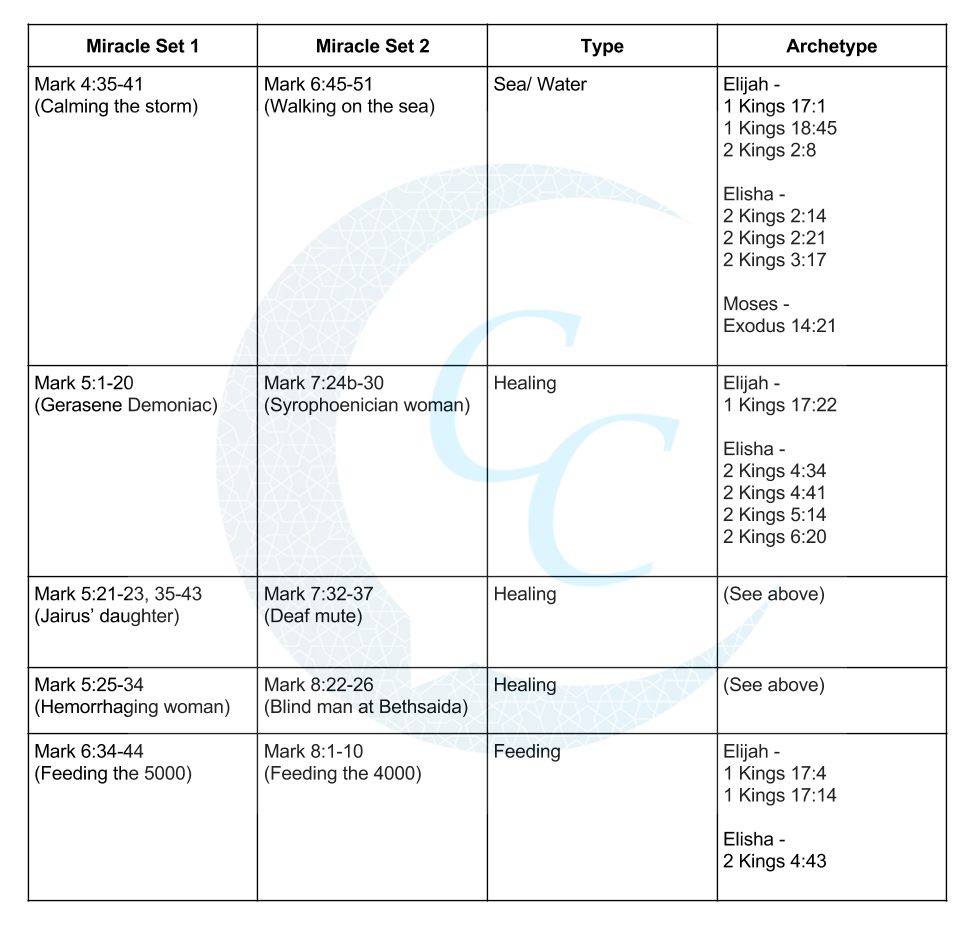
So, while the quote attributed by Eusebius to Papias may be more of a generated communal teaching which later manifested itself in Church tradition, can we truly say that the Gospel ascribed to Mark is the work of a scribe hastily writing down an orator’s recounting, as opposed to a work of systematic literary development? The answer is no. There are two sets of miracle stories in the Markan Gospel that follow a specific pattern, that bear witness to an intentional development of the Christ’s image in comparison with the Messianic archetype prevalent throughout Judaic literature.

Markan Miracle Sets 2

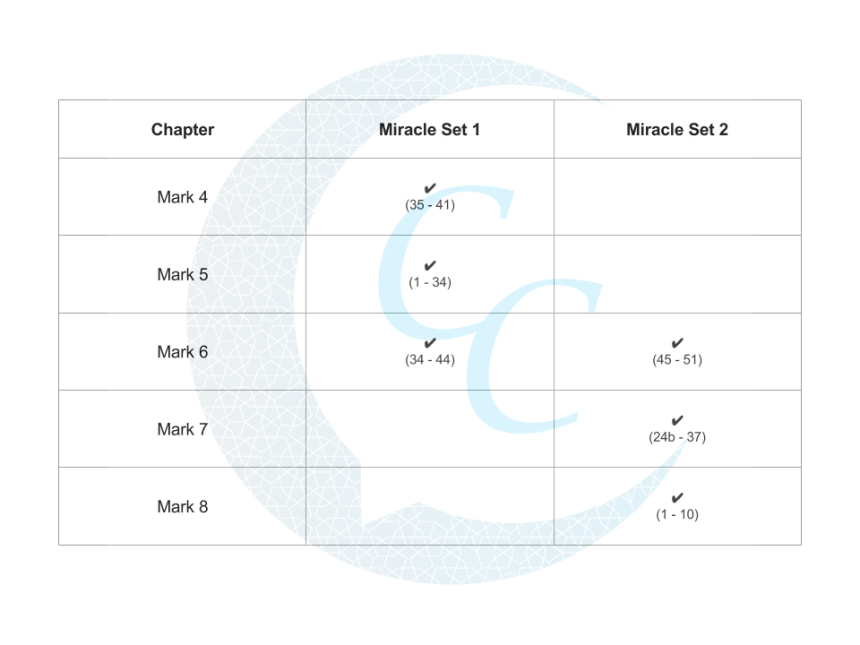
As we can see from this simple break down, the miracle stories are equally divided into two sets. Each set has the same pattern and form of miracles: one sea/ water – three healings – one mass feeding. Both sets of miracles, also occur within six successive chapters, with the first set ending and the second set beginning within the same chapter and within one verse of each other. These are not and cannot be coincidences, or disordered in any way. They are quite specific in pattern and form, the ordering of these miracle stories are intentional and systematic. Further analysis shows, that the author derived these miracle stories from earlier Jewish Messianic types, who were to guide their people in times of great turmoil:

Markan Miracle Sets

Thus, the intention of ordering and mentioning these specific miracles attributed to Christ, was done with the purpose of painting Christ in the same image and stature as that of Moses, Elijah and Elisha. In fact, the author who developed these miracle sets, does include specific mention of Jesus being like, or being Elijah within the same chapters:

Others said, “He is Elijah.” And still others claimed, “He is a prophet, like one of the prophets of long ago.” – Mark 6:15.

They replied, “Some say John the Baptist; others say Elijah; and still others, one of the prophets.” – Mark 8:28.

Therefore, it should be concluded from reading the Gospel ascribed to Mark, that this piece of literature has undergone intentional development, with specific goals in mind to paint Christ in light of earlier Messianic archetypal figures. The narratives are in order, for the purpose the author intended to achieve, and as such, we can understand that it is the case that either Papias’ statement refers to some other piece of literature, or that the Gospel of Mark has undergone significant systematic literary development with a Jewish audience in mind and as such, is no longer in its original form.

and God knows best.

The sacrificial son: Isma’il or Isaac?

بسم الله الرحمن الرحيم الحمد لله وحده و الصلاة و السلام على من لا نبي بعده و على آله و أصحابه أجمعين

Allah had ordered Prophet Ibrahim (Abraham) –peace be upon him- to sacrifice his son. Here, we will be looking in detail from the Torah, the Qur’an and early Islamic narrations for the identity of the sacrificial son. This piece is entirely based on the work [1] of Hamiduddin Farahi and can be considered as a summarized translation of his work.

Introduction

We know from the Torah itself that it is not in the original form that was revealed by Allah.

Concerning the prophets: My heart is broken within me; all my bones tremble. I am like a drunken man, like a strong man overcome by wine, because of the Lord and his holy words.The land is full of adulterers; because of the curse the land lies parched and the pastures in the wilderness are withered. The prophets follow an evil course and use their power unjustly.“Both prophet and priest are godless; even in my temple I find their wickedness,” declares the Lord.“Therefore their path will become slippery; they will be banished to darkness and there they will fall. I will bring disaster on them in the year they are punished,” declares the Lord.“Among the prophets of Samaria I saw this repulsive thing: They prophesied by Baal and led my people Israel astray.And among the prophets of Jerusalem I have seen something horrible: They commit adultery and live a lie. They strengthen the hands of evildoers, so that not one of them turns from their wickedness. They are all like Sodom to me; the people of Jerusalem are like Gomorrah.”Therefore this is what the Lord Almighty says concerning the prophets: “I will make them eat bitter food and drink poisoned water, because from the prophets of Jerusalem ungodliness has spread throughout the land.”This is what the Lord Almighty says: “Do not listen to what the prophets are prophesying to you; they fill you with false hopes. They speak visions from their own minds, not from the mouth of the Lord.They keep saying to those who despise me, ‘The Lord says: You will have peace.’ And to all who follow the stubbornness of their hearts they say, ‘No harm will come to you.’But which of them has stood in the council of the Lord to see or to hear his word? Who has listened and heard his word?See, the storm of the Lord will burst out in wrath, a whirlwind swirling down on the heads of the wicked.The anger of the Lord will not turn back until he fully accomplishes the purposes of his heart. In days to come you will understand it clearly.I did not send these prophets, yet they have run with their message; I did not speak to them, yet they have prophesied.But if they had stood in my council, they would have proclaimed my words to my people and would have turned them from their evil ways and from their evil deeds.“Am I only a God nearby,” declares the Lord, “and not a God far away?Who can hide in secret places so that I cannot see them?” declares the Lord. “Do not I fill heaven and earth?” declares the Lord.“I have heard what the prophets say who prophesy lies in my name. They say, ‘I had a dream! I had a dream!’How long will this continue in the hearts of these lying prophets, who prophesy the delusions of their own minds? They think the dreams they tell one another will make my people forget my name, just as their ancestors forgot my name through Baal worship. Let the prophet who has a dream recount the dream, but let the one who has my word speak it faithfully. For what has straw to do with grain?” declares the Lord. “Is not my word like fire,” declares the Lord, “and like a hammer that breaks a rock in pieces?“Therefore,” declares the Lord, “I am against the prophets who steal from one another words supposedly from me.Yes,” declares the Lord, “I am against the prophets who wag their own tongues and yet declare, ‘The Lord declares.’ Indeed, I am against those who prophesy false dreams,” declares the Lord. “They tell them and lead my people astray with their reckless lies, yet I did not send or appoint them. They do not benefit these people in the least,” declares the Lord. “When these people, or a prophet or a priest, ask you, ‘What is the message from the Lord?’ say to them, ‘What message? I will forsake you, declares the Lord.’ If a prophet or a priest or anyone else claims, ‘This is a message from the Lord,’ I will punish them and their household. This is what each of you keeps saying to your friends and other Israelites: ‘What is the Lord’s answer?’ or ‘What has the Lord spoken?’ But you must not mention ‘a message from the Lord’ again, because each one’s word becomes their own message. So you distort the words of the living God, the Lord Almighty, our God.[2]

Read more

One Christian Scholar’s Dilemma with Christian “Logic”

The following quote is from Professor Dale C. Allison Jr.’s, “The Theological Christ and the Historical Jesus” (Kindle Version). It pretty much sums up the Islamic problem with the New Testament. His articulation of this Christian scriptural issue is so well put, I just had to share it:

Ephesians and the Pastorials are after all probably pseudepigraphical, and why would anyone refuse to preach on a word dubiously ascribed to Jesus yet preach on a word dubiously ascribed to Paul? What, moreover, should those of us who cannot decide whether Paul wrote Colossians do when a passage from that epistle shows up in the lectionary? Should we expound the text or not? Above all, what happens to the Bible as a whole if history and authorship become a criteria for determining theological authority? What, for instance, should we do with the so-called “historical books” of the Old Testament, which contain so much that is not history? And what should we do with the paragraphs and chapters that come to us under the name of Isaiah or some other prophet but which, according to critical scholarship, were instead produced by persons forever unknown?

What should we do? That’s a question each and every Christian should ask. Professor Dale clearly demonstrates that Christians as a whole, need to reconsider the rationale, the logic, the theological concepts they construct to develop their faith, in light of all the historical evidences which clearly contradict the New and Old Testament’s many scriptural, authorship and historical problems.

Would any Christian like to respond to the Professor? Comments are open for all……

and Allaah knows best.

Recent Entries »