بِسۡمِ ٱللهِ ٱلرَّحۡمَـٰنِ ٱلرَّحِيمِ ,
In this list, I intend to present 10 questions which critique the Christian faith in an indepth manner. Whether you’re a Christain who is well educated or lesser educated, these questions are meant to provoke deeper thinking concerning your faith:
- If the earliest Christians within the first two centuries after Jesus did not need a New Testament to qualify their faith, why do modern Christians have such a need? If they did not sanction or consider any other writing beside the Old Testament to be scripture, then isn’t it a digression from the ‘true faith‘ of the earliest believers to incorporate something new as scripture? The first New Testament was codified and canonized by the heretic Marcion who believed that the Jewish YHWH was not the true God, the first time the largest Christian Church sanctioned a New Testament was during the 2nd Ecumenical Council of Carthage in 397 CE, some 360+ years after Jesus.
- In continuing with the New Testament, most scholars accept that Paul’s writings were the first of the New Testament to be written. Dr. Dale B. Martin dates 1st Thessolonians to be from 47 CE, Prof. Bart Ehrman dates it to be from 49 CE, either way the earliest Christian New Testament ‘scripture’ can theoretically be traced back to a man who admitted to being a fool (2 Cor. 11:1, 16), to being demon possessed by a satan sent by Christ (2 Cor. 12:6-11), who stole the name of a Pagan Roman leader (Acts 13:7-9), and who disagreed with the brother of Jesus, even fighting with the Disciples who lived with Christ and referring to them as not true believers! Heck, he even denounces a significant portion of two Gospels by criticising the biographies included in them in Titus 3:9.
- If Christ died for the sins of mankind, then by his sacrifice we are all sinless. On the cross and before his death he did not specify any criteria for his sacrifice to be upon us. He never put such conditions as belief in him as a deity or that we must accept the yet to be announced religion of ‘Christianity’ or to profess belief in the ‘Trinitarian Godhead’. If there are conditions, (let’s say to believe in him), then mere belief in his existence satisfies this condition. If Christ did die, then he died for you, me and everyone else and we are therefore sinless through his death. If it is claimed that he died only for the elect, then his death was useless as he claimed to die for all (John 3:16), but his death was not good enough to save everyone. The logic behind his death is also of great interest.
- According to Psalm 37:28, God would not forsake the faithful and just, He would protect them forever. Jesus on the cross claimed to be forsaken, as such, if Jesus did claim this, then according to Psalm 37:28, he was not faithful and just. The verse also mentions that the wicked would perish, since Christ died/ perished, then this verse would lead us to believe that God considered Christ to be wicked. If Psalm 37:28 does not apply to Jesus, what is the reasoning for this claim?
- If the Bible is the Word of God, and Psalm 119:89 claims that there is one eternal scripture preserved in the heavens, then which Old Testament and New Testament should we believe in? If you are a Bible believing Christian, this is a serious issue as no Bible post-John Mill’s GNT is derived from one holistic text but from a compendium of MSS codices, see the Nestle-Aland GNT. For more information, see here for an expansion of this line of questioning.
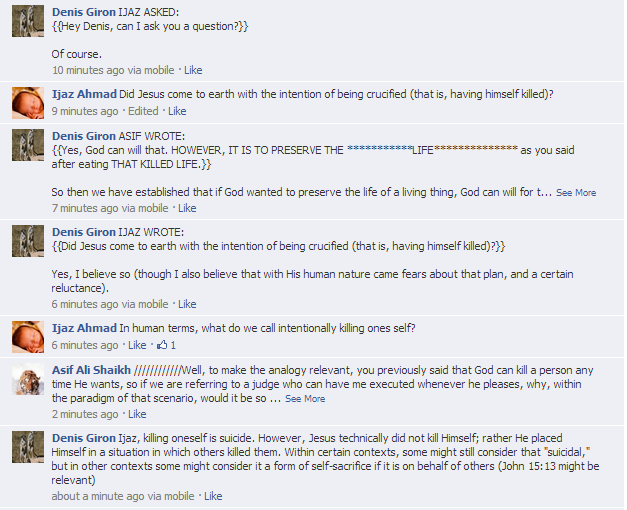
- If Jesus came with the intention of dying for everyone’s sins, then it must be understood that ‘intentionally killing one’s self‘ is considered to be suicide. Therefore Jesus’ death is suicide. If God is the Most Loving, why would he (a) murder his own son instead of forgiving (as He did for those who repented) or (b) commit suicide? Both of these are sinful acts. Can salvation be obtained through murder-suicide?
- Since Jesus said the ‘Father is greater than I‘ and we understand that God the son is co-equal to God the Father, then this is an inherit contradiction in the doctrine of the Trinity. For if one is greater than the other, how can God be greater than God? If one God is greater than another God we have a bigger issue as they are therefore not co-equal and are two distinct entities, therefore they are two Gods and not one. For if they are one, how can one be greater than the other?
- Who exactly is YHWH? Is YHWH Jesus, the Son and the Holy Ghost? Or is YHWH solely the Father? If the son-Jesus is YHWH, why does He never identify himself as such? Despite this problem/ confusion as to who YHWH actually is, another issue has arisen. According to 2 Corinthians 12:4, the inexpressible name of YHWH is actually a man made name, derived to substitute the loss of the real name of God. Yes, Christians and Jews do not really know the name of God. Exegete Adam Clarke explains in detail this conundrum. How can you call people to Christianity, if you don’t actually know who God is?
- The doctrine of the Immaculate Conception refers to Mary’s purity from the original sin upon conception. According to the doctrine of the Original Sin, all born of women, inherit the sin of Adam and Eve. Since Jesus is born of a woman, then he automatically inherits this sin. However, he doesn’t, because of the sinless nature of Mary. Whether you are Catholic or not, in order for Jesus to have been born sinless, then you must believe that Mary at one point or another did not have the original sin and was thus sinless. The question therefore begs itself, where does the Bible say Mary is sinless or was born sinless? To further this argument, if we do inherit the sin of Adam and Eve, why do we not also inherit their repentance and good deeds?
- We’ve covered the Bible, Paul, Jesus, Creeds and Doctrines, Christology/ Theology, the Law and Salvation/ Soteriology. For the last question, I ask something very simple. Since God is the Creator and He created us, it is fitting that God should tell us our purpose of life or why we were created. Therefore, I’m asking for where in the Bible does God-YHWH-the Son-the Spirit or Paul, mention why God created us?
Some Christian Responses and my Refutations:
The following responses are by the former Atheist and Islamophobe, now quasi-Catholic anti-Muslim Denis Giron – located here.
Question #1:
The fact that, at one point in time, believers adhered to texts which some believers may not have been aware of at previous points in time can easily be explained within the context of progressive revelation, or a system where the details of the faith are unfolded over time. Such is not a “digression” if such was part of God’s plan. On a side note, it is worth noting that there are various 2nd century writers who quote many of the texts of the New Testament, and some scholars date the Muratorian fragment to the 2nd century, ergo it seems much (if not all) of the New Testament was used as Scripture by Christians within the first two centuries after Jesus.
He does not directly answer my question. I have asked that since the first Christians did not need to believe in the New Testament to be considered Christians, why does it matter if Christians today believe in the New Testament or not? His answer? To say that Christians did believe in the New Testament by offering a 2nd century quasi-canon. He makes an assumption, that because a list of books existed that all Christians believed in it. I’m not sure if his answer was a joke or if he assumes that I am functionally retarded, but to respond to him, when Athansius’ list was produced there is no evidence that all Christians believed in those books which is why some 30 years later two more Councils had to be held to declare them as scripture. Therefore given that bit of history, the existence of a list does not mean that some, all or most believed those books to be scripture, that is simply wishful thinking. The very fact that it took 2 centuries for the list to develop and be published, yet it took two other centuries after that for a majority of Christians to then accept those books of scripture, proves my point quite well enough.
Question #2:
The charge that he was demon possessed seems a bit of a leap. Many Christians would simply read the relevant text as referring to some trial he had to undergo, which was inflicted upon him by a messenger of Satan. This could be in reference to illness, mockery, or something else. Others, such as Job, were similarly afflicted.Likewise, the charge that he stole the name Paul from a pagan leader is not supported by Acts 13:7-9. At best we can say they had the same “name” (Paulos meaning “small”). Surely Ijaz is not arguing that if two people have the same name, then one must be stolen from the other… e.g. is Ijaz’ own surname, Ahmad, “stolen” from Mirza Ghulam /Ahmad/? Of course, the answer is no, which would mean it is possible for two people to employ the same “name” without one being stolen from the other.
What this Christian calls a leap, I call reading the text and observing the works of the famous exegetes. In the link I provided and as the text states, he (Paul) was afflicted by a Messenger of Satan, which some exegetes have determined to be a demon troubling him. Unfortunately, this Christian ignores Church authority (while claiming to be a Catholic), the exegete Burkitt says in his notes about this verse:
“This thorn in the flesh is called the messenger of Satan, from whence St. Chrysostom concluded that it was some evil angel that was permitted and impowered by God to scourge and buffet him. The sufferings of the best and holiest persons in the flesh, may be the buffetings of a messenger of Satan , and yet be from God. Satan certainly intendeth our hurt, but God over-rules him as an instrument to do us good: It is no proof that a man is not a child of God, because Satan has a permission to torment his flesh. The messenger of Satan was sent to buffet me, says St. Paul, lest I should be exalted.”
I’m sorry that Denis does not read commentaries about such claims about Paul from among his own religious brethren, on the other hand I do and I have qualified my claim. He begins his defense of Paul’s stolen name by stating the text does not support it, to the contrary, immediately after Paul meets a Roman proconsul with the name Paulus, he changes from Saul to Paulus (also known as Paul). He didn’t change his name in either of the two contradicting narrations about his conversion, but miraculously he changes it after meeting someone with the same name, how ‘coincidental’ is that? Lastly, he gives a bad analogy, as my name is not derived from Mirza Ghulam, but derived from the one after which Ghulam was named, i.e. Ahmad, also known as Muhammad (peace be upon him).
Question #3:
One would think that Christ expects believers to believe what He taught (ergo, that would include believing that His blood was shed for the sins of others, et cetera), so it would seem more than mere belief in His existence is required.
This is again, wishful thinking. What Christ taught and said is not determined by your preconceived notions about his message. I think that if we are to be honest with ourselves, what Christ taught and did is of no consequence to us as his blood was already shed for us. Denis’ answer does not respond to my question, it raises the importance of my question. Christ does not say, not once in the Bible that we must believe he died for us to in order that we may receive salvation. Therefore whether we believe that he did x, y, or z does not matter as what truly matters is that he paid for our sins and whether I believe or disbelieve, does not affect his already having died.
Furthermore, Christians do not reduce obligatory doctrine to only that which Christ is quoted as teaching in the Bible. For example, Christ is not quoted as teaching the Virgin Birth, yet mainstream Christians would nonetheless hold that belief in such is obligatory. Ijaz’s methodology, if taken to its logical conclusion, would allow people to wave off the Virgin Birth, and thus it strikes me as a form of reverse-da3wa.
Denis decides the best method of deflecting from the core of my question is to jump to an irrelevant rant about Islam’s belief about the Virgin Birth. My question has nothing to do about empirical evidence about miracles, my question quite simply is meant to deal with a theological dilemma. What’s worse is that the only reason Denis is throwing this irrelevant statement into the mix about some supposed ‘methodology’ (which he does not indicate what it is), was written because of a previous discussion he had with me. In that discussion, I asked about the zombies in Matthew which came out of the grave upon Jesus’ alleged murder which some unknown author some 60 years later wrote about. Denis didn’t like that question, so he spent weeks running past it and it still frustrates him to this day, so he asked me to prove the Virgin Birth, thus doing reverse missionary work and throwing doubt on his own beliefs.
As for Christ’s sacrifice, the Bible makes clear that it makes salvation available to us, but it also makes clear that proper belief and sincere repentance are also needed.
Nowhere does the Bible say that we must believe in the Trinity as proper ‘belief’ to be absolved through Christ’s murder. This is once again, wishful thinking.
Question #4:
Ijaz’ assertion that Jesus claimed to be forsaken is far from an agreed upon point among Christians. A great many Christians hold that Christ wasn’t actually expressing a belief that He had been forsaken; rather He was paraphrasing in Aramaic the opening of the 22nd Psalm. It is worthy of note that the 22nd Psalm has been historically interpreted by some Jews as referring to a Messianic figure suffering for the sins of others. Ergo, Christ was alluding to Scripture and subtly noting that, while observers might have thought that was the end of Him, there is more to the story.
To correct the Christian, he is trying to say that “Jesus did not mean what he said, his words are not to be taken literally”. Why is it not to be taken literally? He claimed to be “forsaken” in no uncertain terms, so why should I understand this to be something else? Does the Christian not take the “I AM” statement to be literal? Does he not take the “Father and I are one” statement to be literal, so why in this specific case should we be led to believe that Christ did not mean what he meant to say? This is the Christian mindset, where it suits them, something is literal and when it destroys their faith, then it must not be taken literally. The question still stands, why is it not to be taken literally in this incident, when he word for word, literally quoted Psalm 22?
As for Psalm 37:28, it does not mean that all righteous persons in this life will be spared from death or that only wicked people will suffer death in this life. Such a view would leave no room for the possibility of martyrdom, or even the mere fact that even righteous people do die. The Hebrew text’s declaration of “l`olam nishmaroo” (i.e. to eternity they [i.e. the chaseedeem of God] are preserved) gives the impression that it is referring to a scale of time which extends beyond death in this world.
The verse in question mentions being forsaken and then perishing. A martyr knows that he is not forsaken, but that his death is something beautiful, destined by God, in God’s plan. Jesus however, when allegedly on the Cross, uses the word “forsaken” and he cries out, questioning his God/ Daddy. In this regard, Christ does not see himself as a martyr or a righteous person, as the words he uses establishes him as a doubter in God’s plan and as one who feels forsaken by God’s love and mercy which is why some Christians point to Galatians 3:13 to emphasize the despair of Jesus.
Question #5:
The precise make-up of Scripture is indeed an interesting question, and has been so for much of Christian history (e.g. consider Jerome’s criticisms of the Septuagint in favor of the Hebrew Text he had access to). Regarding the New Testament, while different Christians will have different Greek corpora they prefer (e.g. a minority might side with the Textus Receptus, others, such as myself, might point instead to one of the more recent editions of the Nestle-Aland platform), none of these corpora will agree perfectly, letter for letter, with any known ancient corpus. Having said that, however, it does not seem that the differences among the different corpora necessitates a change in doctrine. For example, James White and the Jeho___’s Witnesses are pretty much in agreement on what the Greek text should look like, but they disagree doctrinally, while there were no doubt 17th century Calvinists who followed a Greek text essentially like that of the Textus Receptus who were nonetheless in doctrinal lockstep with the positions held by Dr. White, today. Beyond that, as far as the modern editions of the Greek NT are concerned, the points of dispute have become quite minor. It is quite telling that even a hyper-skeptic like Bart Ehrman admitted, in his debate with the aforementioned Dr. White, that were he to produce his own best attempt at reconstructing the Greek NT, it would differ less from the current Nestle-Aland platform than does the Textus Receptus. So perhaps one can go with a standard Greek NT, and we can discuss specific readings within verses which might be at the centers of disputes.As for the OT, as far as Christian history is concerned, the variations there are far more egregious than is the case with the NT. I suppose in the end one is left to wonder whom to trust (e.g. the disbelieving Jews, the ancient Catholic Church, et cetera). I would say run with the Septuagint, supplementing it with the Masoretic Text along the way.
He does not address my question. In fact, he highlights and proves to me that he cannot fulfil the criteria of Psalm 119:89 of one holistic text. His conclusion based on his argument is that a hodge podge of various texts constitutes something as a ‘best attempting at reconstruction’. Best attempt at recreating scripture does not mean that you actually have the scripture, it means that you have something like it, something similar to it, but not the actual text for certainty. Therefore Denis has proven that his scripture is not certain and thus fails its own criteria to establish it as being from God.
Question #6:
I would think there should be a distinction between putting oneself in a position where one might die so that others may live, on the one hand, and suicide simpliciter, on the other. For example, if a would-be assassin fired a gun at the Queen of England, and one of her body guards stepped in between her and the oncoming bullets, and he died as a result of his wounds, I do not think he would be waved off as merely a suicide.
As for the question of how we reconcile God’s love with the system of vicarious atonement proposed by Christianity (or even mildly similar systems of vicarious atonement proposed by Rabbinic Judaism), I would agree that, on the surface, it seems difficult. However, upon deeper reflection, I would think human beings are not in a place to speak on God’s love and justice.
This is the same Denis that also said that it was suicide (i.e. he agreed it was suicide):

Regarding the question “can salvation be obtained through murder-suicide?,” I would say that salvation depends, in part, on the individual (cf. Philippians 2:12). If we rephrase the question, can the death of a person play a role in the atonement of the sins of others, just as Rabbinic Judaism would answer yes, so too would I.
This is quite funny, he concedes that murder-suicide plays a role in salvation. Where in Rabbinic Judaism is suicide sanctioned as a means of salvation, similarly, since when does a quasi-Catholic accept the rulings of Rabbinic Judaism?
Question #7:
The Father being greater than the Son, on the one hand, and the Father and Son being equal, on the other, need not be a contradiction if we understand the former as referring to a difference in rank established since the Incarnation (and continuing to this day), and the latter as referring to their shared divine nature. That is to say, as is alluded to in Philippians 2:5-7, Christ and the Father, as two divine Persons sharing a common divine nature, were equal in nature, but in acquiring a human nature, Christ also took on the role of a servant of the Father, hence establishing a hierarchy of rank from the perspective of that second nature.
Again, the Christian here tries to wiggle away from the apparent contradiction before him. He uses the words ‘rank’, and ‘hierarchy’. Both indicate that one is not equal to the other, he qualifies my contradiction by demonstrating that when the Son assumed a human nature, he became subservient to the Father, therefore God who is eternal, changed to become not eternal and assume a lower position that His former self. Due to this, God is not equal to Himself, but also at the same time, allegedly equal to Himself, in logic, we call this a contradiction.
Question #8:
The being whose Name is the Tetragrammaton is the one God. That is to say, the Trinity. Nonetheless, that being comprises three Persons, and any one of those Persons can bear the Name or titles of the one God they are within (ergo we can use the Tetragrammaton to refer to one of the Persons within the one God whose Name is the Tetragrammaton).As for 2 Corinthians 12:4, in no way does it lead to the conclusion that the Tetragrammaton is a man-made construction.
If YHWH is both 3 and also one distinct person – at the same time – as Denis indicates then where is this indicated in the Old Testament? Since YHWH is not found in the New Testament (as the Christian God did not known how to represent His name in His Greek revelation). Similarly, Jesus in the New Testament does not call himself YHWH and the Holy Spirit does not call itself YHWH, nor does the YHWH of the Old Testament identify itself as Jesus, Immanuel or as Mal’ak YHWH, but simply as YHWH. Lastly, 2 Cor. 12:4 does indicate the tetragrammaton is a man made construction, as even Matt Slick of CARM concedes that Christians cannot claim to know the real name of God or how to pronounce God’s true name.
Question #9:
Now, while I personally do believe in the Immaculate Conception, it is perhaps worth noting that non-Catholics are not forced to believe it. Case in point, some Orthodox take a view similar to that of Aquinas, and many Protestants take the view that, rather than God uniquely purifying Mary, Christ’s divinity simply gave that unique purification to His own human nature.Regarding the question at the end of the ninth paragraph – “if we do inherit the sin of Adam and Eve, why do we not also inherit their repentance and good deeds?” – I would first it might help to ask what, exactly, we inherit from Adam and Eve, but, beyond that, I would say such is God’s will.
Nothing to respond to, or refute, as he pretty much says that this is what he believes and it’s God’s will, i.e. a dogma with no proof from scripture.
Question #10:
Colossians 1:16 states that all things were created for Christ. Philippians 2:10 states that it is God’s will that every person will eventually bow their knees at the Name of Christ. Ergo, from these two verses, all humans were created, in part, for the purpose of serving and acknowledging Christ (whether willingly or by force).
Colossians 1:16, simply says that all things were created by God, it does not say for what purpose. I didn’t ask who created us, my question simply was, ‘where in the Bible does God say why He created us’, telling me that He created us because He is the Creator, does not tell me why we were created, but who created us. I already knew that God created us, I am asking why. He simply did not answer the question. As for bowing to Christ, the Bible also says that God died for my sins, so I think it is more a case of God being created-incarnated to pay for my sins and suffer for me, which is a far worse prospect as I would see it to be, i.e. insulting towards God.
wa Allaahu ‘Alam.


 Calling Christians
You must be logged in to post a comment.