While in Speakers Corner about two weeks ago, I had the opportunity to discuss the New Testament (and a few of its variants) along with the historicity of the Crucifixion narrative using my Nestle-Aland 28th Edition Greek New Testament…with a Greek Christian. This proved very opportune, as he could openly correct me had I lied or made a mistake about what the Greek New Testament said! I was excited to be put to the test and suffice it to say, I think the discussion went quite well.
We earlier tried to have the same discussion but an older missionary gentleman was listening in (as others do), and while this was not a problem, the moment I raised a problematic question he reacted in an absurd way that led to the conversation ending. Thankfully my Greek colleague was up for round two, where we summarized the first discussion and had a full length discussion on the above mentioned topics. It’s decidedly worth the watch, many thanks to the EFDawah YouTube channel for recording and uploading the dialogue with excellent quality!
Two very early and important manuscripts of the New Testament, p66 and p75 have effectively with growing consensus by authoritative scholars, been given later date ranges extending into the 4th century CE. This is a problem.
Brief Introduction
Early New Testament documents were written on papyrus (pl. papyri), which in and of itself is a very fragile material. Summarily, it means they are difficult to preserve and quick to be destroyed (by accident). Due to so few documents existing, we cannot know much to be certain about the early New Testaments in circulation (we cannot speak of a New Testament until Marcion in the 2nd century).
Two important manuscripts, p66 and p75 have traditionally been given very early dates, somewhere around the 2nd century CE. To put this into perspective, we generally have had only roughly 7 or so manuscripts from this time period that are distinctively New Testament texts, so that 2 of them (which is 28.5%) have been given later dates by almost up to two hundreds years more is nothing to scoff at. These later datings will reshape how we view the early New Testament, its invention, development, transmission and general history.
The Problem
The early New Testament documents are dated palaeographically, that is by the way in which they were written (their textual-graphical features). This means that there is almost no early New Testament document that can be said to have been written in a specific year. I have seen some uninformed Christian apologists claiming that specific New Testament papyri date to the year 125 CE, such as p52, or that p66 and p75 are from the year 200 CE. This is incorrect from an elementary standpoint. Palaeographic datings refer to a date range not a date year (even if colophonic). This means whenever someone speaks about early New Testament papyri and they only provide a date year instead of a range, they are being misleading (if one re-reads my first paragraph I allude to a date range and not date year by saying “around the 2nd century CE”). Generally a date range can begin with a few decades and extend into a few centuries (as is common with most New Testament papyri).
Due to these previously very early datings of around the 2nd century CE, many Christian apologists were quick to point out that much of what survives from the most reliable manuscripts is in the form of the 4th century Uncials (Sinaiticus and Vaticanus), with p75 said to be an ancestor text to Codex Vaticanus. This allowed them to claim that there was extant (still surviving) proof that the New Testament, contrary to competing claims, was transmitted faithfully. In this, they boasted that if there were minimal changes between two texts that were related to each other, this meant that the New Testament had been reliably copied over the centuries and thus it could be argued that if there are 200 years between p75 and Codex Vaticanus, then the 200 years between Christ Jesus and p75 should allow Christians to argue that the New Testament has effectively been preserved. Foregoing an overly long analysis as to why this reasoning is both poor and apologetic, it should be noted that p75 and Codex Vaticanus are now no longer seen as having a Father-Son relationship (as in Vaticanus was copied from p75 or a manuscript similar to it in terms of age and reliability) but that they are now sibling texts (that they both descend from a common ancestor text).
This changes things.
Summary Conclusions
This means that they cannot be used to argue for 400 years of reliable transmission, this means that they cannot be used to demonstrate that they were copied from each other. It effectively allows us to dismiss much of what has been argued in the past due to the very existence of these papyri. What one will notice however is the overwhelming silence on behalf of Christian apologists about the severity of the issue that stands before them, what they once boasted with glee (much like with the sham that was First Century Mark) is now being quietly swept under the rugs.
These redatings are not new, Dr. Brent Nongbri has for several years now already published research claiming as much and the Evangelical world has been silent. Their common response was that this was one man with one dating (which itself is a ridiculous argument) but now that Dr. Orsini (who is a top scholar of the field) is saying the same (though their arguments for why differ), we are looking at an effective consensus building and being accepted by some of the best minds in the field. There does not seem to be anything but silence and subsequent acceptance of the once “invincible” early New Testament documents now being resigned to later date ranges, thus placing even more questions on the reliability of the New Testament’s documents itself.
It should also be noted that the Coherence Based Genealogical Method that is being used today to develop the next edition of the New Testament heavily relies on these early papyri being dated accurately, so that a genealogical/ family tree can be drawn up to make sense of how the texts were transmitted. I will not get into how the CBGM works here, but that these dates are changing with consensus should worry some of our Evangelical friends.
The science of textual criticism and ‘Ilm al Rasm al Mushaf have two distinct goals with regards to two distinct books. The Bible and the Qur’an do not stand on equal footing, learn how and why, with us.
traditions of preservation continue to be revealed with detailed study. Come join us we look deeply into the Qur’an and the Bible.
The following is a guest post by Br. Sharif Randhawa, co-author of the illuminating book, “Divine Speech” which was written alongside Ustadh Nouman Ali Khan. Br. Sharif also runs a wonderfully informative blog called Quranic Musings which I highly recommend!
I was sent the following video clips in which an individual named Anthony Rogers claims that that Quran 112:1 (qul huwa ’llāhu aḥadun) contains a grammatical error, and that, moreover, Muslims mis-recite the verse in order to avoid the error:
Both of the above claims are patently false, as anyone with knowledge of even the most basic rules of Arabic grammar will recognize. It is deeply presumptuous of someone who shows ignorance of such basic rules of Arabic grammar to claim to have a better grasp of it than the premier work of Arabic literature, the Quran, and the entire Muslim tradition of Arabic grammar, not to mention of Quranic exegesis and recitation. In any case, the errors in both of these claims are as follows:
Contention 1: Rogers claims that the wording in the Quran of qul huwa ’llāhu aḥadun (“Say: He is Allah, one,” or alternatively “Say: He, Allah, is one”) is grammatically incorrect, because aḥadun means not “one” but “one of”; the text, according to him, should actually say qul huwa ’llāhu aḥadu.
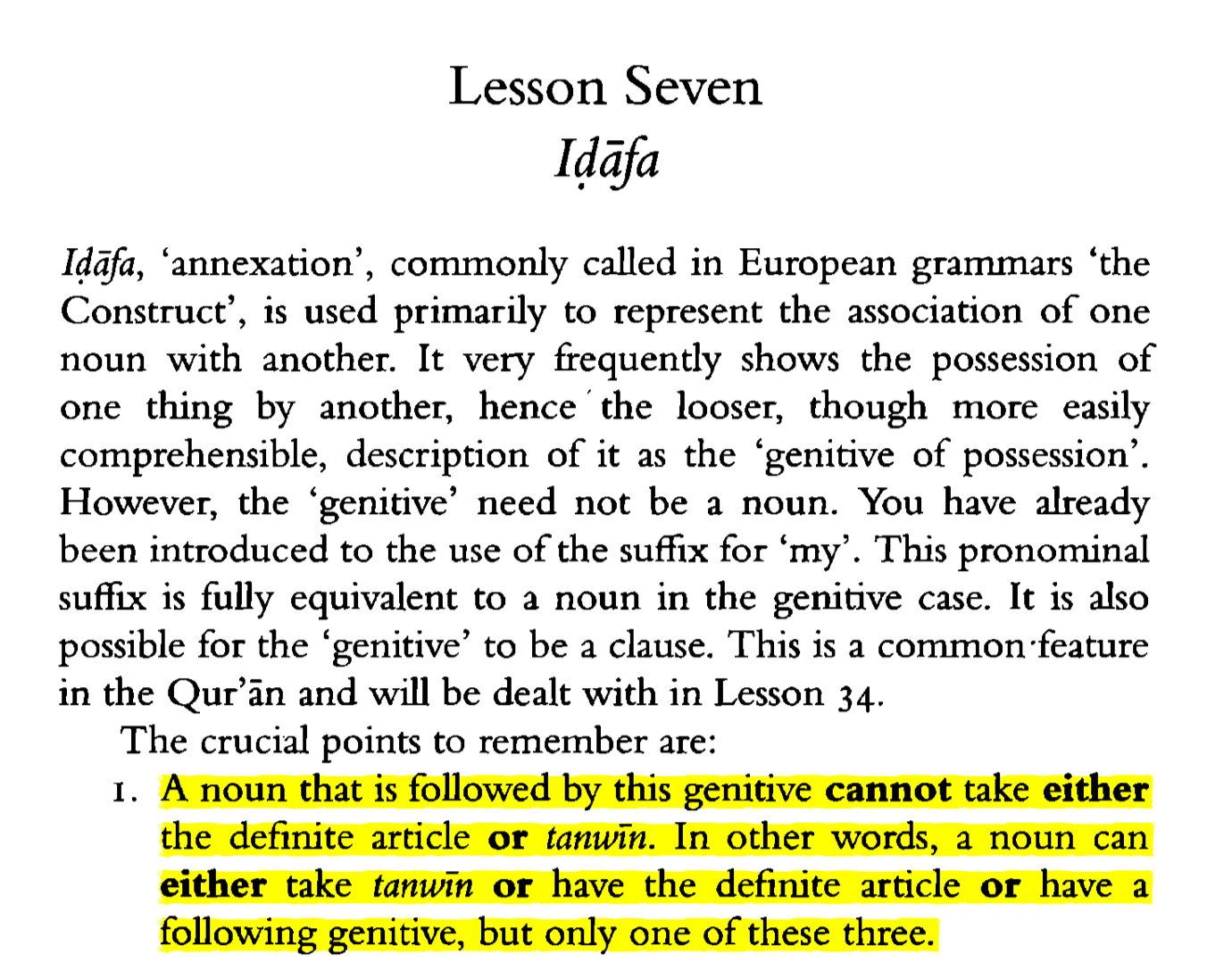
Answer: Rogers’ claim is exactly the opposite of what Arabic grammar entails. In a genitive construct, which is the form that expresses the grammatical formula “X of Y,” the X (or muḍāf) that is followed by the genitive Y (or muḍāf ‘ilayhi) precisely cannot carry tanwīn (the indefinite -n ending). This is literally one of the first rules of a genitive construct in Arabic (see the excerpt from p. 44 from Alan Jones’ Arabic Through the Qur’ān, below).
 Contention 2: Rogers then claims that Muslims mis-recite the verse to avoid this alleged error, as Muslims most frequently recite the verse as qul huwa ’llāhu aḥad, without the inflected -(u)n ending.
Answer: The claim that this is a mispronunciation is, again, false according to the most basic conventions of Arabic. This is because in Arabic speech, when one pauses at the end of a sentence that terminates with a short vowel ending, he or she normally drops the short vowel ending, including the tanwīn if there is one. Any Arabic speaker can confirm that for you.
Many claim that since Islam has many things in common with other faiths that it must be a false religion that borrowed from those other faiths. Why does Islam share many common beliefs and practices with other faiths?
Answer:
One of the beautiful things about Islam, is that we are specifically warned about rejecting the truth merely out of spite or hatred.
“O believers! Stand firm for Allah and bear true testimony. Do not let the hatred of a people lead you to injustice. Be just! That is closer to righteousness. And be mindful of Allah. Surely Allah is All-Aware of what you do.” – Qur’an 5:8 (translation by Dr. Mustafa Khattab, the Clear Qur’an).
This is moreso true in this modern age of confusion where a popular, but unreasonable argument is being circulated. Among atheists and missionaries, is the argument that Islam must be false because it has within it, things in common with other faiths and other writings/ scriptures. Yet, the ayah above and the following clarify this for us:
“And they say, “Legends of the former peoples which he has written down, and they are dictated to him morning and afternoon.” – Qur’an 25:5 (translation by Dr. Mustafa Khattab, the Clear Qur’an).
That the Qur’an affirms pre-existing truths is sensible when one considers the view that the God of Islam is not a new God of a new faith trying to establish itself for the first time in the world. Consider the argument then, shall we absolve ourselves of monotheism (Tawheed) because other faiths also preach and believe in a similar monotheism to us? Should we:
forsake worship because other faiths also worship?
forsake the Qur’an because other faiths have scriptures?
forsake doing good because other faiths command doing good?
To most Muslims, that would seem like a silly idea, to distort our own faith to spite another faith. As the saying goes, would you “cut off your nose to spite your face?”.
Yet, this is what we find within the tri-theism of Christianity. At the Council of Nicaea in 325 CE, the Emperor Constantine said according to Eusebius:
“And first of all, it appeared an unworthy thing that in the celebration of this most holy feast we should follow the practice of the Jews, who have impiously defiled their hands with enormous sin, and are, therefore, deservedly afflicted with blindness of soul. For we have it in our power, if we abandon their custom, to prolong the due observance of this ordinance to future ages, by a truer order, which we have preserved from the very day of the passion until the present time. Let us then have nothing in common with the detestable Jewish crowd; for we have received from our Saviour a different way.” – The Life of Constantine, Book 3, Chapter 18 by Eusebius.
Do not forget these words:
“Let us then have nothing in common with the detestable Jewish crowd; for we have received from our Saviour a different way.”
…and in so doing, they chose to forsake monotheism, cutting off their noses to spite their own faces in that very process. All praise is due to Allah that we do not find ourselves in a similar trap.
For centuries Muslims have revered Mecca as the site of their holiest shrine, the Kaaba. However, in 1977 John Wansbrough, Patricia Crone and Michael Cook published books arguing for a radically different approach to Islam’s origins. Among other things, these revisionists contended that Mecca was not Islam’s birthplace, which they located somewhere in the Fertile Crescent. Though Crone and Cook later repudiated the theory advanced in their book, Crone at least held fast to the idea that Islam’s origins were likely in the Fertile Crescent, possibly in Nabatea.
Forty years later revisionism is still alive and well. Some scholars still promote the idea that the Kaaba was not originally in Mecca. Some say it was in or near Petra, while others refuse to speculate on the location. Their combined evidence was enough to convince popular historian and documentary filmmaker Tom Holland. Since Muslims everywhere pray facing Mecca, this view means they all naively face the wrong direction.
This short but elucidating paper by a Christian scholar, in refutation of Dan Gibson is quite informative and handy for Muslims engaging with Christians on this topic:
In a press release issued today, the Museum of the Bible has announced that 16 of the supposed Dead Sea Scrolls fragments they had on display in their museum as authentic, have now been confirmed to be modern forgeries.
Please note that this information refers only to these 16 scrolls located at this specific museum.
We are happy to publish our latest video on the Qur’an and the Bible. We focused on how both books assess the validity of witnesses and the utility of these witnesses as it pertains to objective analysis by concurrent believers/ truth-seekers. How we determine what is true and what isn’t, is essential in our search for the truth, with this sense of reasoning in mind, please enjoy the video.
Watch the video on EFDawah’s YouTube Channel:
Or…
Watch the video on SCDawah’s YouTube Channel:
Don’t forget to like, share and subscribe to both channels.
On Saturday 20th October, Attorney Yusuf Ismail debated a UK-based Biologist, Jonathan McLatchie on the topic of, “Are the New Testament Gospels Based on Eyewitness Testimony?”. Presented here is an amended review of the initial review posted on our Facebook page.
Roughly one year ago, the same Christian, UK-based Biologist was called out by this website for plagiarizing during another debate with Attorney Yusuf Ismail. We initially published a video detailing one instance of plagiarism:
Consequently, the Christian speaker issued a statement indicating that this was a one-off occurrence that did not happen throughout the rest of that debate or any debate previously. Contrary to this, we then published another video detailing multiple instances of plagiarism:
What followed was a tale of abject dishonesty and personal hostility on the part of the Christian speaker who became incensed due to our expose, we ignored this behaviour. He eventually conceded that he had in fact, had his opening statement (presentation) for that debate, written by another Christian speaker. This was not surprising given the evidence we had published. This year we had hoped that he learned his lesson and would be professional at this event. This was not the case (information forthcoming), but for a large part, his opening statement this year was largely written by him and consisted of a lecture he had been delivering in various Churches on “undesigned coincidences” in the Gospel narratives.
Jonathan McLatchie’s main and only argument was that the Gospels corroborate each other in some minor details therefore they must be based on eyewitness testimony. This approach is problematic because the manuscript record actually shows that the gospel authors and editors had a tendency to harmonize details between the gospels to make their stories more coherent:
“Colwell and Royse both recognize a tendency to harmonize readings with remote parallels in other Gospels (Colwell, 112-114; Royse, 536-544).”
This is as stated by the conservative New Testament British textual critic, Timothy Mitchell citing:
Royse, James R., “Scribal Habits in Early Greek New Testament Papyri.” NTTSD 36. Leiden: Brill, 2008.
Colwell, Ernest C., “Method in Evaluating Scribal Habits: A Study of P45, P66, P75,” pages 106-124 in “Studies in Methodology in Textual Criticism of the New Testament.” NTTS 9. Leiden: Brill, 1969.
This fundamentally undermines the Christian’s claims during the debate. In fact, I, myself lost count of the verses he quoted from the Gospel attributed to John where papyrus 66 (a manuscript of the gospel of John that is dated between 150 – 399), does not confirm what the modern English versions were saying. He was effectively quoting the gospel attributed to John where the initial author’s writing was changed by later correctors to match/ harmonize what the other gospels said by later editors. A simple review of basic textual critical resources would have easily indicated to him that this was both a bad line of reasoning and counter-evidential to his position.
(Left) Attorney Yusuf Ismail, (Right) Jonathan McLatchie
At the start of the debate the Christian speaker claimed his beliefs in Christianity were based on evidence, however when challenged on his views on the dead rising in the gospel attributed to Matthew he claimed he believed in a literal rising miracle of the dead in Jerusalem (back to life) without any evidence, thus proving himself wrong. At this point he also became hostile and in a raised voice, demanded to know why such a question was relevant in the first place, it is possible that he had a memory lapse at this point or had become plainly aware of his earlier statement, thus his reaction was largely based on embarrassment.
He also conceded during a rebuttal period that several verses in the gospel attributed to John were written by anonymous authors and therefore they were not authored by eyewitnesses thus conceding the debate to Attorney Yusuf Ismail.
On the other hand, I was duly impressed by Attorney Yusuf Ismail who is currently pursuing theological studies. I found his presentation and citation of classical Christian authorities on the anonymity of the Gospels to both be stringently academic and quite diverse. Meaning then, that he did not isolate these statements from “liberal” scholarship, nor did he quote-mine. In fact, during their cross-examination section, Attorney Yusuf Ismail produced a brilliant quote by Richard Bauckham which justified his position on the Gospels being anonymous in authorship. In addition to this, it was his opponent that had cited Bauckham as an authority in the first place, thus adding to the strength of Attorney Yusuf Ismail’s position. When reminded of this, the Christian speaker decried the reference, stating that he did not agree with everything Bauckham said, while this is a reasonable position, the Christian speaker did not clarify on what well-researched basis he made this distinction of agreeing and disagreeing with the author.
Surprisingly, Yusuf Ismail did not end there, he was on a roll. McLatchie was asked if he accepted Matthaean Priority (that is, the view that Matthew was authored first, followed by Mark and Luke). McLatchie (the Christian speaker) acknowledged that this was the position he was leaning towards. This is where I believe Yusuf Ismail showed his brilliance, he asked McLatchie if he accepted Papias’ (an unreliable early Church Father, as per Eusebius) claim that the gospel attributed to Matthew was initially written in Hebrew (and then translated into Koine Greek). McLatchie confusingly stated he did not study this position on the gospel attributed to Matthew. It therefore is problematic that he in one instance claims that he can lean towards one view on the original authorship of the gospel and then in another state he had not studied it at all. If he had not studied the genesis of Matthew’s gospel, how then can he lean to its position in authorship? This effectively summarized what was an overall brilliant evening for Yusuf and a disaster for McLatchie.
In the past four weeks there has been a roll out of my latest video to the tune of more than 15,000 views. I recently began a series engaging with Joseph “Jay” Smith of Pfander, about his inconsistent, often erratic and usually dishonest claims. I would like to thank MuslimByChoice, SCDawah and EFDawah for uploading the video to their YouTube platforms.
Watch the video on MuslimByChoice’s channel:
Watch the video on SCDawah’s channel:
Watch the video on EFDawah’s channel:
The video is also viewable on our Facebook page:
I have been watching very closely the kind of feedback I’m receiving from specifically Christians who echo Jay’s material and the feedback has been quite surprising. There have been a lot more messages to Calling Christians over the last four weeks from Christians asking for more information. They usually come to agree that in this instance, on the dating of the Topkapi manuscript, that Jay is indeed incorrect though they would not explicitly state that he is intentionally being misleading. One common response was usually along the lines of, if he’s wrong in this case it does not mean he’s wrong in everything else he claims. To this I usually responded that this is one of his foundational and most oft-repeated claims, if a core claim is so obviously wrong, and we know he knows this information is incorrect, then how can we claim he is reliable in other areas?



 Calling Christians
You must be logged in to post a comment.