Author Archives: Ijaz Ahmad

Calling Christians Now Live!

Bismillahir Rahmanir Raheem
بِسۡمِ ٱللهِ ٱلرَّحۡمَـٰنِ ٱلرَّحِيمِ ,

I would love to announce the launch of CALLINGCHRISTIANS.COM . For sometime now this former blog on theology has grown from a few hits per day to nearing 10,000 10,000+ unique views. With the success of the numerous articles, debates and dialogues that have occurred through our da’wah, it was decided that we should dutifully expand our operations (that means more articles, debates, contradictions, rebuttals!). We will continue with our modus operandi of debating, dialoguing and discussing theology in light of Islam. We ask that you support us and share our articles, videos and debates insha Allaah (God Willing).

To see a list of recent changes made from blog to full blown website, click here.

What’s to Come:

  • Testimonials page (both Muslim and Non-Muslim interviews!)
    [Update: Testimonials being written by respective authors, soon to be posted!]
  • Rebuttals page.
    [Update: Already rebutted a few ignorant anti-Islamists, will place into a single page soon.]
  • Articles Section.
    [Update: Quite a number of articles written, will place into a single page soon.]

Please feel free to contact us on our progress, articles, debates by clicking here.
and Allaah [God] knows best.

Changes…

Bismillahir Rahmanir Raheem
بِسۡمِ ٱللهِ ٱلرَّحۡمَـٰنِ ٱلرَّحِيمِ ,

As Salaamu ‘Alaykum, as some of you would have noticed, the blog’s theme recently changed and there have been a few notable alterations as well. Over the next week significant and more bold changes will be taken to enhance this blog’s readability, visibility, quality and content. The major changes will be rolled out over the months of December (2011) to January (2012), as for now, here are a list of the minor changes:

  • New theme (lighter, less clutter).
  • Disabled and Removed the “About” page.
  • Disabled and Removed the “A Muslim’s View of War” page.
    [Update: Reinstated Page, Added New Content]
  • Altered the “Contact Us” page, you can now reach me directly from the browser via our [simple] contact form.
    [Update: Added New Fields, Challenges for debates can now be issued to us from there]
  • Altered the Sidebar, Search Field at the top, reorganized other areas for post visibility and discovery.
  • Changed blog’s/ website’s name.
  • Added “Rebuttals” page, however private (hidden from users) until page is populated.
  • Developing/ Rendering blog logo, to be uploaded soon.
  • Domain name bought.
  • New name to be launched!
    [Update: If you’re seeing this, then the website has launched with its new name! Subhanallah!]

Over the next few days the major changes will be rolled out bit by bit, and a post will accompany every major change that is made.  Keep us in your du’as insha Allaah.

wa Allaahu Alam.

Atheism: Belief in the Inconsistent.

Bismillahir Rahmanir Raheem
بِسۡمِ ٱللهِ ٱلرَّحۡمَـٰنِ ٱلرَّحِيمِ ,

In light of modern militant atheism, let’s take a logical, analytical and methodological approach towards understanding their position for the purpose of coming to a common understanding to develop our da’wah. To begin with, we must first comprehend what atheism is and is not, that is to define it.

Theism – the belief (ism) in a God (theos).
Atheism – the disbelief in (a) God(s) or the negation (denial) of belief in (a) God(s).

The “a” is a negation of the statement, just as would find in:

Gnostic – a knower.
Agnostic – one who does not know.

It is as this point I’d like to introduce the basis for atheism, the cardinal belief of the atheist:

“God(s) do(es) not exist, because their exists no evidence for this (these) God(s).”

The typical response to such a statement, is usually to create arguments, premises, statements that in someway try to present God or the existence of God as a logical position. This is problematic because the statement of the atheist is by innate nature, inherently flawed. That is to say, their position is flawed, the question is flawed, so the answer will definitely have flaws. Therefore, the response to such a statement should not be an attempt to refute it, as the atheist has already concluded their position:

(If) there is no proof for God => (then, this implies that) God does not exist.

This is called a logical implication, taking the form (if) A (then) => B.

The proper response to such a statement, should be to question their “if”. What does this atheist mean, by “evidence”?

Do they mean philosophical? Super natural? Empirical? All of the above?

Usually, atheists have to create philosophical arguments to defend their empirical reasoning. Meaning, the evidence they seek is empirical. Empirical evidences is defined as that which can be seen, touched, heard, smelled and tasted. More or less, it has to be something which one can directly interact with, in a physical sense.

At this point, as a Muslim, I have to categorically dismiss such a notion of God. This atheist, believes in the disbelief of a God that Islam neither condones nor promotes. Muslims believe in Allaah, who is more or less described as being a non-physical, incomparable being, of which we cannot comprehend, because this Allaah is unlike anything we know and our minds can only generate concepts which are relative to what we see, hear, touch, smell and taste because we as humans function by these mechanical attributes in this world. So the atheist, is disbelieving in a concept of God that we as Muslims also hold to be irrational.

I am not condoning the belief of the atheist, but it is as this occasion, we can begin to understand what form our da’wah has to take towards them. Let them know, that their concept of God, is greatly flawed and thus their arguments towards such a God we wholly reject.

They may then pose the question, if God is all seeing, should God not have 1000 eyes?

Taking my advice from above, why should God need eyes to see? Eyes are built to function in this world, for which we are limited in numerous ways. The eyes of the Christian God only saw the Israelite kingdoms while being tempted by Satan. In this regard, we accept that human vision is greatly limited, which ever being has a human eye, cannot be all seeing, or in this regard, all knowing, as the eye is not meant to function as such.

So then the question presents itself, if you don’t know the nature of this God, how can you know that this God exists. If God is not a physical being, then what is God? How would one be assured that what you don’t see, feel, hear, taste or smell, exists?

I’d like to say that that’s also an inherently flawed question, which we will answer by using the age old method of proof by contradiction through analytical deduction by way of conversing their statements through an analogy:

“How do we know that Alexander the Great (insert any historical figure here) existed?”

None of us, have ever touched, seen, heard, smelled or tasted Alexander. So the erroneous concept of the onus on being on theists to present such a case to suit empiricist concepts is out of the window. If you believe that a historical figure existed without fulfilling the above criteria, then you cannot demand that the only evidence to prove God’s existence should be that which you also cannot use to substantiate your belief.

So what do we rely on to confirm that Alexander the Great existed? Why, the historical record of historians, reliant upon numerous narrations of his conquests, victories and losses. The vast amount of testification to this person’s existence or any other historical person’s existence, really depends upon the mass flow of historical information from the people at his time and after his time, attesting to his existence. Therefore, with that logic, we must also confirm that God exists, just as the reasoning for Alexander’s existence is used to confirm his. The testification of thousands at their specific time in existence to God’s works throughout our history, is testament to His existence. We simply use the same method that we used to substantiate the existence of Kingdom’s, historical figures, or events.

If the atheist presupposes that we cannot use the same method, then we must question their objective integrity. Are they questioning to understand, or questioning to display their character flaw of hypocrisy? What is good for you, is it not also good for me?

wa Allaahu Alam.

Prophetic Cure: The Fly’s Cure

Bismillahir Rahmanir Raheem
بِسۡمِ ٱللهِ ٱلرَّحۡمَـٰنِ ٱلرَّحِيمِ ,

Prophet Mohammad (peace be upon him) said: “If a fly falls down to your vessel, drown it then remove it, for one of its wings has the ailment and the other has the cure,”

The surface of flies is the last place you would expect to find antibiotics, yet that is exactly where a team of Australian researchers is concentrating their efforts.

Working on the theory that flies must have remarkable antimicrobial defences to survive rotting dung, meat and fruit, the team at the Department of Biological Sciences , Macquarie University, set out to identify those antibacterial properties manifesting at different stages of a fly’s development.

“Our research is a small part of a global research effort for new antibiotics, but we are looking where we believe no-one has looked before,” said Ms Joanne Clarke, who presented the group’s findings at the Australian Society for Microbiology Conference  in Melbourne this week. The project is part of her PhD thesis.

The scientists tested four different species of fly: a house fly, a sheep blowfly, a vinegar fruit fly and the control, a Queensland fruit fly which lays its eggs in fresh fruit. These larvae do not need as much antibacterial compound because they do not come into contact with as much bacteria.

Flies go through the life stages of larvae and pupae before becoming adults. In the pupae stage, the fly is encased in a protective casing and does not feed. “We predicted they would not produce many antibiotics,” said Ms Clarke.

They did not. However the larvae all showed antibacterial properties (except that of the Queensland fruit fly control).

As did all the adult fly species, including the Queensland fruit fly (which at this point requires antibacterial protection because it has contact with other flies and is mobile).

Such properties were present on the fly surface in all four species, although antibacterial properties occur in the gut as well. “You find activity in both places,” said Ms Clarke.

“The reason we concentrated on the surface is because it is a simpler extraction.”

The antibiotic material is extracted by drowning the flies in ethanol, then running the mixture through a filter to obtain the crude extract.

When this was placed in a solution with various bacteria including E.coli, Golden Staph, Candida (a yeast) and a common hospital pathogen, antibiotic action was observed every time.

“We are now trying to identify the specific antibacterial compounds,” said Ms Clarke. Ultimately these will be chemically synthesised.

Because the compounds are not from bacteria, any genes conferring resistance to them may not be as easily transferred into pathogens. It is hoped this new form of antibiotics will have a longer effective therapeutic life.

http://www.abc.net.au/science/articles/2002/10/01/689400.htm

wa Allaahu Alam.

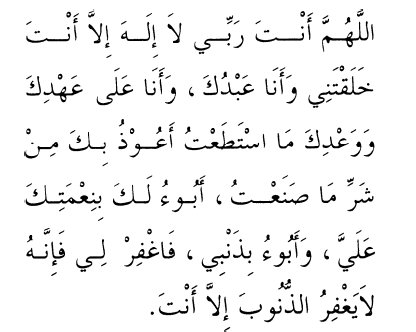
Sayyidul Istighfar

Bismillahir Rahmanir Raheem,

بِسۡمِ ٱللهِ ٱلرَّحۡمَـٰنِ ٱلرَّحِيمِ ,


Transliteration:
`Allahumma Anta Rabbi, la ilaha illa Anta, khalaqtani wa ana `abduka, wa ana `ala `ahdika wa wa`dika mastata`tu, a`udhu bika min sharri ma sana`tu, abu’u laka bini`matika `alayya, wa abu’u bidhanbi faghfir li, fa innahu la yaghfirudh-dhunuba illa Anta.


Translation:

O Allah, You are my Lord, there is none worthy of worship but You. You created me and I am Your slave. I keep Your covenant, and my pledge to You so far as i am able. I seek refuge in You from the evil of what I have done. I admit to Your blessings upon me, and I admit to my misdeeds. Forgive me, For there is none who may forgive sins but You.


wa Allahu Alam

[Updated]: A Basic Video Guide to Salaah [Hanafi Madhab]

Bismillahir Rahmanir Raheem,

بِسۡمِ ٱللهِ ٱلرَّحۡمَـٰنِ ٱلرَّحِيمِ ,

For a detailed read on all the daleel used for the Hanafi Method of Salaah (in great detail) , see this book by Shaykh Abu Yusuf Riyadhul Haqq (db).

[UPDATE]: Here is a picture, step by step guide with audio instructions that is also very simple to follow: Click Here.

wa Allahu Alam.

Was the Qur’an Mistaken on Mary’s Role in Christianity?

Bismillahir Rahmanir Raheem,

بِسۡمِ ٱللهِ ٱلرَّحۡمَـٰنِ ٱلرَّحِيمِ ,


While studying the topic of the “Immaculate” conception of Mary (the Mother of the Jesus), I came across a really contentious quote. Before I show the quote, I’d like us first to read this interpretation of an ayah of the Qur’aan[1]:


5:116

And when Allah saith: O Jesus, son of Mary! Didst thou say unto mankind: Take me and my mother for two gods beside Allah? he saith: Be glorified! It was not mine to utter that to which I had no right. If I had ever said it, then Thou wouldst have known it. Thou knowest what is in my mind, and I know not what is in Thy Mind. Lo! Thou, only Thou, art the Knower of Things Hidden?


Usually, this ayah is misinterpreted by both Muslims (laymen) and Christians (laymen and scholars). Theoretically speaking the argument against this ayah is that no group of “real” Christians believe in Mary to be a God, or have God-like attributes.


I’d now like you to see what I have found:


The salutation of the angel Gabriel — chaire kecharitomene, Hail, full of grace (Luke 1:28) indicates a unique abundance of grace, a supernatural, godlike state of soul, which finds its explanation only in the Immaculate Conception of Mary. But the term kecharitomene (full of grace) serves only as an illustration, not as a proof of the dogma.[2]


God like state of soul? This is sufficient evidence to state that the Qur’aan’s claim is not only valid, but absolutely prophetical in it’s statement. I’d like to add another quote to support the Qur’aan’s claims, to further support it’s statement:


she was created in a condition more sublime and glorious than all other natures.[3]


and one more for the fun of it:


To St. Ephraem she was as innocent as Eve before her fall, a virgin most estranged from every stain of sin, more holy than the Seraphim, the sealed fountain of the Holy Ghost, the pure seed of God, ever in body and in mind intact and immaculate.[4]


Insha Allah (God willing) this is sufficient evidence to calm the quarrelsome nature of the Christians who deny this fact, based upon the writings of the Church Fathers. As much as you hate Islam, the truth is before you and the Qur’aan is indeed among the signs (ayat) of Allah (swt).


Citations:

1. http://www.quranexplorer.com/quran?Sura=5&FromVerse=116&ToVerse=116&Script=Usmani&Reciter=Mishari-Rashid&Translation=Eng-Pickthal-Audio&TajweedRules=Off&Zoom=5.2


2. Holweck, Frederick. “Immaculate Conception.” The Catholic Encyclopedia. Vol. 7. New York: Robert Appleton Company, 1910. 17 Feb. 2011 <http://www.newadvent.org/cathen/07674d.htm>.


3. Theodorus of Jerusalem in Mansi, XII, 1140.


4. Carmina Nisibena.


wa Allahu Alam.

Edgar J. Godspeed on the Success of the Early Church

Bismillahir Rahmanir Raheem,
بِسۡمِ ٱللهِ ٱلرَّحۡمَـٰنِ ٱلرَّحِيمِ ,

“Yet Christianity was not failing. It was winning an amazing success, but in the Greek, not in the Jewish, world. Christianity was, in fact, rapidly becoming a Greek religion. But this success of Christianity in the Greek world only increased the difficulty of the problem. It was nothing like what the prophets had said would happen when the Messiah came.

Paul had seen this difficulty and grappled with it in Romans, chapters 9-11. He cherished the hope that eventually the Jewish people would turn and accept their own Messiah. But in the years that had since passed matters had gone steadily the other way.”

An Introduction to the New Testament – Edgar J. Godspeed; pages 159 and 160, “Matthew”.

Inconsistencies in the Doctrine of Salvation

Bismillahir Rahmanir Raheem,
بِسۡمِ ٱللهِ ٱلرَّحۡمَـٰنِ ٱلرَّحِيمِ ,

SALVA┼ION IN CHRIS┼IANI┼Y
Salvation, in order to discuss what this is, we must first build a concept about it, to do so we must first understand the definition of salvation:

“deliverance by redemption from the power of sin and from the penalties ensuing from it” [1]

The Bible confirms this by stating:

“and to wait for his son from heaven, whom he raised from the dead—Jesus, who rescues us from the coming wrath.” [2]

We round up the definition of the word salvation, by what it means to be saved, a derivative of salvation or of being salvaged:

“saved – rescued; especially from the power and consequences of sin; “a saved soul” [3]

From this we conclude, to be saved, is to have salvation and vice versa.

Now that we know what it is to be saved and have salvation, in Christianity how does one attain this?

Mark 16:15-17
“He said to them, “Go into all the world and preach the good news to all creation. Whoever believes and is whelmed (βαπτίζω) will be saved, but whoever does not believe will be condemned. And these signs will accompany those who believe: In my name they will drive out demons; they will speak in new tongues;”

Acts 2:21-22
“And everyone who calls on the name of the Lord will be saved.’ Men of Israel, listen to this: Jesus of Nazareth was a man accredited by God to you by miracles, wonders and signs, which God did among you through him, as you yourselves know.”

Acts 15:10-11
“Now then, why do you try to test God by putting on the necks of the disciples a yoke that neither we nor our fathers have been able to bear? No! We believe it is through the grace of our master (κύριος) Jesus that we are saved, just as they are.”

Acts 16:30-31
“He then brought them out and asked, “Sirs, what must I do to be saved?” They replied, “Believe in the master (κύριος) Jesus, and you will be saved—you and your household.”

One has to either call on God’s name (interestingly, what is it?), believe in his heart that God perished for his sins or simply believe in Jesus.

What did Jesus do, to give us salvation and what is the punishment for not believing in him?

“For God so loved the world that he gave his one and only son, that whoever believes in him shall not perish but have eternal life.” [4]

Protestant exegetical writer, Adam Clarke says concerning this statement in his exegesis:

“That those who believe receive a double benefit: 1. They are exempted from eternal perdition-that they may not perish. 2. They are brought to eternal glory-that they may have everlasting life. These two benefits point out tacitly the state of man: he is guilty, and therefore exposed to punishment: he is impure, and therefore unfit for glory.” [5]

Note that it says believe, it does not say to believe in (condition), it simply says “believe in him (Jesus)”. The condition most Christians would demand we believe in to be saved, is not mentioned as a condition in the Bible by Jesus or by any of his 12 disciples! Yet Christians falsely make it a prerequisite to be saved, to believe in a death of a pseudo demi-God, whereas the latter part of John 3:16 simply asks for belief in Jesus the Christ, which is what Acts 16:30-31 says.

The Greek for the word believe is:

“πιστεύω” pronounced, pist-yoo’-o.

According to Strong’s Greek Lexicon [6] number G4100, this means:

“From G4102; to have faith (in, upon, or with respect to, a person or thing), that is, credit, – believe (-r), commit (to trust), put in trust with.”

Nothing in the Bible ever states, unequivocally that one needs to believe in Jesus’ death or resurrection to have salvation or to be saved, but just to simply believe (in him).

Now the reason Jesus, “died”, is so that we may be free from sin (as mentioned in the definition and explanation of salvation).

Sin means:
“Theology
a. Deliberate disobedience to the known will of God.
b. A condition of estrangement from God resulting from such disobedience.” [7]

So Jesus died for all of our sins. Our past, present and future sins.

This is confirmed by the Bible as it says:

“For Christ died for sins once for all, the righteous for the unrighteous, to bring you to God. He was put to death in the body but made alive by the Spirit,” [8]

This clearly states that Jesus died for the sins (as a righteous person) for the unrighteous (ἄδικος – heathen, disbeliver). So from Biblical hermeneutics, we deduce the Christian theological fact that Jesus died for the sins of the disbelievers, infidels, heathens [9].

Thus for once and for all proving, that although you can disbelieve in him, you will be punished, but seeing as he clearly died for your sins, surely his death would not be a waste, and since he died for the heathens sins, then the heathen is also sinless, as he clearly states he died for them. Since the heathen is sinless, he cannot obtain eternal perdition, as he earns a grace of being sinless through the death of the Christian God as the Bible unequivocally states so that you will be brought to God.

Simple flow chart of sinless state of disbelievers who will be sent to God:

Jesus died, for the world.
|
|
V
Unbelievers, disbelieve, ergo, by disbelief they are sinning.
|
|
V
Yet, Jesus clearly states that he died specifically for their sins in 1 Peter 3:18.
|
|
V
Since Jesus died for their sins, they are sinless.
|
|
V
Being sinless means one cannot be punished, thus one has salvation.
|
|
V
Heaven.

The only time that it is mentioned one has to believe that Jesus died is by Paul, in Romans 10:8-10, referencing Devarim 30:14, which is an incorrect understanding of the verses, see verses 10-14 for context.

It is also mentioned again 325 years after Jesus by the Nicene Creed:

“We believe in one God the Father Almighty, Maker of heaven and earth, and of all things visible and invisible.
And in one Lord Jesus Christ, the only-begotten Son of God, begotten of the Father before all worlds, God of God, Light of Light, Very God of Very God, begotten, not made, being of one substance with the Father by whom all things were made; who for us men, and for our salvation, came down from heaven, and was incarnate by the Holy Spirit of the Virgin Mary, and was made man, and was crucified also for us under Pontius Pilate. He suffered and was buried, and the third day he rose again according to the Scriptures, and ascended into heaven, and sitteth on the right hand of the Father. And he shall come again with glory to judge both the quick and the dead, whose kingdom shall have no end.
And we believe in the Holy Spirit, the Lord and Giver of Life, who proceedeth from the Father and the Son, who with the Father and the Son together is worshipped and glorified, who spoke by the prophets. And we believe one holy catholic and apostolic Church. We acknowledge one baptism for the remission of sins. And we look for the resurrection of the dead, and the life of the world to come. Amen.” [11]


[1] – Collins English Dictionary – Complete and Unabridged © HarperCollins Publishers 1991, 1994, 1998, 2000, 2003
[2] – 1 Thessalonians 1:10
[3] – Saved, Based on WordNet 3.0, Farlex clipart collection. © 2003-2008 Princeton University, Farlex Inc.
[4] – John 3:16 (NIV).
[5] – Adam Clarke Commentary, John Chapter 3, Verse 16, part 6.
[6] Strong’s Lexicon references:

G907 – Mark 16:15-17
βαπτίζω
baptizō
bap-tid’-zo
From a derivative of G911; to make whelmed.

G2962 – Acts 16:30-31 and Acts 15:10-11
κύριος
kurios
by implication Mr. (as a respectful title): – lord, master, sir.

G94 – 1 Peter 3:18
ἄδικος
adikos
ad’-ee-kos
From G1 (as a negative particle) and G1349; unjust; by extension wicked; by implication treacherous; specifically heathen: – unjust, unrighteous.

[7] – The American Heritage® Dictionary of the English Language, Fourth Edition copyright ©2000 by Houghton Mifflin Company. Updated in 2009. Published by Houghton Mifflin Company. All rights reserved.
[8] – 1 Peter 3:18 (NIV).
[9] –  Heathen

1. pagan, infidel, godless, irreligious, idolatrous, heathenish a heathen temple

2. uncivilized, savage, primitive, barbaric, brutish, unenlightened, uncultured to disappear     into the cold heathen north
Collins Thesaurus of the English Language – Complete and Unabridged 2nd Edition. 2002 © HarperCollins Publishers 1995, 2002
[11] – The Nicene Creed.


« Older Entries Recent Entries »