Tag Archives: islam

Al Shabab and the Kenyan Fall Out

Many right-wing political analysts as well as anti-Shari’ah supporters have jointly promoted the Kenyan Mall attack, as an attack by Muslims on an innocent civilian population. However, a careful study on the attack and on Somalia’s long fought civilian war, paints a much different picture than a prima facie analysis by pseudo-intellectuals who only seek to drive their own popularity based on the abuse of fear and emotion (argumentum ad baculum). The Somalian issue which has birthed a great humanitarian and economic crisis in the African continent. Untold numbers have been massacred, and the added pain of piracy has forced the African Union and Somalia’s neighboring countries to enter into the Somalian civil war.

Somalia’s political crisis did not begin last year, it began in the year 1960 when the Italian and British Somalilands were combined to form a new independent nation. The borders however still existed, the North and the South, the British versus that of the Italian communities. Removing a border line on a map and telling two separate and distinct groups of civilization with fundamentally varying ideologies (democratic-capitalist versus socialist-communist) and forcing them to live together paints a very hazardous image. A rebel coup by a socialist general plunged the decay of Somalia into a fast paced mode on the road to destruction – an eventual clash of civilizations that has persisted to this day, some 23 years later.

A look at the current map of Somalia still shows just how politically, economically and ideologically the nation is divided:
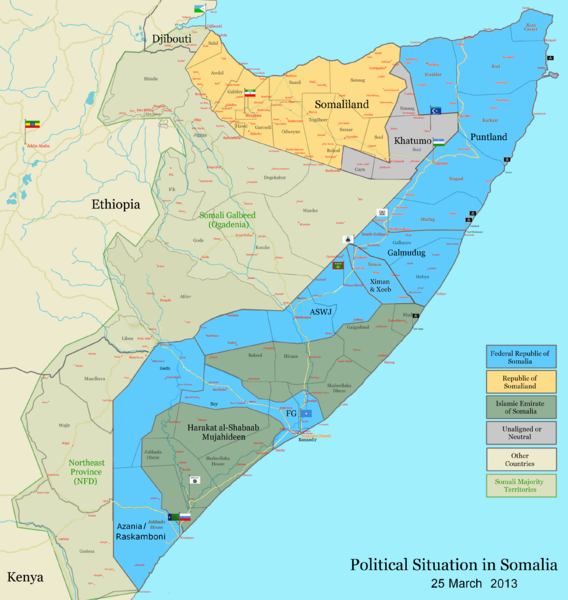
Wikimedia Image

Wikimedia Image

Given that a significant majority of Somalis are Muslim, or practitioners of the Islamic faith, it therefore becomes highly irresponsible to paint every Somali as a terrorist or as a member of al Shabab. Furthermore, it can be understood that the infighting in Somalia is clearly a political issue to gain control of territory and to exercise power over the fragile populations. Seeing as Shari’ah was already designated by the constitution to govern most of Somalia, it’s quite erroneous to claim that the political factions have been fighting to establish it, as it was established in 2006 and ratified in peace and coalition deals in 2009.

The Kenyan attack, should therefore be seen as a response to the Kenyan intervention into a politically hostile neighboring country. The Times of India reports:

Somalia’s al-Qaida-inspired al-Shabaab rebels said the carnage at the part Israeli-owned complex was in retaliation for Kenya’s military intervention in Somalia, where African Union troops are battling the Islamists.

Why is this therefore being painted as an attack by Muslims on non-Muslims, when the persons allegedly responsible, claim for themselves that their motivations are political? It must also be known that the majority of Somalians declare the Shabab group to be unIslamic and to be a threat to the religion of Islam, the BBC reports:

Some 160 Somali religious scholars have issued a fatwa denouncing al-Shabab, saying the group had no place in Islam. Correspondents say it is the first time Somali religious leaders have come up with a fatwa against the group, which controls many rural areas.

At a conference on the phenomenon of extremism in Mogadishu, the scholars said they condemned al-Shabab’s use of violence. Despite being pushed out of key cities in the past two years, it still remains in control of smaller towns and large swathes of the countryside.

One of the aims of the conference was to issue Islamic opinion on whether the group had legitimacy or not, with the final fatwa concluding that it is not an Islamic movement, Sheikh Hassan Jaamai told the BBC. “It’s like a gang that comes together to kill Somalis… without any legitimate reason or justification,” added the Islamic scholar, who flew over from the US to take part in the conference.

“The only thing they want is to create chaos in the country so that they can survive, ” said another participant from the Gulf, Sheikh Abdikani,

The fatwa against the Shabab also states:

At the end of the four-day conference, the seven points of the religious edict were read out by Islamic scholar Sheikh Abdirizak Ahmed Mohamud:

• “Al-Shabab has strayed from the correct path of Islam, leading the Somali people onto the wrong path. The ideology they are spreading is a danger to the Islamic religion and the existence of the Somali society.

• “The Somali government is an Islamic administration; it is forbidden to fight against it or regard its members as infidels.

• “Al-Shabab, an extremist group, must atone to God and must cease its erroneous ideology and criminal actions.

• “It is forbidden to join, sympathise or give any kind of support to al-Shabab.

• “It is a religious duty to refuse shelter to al-Shabab members, who must be handed over to Somali institutions responsible for security.

• “It is a taboo to negotiate on behalf of al-Shabab members in custody or release them from jail.

• “Somali officials have a religious duty to protect the Somali people from the atrocities of al-Shabab. The Somali public also has an obligation to assist the government in its security operations against al-Shabab.”

The political mess that is Somalia, has been birthed by the ideological boundaries created in Europe, imported to Africa, developed by the Somalians and has for the time being, culminated in a region wide war that will persist, given the militant tendencies of the various factions fighting for their independence and right for self governance in the Horn of Africa. A responsible and intelligent individual, will not paint all Africans as violent thugs, nor all Muslims or Somalians as terrorists, as the evidence demonstrates facts to the contrary. If the LRA (Lord’s Resistance Army), a Christian led militant organization can be held to be an unChristian movement by Christians and accepted as such by right wing political analysts, why can’t the Shabab be seen – as it has been declared by the majority of Somalians as an unIslamic group, threatening the religion of Islam?

Change of faith: Why young Brits turn from Christianity to Islam

The following is an article from the Russia Today (RUS) News Portal:

The UK’s official religion is dwindling at a record speed, with the decline of the Church “approaching rock bottom,” experts warn. While Christian congregations age, most British mosques are bringing more and more young people on board. Public mosque services attract thousands of British Muslims, but when you check out a church, there are hardly a dozen participants at Sunday morning worship, RT’s Polly Boiko reports from London.

“The decline of churches in the UK is long term, now it just happens to be approaching rock bottom. So 95 percent of people don’t attend church on an average Sunday. Christian worship is already the concern of a tiny minority of people,” Andrew Copson, chief executive of the British Humanist Association, told RT. “I think over time even the weak cultural identity that still seems to be associated with Christianity will banish away, probably all over Europe, not just in the UK,” Copson added.

The British Muslim population has surged dramatically over the past 15 years, increasing by 75 percent. According to the latest data from the Office for National Statistics, Muslims have the youngest age profile of the religious groups, with 48 percent (1.3 million) aged under 25. Dr. Muhammad Abdul Bari, Honorary Chairman of one of the largest mosques in the UK, the East London Mosque, believes that’s because Islam’s family values are “really bonded, and families really try to nurture young people in the folds of Islam.”

He told RT that the Mosque he goes to, founded in 1910 and accommodating 7,000 worshippers for congregational prayers, has a congregation over 50 percent young people, who feel “part of the Mosque establishment” these days. Contrary to Islam, Christianity showed the oldest age profile among the leading religious groups in 2011. And while the main reason for Christians being economically inactive was retirement, for Muslims economic inactivity was mainly because they were students, or because they were looking after the home or family.
Some argue that unlike Islam, which gives security to people, Christianity isn’t helping young Brits to survive on the violent streets of England.  In fact, the UK had a greater number of murders in 2007 than any other EU country, making it the most violent place in Europe, according to Eurostat. By comparison, there were over 2,000 crimes recorded per 100,000 of population in the UK, and 466 violent crimes per 100,000 in America.  Latest figures from the Crime Survey for England and Wales (CSEW) estimate that in the year ending March 2013 there were 8.6 million crimes in England and Wales.

“The passivity that Christianity promotes is perceived as alien and disconnected to black youths growing up in often violent and challenging urban environments in Britain today,” the former chairman of Brixton Mosque, Abdul Haqq Baker, wrote in the Guardian. “’Turning the other cheek’ invites potential ridicule and abuse, whereas resilience, strength and self-dignity evokes respect and, in some cases, fear from unwanted attention,” he said.  At some point in his life, Baker, raised as a Roman Catholic like his father, converted to Islam. Turning the other cheek has never been an option since then. The majority of young people he had interviewed converted from Christianity to Islam for similar reasons, he says.

You can read the full article on the demise of Christianity in the UK here.

Pauline Christianity, the Prophet’s Access to the Bible, and Similarities in the Gospels

Question:

Asssalamu alaikum. My wife is a Christian and she is currently exploring both Islam and Christianity.

  1. She asked how is it possible for Paul to write that well, obviously with some flaws in the Bible, after our prophet Isiah (Jesus {peace and blessing be upon him}) departure many hundred years later? I know he cooperated with King Constantine and gave in to his demand for one Bible. Are his eleven Apostles right and correctly written in the Bible. Are David’s psalms correct?
  2. Second, Did RasulUllah [saws, peace and blessing be upon him] have access to a Bible in anyway?
  3. Third, How come Matthew, Mark and others are so similar?
  4. Fourth, was Paul really inspired by Jesus [peace and blessing be upon him] to jot down all his statements in the Bible. How did he come to know so much of what to say in the Bible?

Answer:

As-salam alaykum wa rahmatullahi wa barakatuhu,

I hope you are well insha’Allah. You have raised many important issues and questions that deserve a lot of research and reflection. Here are a few quick answers. I hope you follow-up and investigate further.

Read more

Refutation: How can Jesus be God when he will be in eternal subjection?

بِسۡمِ ٱللهِ ٱلرَّحۡمَـٰنِ ٱلرَّحِيمِ ,

Question:

Paul says in 1 Corinthians 15:28 that Christ will be subject to God forever:

When he has done this, then the Son himself will be made subject to him who put everything under him, so that God may be all in all.

In light of this eternal subjection how can any Christian believe that Jesus is God?

Read more

Understanding Abrogation in the Qur’aan

بِسۡمِ ٱللهِ ٱلرَّحۡمَـٰنِ ٱلرَّحِيمِ ,

Unfortunately, most Muslims learn of abrogation in the Qur’aan from the wrong persons. This simple explanation was provided by SeekersGuidance:

Abrogation is one of the lengthiest, most complex, and most important topics in both the science of Qur’anic exegesis [tafsir] as well as that of Legal Theory [usul al-fiqh]. Imam Suyuti mentions that a countless number of scholars authored works solely on the topic of abrogation, and that many Imams said, “No one is allowed to give explanation [tafsir] of the Book of Allah until they understand abrogation.” Our Master Ali [may Allah ennoble his face] asked a judge if he knew which verses abrogated others, to which the judge replied that he did not. Imam Ali said, “You are ruined, and you have ruined others.” [Suyuti, Al-Itqan fi Ulum al-Qur’an]

Insha’Allah, the discussion below will serve as a brief overview of abrogation, followed by answers to the various points you bring up in your question. May Allah Most High provide us all clarity with these and related issues.

Abrogation: Definition

According to Hanafi legal theorists, “abrogation” [naskh] is defined as “the removal or annulment of one legal ruling by a subsequent legal ruling.”

Of course, the “change” entailed in abrogation is perceived only by humans. In Allah’s preeternal knowledge, each ruling had its appointed term. Therefore, some Hanafis put forth a more detailed definition as follows:

“A clarification of the end point of one legal ruling, an end point that was preeternally known to Allah Most High yet nevertheless concealed from those addressed by the Sacred Law, such that it appeared to be a lasting ruling from the perspective of humans.” Hence, abrogation entails replacement from our perspective, yet mere clarification from the Divine perspective, i.e., clarification of the termination of a legal ruling and the beginning of a new legal ruling in its place.

[Ibn Malak/Nasafi, Sharh al-Manar; Bazdawi, Usul al-Bazdawi; Ibn ‘Abidin/Haskafi, Nasamat al-Ashar Sharh Ifadat al-Anwar].

The key aspect of these definitions is the concept of “complete annulment or termination of a legal ruling,” that is, such that it is no longer applicable whatsoever [i.e., irrespective of whether abrogation itself is that termination or merely a clarification of that termination]. This basic understanding is shared in the definitions of major legal theorists of other schools as well, such as Imam Baqillani, Imam Ghazali, Imam Amidi, Imam Baydawi, Imam Mahalli, Imam Qarafi, Imam Razi and others.

[Amidi, Ihkam fi Usul al-Ahkam; Ghazali, Mustasfa; Baydawi, Minhaj al-Wusul ila `Ilm al-Usul; Dimyati/Mahalli/Juwayni, Hashiyat ala Sharh al-Waraqat; Qarafi/Razi, Nafa’is al-Usul fi Sharh al-Mahsul].

Abrogation: Differences in Technical Usage

It is important to understand that definitions were formalized later in Islam. Earlier scholars, especially of the first few generations [salaf], might have used similar terms yet with different meanings. One would have to examine the exact intent of an early scholar and how he used the term before arriving at any conclusions.

As Mufti Taqi Usmani (may Allah preserve him) explains in his “An Approach to the Qur’anic Sciences,” the term “abrogation” had a very wide scope in the technical usage of earlier scholars, due to which in their view it included many verses that later scholars did not consider to be abrogation based on the above technical definitions [mustalah]. A common example is if an earlier verse is very general in its wording and then a later verse limits its scope or conditions it in some way – they would deem the earlier verse to be “abrogated” and the later verse to be its “abrogator.” They did not mean that the ruling of the earlier verse was completely replaced or annulled, but rather that it is no longer general but instead limited or contextualized in some way.

An example is the verse, “And marry not polytheist women until they believe.” (2:221) The ruling here is general in that it is unlawful for Muslims to marry any type of polytheist women, whether idol-worshipers or People of the Book.

Yet a later verse states, “[And you may marry] the chaste of those given the Book.” (5:5) This verse serves to limit the general scope of the earlier verse, whereby it is known that the prohibition refers only to polytheist women that are not from the People of the Book.

Earlier scholars would deem this to be a case abrogation: verse (5:5) serves to “abrogate” verse (2:221). However, it is clear that their understanding of abrogation was not a complete annulment of a previous ruling but rather a change in its scope or applicability.

Later scholars, however, would not deem such cases as abrogation, but only cases in which the earlier legal ruling is completely annulled. According to them, therefore, there are far less cases of abrogation in the Qur’an.

Imam Suyuti states that there were many verses that served to give exceptions or limitations to other verses, and “those who considered them as cases of abrogation were incorrect.” [Al-Itqan fi Ulum al-Qur’an].

[Mufti Taqi Usmani, “An Approach to the Qur’anic Sciences;” Muhammad A. Zurqani, Manahil al-Irfan].

Finally, scholars of legal theory mention that limitation or specification of a general verse is not complete annulment but rather can be related to context and circumstances, while abrogation is complete annulment and therefore negates any usage or applicability of the earlier abrogated verse. [Ghazali, Mustasfa].

Further Reading:

Sam Shamoun’s Poor Scholarship Exposed

بِسۡمِ ٱللهِ ٱلرَّحۡمَـٰنِ ٱلرَّحِيمِ ,

A very embarrassing video exposing the ill tempered, foul mouthed, and abusive, Sam Shamoun has been posted by our respectable Br. MuslimByChoice. In a 2000 debate, Dr. Shabbir Ally rightly brought to light, Sam’s petulant and poor decorum. The video produced by Br. MuslimByChoice summarizes why most intelligent persons choose not to engage in a debate with the ignorant and arrogant, Shamoun:

wa Allaahu ‘Alam.

Bible Burning Egyptian Preacher Sentenced to 11 Years in Prison

بِسۡمِ ٱللهِ ٱلرَّحۡمَـٰنِ ٱلرَّحِيمِ ,

Ahmed Abdullah, or ‘Abu Islam’ who burned Bibles during the ‘Innocence of Muslims’ protests, has been sentenced to 11 years in prison and his son, has been sentenced to 8 years in prison on charges of insulting religion and burning the Bible. Ahram (Arab) News reports:

An Egyptian misdemeanors court has issued an 11 year prison sentence to Islamist preacher Ahmed Abdullah (AKA Abu Islam) on charges of insulting religion and burning the Bible. Abu Islam, who is the head of two Islamic satellite TV channels – the Umma and Mariya – has also been fined LE3000, but the verdict will be suspended pending appeal.

The court also sentenced Islam, Abu-Islam’s son, to eight years in prison and fined him LE 2000 for taking part in burning the Bible with his father. This sentence is also suspended pending appeal. During an 11 September 2012 demonstration in front the US embassy in Cairo protesting the anti-Islam film “Innocence of Muslims,” the Muslim cleric publicly burned copies of the Bible. Before leaving the demonstration, he told the crowd that he would later send his grandson to urinate on the Bible.

Last week, Amnesty International expressed concern over the increasing number of charges for blasphemy and insulting religion in Egypt. Amnesty stated that the majority of those targeted by such accusations in Egypt are Coptic Christians. In February 2013, the prosecutor general ordered Abu Islam’s arrest for allegedly insulting Christianity.

Wonder how Pamella Geller, Robert Spencer or David Wood would describe an ‘Islamist Egypt’ protecting Christianity? For those who don’t know, this guy also justified sexually assaulting female protesters, see this article by Sh. Musa Furber.

wa Allaahu ‘Alam.

Muslims Pray for Sam Shamoun’s Ill Daughter

بِسۡمِ ٱللهِ ٱلرَّحۡمَـٰنِ ٱلرَّحِيمِ ,

Muslims constantly face attack, insult and threats from Sam Shamoun (pictured below).

sam shamoun

Yet, despite his vicious and disparaging behaviour towards Muslims, we show no ill will towards him in his time of need. Very recently Sam indicated that his daughter was sick, immediately upon seeing this, a request for prayers for his daughter was made and Muslims (who Sam abuses and hates) responded beautifully:

cc-2013-prayerforsamsdaughter


cc-2013-prayerforsamsdaughter1


Over 1000+ persons were privy to seeing our prayer request for Sam’s daughter. I even emailed Sam and wished well for his daughter, he has up to this point not responded. As the Qur’aan commands us:

“And the servants of the Most Merciful are those who walk upon the earth easily, and when the ignorant address them [harshly], they say [words of] peace” – Qur’aan 25:63.

wa Allaahu ‘Alam.

« Older Entries Recent Entries »