Tag Archives: Bible

Early Christianity: Diverse Doctrines and Beliefs

Our Brother Alexus, from Lebanon, has braved the threats of his Christian neighbours and has been able to compile a succinct yet extremely detailed introduction to Christianity. If you’re a Christian or Muslim, it presents the beliefs of Christianity in an objectified format, comparing some of the propositions of the Bible with the proclamations of the Qur’aan. As part of our Christmas Special, this post will be made into a page and this will be made into a freely downloadable and distributable PDF file, God Willing. Please look forward to the updated link in this post for the PDF download link.

Download this in PDF form: [Currently Offline]

                         Christianity: A Brief Introduction                   


Opening Statement: Seriously, did you know?
Did you know that ancient Christians—dating from the very earliest centuries, believed there were 2 different Gods, 12, 30, or even 365?

Obviously, many people today would argue that such views could not be Christian. Yet, what is striking is that these people who believed in such things claimed to be “Christians”. They even insisted that their teachings were taught and maintained by Jesus (may God be pleased with him) himself. Ironically, they could appeal to written proof, for they, each group, possessed documents allegedly penned by Jesus’ own apostles.

So how diverse was Christianity, one may ask?

What is Christianity: The Creed?

In order to define Christianity, one would have to examine its creeds. Firstly, what is a creed? A creed is a statement of belief—usually a statement of faith that describes the beliefs shared by a religious community and is often recited as part of a religious service. The word derives from the Latin: credo for “I believe” (because the Latin translation of the Apostles’ Creed and the Nicene Creed both begin with this word).

Of course there are many creeds, including:

-Old Roman Creed

-Nicene Creed

-Apostles’ Creed (based on the Old Roman Creed).

-Chalcedonian Creed.

-Athanasian Creed.

-Tridentine Creed.

-Masai Creed.

-Credo of the People of God.

One of the most widely used creeds in Christianity is the Nicene Creed, first formulated in AD 325 at the First Council of Nicaea. It is the first council which explicitly stated the imperative belief in the divinity of Jesus and the trinity.

It could be summarized as follows:

  • Jesus Christ is described as “God from God, Light from Light, true God from true God,” proclaiming his divinity. When all light sources were natural, the essence of light was considered to be identical, regardless of its form.
  • Jesus Christ is said to be “begotten, not made”, asserting his co-eternalness with God, and confirming it by stating his role in the Creation. Basically, they were saying that Jesus was God, and God’s son, not a creation of God.
  • He is said to be “from the substance of the Father,” in direct opposition to Arianism. Eusebius of Caesarea ascribes the term homoousios, or consubstantial, i.e., “of the same substance” (of the Father), to Constantine who, on this particular point, may have chosen to exercise his authority.

The council did not completely solve the problems and establish the criteria of the Christian faith—this is why many councils were executed later on such as the First Council of Constantinople and the council of Ephesus and many others.

So what do Christians exactly believe: The six points.

In light of the aforementioned, the Christian set of belief can be simply divided as follows:

  • The Divinity of Jesus—He is at the same time fully Divine and fully human.
  • The Trinity—the Father, the Son and the Holy Spirit. Three persons yet One God who share equally the Glory and substance of the one and only God, Almighty.
  • The Original Sin
  • The crucifixion—aka the Cross.
  • The resurrection
  • Salvation.

Before we begin: The Structure.

My focus during this lecture will be based on the first 3 points: The Divinity of Jesus, the Trinity and the Original Sin. I shall discuss these three topics in light of:

1)      The Biblical Scripture—the Old and New Testament.

2)      The Quranic Scripture.

3)      The Logical Perspective.

The Divinity of Jesus: A Fact or a Fiction?

It is noteworthy to mention that there is not a single verse in the Biblical Scripture where Jesus says he is the Almighty God or order worship. This very statement should give us a long pause. If Jesus was indeed God, why didn’t he simply say so? Was he shy? Did he feel awkward? Or maybe was he afraid? A Christian might say: Jesus did not immediately proclaim divinity simply because it is a hard concept on humans to grasp—hence, he did it in a gradual manner. Many difficulties arouse from that response:

1)      There is no gradual process as Jesus did not claim divinity. How could there be a gradual process when the end result is not attained?!

2)      Jesus claimed inferiority rather than equality par rapport to the Creator.

Jesus (pbuh) was a Jewish prophet sent to the Jewish community, a follower of the Jewish law and a devout worshipper of the Jewish God. What’s the issue with Divinity then? The idea that God became a man, a God-man is not a thing just reserved to Christians. Buddhists teaches that God revealed himself in Buddha, Druze claim Al Hakem was God incarnate and Alawites assure that Ali is simply, the Almighty. Ironically, even today, you still find some people declaring divinity. Dr. Jose Luis De Jesus Miranda who recently appeared during a Cnn interview is an example. As a matter of fact, this notion stems from the idea that out of humility and love, the Almighty God decided to take human form to feel and experience what humans go through. To that view, the Holy Quran clarifies, in Surah 67, Ayah 14:

أَلَا يَعْلَمُ مَنْ خَلَقَ وَهُوَ اللَّطِيفُ الْخَبِيرُ

“Should He not know what He created? And He is The Ever-Kind, The Ever-Cognizant.”

We ask why would God need to be a human in order to understand us? Does God really require becoming what He created to understand every aspect? A weird and incomprehensible concept.

Humility? Are we to perceive humility by seeing God, Almighty going to the toilet? Having a round of beat? Or by being spat on? Is this what defines humility. To this blasphemous and atrocious notion, we say:

سُبْحَانَهُ وَتَعَالَىٰ عَمَّا يَقُولُونَ عُلُوًّا كَبِيرًا

“Glorified is He, and High Exalted above what they say!”  (Holy Quran 17:43).

The List: Christianity, a tale?

Before moving in depth, I would like to share the following list. These are religious icons whose myths share many or most of the attributes of Christianity fairy tale most of them including resurrection:

* Chrishna of Hindostan
* Budha Sakio of India
* Salivahana of Bermuda
* Zulis, or Zhule, also Osiris and Orus, of Egypt
* Odin of the Scandinavians
* Crite of Chaldea
* Zoroaster and Mithra of Persia
* Baal and Taut “The only Begotten of God,” of Phenecia
* Indra of Tibet
* Bali of Afghanistan
* Jao of Nepal
* Wittoba of the Bilingonese
* Thammuz of Syria
* Atys of Phrygia
* Xamolsix of Thrace
* Zoar of the Bonzes
* Adad of Assyria
* Deva Tat, and Sammonocadam, of siam
* Alcides of Thebes
* Mkado of the Sintoos
* Beddru of Japan
* Hesus or Eros, and Bremrillah, of the Druids
* Thor, son of Odin, of the Gauls
* Cadmus of Greecde
* Hil and Feta of the Mandaites
* Gentaut and Quexalcote of Mexico
* Universal Monarch of the Sibyls
* Ischy of the island of Formosa
* Divine Teacher of Plato
* Holy One of Xaca
* Fohi and Tien of China
* Adonis, son of the virgin Io, of Greece
* Ixion and Quirinus, of Rome
* Prometheus of Caucasus

Some specifics on a few in ascending order of age (ALL of which predate christianity):
Dionysus, Greece, 500.B.C.
* Born of a virgin, on Dec. 25th
* Performed miracles with his disciples, such as: turning water into wine
* Common names: “king of kings”, “god’s only begotten son”, “alpha and omega”
* Upon death, resurrected

Krishna, India, 900 B.C.
* Born of a virgin
* Birth heralded by a star in the east
* performed miracles
* Upon death, resurrected

Attis, Greece, 1200 B.C.
* Born of a virgin, on Dec. 25th
* Crucified
* Dead for 3 days
* Resurrected

Mithra, Persia, 1200 B.C.
* Born of a virgin, on Dec. 25th
* Had 12 disciples
* Performed miracles
* Dead for 3 days
* Resurrected
* Nicknames: “the truth”, “the light”
(Sacred day of worship of Mithra was Sunday)

Horus, Egypt, 3000 B.C.
(Sun anthropomorphized)
* Born of virgin, on Dec. 25th
* Birth heralded by star in the east that was followed by 3 kings
* Teacher at 12
* Baptized at 30 and began ministry
* Had 12 disciples
* Performed miracles: healing sick and walking on water
* Nicknames: “the truth”, “lamb of god”, “the light”, “the good shepherd”
* Crucified
* Dead for 3 days
* Resurrected

A God-man: Debunked!

I shall present now 15 main points arguing why Jesus cannot be divine tackling it from 3 ways accordingly as already explained.

The Judgment Day.

1) Mark 13:32 read:

“”No one knows about that day or hour, not even the angels in heaven, nor the Son, but only the Father.”

This statement not only assures to us that Jesus is ignorant concerning the Judgment day—a thing which is incomprehensible—it raises another problematic issue: How does Jesus know and doesn’t know? It is like saying a part of God knows while the other has no idea! How can this be?

Adam Clarke, a biblical scholar, who wrote the famous “Commentary on the Bible” says:

“To me it is utterly unaccountable, how Jesus, who knew so correctly all the particulars which he here lays down, and which were to a jot and tittle verified by the event – how he who knew that not one stone should be left on another, should be ignorant of the day and hour when this should be done.  I cannot comprehend, but on this ground, that the Deity which dwelt in the man Christ Jesus might, at one time, communicate less of the knowledge of futurity to him than at another. However, I strongly suspect that the clause was not originally in this Gospel. Its not being found in the parallel places in the other evangelists is, in my opinion, a strong presumption against it.”

Barnes’ Notes on the Bible read:

“Neither the Son – This text has always presented serious difficulties. It has been asked, If Jesus had a divine nature, how could he say that he knew not the day and hour of a future event? In reply, it has been said that the passage was missing, according to Ambrose, in some Greek manuscripts; but it is now found in all, and there can be little doubt that the passage is genuine.  Others have said that the verb rendered “knoweth” means sometimes to “make” known or to reveal, and that the passage means, ‘that day and hour none makes known, neither the angels, nor the Son, but the Father.’ But then it is natural to ask where has “the Father” made it known? In what place did he reveal it?’”

Where did the Father makes it known asks Barnes—No where.

Therefore, how come God does not know when the hour of Judgment is? Allegedly speaking and for the sake of the argument—did He lose His powers when He became a man? If yes, then are we still to consider Him as God? If not, what makes him divine then?

The Glorious Quran strictly refutes this absurd statement:

إِنَّ اللَّهَ لَا يَخْفَىٰ عَلَيْهِ شَيْءٌ فِي الْأَرْضِ وَلَا فِي السَّمَاءِ

“Indeed, from Allah nothing is hidden in the earth nor in the heaven.” (Holy Quran 3:5)

وَمَا كَانَ رَبُّكَ نَسِيًّا

“And your Lord is not forgetful.” (Noble Quran 19:64)

إِنَّمَا إِلَٰهُكُمُ اللَّهُ الَّذِي لَا إِلَٰهَ إِلَّا هُوَ ۚ وَسِعَ كُلَّ شَيْءٍ عِلْمًا

“Your Ilah (God) is only Allah, the One (La ilaha illa Huwa) (none has the right to be worshipped but He). He has full knowledge of all things.” (Glorious Quran 20:94).

A helpless unreliable God?

2) John 5:30-2

“I can of mine own self do nothing: as I hear, I judge: and my judgment is just; because I seek not mine own will, but the will of the Father which hath sent me. “If I testify about myself, my testimony is not valid. There is another who testifies in my favor, and I know that his testimony about me is valid.”

Indeed, one huge can of worms is opened by this verse. Firstly, how can God do nothing by Himself? This is truly a weird unsolved enigma. Secondly, the Biblical Jesus is declaring that his judgment is right—why? Because he is following not his will but the will of God which is according to Christians his will. So in other words, not his will but his will. In short, why are his words true—simply because he abide not by his will but by his will. Do you perceive the difference?

Did anyone, seriously anyone, grasp what was being said here? I guess not.

Finally, the last part—“If I testify about myself, my testimony is not valid”. Can anyone imagine God testimony as invalid? Does this refer to “Lying”? Are we really to believe that? Nonetheless the ultimate problem here is the issue that God is testifying about himself yet insisting that if it relates to Him— “If I testify about myself”—it is wrong. Illogical.

A possible desperate Christian answer might be that God/Jesus is referring to his human nature. I would say, it would have been better to remain silent than to give this ridiculous answer, simply because:

–          You are asserting that by becoming a man, God testimony became invalid yet he was still God whose testimony is even above the word “Valid”—how can this be? How can God words or worse—his testimony valid and not valid at the same time?

–          How can we know when Jesus is talking in his human or divine nature?

–          By assuming that God words became unreliable, this would mean that He would have uttered lies. Istaghfor Allah.

–          Whether it was his human or divine nature—that does not refute the mere fact that it was God—hence still God testimony.
Now, what does the Quran says concerning God testimony:

قُلْ أَيُّ شَيْءٍ أَكْبَرُ شَهَادَةً ۖ قُلِ اللَّهُ ۖ

Say (O Muhammad SAW): “What thing is the most great in witness?” Say: Allah. (Holy Quran 6:22)

While in what relates to the statement “I can of mine own self do nothing”, Allah, the greatest says:

قُلْ أَتَعْبُدُونَ مِن دُونِ اللَّهِ مَا لَا يَمْلِكُ لَكُمْ ضَرًّا وَلَا نَفْعًا ۚ وَاللَّهُ هُوَ السَّمِيعُ الْعَلِيمُ

Say, “Do you worship besides Allah that which holds for you no [power of] harm or benefit while it is Allah who is the Hearing, the Knowing?” (Holy Quran 5:76)


So how many Gods are there?

3) Mark 12:29

“And Jesus answered him, The first of all the commandments is, Hear, O Israel; The Lord our God is one Lord”

John 20:17

“Jesus said to her, Touch me not; for I am not yet ascended to my Father: but go to my brothers, and say to them, I ascend to my Father, and your Father; and to my God, and your God.”

Apparently, according to both these verses, Jesus has a God. How is that so? Doesn’t Christians believe in just one God—a Three Godhead? Or is it Two Gods now? Jesus and his “God”? Nonetheless, It is shiny clear according to Mark 12:29 which is basically a quote of Deuteronomy 6:4 that God is One.

Strikingly, Adam Clarke and Barnes are quite silent about this verse. I will quote another commentary, the well known Gill’s exposition of the entire Bible, as it seems to be exclusively interesting:

“God was his Father, not by creation, as he is to angels, and the souls of men, and therefore is called the Father of spirits; nor by adoption, as he is to the saints; nor with respect to the incarnation of Christ, for, as man, he had no father; or with regard to his office as Mediator, for as such he was a servant, and not a Son; but he was his Father by nature, or with regard to his divine person, being begotten of him, and so his own proper Son, and he his own proper Father;”

According to Gill, Jesus is not a “created” son as par rapport to his Father yet the Bible mentions Jesus as God firstborn—in other words, a created being. Obviously, God is not born, nor will He ever will be. Additionally, this latter tells us that God was a Father to Jesus by nature—What does Father by nature really means, one may ask? The Almighty God is at the same time a Father to himself and a Son—to himself? Surely, Christianity is one big mes.

Finally, Jesus is described and believed to be “Begotten”, a word which literary refers to the sexual mean of reproduction. Not only Jesus was shaped and created in his mother’s womb—this word unfortunately denotes an unworthy description related to the Almighty one really do not wish to open that door.

We have noticed how Jesus refers to his God, “My God and your God”, it is fascinating now to see what the Quran says concerning that issue:

لَقَدْ كَفَرَ الَّذِينَ قَالُوا إِنَّ اللَّهَ هُوَ الْمَسِيحُ ابْنُ مَرْيَمَ ۖ وَقَالَ الْمَسِيحُ يَا بَنِي إِسْرَائِيلَ اعْبُدُوا اللَّهَ رَبِّي وَرَبَّكُمْ ۖ إِنَّهُ مَن يُشْرِكْ بِاللَّهِ فَقَدْ حَرَّمَ اللَّهُ عَلَيْهِ الْجَنَّةَ وَمَأْوَاهُ النَّارُ ۖ وَمَا لِلظَّالِمِينَ مِنْ أَنصَارٍ

“They do blaspheme who say: “Allah is Christ the son of Mary.” But said Christ: “O Children of Israel! worship Allah, my Lord and your Lord.” Whoever joins other gods with Allah,- Allah will forbid him the garden, and the Fire will be his abode. There will for the wrong-doers be no one to help.” (Holy Quran 5:72)

ذَٰلِكَ عِيسَى ابْنُ مَرْيَمَ ۚ قَوْلَ الْحَقِّ الَّذِي فِيهِ يَمْتَرُونَ مَا كَانَ لِلَّهِ أَن يَتَّخِذَ مِن وَلَدٍ ۖ سُبْحَانَهُ ۚ إِذَا قَضَىٰ أَمْرًا فَإِنَّمَا يَقُولُ لَهُ كُن فَيَكُونُ وَإِنَّ اللَّهَ رَبِّي وَرَبُّكُمْ فَاعْبُدُوهُ ۚ هَٰذَا صِرَاطٌ مُّسْتَقِيمٌ

“That is Isa (Jesus) son of Maryam, in word of truth, concerning which they are wrangling. In no way is it for Allah to take to Him a child. All Extolment be to Him! When He decrees a Command, then He only says to it, “Be!” and it is.  And surely Allah is my Lord and your Lord, so worship Him. This is a straight Path.”

He is blaming himself now?!

4)  Mark 15:34   

“And at the ninth hour Jesus cried with a loud voice, saying, Eloi, Eloi, lama sabachthani? which is, being interpreted, My God, my God, why hast thou forsaken me?”

To me, it is one of the best biblical verses. I will draw first what is happening here. As a matter of fact, after being sentenced to death by crucifixion by Pontius Pilate, Jesus was nailed to the cross, where according to the Gospel of Mark; he was silent—unknowing what was happening to him—in a complete state of Shock!

Back to our issue, two points are actually raised here:

-To whom is Jesus talking to?

-Why is he blaming himself?

Apparently, either the Biblical God talk with himself—ask himself or even now blame himself—or something is really fishy going on here? I would say both.

Yet ironically, the bigger critical point here: Why is God blaming himself that he left himself to feel pain—all by himself? How could any normal, rational being believe this?

What do Christian missionaries present as response to this serious dilemma? A smart response is that Jesus was simply quoting Psalms 22, an Old Testament verse which to some extent is similar to that verse—a quote said by David. It may sound as a smart response from a shallow look but we examined carefully—it would seem so ridiculous. Ironically even though it is incomprehensible how David suddenly became Jesus—the passage if read carefully, one would undoubtedly note that it could not refer to Jesus—nonetheless, even if I would want to take it as a Prophecy—I am too nice—still that does not solve the issue. Just saying it is a prophecy simply means that it was known to happen yet it does not present a logical answer why Jesus was blaming himself?! In other words, a prophecy or not—Jesus still blamed why God left him, oddly himself—on the cross? The problem still stands!

To sum up: Difficulty arouse not only with the idea of a suicidal God—we have a biblical God that is not aware of what is going on, talking with himself and strikingly blaming himself why he killed himself—Fantastic.

The Quran:

وَقَالُوا اتَّخَذَ الرَّحْمَٰنُ وَلَدًا لَّقَدْ جِئْتُمْ شَيْئًا إِدًّا  تَكَادُ السَّمَاوَاتُ يَتَفَطَّرْنَ مِنْهُ وَتَنشَقُّ الْأَرْضُ وَتَخِرُّ الْجِبَالُ هَدًّا  أَن دَعَوْا لِلرَّحْمَٰنِ وَلَدًا  وَمَا يَنبَغِي لِلرَّحْمَٰنِ أَن يَتَّخِذَ وَلَدًا  إِن كُلُّ مَن فِي السَّمَاوَاتِ وَالْأَرْضِ إِلَّا آتِي الرَّحْمَٰنِ عَبْدًا لَّقَدْ أَحْصَاهُمْ وَعَدَّهُمْ عَدًّا وَكُلُّهُمْ آتِيهِ يَوْمَ الْقِيَامَةِ فَرْدًا

“They say: “(Allah) Most Gracious has begotten a son!” Indeed you have brought forth (said) a terrible evil thing. At it the skies are ready to burst, the earth to split asunder, and the mountains to fall down in utter ruin, That they should invoke a son for (Allah) Most Gracious. For it is not consonant with the majesty of (Allah) Most Gracious that He should beget a son. Not one of the beings in the heavens and the earth but must come to (Allah) Most Gracious as a servant. Indeed He has already enumerated them, and He has numbered them with (exact) numbering. And everyone of them will come to Him singly on the Day of Judgment. (Noble Quran 19:88-95).

5)  Matthew 4:1-11; Luke 4:1-13

“Then Jesus was led by the Spirit into the desert to be tempted by the devil.”

Out of the four Gospels—only three mentions this incident and just two of them describe specifically what happened. While Mark is content with a general statement—John completely omits it. Therefore, our focus will be stressed on Matthew and Luke who narrate this fascinating story but with a slight difference which we will examine it shortly.

Apparently, the Spirit which is understood to be the Holy Spirit—One of God’s distinct personality that forms the trinity—has directed Jesus (himself?) for his temptation. One by just reading this would normally ask: God lead himself for his own temptation? Really?

We are told that Jesus was tempted for 40 days and during this period he fasted (Matthew 4:2; Luke 4:2)—obviously, so that his concentration be focused and ultimately avoiding sinning. Seeing Jesus has not succumbed—the Devil then uses his last three most powerful moves:

-He tells him to change stones into bread so that he could eat (Matthew 4:3; Luke 4:3)

-He takes him to the top of the temple and order him to jump  (Matthew 4:5-6; Luke 4:9) saying if you are the son of God—you will not be harmed—as the angels will prevent you from falling.

-Finally, he takes him (again?) to a very high mountain, showing him all the kingdom of the world and assuring him if he worships him—all what he has seen will be his. (Matthew 4:8-9; Luke 4:5-6).

From where do I begin—ah that seems a hard task.

I will divide my argument into five points:

I)  Mark, Matthew and Luke flat out contradict what James tells us in his epistle. As a matter of fact, according to James (1:13) “God cannot be tempted and nor does he tempt with evil”. A simple straightforward contradiction.

II) As already mentioned, Jesus fasted for 40 days. Quite interestingly, after that period, it is said that he became “Hungry”. Can anyone imagine a hungry God?

III) We read that Jesus was one time taken to top of the mountain and another to the high mountain—I honestly ask: Is Jesus a sack of potato that Satan throws from one place to another? Wake up Christians!!! This is the Almighty we are talking about.

IV) How could Satan have any effect on God, Almighty? How can he have power over His creator? And telling God to worship him? Seriously? Christians, do you realize what you are saying?

V) The book of Hebrews tells us that Jesus was tempted “in every way just as we are” (Hebrews 4:15). Now this is one bizarre terrible statement. Every way? Are we to believe that God thought of raping a woman? Throwing an old woman from a cliff? Or maybe dancing naked?

One way to reconcile this is to claim that Jesus did not sin, thus temptations did not have any effect any him. The issue is not whether he sinned or not—rather, the temptation. Whether he fell to Satan or not is irrelevant to the point discussed here.  Finally and as usual, you have the man part answer. It was the human part of God that was tempted. I don’t understand how that really solves the issue. First, do Christians, each time they face a difficulty, immediately shout: HUMAN PART! Second, on what basis? Third, even if we would want to accept that it was the human part that was being tempted—still it means that GOD WAS TEMPTED!According to the basic Christian belief, both the human and divine nature is both God.

The Quran:

وَرَبُّنَا الرَّحْمَٰنُ الْمُسْتَعَانُ عَلَىٰ مَا تَصِفُونَ

“And our Lord is the Beneficent Allah, Whose help is sought against what you ascribe (to Him).” (Noble Quran 21:112)

Good or not?

6) Luke 18:19; Matthew 19:16-17 and Mark 10:17-18


Consider the story of the rich young ruler. A story narrated by the first three Gospels. John here too—omits that story. Actually, the man is rich according to all three accounts, but only in Matthew he is said to be young and only in Luke he is said to be a ruler. Does that mean we are facing a contradiction here? Not the least. A contradiction occurs when two (or more) statements in relation to a subject conflict—one of them has to be wrong—which is not the case here.

Now, this young rich ruler approached Jesus by referring to him by the words: “Oh good teacher”. Jesus then asks him: Why are you calling me good? Only God is good! In other words, Jesus refused to be set on the same level of the Almighty—to be even put in a comparison. So how could God be not good but still good? He is not good but yet only he is good? A World of contradictions.

Another striking point to be considered is to compare these accounts. A process called by Christian scholars “Redaction Criticism”—which aims to point out how a Gospel author modified a story and why? It is noteworthy to mention that scholars believe that Mark was the first Gospel to be written, Luke and Matthew followed it and finally John. It is also believe that Matthew and Luke have considered Mark as one of their source. By comparing, we find that Luke agrees with Mark word for word. Yet let us read how Matthew renders the story:

“Now a man came up to Jesus and asked, “Teacher, what good thing must I do to get eternal life?”Why do you ask me about what is good?” Jesus replied. “There is only One who is good. If you want to enter life, obey the commandments.”

One of the interesting things about this passage is that the man who approaches Jesus uses the term “good” in both accounts but in Matthew he uses it to refer to the deed he must do, whereas in Mark and Luke he uses it to refer to Jesus. As a result the ensuing dialogue in Mark makes sense: Jesus by asking refuse to be compared to God while in Matthew the flow of dialogue seems a bit flow: Why would Jesus object to the man asking about what is good, on the ground that God is only good?

One may ask, why did Matthew alter the text? Obviously, Matthew did not like the issue that Jesus was claiming to be inferior to God and realized that this would cause a serious problem so what did he do? He changed the text.

Jesus, a prophet?

7) Luke 24:19:

“What things?” he asked. “About Jesus of Nazareth,” they replied. “He was a prophet, powerful in word and deed before God and all the people.”

Matthew 21:11:

“The crowds answered, “This is Jesus, the prophet from Nazareth in Galilee.”

Matthew 13:57:

And they took offense at him. But Jesus said to them, “Only in his hometown and in his own house is a prophet without honor.”

In the first two verses, we notice Jesus being referred to as a “Prophet” once by Cleopas, the brother of Joseph, the huband of Mary and another by the crowds. Yet what is striking is that in the last quotation, Jesus even refers to himself as a Prophet!!! As a matter of fact, when Jesus began preaching in the Synagogues, in his hometown—Nazareth, he was immediately rebuked by the Jews—his own people. Hence his words: “Only in his hometown and in his own house is a prophet without honor.”

Hence, the question now begs itself: Is Jesus a Prophet or God? Or could he both? Firstly, what is a Prophet? A Prophet is a person who conveys another person message. In religion, it refers generally to an individual who delivers a certain revelation to people. If Jesus was God, how would he be a Prophet? A prophet to whom? To himself? That seems pretty much absurd and illogical.

One answer I presume would be: Jesus was a prophet to the Father. He was delivering his Father message.

Counter-argument:

Yet Jesus and his Father are the one and same God. Hence, when a person says Jesus as a Prophet was simply transferring what the Father or his Father said is like saying God is transferring his own words.

Therefore, logically Jesus has to be either God or Prophet—and obviously, from the Biblical and logical perspective, the latter is to be picked.

Let’s go to the Holy Quran:

يَا أَهْلَ الْكِتَابِ لَا تَغْلُوا فِي دِينِكُمْ وَلَا تَقُولُوا عَلَى اللَّهِ إِلَّا الْحَقَّ ۚ إِنَّمَا الْمَسِيحُ عِيسَى ابْنُ مَرْيَمَ رَسُولُ اللَّهِ وَكَلِمَتُهُ أَلْقَاهَا إِلَىٰ مَرْيَمَ وَرُوحٌ مِّنْهُ ۖ فَآمِنُوا بِاللَّهِ وَرُسُلِهِ ۖ وَلَا تَقُولُوا ثَلَاثَةٌ ۚ انتَهُوا خَيْرًا لَّكُمْ ۚ إِنَّمَا اللَّهُ إِلَٰهٌ وَاحِدٌ ۖ سُبْحَانَهُ أَن يَكُونَ لَهُ وَلَدٌ ۘ لَّهُ مَا فِي السَّمَاوَاتِ وَمَا فِي الْأَرْضِ ۗ وَكَفَىٰ بِاللَّهِ وَكِيلًا

“O people of the Scripture (Jews and Christians)! Do not exceed the limits in your religion, nor say of Allah aught but the truth. The Messiah ‘Iesa (Jesus), son of Maryam (Mary), was (no more than) a Messenger of Allah and His Word, (“Be!” – and he was) which He bestowed on Maryam (Mary) and a spirit (Ruh) created by Him; so believe in Allah and His Messengers. Say not: “Three (trinity)!” Cease! (it is) better for you. For Allah is (the only) One Ilah (God), Glory be to Him (Far Exalted is He) above having a son. To Him belongs all that is in the heavens and all that is in the earth. And Allah is All-Sufficient as a Disposer of affairs.” (4:171)


Circumsized, ate and evidently went to W.C?
8) Luke 2:21

“And when eight days were accomplished for the circumcising of the child, his name was called Jesus, which was so named of the angel before he was conceived in the womb.”

Is anyone not familiar with the meaning of the word “circumcised”? Just in case, circumcision simply means:

“Male circumcision is the surgical removal of some or the entire foreskin (prepuce) from the penis.”

Seriously, I am even ashamed of myself by saying this. How could anyone attribute such a thing to the Almighty God? He had the dirty part of his genitals cut? Dirty and this part? Unfortunately, Christians do not realize the extent of blasphemy they are uttering by believing that God was a man, a fully human being. We Muslims cannot but to say:

سبحان الله و تعالى عما يصفون

Praise is He highly on what they describe.

Now concerning the issue of Jesus eating and hitting the toilet, I would like to quote the Quran to show how God, Almighty deals with such subject, we read:

مَّا الْمَسِيحُ ابْنُ مَرْيَمَ إِلَّا رَسُولٌ قَدْ خَلَتْ مِن قَبْلِهِ الرُّسُلُ وَأُمُّهُ صِدِّيقَةٌ ۖ كَانَا يَأْكُلَانِ الطَّعَامَ ۗ انظُرْ كَيْفَ نُبَيِّنُ لَهُمُ الْآيَاتِ ثُمَّ انظُرْ أَنَّىٰ يُؤْفَكُونَ

“The Messiah, son of Mary, was not but a messenger; [other] messengers have passed on before him. And his mother was a supporter of truth. They both used to eat food. Look how We make clear to them the signs; then look how they are deluded away from the truth.” (Glorious Quran 5:75)

Consider the eloquence of the Quran and how it smoothly and intellectually delivers the message. The verse says that both Mary and Jesus ate food and obviously what does the person do next? It’s the toilet’s time.

Hence, the Quran strictly refute that nonsense but as we have seen in a beautiful eloquent manner. Al Hamdulilah.

The Quran says:

قُلْ أَغَيْرَ اللَّهِ أَتَّخِذُ وَلِيًّا فَاطِرِ السَّمَاوَاتِ وَالْأَرْضِ وَهُوَ يُطْعِمُ وَلَا يُطْعَمُ ۗ قُلْ إِنِّي أُمِرْتُ أَنْ أَكُونَ أَوَّلَ مَنْ أَسْلَمَ ۖ وَلَا تَكُونَنَّ مِنَ الْمُشْرِكِينَ

“Say, ‘Is it other than Allah I should take as a protector, Creator of the heavens and the earth, while it is He who feeds and is not fed?” Say, [O Muhammad], “Indeed, I have been commanded to be the first [among you] who submit [to Allah ] and [was commanded], ‘Do not ever be of the polytheists.’ ” (Holy Quran 6:14)

And finally,

لَيْسَ كَمِثْلِهِ شَيْءٌ ۖ وَهُوَ السَّمِيعُ الْبَصِيرُ

“There is nothing whatever similar unto Him, and He is the One that hears and sees (all things).” (Noble Quran 42:11).

God changed his mind?
9) Matthew 26:39; Mark 14:36; Luke 22:42

“Father, if you are willing, please take this cup of suffering away from me. Yet I want your will to be done, not mine.”

According to the Christian teachings, specifically the Original Sin, no matter what a person does, no matter how much he prays, fasts, does good deeds—he is doomed to eternal Hell. What was the solution according to Christianity? God had to take human form—Jesus, to be crucified and ultimately to take all the sins of the world with him by dying. That may seem a bit weird but according to this faith—God did it according to his very own will. That was the only solution after all.

Ironically, Luke 22:42 tells us another thing. Here we notice Jesus praying to God, Almighty (himself?) not to die by taking away this “Cup of suffering”. In Luke, he simply asks once while in Mark, he insists three times!!!Now, doesn’t that K.O all the Christian faith apart? If God, Almighty willingly decided to go on a suicide mission—considering that it was the only solution plausible—Why did he suddenly change his mind? Are we to believe that God changes his mind now too? Although the Bible clearly mentions otherwise (Numbers 23:19).

Finally, Jesus says:”Your will to be done and not mine”.

We again here face a terrible nonsense. We note that:

-Jesus is talking with himself.

-Praying to himself.

-Asking himself to spare him from the mission.

-And for the final touch down, hoping that God’s will which is his will be done but not his will.

There is nothing I could say apart: Fantastic!

The Quranic perspective:
God is not a man: Is it that hard to understand?

10) Numbers 23:19; Samuel 15:39

“God is not a man, that he should lie; neither the son of man, that he should change his mind.”

A simple straightforward fact: God is neither a man nor the son of a man. Why can’t Christians understand that? Who was Jesus? A pious God-fearing man and the son of Mary. Actually, God, Almighty since the beginning of time has sent Prophets with good news, with the message of Tawheed, the message of La Ilah illa Allah—there is no god but Allah warning mankind not to associate partners with God and not to worship the sun, the moon, the nature and of course—humans.  Nonetheless, thanks to Christianity—we are wrapped back to the ancient times.

A Christian rebuttal to this point might simply be:

“The verse says that God is not a man and not the Son of man—however, it does not say that God can never be a man or the Son of Man.”

Counter rebuttal:

This argument fails to perceive that the Old Testament is filled with verses that say that God is this or that and those verses remain true for eternity as Christians themselves will concede in their theology. What do I mean?

Let us take Deuteronomy 6:4 as an example.

“Hear, O Israel! The LORD is our God, the LORD is one!”

To be consistent the proponents of the first rebuttal must now say that it is possible for God to be 1000 instead of echad(one) in the future if He so wishes. I do not think any reasonable Christian will agree to that.

And finally for my K.O point, Psalms 102:27 assures that God is the same, yesterday, today and tomorrow:

“But you remain the same, and your years will never end.”

Muslims sometimes when shocked by a certain thing say:

سبحان الدي يغير و لا يتغير

Praise is to Him that [causes] change but is never changed.

wa Allaahu Alam.
[and God knows best.]

Muslims & Christmas – Etiquettes and Rulings: Shaykh Mumtaz ul Haq [db]

Bismillahir Rahmanir Raheem
بِسۡمِ ٱللهِ ٱلرَّحۡمَـٰنِ ٱلرَّحِيمِ ,

As Christmas dawns upon us yet again, Shaykh Mumtaz ul Haq [db] has prepared for the Muslims and non-Muslims some Naseeha (advice) on the rulings of the etiquette of Christmas. Can Muslims wish non-Muslims, “Merry Christmas“, “Happy Holidays“, “Season’s Greetings“? How are Muslims supposed to respond to such greetings? All answered in the video below:

Provided in an emergency upload by the Hanafi Fiqh Channel, this video is of utmost importance to Muslim and non-Muslim relations. It assists in helping to foster good relations, understanding where our cultural norms and values differ and how to avoid awkward moments. Please spread insha Allaah, so that many can benefit from it!

As an addendum, here is Shaykh Ibn ‘Uthaymeen’s fatwa on saying, “Merry Christmas”:

Responding to Merry Christmas by Shaykh ibn ‘Uthaymeen (rahimahullaah)

Question:
What is the ruling o­n congratulating the disbelievers o­n their Christmas celebration? And how do we respond to them if they greet us with it. And is it permissible to go to the places where they are having celebrations for that purpose. And does the person (Muslim) take a sin if he does the aforementioned without any intent? Rather he o­nly does it being courteous, or due to shyness or due to being put in an awkward situation, or due to some other reasons. And is it permissible to resemble them in this?

Answer: 

Congratulating the disbelievers o­n their Christmas celebration or other than that from their religious holidays is not permissible according to the consensus. As was related by Imaam Ibn Al Qayyim, may Allaah have mercy upon him, in his book “The ruling o­n the people beneath the Muslim protection”, when he said: “As for congratulating the disbelievers for their religious ceremonies that have kufr (disbelief) attached to it, then it is not permissible according to the consensus. For example congratulating them for their holidays or their fasts, so the person says, “May you have a bless holiday”, or he wishes them well for their holiday or something like that. So this, if the o­ne who says it escapes from falling into kufr (disbelief), is (still) from the impermissible things. And it is o­n the same level as congratulating them for prostrating to the cross. Rather it is a greater sin with Allaah. And it is a more severe abomination than to congratulate them for drinking alcohol and killing someone, committing illegal sexual intercourse and things of this nature. And many of the people who don’t have any deen(or respect for the deen) fall into this. And he doesn’t know the ugliness (evil) of what he has done. So whoever congratulates a person for committing sins, or innovations, or disbelief, then he has exposed himself to the hate, wrath (anger) of Allaah.”

(Shaykh ibn ‘Uthaymeen (rahimahullaah) continues)

So congratulating the disbelievers o­n the religious holidays is not permissible, as shown by the proof brought by Ibn Al Qayim (rahimahullaah). Because in it, (congratulating the kufar o­n their religious holidays) is an approval for what they are upon from their kufr ceremonies, and showing them that you are please with it. Even if the person is not pleased with the actual kufr itself, it is also not permissible for the Muslim to be pleased with kufr ceremonies, or to congratulate them for it. Because Allaah the Exalted is not pleased with that, as Allaah the Exalted says,

“If you disbelieve, then verily, Allaah is not in need of you, He likes not disbelief for His slaves. And if you are grateful (by being believers), He is pleased therewith for you.” (AzZumar 39: 7)

And the Exalted says,

“This day, I have perfected your religion for you, completed My Favor upon you, and have chosen for you Islam as your religion.” (Al-Ma’idah 5: 3)

So congratulating them with this is haram whether this person is your co-worker or not. So if they greet us with their holiday greeting we don’t respond to them with it, because it’s not our holiday, and they are holidays that Allaah is not pleased with, and because it is something that is either innovated in their religion, or it was legislated but has since been abrogated by the deen of Islam that which Muhammad peace and blessing be upon him, was sent with to all of the creation. And He (Allaah) says about it (Islam)

“And whoever seeks a religion other than Islam, it will never be accepted of him, and in the Hereafter he will be o­ne of the losers” (Aali Imran 3: 85)

And for the Muslim to accept their invitations to these occasions (holiday celebrations) is haram (Impermissible). Because this is worst than congratulating them with it, because this would entail participating with them in this. Also it is haram for the Muslim to imitate the disbelievers by establishing celebrations for these occasions, or to exchanges gifts, or to distribute sweets, or trays of food, or to stop work or anything like this. Due to the statement of the Prophet, peace and blessing be upon him, “Whoever imitates a people is from them”. Shaykh ul-Islaam Ibn Taymeeyah, may Allaah have mercy upon him, said in his book, “Follow the straight path and oppose the path to the fire” that “Imitating them in some of their celebration causes happiness in their hearts for what they are upon from falsehood. And it is possible that this might encourage them to take advantage of this opportunity to humiliate the weak minded”.

And whoever does anything from this is a sinner. And it is the same whether he did it being courteous, or seeking friendship, or due to shyness, or any other reason, because this is from being deceitful in the deen of Allaah. And this is from the reasons that reinforce the psyche of the disbelievers and to make them proud of their deen.

Source of Fatwa.

wa Allaahu Alam.
[and Allaah knows best.]

CL Edwards Responds, Again

Bismillahir Rahmanir Raheem
بِسۡمِ ٱللهِ ٱلرَّحۡمَـٰنِ ٱلرَّحِيمِ ,

Earlier today I received a notification that a comment had been posted on this website. It wasn’t really a surprise to see who had written it, but I couldn’t keep a straight face after reading it. I’m still coping with the amount of humour this guy brings to the table. Naturally, I’m a bit perplexed though. You see, earlier yesterday evening, Mr. Edwards decided to author a post about me, “Pulling the cloak off the self appointed Da’ee“, which was fun and all to refute, which you can find here and here. However, as it seems, our respected opponent has a problem with the refutations. He thinks it’s creepy that I’m refuting his attacks on Islam and against me:

It’s always nice to have him comment on my posts, alteast that way I know he’s read something and can’t respond to it, so he leaves a comment to show it “just isn’t worth his time” (although he does have time to send me inbox messages, comments and links on FB), which really just signals to me, he doesn’t have the intellectual capacity to give a rebuttal to my writings. In fact, Mr. Edwards does have a creepy stalker like obsession with me, while I was a legal minor (that is according to most international law declarations), he would message me constantly on FB, until finally, a few months ago I sent him a reply that really must’ve knocked the wind out of him:

I say it must’ve knocked the wind out of him because he stopped sending me messages asking me about my personal life, that being in terms of religion. It’s sad to say he’s at it again, I’m legal now, so he must be rearing to have a chance at me (in what way, I can’t say), otherwise I’m not quite sure why he has the need to message me on FB, post comments on threads I’ve used, comment on my website or write entire articles about me.

As you can see for yourselves, just how many comments I’ve received from this man total atleast 100 +:

1 + 33 + 40 + 11 + 21 = 106

May God guide him from whatever evil he intends towards me, or any other young Muslims on the internet, Ameen.

wa Allaahu Alam.
[and God knows best.]

29 Sexually Explicit, Profane and Dirty Stories and Verses in the Bible

Bismillahir Rahmanir Raheem
بِسۡمِ ٱللهِ ٱلرَّحۡمَـٰنِ ٱلرَّحِيمِ ,

While it is no hidden secret that the Bible contains some of the most perverted, gross and indecent stories of sexual decadence in history, most people are unaware as to the severity of its contents. This post is not intended for audiences under the age of 18, or if you’re older than 18 we still don’t suggest you pervert your mind with these abhorrent tales of sexual escapades as done by the Bible’s “holiest” men. In fact, one of the most anti-Islamic propagandists, the uneducated and disillusioned “sam shamoun”, who is known for his incoherent ramblings and insulting tirades against Muslims, was embarrassed by Br. Shabbir Ally when confronted with a Children’s Bible and its sexual contents:

What’s worse for Christianity, is that sam isn’t alone, his partner in crime, david wood also has admitted that there are many things he great dislikes from his own scripture, as he has said, “there are many things which bother me that are in the Bible“:

You may often wonder why it is that motels and hotels, especially run down and shady rooms for rent businesses, have kept Bibles in the drawers by the bedside. It isn’t any secret that the Bible is full of sexual tales, essentially it’s hardcore pornographic literature, it’s good for business, no one gains sexual morality from reading the Bible, but it sure does stir one’s fantasies:

(1) Then went Samson to Gaza, and saw there an harlot, and went in unto her. – Bible : Judges (16) : 1.

(2) And they made their father drink wine that night: and the firstborn went in, and lay with her father; and he perceived not when she lay down, nor when she arose. And it came to pass on the morrow, that the firstborn said unto the younger, Behold, I lay yesternight with my father: let us make him drink wine this night also; and go thou in, and lie with him, that we may preserve seed of our father. And they made their father drink wine that night also: and the younger arose, and lay with him; and he perceived not when she lay down, nor when she arose. Thus were both the daughters of Lot with child by their father. –  Bible : Genesis (19) : 33 – 36.

(3) And it came to pass, when Israel dwelt in that land, that Reuben went and lay with Bilhah his father’s concubine: and Israel heard it. Now the sons of Jacob were twelve. – Bible : Genesis (35) : 22.

(4) And Judah saw there a daughter of a certain Canaanite, whose name was Shuah; and he took her, and went in unto her. –  Bible: Genesis (38) : 2.

(5) And Judah said unto Onan, Go in unto thy brother’s wife, and marry her, and raise up seed to thy brother. And Onan knew that the seed should not be his; and it came to pass, when he went in unto his brother’s wife, that he spilled it on the ground, lest that he should give seed to his brother. –  Bible : Genesis (38) : 8 – 9.

(6) When Judah saw her, he thought her to be an harlot; because she had covered her face. And he turned unto her by the way, and said, Go to, I pray thee, let me come in unto thee; (for he knew not that she was his daughter in law.) And she said, What wilt thou give me, that thou mayest come in unto me? And he said, I will send thee a kid from the flock. And she said, Wilt thou give me a pledge, till thou send it? And he said, What pledge shall I give thee? And she said, Thy signet, and thy bracelets, and thy staff that is in thine hand. And he gave it her, and came in unto her, and she conceived by him.  – Bible : Genesis (38) : 15 – 18.

(7) And when she had brought them unto him to eat, he took hold of her, and said unto her, Come lie with me, my sister. And she answered him, Nay, my brother, do not force me; for no such thing ought to be done in Israel: do not thou this folly. And I, whither shall I cause my shame to go? and as for thee, thou shalt be as one of the fools in Israel. Now therefore, I pray thee, speak unto the king; for he will not withhold me from thee. Howbeit he would not hearken unto her voice: but, being stronger than she, forced her, and lay with her. –  Bible : 2 Samuel (13) : 11 – 14.

(8) So they spread Absalom a tent upon the top of the house; and Absalom went in unto his father’s concubines in the sight of all Israel. – Bible : 2 Samuel (16) : 22.

(9) Thou hast played the whore also with the Assyrians, because thou wast unsatiable; yea, thou hast played the harlot with them, and yet couldest not be satisfied. –  Bible : Ezekiel (16) : 28.

(10) And they committed whoredoms in Egypt; they committed whoredoms in their youth: there were their breasts pressed, and there they bruised the teats of their virginity. – Bible : Ezekiel (23) : 3.

(11) And Aholah played the harlot when she was mine; and she doted on her lovers, on the Assyrians her neighbours, Which were clothed with blue, captains and rulers, all of them desirable young men, horsemen riding upon horses. Thus she committed her whoredoms with them, with all them that were the chosen men of Assyria, and with all on whom she doted: with all their idols she defiled herself. Neither left she her whoredoms brought from Egypt: for in her youth they lay with her, and they bruised the breasts of her virginity, and poured their whoredom upon her.  – Bible : Ezekiel (23) : 5 – 8.

(12) And when her sister Aholibah saw this, she was more corrupt in her inordinate love than she, and in her whoredoms more than her sister in her whoredoms. She doted upon the Assyrians her neighbours, captains and rulers clothed most gorgeously, horsemen riding upon horses, all of them desirable young men. Then I saw that she was defiled, that they took both one way, And that she increased her whoredoms: for when she saw men pourtrayed upon the wall, the images of the Chaldeans pourtrayed with vermilion, Girded with girdles upon their loins, exceeding in dyed attire upon their heads, all of them princes to look to, after the manner of the Babylonians of Chaldea, the land of their nativity: And as soon as she saw them with her eyes, she doted upon them, and sent messengers unto them into Chaldea. And the Babylonians came to her into the bed of love, and they defiled her with their whoredom, and she was polluted with them, and her mind was alienated from them. So she discovered her whoredoms, and discovered her nakedness: then my mind was alienated from her, like as my mind was alienated from her sister. Yet she multiplied her whoredoms, in calling to remembrance the days of her youth, wherein she had played the harlot in the land of Egypt. For she doted upon their paramours, whose flesh is as the flesh of asses, and whose issue is like the issue of horses. Thus thou calledst to remembrance the lewdness of thy youth, in bruising thy teats by the Egyptians for the paps of thy youth. – Bible : Ezekiel (23) : 11 – 21.

(13) My people ask counsel at their stocks, and their staff declareth unto them: for the spirit of whoredoms hath caused them to err, and they have gone a whoring from under their God. –  Bible: Hosea (4) : 12.

(14) I have seen an horrible thing in the house of Israel: there is the whoredom of Ephraim, Israel is defiled.  – Bible : Hosea (6) : 10.

(15) Rejoice not, O Israel, for joy, as other people: for thou hast gone a whoring from thy God, thou hast loved a reward upon every cornfloor. –  Bible : Hosea (9) : 1.

(16) And he drank of the wine, and was drunken; and he was uncovered within his tent. – Bible : Genesis (9) : 21.

(17) And he stripped off his clothes also, and prophesied before Samuel in like manner, and lay down naked all that day and all that night. Wherefore they say, Is Saul also among the prophets?  – Bible : 1 Samuel (19) : 24.

(18) Then David returned to bless his household. And Michal the daughter of Saul came out to meet David, and said, How glorious was the king of Israel to day, who uncovered himself to day in the eyes of the handmaids of his servants, as one of the vain fellows shamelessly uncovereth himself!  – Bible : 2 Samuel (6) : 20.

(19) So shall the king of Assyria lead away the Egyptians prisoners, and the Ethiopians captives, young and old, naked and barefoot, even with their buttocks uncovered, to the shame of Egypt.  – Bible : Isaiah (20) : 4.

(20) And beheld among the simple ones, I discerned among the youths, a young man void of understanding, Passing through the street near her corner; and he went the way to her house, In the twilight, in the evening, in the black and dark night: And, behold, there met him a woman with the attire of an harlot, and subtil of heart. (She is loud and stubborn; her feet abide not in her house: Now is she without, now in the streets, and lieth in wait at every corner.) So she caught him, and kissed him, and with an impudent face said unto him, I have peace offerings with me; this day have I payed my vows. Therefore came I forth to meet thee, diligently to seek thy face, and I have found thee. I have decked my bed with coverings of tapestry, with carved works, with fine linen of Egypt. I have perfumed my bed with myrrh, aloes, and cinnamon. Come, let us take our fill of love until the morning: let us solace ourselves with loves. For the goodman is not at home, he is gone a long journey: He hath taken a bag of money with him, and will come home at the day appointed. With her much fair speech she caused him to yield, with the flattering of her lips she forced him. He goeth after her straightway, as an ox goeth to the slaughter, or as a fool to the correction of the stocks; –  Bible : Proverbs (7) : 7 – 22.

(21) Their children also shall be dashed to pieces before their eyes; their houses shall be spoiled, and their wives ravished.  – Bible : Isaiah (13) : 16.

(22) And, lo, he hath given occasions of speech against her, saying, I found not thy daughter a maid; and yet these are the tokens of my daughter’s virginity. And they shall spread the cloth before the elders of the city.  – Bible : Deuteronomy (22) : 17.

(23) While the king sitteth at his table, my spikenard sendeth forth the smell thereof. A bundle of myrrh is my well-beloved unto me; he shall lie all night betwixt my breasts.  – Bible : Song of Solomon (1) : 12 – 13.

(24) Thy two breasts are like two young roes that are twins, which feed among the lilies.  – Bible : Song of Solomon (4) : 5.

(25) I am a wall, and my breasts like towers: then was I in his eyes as one that found favour.  – Bible : Song of Solomon (8) : 10.

(26) But all the women children, that have not known a man by lying with him, keep alive for yourselves. – Bible : Numbers (31) : 18.

(27) This thy stature is like to a palm tree, and thy breasts to clusters of grapes. I said, I will go up to the palm tree, I will take hold of the boughs thereof: now also thy breasts shall be as clusters of the vine, and the smell of thy nose like apples; – Bible : Song of Solomon (7) : 7 – 8.

(28) And David sent messengers, and took her; and she came in unto him, and he lay with her; for she was purified from her uncleanness: and she returned unto her house.  –  Bible : 2 Samuel (11) : 4.

(29) Thy two breasts are like two young roes that are twins. – Bible : Song of Solomon (7) : 3.

As a special treat, this website has pictorial depictions of the Bible’s sexual literature, it’s a bit awkward at first but it really brings to reality the obscene acts that this, so called, “holy scripture” contains.

wa Allahu Alam.
[and God knows best.]

Refutation: Pulling the cloak off the self appointed Da’ee [Part 1]

Bismillahir Rahmanir Raheem
بِسۡمِ ٱللهِ ٱلرَّحۡمَـٰنِ ٱلرَّحِيمِ ,

He’s at it again, Mr. Edwards is back at it. After several back and forth arguments over Facebook, Website comments and Article posts, his mind has finally cracked. There is no other logical explanation, save that he may be drunk off of communion wine, but I always try to find the best in my opponents, so I shall regard his latest post as a blunder for which he will develop a grand learning experience from. I do sympathize with his meager post, sure it lacks consistency and really is just an attack on me, but that’s expected when you’re old and slow and can’t keep up with a new, significantly younger generation of enthusiastic Muslims. I do not hold him responsible for his dishonesty or for his ironed fisted tactics, after all he is a Christian, but then that would mean doing as he does and the truth is, as a Muslim it is irresponsible for me to generalize groups of people. Therefore I accept that Mr. Edwards does not represent a significant part of the Christian community, nor of the rest of the human population and that honestly makes me feel better. The world suddenly looks just a tad bit brighter. So, what’s our favourite comedian (sorry, I meant “educated theologian”) up to today?

Well he’s decided to be hypocritical, from his post, he calls me out demanding to know why his comments on my website (this one) are now being censored:

Hijaz of callingchristians has made a big fuss over me implementing moderation on comments …oh the hypocrisy!!! You see in the screen shot below he is holding one of my comments up for moderation, yet posts a comment to a earlier comment of mines!!

At this point, I’m not sure if he’s realised what he’s written but he simply has gotten himself in a bit of a fancy. Yes, I did make a post about him moderating my comments on his “blog”, which you can read here. As one can see,  I was honest and kind enough to update the post when he did let a few of my comments through:

However, since he continued to moderate my comments on his website, I made it clear to him that in reciprocation I would do the same to him, in fact I informed him of this on both my website and his “blog”, that comment, still isn’t available for viewing on his blog, but it is on mines:

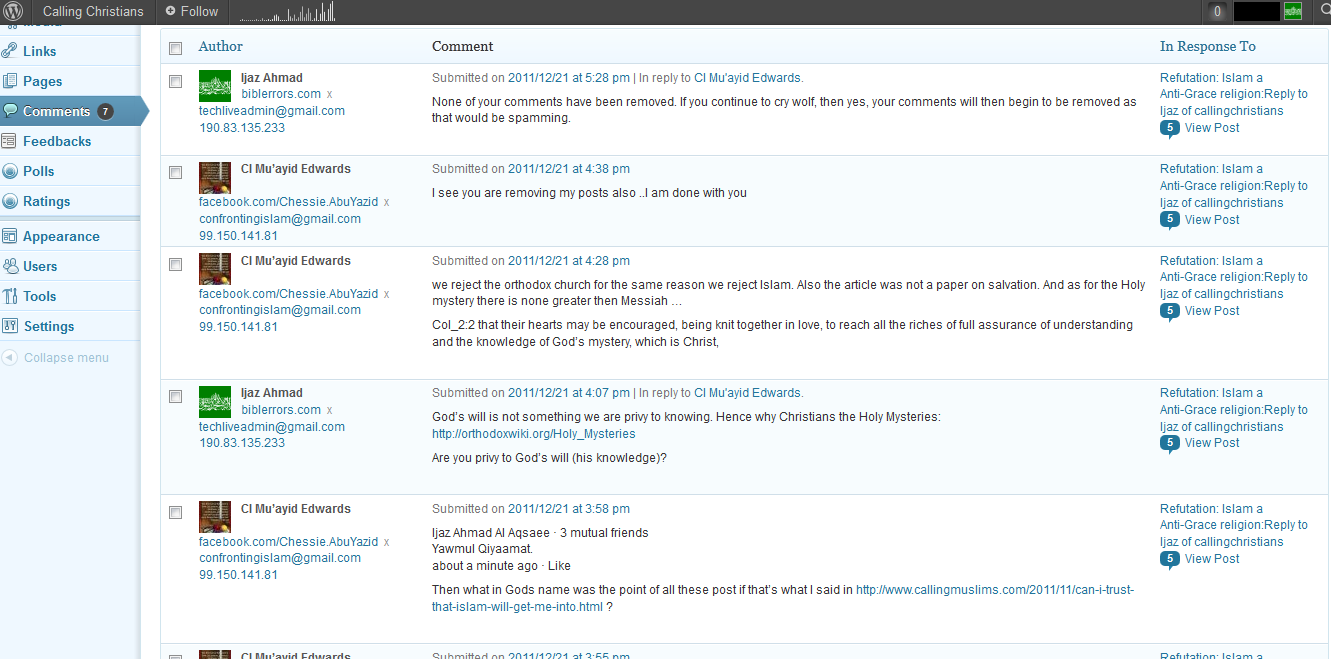
He was clearly told, if he continued to cry wolf, his comments would be removed. Subsequently, when he refused to allow our comments to be displayed on his website, we decided to moderate his. You see, he’s like a child, he doesn’t like when he’s being given a taste of his own medicine. He’s fine with prohibiting us from commenting on his “blog”, but he isn’t man enough to have his own comments moderated on our website. If he does have a problem with us following his lead, then please take it up with the Bible:

Do to others as you would have them do to you. – Bible : Luke (6) : 31.

It’s simple, if you can’t hold yourself to your own standards (however lowly they may be), don’t expect us to satiate your petulant needs, we aren’t your parents, don’t expect us to forgo your own inequities, for we’ll with a surety wage them against you. Also, we do ask, if anyone can help Mr. Edwards (which you can see I’ve always addressed him as), he seems to have a disability, he is currently unable to write my name correctly. In fact I’m beginning to think this explains quite clearly why he’s such an angry little man, perhaps his literacy issue has driven him to always attack others. We can offer him help, but in the meantime we do request that he does learn to spell my name correctly, there’s no “H” in Ijaz.

wa Allaahu Alam.
[and God knows best.]

[Updated: x2] CL Edwards Censors CallingChristians Comments on his Website

Bismillahir Rahmanir Raheem,
بِسۡمِ ٱللهِ ٱلرَّحۡمَـٰنِ ٱلرَّحِيمِ ,

After several bouts of severe public humiliation, CL Edwards has decided to censor and ban all comments of CallingChristians on his website. You can view every single one of his comments on our blog, none have been removed, yet he has the audacity and insincerity to censor responses to him. Christianity does not allow free speech, which is why, with following in his father’s footsteps he needs to attack truth and prohibit the distribution of it:

Do you think he will be honest enough with his viewers and himself to let free speech reign on his website?

The comment up until post time has not been approved.
[UPDATE:] The comment has now bee approved!
[UPDATE x2:] Comments banned from his website, unless he approves they won’t be shown, all of his however are shown on ours.

Before he claims his comments have been removed from our website, here is the administration page, this is a screenshot, which of your comments are missing?

wa Allaahu Alam.
[and God knows best.]

Refutation: Islam a Anti-Grace religion:Reply to Ijaz of callingchristians

Bismillahir Rahmanir Raheem
بِسۡمِ ٱللهِ ٱلرَّحۡمَـٰنِ ٱلرَّحِيمِ ,

I must say that I am quite impressed by Mr. Edwards’ post. It’s truly quite remarkable that any critically thinking hominid could possibly call that disaster of a post, a “response” to my articles here and here. I’m not sure if he’s wanting attention or perhaps he couldn’t afford to not reply, so he’s having to save face here, but it’s absolutely hilarious on his part to assume he has any form of any argument. One of the basic flaws of a failed academic and pseudo intellectual is that they would try to appeal to a few fallacies/ argument inconsistencies:

(1) Fallacy of Reading Between the lines.
(2) Being Overtly Pedantic.
(3) Arguing over Semantics.

He begins his barbaric tirade by implying I did not answer his question(s):

The short of it is He refuses to directly answer the question but we can gather from the above reply he doesn’t, nor does any Muslim for that matter…

However, I suggest you read this article, where not only is my answer a clear and resounding, “Yes”, it’s even in bold and big bright, red lettering for his convenience. If I didn’t reply, then why did he comment on my post? Self contradicting statements are always funny. The deceit of an ignoramus knows no end indeed. He sums up his post by saying his response to me is the above quoted statement:

And that was the point of my post.

So after saying I didn’t provide a response, he then decides to magically see my response, which was:

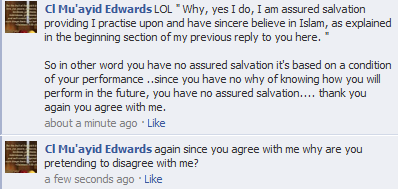
” Why, yes I do, I am assured salvation providing I practise upon and have sincere believe in Islam, as explained in the beginning section of my previous reply to you here. “

To which his reply was:

“Proving you practise is a condition, something with a condition is not assured, because He vary well my not live up to the condition.  If it was truly assurd it would be with out condition.”

So what exactly is his argument? Let me break it down:

(1) He says he will go to heaven.
(2) I say we can only go to heaven depending on God’s will, we cannot tell God we’re going to heaven.
(3) He says he agrees with me:

(4) After saying he agrees with me, he decides that he doesn’t agree, as his blog post now says:

“As for me I have no shame in declaring to the world that I am saved by Grace through Faith in Jesus Christ, He has given me eternal Life, and I rest in Christ with perfect peace because of this salvation He has achieved for me.”

So sir, can you please make up your mind? On one end you’re saying I’m right (you agree with me), the other you’re saying you don’t, as you can self claim going to heaven.

wa Allahu Alam,
[and God knows best.]

[Updated x3!] CL. Edwards Caught Lying: Can’t Make Up His Mind!

Bismillahir Rahmanir Raheem
بِسۡمِ ٱللهِ ٱلرَّحۡمَـٰنِ ٱلرَّحِيمِ ,

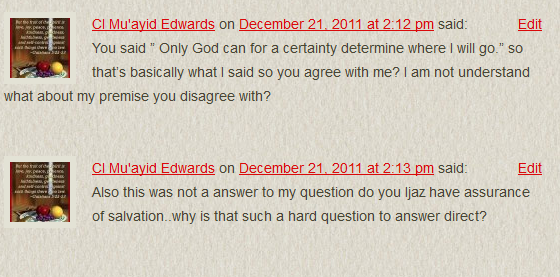
After posting this article, Mr. Edwards decided to publicly shame himself, I’m not sure why he decided to do so, but I must say it was a pleasure to see his act. To begin with, his response to said article was:

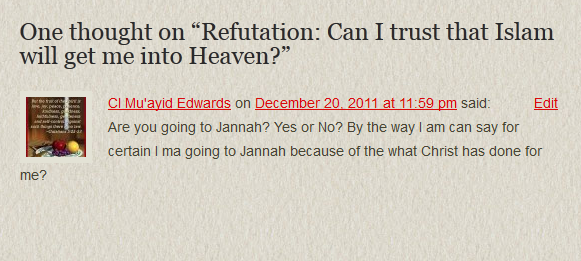
Mr. Edwards, sir, you did not say, “Only God can for a certainty determine where I will go”. Sir you actually said the following, let me refresh your mind for you:

You actually said the opposite,”By the way I can say for certain I ma going to Jannah because of what the Christ has done for me…“.

Mr. Edwards, at this point, I must ask you, which is it?
(1) You can say for sure you’re going to heaven.
(2) You let God decide where you go.

You’re singing two songs here sir, does your own deceit know no end? What I must admit, is that this guy cannot stop fumbling, if we take a look at the second comment from the first photo, he proposes a question to me:

“…do you Ijaz have assurance of Salvation..”

Why, yes I do, I am assured salvation providing I practise upon and have sincere believe in Islam, as explained in the beginning section of my previous reply to you here.

Please learn to read Mr. Edwards, I don’t have the time to have to constantly fix your inequities.

[Updated:]

After showing Mr. Edwards this post, he still couldn’t find the answer to his question, which I have now put in red and bold for his viewing pleasure. Here you can see that I clearly linked to him the post, with his answer being in the second to last line of this very response [article, see in red above]:

[Updated x2:]

I’m not sure if he’s colorblind or illiterate, but this was his response, he still could not find my answer which was in bold and red letters:

[Updated x3]:

Again, Mr. Edwards is simply grasping for straws, after answering his question above, which was not only in this post and my previous post, he decided to create a strawman and attack it. What was my answer to his question?

Why, yes I do, I am assured salvation providing I practise upon and have sincere believe in Islam, as explained in the beginning section of my previous reply to you here.

Do you all see the word, “YES“, in that quote, because I do, unfortunately Mr. Edwards sees the word no, so I’m not sure if he’s being petulant or simply can’t accept the YES which I gave:

wa Allaahu Alam.
[ and God knows best.]

CL. Edwards Responds: Certainty in Jannah

Bismillahir Rahmanir Raheem
بِسۡمِ ٱللهِ ٱلرَّحۡمَـٰنِ ٱلرَّحِيمِ ,

Mr. Edwards decided that he wouldn’t respond to the entire post, so he’d just post a comment because as in his own words, my exposition was “too long”. Not a problem, let’s see what estranged concept he brings to the table this time:

Edwards' Comment

His question is rather absurd, but to humour him, the answer is quite simple. Only God can for a certainty determine where I will go. I do not know the future and I don’t speak on behalf of God. However, the Qur’aan tells us what we need to believe in and what we need to practise upon to gain Jannah and as Muslims we strive towards that, knowing that God’s mercy is greater than His anger. It’s absurd to say, “yes”, because I am not God, I do not know the future and I do know what God’s judgement upon me will be, as I, like all other humans, are a sinner.

The Qur’aan does not make it difficult though, so what does a Muslim need to act upon and believe to gain heaven?

This is the Book; in it is guidance sure, without doubt, to those who fear Allah;

Believe in the Qur’aan, use it as a form of guidance, so that we develop taqwa (God consciousness).

Who believe in the Unseen, are steadfast in prayer, and spend out of what We have provided for them;

Believe in what Allaah has ordained for us and what He has told us, but which we have yet to know or experience. Perform praise and worship of God and live life within the means He has provided for us in a righteous way.

And who believe in the Revelation sent to thee, and sent before thy time, and (in their hearts) have the assurance of the Hereafter.

Belief in the Qur’aan, Injil, Tawrah Zabur, Suhuf al Ibrahim. As for assurance of the hereafter:

(And in the Hereafter they are certain) that is the resurrection, the standing (on the Day of Resurrection), Paradise, the Fire, the reckoning and the the Scale that weighs the deeds (the Mizan). The Hereafter is so named because it comes after this earthly life. – Tafsir ibn Kathir : Suratul Baqarah (2) : 4.

Lastly:

They are on (true) guidance, from their Lord, and it is these who will prosper.

Meaning:

(They are) refers to those who believe in the Unseen, establish the prayer, spend from what Allah has granted them, believe in what Allah has revealed to the Messenger and the Messengers before him, believe in the Hereafter with certainty, and prepare the necessary requirements for the Hereafter by performing good deeds and avoiding the prohibitions.

(And they are the successful) meaning, in this world and the Hereafter. They shall have what they seek and be saved from the evil that they tried to avoid. Therefore, they will have rewards, eternal life in Paradise, and safety from the torment that Allah has prepared for His enemies. – Tafsir ibn Kathir : Suratul Baqarah (2) : 4.

Therefore the Qur’aan is extremely clear, it essentially spells it out for all Muslims, that sincere belief and God sanctioned actions would secure one a place in heaven. Of course Mr. Edwards doesn’t believe in this doctrine. He believes that no matter what he does, he gets to go to heaven, which brings up the question, does God reward sin? Funny enough, his friend and long time partner in crime (of deceit), Antonio Santana did admit to us that God rewards sinning in Christianity:

Antonio - Skype Convo

It’s absolutely nonsensical for one to say he knows where he is going in the afterlife merely based on some inconsistent and incoherent belief of “salvation in Christianity”, which has been thoroughly refuted here. They’re self claimants to their own misigivings, even the Jesus of the Bible lets it be known that merely believing in him will not benefit you in the least:

“Not everyone who says to me, ‘Lord, Lord,’ will enter the kingdom of heaven, but only the one who does the will of my Father who is in heaven. – Bible : Matthew (7) :21.

So who are these people who won’t go to heaven then?

The sense of this verse seems to be this: No person, by merely acknowledging my authority, believing in the Divinity of my nature, professing faith in the perfection of my righteousness, and infinite merit of my atonement, shall enter into the kingdom of heaven, shall have any part with God in glory. – Adam Clarke’s Exegesis : Matthew (7) : 21.

In fact, the Bible wages sin and deceit for the one who speaks on God’s behalf, specifically when it comes to God’s will (judgment, doings etc):

Will you speak wickedly on God’s behalf?  Will you speak deceitfully for him?- Bible : Job (13) : 7.

The meaning of this verse is made much clearer by a scholarly Christian’s commentary:

“In order to support your own cause, in contradiction to the evidence which the whole of my life bears to the uprighteousness of my heart, will ye continue to assert that God could not thus afflict me, unless fragrant iniquity were found in my ways; for it is on this ground alone that ye pretend to vindicate the providence of God. Thus ye tell lies for God’s sake, and this ye wickedly contend for your maker.” – Adam Clarke’s Exegesis : Job (13) : 7.

See, Job in this verse or rather, this chapter, is condemning the people to whom he was sent to preach. It is because they began to play God and judge who is righteous and sinful among themselves. Decided who God afflicted and whom God did not afflict with punishment. They claimed because Job was afflicted, that he was a sinful man (yet it was not the case, he was purer than them all), whereas they perverted the truth (much like Mr. Edwards) and cast righteous judgement on themselves:

“Will you speak wickedly for God?
As he suggests they did, they spoke for God, and pleaded for the honour of his justice, by asserting he did not afflict good men, which they thought was contrary to his justice; but: then, at the same time they spoke wickedly of Job, that he being afflicted of God was a bad man, and an hypocrite; and this was speaking wickedly for God, to vindicate his justice at the expense of his character, which there was no need to do, and showed that they were poor advocates for God…”- The New John Gill Exposition of the Entire Bible : Job (13) : 7.

Well, atleast through Biblical means, his own scripture and by extension his own God, has deemed him a wicked and hypocritical man. Casting judgement on himself (for righteousness) whereas condemning others, when he does now know what God knows is in their hearts. I suppose he needs to be rewarded with Grace for his sin. God rewarding sin, what a joke.

wa Allaahu Alam.
[and God knows best.]

Refutation: A clear Quranic contradiction in Ta-Ha surah 20 verses 83-97

Bismillahir Rahmanir Raheem
بِسۡمِ ٱللهِ ٱلرَّحۡمَـٰنِ ٱلرَّحِيمِ ,

Response to: A clear Quranic contradiction in Ta-Ha surah 20 verses 83-97
By: C.L. Edwards from Calling Muslims website.

The ill reputed author, Mr. Edwards is at it again. This time he is claiming a contradiction in the Qur’aan and quite funnily, borrows the argument of Abraham Geiger which most Orientalists have used against Islam, since some 200 odd years ago. His argument isn’t new or is it of any academic value. However in the name of exposing his indecent affinity towards absurdity, we shall engage his argument step by step and refute him. He begins by asserting that these verses supposedly have a contradiction:

“(When Moses was up on the Mount, Allah said:) “What made thee hasten in advance of thy people, O Moses?”He replied: “Behold, they are close on my footsteps: I hastened to thee, O my Lord, to please thee.”  (Allah) said: “We have tested thy people in thy absence: the Samiri has led them astray.” So Moses returned to his people in a state of indignation and sorrow. He said: “O my people! did not your Lord make a handsome promise to you? Did then the promise seem to you long (in coming)? Or did ye desire that Wrath should descend from your Lord on you, and so ye broke your promise to me?” They said: “We broke not the promise to thee, as far as lay in our power: but we were made to carry the weight of the ornaments of the (whole) people, and we threw them (into the fire), and that was what the Samiri suggested. “Then he brought out (of the fire) before the (people) the image of a calf: It seemed to low: so they said: This is your god, and the god of Moses, but (Moses) has forgotten!” Could they not see that it could not return them a word (for answer), and that it had no power either to harm them or to do them good? Aaron had already, before this said to them: “O my people! ye are being tested in this: for verily your Lord is (Allah) Most Gracious; so follow me and obey my command.” They had said: “We will not abandon this cult, but we will devote ourselves to it until Moses returns to us.” (Moses) said: “O Aaron! what kept thee back, when thou sawest them going wrong, “From following me? Didst thou then disobey my order?” (Aaron) replied: “O son of my mother! Seize (me) not by my beard nor by (the hair of) my head! Truly I feared lest thou shouldst say, ‘Thou has caused a division among the children of Israel, and thou didst not respect my word!'” (Moses) said: “What then is thy case, O Samiri?” He replied: “I saw what they saw not: so I took a handful (of dust) from the footprint of the Messenger, and threw it (into the calf): thus did my soul suggest to me.” (Moses) said: “Get thee gone! but thy (punishment) in this life will be that thou wilt say, ‘touch me not’; and moreover (for a future penalty) thou hast a promise that will not fail: Now look at thy god, of whom thou hast become a devoted worshipper: We will certainly (melt) it in a blazing fire and scatter it broadcast in the sea!” – Suratul Ta-Ha (20) : 83 – 97.

So what is his argument? In summation:

“There are many details in the Quran that differ or are missing from the original account in the Bible, one of which is a person named al Samari. Now the name as-Samari literally means “The Samaritan a person who comes from Samaria”……..The problem in all this is this event in the history of the nation Israel happened over 600 years before the area of Samaria came into existence. To add to this colossal blunder early Muslims(the Salaf) are recorded as explaining that this as-Samari came from a Israelite tribe called Samaria…no such tribe has ever existed.“

To begin with, he implies that the original account is from the Bible, one must point out that he is referring to the Old Testament, therefore that begs the question, which Canon or Codex of the Old Testament is he appealing to this time? Here’s a short list for him to choose from:

(1) Samaritan Scrolls.
(2) Qumran/ Essene’s Scrolls.
(3) Greek Septuagint (LXX).
(4) Masoretic Text.
(5) Massorah Oral Tradition.
(6) Eastern Orthodoxy’s varying Canon’s (Coptic Canon versus Ethiopian Canon….etc).

After he’s played a game of lottery with “God’s word”, the next step is to determine if the Bible’s historical accounts are valid to establish the veracity of a particular historical event. This of course is easily laid to rest with a resounding no, by consensus of most Biblical scholars, to validate this claim, here’s a few quotes:

The original copies of the NT books have, of course, long since disappeared. This fact should not cause surprise. In the first     place, they were written on papyrus, a very fragile and persihable material. In the second place, and probably of even more importance, the original copies of the NT books were not looked upon as scripture by those of the early Christian communities. – (George Arthur Buttrick (Ed.), The Interpreter’s Dictionary Of The Bible, Volume 1, p 599 “Text, NT”.)

To begin with, how can it be logically sound, that if the people at the time of the Bible’s authoring, rejected it as a scripture (inspired by God, contains absolute truth), much less as a historical document (if it isn’t an absolute truth, then it’s fickle truth), how can you expect us, some 2000 years or so later to accept such historical claims?

He says: Complaints about the adulteration of texts are fairly frequent in early Christian literature. Christian texts, scriptural and nonscriptural, were no more immune than others from vicissitudes of unregulated transmission in handwritten copies. In some respects they were more vulnerable than ordinary texts, and not merely because Christian communities could not always command the most competent scribes. Although Christian writings generally aimed to express not individual viewpoints but the shared convictions and values of a group, members of the group who acted as editors and copyists must often have revised texts in accordance with their own perceptions. This temptation was stronger in connection with religious or philosophical texts than with others simply because more was at stake. A great deal of early Christian literature was composed for the purpose of advancing a particular viewpoint amid the conflicts of ideas and practices that repeatedly arose within and between Christian communities, and even documents that were not polemically conceived might nevertheless be polemically used. Any text was liable to emendation in the interest of making it more pointedly serviceable in a situation of theological controversy. – (H. Y. Gamble, Books And Readers In The Early Church: A History Of Early Christian Texts, 1995, Yale University Press: New Haven & London, pp. 123-124.)

The Bible, clearly as a historical document is said to have been emendated (improved with bias) according to each sect’s understanding of it. What’s worse is that the first person to ever canonize and codify the Bible (canonize – to say what is scripture, codify – collected to be arrange in some order) emendated his own version, enough for him and his followers to be persecuted (see: Marcion’s Canon). With the above quotes and subsequent historical lesson, there is no basis for us to accept the account of the Bible, none whatsoever. It is merely wishful thinking and an appeal to emotion that CL Edwards seeks.

His second error, is that he incorrectly, which was his purpose, defines the term: “As-Samiri” (السَّامِرِ‌يُّ).

We do ask Mr. Edwards, on what authority do you have to give the absolute definition of the term above? Are you an expert in the field of Arabic or Hebraic Etymology? From where is your certification in these fields derived? To answer on his behalf and rightly so, nowhere! Therefore we assume he’s probably appealed to the fallacy of appeal to authority (to Orientalist Christian Scholarship). In his desperation for trying to find an error in Al Qur’aan ul Kareem, he has inadvertently exposed his lack of honesty, integrity and self respect. Thus, we do request that he come to terms with these self deficiencies.

Let’s continue by trying to grasp the history of this Samiri, so we can know who he was or from where he came:

“Samiri’s name as generally believed, was Musa Ibn Zafar. Ibn Jarar has narrated from Sayiddina Ibn ‘Abbas {ra} that Samiri was born in the year when under the orders of Pharaoh all male Israili children were to be killed. His mother, fearing the worst, put him in the hallow of a cave and covered its mouth.” – Tafsir Maa’riful Qur’aan, page 144.

Now that we’ve established some form of historical context to this person, his lineage does go back to the time of Moses (Musa alayhi as salaam), so this person did exist at the time of Moses. In that context, why is he called “As Samiri”, well, there are two probablities here:

(1) It could be a place from which he came.
(2) It could be a title due to his beliefs.

Earlier Islamic sources tend to cite both (1) and (2) as their understanding of the person named As-Samiri, that being, he came from a people who were worshipers of the cows:

Sayiddina Ibn ‘Abbas {ra} says that he belonged to a nation of cow-worshippers who somehow reached Egypt and pretended to join the religion of Bani ‘Israil whereas in actual fact he was a hypocrite. (Qurtubi) – Tafsir Maa’riful Qur’aan, page 143.

Where did they come from, if they were not from around Egypt?

“According to Sayddina Sa’id ibn Jubair {ra} he was a Persian from the Kirman province.” – Tafsir Maa’riful Qur’aan, page 143.

Now this logically makes sense.

(1) The Samiri was born during the time of Moses.
(2) The Samiri was from Persian (Mesopotamia) and was brought to or near Egypt when a group of Persians migrated.
(3) Persia is near the Indus Valley River Civilization (known cow worshipers), in fact, they share similar cultural traits (languages, religions, dress).

Therefore it is logical to assume that the Samiri is a person who was from among a people who worshiped cows, and who had migrated to near Egypt. The entire narration from the Qur’aan makes sense when compared to basic history. Of course one had to be objective and look outside the inconsistent and incoherent Biblical tradition and really accept the historical narrative as it exists through modern historical interpretations.

The historical context is easy to grasp, the Samiri was a cow worshiper with Mesopotamian origins (from which his religion came) through the Indian peoples (Indus Valley Civilization – known cow worshipers):

In the case of Egyptian and Harappan civilizations, there exists considerable evidence that the two societies, which flanked Mesopotamia on the west and east, respectively, had continuous trade contact with the cities of Sumer and, in the case of Egypt, political and military contacts as well. So the channels for the diffusion of technology and ideas certainly were there. It should probably be stressed at this point that a certain amount of diffusion and cross-fertilization is critical to the development of any civilization and no society has developed in total isolation. Whatever the degree of borrowing, however, every civilization adapts and applies ideas, technologies and institutions to its own physical environment and cultural heritage. – (The World’s History (Volumes 1 and 2 – 2nd Edition), Chapter 3 (River Valley Civilizations), Page 11 – by Howard Spodek.)

Therefore in conclusion, the Biblical claim is that a city known as Samaria did not exist until some 700 years after Moses, therefore the Samiri people could not have existed. Whereas historical knowledge (go figure, the Bible contradicts history) indicates that the Mesopotamian, Harappan (Indus Valley Civilization) and the Egyptians all shared a common and integrated history some 1500 years before Moses (Civlizations from 3000 BCE, Moses from 1500 BCE) and the incident of Pharaoh.

We therefore propose that Mr. Edwards rescinds his absurd, infantile, petulant, irrational and ignorant arguments and perhaps, for the good will of his humanity, cease to embarrass himself and his archaic faith.

wa Allaahu Alam.
[and God knows best.]

« Older Entries Recent Entries »