Refutation: If Jesus is God … was he praying to himself?

Bismillahir Rahmanir Raheem
بِسۡمِ ٱللهِ ٱلرَّحۡمَـٰنِ ٱلرَّحِيمِ ,

Question:

If Jesus is God, then who was he praying to on the cross when he said, “My God, my God, why have you forsaken me”? (Mark 15:34; Matthew 27:46) Was he praying to himself? If so, was he complaining to himself about why he had forsaken himself?

Answer:

Sam Shamoun does not actually answer this question directly. Instead he meanders back and forth about the Trinity, mentions the Crucifiction and then in the end diverts from this absurdity in his doctrine and invents a strawman, whereby he attempts to question Muslims about Allaah’s “Prayer”. In spite of all his trickery, after much searching for a decisive answer in his article, I found that he does hint at an answer, or strongly tries to imply one by stating:

The Holy Bible teaches that there are three distinct, yet inseparable Persons who exist as the one true God: the Father, the Son and the Holy Spirit. The three Persons of God, because they are personally distinct, have loving communion and dialog amongst themselves. Therefore, the Lord Jesus wasn’t praying to himself on the Cross, but was actually praying to the Person of the Father.

This ‘answer’ of sorts, actually furthers the case the question presents, it actually proves that Jesus was praying to Himself, allow me to explain. The logic flows as such:

  • Jesus is God.
  • Father is God.
  • Jesus is praying to God.
  • Since Jesus is God and he is praying to God.
  • Then he is praying to himself.

The only way this would not be circular theological reasoning, is if Jesus was not God, since this is not the case and Jesus is praying to God, and God is also Jesus, then he indeed and most certainly was praying to himself. Sam then adds insult to injury by claiming that his God, was and will forever be an equal to him, a human, a man:

Furthermore, the Holy Bible also teaches that Jesus became, and forever will remain, a true human being. It is, therefore, not surprising that Christ did what every God-fearing person is supposed to do, namely pray and worship God.

Given the above, Sam continues to persist in building the case against him, once again his argument can be represented as:

  • He says Christ is God.
  • He says Christ worships God.
  • Therefore Christ is worshipping himself.

Therefore Sam’s answer qualifies the belief that Christ was praying to himself, for if Christ is fully God, as Sam believes, then Christ was forsaking himself. Unless Sam believes that the Father who is God, can diminish the power of the Jesus-God person in the Godhead, which would then mean that they are not co-equal nor co-existent in the ‘Godhead’. Either way, Sam’s case is against Christianity. As indicated in this article, an earlier pronouncement in the book of Psalms ensures that God could not have killed Jesus, his ‘son’, specifically ‘forsaking‘ or ‘cutting off his loved ones‘:

“For the LORD loves the just and will not forsake his faithful ones. They will be protected forever, but the offspring of the wicked will be cut off;” – Bible : Psalms (37) : Verse 28.

Our modus operandi from this verse onwards is intended to imply that Jesus would be the most faithful and the most just person of his time with respect to his life and personhood, whether you consider him to be a God, a man or otherwise. Both Muslims and Christians can agree on this following excerpt from the Gospel, which attributes these words to him:

“…I judge only as I hear, and my judgment is just, for I seek not to please myself but him who sent me.” – Bible : John (5) : Verse 30.

The verses from Psalms (Tehillim) and from John (above), promote the understanding that Jesus was just because he judged according to the rule and law of God and thus since the Old Testament says that God loves and will not forsake such a person, we all can accept that Christ was loved and would not be forsaken by God. However as a Muslim reading the New Testament, the image it portrays of Christ is in opposition to the promise of Psalms as we have previously read, the Bible says:

“About the ninth hour Jesus cried out in a loud voice, “Eloi, Eloi lama sabachthani?”—which means, “My God, my God, why have you forsaken me?”  – Bible : Matthew (27) : Verse 46.

“And at the ninth hour Jesus cried out in a loud voice, “Eloi, Eloi, lama sabachthani?”—which means, “My God, my God, why have you forsaken me?” – Bible : Mark (15) : 34.

It is clear for anyone who is purely intended that these stories, depictions of a man forsaken by God, cannot be the man portrayed in John 5:30 and Psalms 37:28. Rather, it reminds of the man later spoken of in Psalms 37:28:

“…They will be protected forever, but the offspring of the wicked will be cut off;” – Bible : Psalms (37) : Verse 28.

Am I supposed to believe that Christ was a wicked man, cut off from the mercy of God? As a Muslim, it burdens my heart to have to believe that this is what someone who loves Christ could possibly believe.  In fact, even Christian scholars have purported that this alleged saying of Christ is out of his character and simply demeans him, Matthew Henry in his Commentary of the Bible, says:

“That our Lord Jesus was, in his sufferings, for a time, forsaken by his Father. So he saith himself, who we are sure was under no mistake concerning his own case. That Christ’s being forsaken of his Father was the most grievous of his sufferings, and that which he complained most of. “ – Matthew Henry’s Complete Commentary on the Bible, Matthew 27.

Therefore, not only was Christ-God forsaking himself, he made himself to suffer and he even complained to himself about himself. Mind blowing absurdity to say the least. Lastly, Sam tries to meander away from this theological conundrum by attempting to claim that Allaah prays to Himself:

The Quran says that Allah prays:

Upon them shall be prayers (salawatun) from their Lord and mercy, and they are the rightly directed. S. 2:157

He it is who sends PRAYERS on you (Arabic- yusallii alaykum), as do His angels … S. 33:43

Allah and His angels PRAY for the Prophet (Arabic- yasalluuna alan-Nabiyy): O ye that believe PRAY for him (salluu `alayhi), and salute him with all respect. S. 33:56

However this is responded to in detail by Br. Ibn Anwar in his post here on the Unveiling Christianity website. In short, Br. Ibn Anwar explains:

The following is from Lisan al-Arab authored by Ibn Mazur al-Afriqi which is one of the major reference materials for anyone persuing academic studies in Arabic:

والصلاة الدعاء والاستغفار…وصلاة الله على رسوله رحمته له وحسن ثنائه عليه وفى حديث ابن أبى آوفى آنه قال أعطانى أبى صدقة ماله فاتيت بها رسول الله صلى الله عليه وسلم فقال اللهم صل على آل أبى أوفى قال الازهرى هذه الصلاة عندى الرحمة ومنه قوله عز وجل ان الله وملا ئكته يصلون على النبى يٰأَيُّهَا ٱلَّذِينَ آمَنُواْ صَلُّواْ عَلَيْهِ وَسَلِّمُواْ تَسْلِيماً فالصلاة من الملائكة دعاء واستغفار ومن الله رحمة وبه سميت الصلاة لما فيها من الدعاء ولاستغفار وفى الحديث التحيات لله والصلوات قال أبوىبكر الصلوات معن ها الترحم وقوله تعالى ان الله وملا ئكته يصلون على النبى اى يترحمون

Al-Salah is supplication and seeking forgiveness…and the Salah of Allah upon his messenger is His blessing/mercy for him and magnification/praises  upon him. In the narration of Ibn Abi Awfa verily he said: “My father gave charity from his own wealth. Thereafter I went to the messenger of Allah with it whereby the Prophet s.a.w. said, “Oh Allah send Salah on the family of Abi Awfa.” Azhari said that this Salah in his sight means al-Rahmah(the blessing/mercy). And Allah s.w.t. says,”Verily, Allah and His angels send Salah(blessings) upon the Prophet. O you who believe, do pray Allah to bless him, and send your Salam to him in abundance.” Thus theSalah of the angels are supplication(du’a) and seeking forgiveness(for the messenger) and from Allah it is His blessing(rahmah). And it is called Salah within which is supplication and seeking for forgiveness. And in the narration on the greetings and salawat(plural of salah), Abu Bakr said, “Al-salawat means conferring blessing” and Allah said, “Verily, Allah and His angels send Salah(blessings) upon the Prophet” which means they bless him.”

Isma’il bin Hammad al-Jawhari in his Sihah Taj al-Lughah wa Sihah al-’Arabiyyah defines it as follows:

والصلاة من الله تعالى : الرحمة

“Al-Salah when it is from Allah means mercy/blessing.”

Abi Mansur Muhammad bin Ahmad al-Azhari in his massive Tahzib al-Lughah  defines it as follows:

نوما فإن لجنب المرء مضطجعا وأما حديث ابن أبى أوفى أنه قال : أعطانى أبى صدقة ماله فأتيت بها رسول الله صل الله عليه وسلم فقال : (( اللهم صل على آل أبى أوفى )) فإن هذه الصلاة عندى الرحمة , ومنه قوله جل وعز : ( إن الله وملائكته يصلون على النبى ) فالصلاة من الملائكة دعاء واستغفار , ومن الله سبحانه رحمة .

He mentions the same narration as Ibn Manzur al-Afriqi that Ibn Abi Awfa went to the Prophet s.a.w. with charity given by his father from his wealth “upon which the Prophet s.a.w. remarked, “Oh Allah, send Salah on the family of Abi Awfa.” Therefore this al-Salah with me means al-Rahmah(the blessing/mercy). And from His(Allah’s) word: “Verily, Allah and His angels send blessings on the Prophet”. Al Salah from the angels is supplication and seeking for forgiveness(for him), and from Allah s.w.t. it means blessing/mercy.””

Therefore when it is said Allaah’s ‘prayer’ it does not mean that like the God of the Bible, where he is praying to himself to save himself from himself, rather it refers to Allaah’s rahmat and barakat upon a person or group of persons by bestowing His favours (mercy) upon them as mentioned in Surah Ar Rahman:

فَبِأَيِّ آلَاءِ رَبِّكُمَا تُكَذِّبَانِ

Then which of the Blessings of your Lord will you both (jinns and men) deny?

Let’s embarrass Sam further and examine the verses he uses:

أُولَـٰئِكَ عَلَيْهِمْ صَلَوَاتٌ مِّن رَّبِّهِمْ وَرَحْمَةٌ ۖ وَأُولَـٰئِكَ هُمُ الْمُهْتَدُونَ
(2:157) – They are those on whom are the Salawat (i.e. blessings, etc.) (i.e. who are blessed and will be forgiven) from their Lord, and (they are those who) receive His Mercy, and it is they who are the guided-ones.

In the first case, the ayah he uses explicitly tells us both in the Arabic that God’s ‘prayer upon’ a people, means that His Rahma (mercy) is conveyed upon them. This as Sam admits by use of the verse (and explicitly as we will see later), does not mean God is praying to anyone. Thus this cannot be equated to the God of the Bible, whom Sam concedes was praying to himself. Let’s take a look at the next ayah he references:

هُوَ الَّذِي يُصَلِّي عَلَيْكُمْ وَمَلَائِكَتُهُ لِيُخْرِجَكُم مِّنَ الظُّلُمَاتِ إِلَى النُّورِ ۚ وَكَانَ بِالْمُؤْمِنِينَ رَحِيمًا
(33:43) – He it is Who sends Salat (His blessings) on you, and His angels too (ask Allah to bless and forgive you), that He may bring you out from darkness (of disbelief and polytheism) into light (of Belief and Islamic Monotheism). And He is Ever Most Merciful to the believers.

Once again, in the verse that Sam uses, it demonstrates to us that God’s “Salat” is His conveyance of mercy to the believers. Notice the term (يُصَلِّي عَلَيْكُمْ) which means “Prays Upon”, just as how we would pray upon a person, this would not mean praying to a person. Unless Sam believes that when he prays upon his wife or mother when she is ill, he actually means to be praying to them? If that’s the case, then he needs to study basic Grammar. Let’s now examine the last verse he references:

إِنَّ اللَّـهَ وَمَلَائِكَتَهُ يُصَلُّونَ عَلَى النَّبِيِّ
(33:56) – Allah sends His Salat (Graces, Honours, Blessings, Mercy, etc.) on the Prophet (Muhammad SAW) and also His angels too (ask Allah to bless and forgive him).

Notice once again the use of the word ( عَلَى), as aforementioned, there is a distinction between praying ‘upon’ and praying ‘to’, the word ( عَلَى), means ‘upon’. Just as in As Salaamu ‘Alaykum – the same term ( عَلَى) is used, but in the plural meaning “upon you all“. This only goes to demonstrate that Sam is both heavily deficient in both the Arabic and English languages. Lastly, Sam Shamoun concedes that when the term ‘salat’ is used in relation to Allaah, it refers to Allaah’s conveying of His mercy:

The following is a translation of an alleged prayer of Allah taken from Ibn Hisham’s Al-Sirah Al-Halabiyya:

قلت يا جبريل أيصلى ربك قال نعم قلت وما يقول قال يقول سبوح قدوس رب الملائكة والروح سبقت رحمتى غضبى

I [Muhammad] said, “O Gabriel, does your Lord pray?” He said, “Yes.” I said, “What does he say?” “This is what he says. He says: ‘Glory, holy, Lord of the angels and the Spirit. My mercy overcomes my wrath.’” (Source; translation, bold, underline and comments within brackets ours)

Another Muslim scholar made the following comments about surah 33:56 and Allah praying:

Allah makes the merit of His Prophet clear by first praying blessing on Himself, and then by the prayer of the angels, and then by commanding His slaves to pray blessing and peace on him as well. Abu Bakr ibn Furak related that one of the ‘ulama interpreted the words of the Prophet, “The coolness of my eye is in the prayer,” as meaning Allah’s prayer, that of the angels and that of his community in response to Allah’s command until the Day of Rising. The prayer of angels and men is supplication for him and that of Allah is mercy.

Therefore in Sam’s own argument he concludes for himself, that Allaah’s pray means Allaah’s conveyance of His mercy upon someone. This however, cannot be and is not equitable to the Christian God who prays to Himself, as aptly demonstrated above. This strawman argument from Sam, was only intended to distract the reader from the main question, which still remains unanswered:

If Jesus is God and Jesus prays to God, then why is Jesus praying to Himself? Sam has failed to answer this question and has only been able to demonstrate his weak Grammar and comprehension of both the Arabic and English languages. I pray and hope that Sam can one day, eventually seek to directly answer this theological conundrum.

wa Allaahu Alam,
and God knows best.

Sources:

  1. Sam Shamoun’s, “A Series of Answers to Common Questions and Claims”.
  2. Br. Ijaz Ahmad’s, “Would a Loving and Merciful God, Kill Himself/ His Own Son?
  3. Br. Ibn Anwar’s, “Does Allah pray? If yes then who does he pray to?“: Ibn Manzur al-Afriqi (2003). Lisan al-Arab, Vol. 18. Saudi Arabia: Dar ‘Alim Al-Kutub. p. 198, Abi Nasr Ismail bin Hammad al-Jawhari (1999). Al-Sihah Taj al-Lughati Wa Sihah al-’Arabiyyah, Vol. 6. Beirut, Lebanon: dar al-Kutub al-’Ilmiyyah. p. 384, Abi Mansur Muhammad bin Ahmad al-Azhari (n.d.). Tahzib al-Lughat, Vol. 17. Cairo, Egypt: Matabi’ Sabil al-Arab. p. 236.


Refutation: If Jesus is God…How can God Die?

Bismillahir Rahmanir Raheem
بِسۡمِ ٱللهِ ٱلرَّحۡمَـٰنِ ٱلرَّحِيمِ ,

Question:

If Jesus is God, how can God die? Who was running the universe those three days that Jesus was dead?

Answer:

Sam’s initial response is to redefine the meaning of the word death, he gives two meanings from the Bible:

  1. Spiritual death, “The LORD God took the man and put him in the Garden of Eden to work it and take care of it. And the LORD God commanded the man, ‘You are free to eat from any tree in the garden; but you must not eat from the tree of the knowledge of good and evil, for when you eat of it you will surely die.” –  Genesis 2:15-17.
  2. Physical death, “As the body without the spirit is dead, so faith without deeds is dead.” –  James 2:26,

Finally, he concludes:

Christ, therefore, did not cease to live when he died on the cross since, as the Holy Bible teaches, the Lord’s soul was still consciously alive during the three days his body lay in the tomb. The only way that Christ could be able to raise himself from the dead is if Christ were still consciously alive. This establishes that Christ did not cease to exist for those three days that his body remained in the grave. Both Christ’s divine nature and his human soul were still conscious during that period of time. So in answer to the question, the one true God always exists as three distinct Persons even during the entombment of Christ’s physical body. And, even as his body lay buried, Christ was alive and sovereignly sustaining the universe along with the Father and the Holy Spirit.

According to Sam Shamoun, Jesus did not die, whether physically or spiritually. If Jesus did not die, then the notion of Christ dying for our sins is a false one. See, the argument works as :

  • Christ died for your sins.
  • As a sacrificial lamb was able to atone for sins, so was Christ.

Since according to Sam Shamoun, Christ never actually died, then no atonement actually took place. Sam never really answers the question as to how God died, instead he tells us that Jesus did not actually die, at all. He gives an either or option, that is a physical or spiritual death, then he negates both options. Thus leaving us with the understanding that Christ/ “God” never died. His argument can be represented as such:

  • Christ died.
  • He could have died either a spiritual death or physical death.
  • Christ neither had a spiritual or physical death.

Which is a problem as the Bible mentions that the sacrificial lamb was to be killed and by kill, we mean be put to death i..e not alive:

 Take care of them until the fourteenth day of the month, when all the members of the community of Israel must slaughter them at twilight. – Exodus 12:6.

As an addendum, Sam must answer the question, that if the sacrificial animal does not die, i.e. there is no cessation of life, is the sacrifice valid, or must the animal die? This death as referred to in Exodus 12:6, or slaughtering of the animal/ sacrifical animal refers to a physical cessation of life. This definition can be attested to by CARM’s Theological Dictionary:

Death is understood two main ways in the Bible. First, it is used to describe the cessation of life, this can be physical or spiritual. – Death.

Either way, Sam Shamoun has put himself between a rock and a hard place:

  • Either he concedes to the fact Jesus never died (which Sam did), therefore shelving his entire faith (1 Corinthians 15:12-17).
  • Or if Jesus died (which Sam believes), then God ceased to live, therefore his God is not Ever Living, All Powerful.

wa Allaahu ‘Alam,
and God knows best.

A Reminder to Our Christian Friends

Bismillahir Rahmanir Raheem
بِسۡمِ ٱللهِ ٱلرَّحۡمَـٰنِ ٱلرَّحِيمِ ,

This is a small reminder to our Christian friends, not to be insulting, but to ask some questions which we believe need to be answered.

See that picture above? I hope you do, that’s what God is to you.
See that man in the silhouette? That’s what you attest to worship.

اعباد المسيح لنا سؤال….نريد جوابه ممن و عاه
O Christ-worshippers! We want an answer to our question [from your wise ones],
إذا مات الإله بصنع قوم….أماتوه فما هذا الإله
If the Lord was murdered by some peopleýs act, what kind of god is this?
وهل أرضاه ما نالوه منه….فبشراهم إذا نلوا رضاه
We wonder! Was He pleased by what they did to Him?
If yes, blessed be they, they achieved His pleasure,
وإن الذي فعلوه فيه….فقؤتهم إذا أوهت قواه
But if He was discontented, this means their power had subjugated Him!

وهل بقي الوجود بلا إله….سميع يستجيب لمن دعاه
Was the whole entity left without a Sustainer, so who answered the prayers?
وهل خلت الطباق السبع لما….ثوى تحت التراب وقد علاه
Were the heavens vacated, when He laid under the ground somewhere?
وهل خلت العوالم من إله….يدبر ها وقد سمرت يداه
Were all the worlds left without a God, to manage while His hands were nailed?
وكيف تخلت الأملاك عنه….بنصرهم وقد سمعوا بكاه
Why did not the angels help Him, when they heard him while he wailed?

وكيف أطاقت الخشبات حمل الإله….الحق شد على قفاه
How could the rods stand to bear the True Lord when He was fastened,
وكيف دنا الحديد إليه حتى….يخالطه ويلحقه أذاه
How could the irons reached Him and [had] His body pinned?
وكيف تمكنت أيدي عداه….وطالت حيث قد صفعوا قفاه
How could His enemiesý hands reach Him and slap His rear,
وهل عاد المسيح إلى حياة….أم المحيي له ربٌ سواه
And was Christ revived by himself, or was the Reviver another god?

ويا عجبا لقبر ضم رباً….وأغجب منه بطن قد حواه
What a sight it was, a grave that enclosed a god,
Stranger still is the belly that confined Him!
أقام هناك تسعا من شهور….لدى الظلمات من حيض غذاه
He stayed there for nine months in utter darkness, fed by blood!
وشق الفرج مولودا صغيرا….ضعيفا فاتحا للثدى فاه
Then he got out of the womb as a small baby,
Weak and gasping to be breast-fed!
ويأكل ثم يشرب ثم ياتي….بلازم ذاك هل هذا إله
He ate and drank, and did what that naturally resulted,1
Is this [what you call] a god?
تعالى الله عن إفك النصارى….سيسأل كلهم عما افتراه
High Exalted be Allah above the lies of Christians,
All of them will be held accountable for their libels!

أعباد الصليب لأي معنى….يعظم او يقبَه رماه
O Cross-worshippers! For what reason is this exalted
and blame [is cast upon those] who reject it?
وهل تقضى العقول بغير كسر….وإحراق له ولمن بغاه
Is it not logical to break and burn it, along with the one who innovated it?
إذا ركب الإله عليه كرها….وقد شدت لتسمير يداه
Since the Lord was crucified on it, and his hands were fastened to it?
فذاك المركب الملعون حقا….فدسه لا تبسه إذا تراه
That is really a cursed cross to carry,
So discard it, do not kiss it!

يهان عليه رب الخلق طرًا….وتعبده فإنك من عداه
The Lord was abused on it, and you adore it?
So [it is clear that] you are one of His enemies!
فإن عظمته من أخل أن قد….حوى رب العباد وقد علاه
If you extol it because it carried the Lord of the Worlds,
وقد فقد الصليب فإن رأينا….له شكلا تذكرنا سناه
Why donýt you prostrate yourself and worship graves,
فهلا للقبور سجدت طرًا….لضم القبر ربَك في حشاه
Since the grave contained your god in it?

فيا عبد المسيح فق فهذا….بدايته وهذا منتهاه
So Christ-worshipper, open your eyes,
This is the Beginning and this is the End.

Poem by Ibn Qayyim al Jawziya to the Christians in Aýobbad al-Maseeh Fi Naqd al-Nasraniyyah (O Christ-Worshippers! In Refuting Christianity).

wa Allaahu Alam,
and God knows best.

Simple Reasons to Disbelieve in the Bible

Bismillahir Rahmanir Raheem
بِسۡمِ ٱللهِ ٱلرَّحۡمَـٰنِ ٱلرَّحِيمِ ,

Christians are fond of saying that although the Bible has unstable and sketchy textual contradictions, they can analyse the manuscripts and develop (yes, develop), a Bible as close to God’s words as possible. The problem however is that if you don’t know what God’s word was, how can you develop something, into it? That’s like saying you don’t know what an aeroplane looks like, but you’re going to design one.

The problem isn’t that errors can be corrected within the manuscripts, by all means this is not the point. To clarify, I will state what the points of such a dialogue on the Bible’s authenticity should be about:

  1. Authorship.
  2. Validation of Authorship.
  3. Validity of Chain of Transmission.
  4. Comparison with other scriptures.

Authorship:
The authorship of any document, especially those of high esteem must accompany the scribe’s identity.

E.g. I write a document, claim it’s from the President and it doesn’t have his signature. No one would accept it.

Likewise, if I were to claim that I have a scripture from God, written by “unknown”, how much trust would you actually place on me? In stating this, it should be noted the names of the Gospels were based on assumptions and traditions. Although it is common for scribes to leave a manuscript autograph signature, we have no such signature from any of the four (4) synoptic Gospels.

Validation of Authorship:
The validity of the author must be sought.

E.g. I write a document, sign my name and say I am the President. There is no evidence I am the President, who would then believe me?

Likewise if I authored a scripture and claimed to be a scribe of God, then some evidence must be shown, after all would you trust someone based on word of mouth or credentials? Similarly, the Bible has no such form of verification. There is no one from the Patristics (early Church Fathers), the Presbyters (early Church elders) or from the Disciples (Peter, Barnabus) to testify to the identity and works of Mark, Luke, John or Matthew.

Validation of Chain of Transmission:
Again, questionable character comes in here, if the chain of narration contains those persons who are known to lie, shall we trust their words? Surely this is not so. Similarly, what about a man who willingly declares himself to be a fool (2 Corinthians 11) and possessed by a demon (2 Corinthians 12)?

Comparison with Similar/ Linked Scriptures:
If we compare the OT with the NT, it is radically different. You have to apply your own exegesis (therefore eisegesis) to create some form of bond/ relationship between these two “revelations”. Yet, Jews, the majority of which, do not accept the New Testament as scripture, because it does not comply with their mainstream beliefs.

Generally, the problem with 150,000 manuscripts, is not that they have errors which can be corrected, but it is that there is not a single original of which to compare any of these manuscripts with. Of the 24,000 pre-Codex Sinaiticus manuscripts, most are not used.

The Bible is generally a book where errors have to be continuously eliminated as errors keep popping up, such as with Mark 16:9-20. How are we to know, that for almost 2000 years men believed those words to be true, many today, yet the earliest manuscripts never had them.

According to Bruce Metzger[1]:

Variant Readings among the Manuscripts

The first problem facing Bible translators is the differences in wording among manuscripts of the Scriptures. These differences have arisen because, even with the strongest determination to copy a text without error, a scribe copying a text of considerable length will almost inevitably introduce changes in the wording. It is understandable that mistakes can arise from inattentiveness brought on by weariness. For example instead of the correct reading, “Is a lamp brought in to be put under a bushel, or under a

bed, and not on a stand?” (Mark 4:21, RSV), several important manuscripts read “under the stand.” This is obviously a scribal error in repeating the preposition “under” in the third phrase.

Sometimes a scribe’s error of judgment works havoc with the text. One of the most atrocious blunders of this kind is in the minuscule Greek manuscript no. 109, dated to the 14th century. This manuscript of the four Gospels was transcribed from a copy that must have had Luke’s genealogy of Jesus (3:23–38 ) in two columns of 28 lines in each. Instead of transcribing the text by following the columns in succession, the scribe of MS 109 copied the genealogy by following the lines across the two columns.

In addition to such transcriptional blunders, which can usually be detected and corrected, occasionally a scribe deliberately introduced into the copy a change that seems to clarify the sense or eliminate a difficulty. For example the older manuscripts of Mark 1:2–3 attribute to the Prophet Isaiah the evangelist’s composite quotation from both Malachi and Isaiah, whereas later manuscripts (followed by the King James translators of 1611) read, “As it is written in the prophets,” an obvious amelioration of the earlier text.

wa Allaahu Alam,
and God knows best.

1 – Bruce Metzger, Persistent Problems Confronting Bible Translators, Bibliotheca Sacra 150: 599 (1993): 273-284.

[Originally published: April 20th, 2010, 21:24 pm]
[Altered and republished: August 12th, 2012, 4:00 pm]

Pastors Gone Wild: Dearborn Edition

Bismillahir Rahmanir Raheem
بِسۡمِ ٱللهِ ٱلرَّحۡمَـٰنِ ٱلرَّحِيمِ ,


Dearborn is host to the Arab festival, a year gathering Arabs throughout the Western Hemisphere, who congregate to celebrate their culture and participate in commerce. During that time it’s usually a major attraction for Christian missionaries to try to convert Arab Muslims, which more often that usual, ends up turning into lots of mad arguing. Today however, we’ve got interesting news:

The pastor of Sacred Heart Parish in Dearborn was suspended Monday after the Catholic Archdiocese of Detroit learned he had been arrested on suspicion of drunken driving — in the nude. The archdiocese issued a statement Tuesday saying the Rev. Peter Petroske, 57, had been placed on administrative leave. A knowledgeable city source told the Free Press that Petroske was arrested early Friday about a block from the church on Michigan Avenue in Dearborn, and had a laptop computer with him in the vehicle.

The archdiocese statement said that when Petroske was arrested, he was alone in his vehicle and “was charged with driving under the influence of alcohol and indecent exposure. Archdiocesan officials met with parish staff on Monday.” Archdiocese spokesman Joe Kohn said the leave is indefinite. He said he could not discuss the laptop but confirmed that Petroske was not dressed at the time of the arrest.

Funny enough, the Christian support behind the drunk nudist preach is astounding:

“He’s been just a fantastic pastor, an inspiring speaker. Obviously something very strange must have occurred,” said Ned Nikodem of Dearborn, a former vice chairman of the church’s Pastoral Council. “He has just a devout appreciation for the liturgy and scripture, and he can interpret it in ways that make it moving and meaningful.”

Pretty certain if this was an Imam, things would have been much different. Community wide protests, charges laid, fired from job, front page news in James White’s, Pamella Geller’s and David Wood’s website. You can read the full article here, via the Detroit Freepress.

wa Allaahu ‘Alam,
and God knows best.

Debunking Anthony Roger’s Weird Logic

Bismillahir Rahmanir Raheem
بِسۡمِ ٱللهِ ٱلرَّحۡمَـٰنِ ٱلرَّحِيمِ ,

In probably what is one of the most hilarious replies to Anthony Rogers you will ever read, Br. Ijaz embarks on a journey through his latest comedy masterpiece, “Mark’s High Christology of Divine Inclusion”. Grab some popcorn, sit back and enjoy the show. To this day, we’re still not sure what Anthony was smoking or drinking when he authored this embarrassing article. He got a spanking he’s sure not to forget.

Check out the full article here >>

Sam Shamoun’s Fatwa!

Bismillahir Rahmanir Raheem
بِسۡمِ ٱللهِ ٱلرَّحۡمَـٰنِ ٱلرَّحِيمِ ,

Sam Shamoun’s has pronounced a fatwa against Br. Ijaz Ahmad! On his friend’s blog, badmanna, Sam has proclaimed that no Christian should interact with Br. Ijaz. Apparently, doing so would only serve to give me more publicity and fuel the good work we’re doing. In this article, Br. Ijaz extends his gratitude to Sam for his fatwa.

Click here to read the full scoop! >>

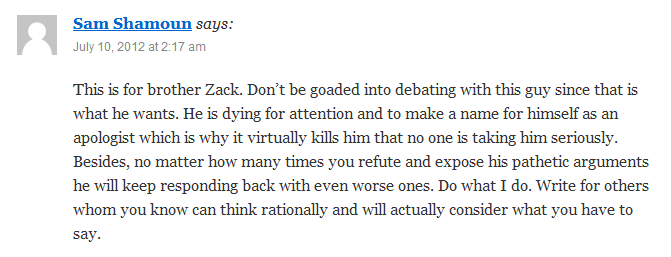
Sam Shamoun Warns: Stay Away from Ijaz Ahmad!

Bismillahir Rahmanir Raheem
بِسۡمِ ٱللهِ ٱلرَّحۡمَـٰنِ ٱلرَّحِيمِ ,

It’s been sometime since my last run in with Sam Shamoun, after all he had fun while his friends threatened to rape me and then he had a blast insulting me. He’s gone one step further though. It seems after responding to him on his friend’s blog, along with Br. Qmark, Sam got a little more than annoyed and thus we have a new fatwa by Sam:

I’ve really got to hand it to Sam, it’s strange that he’s warning his brethren to avoid me like the plague, after and only after he’s engaged with me on that blog. What’s worse is that neither Anthony or him have as of yet, been able to respond to any of my arguments against them, which you can read here and here. It seems as if I must thank Sam Shamoun for placing a Christian missionary embargo on me. The longer he is silent against me and the more he preaches against me, the more it shows his inability to respond to my articles and refutations against his lies. Yet his embargo does not seem to be working.

For the month of August 2012, we’ve had 20 fantastic articles posted, last month we had a TV series in my native country, the website received it’s highest views ever in May, while our fan base continues to grow in the US, UK, Europe and Asia, as is testament by our growing Facebook fanpage as well. With all of our growth, I’m really not sure how well Sam’s embargo seems to be working. Whatever the case may be, I’d still like to thank the guy for disliking me that much to go so far as to personally warn his brothers in Christ to stay away from me. That most certainly is an achievement that I am proud of, thank you, Sam.

As a side note, I’m not exactly how it is that I’m dying for attention as neither Sam or any of his cronies know my real name, where I live or what I look like. If you or anyone else have ever seen a celebrity whose identity is unknown, let me or Sam know! He really has a funny idea of what fame is.

wa Allaahu Alam,
and God knows best.

Refutation: Missing the Mark: Unveiling Mark’s High Christology of Divine “Inclusion”

Bismillahir Rahmanir Raheem
بِسۡمِ ٱللهِ ٱلرَّحۡمَـٰنِ ٱلرَّحِيمِ ,

Introduction

On this day has probably dawned the end of Anthony Roger’s apologetics career. I’ve read a vast majority of his “articles”, been privy to a debate with him, but I was completely flabbergasted to read his latest article on the Answering Islam website. Whether it is or not this was something hastily written in fifteen minutes or an early April fools joke, I’m still not quite sure, but whoever is managing quality control at that “website”, seriously needs to be reprimanded for allowing this to slip through the cracks. Essentially Anthony’s article boils down to:

  1. Mark’s Gospel uses the term ‘son of God’.
  2. As a Christian we believe in a literal ‘son of God’.
  3. If Mark uses this term, it must refer to the ‘son’ I believe in.

This argument can be simplified to realise its absurdity:

  1. The Old Testament in English uses the term, ‘God’.
  2. As a theist, I believe in God.
  3. Since the Old Testament uses the term God, it must refer to the ‘God’, I believe in.

If you don’t believe this was Anthony’s argument, he even explicitly states this at the beginning of his article, I quote:

“The following article seeks to show a stunning way by which Mark identifies Jesus as the divine Son of God and heir of all things.”

That ‘stunning’ way, is simply Mark using the term, ‘Son of God‘. In Anthony’s case, he tries to redefine ‘Son of God’ to be ‘Divine son of God’, unfortunately for him, the verbatim term, ‘Divine son of God‘, is nowhere to be found in the Markan gospel, or for that matter, anywhere in the Greco-Roman New Testament. He essentially begins his article by being deceitful, not that I expected any better of him.

The Son of God

He begins by conceding to the fact that many do not consider the Markan Gospel to contain a high Christology:

It is commonplace to hear that Mark’s Gospel does not embody a high Christology, and this in spite of the fact that the thesis statement at the incipit of the book, one that is explicated in the course of the narrative, boldly declares that Jesus is the Son of God.

He goes on to reference the following verses: Mark 1:1, 3:11, 5:7, 15:39, 13:32, 14:61, 1:11, 9:7. You might wonder why Anthony did not quote the verses he referenced, well that’s mostly because what he implies by referencing and then what they actually state are two fundamentally different things. For example, Anthony says:

The meaning of this title is unpacked in the ensuing narrative which makes it quite clear that Jesus is God’s Son in a unique and exclusive sense (1:11, 9:7).

Those two verses read:

  • A voice from heaven said, “You are my Son, whom I love. I am pleased with you.”
  • Then a cloud overshadowed them. A voice came out of the cloud and said, “This is my Son, whom I love. Listen to him!”

Which turns out, isn’t that unique, David who is also called God’s son (Psalms 2:7) is said to be the heart of God:

  • And when he had removed him, he raised up unto them David to be their king; to whom also he gave testimony, and said, I have found David the [son] of Jesse, a man after mine own heart, which shall fulfil all my will. – Acts 13:22
  • But now thy kingdom shall not continue: the LORD hath sought him a man after his own heart. – 1 Samuel 13:14

Also speaking in reference to David, the God of the Bible also says:

  • But I will never stop showing him my love as I did to Saul, whom I took out of your way. – 2 Samuel 7:15.

At this point, I’m not quite sure as to what Anthony’s definition of unique is, but that poorly written argument seems to have backfired from the moment he wrote it. Anthony then continues to show the ‘divinity of Christ’ by using one of the most absurd evidences known to reason, and I quote:

one that sets Him quite apart from angels and men (13:32)

What does Mark 13:32 actually state? It says, “No one knows when that day or hour will come. Even the angels in heaven and the Son don’t know. Only the Father knows.” Now this is a problem, if God is all knowing and Jesus is supposed to be a divine son of God, then Jesus is expected to have the same attribute of being all knowing as God. Since Jesus is not all knowing, this verse actually proves that Jesus is not a divine being.

  • If God is all knowing and God increases in knowledge, then it would mean that before God gained this knowledge He was not all knowing. Such a being cannot be God, as God is not ignorant.
  • If God is all knowing and decreases in knowledge (as is the case of Christ in Mark 13:32), then since God is ignorant, He cannot be considered to be ‘All Knowing’.

Anthony’s case for the divinity of Christ takes a further step back in his following argument, I quote:

“As the unique Son of God Jesus is to be obeyed (9:7)”

We referenced 9:7 earlier which read:

  • Then a cloud overshadowed them. A voice came out of the cloud and said, “This is my Son, whom I love. Listen to him!”

Apparently if God tells you to obey someone, then that person becomes a divine being, which is a problem, as God in the Old Testament did command his followers to obey many others:

  • A scepter will never depart from Judah nor a ruler’s staff from between his feet until Shiloh comes and the people obey him. – Genesis 49:10.
  • Give him some of your authority so that the whole community of Israel will obey him. – Numbers 27:20.
  • Does this then mean that Shiloh and Joshua are both divine beings, since God has commanded the people to obey them? If not, what’s the reason Mr. Rogers?

The rest of the verses follow the same pattern, he cites a verse, makes an overtly generalized statement and then when actually read the verses themselves do not seem in the least to portray what he’s trying to imply. I honestly believe that this was a last minute article, given the number of errors, contradictions and mistakes he’s made thus far it is almost impossible to believe that any actual study and research went into its writing.

The Son-Inclusio

After referencing the following two sets of passages of Mark 1:9-11 and Mark 15:33-41, Anthony makes the argument:

That these two passages strategically located at the beginning and end of Christ’s ministry form an inclusio is discernable from several notable factors.

Essentially, an inclusio takes the form (this is an analogy of the form of an inclusio, using Anthony as our main character):

  • Start of Story: Anthony likes kittens.
  • Body of Story: Anthony likes to act, his role model is Alexis Arquette.
  • End of Story: Anthony likes kittens.

Taking a page from Anthony’s book, it must be a very amazing miracle that Anthony liking kittens is at the beginning and end of his biography. As we now return to reality, I still do not understand, or grasp how Mark’s statement that Jesus is a Son of God at the beginning and end of a book about Jesus, is a miracle. Anthony definitely seems to think it’s a miracle and he gives 8 reasons why. Therefore I’m going to summarize his 8 reasons:

  1. Both passages call Jesus a son of God.

    Well that’s a bit obvious, isn’t it? This is a title reserved for many persons by God throughout the Old and New Testaments, Adam was a Son of God (Luke 3:8), God has sons and daughters (Genesis 6:2), Israel is God’s son (Exodus 4:22), David is God’s son (Psalms 2:7), Christians are the sons of God (Romans 8:14), etc. There is nothing special or unique about being referred to as the son of God and the mere fact that this title is used to describe Jesus throughout the Gospel of Mark, (including the center, not just the beginning and the end), is an awful attempt and wishful thinking by Anthony Rogers.

  2. Similar language of being baptised and having life poured out of Him.

    I’m still trying to see whether Anthony was attempting to make a poorly worded joke here or not. His reasoning works a little something like this:

    * Baptising has to do with water.
    * Water is something you pour.
    * Jesus’ life was poured out of him.
    * MIRACLE!

    Again, I am not sure this article or his reasoning was an attempt to be funny, but if indeed this is what Anthony considers a miracle and proves the divinity of Christ, then I am most certain this is as desperate as you can get.

  3. Both passages reference Elijah.

    I most certainly retract my previous declaration, this is the most ridiculous reasoning a man can make. Why would being referenced to another Prophet make Jesus a divine being? He’s being compared to a Prophet, the only way Anthony can possibly use this as an excuse to link Jesus being a divine being, with Elijah being mentioned, is if Elijah is also considered to be a deity.

  4. One passage refers to the spirit, the other uses the term ‘Jesus breathed out’.

    You would like to think at this point I was joking, however I’m not, again Anthony’s immature reasoning is really beginning to shine:

    * Spirit is a Greek word for breath.
    * Jesus breathed.
    * Jesus is God because he breathed!

    I wish I was making this reasoning up, but I’m going to quote him on this one:

    “Both passages speak or allude to the Spirit: in the former passage the reference to the Spirit is explicit; in the latter it is implicit in the word “breathed” or “expired,” ἐξέπνευσεν,exepneusen, which is a cognate word in Greek for “spirit,” πνεῦμα, pneuma.” *

  5. God speaks in the beginning of the book of Mark and at the end of Mark, Jesus speaks. Since God is speaking at the beginning of the Book and Jesus is speaking at the end, then Jesus is God. Let me quote him so no one thinks I’m making this stuff up:
    1. “Both passages speak of a voice, φωνὴν, phonen: In the former it is the voice of the Father from heaven; in the latter it is that of the Son from the cross.”

    So far this guy’s reasoning has been: Baptising has to do with water and Jesus’ life is poured out, therefore MIRACLE. Spirit is mentioned in the beginning, its Greek word means breath, Jesus breathes, therefore MIRACLE. God speaks in the beginning, Jesus has a voice, therefore MIRACLE. [I can’t stop laughing at the absurdity here!]

  6. He states and I quote, “In both passages something is said to descend: in the former it is the Spirit; in the latter it is the veil of the temple, “from top to bottom.”. Again, Anthony’s reasoning can be summed up as:

    *Spirit descends, that means he goes downwards.
    * Something was torn and wait a minute….
    * The veil was torn from top to bottom….this means…
    * The veil also descended!
    * MIRACLE!

  7. He states and I quote, “In both passages something is torn, σχιζω, skidzo: in the former passage it was the heavens; in the latter it was the veil of the temple.” Again, his reasoning can be summed up as:

    * The sky opens.
    * The veil was torn.
    * I wonder if the sky ripping open is the same word for the veil tearing, because the veil was you know, ripped in half.
    * MIRACLE! They use the same word “tear = rip”.
    * Irrefutable evidence Jesus is God!

  8. Lastly, Anthony ends his amazing comedic performance with saying: “In both passages mention is made of Jesus being or having been ministered to: the former passage refers to angels; the latter refers to Christ’s women followers.” Apparently, in Anthony’s reasoning, in a book about God where people preach to and about God, it’s a miracle that people are preaching at the beginning and end of said book. It’s like going to an action movie and being surprised that there is action at the start of the movie and at the end of the movie or it’s like reading a Harry Potter book and being surprised it involves magic at the start of the book and at the end of the book.

Conclusion

This article by Anthony has served no other purpose than to demonstrate the low level thinking involved in preaching Christianity. Not only am I ashamed for Anthony, I am ashamed that Sam Shamoun calls a man with such childish reasoning, “the greatest apologist of our time“. This article went out of the way to draw links which were far out, remotely related and was severely coated with a dressing of desperation. I’ve seen people being criticised for lack of intellectualism, perhaps even grasping for straws, but this certainly was the single most shallow use of the Bible by a Christian I have ever seen. Anthony, if you do end up reading this, please know that if this is the reasoning you employ to remain in Christianity, then I am sorry but you’re insulting yourself and God for not using the brain He gave you. I expected much better from him (who am I kidding?), but this was possibly the most degenerate, backward, irrational, pre-school, toddler reasoning I have ever witnessed from a Christian apologist. You most certainly have my pity.

wa Allaahu ‘Alam,
and God knows best.

Peter or Paul?

Bismillahir Rahmanir Raheem
بِسۡمِ ٱللهِ ٱلرَّحۡمَـٰنِ ٱلرَّحِيمِ ,

Are you following the teachings of  Jesus’s  apostles? We note that out of the 27 books found in the New Testament, 14 books (including the Book of Hebrews as it was thought to be written by Paul) are ascribed to Paul and 2 Books (Gospel of Luke and the book of Acts) ascribed to his companion. More than half of the Christian teachings come from Paul. Paul (known as Paul the Apostle , Saul of Tarsus ) was a Jew who persecuted Christians, on his way to Syria (Damascus) his journey was interrupted when Jesus appeared to him as a blinding light (Acts 9, Acts 22: both accounts contradict one another)  and speaks to Paul, leading Paul to believe and spread the Message.  This should make you ask, a person who in one incident only has received a vision of Jesus, how can he become the leading author and main interpreter of the words of Jesus, while all the other 12 disciples lived, accompanied, learned and were taught by Jesus have little or nothing to say.

Jesus clearly tells Peter (“Cephas” was Peter’s real name, the Greek word for “Peter” means “rock”) :

Matthew 16:18

18 And I tell you that you are Peter, and on this rock I will build my church, and the gates of Hades will not overcome it.

Peter the leading disciple, Jesus’s rock has only two small epistles (New Testament books) to his name 1 and 2 Peter and ironically both books authors are believed to be anonymous :

“Some modern scholars on the basis of a number of features that they consider incompatible with Petrine authenticity, regard the letter as the work of a later Christian writer. Such features include the cultivated Greek in which it is written, difficult to attribute to a Galilean fisherman, together with its use of the Greek Septuagint translation when citing the Old Testament; the similarity in both thought and expression to the Pauline literature; and the allusions to widespread persecution of Christians, which did not occur until at least the reign of Domitian (A.D. 81-96). In this view the letter would date from the end of the first century or even the beginning of the second, when there is evidence for persecution of Christians in Asia Minor. (The New American Bible, ISBN: 978-0-529-06484-4, Page 1348)”

“Nevertheless, acceptance of 2 Peter into the New Testament canon met with great resistance in the early church. The oldest certain reference to it comes from Origen in the early third century. (The New American Bible, ISBN: 978-0-529-06484-4, Page 1354)”

“Among modern scholars there is wide agreement that 2 Peter is a pseudonymous work, i.e., one written by a later author who attributed it to Peter. (The New American Bible, ISBN: 978-0-529-06484-4, Page 1354)”

With respect to 1 Peter:

Some scholars believe the author was not Peter, but an unknown author writing after Peter’s death. Estimates for the date of composition range from 60 to 112 AD. Most critical scholars are skeptical that the apostle Simon Peter, the fisherman on the Sea of Galilee, actually wrote the epistle, because of the urbane cultured style of the Greek and the lack of any personal detail suggesting contact with the historical Jesus of Nazareth. The letter contains about thirty-five references to the Hebrew Bible, all of which, however, come from the Septuagint translation, an unlikely source for historical Peter the apostle, but appropriate for a Hellenized audience; thus the use of the Septuagint helps define the audience. The Septuagint was a Greek translation that had been created at Alexandria for the use of those Jews who could not easily read the Hebrew and Aramaic of the Tanakh and for proselytes. A historical Jew in Galilee would not have heard Scripture in this form, it is argued.

Source:  http://en.wikipedia.org/wiki/Authorship_of_the_Petrine_epistles

So we ask again our Christian friends whose understanding have you been following?

To further strengthen our case:

Paul’s understanding of the Law (The commandments of God according to the Bible): 

Galatians 3:10-13  

 For as many as are of the works of the law are under the curse: for it is written, Cursed is every one that continueth not in all things which are written in the book of the law to do them. But that no man is justified by the law in the sight of God, it is evident: for, The just shall live by faith. And the law is not of faith: but, The man that doeth them shall live in them. Christ hath redeemed us from the curse of the law, being made a curse for us: for it is written, Cursed is every one that hangeth on a tree.

Romans 3:20

20Therefore no one will be declared righteous in his sight by observing the law; rather, through the law we become conscious of sin.

Romans 10:9-10

That if you confess with your mouth, “Jesus is Lord,” and believe in your heart that God raised him from the dead, you will be saved. 10For it is with your heart that you believe and are justified, and it is with your mouth that you confess and are saved.

Contrary to what Paul says, Jesus had always requested the law to be applied:

Matthew 5:17-19

17 “Do not think that I have come to abolish the Law or the Prophets; I have not come to abolish them but to fulfill them. 18 For truly I tell you, until heaven and earth disappear, not the smallest letter, not the least stroke of a pen, will by any means disappear from the Law until everything is accomplished. 19 Therefore anyone who sets aside one of the least of these commands and teaches others accordingly will be called least in the kingdom of heaven, but whoever practices and teaches these commands will be called great in the kingdom of heaven.

Matthew 23: 1-3

1 Then Jesus said to the crowds and to his disciples: 2 “The teachers of the law and the Pharisees sit in Moses’ seat. 3 So you must be careful to do everything they tell you. But do not do what they do, for they do not practice what they preach.

Furthermore, Paul confronts and calls Peter (Cephas) and James Hypocrites for trying to abide by and teach the Law:

Galatians 2: 11 -21

11 When Cephas came to Antioch, I opposed him to his face, because he stood condemned. 12 For before certain men came from James, he used to eat with the Gentiles. But when they arrived, he began to draw back and separate himself from the Gentiles because he was afraid of those who belonged to the circumcision group. 13 The other Jews joined him in his hypocrisy, so that by their hypocrisy even Barnabas was led astray.

14 When I saw that they were not acting in line with the truth of the gospel, I said to Cephas in front of them all, “You are a Jew, yet you live like a Gentile and not like a Jew. How is it, then, that you force Gentiles to follow Jewish customs?

15 “We who are Jews by birth and not sinful Gentiles 16 know that a person is not justified by the works of the law, but by faith in Jesus Christ. So we, too, have put our faith in Christ Jesus that we may be justified by faith in Christ and not by the works of the law, because by the works of the law no one will be justified.

17 “But if, in seeking to be justified in Christ, we Jews find ourselves also among the sinners, doesn’t that mean that Christ promotes sin? Absolutely not! 18 If I rebuild what I destroyed, then I really would be a lawbreaker.

19 “For through the law I died to the law so that I might live for God. 20 I have been crucified with Christ and I no longer live, but Christ lives in me. The life I now live in the body, I live by faith in the Son of God, who loved me and gave himself for me. 21 I do not set aside the grace of God, for if righteousness could be gained through the law, Christ died for nothing!”

If Peter (Jesus’ Rock) , James and Barnabas the apostles of Jesus were considered to have gone astray in their teachings by a person who had only one vision of Jesus (Paul)… Whose side would you pick?   According to the Pseudo-Clementines,  there is a debate to show Peter supporting the ongoing validity of the Law against Paul (Disguised as Simon Magus).

For some from among the Gentiles have rejected my lawful preaching and have preferred a lawless and absurd doctrine to the man who is my enemy. And indeed some have attempted, while I am still alive, to distort my words by interpretations of many sorts, as if I taught the dissolution of the law… But that may God forbid ! For to do such a thing means to act contrary to the Law of God which was made to Moses and was confirmed by our Lord in its everlasting continuance. For he said, “The heaven and the earth will pass away, but not one jot or one tittle shall pass away from the Law.” (Letter of Peter to James, 2.3-5)

In a portion of the Homilies Peter attacks Paul:

And if our Jesus appeared to you also and became known in a vision and met you as angry with an enemy [recall: Paul had his vision while still persecuting the Christians: Acts 9], yet he has spoken only through visions and dreams or through external revelations. But can anyone be made competent to teach through a vision? And if your opinion is that that is possible, why then did our teacher spend a whole year with us who were awake? How can we believe you even if he has appeared to you?… But if you were visited by him for the space of an hour and were instructed by him and thereby have become an apostle, then proclaim his words, expound what he has taught, be a friend to his apostles and do not contend with me, who am his confidant; for you have in hostility withstood me, who am a firm rock, the foundation stone of the Church (Homilies 17.19)

In conclusion, I will say Peter, not Paul, is the true authority for understanding the message of Jesus, but since Peter’s (The Rock ) writings are not around, whose teachings are you following ?

Jesus says in the Bible:

Matthew 7:15

Jesus said “Watch out for false prophets. They come to you in sheep’s clothing, but inwardly they are ferocious wolves.

« Older Entries Recent Entries »