Saudi Mother Pardons Son’s Murderer

Bismillahir Rahmanir Raheem
بِسۡمِ ٱللهِ ٱلرَّحۡمَـٰنِ ٱلرَّحِيمِ ,

In one of the most heart wrenching stories of the year. A Muslim Saudi woman, has forgiven her son’s murderer and by that act has saved the murderer from execution or any form of punishment by the state. The woman who has no house of her own and lives with her three orphaned daughters said:

Marzooghah Al-Blewi of Tabuk refused an offer of property and millions of riyals to pardon the man who took her son’s life more than two years ago.

Instead, in a dramatic scene after the sentencing in court, the mother of the victim asked to see her son’s murderer after which she said that she forgave him without conditions. This was documented in the presence of the judge, and the grateful young man asked the woman to accept him as her son to serve her for the rest of her life.

The victim’s mother said that she could not forget the night when her 19-year-old son Suhail was murdered, while she was waiting for him to drive her to visit some relatives.

She accepted the matter as fate and test of her patience from God. She said the killer’s family had constantly contacted her offering property and money and seeking forgiveness to spare their son from execution.

She said she resides in Prince Sultan Charitable Housing with her three orphaned daughters, one of whom is completely paralyzed, and her 80-year-old father who is also partially paralyzed.

They live on her deceased husband’s pension of SR2,000 in addition to SR1,000 from social insurance. She forgave her son’s killer seeking God’s recompense.

The perpetrator’s father, Ayed Al-Blewi, spoke of the many attempts to have the distraught mother drop the charges by offering SR2 million and his property, but she refused many times, until that day in court.

He offered his sincere thanks to her and to the relatives of the deceased.

Such an act due to the laws of Islam and to the piety that Islam instills in us, allows for such acts of great kindness to occur. This news most certainly demonstrates the mercy of Islam and the compassion it grows within us, for the betterment of society. You can read the article at its original source, The Saudi Gazette. It is most certain that you will not see this story on David Wood’s website, Pamela Geller’s website, or Ali Sina’s website, yet this is one law (forgiveness of murderers), that is found in Shari’a law and only in Shari’a law.

wa Allaahu Alam,
and Allaah knows best.

John 5:23 – The Sweetest Trinitarian Honey!

Visiting the darling Trinitarian argument from a neutral perspective.

Question Mark

Introduction

One of the best argument which a Trinitarian would brandish in support of Jesus’ (peace be upon him) deity is the appeal to John 5:23. The flagrantly high “Christology” in the youngest of all gospels – the gospel of John – has in it Jesus (peace be upon him) asserting that he is to be honored “just as” the Father.

Under most circumstances, Trinitarians would love to use it to worship a mere man; however, this could be done after comfortably neglecting or rejecting the (i) immediate and (ii) overall context of the Bible and (iii) the contemporary prevailing beliefs of “orthodox” Christians.

Once the verse is seen in its proper perspective either, Jesus (peace be upon him) could not be deified unless otherwise resorted to slanted exegesis; or, multiple mere mortals would also have to be deified, accordingly!

With that said, let us test the viability of one of the best Trinitarian argument!

Honor the Son in the “same way” as Father

 The following is the text used as a proof to deify Jesus (peace be upon him):

Nor does the Father himself judge anyone. He has given his Son the full right to judge, so that all will honor the Son in the same way as they honor the Father. Whoever does not honor the Son does not honor the Father who sent him. (John 5: 22-23, Good News Bible)

The following transliteration of the video clipping would prove how desperately Trinitarian apologists have been mishandling the above verse towards their polytheistic agenda:

“Why did the Father appointed his Son to be the Judge of all? All creation, all flesh. Here is the answer. Here is the reason from the lips of Jesus Christ our Lord; from the very chapter that Zakir Naik misquoted – that all my honor the Son just as they honor the Father. Let me just stop here for a moment. Notice what the Lord Jesus Christ did not say. He did not say, “the reason why the Father appointed me judge is so that everyone honors me as a prophet”. That’s not what he said. He didn’t say, “that the reason why I have been appointed judge of all is so that you can honor me as you honor the righteous or your parents or a messenger. No, he says, the reason why I judge everyone is so that everyone honors me in the same way they honor the Father. ” (Shamoun Time 07:24 – 08:14)

Before we dissect the argument for closer examination, we will make certain very important observations from the above adduced verse. These observations would sufficiently allude that the otherwise obvious “Christology” (for Trinitarians) of the verse, is not, in reality that obvious!

Observe that Jesus (peace be upon him) is to be honored the “same way” as God for the following two reasons:

1.      Father (God) has made or appointed Son (Jesus, peace be upon him) to judge on His behalf on this Earth. In other words, Jesus (peace be upon him) would be representing God’s sovereignty in this world, he has been given that privilege. In other words, the attribute of judging does not come intrinsically from him. Consequently, elsewhere in the Bible such a deferred privilege is portrayed as a non-divine act of Jesus (peace be upon him):

“If people hear my message and do not obey it, I will not judge them. I came, not to judge the world, but to save it. Those who reject me and do not accept my message have one who will judge them. The words I have spoken will be their judge on the last day! This is true, because I have not spoken on my own authority, but the Father who sent me has commanded me what I must say and speak. And I know that his command brings eternal life. What I say, then, is what the Father has told me to say.” (John 12: 47-50)

Moreover, New Testament also declares that mere Christian believers would also judge on the judgment day! This further proves that judging others was not a task to deify a candidate.

2.      Also observe that Jesus (peace be upon him) has been “sent” by Father; he was commissioned into this world. This particular act of “sending” somebody has the imports of non divine prophet-hood on the one who is send. Moreover, in biblical context such a commissioned person is yet again portrayed as somebody lesser than God. Consider the following few verses regarding Jesus (peace be upon him) as substantiation for this notion:

“Jerusalem, Jerusalem! You kill the prophets and stone the messengers God has sent you! How many times I wanted to put my arms around all your people, just as a hen gathers her chicks under her wings, but you would not let me! (Matthew 23:37)

Jesus saith unto them, My meat is to do the will of him that sent me, and to finish his work. (John 4: 34)

I can of mine own self do nothing: as I hear, I judge: and my judgment is just; because I seek not mine own will, but the will of the Father which hath sent me. (John 5:30)

Jesus answered them, and said, My doctrine is not mine, but his that sent me. (John 7:16)

And he that sent me is with me: the Father hath not left me alone; for I do always those things that please him. (John 8:29)

(King James Version)

This gives us a good picture that neither (i) judging on behalf of God as His representative nor (ii) being the one sent by God can be treated as divine phenomenon and yet we find our subject phrase – to honor Son just as Father – smack dab at the middle of  mutually opposing clauses – the two non-divine functionalities or attributes.

Therefore it still has to be enquired why the controversial subject phrase was placed in between two necessarily non-divine context. The answer to this query was “shadowed” in the Old Testament!

The way the Old Testament portrays its Prophets

Trinitarians would accept that Jesus (peace be upon him) was not merely a New Testament “God” but he was also a messianic prophet; a Davidic prophet; a royal prophet (c.f. Matthew 1:1, 17, 9:27, 13:55-57, 21: 5-9, 10-11, 45-46. Luke 1:30-32, 13:32-33, 24:18-19, John 6:14, Acts 2:22, 30)

So whatever was attributed and applicable to the Old Testament prophets, especially those who were Davidic and royal, could be applied at par for Jesus (peace be upon him) as well!  With that said let us observe very closely how the Old Testament portrayed its prophets and what was attributed to them.

1.      Davidic royal Prophets were required to be worshipped:

“Then David said to the whole assembly, ‘Bless Yahweh your God.’ And the whole assembly blessed Yahweh, the God of their fathers, and bowed their heads low and worshipped Yahweh AND the king (wayyiqadu wayyishtahawu YHWHW walammelek).” (1 Chronicles 29: 20)

“You have delivered me from the strivings of the people; You have made me the head of the nations; A people I have not known shall serve me (ya’abduni). As soon as they hear me they obey me; The foregners submit to me.” (Psalm 18: 43-44)

“Give the king your justice, O God, and your rightenouness to the royal son!…May desert tribes bow down before him, and his enemies lick the dust! …May all kings fall down before Him (wayishtahawulow); May all nations serve Him (ya’abduhu).” (Psalm 72:1,9, 11)

They will serve(wa’abadu) Yahweh their God AND David their king whom I will raise up for them.” (Jeremiah 30:9)

Notice the construction of the Old Testament “verses”: It has instructed its believers to worship and serve Yahweh and the prophet(s) in the same breath.

The “verses” do not make any qualification that God is to be worshipped the way befits Him and the worldly kings are to be honored the way which suits the mortals. In fact it does not even differentiates the word – it uses the same word “worship” while referring to both God “and” mortal kings.

Furthermore, observe the Hebrew words used for worship (and services) and compare them with the following words as used while referring to Yahweh. They are either identical or a derivative of the root word:

Serve (‘ibdu) the Lord with fear, And rejoice with trembling. Psalm 2:11

Serve (‘ibdu) the Lord with gladness; Come before His presence with singing. Acknowledge that Yahweh is God. He made us, and we are His—His people, the sheep of His pasture.” Psalm 100:2-3

“All nations whom You have made Shall come and worship (wayishtahawu) before You, O Lord (adonay), And shall glorify (wikabbadu) Your name.” Psalm 86:9

“‘From one New Moon to another and from one Sabbath to another, all flesh will come and bow down (lahishtahawot) before Me,’ says Yahweh.” Isaiah

Thus, we see that the Old Testament had a peculiarly high “prophetology” for its prophets. They were to be “worshipped” alongside Yahweh (“and”) and to express this notion Hebrew Bible uses the same root word which it uses for Yahweh.

2.      Mere prophets were praised “just as” Yahweh

The Old Testament requires its believers to exalt and praise Yahweh,

“Give to Yahweh, O families of the peoples, Give to Yahweh glory (kabod)and strength. Give to Yahweh the glory (kabod) due His name; Bring an offering, and come into His courts. Oh, worship (hishtahawu) Yahweh in the beauty of holiness! Tremble before Him, all the earth. (Psalm 96:7-9)

Let the peoples praise You, O GodLet all the peoples praise You. Oh, let the nations be glad and sing for joy! For You shall judge the people righteously, And govern the nations on earth. Selah Let the peoples praise You, O God; Let all the peoples praise You. Then the earth shall yield her increase; God, our own God, shall bless us. God shall bless us, And all the ends of the earth shall fear Him.” (Psalm 67:3-7)

Yet it also requires that mere prophets be also exalted and praised:

His glory (kabodo) is great in Your salvation; Honor and majesty You have placed upon him. For You have made him most blessed forever; You have made him exceedingly glad with Your presence.” (Psalm 21:5-6)

“So the King will greatly desire your beauty; Because He is your Lord (adonayik), worship Him (wahishtahawilow)… I will make Your name to be remembered in all generations; Therefore the people shall praise You forever and ever. (Psalm 45:11, 17)

Notice that it is not merely the usage of same Hebrew words (“Kobodo”) for glorifying prophets as was used for Yahweh but that the last verse even requires its followers to praise a mere king “forever and ever” – something which falls in the genre of divinie praise! We do not “kobod” (praise) mere mortal prophets “forever and ever”, yet, biblically these are allowed phrases without breaching its brand of monotheism.

3.      Mere prophets sharing the same title with Yahweh

In the same adduced Psalm verse (45:11, above) notice that Davidic prophet(s) was referred as “Lord” using the Hebrew word “adonayik”. Comparatively, the same word is elsewhere used for Yahweh as well:

Thus says your Lord (adonayik), Yahweh and your God, Who pleads the cause of His people: ‘See, I have taken out of your hand The cup of trembling, The dregs of the cup of My fury; You shall no longer drink it.’” Isaiah 51:22

Thus we have instance where Yahweh – the “God” of the Bible – has even shared his title with mere mortals. No wonder, Yahweh is also portrayed as sharing his throne as well:

Prophets on the Throne of God Himself:

Then Solomon sat on the throne of the Lord as king instead of David his father; and he prospered, and all Israel obeyed him. All the officials, the mighty men, and also all the sons of King David pledged allegiance to King Solomon. The Lord highly exalted Solomon in the sight of all Israel, and bestowed on him royal majesty which had not been on any king before him in Israel.” (1 Chronicles 29:23-25)

“Blessed be the Lord your God who delighted in you, setting you on His throne as king for the Lord your God; because your God loved Israel establishing them forever, therefore He made you king over them, to do justice and righteousness.” (2 Chronicles 9:8)

All of the above Old Testament verses by allowing its prophets,

  1. To be “worshipped” alongside Yahweh,
  2. To be glorified  just as Yahweh,
  3. To share same title as Yahweh,

creates good ground for correct and congenial interpretation of John 5:23. In the backdrop of foregoing Old Testament verses if Jesus (peace be upon him) asserted that son is to be honored “just as” Father then he had the Old Testament pretext in which he was asserting! He knew that the Jewish traditions allow that mere prophets be “worshipped”, “glorified” alongside Yahweh “just as” He is worshipped and glorified. Similarly, Jesus (peace be upon him) even knew that Old Testament prophets even shared Yahweh’s titles to their end and yet none of it violated any Old Testament monotheism.

Therefore, if Jesus (peace be upon him) supposedly demands “same honor” with Father then it could not possibly be taken to establish divinity for Jesus (peace be upon him) given the Old Testament framework. Yet if Trinitarians want to do it then either (i) they want to reject the overall Old Testament context in which Jesus (peace be upon him) was speaking or (ii) they have to deify multiple Old Testament prophets (or at least the royal, Davidic prophets for that reason)!

The problem does not end here with the best-argument. Consider the following section.


What did Jesus (peace be upon him) do with the “honor” he demanded? 

Even if we reject all of the Old Testament pretext to claim that because Jesus (peace be upon him) demanded “same honor” with Father, therefore, he must be divine; yet it does not help the Trinitarian agenda in any way since it is very interesting to observe what Jesus (peace be upon him) later did with the “honor” – the so assumed “divine” honor – once it was vested on him. In the following passages we explore it.

Later in the same gospel, towards the end of his life, Jesus (peace be upon him) picks up the topic of his honor and glory once again. In fact John dedicates an entire chapter towards the honor and glory of Jesus (peace be upon him). We pick it up from there:

John portrays Jesus (peace be upon him) demanding the glory which he had initially – even before the world was ever made:

After Jesus finished saying this, he looked up to heaven and said, “Father, the hour has come. Give glory to your Son, so that the Son may give glory to you. I have shown your glory on earth; I have finished the work you gave me to do. Father! Give me glory in your presence now, the same glory I had with you before the world was made. (John 17: 1, 4-5)

Trinitarian exegetes are unanimous upon it that the primordial glory of Jesus (peace be upon him) was particularly divine!

However, later in the same chapter, after praying for his followers, Jesus (peace be upon him) interestingly (or embarrassingly) gave away the same glory to his multiple disciples:

“I pray not only for them, but also for those who believe in me because of their message. I pray that they may all be one. Father! May they be in us, just as you are in me and I am in you. May they be one, so that the world will believe that you sent me. I gave them the same glory you gave me, so that they may be one, just as you and I are one: (John 17: 20-22)

Observe it once again that Jesus (peace be upon him) gave his followers the “same glory” which God vested on him. Don’t forget, verses 4 and 5 informed us that, according to Trinitarian exegesis, Jesus (peace be upon him) was seeking his “divine” primordial glory from Father!

Acknowledging the “high” status of followers, Trinitarian commentators have following to remark:

John 17:22  The glory which thou hast given me, I have given them – The glory of the only begotten shines in all the sons of God. How great is the majesty of Christians. (John Wesley’s Explanatory Notes, John 17:22)

Notice the Wesley’s exclamatory note towards the end of his comment. He exclaims about the extra high esteemed status of Christians – why? Because they enjoy thesame glory which Christ (peace be upon him) was conferred with for being the “only begotten” of the God!

It is very disturbing that within the purported realms of “monotheistic” Christianity, the supposed divine and special glory of the alleged Trinitarian god is shared with multiple mere mortals!

Another set of Trinitarian Scholars – Matthew Henry – go a step ahead of John Wesley to claim more divine qualities and positions for mere mortals which assumedly befits Christ (peace be upon him) alone:

Those that are given in common to all believers. The glory of being in covenant with the Father, and accepted of him, of being laid in his bosom, and designed for a place at his right hand, was the glory which the Father gave to the Redeemer, and he has confirmed it to the redeemed. (Matthew Henry’s Commentary on the Whole Bible, John 17:20-23)

As a proof for Jesus’ (peace be upon him) divinity, Trinitarians down the ages have been appealing to the biblical verses wherein Jesus (peace be upon him) is portrayed as “laid in God’s bosom” and “at His right hand”.

The “right hand” of the God is an exclusive, divine place suitable only for Christ (peace be upon him) appeals most Trinitarians, nevertheless, we saw above thatTrinitarian scholars had no scruple into vesting these “divine” status on mere mortals implying either (i) the “glory” of Jesus (peace be upon him) was not divine or (ii) there are numerous individuals in Trinitarian Christianity enjoying such “glory”!

Furthermore, honor of being the “redeemer” of the entire world has to be divine at least in the Trinitarian parlance yet Trinitarian scholars confirm it on multiple mere creatures! This once again establishes that honor of Jesus (peace be upon him) although special and prized but was not divine.

The problem with the best argument continues…


 Earliest “Orthodox” Beliefs 

We are now to the very last argument against Trinitarian misuse of John 5:23. In this section we would consider the writings of earliest, “orthodox”, church father Ignatius. Remember that Ignatius is as old as contemporary to gospel of John and a student of John himself!

Consider then what Ignatius had to portray about the “orthodox” belief system of theearliest Christians regarding the status of church bishops:

“Be subject to the bishop as to the commandment” (Ign. Trall. 13.2)

We are clearly obliged to look upon the bishop as the Lord himself” (Ign. Eph. 6.1)

Since the mortal “bishops” were to be seen as “Lord” himself and their commandments were to be treated at par with the Laws of Yahweh, Ignatius of Antioch gave no religious freedom to the laity:

“You should do nothing apart from the bishop” (Ign. Magn. 7.1)

On the preceding, New Testament authority Bart Ehrman rightly asserts the following:

Each Christian community had a bishop, and this bishop’s word was LAW [Mosaic]The bishop was to be followed as if he were God himself. (Bart Ehrman, Lost Christianities, p.141)

Even if we neglect that the writings of the earliest, “orthodox” church father – Ignatius as outright polytheistic yet it can still be used to fathom the then prevailing state of affairs with regards to the status of celebrated people inside church walls. If mere church bishop(s) can be viewed as “God himself” then we do not see much appeal if “Jesus” (peace be upon him) – the supposed “head of the Church” demanded merely “same honor” with Father! It was just part and parcel and legacy of “orthodox” Christianity.

Therefore, to declare Jesus (peace be upon him) as God – Almighty just because somewhere he had allegedly demanded “same honor” with Father comes more as an act desperation in the wake of absence of conclusive proofs.

Christians could not conveniently brush aside Ignatius’ writings since (i) he is the very prototype of all “orthodox” Christians (ii) a student of John (the evangelist) himself and most importantly (iii) he – the “Saint” Ignatius – considered his words to be divinely inspired. Check this out:

For even if some people have wanted to deceive me according to the flesh, the Spirit is not deceived, since it comes from God. For it knows whence it comes and where it is going, and it exposes the things that are hidden. I cried out while among you, speaking in a great voice, the voice of God, “Pay attention to the bishop and the presbytery and the deacons!” But some suspected that I said these things because I knew in advance that there was a division among you. But the one in whom I am bound is my witness that I knew it from no human source; but the Spirit was preaching, saying: “Do nothing apart from the bishop; keep your flesh as the Temple of God; love unity; flee divisions; be imitators of Jesus Christ as he is of his Father.” (Ign. Phil., 7)


Conclusion 

Our concern was to understand if there is any viability in one of the most celebrated Trinitarian argument in support of Jesus’ (peace be upon him) deity, namely, John 5:23.

In the very first place we saw that the subject verse of honoring son just as Father was placed amidst two mutually opposing phrases which essentially portray Jesus (peace be upon him) in a non divine light.

Later we realized that let alone Jesus (peace be upon him) demanding (merely) “same honor” with Father, Old Testament prophets had centuries ago enjoyed colossal privileges than that. In it, (i)they were to be worshipped alongside Yahweh (ii) they were to be glorified “same as” God so much so that (iii) they were to even share the titles and throne of God – Himself with Bible making no distinction in the construction of the sentence or the choice of words in any of the above! Furthermore (iv) contemporary (to New Testament), “orthodox” church writings declare mere Christian believers in church offices to be looked upon as “God himself” and their fleeting sayings at par with Yahweh’s own words!

If there is a lot of Trinitarian hue and cry over Jesus (peace be upon him) demanding “same honor” with God then, on the preceding biblical proofs, there should be even greater voices raised for worshipping numerous Old Testament prophets and multiple church bishops in various parts of the world and down the ages.

With that said, we request Christians to look upon the alleged Jesus’ (peace be upon him) assertion in its proper biblical perspective and come to conclusions accordingly.

Notes:

  • Unless otherwise mentioned all biblical texts courtesy Sam Shamoun. Jazakallah khair, Shamoun. May Allah (SWT) guide you towards monotheism for this service!

iERA Inspires Young and Old to Do Da’wah

Bismillahir Rahmanir Raheem
بِسۡمِ ٱللهِ ٱلرَّحۡمَـٰنِ ٱلرَّحِيمِ ,

Say Masha Allaah! Br. Haroon Qureishi of iERA’s Mission Da’wah, posted these cute photos yesterday of a little Muslim girl in hijab enthusiastic about giving da’wah:

The jersey she’s wearing is as big as she is. This is probably one of the most sincere and adorable acts of Iman that I have ever witnessed. I’ve linked to their Mission Da’wah site above and I pray that you check it out and spread the link insha Allaah. If this little angel can do da’wah, what’s holding you back from doing so?

wa Allaahu Alam,
and Allaah knows best.

Samuel Green, Islam and Paedophilia

Bismillahir Rahmanir Raheem
بِسۡمِ ٱللهِ ٱلرَّحۡمَـٰنِ ٱلرَّحِيمِ ,

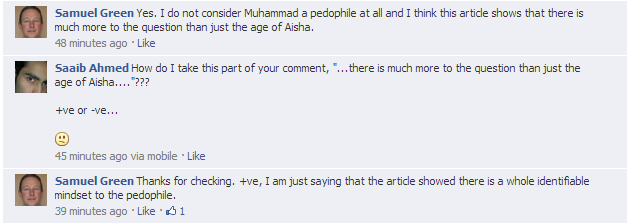
Answering Muslims and Acts17 are Christian Apologetics Ministries that are infamous for creating propaganda against Islam. David Wood, Anthony Rogers and Samuel Green are what I would consider to be the main proponents of these organization’s workings. Yet, I was thrown off balance by a shocking admission by Samuel Green via a Facebook article written by Calling Christian’s team member, Br. Azhan Ahmed on the topic of Muhammad [saws] and Paedophilia:

That’s a revelation by itself. Samuel Green openly disagrees with the views of David Wood, Sam Shamoun, and the rest of the Answering Muslism team, Acts17 team and the Answering Islam team. Samuel Green is known for his debates against numerous Muslim Da’ees in Australia and he is also known for associating with missionary groups organized for the sole purpose of Ministering to Muslims. Therefore, when he reneges on a view not only held by his closest Missionary friends, but by 3 other organizations he’s involved with, that speaks volumes. We look forward to Samuel Green’s further discussion on this revealing news, we also look forward to David Wood’s take on one of his writers disagreeing with what is considered to be a standard belief among his peers.

Does this represent dissension among the ranks of Answering Muslims and Answering Islam? Would Samuel Green be publicly refuted by his peers, or would he be forced to recant such statements? I can’t say what will happen, but this is overall good news for Islamic da’wah.

wa Allaahu Alam,
and Allaah knows best.

A Christian’s Love for Muslims

Bismillahir Rahmanir Raheem
بِسۡمِ ٱللهِ ٱلرَّحۡمَـٰنِ ٱلرَّحِيمِ ,

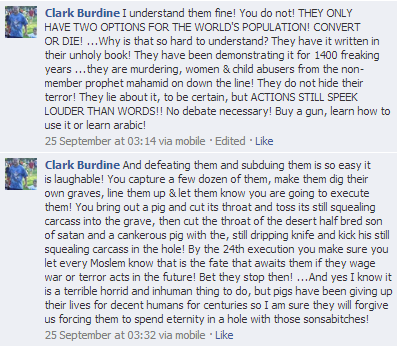
I’m sure we’ve all heard that emotional mumbo jumbo about ‘love’ from our Christian friends. That Muslims don’t have a God that loves them, that Muslims  don’t know what love is, that Islam is a religion void of love, that we Muslims need to embrace Christianity to truly understand and know what love is. We’ve all seen Christians preach that whole, ‘turn the other cheek’ mantra, too bad I felt too much Christian love from this group of Christians discussing Islam:

I’m not exactly sure where the Qur’an says that we have to convert the world or kill everyone in the world, perhaps someone who agrees with Clark can show me. Feel free to post your response in the comments section and I’d address the claim. Let’s return to our pal’s comments now. Strangely enough, our friend Clark makes it clear that he rather buy a gun, than debate/ discuss his concerns with Muslims. I’m thinking that this is the “shoot first, ask questions later”, kind of mentality.  If it isn’t enough to just buy a gun, our friend Clark has a brilliant master plan to bring peace and stability to the world. Kidnap a few Muslims, have them dig their graves, kill them and throw a pig’s carcass in their just for the heck of it. Just to be sure that they got the message, shout at their graves and let them know that they are not allowed to commit any future terrorist acts. At the end, Clark turns into some sort of a philosopher and decides that killing pigs and not humans may be a bad thing. I did some digging and well, Clark is just about Christian as they come:

Our loving Christian friend Clark, isn’t alone. He’s got a pal that also shares similar views:

I’m not sure that I can add much commentary to these images, it’s pretty clear to me that we’re dealing with persons who are actively discussing and intending to act violently towards Muslims. Their mentality is absolutely horrendous and quite shocking to say the least. Normally you’d expect folks who are discussing these things to do so privately, but to make such comments public and to share them among large groups of persons is disturbing to say the least. I can’t begin to imagine the outrage if Muslims had said this about Christians or Jews! I did some further digging and as it turns out, our buddy Louis supports Pamela Geller, the infamous Islamophobe who incited the Norwegian Anders Behring Breivik’s terrorist attacks against Muslims and Muslim friendly groups in Norway.

It should be noted that Christian Missionaries, David Wood and Sam Shamoun both support and promote Geller’s views. A quick look at David Wood’s Answering Muslims website shows numerous videos of Pamela. Two peas in a pod. Similar to the self declared “Crusader”, Anders not only discussed killing Muslims online, but he shared many of the same views as our friends Clark and Louis. If this trend is anything to base our suspicions on, we’re looking at persons intent on mass murdering Muslims and those who sympathize with Muslims, in the name of their Lord, Christ.

wa Allaahu Alam,
and Allaah knows best.

Malala Yousafzai and the Taliban

Bismillahir Rahmanir Raheem
بِسۡمِ ٱللهِ ٱلرَّحۡمَـٰنِ ٱلرَّحِيمِ ,

Some of you should recognize the stylishly clad gentleman in the top left of the above photo. If you don’t, then let me remind you that he is none other than esteemed, famed, patriotic Mr. Ronald Reagan, a former President of the United States. In his company are members of the infamous ‘Taliban’ of Afghanistan during a meeting in the White House.  It isn’t a secret that the United States armed and trained the Taliban militants in Afghanistan and Pakistan. In fact, this Reuters report indicates that the Taliban still had ‘stinger rockets’ that were funded and supplied by Reagan himself. Yet, even today according to this Guardian UK’s article, most Afghanis, including well known politicians and those of higher authority, they believe that the US continues to fund the Taliban:

One political scientist, who works as an advisor to US agencies in the north of the country, recounts how people fear the continuing influence of the warlords, illustrating his point with descriptions of violence and corruption that extends into the realms of banking, government and trade. Afghans hate these warlords, he says, but the US wants them kept in place. “If they were removed, and competent and clean people brought in, we would bring in revenues of our own. We could have our own economy, and demand foreign investment with transparency. We would have a true army, to protect us and serve Afghanistan.”

It’s also well known that American paid construction contracts, actually fund the Taliban. According to this Global Post US’ article, most contractors actually plan deals and negotiate contracts with the members of the rebel group. Sometimes even agreeing to let them blow up bridges, only to attain a new contract to rebuild, siphoning off more US funds to the Taliban. Former Afghani-Taliban envoy to the US, Yale educated – Sayyid  Rahmatullah Hashimi has even spoken on US policies during a lecture at the University of Southern California, where he explained that the Taliban was not opposed to the education of girls:

According to him, the Afghani state had a majority Muslim population and thus segregated education was on their agenda. While they were busy building girl’s schools, UN interests removed much needed funding, inclusive of funds needed to develop and maintain agricultural lands. Thus, when it comes to the issue of Malala Yousafzai, many questions need to be asked. If the Taliban are supposed to be representing Islam or Prophet Muhammad [saws], then shouldn’t they teach women?

Narrated Abu Said: A woman came to Allah’s Apostle and said, “O Allah’s Apostle! Men (only) benefit by your teachings, so please devote to us from (some of) your time, a day on which we may come to you so that you may teach us of what Allah has taught you.” Allah’s Apostle said, “Gather on such-and-such a day at such-and-such a place.” They gathered and Allah’s Apostle came to them and taught them of what Allah had taught him. – Sahih al Bukhari, Book #92, Hadith #413.

It should be noted that we can find in excess of 600 Ahadith from ‘Aisha [ra], the Prophet’s  [saws] wife, where either she is teaching or explaining some element of Islam to men and women. Therefore, if we see that the Prophet [saws] and his wife taught women, then can anyone who believes that Islam commands that women are not to be taught or educated, demonstrate such a belief from the Qur’an or Hadith corpus? Let’s continue with just one or two further examples of women and education in Islam.

  • Khabbab (may Allaah be pleased with her), taught the Qur’an, both to Fatima – may Allaah be pleased with her (‘Umar bin Al Khattab’s sister), and her husband, Sa’id bin Zaid. – Ibn Ishaq’s, “As Siyar wa al Maghazi”, ed. by Zakkar, pp. 181 – 184.
  • The very first revealed verse of the Qur’an commands all Muslims, not just men, to read: “اقْرَأْ بِاسْمِ رَبِّكَ الَّذِي خَلَقَ” – “Read in the name of your Lord who created“.

If Malala Yousafzai’s killing is appropriate according to Islam law, Qur’an or Ahadith, would anyone be able to demonstrate this for me? Most certainly not. This leads us to another question, why the hypocrisy? Pakistan became outraged, holding national protests and requests for justice, where even a national Day of Prayer was observed for her benefit:

On Friday, school children dedicated prayers to her recovery in morning assemblies and she was also remembered during weekly prayers at mosques across the country. Many prayer leaders condemned the attack, including the chief cleric of Pakistan’s largest mosque, Shahi Masjid, in Lahore. He called the young activist an “ambassador of peace and knowledge'”. Schools in the Swat Valley closed on Wednesday – the day after the shooting – in protest at the attack. Rallies have also been held in Islamabad, Peshawar, Lahore, Multan as well as in Malala’s hometown of Mingora.

I mentioned hypocrisy above, because I find it so strange, that Missionaries, TV Pundits, Mainstream Media, are all condemning this act of a girl wanting to learn and being shot for it. Yet when American forces murdered 69 children by bombing a school, where was the outrage?

A week after the attack, a local English newspaper published the names and home villages of 80 victims. Sixty-nine were reported as children aged 17 or under. According to the paper’s sources,

It was claimed that ‘one of the deceased was only seven-year old, three were eight, three nine, one was 10, four were 11, four were 12, eight were 13, six were 14, nine were 15, 19 were 16, 12 were 17, three were 18, three were 19 and only two were 21-years old’. Yusufzai is adamant that the attack was the work of the CIA: “I am absolutely confident, 100 per cent, that this was carried out by US drones, based on witnesses at the time and the subsequent comments of [Pakistani] government officials.” The US Embassy in Islamabad declined to comment on the case when offered the opportunity by the Bureau and The Express Tribune.

Where were the protests? Why didn’t America hold a national day of prayer? Why should Muslims be the only ones guilty when children are attacked for seeking an education, but when the US strikes a school and murders 69 children, we hear nothing? Hypocrisy is rife among those who criticise Islam, who trade one girl’s life for 69 dead children.

wa Allaahu Alam,
and Allaah knows best.


Top 10 Muslim vs Christian Debate Clips

Bismillahir Rahmanir Raheem
بِسۡمِ ٱللهِ ٱلرَّحۡمَـٰنِ ٱلرَّحِيمِ ,

Br. Muslim by Choice has released a hilarious 10 clip countdown of the best Muslim vs Christian debates. Some familiar faces include Dr. Shabbir Ali, Br. Sami Zataari and Ustadh Ali Ataie, alongside infamous Islamophobes, James White, Jay Smith and arsonist Anis Shorrosh. Entertaining and educational, it’s quite the video to watch:

wa Allaahu ‘Alam,
and Allaah knows best.

Funding Through 2013 and 2014

Bismillahir Rahmanir Raheem
بِسۡمِ ٱللهِ ٱلرَّحۡمَـٰنِ ٱلرَّحِيمِ ,

Calling Christians, prides itself in being self funded. Our team continues to donate towards expanding and maintaining the website and I am proud to announce that two members of our hard working team, have provided funding through the year until 2013 and until 2014. This means, that Calling Christians will continue to exist and our da’wah will continue to be available for all. It’s almost been one year since our website has existed and we’ve had many gains. Our large database of academic responses to intellectually void Missionaries is ever expanding, and our quality is ever improving.

It’s been a fun experiment, amassing ten’s of thousands of website views, while our reach extends into the US, UK, Canada, most European countries and a significant amount of Asian nations. Surprisingly, most of our website visits come from non-Muslim majority nations, that would mean that Christian majority nations (that is, our target audience) continue to be our greatest source of viewership. Our one year anniversary will coincide with the week of Christmas and plans are already afoot to have special articles, videos and many more surprises for this period.

We’ve accomplished one amazing debate, contributed to several international events and aided in exposing several notable Christian Missionary Scholars, I am proud of our achievements, but I am much more excited for what’s to come. The continued support from the Muslim community, and the continued and sustained dialogue with the Christian community, lends credence to this website’s ability to cross the threshold of interfaith academia. With all this having been said, I look forward to what the next few months bring and God willing, what the next few years holds for us and our work of da’wah.

wa Allaahu ‘Alam,
Br. Ijaz Ahmad.
– Director of CC.

New Covenant, Old Traditions

Bismillahir Rahmanir Raheem
بِسۡمِ ٱللهِ ٱلرَّحۡمَـٰنِ ٱلرَّحِيمِ ,

The crucifixion of Christ is alleged to have herald into commission, the New Covenant [1].  However, if we are to do a basic reading of the New Testament narrative of Christ’s alleged death, we run into some theological conundrums. The unknown authors of the synoptic Gospels were familiar with the Tanach, citing it at every chance they got, yet in doing so they’ve unearthed a vast amount of room for misapplied dogmas and theological errata. Often times, leading to the mess we’re about to uncover. On the cross, Jesus is alleged to have said:

“About three in the afternoon Jesus cried out in a loud voice, “Eli, Eli, lemasabachthani?” (which means “My God, my God, why have you forsaken me?”).[d]” – Matthew 27:46.

Most people see that little citation, that “d” and don’t seem to investigate it. So where does that “d”, lead to?

Matthew 27:46 – Psalm 22:1

Therefore, it is apparent that while Jesus was on the cross, he was referencing this chapter from Psalms. If we go to the chapter in Psalms, most people upon reading would be shocked at the contents within:

My God, my God, why have you forsaken me?
Why are you so far from saving me,
so far from my cries of anguish?
My God, I cry out by day, but you do not answer,
by night, but I find no rest.

According to the reading, God has abandoned Christ on the Cross. This is a far worse depiction of Christ, than any Pharisee could muster. Christ is depicted as abandoned by God, he is suffering and is not being saved by God, hardly a ‘willing sacrifice’ if you were to ask me. Strikingly, even Jesus concedes to the fact that if he was being crucified, that his own “Father”, did not answer his cries for help, this wasn’t for a moment, but lasted day and night. A most strange circumstance, considering that Christ is alleged to have said, “Ask and it will be given to you; seek and you will find; knock and the door will be opened to you.[2]” Unfortunately for Jesus, this was not the case, as God never answered him. If it didn’t work for Christ on the Cross, why do Christians expect anything to be granted to them, save for them believing they are greater than Christ, for if Christ’s sonship could not merit mercy from the “Father”, on what grounds should a lay Christian expect to be given more mercy than the son himself?

Yet you are enthroned as the Holy One;
you are the one Israel praises.
In you our ancestors put their trust;
they trusted and you delivered them.
To you they cried out and were saved;
in you they trusted and were not put to shame.

The diatribe continues by questioning God’s actions, see, God saved the Israelites when they called out to Him, yet when His own alleged Son calls out, there was no answer. Christ is also indicating here, that he was put to shame, yet the Israelites were not, can any Christian answer as to why Jesus was put to suffer and was void of God’s mercy and help?

But I am a worm and not a man,
scorned by everyone, despised by the people.
All who see me mock me;
they hurl insults, shaking their heads.
“He trusts in the Lord,” they say,
“let the Lord rescue him.
Let him deliver him,
since he delights in him.”

Yet you brought me out of the womb;
you made me trust in you, even at my mother’s breast.
10 From birth I was cast on you;
from my mother’s womb you have been my God.

11 Do not be far from me,
for trouble is near
and there is no one to help.

At this point, Christ, in referencing these verses, he no longer considers himself a ‘man’, he considers himself to be less than a man. We’ve all heard of the hypostatic union, half man, half God, well as it turns out, Christ negates being a man and assumes the role of a worm. I guess this is the Hypostatic Union Version 2.0. It’s also telling that Christ says there is no one to help him, this would either mean that Christ who is God, could not help himself or God, the all powerful, failed to help his son.

12 Many bulls surround me;
strong bulls of Bashan encircle me.
13 Roaring lions that tear their prey
open their mouths wide against me.

This is most intriguing, why does Christ reference Psalms 22, when it is in these passages that insults to Gentiles are still considered to be normal? If Christ was dying for their sins, shouldn’t he be dying with the intention of, “Father, forgive them, for they do not know what they are doing.[3]” Yet this is not Jesus’ attitude, it’s quite the opposite, he lowers himself to mocking and insulting, with curses meant for gentiles. In fact, this verse contains some level of anti-Semitism (not too dissimilar to John 8:44-48), Adam Clarke, a famed Christian exegete comments:

The bull is the emblem of brutal strength, that gores and tramples down all before it. Such was Absalom, Ahithophel, and others, who rose up in rebellion against David; and such were the Jewish rulers who conspired against ChristBashan was a district beyond Jordan, very fertile, where they were accustomed to fatten cattle, which became, in consequence of the excellent pasture, the largest, as well as the fattest, in the country. See Calmet. All in whose hands were the chief power and influence became David’s enemies; for Absalom had stolen away the hearts of all Israel. Against Christ, the chiefs both of Jews and Gentiles were united. [4]

Christ therefore, according to Christian theology, in his weakest moment, not only questioned God’s mercy but he fell privy to the sin of insulting and cursing both Gentiles and Jews. This as previously stated, in direct contrast to the earlier statement of, “Father, forgive them, for they do not know what they are doing.”

16 Dogs surround me,
a pack of villains encircles me;
they pierce my hands and my feet.

Lastly, we jump to the last of the insults, using a term that he also used to describe gentiles in Matthew 7, which reads:

Do not give dogs what is sacred; do not throw your pearls to pigs. If you do, they may trample them under their feet, and turn and tear you to pieces.”

Who are these dogs? According to several commentaries, it refers to ‘disbelievers‘, therefore Jews, Muslims, Hindus, Atheists are all considered to be dogs by the Christian God while bringing into commission, the New Covenant. The People’s New Testament Commentary says:

The dog was regarded an unclean animal by the Jewish law. They probably represent snarling, scoffing opposers. The characteristic of dogs is brutality. To try to instill holy things into such low, unclean, and sordid brutal minds is useless. [5]

Therefore infidels (those who are unfaithful) to Christ, are like dogs, because we oppose the religion of Christianity. How strange are these words indeed, especially when Christ was supposed to be dying for our sins. In his supposed ultimate act of mercy and sacrifice, Christ berates, curses and abuses the very people he is allegedly killing himself for.

Conclusion

While Christ was dying for our sins, he references Psalms 22. Upon reading Psalms 22, we discover that it entails a man who is abandoned by God, void of God’s mercy, leading the one in pain to question God’s authority and means of grace. The person suffering then decides to insult, mock and curse those who do not accept his beliefs. If these verses were referenced by Christ as a means of expressing his emotion while on the cross, then the notion that Christ introduced a New Covenant is hogwash, as Christ insults, mocks and curses both Gentiles and Jews. If this is not what Christ intended to communicate with his referencing of the aforementioned passages, why would he allegedly reference them to begin with?

Sources:

  1. Luke 22:20, “In the same way, after the supper he took the cup, saying, “This cup is the new covenant in my blood, which is poured out for you.”.
  2. Matthew 7:7.
  3. Luke 23:34.
  4. Adam Clarke’s Commentary, Psalms 22:12-13.
  5. People’s New Testament Commentary, Matthew 7:6.

Refutation: Is Jesus God because he did mighty miracles?

Bismillahir Rahmanir Raheem
بِسۡمِ ٱللهِ ٱلرَّحۡمَـٰنِ ٱلرَّحِيمِ ,

Question:

Some Christians believe that Jesus’ miracles prove that he is God. The problem with this claim is that almost every single miracle performed by Jesus finds a parallel within the OT. There are many OT prophets that performed the very same kinds of miracles that Jesus did. If the miracles of Jesus make him God then why don’t the miracles of the other prophets prove that they are God/gods as well?

Answer:

Sam’s response is quite muddled, in the sense that while he does attempt to answer the question, he actually falls just short. I understand that this was an honest attempt at responding to the question, but Sam seems unable of directly answer questions. Whether this is due to a lack of faith or a lack of intelligence, I cannot say. but clearly he has lost the plot. He says, and I quote:

 In the first place, it isn’t so much the miracles which make Jesus God, but the divine claims of Jesus which the miracles serve to validate. Jesus made certain statements that no other true prophet before him ever did, and then performed supernatural miracles to back up the truthfulness and validity of those claims:

“‘My sheep hear my voice, and I know them, and they follow me. I GIVE THEM ETERNAL LIFE, and they will never perish, AND NO ONE WILL SNATCH THEM OUT OF MY HAND. My Father, who has given them to me, is greater than all, and no one is able to snatch them out of the Father’s hand. I and the Father are one.’ The Jews picked up stones again to stone him. Jesus answered them, ‘I have shown you many good works from the Father; for which of them are you going to stone me?’ The Jews answered him, ‘It is not for a good work that we are going to stone you but for blasphemy, because you, being a man, make yourself God.’ Jesus answered them, ‘Is it not written in your Law, “I said, you are gods”? If he called them gods to whom the word of God came–and Scripture cannot be broken– do you say of him whom the Father consecrated and sent into the world, “You are blaspheming,” because I said, “I am the Son of God”? If I am not doing the works of my Father, then do not believe me;but if I do them, even though you do not believe me, believe the works, that you may know and understand that the Father is in me and I am in the Father.’ Again they sought to arrest him, but he escaped from their hands.” John 10:25-39

“Jesus said to him, ‘Have I been with you so long, and you still do not know me, Philip? Whoever has seen me has seen the Father. How can you say, “Show us the Father”? Do you not believe that I am in the Father and the Father is in me? The words that I say to you I do not speak on my own authority, but the Father who dwells in me does his works. Believe me that I am in the Father and the Father is in me,or else believe on account of the works themselves.’” John 14:9-11

If I had not done among them the works that no one else did, they would not be guilty of sin, but now they have seen and hated both me and my Father.” John 15:24

“concerning his Son, who was descended from David according to the flesh and was declared to be the Son of God IN POWER according to the Spirit of holiness by his resurrection from the dead, Jesus Christ our Lord,” Romans 1:3-4

Thus, the miracles do not make Jesus God, but rather it is Jesus’ own claims which demonstrate that he at least believed he is God. The miracles only served the purpose of providing divine validation for Christ’s claims.

According to Sam, it’s Jesus’ own words which make him into their God and the miracles Jesus did are simply done to validate Christ’s statements. However, this is a dogmatic answer, it is quite well known that these statements attributed to Christ in the Bible are not first person verbatim (Greek: grapho) statements. Meaning then, that they cannot directly be traced back to Jesus, but can be traced back to someone attributing them to Jesus. If I were to throw this piece of knowledge out of the discussion and assume that Jesus did speak these words, we would still reach at the conclusion that Christ is not a God. For example, using Sam’s quote from John 10 above, we read:

My sheep hear my voice, and I know them, and they follow me. I GIVE THEM ETERNAL LIFE, and they will never perish, AND NO ONE WILL SNATCH THEM OUT OF MY HAND. My Father, who has given them to me, is greater than all, and no one is able to snatch them out of the Father’s hand……I have shown you many good works from the Father;

If we also examine his quote of John 14, we see:

“Jesus said to him, ‘Have I been with you so long, and you still do not know me, Philip? Whoever has seen me has seen the Father. How can you say, “Show us the Father”? Do you not believe that I am in the Father and the Father is in me? The words that I say to you I do not speak on my own authority, but the Father who dwells in me does his works. Believe me that I am in the Father and the Father is in me,or else believe on account of the works themselves.’” John 14:9-11

While Jesus is able to do the miracle, he is claiming that the source of the miracle is not himself, but the Father (God). Jesus is making it clear that the authority who is permitting him to exercise these ‘miracles’ are from the Father (God). Sam’s quote of Romans is irrelevant as these are Paul’s words and not Christ’s. If he cannot prove Christ’s divinity without needing Paul, then clearly he has failed at proving Christ’s divinity, as this would mean that Christ’s words alone are not sufficient in determining his deity. There exists another problem, Sam’s argument can be summarised as such:

  • Christ is God because of what he says.
  • Miracles add validity to his claim of being a deity.

The logic being:

  • If Christ says he is a God.
  • Then miracles add credence to his claim.

Yet, none of Sam’s passages, whether they be Mark 2:5-12, Mark 3:9-11, Matthew 14:22-23, John 6:5-15, 26-42, 47-59, John 11:1-3, 23-27, 38-43 or John 5:2-10, 16-21, 25-26, 28-29, demonstrate that Christ is God, Sam has instead, skipped his initial premise and jumped into the second premise, foregoing his onus of having to prove that Jesus claimed to be a deity. He recognized this by labelling them miracles:

  • Miracles Proving that Jesus Forgives Sins
  • Miracles Proving that Jesus is Sovereign over both the Spiritual and Physical Realms
  • Miracles Proving that Jesus is the Sustainer and the Source of Life
  • Miracles Proving that Jesus is co-equal to the Father

Therefore by Sam’s purposeful ignoring of his own criteria, and because of his own actions, he has intentionally rested his case on miracles and not on Christ claiming to be a deity. This would then mean that because Sam has not proved Christ’s deity through Christ’s own words, then logically, the miracles do not add validity to the claim of Jesus being a deity. Thus rendering Jesus as a miracle worker and not a man-God. If we examine Sam’s ‘miracles‘, what do we see? If we take each of the miracles that Sam has used an example and refer them to Acts 2:22, which reads:

Fellow Israelites, listen to this: Jesus of Nazareth was a man accredited by God to you by miracles, wonders and signs, which God did among you through him, as you yourselves know. – Acts 2:22.

and John 5:30, which reads:

By myself I can do nothing; I judge only as I hear, and my judgment is just, for I seek not to please myself but him who sent me. – John 5:30.

Our resulting conclusion of those miracles should be that:

  • Jesus told someone that there sins were forgiven because the Father forgave the person.
  • Jesus was called the Son of God (a title given to many throughout the OT and NT), and his hand was licked like a dog licking its master’s hand (the word used for worship is  ‘προσκυνέω’ – Strong’s Lexicon, G4352, ‘From G4314 and probably a derivative of G2965 (meaning to kiss, like a dog licking his master’s hand)’.
  • Jesus brings life to those who are spiritually dead, he will ‘resurrect’ their spirituality.
  • The Father has sent Christ to do works in His name.

Practically nothing that Sam has quoted or referenced, lends credence to the claim that Christ is a deity, in fact, what we’ve seen is the direct opposite. Christ constantly indicates that he is doing the work or will of God, by the authority of God. After not proving Christ’s deity and relegating Christ’s miracles as a sign that he is not a God (Note: Sam said that miracles do not make Christ a God, yet Sam constantly tries to demonstrate the miracles which allude to Christ being a God). Sam goes on to say:

No prophet or apostle ever made the claims that the Lord Jesus made, and none of their miracles were done to validate their claims of being Deity.

None of the passages above demonstrate any odd claims that Jesus made. Christ constantly indicates that he is doing the will of the Father (God), in fact, Christ never lays claim to deity, as opposed to his alleged ‘Triune Father’ – YHWH who boasted of it, and made it known to thousands constantly – see my article, “The Christian God: Non Compos Mentis“. Sam continues by saying:

The prophets went out of their to show that they were nothing more than fallible human beings whom God empowered to carry out his specific purpose and will. This is quite unlike the Lord Jesus.

How is this, ‘unlike Jesus‘? Jesus showed that he was weak and feeble, that he had to run and hide, as any other man would, when his life was threatened:

 Believe in the light while you have the light, so that you may become children of light.” When he had finished speaking, Jesus left and hid himself from them. – John 12:36.

Sam, realising that he can’t prove Jesus’ deity through Jesus’ own words, then tried to prove Jesus was God through another alleged miracle, he attempted to do so using Mark 9:38, which reads:

“Teacher,” said John, “we saw someone driving out demons in your name and we told him to stop, because he was not one of us.”

The phrase, ‘in your name’, is rendered as: ‘εν σου ονομα‘, which according to the Greek, also reads, ‘by your authority‘ (see: Strong’s Lexicon, G1722, G4675, G3686). Therefore Sam’s appeal to the text is fanciful at best as the text can be rendered both ways, which is in light of the Gospel’s account of him, which reads:

When Jesus had finished saying these things, the crowds were amazed at his teaching, because he taught as one who had authority, and not as their teachers of the law. – Matthew 7:29.

Therefore, in Mark 9:38, the person was able to drive out demons, by the authority of Christ’s teachings. Similarly, the account in Acts which  Sam has appealed to are once again based on experiences of Paul and not from Jesus, thus directly contradicting his own criteria. If Sam needs more than what Jesus said or did to prove him to be a deity, as opposed to using examples of Christ-only events, then Christ’s own testimony is not sufficient to qualify his claims. Sam then says:

The Quran mentions many of the miracles of the prophets but fails to record a single miracle of Muhammad.

Which is a bit funny, as he then goes on to quote two ayat (verses) from the Qur’an, which says that the Qur’an itself is one of the miracles attributed to Muhammad [saws] (see quote below). That being a direct contradiction of his previous claim:

In fact, many passages of the Quran explicitly deny that Muhammad could perform any sign or wonder. Here are a couple of verses:

But (now), when the Truth has come to them from Ourselves, they say, “Why are not (Signs) sent to him, like those which were sent to Moses?” Do they not then reject (the Signs) which were formerly sent to Moses? They say: “Two kinds of sorcery, each assisting the other!” And they say: “For us, we reject all (such things)!” S. 28:48

Nay; rather it is signs, clear signs in the breasts of those who have been given knowledge; and none denies Our signs but the evildoers. They say, ‘Why have signs not been sent down upon him from his Lord?’ Say: ‘The signs are only with God, and I am only a plain warner. What, is it not SUFFICIENT FOR THEM that We have sent down upon thee the Book that is recited to them? Surely in that is a mercy, and a reminder to a people who believe. S. 29:49-51 A.J. Arberry

It should be noted that none of the ayat say that Muhammad [saws] could not perform any sign or wonder. I know that Sam can be desperate at times, but to quote something and then directly lie about what he has just quoted either demonstrates abject dishonesty or really horrible comprehension abilities. He continues his eisegesis of the Qur’an by saying:

The last passage expressly states that the Quran is sufficient as a sign, which means that no other sign or miracle was necessary. Thus, this surah poses huge problems for Muslims since if Muhammad did perform miracles then this means that the Quran is not sufficient, thereby falsifying the claims of the Quran!

In a previous response to Sam, I dubbed the term, “Shamounian Logic”, and it’s mostly certainly showed up again. The Qur’an clearly says that the Qur’an is a sufficient miracle for those who have knowledge and understanding, it does not say that it is the only miracle that is necessary, or that other miracles would be more sufficient, or that there would be no other miracles. In Sam’s reasoning, although the Qur’an says it is sufficient, if more miracles were done, this somehow makes the Qur’an less sufficient. His reasoning is not clear, the Qur’an does not say that nothing else is a sufficient miracle or that there would be no more miracles, but what it does say, is that by itself, the Qur’an is a sufficient miracle, if there are other miracles that are sufficient for other persons, that does not negate the appropriateness or sufficiency of the Qur’an. I’ll give an example of Sam’s reasoning using Paul and “the sufficiency of Christ’s Grace“. In 2 Corinthians 12 we read:

Therefore, in order to keep me from becoming conceited, I was given a thorn in my flesh, a messenger of Satan, to torment me.  Three times I pleaded with the Lord to take it away from me. But he said to me, “My grace is sufficient for you, for my power is made perfect in weakness.” – 2 Corinthians 12:7-9.

Even though Christ’s grace was supposed to be sufficient enough for Paul to deal with the messenger of Satan tormenting him, Paul still begged and pleaded for the ‘thorn in his flesh’ to be removed. This thorn was never removed, does this mean that Christ’s grace was not sufficient? According to Sam’s reading, the answer is “Yes”. Sam then admits that while there are miracles that the Prophet Muhammad [saws] did do, that these are recorded in ahadith and they are therefore ‘all made up or false‘, an appeal to ignorance really. Sam does not understand Ulum al Hadith, of which is the basis for the modern science of Textual Criticism. Hadiths were not written later or hundreds of years after the Prophet [saws], but during and directly after his lifetime, see the following excerpt from this article by Brother Jibreel (a former Christian convert to Islam):

2. The Muslim Methodology of Preserving Information

The Jewish and Christian Scriptures suffered at the hands of the very people who should have guarded them. Because of this, the Muslim community felt a pressing need to safeguard the knowledge that was entrusted to them. To write a book using a false name is tremendously easy; in the literary world the use of pen names is commonplace. Similarly, it is possible to tamper with someone else’s work then republish it under the original author’s name…Muslims devised a working solution long ago, developing a watertight system which they employed faithfully for eight or nine centuries.[4] Starting from the time of prophet Muhammad (peace be upon him) him receiving the firs revelation, knowledge proliferation has been at the core of the Muslim nation. Upon reaching Madinah the prophet (peace be upon him) arranged schools and ordered scribes to write whatever he dictated. Many companions had copies of his letters dispatched to different people.[5] Not only those things were written down with the outmost care, but also at the same time information was being checked for reliability and content. From the affairs of the government during the reigns of the three caliphs to the administrative lessons, religious rulings, political and military strategies and all of the prophet’s traditions were passed on through a very strict system.[6] The Muslims methodology of gathering information, verifying it and passing it on had no match. The isnad systems that were developed to make sure that each incident or rapport is reported by an unbroken chain back to the original narrator[7]. Evidence for the transmission of knowledge in this manner comes from thousands of ahadith bearing identical wordings but coming from different corners of the Islamic world, each tracing its origin back to a common source – the Prophet, a Companion, or a Successor.[8] For example the hadith of Abu Huraira about the obligation of following the Imam is recorded at least 124 times, and reported by 26 third-generation authorities that unanimously trace its origin to Companions of the Prophet (peace be upon him).[9] However theisnad system was only the first step in establishing authenticity and preserving information. Establishing trustworthiness (morality, ability, memory etc.) of the narrator was another important step in the Muslim methodology of preserving information. Umar Al Khatab and Abu Bakr, when collecting the Quran in one book, they followed the instructions of Allah the Almighty:

“…and take for witness two persons from among you, endued with justice.”[10]

The people of ahlul suffah (companions of the rows) used to dedicate their whole lives just to record and propagate the teachings of Islam during the time of prophet Muhammad (peace be upon him). Many companions such as Uthman, Ali, Umar and others memorized not only the sayings of prophet Muhammad (peace be upon him) but also the whole Quran. The knowledge they preserved was passed on in the forms of books through a very stringent system that involved different levels of information delivery such as Sama’ (teacher reading to student), Ardh(student reading to teacher), Munawala (hading someone a text and allowing transmission), Kitaba (a form of correspondence), and Wasiyya (entrusting someone with knowledge to be delivered). These are just a few examples of the strict methods taken by Muslims to preserve information and the early stage in which such began being implemented[11]. Now we turn our attention to the proofs of the documentation of the Sunnah of prophet Muhammad (peace be upon him) during his time.

3. Documentation of the Sunnah during the Prophet’s (peace be upon him) time

It is agreed upon that the Sunnah of prophet Muhammad (peace be upon him) was not fully recorded in written form during his life time, however as we have pointed out the Muslim methodology was not restricted to writing, and it relied heavily on memorization. However much of the ahadtih have been recorded in writing and books during the lifetime of the prophet (peace be upon him). There are many evidences showing that companions (in this case Abu Shah) used to write the speeches of prophet Muhammad such as the example of the speech of the inviolability of Makkah.[12] The prophet (peace be upon him) also wrote letters to many kings inviting them to Islam, some of them still being available today. Some critics have raised an objection by quoting the hadith of Abu Sa’eed al-Khudri, who narrates that prophet Muhammad said:

“Do not take down anything from me, and he who took down anything from me except the Qur’an, he should efface that…”[13]

They claim that prophet Muhammad (peace be upon him) did not allow hadith to be recorded, however they selectively take what suits their agenda and ignore the whole corpus of ahadith. It is clear from the wording of prophet Muhammad that such a statement was general and it was during the time when the writing of the Quran was in it’s early stages. The prophet allowed and encouraged his companions to write ahadith once the system for recording Quran was in place. He did not want companions to mix the Quran with ahadith, and indeed we see today that such genius paid off. When some companions heard that Amr ibn Al As’s had scrolls of ahadith, they reproached him, however he went and told the prophet who said:

“Write from me, for by the One Who has my soul in His hand, nothing other than the truth has ever come out of my mouth”.[14]

The same Abdullah ibn Amr ibn Al As’s collected the book called Al-Sahefah As-Sadiqah. This is a book that contained many ahdith of the prophet Muhammad (peace be upon him) and was spread amongst the companions and later generations. The Sahefah of Abu Hurayrah, which was proliferated by his student Hammam ibn Munabbih, that has survived till today and was published by Dr. Hamidullah.[15] It is without a doubt that there is sufficient information in the history of Islam to show that the Sunnah of prophet Muhammad (peace be upon him) was recorded and passed on with his permission and during his lifetime. Those who say that the Sunnah was recorded only centuries after prophet Muhammad during the time of Bukhari and Muslim are far away from the historical proofs that are widely available, wishing only to escape the strict security measures that were divinely implemented in guarding not only the Quran and the Sunnah, but also Islam as a way of life.

4. Documentation of the Sunnah after the Death of Prophet Muhammad (peace be upon him)

After the death of Muhammad (peace be upon him), his companions took an even stricter approach in preserving and reporting the Sunnah. In this period, a number of leading companions wrote down narrations and preserved them. Abu Hurayrah to whom 5374 channels of hadith are attributed, had many books in his possession as reported by Hasan ibn Amr ad-Damari.[16] Abdullah ibn Abbas to whom 1600 channels of narrations are attributed used to write whatever he heard and used to hire his servants to write ahadith for him.[17] Abdullah ibn Amr ibn Al Aas to whom 700 channels of narration are attributed recorded ahadith in his Sahefah, while Abu Bakr was also amongst those who used to possess written copies of the Sunnah of prophet Muhammad (peace be upon him).[18] After the companions of prophet Muhammad (peace be upon him), their students passed on the knowledge to their students. Abu Hurairah had nine students writing down from him, Ibn Umar had eight, Anas had sixteen, Aisha had three, ibn Abbas had nine, Jabir had fourteen, and others did the same as well.[19] The time in history is known as the era of the Tabi’oon and in this era the science of gathering ahadith became stricter, as people began inventing ahadith. It is very important to highlight here the fact that fabrication was discovered and dealt with. This shows the strict nature of the system and the strong filters it had for innovations and lies. Under the reign of Umar ibn Abdul Azeez[20] the scholars compiled books of ahadith containing biographical data on the various narrators of ahadith, exposing the liars and fabricators.[21] The hadith proliferation spread with such a great strength and precise science that the science began influencing the other branches of Islamic knowledge such as Aqeedah, Fiq and other. The people would not accept the authority of any teacher of any subject, unless he or she would possess the unbroken link till prophet Muhammad (peace be upon him) coupled with the reliability criteria for that person in question. The collection of ahadith and knowledge was so intense and serious that some would not wait for the ahadith to reach them but they would travel for long periods of time to hear and verify ahadith. Jabir ibn Abdullah heard of a hadith and traveled on a mount that he had purchased, and after one moth of travel he gathered the hadith and returned back. The same happened to Abu Ayoob al Ansari.[22] The sciences have only intensified and crystallized as time advanced and following the ear of the companions, the followers and their followers came the ear of the Saheehs, which was the pinnacle of hadith sciences[23].

The following excerpt is from “The Compilation of Hadith, by Shaykh Abdul Ghafar Rahmanee“, wherein he mentions the earliest codices of ahadith, dating from the time of the Prophet [saws], to directly after his death, not several hundred years later as Sam has dishonestly stated:

The Written Works of the First Period

1. Saaheefa Saadiqaa
This has been attributed to Abdullaah Ibn Amr al-Aas (d.63H at the age of 77). He had a great love for writing and making notes and whatever he heard from the Prophet Muhammad (sal-Allaahu ‘alayhe wa sallam), he would write down. He personally had permission from the Messenger of Allaah (sal-Allaahu ‘alayhe wa sallam).5 This treatise is composed of about 1000 ahaadeeth. It remained secure and preserved
within his family for a long time. All of it can be found in the Musnad of Imaam Ahmad (rahimahullaah).

2. Saaheefa Saheehaa
This is attributed to Humaam Ibn Munabbeh (rahimahullaah) (d.101H). He was from the famous students of Abu Hurairah (radi-Allaahu ‘anhu); he wrote all the ahaadeeth from his teacher. Copies of this manuscript are available from libraries in Berlin (Germany) and Damascus (Syria); Imaam Ahmad Ibn Hanbal (rahimahullaah) has categorised all of this Saaheefa in his Musnad, under Abu Hurairah (radi-Allaahu ‘anhu).6 This treatise, after considerable effort by Dr. Hameedullaah, has been printed and distributed from Hyderabad (Deccan). It contains 138 narrations. This Saaheefa is a part of the ahaadeeth narrated from Abu Hurairah, most of its narration’s are in Bukhaaree and Muslim; the words of the ahaadeeth are extremely similar and there are no major differences between them.

3. Saaheefa Basheer Ibn Naheek
He was the student of Abu Hurairah (radi-Allaahu ‘anhu). He also gathered and wrote a treatise of ahaadeeth which he read to Abu Hurairah (radi-Allaahu ‘anhu), before they departed, and he verified it.7

4. Musnad Abu Hurairah (radi-Allaahu ‘anhu)
It was written during the time of the Companions. Its copy was with the father of Umar Ibn Abdul Azeez (radi-Allaahu ‘anhu), Abdul Azeez Ibn Marwaan, the Governor of Misr who died in 86H. He wrote to Katheer Ibn Murrah instructing him to write down all the hadeeth he heard from the Companions and to send them to him. Along with this command, he told him not to send the ahaadeeth of Abu Hurairah as
he already had them.8 And the Musnad of Abu Hurairah (radi-Allaahu ‘anhu) was hand-written by Ibn
Taymiyyah (rahimahullaah). It is available in a library in Germany. 9

5. Saaheefa Alee (radi-Allaahu ‘anhu)
We find from Imaam Bukhaaree’s checking that this collection was quite voluminous and it had in it issues of zakah, and from the actions that were permissible or  impermissible in Madeenah, the Khutbatul-Hajjah al-Widah and Islaamic guidelines.10

6. The Final Sermon of the Messenger of Allaah (sal-Allaahu ‘alayhe wa sallam)
On the conquest of Makkah the Messenger of Allaah (sal-Allaahu ‘alayhe wa sallam) told Abu Shah Yamanee (radi-Allaahu ‘anhu) to write down the final sermon. 11

7. Saaheefa Jaabir (radi-Allaahu ‘anhu)
His students, Wahb Ibn Munabbeh (d.110H) and Sulaymaan Ibn Qais Lashkaree, collected the narrations of Jaabir (radi-Allaahu ‘anhu). In it they wrote down issues of Hajj and the Khutbatul-Hajjah al-Widah.12

8. Narrations of Aa’ishah Siddeeqa (radi-Allaahu ‘anhaa)
The narrations of Aa’ishah Siddeeqa were written by her student, Urwah Ibn Zubair.13

9. Ahaadeeth of Ibn Abbaas (radi-Allaahu ‘anhu)
There were many compilations of the ahaadeeth of Ibn Abbaas (radi-Allaahu ‘anhu). Sa’eed Ibn Jubair would compile his ahaadeeth.14
10. The Saaheefa of Anas Ibn Maalik (radi-Allaahu ‘anhu) Sa’eed Ibn Hilaal narrates that Anas Ibn Maalik (radi-Allaahu ‘anhu) would mention
everything he had written by memory; whilst showing us he would say: “I heard this narration from the Messenger of Allaah (sal-Allaahu alayhe wa sallam) myself and I would write it down and repeat it to the Messenger of Allaah (sal-Allaahu ‘alayhe wa sallam) so that he would
affirm it.” 15

11. Amr Ibn Hazm (radi-Allaahu ‘anhu)
When he was made the Governor and sent to Yemen he was given written instructions and guidance. Not only did he protect the guidelines but he also added 21 commands of the Messenger of Allaah (sal-Allaahu ‘alayhe wa sallam) and he made it into the
form of a book.16

12. Risaalah of Samurah Ibn Jundub (radi-Allaahu ‘anhu)
This was given to his son in the form of a will; this was a great treasure.17

13. Sa’ad Ibn Ubaadah (radi-Allaahu ‘anhu)
He knew how to read and write from the time of Jahiliyyah.

14. Maktoob Naaf’i (radi-Allaahu ‘anhu)
Sulaymaan Ibn Moosaa narrates that Abdullaah Ibn Umar (radi-Allaahu ‘anhu) would dictate and Naaf’i would write.18

Citations and Sources:

5 See Mukhtasar Jaami Bayaan al-Ilm (pp. 36-37).
6 For further details see Saaheefa Humaam of Dr. Hameedullaah and Musnad Ahmad (2/312-318).
7 See Jaami al-Bayaan (1/72) and Tahdheeb at-Tahdheeb (1/470)
8 See Saaheefa Humaam (p.50) and Tabaqaat Ibn Sa’ad (7/157)
9 Muqqadimah Tuhfatul-Ahwadhee Sharh Jaami Tirmidhee (p.165)
10 Saheeh al-Bukhaaree, Kitaab al-Ei’tisaam bil-Kitaab was Sunnah (1/451)
11 Saheeh al-Bukhaaree (1/20), Mukhtasar Jaami Bayaan al-Ilm (p. 36) and Saheeh Muslim (1/439)

12 Tahdheeb at-Tahdheeb (4/215)
13 Tahdheeb at-Tahdheeb (7/183)
14 ad-Daarimee (p. 68)
15 Saaheefa Ibn Humaam (p. 34) from Khateeb al-Baghdaadee and al-Haakim (3/574)
16 al-Wathaiq as-Siyaasah (p.105), Tabaree (p.104)
17 Tahdheeb at-Tahdheeb (4/236)
18 Ad-Daarimee (p.69) and Saaheefa Ibn Humaam (p.45) from Tabaqaat Ibn Sa’ad

You can see more of the Prophet’s [saws] miracles here and here:

Ergo, Sam Shamoun has been duly debunked, his incompetence demonstrated and his dishonesty made public. He has thus far, failed to answer the question, abused his own logic, and lied against common ahadith knowledge. His attempts to deceive and pervert basic historical information have been shown to be infantile, and I must conclude that Sam’s arguments have been thoroughly reduced to nothing more than an ignorant’s rants.

wa Allaahu ‘Alam,
and Allaah knows best.

« Older Entries Recent Entries »