Category Archives: Muslim and Non-Muslim Dialogue

Thank You!

Bismillahir Rahmanir Raheem
بِسۡمِ ٱللهِ ٱلرَّحۡمَـٰنِ ٱلرَّحِيمِ ,

It’s been a fantastic full 8 months of operation. This month of August is special to the Calling Christians team. For the month of August we celebrate two new records!

  • We’ve reached 2000+ Likes on Facebook. Click the image above or here, to like our Facebook page. Get daily Islamic news, discussions, our latest posts, interact with the authors, debate with Christians, Jews, Atheists. The Calling Christians ecosystem continues to expand and with that expansion comes a host of new readers, supporters and new Muslims, allhamdulillah.
  • This month we’ve reached our highest visitor count to the website, more than triple that of our first entire month, which was January of 2012. That’s right, in 8 months we’ve tripled our views, we’ve amassed a couple thousand views each month for several months with each month bringing a new increase of visitors, allhamdulillah. Our growth has been exponential, yet smooth. Our content has become more frequent and the average quality of posts has been raised dramatically. Many of our authors have also began to engage in live da’wah (on the streets- Br. Hamza, Br. Alex, Sr. Alice), and some to the TV (Br. Ijaz). We have many more surprises in store before the close of 2012, so stay tuned and thank you for supporting our cause.

We remain committed to defending Islam, answering the lies of the missionaries, guiding misguided Muslims back to Islam and bringing Christians and Jews to Islam. Our mission and our success has only been made possible through the will of Allaah ta ‘ala and He alone deserves our praise and worship. May Allaah ta ‘ala continue to bless our da’wah, make it a source of guidance for many and allow us to preach the haqq of Islam, ameen.

wa Allaahu Alam,
and God knows best.

Is Islam accurate to blame Christians for Priest-Worship?

Question Mark

Introduction

Notwithstanding the complexities of “Trinity”, certain forms of Christianity (1.) have always assumed itself to be monotheistic! Islam disqualified the claims of Christianity as being strictly monotheistic. Deification of Jesus (peace be upon him) – one of the more obvious breach in monotheism for Islam – was not the only reason for Islam to reject Christianity as precisely monotheistic. Islam went beyond the boundaries ofobvious acts of polytheism. It included much finer nuances. Precisely, Islam impeached Christianity for following their priests, anchorites and presbyters and claimed that by doing so the Christians worship them.

In this paper we intend to look at this issue in some detail. Was Islam accurate to claim that Christians worship their church orders? Or did Islam misrepresent an otherwise “monotheistic” religion?

“They take their priests and their anchorites to be their lords”


Qur’an claimed that the Christians (not merely Roman Catholics) worship their priests and other presbyters:

They take their priests and their anchorites to be their lords in derogation of Allah, and (they take as their Lord) Christ the son of Mary; yet they were commanded to worship but One Allah: there is no god but He. Praise and glory to Him: (Far is He) from having the partners they associate (with Him). (Qur’an 9:31, Yusuf Ali’s Quran Translation)


When the above verse was read in to Adi Ibn Hatim, a newly convert from Christianity and a companion of the Prophet (peace be upon him) he exclaimed as if it was a misrepresentation of his former abandoned belief. He clarified that they did not used to worship their church elders: “Surely we did not worship them

Upon this remark the Prophet (peace be upon him) answered him that by overruling the commands of God to the words of Priests they used to worship them:

Did they not make forbidden (haram) what Allah had made allowable (halal) and you all made it haram, and did they not make halal what Allah made (haram) and you all made it halal?” He replied, “We certainly did.” The Prophet then said, “That was how you worshipped them.” (Collected by Tirmidhi, as cited in Fundamentals of Tawheed, Dr. Bilal Philips. p. 40)

On the foregoing, Dr. Bilal cites examples how Christian priests have overruled divine laws of God and instituted them for their laity:

Lawful made unlawful:

“Christian clergy made haram the marrying of more than one wife and the marrying of first cousins. Roman Catholicism forbade priests from marrying and forbade divorce in general.” (Dr. Bilal Philips, Fundamentals of Tawheed, Footnote no. 33, p. 40)

And, Unlawful made Lawful:

“The Christian Church made halal the consumption of pork, blood and alcohol. Some of them also made allowable painting and statues depicting God as a man. (Dr. Bilal Philips, Fundamentals of Tawheed, Footnote no. 34, p. 40)

It is not too perplex to understand the appeal of Islam. If mere mortals, the priests, had the privilege to overrule the divine laws instituted by God Himself then they rise to a status at par with Him. Now there voice becomes one with the voice of God; their rivaling injunctions become the divine rules for the laity. This phenomenon of distorted faith naturally ends up deifying priests.

Sadly, Christianity does not recognize it as a problem, let alone, most heinous one. On the contrary they profess this malpractice thereby bolstering Qur’an and its Prophet (peace be upon him) for their precise representation of their faith.

Consider, for example, some of the writings of famous and one of the earliest (latefirst century), orthodox, Church Father Ignatius of Antioch:

“You should do nothing apart from the bishop” (Ign. Magn. 7.1)

“Be subject to the bishop as to the commandment” (Ign. Trall. 13.2)

We are clearly obliged to look upon the bishop as the Lord himself” (Ign. Eph. 6.1)

Notice that orthodox Christians (including Protestants) were not given any leeway for their own perspective; they just had no voice of their own unless they complied with the “Bishop” – the successors of the disciples themselves! They can “do nothingapart from the bishop” (2.). This claim in itself has overtones of absolute sovereigntybestowed upon the “Bishop”No wonder Ignatius goes on to assert that the utterances of the “Bishops” was just like – “as” – divine, holy and inspired as the Mosaic commandments themselves!

Logically, it does not come very appalling that Ignatius – the prototype of the “monotheist”, orthodox Christians – exhorted that the “Bishops”, the mere mortals that they were, were to be looked upon as “Lord himself”!

On the preceding, New Testament authority Bart Ehrman rightly asserts the following:

Each Christian community had a bishop, and this bishop’s word was LAW [Mosaic]The bishop was to be followed as if he were God himself. (Bart Ehrman, Lost Christianities, p.141)

[Side Remark: At this point, we strongly recommend our earlier articles on the same topic,

What is even embarrassing, Ignatius believed that he was divinely inspired for his otherwise idolatrous comments:

For even if some people have wanted to deceive me according to the flesh, the Spirit is not deceived, since it comes from God. For it knows whence it comes and where it is going, and it exposes the things that are hidden. I cried out while among you, speaking in a great voice, the voice of God, “Pay attention to the bishop and the presbytery and the deacons!” But some suspected that I said these things because I knew in advance that there was a division among you.But the one in whom I am bound is my witness that I knew it from no human source; but the Spirit was preaching, saying: “Do nothing apart from the bishop; keep your flesh as the Temple of God; love unity; flee divisions; be imitators of Jesus Christ as he is of his Father.” (Ign. Phil., 7)

Ignatius, an Orthodox Church father, contemporary to the gospel(s) themselves, had no scruples in asserting that it was “God” – the Holy “Ghost” – himself who inspired him to preach Bishops at par with the Triune gods and their “preaching”.

This compels us to think: At best every ecclesiastical structure has at least one supreme Bishop. And there are numerous such church bodies around the world. We can only imagine how many Lord-Himselves and God-Himselves roam around us!! So much for orthodox Christianity being a “monotheistic” religion!

Once Christian “believers” were made to believe that the heads of their churches had divine authority, if not God “himself”, it was not hard that they blindly follow their “commandments” without questioning its otherwise negative theological and sociological implications. The presbyters were now easily at a position to enjoy the meek “services” of the complying laity and to impose on them “commandments” motivated with particular biases at times even contradicting the so-called “scriptures”. Now any “commandment” coming out of the very mouth of God-Themselves-Bishops had to be divine enough to be accepted by laity even though they might contradict the written “scriptures”. All of this was enough a ground for the strictest form of Monotheism – Islam – to question Christians for their Bishop worship(Bishopology?).

What Inspired Ignatius?


One pressing question still needs to be addressed: from where was Ignatius getting his teachings? What was the basis of his otherwise flagrantly idolatrous preaching? Well, it’s not too difficult to decipher! Ignatius postdated merely 60 odd years to Paul, around contemporary to the penning of gospel of John! As such he was drawing all of his teachings, but naturally, from Paul himself.

Moreover, being an “orthodox” Christian he had to derive his theological niceties from none other but Paul. Thus it would be interesting to note the perceptions Paul had about himself on one hand and the status and words of God – Almighty on the other:

The Old Testament Laws were directly breathed by God Himself:

Obey my laws and do what I command. I am the LORD your God. Follow the practices and the laws that I give you; you will save your life by doing so. I am the LORD.” (Leviticus 18: 4-5)

“And so I led them out of Egypt into the desert. I gave them my commands and taught them my laws, which brings life to anyone who obeys them.” (Ezekiel 20:11)

Being “God-breathed”, the Laws were very beneficial:

Happy are those whose lives are faultless, who live according to the law of the LORDHappy are those who follow his commands, who obey him with all their heartThey never do wrong; they walk in the LORD’S ways. LORD, you have given us your laws and told us to obey them faithfully.How I hope that I shall be faithful in keeping your instructions! If I pay attention to all your command then I will not be put to shame. As I learn your righteous judgments, I will praise you with a pure heart. I will obey your laws; never abandon me!” (Psalms 119:1-8)

Such a man obeys my commands and carefully keeps my lawsHe is righteous, and he will live,” Says the Sovereign LORD. (Ezekiel 18: 9)

As such they were held in high esteem by its observers:

“But your (God’s) people rebelled and disobeyed you; they turned their backs on your Law…In your great mercy you sent them leaders who rescued them from their foes. When peace returned, they sinned again, and again you let their enemies conquer them. Yet when they repented and asked to save them, in heaven you heard, and time after time you rescued them in your great mercy. You warned them to obey your teachings, but in pride they rejected your laws, although keeping your Law is the way of life. Obstinate and stubborn, they refused to obey.” (Nehemiah 9:26-29)

No wonder Jesus (peace be upon him) – the Jewish Rabbi – not just endorsed the blessed providences of the Laws but even stipulated its obedience until judgment day:

Think not that I am come to destroy the law, or the prophets: I am not come to destroy, but to fulfil. For verily I say unto you, Till heaven and earth pass, one jot or one tittle shall in no wise pass from the law, till all be fulfilled. Whosoever therefore shall break one of these least commandments, andshall teach men so, he shall be called the least in the kingdom of heaven:but whosoever shall do and teach them, the same shall be called great in the kingdom of heaven. (Mat 5:17-19, King James Version)

Like the Old Testament prophets, Jesus (peace be upon him) also paved the path to success through the Laws:

“A teacher of the Law came up and tried to trap Jesus. “Teacher,” he asked, “what must I do to receive eternal life?” Jesus answered him, “What do the Scriptures say? How do you interpret them?” The man answered, “‘Love the Lord your God with all your heart, with all your soul, with all your strength, and with all your mind’; and ‘Love your neighbor as you love yourself.’” You are right,” Jesus replied; “do this and you will live.” (Luke 10:25-28)

Even after so much stress on the observance of the Laws, Paul had no qualms in liquidating it categorically after all the Old Testament prophets and Jesus (peace be upon him) had left this world.

He devised, contradicting Jesus (peace be upon him), that Laws were meant for a limited time period and with the alleged death of Jesus (peace be upon him), Laws must be rendered oblivion:

That is how it is with you, my friends. As far as the Law is concerned, you also have died because you are part of the body of Christ; and now you belong to him who was raised from death in order that we might be useful in the service of God. (Romans 7:4)

Now, however, we are free from the Law, because we died to that which once held us prisoners. No longer do we serve in the old way of a written law, but in the new way of the Spirit. (Romans 7:6)

If the Spirit leads you, then you are not subject to the Law. (Galatians 5:18)

Paul unequivocally falsified Jesus (peace be upon him) and even attributed a lie on him by claiming that he abolished the Laws:


He [Christ] abolished the Jewish Law with its commandments and rules, in order to create out of the two races one new people in union with himself, in this way making peace. (Ephesians 2:15)

We can see how what was ordained lawful (halal) by Old Testament God, was made unlawful (haram) by mere man – Paul and Christians follow him, by doing so they ought to worship him.

As if it was not merely enough to nullify the Laws, much to the disliking of all Jews including Jesus (peace be upon him), Paul portrayed it in utterly belittling light:

“Death gets its power to hurt from sin, and sin gets its power from the Law. But thanks be to God who gives us the victory through our Lord Jesus Christ!” (1 Corinthians 15: 56-57)

“For if they which are of the law be heirs, faith is made void, and the promise made of none effect: Because the law worketh wrath: for where no law is, there is no transgression.” (Romans 4:14-15)

Paul even considered God-breathed Laws to be the very reason why his innocent self knew sin; apart from the Laws, sin was dead in him:

If the Law not said, “Do not desire what belongs to someone else,” I wouldnot have known such a desire. But by means of that commandment sin found its chance to stir up all kinds of selfish desires in me. Apart from law, sin is a dead thing.” (Romans 7:7-8)

By claiming what he claimed, Paul elevated himself to a station from where he could trump God of OT for his otherwise holy and beneficial Laws, let alone, sin provoking.

Conclusion


Thus we see how Paul, through the above writings (divine?), was laying a incredibly maverick path for his successors. He showed them how to trump the otherwise “divine” Laws revered by numerous prophets including their lord and savior Jesus (peace be upon him).

Thus, if Paul – the self claimed head (Bishop!) of the Gentile church, could defy the “inspired” Laws of the Old Testament, acting at par with God, then, by the same token, Ignatius, his immediate successor, had all the good grounds to claim that “Bishops” – the heads of Churches, should be considered as “Lord Himself” and his mere fleeting words as God’s commandments at odds with it! However, this exactly is associating partners with God in His divinity (Polytheism) and Islam for a millennium and more had been vehemently opposing it.

At this point, we would like to revisit the Qur’anic verse and the Prophetic (peace be upon him) explanation for one last time:

They take their priests and their anchorites to be their lords in derogation of Allah, and (they take as their Lord) Christ the son of Mary; yet they were commanded to worship but One Allah: there is no god but He. Praise and glory to Him: (Far is He) from having the partners they associate (with Him). (Qur’an 9:31, Yusuf Ali’s Quran Translation)

And Prophet (peace be upon him) explained the above Qur’anic verse as follows:

“Did they note make forbidden (haram) what Allah had made allowable (halal) and you all made it haram, and did they not make halal what Allah made (haram) and you all made it halal?” He replied, “We certainly did.” The Prophet then said, “That was how you worshipped them.” (Collected by Tirmidhi, as cited in Fundamentals of Tawheed, Dr. Bilal Philips. P. 40)

Notes:

  • All Qur’anic text unless otherwise mentioned taken from Yusuf Ali’s Translation.
  • All biblical text unless otherwise mentioned taken from Good News Edition.
  • Emphasize wherever not matching with original, is ours.

Footnotes:

(1.) There have been various forms of Christianity and not all of them were “monotheistic” per say. For example, the Marcionites, the second century Christian group, harbored the belief in two gods – the God of Jesus (peace be upon him) and the God of the Old Testament. Moreover, certain Gnostic Christian faiths harbored complex hierarchy of “divine” entities originating from God called aeons.

(2.)  Contrary to the specific Christian tradition, Islam gave Muslims the right to even question the rightly guided caliphs – as early as second caliph:

One day Caliph Umar during the course of his sermon to the people, said: “If any one marries and fixes a mehr (dowry) for more than 400 dirhams for his wife, I will inflict the prescribed punishment on him and will deposit the excess amount in the Baitu’l-Mal (Public Treasury).”

woman from the audience called out: “Umar! Is what you say more acceptable or Allah’s ordinance? Does not Allah Almighty say: ‘And if you wish to have (one) wife in place of another and you have given one of them a heap of gold, then take not from it anything.’” (4:20)

Having heard this verse and the retort of the woman, Umar said: “You have better knowledge of fiqh and problems than Umar, all of you, including even the women observing purdah sitting in their homes.

Then Umar again mounted the pulpit and said: “Although I have forbidden you to give more than 400 dirhams as dowry to your wives, I now permit you to give as much as you like beyond the appointed limit. There is no harm in it.” (Umar Ibn Khattab, May Allah (SWT) be pleased with him. Except for the citation we do not necessarily accept other theological interpretation of this website.)


David Wood’s Hypocrisy

Bismillahir Rahmanir Raheem
بِسۡمِ ٱللهِ ٱلرَّحۡمَـٰنِ ٱلرَّحِيمِ ,

David Wood has gone off into desperation again. Recently he’s been promoting the view that all Muslims should protest and speak out against violent acts done by fellow Muslims, regardless of whether the act was done because the person was motivated by Islam or not. Which is a bit odd, since David Wood himself, remained silent when Muslims were being attacked:

Therefore I must question David’s lowly integrity. On what basis does he demand all Muslims be blamed for the acts of others, when he himself, is silent when Muslims are violently attacked in his own nation? David must remove his blinders and lay low on the alcohol or the communion wine, because as it is, the double standards he uses are growing quite pathetic, which says alot about his personal integrity. What’s worse, is that I personally believe that David has a literacy problem, in a recent post on his blog, he says:

Can’t CAIR, ISNA, and their Muslim and non-Muslim supporters spare a few minutes of their endless complaint-time to inform Muslims in Pakistan (and Egypt, and Iraq, and Sudan, etc.) that Islam is a religion of peace and tolerance?

Well David, the problem is that either you can’t read, or willing choose to insult the intelligence of your viewership. A simple search brings up a CAIR news release on the same issue:

Even ISNA, has released a press statement on this issue:

ISNA Calls for Release of Christian Girl in Pakistan

(Washington, DC – August 24, 2012) The Islamic Society of North America condemns the arrest of Ramsha Masih, a young Christian girl who was accused of burning pages from a book that included verses from the Qur’an. It is believed that the girl suffers from Down syndrome.

According to Islamic law, a person who is both a minor and has an intellectual disability cannot be held accountable for his/her actions. “I ask the Pakistani Muslim community to act with compassion and restraint,” said ISNA President Imam Mohamed Magid. “We call on the government of Pakistan to immediately release Ramsha to her family and ensure their safety.”

ISNA remains deeply concerned about the treatment of religious minorities in Muslim-majority communities and has been engaged in work to address this issue for the past several years. In 2011, following the assassination of Minister of Minorities Shahbaz Bhatti and Punjab Governor Salmaan Taseer, ISNA called on the Pakistani government  to take every measure necessary to secure the rights of religious minorities in Pakistan, as well as their safety and those of their places of worship. Within the past year, we have continued to work on these issues by consulting with Muslim scholars from around the world to create a mechanism for Islamic standards and protocols on the rights of religious minorities in the Muslim-majority communities.

From: ISNA e-Newsletter <bounce@isna.com>

Date: August 25, 2012 1:31:04 AM GMT+01:00
To: alam.faisal@gmail.com
Subject: ISNA Calls for Release of Christian Girl in Pakistan
Reply-To: bounce@isna.com

Therefore, I renew my calls for David Wood to apply the same standards he applies to Muslims and if he dares, we hope he attempts to atleast research something before publishing ignorant comments.

wa Allaahu Alam,
and God knows best.

Inexplicable Hatred: “Believers” desecrating their temple to assault Muslims

Question Mark

Pure Serendipity

It was another routine, boring grocery shopping at continual pokes from mom. Waiting impatiently for the shopkeeper to pack rice for me, I was casually looking around when I found old sheets of news paper dangling by the shelves almost ready to fall down. One of them caught my eyes; it read: “Four Hindu youths held for desecration of temple”.

Intrigued by the title, I thought why would Hindus profane their own temple? Thus, I pulled it out from the bunch of otherwise junk papers and started to read the article until the shop keeper prodded with the rice packet and a bill slip. I requested the gentleman if I can carry the piece of “junk” I just found. He had no thoughts of preserving it. He gave it to me with a smile assuming that I would patronize his shop.

Bizarre Hatred 

At home while reading the article, I discovered what was a bizarre, inexplicable hatred and vitriol against Muslims.

According to this report articulated in a famous Indian daily, The Hindu, dated: Sunday, April 29, 2012, p.9 four Hindu men concerted to sacrilege their own Temple by placing bovine legs in the temple along with sprays of green color on the temple walls.

Note that cows are considered to be sacred in certain Hindu sects as such killing a cow for any reason is considered to be blasphemous enough to wage riots (presumably against Muslims). In certain areas there is tacit ban on selling of cow meat as well!

Green color generally in South Asian countries is related to Islam by certain Muslims. As such Green now represents Islam and its presence.  Of course, to the best of my knowledge, it is unsupported by Islamic Scriptures. In fact Prophet (peace be upon him) had proclivities towards White.

Honest and praiseworthy Police authorities declared that when a Hindu festival, namely, “Sri Ram Navami and Hanuman Jayanti” passed by peacefully, the zealots were pestered  as they could not get any chance to beleaguer Muslims to “unite” Hindus. As such they thought of engineering an antagonizing incident between the two communities.

The plan was chalked by miscreants and it merely needed execution. A certain Nagraj, one of the cohorts in the conspiracy, gathered severed animal legs from “Chanchalguda, where the burnt legs of animals are dumped.

Past midnight on April 7, these devotees “went up to the temple, planted the legs on the wall, inserting them through the iron grill, and sprinkled the [Green] paint.

The next morning, regular temple goers unaware of the diabolical proceedings of the past night were obviously outraged at the blasphemous scenes. And the suspicion fell, as per plan, on the Muslims. Now, the self-offended “mob…started throwing stones, damaging Muslim property.”! No wonder Muslims retaliated.

Police did a fair job by controlling the situation. Their unbiased investigation brought the truth that, “It was not ‘jihadis,’ but four Hindu youths, instigated by two local leaders, who planted the legs of a cow and sprinkled green paint in a temple…

What is still unfortunate is that these trouble-makers were not nominal Hindus. They were convener organizers of multiple Hindu festivals in the area. As the article states:

The arrested persons did not have any criminal record, but were organizing religious programmes in the area.

            They used to lead youngsters of the area in celebrating Ganesh Chaturthi and Navaratri.

Sorry state of affairs

On one hand where the Police authorities of Hyderabad need to be applauded for their neutral position in the dispute, however, on the other hand, it becomes incredible how active Hindus, out of pure hatred for Islam, can go out of their way to sacrilege their own religious centers!

This should alarm lay and innocent Hindus if they were made to fall prey to yet another gory riot in the history of India. Hyderabad could have well witnessed another Ahmadabad massacre of 2002 had the vandals succeeded in their plans. Although the incident is months old now yet it once again displays the level to which the hate-mongers can condescend!

As for Muslims, as now as always, they have to make distinction between a certain few hate-mongers and general Hindus. Besides, they have their Protector (SWT) with them.

Below, we produce the entire article as published in the News Paper with mine emphasize:

The Christian God: Non Compos Mentis

Bismillahir Rahmanir Raheem
بِسۡمِ ٱللهِ ٱلرَّحۡمَـٰنِ ٱلرَّحِيمِ ,

Non compos mentis, a most suitable phrase to describe the behaviour of the Judeo Christian God. What truly behoves me has to be the complete change of character from the Old Testament God to that of the New Testament God. Therefore, in my judgement, I have no choice but to deem this God, “out of his mind“.  Before I begin to explain my argument, we must first examine the evidences my rationale is based upon, therefore let’s examine some verses from the Bible:

  • He also said to him, “I am the LORD, who brought you out of Ur of the Chaldeans to give you this land to take possession of it.” – Genesis 15:7.
  • When Abram was ninety-nine years old, the LORD appeared to him and said, “I am God Almighty ; walk before me faithfully and be blameless. – Genesis 17:1.
  • That night the LORD appeared to him and said, “I am the God of your father Abraham. Do not be afraid, for I am with you; I will bless you and will increase the number of your descendants for the sake of my servant Abraham.” – Genesis 26:24.
  • There above it stood the LORD, and he said: “I am the LORD, the God of your father Abraham and the God of Isaac. I will give you and your descendants the land on which you are lying. – Genesis 28:13.
  • God also said to Moses, “I am the LORD. – Exodus 6:2.
  • “Therefore, say to the Israelites: ‘I am the LORD, and I will bring you out from under the yoke of the Egyptians. I will free you from being slaves to them, and I will redeem you with an outstretched arm and with mighty acts of judgment. I will take you as my own people, and I will be your God. Then you will know that I am theLORD your God, who brought you out from under the yoke of the Egyptians. And I will bring you to the land I swore with uplifted hand to give to Abraham, to Isaac and to Jacob. I will give it to you as a possession. I am the LORD.’” – Exodus 6:6-8.
  • he said to him, “I am the LORD. Tell Pharaoh king of Egypt everything I tell you.” – Exodus 6:29.
  • And the Egyptians will know that I am the LORD when I stretch out my hand against Egypt and bring the Israelites out of it.” – Exodus 7:5.
  • This is what the LORD says: By this you will know that I am the LORD: With the staff that is in my hand I will strike the water of the Nile, and it will be changed into blood. – Exodus 7:17.

The common and most frequently repeated statement in the aforementioned verses, clearly indicates that in the Old Testament, YHWH is God. There are no two ways about it, no one can interpret these verses to be understood that YHWH is not God. You open up the Old Testament and from Genesis to Zechariah, you will find, littered throughout the scripture, declarations by YHWH, that He is God, the Eternal, Everlasting Lord. These statements are frequent, explicit, extant, overtly repeated, bold, valiantly declared, boasted, rash and crystal clear. There is no way one can miss these declarations. No one has to find the need to imply that He is God, no one has to interpret an ambiguous verse, no one has to do anything to prove that YHWH is the God of the Old Testament, because as it is, He says so Himself.

Which brings me to my point. What happened to YHWH? According to the Christian version of events, He came to earth and got tired of declaring Himself to be God. There is not a single unequivocal statement in the New Testament where Jesus ever declared Himself God, as YHWH did (in the many verses above). Isn’t that strange? If Jesus the Christ, is the YHWH of the Tanach, shouldn’t He emulate the bold and rash declarative statements of the Judaic God? Yet, in spite of this jealous and glorious God, whose persona is magnificent, unashamed to announce His power, His position, we are left with nothing more than ambiguous, interpolated excuses, more or less, ‘chicken scratch‘, when it comes to the persona of Jesus as a God. Timid, perhaps shy, not even his own mother could have understood that Jesus was trying to indicate his Godly stature:

“Why were you searching for me?” he asked. “Didn’t you know I had to be in my Father’s house?” But they did not understand what he was saying to them. – Luke 2:49-50.

Such an amazing change, the Christian God went from boasting about His stature, to being relegated as incomprehensible by his own “mother“. Can you imagine giving birth to a God and for the entire childhood of the child, not recognizing the child as a God? So timid is Jesus, the alleged God, that even when his own mother whom he created does not realise he is God, he does nothing. Yet when a few men looked upon the Ark of the Lord, i.e. they disrespected him by looking at a sacred object, He killed 50,000 persons in retribution:

And he smote the men of Bethshemesh, because they had looked into the ark of the Lord, even he smote of the people fifty thousand and threescore and ten men: and the people lamented, because the Lord had smitten many of the people with a great slaughter. – 1 Samuel 6:19.

Yet, his own mother, his own creation, is denying his deity, she does not comprehend him to be a God, the worse kind of sin, disbelief in God is being committed and so shackled, so weak, so pathetic, so fragile is this “God”, that he does nothing. Where is the mighty God? The proud Lord of the Heavens and the Earth? Nowhere to be found. I have no choice but to declare this God to be MIA (missing in action), hence my statement that the Christian God has to be seen as ‘non compos mentis‘, that is to be, ‘out of his mind‘. The YHWH we’re accustomed to is missing. When we read the New Testament, we don’t have a clear, extant, explicit statement by Jesus declaring his deity, as opposed to that of the Old Testament.  Perhaps the Christian God suffers from selective mutism, social anxiety, or some other personality disorder. Whatever the case maybe, us Muslims are not alone in noticing this. So striking and clear is the view that these two Gods as represented in the Old and New Testaments are distinct, that even early Christians themselves declared YHWH and Jesus to be two different Gods. This group was called the Marcionites, named after Marcion, whose beliefs are as such:

Marcion’s teachings departed from traditional Christianity in a number of ways. Most dramatically, perhaps, Marcion rejected the idea that the Old Testament God and the New Testament God were the same being. Up until then, the traditional Church had considered the Old Testament to be sacred and assumed that Christianity was a fulfillment or continuation of Judaism. Marcion’s rejection of that idea affected many different doctrines and beliefs. – A Survey of Marcion’s Life and Legacy, by Chris Price.

In ending, I ask one pivotal question, would the real YHWH please stand up, is it the proud God of the Tanach or the selective mute of the New Testament?

wa Allaahu Alam,
and God knows best.

Update: See my response to James White’s attack on this article.

Refutation: Since Jesus has a God, how can he be God himself?

Bismillahir Rahmanir Raheem
بِسۡمِ ٱللهِ ٱلرَّحۡمَـٰنِ ٱلرَّحِيمِ ,

Question:

According to Hebrews 1:8-9 Jesus as God has a God over him. Some Christians claim that Hebrews 1:8-9 is referring to Jesus’ humanity, that as a man he has a God over him. The only problem with this position is that it would imply that Jesus as a man is being called God, which means that his humanity is being deified. How do Christians get around all these problems?*

Answer:

Sam Shamoun begins to answer this verse by firstly quoting the portion of verses that the person references:

“Long ago, at many times and in many ways, God spoke to our fathers by the prophets, but in these last days he has spoken to us by his Son, whom he appointed the heir of all things, through whom also he created the world. He is the radiance of the glory of God and the exact imprint of his nature, and he upholds the universe by the word of his power. After making purification for sins, he sat down at the right hand of the Majesty on high, having become as much superior to angels as the name he has inherited is more excellent than theirs. For to which of the angels did God ever say, ‘You are my Son, today I have begotten you’? Or again, ‘I will be to him a father, and he shall be to me a son’? And again, when he brings the firstborn into the world, he says, ‘Let all God’s angels worship him.’ Of the angels he says, ‘He makes his angels winds, and his ministers a flame of fire.’ But of the Son he says, ‘Your throne, O God, is forever and ever, the scepter of uprightness is the scepter of your kingdom. You have loved righteousness and hated wickedness; therefore God, your God, has anointed you with the oil of gladness beyond your companions.’ And, ‘You, Lord, laid the foundation of the earth in the beginning, and the heavens are the work of your hands; they will perish, but you remain; they will all wear out like a garment, like a robe you will roll them up, like a garment they will be changed. Bt you are the same, and your years will have no end.’ And to which of the angels has he ever said, ‘Sit at my right hand until I make your enemies a footstool for your feet’? Are they not all ministering spirits sent out to serve for the sake of those who are to inherit salvation? Hebrews 1:1-14*

This Epistle’s rendition by an unknown author/ traditionally referred to as the Apostle Paul, was taken from the ESV [English Standard Version] version of the Bible. All of Sam’s emphasis (bold, italics) have been left in place. To begin with, there are two renditions of the verses 8 and 9 and both are problematic for the Christian faith. One must understand that Sam has chosen this specific translation to present a certain theological view point, that is, Paul’s trinitarian doctrine, but as the questioner rightly asks, if we do abide by Paul’s theological absurdity, we still arrive at a doctrinal issue. How can God (who Sam refers to as Christ), have a God? The specific verses in question states (from Sam’s version):

But of the Son he says, ‘Your throne, O God, is forever and ever, the scepter of uprightness is the scepter of your kingdom. You have loved righteousness and hated wickedness; therefore God, your God, has anointed you with the oil of gladness beyond your companions.’  – Hebrews 1:8-9*.

We will return to Hebrews 1:8-9 momentarily, for now let’s seek to understand how Sam’s reasoning from these points he stated, make much if any sense, Sam states* due to Hebrews 1 we can conclude:

  1. Before his Incarnation as the Agent of Creation.
  2. During his Incarnation when he became the Redeemer.
  3. After his resurrection and exaltation into glory where he then began ruling on the Divine throne forever.

Agent of Creation.

Paul (alleged author*) opens this epistle with alluding to Christ as a God who has been foretold by the Prophets of old. Unfortunately, there is no reference given by Paul to any mention of a Christ who is also the Creator in the Old Testament. He does reference the Father as the creator later down in other verses, but the only actual evidences to indicate that Jesus (by name or mention) actually partook in the creation of the universe is not based on any explicit Old Testament statements. Hence why neither Sam or his Paul sought to defend but only parrot this particular sentiment.

Christ becomes the Redeemer.

God in the Old Testament in Psalms 103:3*, is described as one who forgives all sins, in Psalms 19:14 that same God is also referred to as a Redeemer, in Isaiah 41:14* the same title of the Redeemer is afforded to God and not to Christ Jesus. Therefore when Sam says Jesus became the redeemer, this presents a fundamental theological issue. If God is eternal, and Sam’s God becomes the Redeemer, as opposed to the God of the Old Testament who was always the Redeemer, then we must conclude that Sam’s God (Jesus) is not the same God of the Old Testament. For if they were the same God, then Jesus would have always had to be the Redeemer, a title eternally his, however as Sam has aptly demonstrated this is not the case and Christ unlike the God of the Old Testament, eventually accepted this title.

Christ becomes a Divine Ruler.

In Exodus 17:16*, the God of the Old Testament is described as having a throne and has deemed destruction for a people who rose against it. This is referring to the kingdom of Israel, which is also called God’s kingdom, where God’s throne (God’s promised throne to David) resides. It does not actually refer to YHWH’s throne. This can be understood with the following: God’s daughters. God does not actually have daughters but this title is to refers to a note of distinction among the believing peoples. Similarly, God’s house does not mean that God shacks up under a roof. This form of scriptural hyper-literalism can only be considered indecent and grossly inappropriate for any educated person to do. An uneducated person however is much more susceptible to eisgesis such as the aforementioned. We know that God has a heavenly throne already, as David and others mention this, one example is of that in Psalm 11:4*, similarly in Psalm 103:19. Fast forward to the 21st century and Sam Shamoun is saying that Christ after his resurrection only then took upon the throne. This again, gives credence to the belief that the God of the Old Testament (who is already established upon His throne) is different to the God who is Jesus who only accepted the glory of the throne after his (so-called) resurrection.

Thus, as it can be seen, Sam’s ‘explanation‘ or ‘response‘ to this question, still has not definitively answered it, in fact what he has done is divert from the question, all the while providing evidences for why Christ is not and cannot be considered a God. He tries to alleviate his intellectually inadequacies and theological doctrinal self suicide by then trying (keyword: trying) to do a study on Psalms 45:6-7 from where Hebrews 1:8-9 was copied. Sam states:

The author of Hebrews applied this text in reference to Jesus’ Messianic office, an office which he received by virtue of becoming a human descendant of king David after the Incarnation:

“And the angel said to her, ‘Do not be afraid, Mary, for you have found favor with God. And behold, you will conceive in your womb and bear a son, and you shall call his name Jesus. He will be great and will be called the Son of the Most High. And the Lord God will give to him the throne of his father David, and he will reign over the house of Jacob forever, and of his kingdom there will be no end.’” Luke 1:30-33

“concerning his Son, who was descended from David according to the flesh and was declared to be the Son of God in power according to the Spirit of holiness by his resurrection from the dead, Jesus Christ our Lord,” Romans 1:3-4

Putting it in another way, the writer applied Psalm 45:6-7 to Jesus in reference to his Messianic role, that as the Son of David he perfectly fulfills all the promises God made to David and his sons that theirs would be an eternal royal dynasty:

“And I will appoint a place for my people Israel and will plant them, so that they may dwell in their own place and be disturbed no more. And violent men shall afflict them no more, as formerly, from the time that I appointed judges over my people Israel. And I will give you rest from all your enemies. Moreover, the LORD declares to you that the LORD will make you a house. When your days are fulfilled and you lie down with your fathers, I will raise up your offspring after you, who shall come from your body, and I will establish his kingdom. He shall build a house for my name, and I will establish the throne of his kingdom forever. I will be to him a father, and he shall be to me a son. When he commits iniquity, I will discipline him with the rod of men, with the stripes of the sons of men, but my steadfast love will not depart from him, as I took it from Saul, whom I put away from before you.” 2 Samuel 7:10-15


The primary reason he never explicitly states that Paul is the author of Hebrews, is due to modern studies concluding that Paul’s once unquestionable authorship is now in severe doubt. Some asserting that a scribe of Paul or someone listening to one of Paul’s sermons may have authored this Epistle. Whatever the case may be, this Epistle is now a fundamental part of the Christian New Testament and plays a significant role in Christ evolving from a Messiah into a Messianic-Deity.

It should be noted, that Sam’s references to the Davidic kingdom, refers specifically to an earthly kingdom. We know it’s an earthly kingdom because as the Bible demonstrates itself, many were heirs to it:

And now, as surely as the LORD lives—he who has established me securely on the throne of my father David and has founded a dynasty for me as he promised—Adonijah shall be put to death today!” – 1 Kings 2:24*.

Solomon answered, “You have shown great kindness to your servant, my father David, because he was faithful to you and righteous and upright in heart. You have continued this great kindness to him and have given him a son to sit on his throne this very day. – 1 Kings 3:6*.

I intend, therefore, to build a temple for the Name of the LORD my God, as the LORD told my father David, when he said, ‘Your son whom I will put on the throne in your place will build the temple for my Name.’ – 1 Kings 5:5*.

David’s kingdom was to be passed on to his sons. This raises two important issues. If David’s kingdom was earthly and promised to his sons (i.e. male descendants) and this kingdom was promised to eventually become eternal:

  • How does David’s earthly throne become God’s eternal throne?
  • David’s throne was promised to his blood sons (his heirs). Jesus can be considered David’s brother since he shares the title Son of God with him, but not the title of son of David.
  • Jesus can only be considered to be a son of David, if Jesus had an earthly father, Jesus did not have a father from the lineage of David.

What’s most damning to Sam’s argument however is the following verse from which he quotes from 2 Samuel 7*:

Moreover, the LORD declares to you that the LORD will make you a house. When your days are fulfilled and you lie down with your fathers, I will raise up your offspring after you, who shall come from your body, and I will establish his kingdom. He shall build a house for my name, and I will establish the throne of his kingdom forever.

This demonstrates that David’s sons (heirs) would not inherit YHWH’s throne. As YHWH already has a throne according Psalm 103:19, also alluded to in Psalm 89:14*. The very fact that YHWH has to create a house and then, from this house a kingdom with a throne, demonstrates that this clearly never was and never will be the same throne as God’s. This leaves Sam’s evidences nothing more than the result of a poor study of the Bible, along with intentional misapplication of Biblical prophecies. Sam continues:

But since the only way Jesus could have ever fulfilled these promises is by becoming a man from the line of David this implies that Hebrews 1:8-9 has Jesus’ Incarnation and exaltation in view. After all, if Jesus hadn’t taken on a human nature he would not have become a descendant of David and could not therefore rule on the throne as his representative. Moreover, since Jesus became a true human being and will forever remain a man who sits on the throne as David’s representative, the Father became and will forever remain his God. So there is no problem with Jesus having a God over him.

I’ve already dealt with Sam’s so-called ‘prophecies’, however what’s most perplexing is that according to Sam Shamoun, if Jesus did not become a man, he could not inherit the throne. Since he believes that Jesus is YHWH and David’s throne is alluded to being God’s representative throne on earth (as those who Judge by YHWH’s laws are considered to be ruling by God, ergo God’s throne, see Psalm 82:6-7*), then how could it be that Jesus has to inherit a throne that if he was God, he would already be ruling by? Again, Sam’s inconsistent beliefs are glaringly obvious. According to Sam, Jesus came to earth to inherit God’s earthly throne (again, recall that ruling by God’s laws in God’s earthly kingdom means the ruler is like God in the sense of his judicial reach, see Psalm 82:6-7), this would then mean:

  • Sam has a God.
  • This God is the Creator.
  • This God has an eternal heavenly throne and kingdom.
  • This God Redeems and Forgives sins.
  • This God raises a chosen people and they rule by God’s laws.
  • Therefore God has an earthly Kingdom.
  • God’s kingdom is insufficient to guide the people.
  • Because the law cannot atone for the sins of the people.
  • Even though God gave those laws and can forgive any sin.
  • God comes to earth to solve the problem as a man.
  • By fulfilling a Prophecy to inherit his earthly throne.
  • This man-God-Messiah who is supposed to inherit a throne…
  • Then gets himself killed by the same nation of people he came to lead.
  • Ascends back to heaven to return to his eternal throne.
  • Makes perfect sense.                                                                     (sarcasm intended).

Sam continues by stating:

At the Incarnation Jesus did not cease to be God, but simply added an additional nature to his Divine Person.

If Sam’s God is eternally divine, how can God who is perfect, create and then add to himself? If God is perfect then adding something to God would mean:

  • God was not perfect before and is now perfect. The result being if God continues to add natures to His divine person, then this God is in perpetual improvement and thus not all powerful nor divine.

Thus far, Sam has not established a proper basis for why Jesus according to the Hebrews 1:8-9 is said to have a God. Despite his meandering, the question remains unsolved. If God who is in heaven, and according to the Trinitarian doctrine, is co-equal to the other two Persons in the Godhead, why does the Father, refer to another person as his God? If Jesus’ divine nature is being ignored, then YHWH has demeaned himself, demoted himself as he is referring to a human as his God. Sam has failed to properly answer this question, I still do not see why Jesus as a man, God or both is considered to be a God of God.

Addendum:

In objection to another verse which presents Jesus as having a God, we read:

“The one who conquers, I will make him a pillar in the temple of my God. Never shall he go out of it, and I will write on him the name of my God, and the name of the city of my God, the new Jerusalem, which comes down from my God out of heaven, and my own new name.” – Revelation 3:12.

Sam says:

What this objection erroneously assumes is that Jesus, in Revelation, is no longer man now that he is in heaven. As we noted earlier, the Holy Scriptures explicitly affirm that Jesus hasn’t ceased being human after his resurrection. In fact, the resurrection presupposes that Christ remains a true human being, albeit a glorified human at that!

Again, Sam does not solve the theological blunder. Jesus here, who is both a man and God at all times as stated by Sam, “It isn’t an either/or scenario, but a both/and situation“, means that Jesus can call upon God (himself) or be referred to as God (by himself). This is purely rhetoric and circular thinking. This demonstrates modality, when God is a man, he has a God, when God is a God he calls himself God. This ends up with the hilarious perpetual reasoning that God has a God and God will always have a God. If God has a God, then who exactly is the Most High? If God has a God, who has a God who is a God, who has a God who is a God, then at what point do we stop and ask, which one of these is the true one?

Conclusion:

In closing, Sam has once again failed to answer the question, aptly demonstrated his weak intellect and has gone above and beyond to demonstrate that his God, has a God. Quite absurd to say the least, can’t say I expected any better from him. Atleast we can agree with Sam’s statement: ” In fact, the resurrection presupposes that Christ remains a true human being, albeit a glorified human at that!”

wa Allaahu Alam,
and God knows best.
*:

  1. Sam Shamoun’s, “Since Jesus has a God, how can he be God himself?“, Answering Common Claims and Questions, Answering Islam.
  2. Hebrews 1:1-4, Ibid.
  3. Hebrews 1:1-9, Ibid.
  4. Sam Shamoun, Ibid.
  5. Got Questions’, “Who was the author of Hebrews“.
  6. Bible, Psalm 103:3.
  7. Bible, Isaiah 41:14.
  8. Bible, Exodus (Shemot) 17:16.
  9. Bible, Psalm 11:4.
  10. Bible, 1 Kings 2:24.
  11. Bible, 1 Kings 3:6.
  12. Bible, 1 Kings 5:5.
  13. Sam Shamoun’s, “Since Jesus has a God, how can he be God himself?“, 2 Samuel 7.
  14. Bible, Psalm 89:14.
  15. Bible, Psalm 82:6-7, see:

    Gill’s Exposition of the Entire BibleI have said, ye are gods,…. In the law, Exodus 21:6 or they were so by his appointment and commission; he constituted them judges and magistrates, invested them with such an office, by which they came to have this title; see Romans 13:1 , and so our Lord interprets these words, that they were gods “to whom” the word of God came, which gave them a commission and authority to exercise their office, John 10:35 , or rather “against whom” it came, pronouncing the sentence of death on them, as in Psalm 82:7 , to which the reference is; declaring, that though they were gods by office, yet were mortal men, and should die. The Targum is, “I said, as angels are ye accounted”; and so judges and civil magistrates had need to be as angels, and to have the wisdom of them; see 2 Samuel 14:20. Jarchi interprets it of angels, but magistrates are undoubtedly meant:

    and all of you are children of the most High; the Targum here again renders it,

    “the angels of the most High:”

    and so Aben Ezra explains it of them who are called the sons of God, Job 38:7 but men in power are meant, who, because of their eminency and dignity, their high office, post, and place, are so called; see Genesis 6:2.

  16. Sam Shamoun’s, “Since Jesus has a God, how can he be God himself?“, Revelation 3:12.

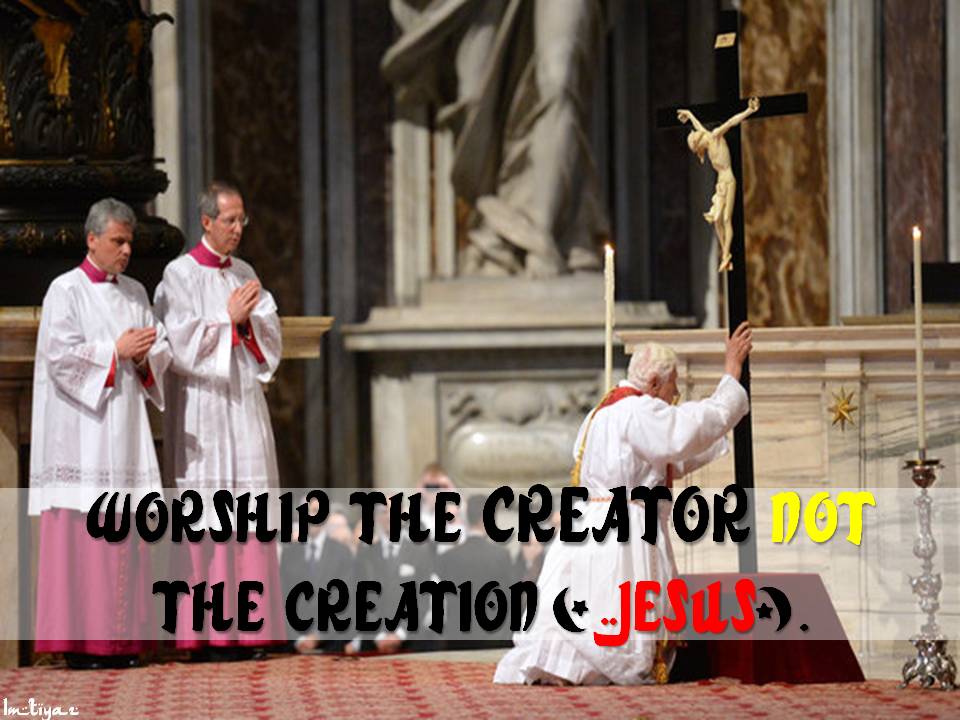
Worship the Creator not the Creation

Bismillahir Rahmanir Raheem
بِسۡمِ ٱللهِ ٱلرَّحۡمَـٰنِ ٱلرَّحِيمِ ,

Article by Br. Imtiyaz Nawaz [India].

The Qur’an and Bible says Worship the creator not the Creation of God [Jesus]. The Qur’an gives us strong evidence that Jesus is not God and he was created as a man. Just as many men before him by their very nature did miracles with God’s help, he too as a prophet (like the many before him) was aided by God in doing miracles (Acts 2:21-22). Christians are deluded  from the truth and they fail to understand who God really is. Does the Bible support claims which the Qur’an has laid down about Jesus? Let’s take a close look at the Bible, as it says itself not to worship God’s Creation including Jesus.

Allah says in Quran Chapter 5 Verse 75,

✔ CHRIST the son of Mary was NO MORE THAN A MESSENGER.
✔ There were many MESSENGERS THAT PASSED AWAY BEFORE HIM.
✔ His mother was a SAINTLY WOMAN.
✔ They both ATE EARTHLY FOOD. ☜
✔ SEE! HOW CLEAR WE MAKE FOR THEM OUR MESSAGES.
✔ YET SEE! HOW THEY ARE DELUDED AWAY FROM THE TRUTH.

What’s in the BIBLE:

The following passages from the Bible will give you a clear picture of the true nature of God who is the Supreme, the Ruler, the Infallible and the Transcendent and Jesus a finite being, who suffers from wants and is subject to God’s Will:

NOT MORE THAN A MESSENGER ☟

☞ And you, my child, will be called ➭ a prophet of ➭the Most High; for you will go on before the Lord to prepare the way ➭for him [Luke 1:76]

☞My teaching is not mine, but His who sent me [John 7:16]

☞The word which you hear is not mine, but the Father’s who sent me [John 14:24]

☞ Now you seek to kill me, A MAN who has told you the truth that I heard from God
[John 8:40]

☞ The Father Himself who sent me has given me a commandment as to what to say and what to speak [John 12:49]

☞ “I live because of the Father” (John 6:57).

A big gathering of people came to listen to Jesus and brought many sick persons who were healed of their infirmities.

☞ “So that the crowd wondered, when they saw the mute speaking, the crippled healthy, the lame walking, and the blind seeing. And they glorified the God of Israel” [Matthew15:31]

How is it that the God of the Christians is three and the God of the Jews is ONE?

MESSENGERS THAT PASSED BEFORE HIM ☟

☞ Think not that I have come to abolish the law and the prophets; I have come not to abolish them but to fulfil them [Matthew 5:17]

☞ And they took offense at him. But Jesus said to them, “Only in his hometown and in his own house is a prophet without honor. [Matthew 13:57]

ATE EARTHLY FOOD ☟

☞”The Son of man came EATING AND DRINKING, and they say, behold a man gluttonous, and a wine bibber, a friend of publicans and sinners.” [Matthew, 11:9; Luke, 7:34]

☞ They gave him a piece of broiled fish, and he took it and ate it in their presence. [Luke 24:42-43]

SEE! HOW CLEAR WE MAKE FOR THEM OUR MESSAGES ☟

☞ “Why do you call me good? No one is good but God alone.” [Mark 10:18]

☞ “And this is eternal life, that they know thee the only true God, and Jesus Christ whom thou hast sent.” [John 17:3]

☞ “I can of mine own self do nothing: as I hear, I judge: and my judgment is just; because I seek not my own will, but the will of the Father which hath sent me.’ [John 5:30]

☞ “But of that day and that hour knoweth no man, no, not the angels which are in heaven, neither the Son, but the Father.” [Matthew 24:36 & Mark 13:32]

☞ I (Jesus) ascend unto my Father and your Father; and to MY GOD and your God. [John 20:17]

All the above verses pinpoint Jesus’ inferiority, weakness and dependence on God’s favor.

YET SEE! HOW THEY ARE DELUDED AWAY FROM THE TRUTH ☟

Proof that Christians are indeed deluded away from truth, even with reading their own Bible. All things are created by God, we are all his creation, there is a clear distinction between the Creator and the creation.

Worship none but one:

“Here, O Israel: The LORD our God is one Lord.” [Deut. 6:4]

“See now that I, even I, am he, and there is no god besides me.” [Deut. 32:39]

“I am the LORD, that is my name; my glory I give to no other, nor my praise to graven images.” [Isaiah 42:8]

“I am the first and I am the last; besides me there is no god.” [Isaiah 44:6]

“You are my witnesses,” says the LORD, and my servant whom I have chosen, that you may know and believe me and understand that I am He. Before me no god was formed, nor shall there by any after me. I, I am the Lord and besides me there is no saviour.” [Isaiah 43:10-11]

“You shall worship the Lord your God and him only shall you serve.” This can be found in the Gospels of (Matthew 4:10) and (Luke 4:8) both in the Bible.

Jesus clearly says that only God is to be worshipped.

Jesus was a creation of God.  Anything created by GOD, becomes His creation including Jesus according to Colossians 1:15 and 1 Corinthians 15:28, therefore created things do not deserve worship and this clearly leads to idol worshipping according to the Bible.

Jesus was created lower than Angels:

Bible says Angels are not worthy of worship and claims Jesus was created lower than angels which confirms Jesus does not deserve to be worshipped:

⇨ But he (the Angel) said, “No, don’t worship me. I am a servant of God, just like you and your brother’s the prophets, as well as all who obey what is written in this book. Worship only God!” [Revelation 22:9]

What about someone who is lower than the Angels ?!!

⇨”But we see Jesus, who was made a little lower than the angels, now crowned with glory and honor…” [Hebrews 2:9]

We have clearly shown from the Bible itself that Jesus was the creation of GOD and how he was created. Worship the creator not the created Jesus. Who is speaking here? Who is condemning the people for turning God into the creation, for likening God unto the creation, who is the one condemning the people for worshipping the creation over the creator?

Is this an Islamic scholar?
No.

This is none other than the apostle Paul!
Yes, this is Jesus’ favourite apostle Paul and the founder of Christianity, speaking directly from the Christian Bible:

➲ Yes, they knew God, but they wouldn’t worship him as God or even give him thanks. And they began to think up foolish ideas of what God was like. As a result, their minds became dark and confused.

➲ Claiming to be wise, they instead became utter fools.

➲ And instead of worshiping the glorious, ever-living God, they worshiped idols made to look like mere people and birds and animals and reptiles.

➲ So God abandoned them to do whatever shameful things their hearts desired. As a result, they did vile and degrading things with each other’s bodies.

➲ They traded the truth about God for a lie. So they worshiped and served the things God created instead of the Creator himself, who is worthy of eternal praise! Amen.

[Romans 1:21-25]

● Jesus said to the crowds and to his disciples:

Do not call anyone on earth ⇛ ‘father,'(GOD) for you have one Father, and he is in heaven. [Matthew 23: 1,9]

[Allah knows the best]

A Simple Comparison of the Islamic God vs the Christian God

Bismillahir Rahmanir Raheem
بِسۡمِ ٱللهِ ٱلرَّحۡمَـٰنِ ٱلرَّحِيمِ ,

We are used to a certain concept of God. We tend to think of this supreme  power as having wisdom and greatness. We think of this flawless deity that resembles us in no way. We think that this concept of God is supported by the scriptures or is it? Well, not all scriptures represent such a concept. It is shocking to find out how the biblical God is depicted. On the contrary, the Qur’an presents a totally opposite notion. This article is going to examine how the bible describes God and compare this description with that in the Qur’an.

God in the bible is one who falls asleep:

Psalms 78:65 Then the Lord awoke as from sleep, as a man wakes from the stupor of wine.

Barnes’ Notes on the Bible

Then the Lord awaked as one out of sleep – literally, as one sleeping; that is, as one who is asleep suddenly arouses himself. The Lord seemed to have slept, or to have been inattentive to what was occurring. Suddenly he aroused himself to inflict vengeance on the enemies of his people

This verse shows God suddenly realized what was going on and was shaken by it. We ask is this an appropriate analogy befitting of God’s majesty? If God is all knowing, how come he was inattentive and suddenly decided to avenge his people?

In the Qur’an, Allah is the all knower, is always aware, and is control of everything:

The Noble Qur’an 2: 255 Allah. There is no god but He,-the Living, the Self-subsisting, Eternal. No slumber can seize Him nor sleep. His are all things in the heavens and on earth. Who is there can intercede in His presence except as He permitteth? He knoweth what (appeareth to His creatures as) before or after or behind them. Nor shall they compass aught of His knowledge except as He willeth. His Throne doth extend over the heavens and the earth, and He feeleth no fatigue in guarding and preserving them for He is the Most High, the Supreme (in glory).

ٱللَّهُ لَآ إِلَـٰهَ إِلَّا هُوَ ٱلۡحَىُّ ٱلۡقَيُّومُ‌ۚ لَا تَأۡخُذُهُ ۥ سِنَةٌ۬ وَلَا نَوۡمٌ۬‌ۚ لَّهُ ۥ مَا فِى ٱلسَّمَـٰوَٲتِ وَمَا فِى ٱلۡأَرۡضِ‌ۗ مَن ذَا ٱلَّذِى يَشۡفَعُ عِندَهُ ۥۤ إِلَّا بِإِذۡنِهِۦ‌ۚ يَعۡلَمُ مَا بَيۡنَ أَيۡدِيهِمۡ وَمَا خَلۡفَهُمۡ‌ۖ وَلَا يُحِيطُونَ بِشَىۡءٍ۬ مِّنۡ عِلۡمِهِۦۤ إِلَّا بِمَا شَآءَ‌ۚ وَسِعَ كُرۡسِيُّهُ ٱلسَّمَـٰوَٲتِ وَٱلۡأَرۡضَ‌ۖ وَلَا يَـُٔودُهُ ۥ حِفۡظُهُمَا‌ۚ وَهُوَ ٱلۡعَلِىُّ ٱلۡعَظِيمُ

The Noble Qur’an 19:64 “…And your Lord is not forgetful.”

وَمَا نَتَنَزَّلُ إِلَّا بِأَمۡرِ رَبِّكَ‌ۖ لَهُ ۥ مَا بَيۡنَ أَيۡدِينَا وَمَا خَلۡفَنَا وَمَا بَيۡنَ ذَٲلِكَ‌ۚ وَمَا كَانَ رَبُّكَ نَسِيًّ۬ا

Once we can find a verse showing how God “awoke”, we can easily find another showing how God rested after creation:

Exodus 20:11 For in six days the LORD made the heavens, the earth, the sea, and everything in them; but on the seventh day he rested. That is why the LORD blessed the Sabbath day and set it apart as holy.

Genesis 2:2 On the seventh day God had finished his work of creation, so he rested from all his work.

According to Clarke’s Commentary on the Bible:

On the Seventh day God ended, etc. – It is the general voice of Scripture that God finished the whole of the creation in six days, and rested the seventh! Giving us an example that we might labor six days, and rest the seventh from all manual exercises.

Usually, humans are the ones that get weary after working. They are the ones that need to “rest” after labor. So, whoever’s giving them the example to rest should be tired as well. In that case it was God. We ask, why did the biblical God have to rest after he was finished with his work? Was the creation of this world too much?! If the idea to be conveyed was that God finished his work and stopped after it, the verse would have said so. Instead, the word “rest” was used. How can someone grasp the idea that God Almighty took a break?

The Qur’an strips such characteristics of weariness away from Allah (swt).

The Noble Qur’an 50:38 And indeed We created the heavens and the earth and all between them in six days and nothing of fatigue touched Us.

وَلَقَدۡ خَلَقۡنَا ٱلسَّمَـٰوَٲتِ وَٱلۡأَرۡضَ وَمَا بَيۡنَهُمَا فِى سِتَّةِ أَيَّامٍ۬ وَمَا مَسَّنَا مِن لُّغُوبٍ۬

This verse is simple and clear. It had no linguistic problems or confusions. It eloquently expresses the grandeur of Allah and his power.

A Biblical God that has to rest or Allah, the mighty?

Surprisingly, this is not the only instant in the Bible where God is not all powerful. Apparently, he could not drive out the inhabitants of the valley because they had iron chariots!?

Judges 1:19 And the LORD was with Judah, and he took possession of the hill country, but he could not drive out the inhabitants of the plain because they had chariots of iron.

Let’s shed some light through a commentary of that verse:

Clarke’s Commentary on the Bible:

Strange! were the iron chariots too strong for Omnipotence? The whole of this verse is improperly rendered. The first clause, The Lord was with Judah should terminate the 18th verse, and this gives the reason for the success of this tribe:The Lord was with Judah, and therefore he slew the Canaanites that inhabitedZephath, part of the verse either refers to a different time, or to the rebellion of Judah against the Lord, which caused him to withdraw his support. Therefore the Lord was with Judah, and these were the effects of his protection; but afterwards, when the children of Israel did evil in the sight of the Lord, and served Baalim, God was no longer with them, and their enemies were left to be pricks in their eyes, and thorns in their side, as God himself had said.

Adam Clarke was surprised by how demeaning this verse made God look; so he desperately tried to find a solution to his conundrum. What he came up with is a suggestion to how this verse should have been written. A minor adjustment would not harm anyone… after all it’s not uncommon to find scribes editing the bible. Is this true scripture? Or the hands of man trying to cover up a fault of the Christian God?

Do you think the Qur’an would depict God in that disturbing way? Of course not.

The Noble Qur’an 59:23 Allah is He, than Whom there is no other god;- the Sovereign, the Holy One, the Source of Peace (and Perfection), the Guardian of Faith, the Preserver of Safety, the Exalted in Might, the Irresistible, the Supreme: Glory to Allah. (High is He) above the partners they attribute to Him.

هُوَ ٱللَّهُ ٱلَّذِى لَآ إِلَـٰهَ إِلَّا هُوَ ٱلۡمَلِكُ ٱلۡقُدُّوسُ ٱلسَّلَـٰمُ ٱلۡمُؤۡمِنُ ٱلۡمُهَيۡمِنُ ٱلۡعَزِيزُ ٱلۡجَبَّارُ ٱلۡمُتَڪَبِّرُ‌ۚ سُبۡحَـٰنَ ٱللَّهِ عَمَّا يُشۡرِڪُونَ

The Biblical God changes his mind. Not only that,  He grieves over what he has done.

1 Samuel 15:35 And Samuel did not see Saul again until the day of his death, but Samuel grieved over Saul. And the LORD regretted that he had made Saul king over Israel.

Exodus 32:14 So the LORD changed His mind about the harm which He said He would do to His people.

Genesis 6:7 So the LORD said, “I will blot out man whom I have created from the face of the land, man and animals and creeping things and birds of the heavens, for I am sorry that I have made them.”

Changing mind and regretting are definitely human attributes. Who would imagine these being associated with God? In addition, these traits again portray that the Biblical God is not all- knowing, or else he would have predicted that man would have sinned …

Below are other verses that express the opposite notion:

The Noble Qur’an 41:47 Unto Him is referred (all) knowledge of the Hour. And no fruits burst forth from their sheaths, and no female carrieth or bringeth forth but with His knowledge. And on the day when He calleth unto them: Where are now My partners? they will say: We confess unto Thee, not one of us is a witness (for them)

إِلَيۡهِ يُرَدُّ عِلۡمُ ٱلسَّاعَةِ‌ۚ وَمَا تَخۡرُجُ مِن ثَمَرَٲتٍ۬ مِّنۡ أَكۡمَامِهَا وَمَا تَحۡمِلُ مِنۡ أُنثَىٰ وَلَا تَضَعُ إِلَّا بِعِلۡمِهِۦ‌ۚ وَيَوۡمَ يُنَادِيہِمۡ أَيۡنَ شُرَڪَآءِى قَالُوٓاْ ءَاذَنَّـٰكَ مَا مِنَّا مِن شَہِيدٍ۬

The Noble Qur’an 3:5 From Allah, verily nothing is hidden on earth or in the heavens.

إِنَّ ٱللَّهَ لَا يَخۡفَىٰ عَلَيۡهِ شَىۡءٌ۬ فِى ٱلۡأَرۡضِ وَلَا فِى ٱلسَّمَآءِ

Moreover, the biblical verses above portray God as unwise (regrets and changes his mind); however the Qur’an clearly shows how wise God is:

The Noble Qur’an 67:14  Should He not know what He created? And He is the Subtile, the Aware.

أَلَا يَعۡلَمُ مَنۡ خَلَقَ وَهُوَ ٱللَّطِيفُ ٱلۡخَبِيرُ

The Noble Qur’an 3:6 He it is Who shapes you in the wombs as He wills. La ilaha illa Huwa (none has the right to be worshipped but He), the All-Mighty, the All-wise.

 هُوَ ٱلَّذِى يُصَوِّرُڪُمۡ فِى ٱلۡأَرۡحَامِ كَيۡفَ يَشَآءُ‌ۚ لَآ إِلَـٰهَ إِلَّا هُوَ ٱلۡعَزِيزُ ٱلۡحَكِيمُ

According to the doctrine of the trinity, Jesus is also God. Surprisingly, the representation of Jesus is not befitting if we were to assume that he was God. The view of God the Father and the son are demeaning and make us wonder what kind of God Christians worship.  If Jesus was God, what kind of God does the Bible make him look like?

A God that grows in knowledge:

Luke 2:52 And Jesus grew in wisdom and stature, and in favor with God and men.

A God that was mocked and spat on:

Matthew 27:30-31 – “And then twisted together a crown of thorns and set it on his head. They put a staff in his right hand and knelt in front of him and mocked him. “Hail, king of the Jews!” they said. They spit on him, and took the staff and struck him on the head again and again.”

A God that was tempted by the devil:

 Matthew 4:1 – Then Jesus was led by the Spirit into the desert to be tempted by the devil.

A God that was made lower than angels:

Hebrews 2:9 – What we do see is Jesus, who was given a position “a little lower than the angels”;

A God that was strengthened by angels:

Luke 22:43 – An angel from heaven appeared to him and strengthened him.

A God that was circumcised:

Luke 2:21 Eight days later, when the baby was circumcised, he was named Jesus, the name given him by the angel even before he was conceived

On the other hand, the Qur’an presents a pristine image of Allah (swt). Simply, none resembles Allah:

The Noble Qur’an 42:11 “ There is nothing whatever similar unto Him, and He is the One that hears and sees (all things).”

 لَيۡسَ كَمِثۡلِهِۦ شَىۡءٌ۬‌ۖ وَهُوَ ٱلسَّمِيعُ ٱلۡبَصِيرُ…

As a conclusion, we have seen how the bible and the Qur’an portray God. The bible presents a God that is inadequate. The Qur’an shows us how Allah (swt) is truly worthy of worship. Finally we ask, how can Christians accept to believe in such a portrayal of God? Doesn’t that make them ask the question how can the Bible be God’s word if it depicts God the way it does.

The Noble Qur’an 37:180 Glorified be thy Lord, the Lord of Majesty, from that which they attribute (unto Him)

سُبۡحَـٰنَ رَبِّكَ رَبِّ ٱلۡعِزَّةِ عَمَّا يَصِفُونَ

It is worthy of noting, that a contradicting verse can be found to almost every verse I quoted from the Bible. So, Christians should either accept that their Bible is self contradictory or accept that the Biblical God is weak and inadequate…

Refutation: If Jesus is God … was he praying to himself?

Bismillahir Rahmanir Raheem
بِسۡمِ ٱللهِ ٱلرَّحۡمَـٰنِ ٱلرَّحِيمِ ,

Question:

If Jesus is God, then who was he praying to on the cross when he said, “My God, my God, why have you forsaken me”? (Mark 15:34; Matthew 27:46) Was he praying to himself? If so, was he complaining to himself about why he had forsaken himself?

Answer:

Sam Shamoun does not actually answer this question directly. Instead he meanders back and forth about the Trinity, mentions the Crucifiction and then in the end diverts from this absurdity in his doctrine and invents a strawman, whereby he attempts to question Muslims about Allaah’s “Prayer”. In spite of all his trickery, after much searching for a decisive answer in his article, I found that he does hint at an answer, or strongly tries to imply one by stating:

The Holy Bible teaches that there are three distinct, yet inseparable Persons who exist as the one true God: the Father, the Son and the Holy Spirit. The three Persons of God, because they are personally distinct, have loving communion and dialog amongst themselves. Therefore, the Lord Jesus wasn’t praying to himself on the Cross, but was actually praying to the Person of the Father.

This ‘answer’ of sorts, actually furthers the case the question presents, it actually proves that Jesus was praying to Himself, allow me to explain. The logic flows as such:

  • Jesus is God.
  • Father is God.
  • Jesus is praying to God.
  • Since Jesus is God and he is praying to God.
  • Then he is praying to himself.

The only way this would not be circular theological reasoning, is if Jesus was not God, since this is not the case and Jesus is praying to God, and God is also Jesus, then he indeed and most certainly was praying to himself. Sam then adds insult to injury by claiming that his God, was and will forever be an equal to him, a human, a man:

Furthermore, the Holy Bible also teaches that Jesus became, and forever will remain, a true human being. It is, therefore, not surprising that Christ did what every God-fearing person is supposed to do, namely pray and worship God.

Given the above, Sam continues to persist in building the case against him, once again his argument can be represented as:

  • He says Christ is God.
  • He says Christ worships God.
  • Therefore Christ is worshipping himself.

Therefore Sam’s answer qualifies the belief that Christ was praying to himself, for if Christ is fully God, as Sam believes, then Christ was forsaking himself. Unless Sam believes that the Father who is God, can diminish the power of the Jesus-God person in the Godhead, which would then mean that they are not co-equal nor co-existent in the ‘Godhead’. Either way, Sam’s case is against Christianity. As indicated in this article, an earlier pronouncement in the book of Psalms ensures that God could not have killed Jesus, his ‘son’, specifically ‘forsaking‘ or ‘cutting off his loved ones‘:

“For the LORD loves the just and will not forsake his faithful ones. They will be protected forever, but the offspring of the wicked will be cut off;” – Bible : Psalms (37) : Verse 28.

Our modus operandi from this verse onwards is intended to imply that Jesus would be the most faithful and the most just person of his time with respect to his life and personhood, whether you consider him to be a God, a man or otherwise. Both Muslims and Christians can agree on this following excerpt from the Gospel, which attributes these words to him:

“…I judge only as I hear, and my judgment is just, for I seek not to please myself but him who sent me.” – Bible : John (5) : Verse 30.

The verses from Psalms (Tehillim) and from John (above), promote the understanding that Jesus was just because he judged according to the rule and law of God and thus since the Old Testament says that God loves and will not forsake such a person, we all can accept that Christ was loved and would not be forsaken by God. However as a Muslim reading the New Testament, the image it portrays of Christ is in opposition to the promise of Psalms as we have previously read, the Bible says:

“About the ninth hour Jesus cried out in a loud voice, “Eloi, Eloi lama sabachthani?”—which means, “My God, my God, why have you forsaken me?”  – Bible : Matthew (27) : Verse 46.

“And at the ninth hour Jesus cried out in a loud voice, “Eloi, Eloi, lama sabachthani?”—which means, “My God, my God, why have you forsaken me?” – Bible : Mark (15) : 34.

It is clear for anyone who is purely intended that these stories, depictions of a man forsaken by God, cannot be the man portrayed in John 5:30 and Psalms 37:28. Rather, it reminds of the man later spoken of in Psalms 37:28:

“…They will be protected forever, but the offspring of the wicked will be cut off;” – Bible : Psalms (37) : Verse 28.

Am I supposed to believe that Christ was a wicked man, cut off from the mercy of God? As a Muslim, it burdens my heart to have to believe that this is what someone who loves Christ could possibly believe.  In fact, even Christian scholars have purported that this alleged saying of Christ is out of his character and simply demeans him, Matthew Henry in his Commentary of the Bible, says:

“That our Lord Jesus was, in his sufferings, for a time, forsaken by his Father. So he saith himself, who we are sure was under no mistake concerning his own case. That Christ’s being forsaken of his Father was the most grievous of his sufferings, and that which he complained most of. “ – Matthew Henry’s Complete Commentary on the Bible, Matthew 27.

Therefore, not only was Christ-God forsaking himself, he made himself to suffer and he even complained to himself about himself. Mind blowing absurdity to say the least. Lastly, Sam tries to meander away from this theological conundrum by attempting to claim that Allaah prays to Himself:

The Quran says that Allah prays:

Upon them shall be prayers (salawatun) from their Lord and mercy, and they are the rightly directed. S. 2:157

He it is who sends PRAYERS on you (Arabic- yusallii alaykum), as do His angels … S. 33:43

Allah and His angels PRAY for the Prophet (Arabic- yasalluuna alan-Nabiyy): O ye that believe PRAY for him (salluu `alayhi), and salute him with all respect. S. 33:56

However this is responded to in detail by Br. Ibn Anwar in his post here on the Unveiling Christianity website. In short, Br. Ibn Anwar explains:

The following is from Lisan al-Arab authored by Ibn Mazur al-Afriqi which is one of the major reference materials for anyone persuing academic studies in Arabic:

والصلاة الدعاء والاستغفار…وصلاة الله على رسوله رحمته له وحسن ثنائه عليه وفى حديث ابن أبى آوفى آنه قال أعطانى أبى صدقة ماله فاتيت بها رسول الله صلى الله عليه وسلم فقال اللهم صل على آل أبى أوفى قال الازهرى هذه الصلاة عندى الرحمة ومنه قوله عز وجل ان الله وملا ئكته يصلون على النبى يٰأَيُّهَا ٱلَّذِينَ آمَنُواْ صَلُّواْ عَلَيْهِ وَسَلِّمُواْ تَسْلِيماً فالصلاة من الملائكة دعاء واستغفار ومن الله رحمة وبه سميت الصلاة لما فيها من الدعاء ولاستغفار وفى الحديث التحيات لله والصلوات قال أبوىبكر الصلوات معن ها الترحم وقوله تعالى ان الله وملا ئكته يصلون على النبى اى يترحمون

Al-Salah is supplication and seeking forgiveness…and the Salah of Allah upon his messenger is His blessing/mercy for him and magnification/praises  upon him. In the narration of Ibn Abi Awfa verily he said: “My father gave charity from his own wealth. Thereafter I went to the messenger of Allah with it whereby the Prophet s.a.w. said, “Oh Allah send Salah on the family of Abi Awfa.” Azhari said that this Salah in his sight means al-Rahmah(the blessing/mercy). And Allah s.w.t. says,”Verily, Allah and His angels send Salah(blessings) upon the Prophet. O you who believe, do pray Allah to bless him, and send your Salam to him in abundance.” Thus theSalah of the angels are supplication(du’a) and seeking forgiveness(for the messenger) and from Allah it is His blessing(rahmah). And it is called Salah within which is supplication and seeking for forgiveness. And in the narration on the greetings and salawat(plural of salah), Abu Bakr said, “Al-salawat means conferring blessing” and Allah said, “Verily, Allah and His angels send Salah(blessings) upon the Prophet” which means they bless him.”

Isma’il bin Hammad al-Jawhari in his Sihah Taj al-Lughah wa Sihah al-’Arabiyyah defines it as follows:

والصلاة من الله تعالى : الرحمة

“Al-Salah when it is from Allah means mercy/blessing.”

Abi Mansur Muhammad bin Ahmad al-Azhari in his massive Tahzib al-Lughah  defines it as follows:

نوما فإن لجنب المرء مضطجعا وأما حديث ابن أبى أوفى أنه قال : أعطانى أبى صدقة ماله فأتيت بها رسول الله صل الله عليه وسلم فقال : (( اللهم صل على آل أبى أوفى )) فإن هذه الصلاة عندى الرحمة , ومنه قوله جل وعز : ( إن الله وملائكته يصلون على النبى ) فالصلاة من الملائكة دعاء واستغفار , ومن الله سبحانه رحمة .

He mentions the same narration as Ibn Manzur al-Afriqi that Ibn Abi Awfa went to the Prophet s.a.w. with charity given by his father from his wealth “upon which the Prophet s.a.w. remarked, “Oh Allah, send Salah on the family of Abi Awfa.” Therefore this al-Salah with me means al-Rahmah(the blessing/mercy). And from His(Allah’s) word: “Verily, Allah and His angels send blessings on the Prophet”. Al Salah from the angels is supplication and seeking for forgiveness(for him), and from Allah s.w.t. it means blessing/mercy.””

Therefore when it is said Allaah’s ‘prayer’ it does not mean that like the God of the Bible, where he is praying to himself to save himself from himself, rather it refers to Allaah’s rahmat and barakat upon a person or group of persons by bestowing His favours (mercy) upon them as mentioned in Surah Ar Rahman:

فَبِأَيِّ آلَاءِ رَبِّكُمَا تُكَذِّبَانِ

Then which of the Blessings of your Lord will you both (jinns and men) deny?

Let’s embarrass Sam further and examine the verses he uses:

أُولَـٰئِكَ عَلَيْهِمْ صَلَوَاتٌ مِّن رَّبِّهِمْ وَرَحْمَةٌ ۖ وَأُولَـٰئِكَ هُمُ الْمُهْتَدُونَ
(2:157) – They are those on whom are the Salawat (i.e. blessings, etc.) (i.e. who are blessed and will be forgiven) from their Lord, and (they are those who) receive His Mercy, and it is they who are the guided-ones.

In the first case, the ayah he uses explicitly tells us both in the Arabic that God’s ‘prayer upon’ a people, means that His Rahma (mercy) is conveyed upon them. This as Sam admits by use of the verse (and explicitly as we will see later), does not mean God is praying to anyone. Thus this cannot be equated to the God of the Bible, whom Sam concedes was praying to himself. Let’s take a look at the next ayah he references:

هُوَ الَّذِي يُصَلِّي عَلَيْكُمْ وَمَلَائِكَتُهُ لِيُخْرِجَكُم مِّنَ الظُّلُمَاتِ إِلَى النُّورِ ۚ وَكَانَ بِالْمُؤْمِنِينَ رَحِيمًا
(33:43) – He it is Who sends Salat (His blessings) on you, and His angels too (ask Allah to bless and forgive you), that He may bring you out from darkness (of disbelief and polytheism) into light (of Belief and Islamic Monotheism). And He is Ever Most Merciful to the believers.

Once again, in the verse that Sam uses, it demonstrates to us that God’s “Salat” is His conveyance of mercy to the believers. Notice the term (يُصَلِّي عَلَيْكُمْ) which means “Prays Upon”, just as how we would pray upon a person, this would not mean praying to a person. Unless Sam believes that when he prays upon his wife or mother when she is ill, he actually means to be praying to them? If that’s the case, then he needs to study basic Grammar. Let’s now examine the last verse he references:

إِنَّ اللَّـهَ وَمَلَائِكَتَهُ يُصَلُّونَ عَلَى النَّبِيِّ
(33:56) – Allah sends His Salat (Graces, Honours, Blessings, Mercy, etc.) on the Prophet (Muhammad SAW) and also His angels too (ask Allah to bless and forgive him).

Notice once again the use of the word ( عَلَى), as aforementioned, there is a distinction between praying ‘upon’ and praying ‘to’, the word ( عَلَى), means ‘upon’. Just as in As Salaamu ‘Alaykum – the same term ( عَلَى) is used, but in the plural meaning “upon you all“. This only goes to demonstrate that Sam is both heavily deficient in both the Arabic and English languages. Lastly, Sam Shamoun concedes that when the term ‘salat’ is used in relation to Allaah, it refers to Allaah’s conveying of His mercy:

The following is a translation of an alleged prayer of Allah taken from Ibn Hisham’s Al-Sirah Al-Halabiyya:

قلت يا جبريل أيصلى ربك قال نعم قلت وما يقول قال يقول سبوح قدوس رب الملائكة والروح سبقت رحمتى غضبى

I [Muhammad] said, “O Gabriel, does your Lord pray?” He said, “Yes.” I said, “What does he say?” “This is what he says. He says: ‘Glory, holy, Lord of the angels and the Spirit. My mercy overcomes my wrath.’” (Source; translation, bold, underline and comments within brackets ours)

Another Muslim scholar made the following comments about surah 33:56 and Allah praying:

Allah makes the merit of His Prophet clear by first praying blessing on Himself, and then by the prayer of the angels, and then by commanding His slaves to pray blessing and peace on him as well. Abu Bakr ibn Furak related that one of the ‘ulama interpreted the words of the Prophet, “The coolness of my eye is in the prayer,” as meaning Allah’s prayer, that of the angels and that of his community in response to Allah’s command until the Day of Rising. The prayer of angels and men is supplication for him and that of Allah is mercy.

Therefore in Sam’s own argument he concludes for himself, that Allaah’s pray means Allaah’s conveyance of His mercy upon someone. This however, cannot be and is not equitable to the Christian God who prays to Himself, as aptly demonstrated above. This strawman argument from Sam, was only intended to distract the reader from the main question, which still remains unanswered:

If Jesus is God and Jesus prays to God, then why is Jesus praying to Himself? Sam has failed to answer this question and has only been able to demonstrate his weak Grammar and comprehension of both the Arabic and English languages. I pray and hope that Sam can one day, eventually seek to directly answer this theological conundrum.

wa Allaahu Alam,
and God knows best.

Sources:

  1. Sam Shamoun’s, “A Series of Answers to Common Questions and Claims”.
  2. Br. Ijaz Ahmad’s, “Would a Loving and Merciful God, Kill Himself/ His Own Son?
  3. Br. Ibn Anwar’s, “Does Allah pray? If yes then who does he pray to?“: Ibn Manzur al-Afriqi (2003). Lisan al-Arab, Vol. 18. Saudi Arabia: Dar ‘Alim Al-Kutub. p. 198, Abi Nasr Ismail bin Hammad al-Jawhari (1999). Al-Sihah Taj al-Lughati Wa Sihah al-’Arabiyyah, Vol. 6. Beirut, Lebanon: dar al-Kutub al-’Ilmiyyah. p. 384, Abi Mansur Muhammad bin Ahmad al-Azhari (n.d.). Tahzib al-Lughat, Vol. 17. Cairo, Egypt: Matabi’ Sabil al-Arab. p. 236.

Refutation: If Jesus is God…How can God Die?

Bismillahir Rahmanir Raheem
بِسۡمِ ٱللهِ ٱلرَّحۡمَـٰنِ ٱلرَّحِيمِ ,

Question:

If Jesus is God, how can God die? Who was running the universe those three days that Jesus was dead?

Answer:

Sam’s initial response is to redefine the meaning of the word death, he gives two meanings from the Bible:

  1. Spiritual death, “The LORD God took the man and put him in the Garden of Eden to work it and take care of it. And the LORD God commanded the man, ‘You are free to eat from any tree in the garden; but you must not eat from the tree of the knowledge of good and evil, for when you eat of it you will surely die.” –  Genesis 2:15-17.
  2. Physical death, “As the body without the spirit is dead, so faith without deeds is dead.” –  James 2:26,

Finally, he concludes:

Christ, therefore, did not cease to live when he died on the cross since, as the Holy Bible teaches, the Lord’s soul was still consciously alive during the three days his body lay in the tomb. The only way that Christ could be able to raise himself from the dead is if Christ were still consciously alive. This establishes that Christ did not cease to exist for those three days that his body remained in the grave. Both Christ’s divine nature and his human soul were still conscious during that period of time. So in answer to the question, the one true God always exists as three distinct Persons even during the entombment of Christ’s physical body. And, even as his body lay buried, Christ was alive and sovereignly sustaining the universe along with the Father and the Holy Spirit.

According to Sam Shamoun, Jesus did not die, whether physically or spiritually. If Jesus did not die, then the notion of Christ dying for our sins is a false one. See, the argument works as :

  • Christ died for your sins.
  • As a sacrificial lamb was able to atone for sins, so was Christ.

Since according to Sam Shamoun, Christ never actually died, then no atonement actually took place. Sam never really answers the question as to how God died, instead he tells us that Jesus did not actually die, at all. He gives an either or option, that is a physical or spiritual death, then he negates both options. Thus leaving us with the understanding that Christ/ “God” never died. His argument can be represented as such:

  • Christ died.
  • He could have died either a spiritual death or physical death.
  • Christ neither had a spiritual or physical death.

Which is a problem as the Bible mentions that the sacrificial lamb was to be killed and by kill, we mean be put to death i..e not alive:

 Take care of them until the fourteenth day of the month, when all the members of the community of Israel must slaughter them at twilight. – Exodus 12:6.

As an addendum, Sam must answer the question, that if the sacrificial animal does not die, i.e. there is no cessation of life, is the sacrifice valid, or must the animal die? This death as referred to in Exodus 12:6, or slaughtering of the animal/ sacrifical animal refers to a physical cessation of life. This definition can be attested to by CARM’s Theological Dictionary:

Death is understood two main ways in the Bible. First, it is used to describe the cessation of life, this can be physical or spiritual. – Death.

Either way, Sam Shamoun has put himself between a rock and a hard place:

  • Either he concedes to the fact Jesus never died (which Sam did), therefore shelving his entire faith (1 Corinthians 15:12-17).
  • Or if Jesus died (which Sam believes), then God ceased to live, therefore his God is not Ever Living, All Powerful.

wa Allaahu ‘Alam,
and God knows best.

« Older Entries Recent Entries »