Category Archives: Muslim and Non-Muslim Dialogue

Bible: Inspired Incoherencies Part 2

Bismillahir Rahmanir Raheem
بِسۡمِ ٱللهِ ٱلرَّحۡمَـٰنِ ٱلرَّحِيمِ ,

In Part 1, we examined the textual nature of the New Testament, along with some examples of the incoherencies within. The understanding that God’s revelation cannot be inconsistent was developed through multiple evidences and at this point, one should realise that the Bible as we know it, is very dynamic. In this article, we’ll be looking at the ramifications of Paul’s writings versus an entire Book in the New Testament. Meaning then, that there exists a major inspired incoherency, note, I’m using the term, ‘inspired’ here, very loosely. Our journey today begins in the Epistle to Corinth, specifically, in the 2nd Epistle, Chapter 12, we read:

I know a man in Christ who fourteen years ago was caught up to the third heaven. Whether it was in the body or out of the body I do not know—God knows.  And I know that this man—whether in the body or apart from the body I do not know, but God knows—  was caught up to paradise and heard inexpressible things, things that no one is permitted to tell. – Verses 2 – 4.

Paul’s epistles were authored between 50 AD (beginning with 1st Thessalonians) and 65 AD (his death). As opposed to the New Testament Gospels which were largely authored between 70 AD (if we take into consideration the Q theory) and progressed until 125 AD (Papyrus 52). The dating of the Pastorials and the Personal Revelation of John (The Book of Revelation), has spurious dating and therefore would require a dedicated article to convey a holistic understanding of those texts, for now, let’s continue examining our current topic at hand. With the information given, it is then understood that Paul’s epistles were clearly completed before the development of the New Testament Synoptic Gospels began. We also have to take into consideration that manuscripts were not as quickly transmitted as they are today. Often times a manuscript would be written by a single scribe (usually the author himself) and delivered where it was read and kept safely. Unlike in today’s world where something can be copied in a matter of seconds, to be able to write, let alone read and spell was a significant skill set that a majority of the world did not possess. One must understand that textual transmission is relatively new to the world, as opposed to thousands of years of liturgical transmission (i.e. oral and aural). With that in mind, at the time of the Pauline letters (circa 1st century CE), the main method of transmitting data was primarily liturgical. Therefore with the advent of manuscripts, instead of making instant copies to distribute, the manuscripts would often be read out to persons, and perhaps when it became feasible (depending on the importance of said manuscript), a scribe would copy it meticulously.

Paul’s letters are often, generally classified into two types, as is testament by the manuscripts we possess today. Paul or his scribes would write a letter and address it to a Church in a particular city, cities or none at all. His letters were therefore either either direct (individual) or chain (circular). Direct letters would be directly specified to one named Church, e.g. 1st Thessalonians, as opposed to a letter where it was not directed to any Church, the title being left blank, later to be filled in by a scribe at that city, these are called circular letters. One example of a circular letter would be the Epistle to the Ephesians. For a more indepth understanding of the textual nature of a circular epistle, see the following excerpt from Reformed (Calvinist) Theologian Louis Berkhof:

Now if we examine the internal evidence, we find that it certainly favors the idea that this Epistle was not intended for the Ephesian church exclusively, for (1) It contains no references to the peculiar circumstances of the Ephesian church, but might be addressed to any of the churches founded by Paul. (2) There are no salutations in it from Paul or his companions to any one in the Ephesian church. (3) The Epistle contemplates only heathen Christians. while the church at Ephesus was composed of both Jews and Gentiles, 2:11, 12; 4:17; 5: 8. (4) To these proofs is sometimes added that 1: 15 and 3: 2 make it appear as if Paul and his readers were not acquainted with each other; but this is not necessarily implied in these passages.

In all probability the words ἐν ̓Εφέσῳ were not originally in the text. But now the question naturally arises, how we must interpret the following words τοῖς ἁγίοις τοῖς οὖσιν και πιστοῖς; etc. Several suggestions have been made. Some would read: “The saints who are really such ;” others: “the saints existing and faithful in Jesus Christ ;” still others: “the saints who are also faithful.” But none of these interpretations is satistactory: the first two are hardly grammatical; and the last one implies that there are also saints who are not faithful, and that the Epistle was written for a certain select view. Probably the hypothesis first suggested by Ussher is correct, that a blank was originally left after τοῖς οὖσιν, and that Tychicus or someone else was to make several copies of this Epistle and to fill in the blank with the name of the church to which each copy was to be sent. The fact that the church of Ephesus was the most prominent of the churches for which it was intended, will account for the insertion of the words ἐν ̓Εφέσῳ in transcribing the letter, and for the universal tradition regarding its destination. Most likely, therefore, this was a circular letter, sent to several churches in Asia, such as those of Ephesus, Laodicea, Hierapolis, e. a. Probably it is identical with the Epistle ἐκ Λαοδικίας, Col. 4:16.

At this point, one should be able to understand the dubious nature of the transmission of earlier New Testament manuscripts. Our next point of discussion, logically, should be to understand how this historical lesson on the transmission of the aforementioned manuscripts plays into the quote from 2nd Corinthians. However, before we do so, a point must be noted: God by definition is all knowing, for example, God can’t claim to be all knowing and at the same time, not know something (that is to be ignorant). As previously mentioned in Part 1, there is a verse which mentions this specific quality about God:

For God is not a God of confusion but of peace. As in all the churches of the saints. – Bible : 1 Corinthians (14) : 33.

It is quite ironic that Paul states this, as he is at fault for possibly one of the bigger theological contradictions that we’re about to see. Recall Paul’s statements:

I know a man in Christ who fourteen years ago was caught up to the third heaven. Whether it was in the body or out of the body I do not know—God knows.  And I know that this man—whether in the body or apart from the body I do not know, but God knows—  was caught up to paradise and heard inexpressible things, things that no one is permitted to tell. – Bible : 2 Corinthians 12 : 2 – 4.

How is all of this relevant? What is the point I’m trying to make?

The fact of the matter is that, the Personal Revelation of John (the Book of Revelation) draws on what John (not the John from the Gospel of John, but John of Patmos), allegedly heard/ saw from Jesus the Christ. It so happens that what Paul tells us he is unable to say, that he is not permitted to tell, that John of Patmos a few decades later (based on the more plausible Domitianic date of 95 AD),  writes about those same things. Yes, Paul says it is unlawful to mention the inexpressible things about paradise and then we have John of Patmos, tell us those very ‘inexpressible things’, to the extent that John’s personal revelation makes it into the New Testament as canonical scripture. To properly understand this, let’s examine what John Gill, in his exposition says on this issue:

heard unspeakable words, which it is not lawful for a man to utter; to instance in particular things, which be then either saw or heard, as some have done, is bold and daring; as that he saw the divine Being with the eyes of his understanding, the several angelic forms, thrones, dominions, principalities, and powers, and the glory and beauty of the souls of departed saints; and heard the harmonious music of each of these happy creatures; had a view of the book of life, and was shown the order and method of divine predestination; was let into the mystery of the calling of the Gentiles, and the change that will be on living saints, and heard the whole account of the dispensation of things, in the church of Christ to the end of the world: the things were unspeakable, never yet related, and so not to be known: they were such things which the apostle himself, when out of the rapture, might have but very inadequate ideas of, and such as he was not able to put into proper words and language to be understood by others; and which as he heard them not from a mere man, but from the Lord, so no mere man was able to utter them, none but he of whom he had heard them: and besides, whatever conceptions the apostle might have of them himself, and how capable soever he was of expressing them; yet they were not fit and proper to be told in the present state of things, being no part of the counsel of God relating to man’s salvation, the whole of which he faithfully declares; and yet were necessary to be heard by him, in order to establish his faith in the Gospel, to animate him in his ministry, and fortify his mind against all the afflictions, reproaches, and persecutions, he was to meet with for the sake of Christ. The phrase seems to be the same with (wrmal rvpa ya) , “it is impossible to say it”; and of such like secret things in paradise, or the world of souls, the Jews say that

“they are hidden, and which (hbytkb twlel Mywar Mnya) , “are not fit to produce in writing“;”and so these were such as were not lawful to speak out, (glwssaiv) (anyrwpinaiv) , “with human tongues”, as Justin Martyr says {z}; they were not in such sense “unspeakable”, as not to be expressed by any; for they were expressed either by Christ himself, who was glorified in human nature, whom the apostle might now see and hear, or by some angel or angels, or they could not have been heard by the apostle as they were; but they were such as before never been spoken to any mortal man, and so could never have been spoken by any; and though they had been spoken to a mortal man, yet they could not be spoke by him to others; for though when he heard them, his human soul, for that present time, might conceive and take in much of the nature and meaning of them, yet they were such as he could not express by words, and represent to others by speech after the vision was over, and especially at this distance: not that it was sinful to have done it, if he could have done it; or that the things themselves were of such a nature, that it would have been criminal to have rehearsed them; but rather that it was impossible to do it, at least fully, since they might greatly regard the glory of the divine Being, and the worship paid him by the heavenly inhabitants: or could it be done in any tolerable manner, it might not be altogether convenient and proper in the present state of things; since the worship of the upper world lying in praise without prayer, might not be so fit to be related, lest it should be imitated by saints on earth: and seeing what the apostle heard was ineffable, and not to be spoken by himself; no credit is to be given to those spurious things called the Revelation and Ascension of Saint Paul, in which the author or authors of them pretend to tell us what these things were.

Therefore the entire Book of Revelation, which almost exclusively deals with unseen events in both heaven and earth, was not to be spoken about. Even Paul did not write it, yet today millions of Christians have it in their possession, information which according to Paul are “things that no one is permitted to tell“. If no one is permitted to speak about those events seen and heard in heaven, then why is it in the Christian Bible? Doesn’t that seem odd to….anyone? In the very first chapter of the Book of Revelation (John of Patmos’ personal revelation) we read of unseen things that no one was permitted to tell (events in heaven):

12 I turned around to see the voice that was speaking to me. And when I turned I saw seven golden lampstands,13 and among the lampstands was someone like a son of man, dressed in a robe reaching down to his feet and with a golden sash around his chest. 14 The hair on his head was white like wool, as white as snow, and his eyes were like blazing fire. 15 His feet were like bronze glowing in a furnace, and his voice was like the sound of rushing waters.16 In his right hand he held seven stars, and coming out of his mouth was a sharp, double-edged sword. His face was like the sun shining in all its brilliance.17 When I saw him, I fell at his feet as though dead. Then he placed his right hand on me and said: “Do not be afraid.I am the First and the Last. 18 I am the Living One; I was dead, and now look, I am alive for ever and ever! And I hold the keys of death and Hades.

This leaves us with several conclusions:

  1. Paul lied as God allowed the Book of Revelation to be written, thought of as scripture and widely produced for roughly 1800 years.
  2. God lied and told Paul he was not permitted to write it, but then let’s some unknown John on a remote island write it.
  3. Both 1 and 2 are wrong and the Personal Revelation of John (the Book of Revelation) is an interpolation, a fraud and should be removed from the Biblical canon, as it had been before, see:

    The Alogi, about A.D. 200, a sect so called because of their rejection of the logos-doctrine, denied the authenticity of the Apocalypse, assigning it to Cerinthus (Epiphanius, LI, ff, 33; cf. Irenaeus,Against Heresies III.11.9). Caius, a presbyter in Rome, of about the same time, holds a similar opinion. Eusebius quotes his words taken from his Disputation: “But Cerinthus by means ofrevelations which he pretended were written by a great Apostle falsely pretended to wonderful things, asserting that after the resurrection there would be an earthly kingdom” (Church HistoryIII.28). The most formidable antagonist of the authority of the Apocalypse is Dionysius, Bishop ofAlexandria, disciple of Origen. He is not opposed to the supposition that Cerinthus is the writer of the Apocalypse. “For”, he says, “this is the doctrine of Cerinthus, that there will be an earthly reign of Christ, and as he was a lover of the body he dreamed that he would revel in the gratification of the sensual appetite”. He himself did not adopt the view that Cerinthus was the writer. He regarded the Apocalypse as the work of an inspired man but not of an Apostle (Eusebius, Church HistoryVII.25). During the fourth and fifth centuries the tendency to exclude the Apocalypse from the list of sacred books continued to increase in the Syro-Palestinian churches. Eusebius expresses no definite opinion. He contents himself with the statement: “The Apocalypse is by some accepted among the canonical books but by others rejected” (Church History III.25). St. Cyril of Jerusalemdoes not name it among the canonical books (Catechesis IV.33-36); nor does it occur on the list of the Synod of Laodicea, or on that of Gregory of Nazianzus. Perhaps the most telling argument against the apostolic authorship of the book is its omission from the Peshito, the Syrian Vulgate. But although the authorities giving evidence against the authenticity of the Apocalypse deserve full consideration they cannot annul or impair the older and unanimous testimony of the churches. The opinion of its opponents, moreover, was not free from bias. From the manner in which Dionysiusargued the question, it is evident that he thought the book dangerous as occasioning crude and sensual notions concerning the resurrection. In the West the Church persevered in its tradition ofapostolic authorship. St. Jerome alone seemed to have been influenced by the doubts of the East. – The Catholic Encyclopedia, Book of Revelation.

These inconsistencies never seem to end, in Part 1 we dealt with verses and chapters being contradictory, this time we’re dealing with an entire Book. The inconsistent nature of the Bible therefore has been demonstrated among verses, chapters and books, thereby constituting the Bible itself as an inconsistent, ‘scripture‘.

Further Reading:

wa Allaahu Alam,
and Allaah knows best.
Non-Christians Can Never Understand the Bible?

Bismillahir Rahmanir Raheem
بِسۡمِ ٱللهِ ٱلرَّحۡمَـٰنِ ٱلرَّحِيمِ ,

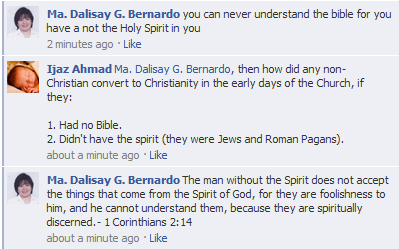
As a Muslim who frequently discusses the Bible and its thousands of passages with Christians, I often come across some really unique arguments. By unique, I mean quite illogical, irrational and morbidly absurd argumentation, in otherwords, I mean constantly breaking the threshold of human stupidity. Let’s take a look at one such example:


Br. Shabbir Ally had argued against this passage from 1 Corinthians 2:14 during a debate as well, I fondly remember scoffing at the absolute inanity of his opponent for raising such an illogical notion.  The passage in question, reads:

“The person without the Spirit does not accept the things that come from the Spirit of God but considers them foolishness, and cannot understand them because they are discerned only through the Spirit.” –  1 Corinthians 2:14.

Their illogical argument can be summarized as such:

  1. The Bible is inspired through the Holy Spirit.
  2. Muslims, Atheists, Jews, all non-Christians cannot understand the Bible.
  3. They cannot understand the Bible because they do not have the Holy Spirit to guide them (to understanding).

This presents many arguments against Christianity:

  1. If non-Christians cannot understand the Bible, why do you share free Bibles?
  2. If non-Christians cannot understand the Bible (which is the Gospel), how can you ‘spread the Gospel’ ?
  3. If non-Christians cannot understand the Bible, how did any of the early Christians convert to Christianity by use of the Bible?
  4. If non-Christians cannot understand the Bible, were the people who wrote it, always Christian, if not, then the people who wrote it, did not understand it!

Do these people sit and think about the arguments they present? I really do not think so. I’m not saying all Christians are guilty of this really silly argument, but as of late, it’s been popping up a lot more frequently and it’s really sad to see. If an adult does not have the foresight, the mental fortitude, the critical thinking abilities to see how irrational such an argument is, then what kind of brain dead cult is this religion truly mass producing? I really must be frank about it, you must suffer from severe learning disabilities to present such a case against your own religion. The funny thing about this, is the sheer arrogance that some of these Christians possess who say this to us. The lady in the picture was proud! She got many congratulations for posting that verse, I think they were happy to see me fall silent after she posted that comment, but I did not fall silent due to that comment being ‘solid argumentation’. Rather, the abject and rash stupidity it required to use it, made me feel really depressed for the human race, which is why I’m currently writing this article.

If you are a Christian and you or someone you know, uses such an argument, just think for a moment. Just a moment, it isn’t too hard, trust me, as a Muslim I do it all the time. How can you guide any non-Christian with the Bible, if they can never understand the Bible?

To the woman who posted that verse for me, I say to you, how did you ever expect me to understand 1 Corinthians 2:14, if I did not have the Spirit in me? Your own argument has back fired on you, it’s self defeating to be honest. In closing, if anyone uses this argument against you and uses this verse as evidence or even posts the verse itself, share with them the 4 points I noted above and educate them before they continue to embarrass themselves.

wa Allaahu Alam,
and God knows best.

Paul: Influenced by Satan

Bismillahir Rahmanir Raheem
بِسۡمِ ٱللهِ ٱلرَّحۡمَـٰنِ ٱلرَّحِيمِ ,

The Pauline Epistles and the narrative of Acts of the Apostles, present the vast majority of information that we have today on Paul of Tarsus (pictured above). Paul is essentially one of the greatest influences on early Christian theology, his struggles, his preaching, his conversion all constitute major plot elements of the early Christian narrative. I would like to begin this exposition by stating that this is not a simple and erratic attack on Paul. Rather, this is an examination of his statements as recorded in the New Testament, accompanied by commentaries from illustrious Christian exegetes. It is not my intention to hurt the sensitivities of our Christian brethren, but as a Muslim, it is my duty to examine the veracity of the Christian faith which claims to be the truth, above and beyond my own religion of Islam. With that in mind, let’s take a look at what we’ll be seeking to understand:

  • The New Testament Source.
  • YHWH/ Christ commands the Messengers of Satan.
  • Paul is afflicted by a Messenger of Satan.
  • Paul writes Epistles while under the influence of the Messenger of Satan.
  • Paul learns about Christ’s grace through a Messenger of Satan.

The New Testament Source:

Recorded in the Second Epistle to Corinth, we read of an experience that Paul encounters:

Therefore, in order to keep me from becoming conceited, I was given a thorn in my flesh, a messenger of Satan, to torment me. Three times I pleaded with the Lord to take it away from me. But he said to me, “My grace is sufficient for you, for my power is made perfect in weakness. ” Therefore I will boast all the more gladly about my weaknesses, so that Christ’s power may rest on me. – 2 Corinthians 12:7-9.

If we were to read from the beginning of this Epistle, we would easily derive the understanding that Paul is being taught a lesson by God.  This is in doing so that Paul, can avoid becoming conceited through his own experiences, thus, God has put a ‘thorn in his side’ – a messenger of Satan. This however is not a position unique to Paul, according to the Old Testament, God has, and frequently does, send evil Spirits/ Messengers of Satan to his own people.

YHWH/ Christ Commands the Messengers of Satan:

As the verse itself indicates, it is God who commanded the Messenger of Satan to become a ‘thorn in Paul’s side’. This presents a problem for the Christian faith, specifically because:

  • How can it be a Messenger of Satan if it is being commanded by God?
  • Therefore it has to be a Messenger of God as it is abiding by the commands of the Lord.
  • The Messenger of Satan therefore, according to the Bible is also the Messenger of God.

The question begs itself, if the Messengers of Satan are also the Lord’s messengers, then how can we can distinguish between the messages that the  Messengers are bringing, if the messenger is simultaneously under the authority of God and Satan? Paul himself, prayed for God to remove a Messenger of Satan sent by God from tormenting him, but God refused his request. Therefore we have Paul refusing to listen to a Messenger as sent by God to him. This would therefore have to mean that all Messengers of Satan are also Messengers of God.

Paul is Afflicted by the Messenger of Satan:

According to the verse, Paul became tormented by this messenger of Satan:

“I was given a thorn in my flesh, a messenger of Satan, to torment me.”

In what exact way the messenger of Satan/ God tormented Paul, is up for much discussion. Various exegetes have derived polarising views on the exact meaning of what the torment could be, however, there are a few general views on this issue. Let’s first read Adam Clarke’s exegesis:

What this thorn in the flesh might be has given birth to a multitude of conjectures: Tertullian thought it dolor auriculae, the ear ache;Chrysostom, the head ache; Cyprian, carnis et corporismulta ac gravia tormenta, many and grievous bodily torments. I believe the apostle to refer simply to the distresses he had endured through the opposition he met with at Corinth; which were as painful and grievous to him as a thorn in his flesh, or his being bound to a stake;

Therefore we can deduce the torment as given to Paul by the Messenger of Satan as being:

  1. Ear aches.
  2. Head aches.
  3. Bodily torments.
  4. Difficulties in preaching.

However, we have a much more detailed and reference list of supposed ailments that could have been what the tormenting was, according to the Coffman Commentaries on the Old and New Testaments, he states:

Tertullian thought it was a headache.

Klausner believed it was epilepsy. 

Ramsay identified it as recurrent malarial fever. 

Chrysostom said it was “all the adversaries of the Word.

John Calvin made it “fleshly temptation.” 

Martin Luther considered it “spiritual temptation.”

John Knox decided it was “infirmities of the mind.”

Catholic commentators generally say “lustful thoughts.”

McGarvey: “acute, disfiguring ophthalmia.” 

Macknight spoke of some who believed it was “the false teachers.”

Lightfoot suggested “blasphemous thoughts of the devil.” 

Alexander was sure it was “Malta fever.” Etc., etc.

Therefore, the ailments can be summarised as such:

  1. Bodily.
  2. Of the mind.
  3. Of the Spirit.

Whichever of these the case may be, the point is that Paul was most definitely indeed, emotionally at pain and suffering from some form of physical impediment, to the extent he could not bare it and called upon God to help him.

Epistles were Written Under the Influence of the Messenger of Satan:

According to verse 14 of the same chapter, Paul continues to preach while under the influence and torment of the Messenger of Satan/ God, the verse reads:

“Now I am ready to visit you for the third time”

In verse 20, Paul reaffirms that something is not right with him, something is amiss, so he tells the people at Corinth to not expect him to be normal upon his arrival:

“you may not find me as you want me to be”

Up to this point, Paul has not yet been able to remove the torment/ influence of the Messenger of Satan/ God upon him and he admits in Chapter 13 of the same Epistle that he continues to write while under the influence:

This is why I write these things when I am absent, that when I come I may not have to be harsh in my use of authority—the authority the Lord gave me for building you up, not for tearing you down.”

While Paul is under the influence of the messenger of Satan, he continues to write and continues to hold the authority of the Lord. This brings into validation my earlier argument that since the messenger of Satan was under the authority of the Lord, then it was indeed a messenger of the Lord. What qualified my statement, was that even Paul who was being directly influenced and tormented by the messenger of Satan (the Lord), he persisted in laying claim to God’s authority. Therefore even while under the directives of the messenger of Satan, Paul continued to write to Churches and still carried the ‘authority’ of God. Hence the question begs itself, if this is as the case presents itself, how can we distinguish between the authority of the Lord and the influence of the Messenger of Satan/ the Lord? Paul here, indirectly refers to Satan (who is influencing him presently) as giving him the authority of the Lord!

The Messenger of Satan Teaches Paul, Christ’s Grace:

According to the verse (7), Paul asks Christ (his God) to remove the influence/ torment of the messenger of Satan. However God’s reply is strange, God says to Paul that the messenger is meant to teach him grace, as only grace an save him from the punishment of the messenger of Satan:

Three times I pleaded with the Lord to take it away from me. But he said to me, “My grace is sufficient for you, for my power is made perfect in weakness. ”

Therefore, as the verse clearly demonstrates, the purpose of the messenger of Satan, was to teach Paul of Tarsus the true message of Christ’s grace.

Conclusion:

The case henceforth, is that Paul was sent a messenger of Satan, who is truly a messenger of God, to torment Paul. The tormenting could be bodily, of the mind or spiritually, perhaps even a combination of two or all three ailments. Paul received this messenger of Satan because he became prideful (self conceited), the use of the messenger was also to teach Paul grace. A Messenger of Satan was sent to teach Paul the true meaning of grace. Last but not least, Paul was unable to rid himself of this messenger of Satan, who remained with Paul and influenced/ tortured him as he preached and wrote Epistles, which are in today’s Bible.

wa Allaahu Alam,
and God knows best.


Pakistani Clerics Vow to Defend and Support Framed Christian Girl

Bismillahir Rahmanir Raheem
بِسۡمِ ٱللهِ ٱلرَّحۡمَـٰنِ ٱلرَّحِيمِ ,

In a show of true Islamic spirit, the All Pakistan Ulema Council has come out in defense of the framed Christian girl. They have unanimously decided to support her and are publicly decrying the acts of the Imam who attempted to malign the girl through a blasphemy case. The Guardian (UK) says:

The Christian girl who was allegedly framed for blasphemy by her local mullah has been hailed as a “daughter of the nation” by one of Pakistan‘s most senior Islamic clerics, who also vowed to guarantee her safety if she is eventually released from prison.

The heavyweight support for Rimsha Masih from the chairman of the All Pakistan Ulema Council, a grouping of Islamic clerics, is being seen as a remarkable turn of events in a country where individuals accused of insulting Islam are almost never helped by powerful public figures.

On Sunday, Ashrafi said he had been moved to speak out after reading reports that Rimsha had Down’s syndrome, a condition that also affects Ashrafi’s 15-year-old son. He said the Ulema Council would guarantee Rimsha’s security from vigilantes or extremists if she was released.

You can read the entire article here. An organization representing thousands of Muslim clerics, who are showing support for the girl has gone on to demonstrate that Islam is not under the control of a few radicals. What is most interesting is that almost no pro-Christian website, including, the Islamophobic, “Answering Muslims“, has yet to highlight this act of compassion by this Muslim organization.

You’d often hear the claim, that Muslims don’t do enough to denounce extremists, but here we have a perfect example of a major organization doing so, not to mention two other organizations recently doing so, yet we are hearing nothing from anti-Islamic Christians on this recent news. Cat got their tongue, maybe?

wa Allaahu Alam,
and God knows best.


Cardinal says Church is ‘200 years behind’ the Times.

Bismillahir Rahmanir Raheem
بِسۡمِ ٱللهِ ٱلرَّحۡمَـٰنِ ٱلرَّحِيمِ ,

Well, so much for stating the obvious. Cardinal Carlo Maria Martini, had some very special last words. Before his death, which took place only a few days after laying the smack down on the Catholic Church, Cardinal Maria Martini had some scorching remarks to make. So rapidly is Christianity dying, that he describes the ‘prayer rooms’ as empty:

Italian newspaper Corriere della Sera has published his last interview, recorded in August, in which he said: “The Church is tired… our prayer rooms are empty.”

He repeats his point that the Church is no longer what it used to be. Do you enjoy watching those pictures of the old European Churches, large, majestic, powerful? Those Churches of wonder and beauty? So do I, but as it turns out, those things are empty and have been so for quite some time. No one is willing to attend services in them:

Catholics lacked confidence in the Church, he said in the interview. “Our culture has grown old, our churches are big and empty and the church bureaucracy rises up, our religious rites and the vestments we wear are pompous.”

If the Cardinal were still alive, I’d let him know, that as a Muslim who spent several years in a Catholic institution, I can agree with his sentiments, better yet, as a Muslim, I’ve always lacked confidence in the Catholic Church. Violent, oppressive and pseudo religious, it is no longer relevant to the modern world. What’s worse is that the only mention of the Church these days is to highlight the rampant sexual abuse problems it is facing, something the Cardinal also touched upon:

“The child sex scandals oblige us to undertake a journey of transformation,” Cardinal Martini says, referring to the child sex abuse that has rocked the Catholic Church in the past few years.

You can read the entire article here. As Muslims, we’ve always recognized the self destructive nature of the Catholic Church, it offers no sense of religious guidance, its laws are founded on irrational bases and its practitioners usually apostate or just convert to other faiths. I attended a Catholic school for several years, the prayer leader of the school, a former Headboy and preacher, is now atheist/ agnostic. The Catholics at the school itself forced themselves to attend ‘mass’ and the rest of the so called ‘Christians’ in the school, opposed the archaic Church. It definitely seems that the writing is on the wall for this religion.

wa Allaahu Alam,
and God knows best.

Priest says ‘Children are Seducers’

Bismillahir Rahmanir Raheem
بِسۡمِ ٱللهِ ٱلرَّحۡمَـٰنِ ٱلرَّحِيمِ ,

Believe it or not, 78 year old Father Benedict Groeschel (pictured above) in an interview with the National Catholic Register made the following statements, when asked about his experience in working with Priests who were involved in abuse of children:

“People have this picture in their minds of a person planning to — a psychopath. But that’s not the case,” Groeschel explained. “Suppose you have a man having a nervous breakdown, and a youngster comes after him. A lot of the cases, the youngster — 14, 16, 18 — is the seducer.”

“Well, it’s not so hard to see — a kid looking for a father and didn’t have his own — and they won’t be planning to get into heavy-duty sex, but almost romantic, embracing, kissing, perhaps sleeping but not having intercourse or anything like that,” he continued.

Groeschel called the abuse “an understandable thing,” and pointed to Penn State football coach Jerry Sandusky, who he called a “poor guy.”

I wish I could be making this up, but it gets worse:

Groeschel pointed out that “sexual difficulties” were rarely prosecuted 10 or 15 years ago, and now if “any responsible person in society would become involved in a single sexual act — not necessarily intercourse — they’re done.”

“And I’m inclined to think, on their first offense, they should not go to jail because their intention was not committing a crime,” he added.

You can read the full story here. His comments have invited staunch criticism from both Church and non-Catholic groups, the interview in question has already been pulled from the National Catholic Register’s website, but can still be read via Google Cache. Interestingly enough, David Wood of the Answering Muslims blog (see: Thursday 30th, August, 2012, 6:28 PM), asked for Muslims to condemn when persons of their own religious group commit crimes of this nature, but so far David (as expected) has been silent on the issue of Church abuse and more specifically, the horrendous statements of this Church Father.

For such a senior member of the Catholic Church, whose life has revolved around social work to defend such acts, seriously brings into question the acceptance of Church abuse by these elderly, ‘faithful’ Church Fathers. How far does it have to go, until someone says stop?

Further Reading:

wa Allaahu Alam,
and God knows best.

Paul, Jesus, Disciples – Mentally Ill says Church of England

Bismillahir Rahmanir Raheem
بِسۡمِ ٱللهِ ٱلرَّحۡمَـٰنِ ٱلرَّحِيمِ ,

This is not a joke. News reports are indicating that the Church of England intends to embark on a new “Mental Health” campaign and trust me when I say they’ve gone all out, suggesting that Paul, Jesus and the disciples were all to some extent, mentally ill persons. This isn’t a Muslim saying this, or an Atheist, but the Church of England, and the best news is that they’ve even included Biblical justification:

A SUGGESTED sermon produced by the Church of England for clerics attempting to tackle the stigma of mental health pulls no punches.

Written by the Rev Eva McIntyre on behalf of the Church’s Archbishops’ Council and the Time to Change mental health campaign, it suggests John the Baptist, St Paul, St Francis and other figures from the Bible may all have been mentally ill.It even asks followers to consider accusations made in the New Testament that Jesus “had lost his mind”.

It reads: “Many of the people we read about in Bible stories might today be considered as having mental health issues.

“For example, ‘Would Jesus’ family maybe on occasion have said, ‘Cousin John is a bit odd, bless him!’ when John the Baptist took to his eccentric style of life?

“It has long been thought that King Saul, in the books of Samuel, was displaying mood swings that suggest he had bi-polar disorder and some think that St Paul’s Damascus Road experience was the result of some sort of breakdown or psychotic episode.

“Even Jesus was not immune to accusations about his mental health: there is a story in the gospel that tells of his mother and siblings attempting to take him home because they are afraid that he has lost his mind.”Many of the stories of the Saints, too, have led people to discuss their mental health. “For example was St Francis suffering from a mental health title?”

Acknowledging how shocking these ideas might be, Ms McIntyre, a member of the General Synod, adds: “Some may find these suggestions disturbing or offensive even.

“Perhaps we need to ask why it would be so terrible to think that some of our most inspirational forebears might have experienced mental health illness. – Source.

I’ve always hinted/ strongly implied, that St. Paul was infact, mentally ill, and the Jesus that the Bible portrays also seems to indicate a mentally unstable character. You can read my articles here and here on this issue. I can understand if a non-Christian held these views, but the very fact that Christians are beginning to point out, what Muslims, Atheists and Jews have been saying for centuries, make this a stark and bold revelation, indicating the extent to which learned Christians are realising the falsehood of their own faith.
wa Allaahu Alam,
and God knows best.

Pastor Spreads HIV Amongst Congregation

Bismillahir Rahmanir Raheem
بِسۡمِ ٱللهِ ٱلرَّحۡمَـٰنِ ٱلرَّحِيمِ ,

Shocking news really! A married Pastor of a Full Gospel Baptist Church, Pastor Craig Lamar Davis whose previous girlfriend indicated that she had HIV, then went on to sleep with multiple women. Ending in ‘romps’ at his family home, thus spreading the disease to other female members of his congregation.

Pastor Craig Lamar Davis (pictured) of Atlanta’s Full Gospel Baptist Church was arrested on July 22 for reckless conduct, when police investigators discovered that he has HIV and had allegedly been indulging in unprotected sex with several of his congregation members, reports WVIG.  Now one of his congregation victims have come forward with her story.

hus far, two women have pressed charges against the married preacher. One of the victims,Ronita McAfee, told police officials that she met the pastor on Facebook and began communicating with him.  The online relationship soon progressed into sexual romps at the pastor’s home.  McAfee says a few months in to the affair, Davis revealed that one of his former girlfriends had tested positive for HIV. The seemingly concerned preacher allegedly advised McAfee that the virus would not kill her if she tested positive and even went as far as to suggest some drugs that she could take to avoid infection.

Say what?

Source: http://newsone.com/2033009/craig-lamar-davis-full-gospel-baptist-church/

wa Allaahu Alam,
and God knows best.

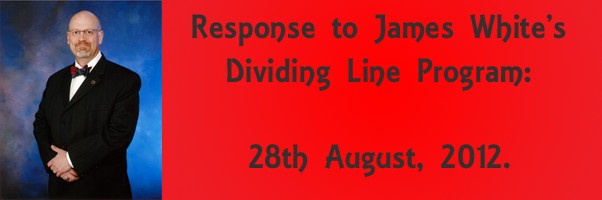
Response to James White’s Dividing Line Program 28-08-2012

Bismillahir Rahmanir Raheem
بِسۡمِ ٱللهِ ٱلرَّحۡمَـٰنِ ٱلرَّحِيمِ ,

Once again, I’ve rattled the hornet’s nest of Evangelical extremism. This isn’t something I’m unfamiliar with, but this week’s Dividing Line program had me in stitches, allow me to explain why. James White found my article located here, to be ‘condescending‘, ‘insulting‘ and alluded to my writing as being ‘extremist‘. The problem therein is that James White has no problem with the language, the insults, the wild accusations that his friends over at Answering Islam or ABN Tv use (see here and here). In fact, it’s quite well known that James is a friend and ally, even a student and sometimes a teacher of one, a Mr. Sam Shamoun. Those who are familiar with Sam know that he is far removed from any level of dignity. Therefore, it is in that light that I am calling James White out on his hypocrisy. If he does not condemn Sam for the language he and his co-missionaries use, on what grounds of intellectual responsibility does he stand? Nay, on what grounds as a Christian (as he claims himself to be), can he be silent on the acts of his own brothers in faith, but attack Muslims when they use the same form of argumentation? It should also be noted, that I found James to be fond of using the term, ‘double standard’, yet in his rant, he was often more than inconsistent, falling prey to his own double standards.

I’d like to make it clear, that my article was simple:

  • To identify a criteria to determine who God was according to the Old Testament.
  • This criteria had to be unique, solely to YHWH.
  • Demonstrate said quality of YHWH that identifies YHWH solely as God.
  • Compare aforementioned quality to Jesus of the New Testament to see if the same unique quality can be equated.
  • Comment on the findings.

This is all my article did. Based on that, James did not answer my question, in fact he demonstrated his inability to properly respond to basic theological analysis. The premise was simple, if YHWH is God, does He do something only God can declare?  This is exactly what YHWH did, He declared himself to be God in no uncertain terms. The same cannot be said of Jesus, although James did try by referencing Titus 2:13 which reads:

“while we wait for the blessed hope—the appearing of the glory of our great God and Savior, Jesus Christ,”

Which isn’t what I asked for. I asked, where did Jesus declared Himself to be God, as YHWH did in the Old Testament. No one says YHWH is God because Abraham, David or Moses call Him God. We know YHWH is the God of the Old Testament because He says so Himself, because He identifies Himself as God almighty. The same cannot be said of Jesus, because at no point does He ever mimic the behaviour of YHWH as a proud God. For hundreds of years, nay, thousands of years, YHWH continuously declared Himself to be Hashem Adonai, Elohiym, etc. Yet the point remains, that despite thousands of years of doing so, he was unable in the person of Jesus to do so once. If they were the same God, why does Jesus not have the same proud, boastful, magnificent, powerful declarations of YHWH? You can find a more expansive study of that argument, with relevant verses here.

Now James did try to counter my questions by referring to quite pathetic straw men. Today, I’m going to analyse some of his straw men and ask him why it is that he could not present a counter question, relevant to mines. You can find his rabid diatribe here, his rant against my article begins at the 48th minute mark.

Argument 1:

  • Is every single Surah of the Qur’an the same? No.

I don’t see what Chapters (Surahs) have to do with fundamental alterations to God’s persona. I did not question James on what Matthew says, as compared to that of Luke, I asked James why YHWH had one persona for thousands of years, and suddenly in the space of 33, could not continue this persona. This has nothing to do with chapters, verses, books, scripture, it’s a question about His deity. Therefore not only is this question irrelevant, it’s a poor attempt at diverting from the issue at hand. Perhaps it was an emotional argument, but nonetheless, it can only give nothing but credence to his weak scholarship.

Argument 2:

  • If you read the Qur’an, in a contextual and chronological fashion you will see a development, the first portions of the Qur’an barely emphasizing tawheed. That specific term does not appear in the Qur’an. The oneness of Allah against polytheists, at that time Muhammad [saws] is a minority Prophet,  and he’s calling the Quraysh and Meccans to true worship.

I’m not sure if James White was at any point intoxicated during this radio program, or if he intentionally was being deceptive. The very first verse to be revealed (see Ahmed Von Deffer’s, “Ulum al Qur’an” for the Chronology of the verses revealed), refers to Allaah as being Lord (singular, i.e. Tawheed):

Read! In the Name of your Lord, Who has created (all that exists), – Qur’an 96:1.

Not only is Allaah defined as Lord (Rabb), He is also defined as the Creator, and that’s in the very first verse. It gets worse, the second set of verses to be revealed enforce this message once more:

Glorify your Lord – Qur’an 74:3
And persevere in the way of your Lord. – Qur’an  74:7.

Tawheed refers to the oneness of our Lord (Rabb) and I am pretty sure that any functionally literate human sees the singular word, ‘Lord’ and not ‘Lords’. If referring to God as a ‘Lord’, that is: singular, does not emphasize the oneness of God, then James is sacrificing his intellectual integrity for an argument a child would be able to refute. To rub some salt into his intellectual wounds, the next two Surahs which were revealed speak specifically about Tawheed (some say Surah 73 came second and then Surah 74, quoted above):

Lord of the East and Lord of the West – there is no God except Him, therefore make Him your sole Trustee of affairs. –  Qur’an 73:9.

Tawheed is pretty clear, protruding, extant, explicit, in the verse above, even if that does not satisfy him, the very next (forth) revealed Surah mentions it in even more detail:

In the name of Allah, most benevolent, ever-merciful. ALL PRAISE BE to Allah, Lord of all the worlds, Most beneficent, ever-merciful, King of the Day of Judgement. You alone we worship, and to You alone turn for help. Guide us (O Lord) to the path that is straight, The path of those You have blessed, Not of those who have earned Your anger, nor those who have gone astray. – Qur’an 1:1-7.

Here’s a bit of advice James, if you have to lie, atleast make a smart lie, something with some level of ambiguity, something that I may not have knowledge about, but out of all things, do not lie about the Qur’an or early Islam. We have endless access to vast amounts of information that make it almost impossible for you to qualify your deceitful statements.

Argument 3:

  • I mean some Surahs say one thing and another Surah does not contain the exact same thing as another one, that must mean there is some change. Must be a different God.

This is another poorly constructed straw man. My argument was not nor has it ever been differing contents from one chapter to a next, my argument has and will always be, why the change in persona from a boastful, prideful God, to a mute that would not dare declare his deity, as opposed to thousands of years of magnificent declarations?

Argument 4:

  • When jesus comes, there are prophecies, those prophecies identify him as El Gibbor and Father God, Father Eternity. John comes to make straight the way for YHWH. The original followers of Jesus identify him as YHWh and cite texts from the OT and apply them to Jesus.

The problem arises once more, these are not the proud, bold, extant, explicit statements of YHWH, Jesus does not make these statements, nor does he interpret such statements to be about him. The epistles which do so, and the gospels which are written about him, are not the same as his interpretations, or his points of view. Taking post hoc eisegesis by unknown scribes as evidence of a man’s deity is not only lazy scholarship but grasping for straws at the least. It is also  quite abhorrent to identify the original followers of Jesus as being those from whom Tanach prophecies were applied, as we have no proper definition of who a ‘real’ Christians was until 325 AD when a vote decided that. It’s merely wishful thinking to assume that a decision of who a real Christian was, some 290 years after the man’s ministry, somehow transforms him into a God.

Argument 5:

  • So is your argument, really that Jesus should have just popped into existence.

After roughly 10 minutes of ranting, James finally asks an intelligent question. He wants to know what my argument is. See, this makes sense, all the previous questions he has asked are unintelligible and not related to what I asked in my article. I applaud James for conceding that he has faulty argumentation and for not knowing what my argument actually was. My argument is not that Jesus should have just popped into existence, my argument is why does he never say he is God, like YHWH does in the 12 verses I gave (not to mention the vast amounts of others I am willing to provide)?

Argument 6:

  • Is he just supposed to pop out with a big sign and say I am God, worship me? That’s the only way God can do these things. I am God, worship me. Is that the only way God can really do this thing? It is not possible, that the God man can come and actually come to veil his glory.

Again James, your inability to answer my question and to divert by promoting a straw man, leads me to further understand why Paul Williams refuses to share a stage with you. Such a low level of academia should not be entertained. I will quote myself:

 I asked for where Jesus declared Himself to be God, as YHWH did in the Old Testament. No one says YHWH is God because Abraham, David or Moses call Him God. We know YHWH is the God of the Old Testament because He says so Himself, because He identifies Himself as God almighty. The same cannot be said of Jesus, because at no point does He ever mimic the behaviour of YHWH as a proud God. For hundreds of years, nay, thousands of years, YHWH continuously declared Himself to be Hashem Adonai, Elohiym, etc. Yet the point remains, that despite thousands of years of doing so, he was unable in the person of Jesus to do so once. If they were the same God, why does Jesus not have the same proud, boastful, magnificent, powerful declarations of YHWH?

What is worse is that James mentions that God may have wanted to ‘veil‘ His glory. Veil here means to ‘cover‘, so God who is Eternally Majestic, would like to ‘hide’ His majesty? Logically speaking, to be Eternal is a constant, i.e. never ending and to ‘hide’ is to alter this constancy and thus be rendered as non-eternal. Therefore James provides another reason why YHWH is not Jesus, YHWH declares Himself to be eternal:

Abraham planted a tamarisk tree in Beersheba, and there he called on the name of the LORD, the Eternal God. – Genesis 21:33.

While Jesus is not eternal in His attributes, but veiled and hidden, atleast according to James White.

Argument 7:

  • Is it possible, just slightly possible, Ijaz, that God doesn’t want to present his son in this fashion? That maybe the idea of faith, is to be something other than just simply accepting some massively overpowering display.

So James at one point, hit a note of desperation and decided to throw an emotional argument into the mix. Yet the Bible refutes James once more, it says:

Who among the gods is like you, LORD? Who is like you— majestic in holiness, awesome in glory, working wonders? – Exodus 15:11.

YHWH is defined as an eternal God, eternally Majestic, Eternal in Glory, yet James’ version of YHWH is timid and veiled, not overpowering, which is different from the powerful and magnificent YHWH:

For the LORD your God is God of gods and Lord of lords, the great God, mighty and awesome, who shows no partiality and accepts no bribes. – Deuteronomy 10:17.

Argument 8:

  • When your quran says your prophet came with no other miracle than the qur’an, now narrations came up with all sorts of stuff that he allegedly did but that was later on. That’s odd isn’t it….Why isn’t there any glowing massive demonstration that Muhammad is the final prophet outside of well, just the Qur’an, which I just read and don’t find all that impressive?

I’m not sure what YHWH being God and Jesus not declaring himself as such, has to do with miracles of the Prophets. Doing miracles does not make one a Prophet, even the Bible attests to this:

They are demonic spirits that perform signs, and they go out to the kings of the whole world, to gather them for the battle on the great day of God Almighty. – Revelation 16:14.

Similarly, your argument that the ahadith came later on, is not only ignorant of the early transmission of the Sunnah, but ignorant of the fact that the argument backfires against you. Another one of your ‘double standards‘, recall that the stories of Jesus’ life were produced decades after his ‘worldly ministry’, since you lay claim to the notion that time affects validity, then your claim to miracles being a criteria can be equally as dismissed through dated record by scribes about your New Testament.

Argument 9:

  • Marcionite was not an actual Christian. We should hold all those little Muslim sects and cults to be Muslims as well. The great double standard.

Marcion was a Christian, the formal declaration of a Christian which you now hold to was only decided at the Council of Nicea. The same Catholic Church which you refer to as apostate and following the devil, is the same Church’s definition you use to define who a true Christian was, before 325 AD. The same Catholic patristics you demonise are the ones who opposed Marcion. Yet Marcion had vast amounts of followers and was the first man to codify as scripture, the New Testament you use today. Clearly if you want to talk about double standards, you must question yourself first.

In closing the question that sparked this article and a radio show, remains unanswered. Why is it that the YHWH of the Tanach is able for thousands of years to declare Himself as an Eternal, Majestic, Mighty, Powerful, Jealous, Vengeful God, with explicit, extant and clear statements, but Jesus, in 33 years, is unable to do so, not even once? James did indicate he may continue his ‘response’ to me on Thursday, if that is the case, is he planning to actually answer the crux of the argument then, or would I have to seep through his straw men to find it?

wa Allaahu Alam,
and God knows best.

« Older Entries Recent Entries »