Category Archives: Muslim and Non-Muslim Dialogue

A Missionary’s Response to John 8:58

After my article here, Anthony decided to respond in an article copiously filled to the brim with nonsensical ad hominem and straw man attacks. He’s upset, very upset after a bust up we had along with Br. Yahya Snow via e-mail, I didn’t realise my words had stung him that badly that it drove him to such madness. I’ll be skipping the filibustering and get straight to his counter arguments:

Contrary to this authors’ claim, Christians do not argue that Jesus is referring to himself as “a” God, as if Jesus is just one God among others.

He’s arguing pedantically, I removed the word ‘a’ and the argument still stands, “Many Christians claim that Jesus in John 8:58 claims to be “I AM”, and God in Exodus 3:14 refers to Himself by this title/ name, therefore Jesus is knowingly referring to himself as God.” So his qualms, cries and rantings thus far have been negated by simply removing a word. Regardless of how much he writes, the premise still stands, by removing the word ‘a’, he effectively now cannot claim I’m appealing to modalism. Now he has to actually respond to the argument at hand. It’s a shame though, since a significant majority of his “response” is fixated on the trumped up connotations that the word ‘a’ is supposed to imply a belief other than trinitarianism. In no way did I appeal to, or for myself believe, that by applying the word ‘a’, that I would be arguing using modalism. Therefore, by removing one letter, I’ve essentially rendered 90% of his counter argument useless. His next argument rests on this claim:

Those who enter John’s Gospel through the front door would already be alerted to this idea and would not be surprised when they come across it in the narrative. In the prologue to the book, John introduces Jesus as the eternal Word…

Except for a very big problem, the Johannine Prologue is effectively as most textual critics would agree, an interpolation onto the Gospel of John. There are three facts that this propagandist must face:

  • John 1 and 21 are philologically outside of the original text of the Gospel.
  • None of the other Gospels report such language, terms or beliefs associated with Christ.
  • The prologue is in of itself unique to John 1 and cannot be found anywhere else throughout Johannine literature.

In as much as he wants to appeal with it, he has to concede that the prologue is not from the original author of John, we read from the Hermeneia Series on the Johannine Prologue:

“Bultmann has done us the great service of demonstrating, on the basis of style, that the core of the Johannine Prologue is an independent entity, a hymn, that was added to the Gospel as an introduction.”

“What really prompted the author of this Gospel to preface his work with this hymn? Ever since Harnack’s essay, “Uber das Verhaltnis des Prologs des vierten Evangeliums zum ganzen Werk,” this question has been given serious consideration. Did the Evangelist intend to preface his work with a statement of its leading ideas – as an introduction? But does the Prologue really recite these leading ideas? Did the Evangelist want to make his work palatable to hellenistic readers by making use of the Logos concept?”

Anthony even concedes to the fact that there are numerous other “I AM” statements littered throughout the Gospel of John which do not hold such weight as in equating such instances with Exodus 3:14:

In fact, even if we restrict ourselves to the local context of John 8:58 we see Jesus assert this several times in the same dialogue. Moreover, two of these notices even occur in conjunction with other “I Am” statements:

Then He said again to them, “I go away, and you will seek Me, and will die in your sin; where I am going, you cannot come.” So the Jews were saying, “Surely He will not kill Himself, will He, since He says, ‘Where I am going, you cannot come’?” And He was saying to them, “You are from below, I am from above; you are of this world, I am not of this world. Therefore I said to you that you will die in your sins; for unless you believe that I am, you will die in your sins.” (John 8:21-24)

So Jesus said, “When you lift up the Son of Man, then you will know that I am, and I do nothing on My own initiative, but I speak these things as the Father taught Me. And He who sent Me is with Me; He has not left Me alone, for I always do the things that are pleasing to Him.” As He spoke these things, many came to believe in Him. (John 8:28-30)
Therefore, even this Christian polemicist agrees that John 8:58 uses a phrase uttered by Jesus many times, and that it’s use in one verse cannot magically carry over to Exodus 3:14. He later fully admits this by stating:
As for Exodus 3:14, along with many scholars I don’t think that it is the most directly relevant verse to John 8:58.
We thank him for disagreeing with the majority of Trinitarin scholarship on the issue, as he echoes a sentiment also claimed by Dr. Anthony Buzzard, a noted Unitarian Biblical scholar. We can now read where in one paragraph the author, Anthony, refutes himself and clearly demonstrates that he is lying:
According to the author the word for “God” in Exodus 3:14 is Elohim. Furthermore, the author tells us that for Christians this word can refer either to the Father alone or to all three persons together. But this isn’t correct, or at least it is not the whole truth, which means that our author has committed the fallacy of false choices or exhaustive hypotheses.
Here he claims that I am wrong for saying that Elohim or God, can refer to one person in the Godhead or all three. Yet here he agrees with what I’ve stated above:
Since all three persons are consubstantial, the word God is equally applicable to any single member of the Godhead, whether Father, Son, or Spirit, or to all three persons together. This means the word can either refer to the Father, to all three persons, or to either one of the other persons, whether the Son or the Spirit.
At this point, we have to ask, does Anthony realise he is arguing against that which he himself claims of his own beliefs? This takes care of his “response” to Problems 1 and 2. Despite refuting himself and declaring what I said as wrong, although he himself in the very same paragraphs claims to believe in that same belief, he went on to state:
In other words, the word Elohim can be used for the Son even as it can be used for the Father by Himself or for the Holy Spirit by Himself.
This is in no way different to what I claimed previously. So the problems still persists:

Problem 1:

Elohiym consists of the Father, Son and the Holy Spirit of one substance, united by the Godhead. If Christ is claiming to be this Elohiym (the united Three Persons), then he is claiming to be the Father as well as the Holy Spirit. According to Trinitarian dogma, the Son is not the Father or the Spirit. In other words, if Christ is claiming to be the Elohiym (of Three Persons) then he is effectively breaking the rules of the Trinitarian dogma as the Son is claiming to be other persons in the Godhead.

Problem 2:

If the Elohiym of Exodus 3:14 is the Father alone, then Christ who is the Son is claiming to be the Father and according to Christian Trinitarian belief, the Son is not the Father. Therefore if the Christian is claiming Christ to be Elohiym – the Father, then the Christian is admitting that the Trinity in this case is a false teaching or that Christ did not believe in the Trinity that they appeal to.

Anthony at this stage, did not offer any response to Problem 3, which can be seen here:

The Fallacy of False Equivocation.

Jack is a boy.
James is a boy.
Jack is James.

Obviously Jack is not James.

Orange is a fruit.
Apple is a fruit.
Oranges are Apples.

Obviously Oranges are not Apples.

God says I am.
Jesus says I am.
God is Jesus.

Clearly we can see that this is the fallacy of false equivocation.

His only meaningful reply was:
If first century Jews reasoned like this author they wouldn’t have been upset with Jesus.
Which is hilarious because on this occassion the Christian is willing to accept the testimony of Jews against Christ and he’s also willing to admit that the Johannine author who put those interpolated words into the mouth of Jesus is hinged on 1st century Graeco-Roman Jewish Syncretism with their Roman counterparts whom they saw the word or wisdom of God as being a distinct deity. So appealing to Jewish reasoning during the 1st century is one of the worst counter-arguments he could have used. In other words, he’s appealing to the arguments and reasoning of the same people whom Christ declared as being severely misguided on their beliefs about him, see John 8:44-48.
In response to Problem 4, he states:
While Christians do believe that “the Son is not the Father or the Spirit,” we do not believe that “the Son is the Father and the Spirit unified.”
My argument was as such:

You cannot say that John is an employee in the company, but you can say that John works for the company.
You cannot say that Shem and Ham are brothers, but you can say that they have the same mother and father.
You cannot say that a banana is a fruit, but you can say that the banana belongs in the fruit basket.

Similarly:

You cannot say that the Son is the Father or the Spirit, but you can say that the Son is the Father, Son and Spirit.

I therefore do not see how Anthony has responded to the argument. I agree that you do not believe the Son is the Father and the Spirit unified, you do believe however, that the Son is the Son, the Father and the Spirit unified. By ignoring the argument and responding to his whims and fancies, he’s distracted himself and failed to address the point at hand which still stands.

Conclusion:

Anthony hasn’t presented any new rebuttals, this article of his was a poor attempt at responding to my Problems with John 8:58 which he has yet to refute. In essence, it seems hastily authored and filled with assumptions and ad hominem. The Problems with John 8:58 in Christian usage still stands and Anthony’s article does not add to the discourse on its use but rather distracts from it.

I hope and pray he has something of substance to present next time in response to what I author, I do not consider mad ranting or inane arguing worthy of my time. His response was nothing more but an attempt to recover from the whooping he received via private e-mail discourse.

and God knows best.
The Problem of John 8:58 for Christianity

Update: Anthony Rogers tried(?) to respond to the Problems of John 8:58 for Christians, I’ve refuted him here.

Question:

Many Christians claim that Jesus in John 8:58 claims to be “I AM”, and God in Exodus 3:14 refers to Himself by this title/ name, therefore Jesus is knowingly referring to himself as God. How can Muslims respond to this argument?

Answer:

John 8:58 is perhaps one of the best verses to disprove the deity of Christ, most Christians simply fail to see the problems with utilizing such a verse and in this article I’d like to demonstrate just how useful the “I AM” statement attributed to Christ is. Let’s first take a look at the verses in question:

God said to Moses, “I am who I am. This is what you are to say to the Israelites: ‘I am has sent me to you.’” – Exodus 3:14.

“Very truly I tell you,” Jesus answered, “before Abraham was born, I am!” – John 8:58.

There is something very important to note, we must ask, who is God in Exodus 3:14? The Hebrew from the Westminster Leningrad Codex references God as  Elohiym, see here. According to Christian belief, Elohiym can either refer to the Father (God) or the Godhead (all three persons of the Trinity). If Christ is claiming to be the Elohiym of Exodus 3:14 then there exists a major problem.

Problem 1:

Elohiym consists of the Father, Son and the Holy Spirit of one substance, united by the Godhead. If Christ is claiming to be this Elohiym (the united Three Persons), then he is claiming to be the Father as well as the Holy Spirit. According to Trinitarian dogma, the Son is not the Father or the Spirit. In other words, if Christ is claiming to be the Elohiym (of Three Persons) then he is effectively breaking the rules of the Trinitarian dogma as the Son is claiming to be other persons in the Godhead.

Problem 2:

If the Elohiym of Exodus 3:14 is the Father alone, then Christ who is the Son is claiming to be the Father and according to Christian Trinitarian belief, the Son is not the Father. Therefore if the Christian is claiming Christ to be Elohiym – the Father, then the Christian is admitting that the Trinity in this case is a false teaching or that Christ did not believe in the Trinity that they appeal to.

Problem 3:

The Fallacy of False Equivocation.

Jack is a boy.
James is a boy.
Jack is James.

Obviously Jack is not James.

Orange is a fruit.
Apple is a fruit.
Oranges are Apples.

Obviously Oranges are not Apples.

God says I am.
Jesus says I am.
God is Jesus.

Clearly we can see that this is the fallacy of false equivocation.

Problem 4:

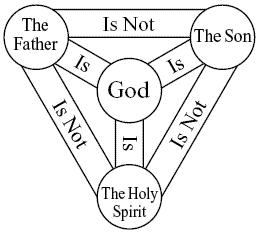
The Christian claims that while the Son cannot claim to be the Father or the Spirit, the Son can claim to be God. For explanation purposes, let’s use a common learning aid which Christians use to explain this reasoning:

cc-2014-trinity-diagram

However, this makes it worse for the Christian. Consider the following examples:

You cannot say that John is an employee in the company, but you can say that John works for the company.
You cannot say that Shem and Ham are brothers, but you can say that they have the same mother and father.
You cannot say that a banana is a fruit, but you can say that the banana belongs in the fruit basket.

Similarly:

You cannot say that the Son is the Father or the Spirit, but you can say that the Son is the Father, Son and Spirit.

It’s a contradictory claim. The Son is not the Father or the Spirit, yet they believe the Son is the Father, Son and the Spirit unified. Allow the Christian to ponder on this logic and see where it leads them, aid their thinking process by using the other examples provided above.

Conclusion:

The Christian cannot appeal to John 8:58 without disproving the doctrine of the Trinity by means of demonstrating that Christ himself did not know he could not claim to be the other persons of the Godhead. We can also demonstrate that they are applying faulty reasoning in their argumentation and thus can quickly disarm their frivolous claims.

and God knows best.

Pastor Samuel Green Caught Lying About “New” Quote

Pastor Samuel Green has been caught openly lying in a quote on the textual study of the Qur’aan. Behnam Sadeghi in Arabica 57 as quoted by Samuel Green has said the following:

cc-2014-samuegreen-quranlying

So Behnam Sadeghi is saying we have a “GENUINE ARCHETYPE” of the Qur’aanic text, breaking these terms down, we see:

gen·u·ine  (jĕn′yo̅o̅-ĭn)

adj.

1. Actually possessing the alleged or apparent attribute or character: gen
2. Not spurious or counterfeit; authentic. See Synonyms at authentic.
and the other definition:

archetype (ˈɑːkɪˌtaɪp)

n

1. a perfect or typical specimen
2. an original model or pattern; prototype
So according to the scholar Pastor Green quotes, we have an GENUINE/ AUTHENTIC, ORIGINAL TEXT of the Qur’aan. Yet, Green is saying the clear opposite. Can someone who speaks the English language, inform Pastor Green of what the words, genuine, authentic and original mean?

and God knows best.

How to Answer: What is the Proof that God exists?

Question:

If God exists, what is the evidence of its existence?

Answer:

This is a frequently asked question, and most religious lay men, regardless of their religious affiliation find it somewhat difficult to answer. That’s understandable because most people have not ever really asked themselves this question, so when it’s asked – they find great difficulty in articulating their answers.

However, the answer is simple, but there is a process one must go through in order to reach an amicable conclusion with the atheist. When they ask, “If God exists, what is the evidence that God exists?“, you need to ask, “What kind of evidence are you looking for, what kind of evidence would satisfy your question?“. Why do you need to ask this? From experience you’ll learn that the atheist will denounce every ‘answer’ as not accurately answering their question. Perhaps you may give them a verse or two from your religious scripture, perhaps you pointed to a prophecy, maybe a life experience or a historical occurrence. More often than not, the atheist will rebuke these responses as not answering the question.

The reason that your answers don’t answer the atheists’ question, is because the atheist themself, does not know what kind of evidence they are looking for. Evidences can be categorized into three general sets: theological, philosophical and empirical. The atheist will often answer physical or empirical evidence. Maybe they would like to see God, talk to God, or touch God. These are all empirical evidences. The next step in this process of answering the question at hand now diverges based on your belief. For the sake of brevity, I will be promulgating the Muslim view point. However, on request I can write on the Christian or Jewish viewpoint.

For the Muslim, we simply indicate to the Christian that we do not subscribe to the popular belief that God is a physical entity, for we believe He is unlike anything in creation (Qur’aan 42:11, 112:4). So asking for evidence of a physical God, when we as Muslims do not believe in a physical God, demonstrates that the atheists’ understanding of God is based on a flawed premise: an empirical one. An empirical God of which the Christians and Hindus believe in, will have to answer that they do believe in such a God and thus they will have to provide physical evidence. Since the Muslim does not, and we consider a physical God to be an antithesis to the very definition of the word God (an omnipotent being) – an all powerful God who is physical is limited to physical extremities and thus cannot be considered omnipotent.

We can then question their reasoning even further. If theists believe that God is uncreated, but that everything in existence is created, how can we use empirical tests which test created matter, to test an uncreated being? The likeness of this is to test the unknown with the known. We want to measure the size of the unknown, but we do not know what the unknown is, in what state it exists, how it exists. That’s a stupendous test! How can you test something, if you do not even know what the thing is? Therefore a perfect God, is 0ne which is not empirical and one which cannot be ‘tested’ by existing means. At this point, the atheist will either have to retreat from his position of seeking empirical evidence and settle for either theological or philosophical proofs. If at this point they still insist on empirical evidences, then they did not understand that they are arguing from the perspective that a physical God exists and you do not believe in such a God, this is arguing a straw man, this is fallacious reasoning.

Philosophically, we can say that if we exist, something had to bring us into existence. Since something cannot come from nothing, then we must assume that something brought everything into existence or being. We theists refer to this thing as God. So in summation, the proof that God exists, is that something had to bring everything into being. To prove this point, ask the atheist to demonstrate empirically, in front of you – something being produced, or derived from nothing. Since this cannot be done, we can then agree with the atheist that something exists and they are free to believe in whatever that thing is, but we simply ascribe that thing to be a God. As for the Christians and Hindus who believe in an empirical deity, they have to express their reasoning for belief in a physical deity and in arguing this, the onus (responsibility) is on them to provide physical evidence of this deity.

and God knows best.

Explanation: Qur’aans that contain less or more Surahs

Many Christian polemicists argue that certain companions of the Prophet (peace and blessings of God be upon him) had varying amount of Surahs in their copies of the Qur’aan. Some had 112, others had 111, etc. Br. Waqar has refuted those claims in detail here. While I won’t go into explicit detail, I will provide the Muslim with the tools to respond to such claims in a simple and concise manner.

The Argument:

Sahabi X only had Y number of Surahs in his copy of the Qur’aan, therefore he didn’t believe in the Surahs not included in his copy.

Responses:

  • The question must be asked to the Christian, where does the Sahabi (companion) say that he doesn’t believe in the excluded Surahs? The truth is, nowhere is that said. Therefore, the onus (responsibility) is on the Christian to provide evidence for such a claim.
  • Codex is a collection, Canon is an established list, so the canonical codex of the Qur’aan is a Qur’aan consisting of all the Surahs from al-Fatihah to an-Nas, all 114 of them. Many of us have booklets at home that contain the last 10 Surahs, or Surah ar-Rahman with Surah al-Baqarah. Do we consider the excluded Surahs from these booklets to not be Qur’aanic? Of course not! Therefore, not every codex is a canon of the Qur’aan. A codex with 2 Surahs does not mean that Uncle Khan or Aunty Summayah believes the Qur’aan only has 2 Surahs or 10 Surahs.
  • So we must ask the Christian, since every codex is not indicative of a canon, why do you apply this belief to the Qur’aan?
  • We can also turn their own reasoning back onto them. Since Paul wrote 10 of his 13 epistles, then the New Testament according to Paul is only his epistles and not the four Gospels, where does he say he believes in the 4 Gospels? Since the Christian says every collection (codex) is a canon, then Paul’s canon of the New Testament, excludes the Gospels. If the Christian says this is wrong reasoning, shake their hands and congratulate them on using such reasoning in the first place.
  • We can further this by saying, since none of the 4 Gospels refer to Paul’s letters and we have no evidence that any of the Gospel authors knew of Paul’s letters, then the canon of the New Testament for the Gospel authors is their Gospel and their Gospel only. So the New Testament to the anonymous author of the Gospel of John, was just the Gospel of John, to the anonymous author of Matthew, the only canonical New Testament book was his own book.

Closing the Argument

We can make things worse for the Christian – yes, worse, much worse. If we go to the earliest codices of the Bible, namely Codices Sinaiticus, Vaticanus, Alexandrinus and Ehpraemi Rescriptus, they all contain extra books, and some even have missing books. Therefore we must ask the Christian, does he take those codices to be canons, and if not, why does he apply such a reasoning to the Qur’aan?

Conclusion

One of the more popular proponents who propagate such an argument is that of Pastor Samuel Green. He’s fond of repeating it, but is unable to see the backward, and illogical reasoning he employs in formulating such an uneducated argument. If you see anyone quoting Pastor Green’s article, send them this link, or use the arguments within – for just like the Pastor, when faced with these responses they will either go silent, try as best as they can to ignore you or simply keep repeating it without attempting to understand what they are saying. If the Christian chooses to be honest, then he would drop this argument and apologize for using it in the first place.

and Allaah knows best.

Elder of 7th Day Adventist Church, Principal on 14 Sexual Assault Charges

For what is the second time in the space of one year, my home country, the beautiful twin island Republic of Trinidad and Tobago is facing a scourge of sexual deviancy by the Seventh Day Adventist Church’s most senior members. On the 23rd of July 2013, Pastor Marlon Holder of the 7th Day Adventist Church in Tobago was brought to court, facing charges of 6 accounts of sexual assault. More information is provided on the Pastor (now former Pastor) of the Church’s charges via the Trinidad newspaper – the Trinidad Express.

The crisis has worsened when on February 10th (2014), school Principal and Senior Elder of the 7th Day Adventist Church – David Smith was charged with 14 accounts of sexual assault. The Trinidad Express reports:

Fifty-two-year-old father of five, David Smith, has been placed on $400,000 bail with surety clerk of the peace approval. The former principal of a primary school in Tobago appeared in the Scarborough Magistrates’ Court yesterday on 14 sexual offence charges.

Smith was not called upon to plead as the charges were indictable.  The 14 sex charges were a combination of indecent assault and serious indecency, which occurred between 2012 and 2013.  The incidents allegedly occurred on the school compound.

Available for online viewing is the nightly news’ segment on the Christian Elder’s court case. More information including that of the Elder’s picture can be viewed in the Trinidad Express article. I ask that the international community pray to help save the children of Trinidad and Tobago from these evil preachers who use their positions within the Christian/ Religious community to commit indecent and morally despicable acts against innocent children.

and God knows best.

Pastor Samuel Green: Human will overpowers God’s will

I’m not sure how many Christians would be willing to agree with Pastor Samuel Green’s view that humans can perform actions which God has not willed into existence or permitted. In essence, the Pastor is teaching that human will, overpowers God’s will. Do Christians agree with the Pastor’s message that humans are greater than the Christian God?

cc-2014-samuelgreen-godswill


If the creation of God, can overcome the will of their Creator, then as humans – we are more powerful than the weak Christian God. This is not a polemical claim, this is based on the doctrinal statements of Pastor Green.

and Allaah knows best.

Do Christians believe in the message of the Jewish Books as Samuel Green thinks?

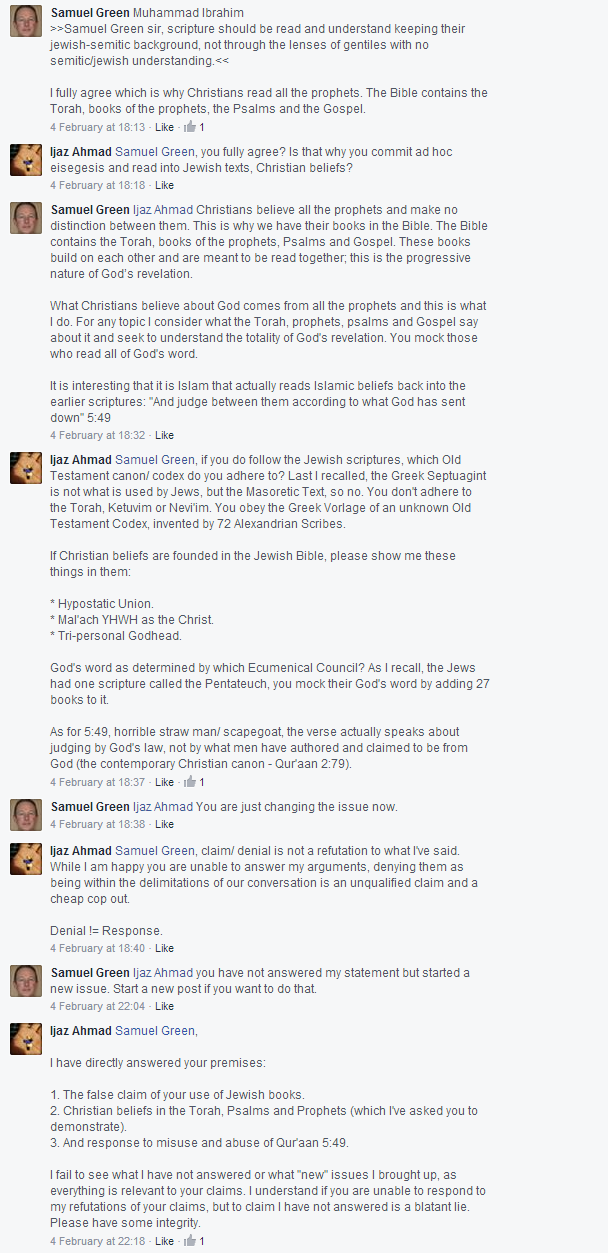
Discussion between myself and Pastor Samuel Green:

Pastor Green Caught Lying

Pastor Green Caught Lying

Pastor Green as seen here is unable to demonstrate evidences for a claim he repeats ad nauseum. The Pastor in his attempts to discredit Islam, claims adherence to the messages of the Jewish Prophets, however, the case which has been made by me is, if he is indeed adhering to their message – where is the evidence for this?

As can clearly be seen, Jewish Orthodox beliefs as rooted in the Torah, Psalms and Prophets do not preach what the heretical and apostate Jewish sect of proto-orthodox Christianity teaches. Therefore, the Torah, Prophets and Psalms are not only in disagreement with Pastor Green’s message, they inadvertently disprove the Christian faith’s claims of beliefs rooted in the Jewish scriptures.

and Allaah knows best.

Christians Naturally Distrust and Disbelieve in the New Testament

There’s a problem with the New Testament, and every conservative Christian scholar, including the likes of Daniel B. Wallace, James White to the Liberals such as Dr. Crossan have implicitly conceded to their distrust of the New Testament text. Let’s first list a few facts to establish the foundation for our case:

  • The Council of Nicea was held in 325 CE.
  • The oldest editions of the New Testament in their most complete forms date between 350 – 450 CE (Codices Sinaiticus, Vaticanus, Alexandrinus and Ephraemi Rescriptus).
  • The Councils of Carthage in 393 and 397 CE affirmed the Christian canon of the New Testament.

The Argument

If Christians are satisfied that the ‘true’ and ‘original’ text of the New Testament was in circulation at the time of the Council of Nicea, and accept that the New Testament books were used before, during and after the Council to affirm the Athansian Creed of the Hypostatic Union, versus that of the Arian Creed, and also accept that in 367 CE Athansius affirmed these texts, and also agree that in 393 and 397 CE the Patristics (Early Church Fathers) agreed that the New Testament in circulation was the ‘true’ and ‘original’ scripture, then why do Christians seek manuscripts before the Councils of Nicea and Carthage to ‘validate the text of the New Testament’?

What am I saying? I’m saying –

We have New Testament codices from the 4th century. In the 4th century, three important Ecumenical councils utilized the New Testament canon and since it was used during the Council of Nicea, then Christians should be statisfied with the New Testament codices of the 4th century. Since they are not satisfied and constantly seeking to rediscover the ‘original’ (authograph) manuscripts from the time of the presbyters and apostles, then they are acknowledging their distrust in the New Testament which existed at the time of the 4th century – the same New Testament we essentially have today. That being the same New Testament canon and codex that Christians today call scripture.

The Problem

If the Christians accept the canon of the New Testament during the 4th century and believe as they do today in the New Testament we currently have – largely based on 4th century codices, then they should not seek a New Testament before the 4th century, as that would by and large mean that the Church Fathers affirmed the wrong canon, they affirmed false books, invented books, incorrectly attributed books to the apostles as being scripture, moreso their use of it during their debates against each other would mean that the evidences used to establish proto-Orthodox Christian doctrine are false, therefore meaning the beliefs and scripture of contemporary Christians is false.

Apologetic Use of this Argument

We now no longer need to invest our time in approaching Christians to discuss their New Testament. The very fact that they are zealously attempting to rediscover the original text, when they already have the texts ratified, verified and authenticated by the Church Fathers, the same text the Church Fathers used to defend current orthodox Christian beliefs – demonstrates that Christians have based their beliefs on foundations they themselves do not trust. Therefore, in terms of polemics and apologetics, the Christians who claim to understand Textual Criticism and adamantly preach about any New Testament manuscript before the 4th century has demonstrated to the Muslim that he is unsatisfied with the New Testament and the beliefs based on it.

This would mean, in simple terms – there is no reason to argue or debate about the New Testament text, when we can simply agree with the Christians in their search for an earlier than 4th century text. We should simple shake their hands and say, “thank you for giving us reasons to doubt your scripture and your beliefs about God”.

Conclusion

If the Church fathers used the wrong New Testament text, and based their beliefs (which they quoted heavily) on the New Testament of the 4th century, then undoubtedly the religion of Christianity has collapsed due to their own search for any New Testament document/ manuscript before the 4th century CE.

Does the Qur’aan affirm the Bible?

Question:

Does the Qur’aan affirm the Torah and the New Testament?

Answer:

There is a fundamental difference between what Muslims consider the Bible to be, and what the Christians and Jews consider the Bible to be. To understand these differences, please note the following verses:

وَلَقَدْ آتَيْنَا مُوسَى الْكِتَابَ وَقَفَّيْنَا مِن بَعْدِهِ بِالرُّسُلِ ۖ وَآتَيْنَا عِيسَى ابْنَ مَرْيَمَ الْبَيِّنَاتِ وَأَيَّدْنَاهُ بِرُوحِ الْقُدُسِ

And We did certainly give Moses the Torah and followed up after him with messengers. And We gave Jesus, the son of Mary, clear proofs and supported him with the Pure Spirit. (2:87)

وَقَفَّيْنَا عَلَىٰ آثَارِهِم بِعِيسَى ابْنِ مَرْيَمَ مُصَدِّقًا لِّمَا بَيْنَ يَدَيْهِ مِنَ التَّوْرَاةِ ۖ وَآتَيْنَاهُ الْإِنجِيلَ فِيهِ هُدًى وَنُورٌ وَمُصَدِّقًا لِّمَا بَيْنَ يَدَيْهِ مِنَ التَّوْرَاةِ وَهُدًى وَمَوْعِظَةً لِّلْمُتَّقِينَ

And We sent, following in their footsteps, Jesus, the son of Mary, confirming that which came before him in the Torah; and We gave him the Gospel, in which was guidance and light and confirming that which preceded it of the Torah as guidance and instruction for the righteous. (5:46)

In the Islamic belief, the Prophets Moses and Jesus (may God’s peace be upon them), both were given scripture – to Moses the Torah and to Jesus the Injeel.

Read more

« Older Entries Recent Entries »