Category Archives: FAQS

Islamic Response to ISIS/ Daesh’s Book Burning

According to an article by the National Post, Daesh has massacred a significant quantity of books they deemed to be “unIslamic”:

BAGHDAD — When Islamic State group militants invaded the Central Library of Mosul earlier this month, they were on a mission to destroy a familiar enemy: other people’s ideas. Residents say the extremists smashed the locks that had protected the biggest repository of learning in the northern Iraq town, and loaded around 2,000 books — including children’s stories, poetry, philosophy and tomes on sports, health, culture and science — into six pickup trucks. They left only Islamic texts.

Mideast Iraq Libraries In Danger

I have a great disgust for those people who burn literature, whether they agree with its contents or not. The hallmark of an intellectual society is one that can harbour ideas and beliefs they don’t agree with. As a Muslim, I study Christianity and Judaism, I don’t agree with everything those faiths teach but it is my job to entertain differing arguments and to approach them in a sensible manner. Acts like these seem more Christian to me than Islamic, as book burning is something condoned by the New Testament:

Large numbers of those who had practiced magic (περίεργα, περίεργος) collected their books and burned them up in the presence of everyone. When the value of the books was added up, it was found to total fifty thousand silver coins. – Acts 19:19 (NET).

Most New Testaments carry the translation of magic, but the primary meaning of “περίεργος” according to Strong’s Lexicon is:

of persons: over-careful; curious, meddling, a busy-body; of things: over-wrought; superfluous; curious, uncanny; subst: curious arts

A more English friendly translation according to Helps Ministries Word Studies is:

spending excessive time (effort) where it doesn’t belong (or should not happen).

Dr. James Dunn explains this term a bit more concretely, he says:

‘not doing any work but meddling/ being busy bodies’ (BDAG 800). The inference is probably that the individuals referred to were so caught up with their convictions that they spent time disrupting the work of other believers by their continual attempts to propagate their views. – ‘Beginning from Jerusalem: Christianity in the Making’, p. 717.

In other words, not sorcery or magic, but whatever Christians found to be challenging of their own views. Which is exactly what Daesh/ ISIS is doing, burning books which challenge their rhetoric. In response to this, Ibn Hazm states:

دعوني من إحراق رق و كاغد
و قولوا بعلم كي يرى الناس من يدري

Leave this (ridiculous) burning of books and texts,
Articulate your arguments and let the people decide (who is upon falsehood). – Ibn Hazm as quoted by Mufti Abu Layth al Maliki.

and Allah knows best.

Christine Weick: The New Face of Islamophobic Evangelical America

Christine Weick is the new face of Christian radical extremism in America. Very recently, she’s been known as the “crazy” Monster Energy lady:

She’s also known as that lady which interrupted the Muslim-Christian event in a Washington Cathedral:

Lately, she’s been known as that lady which screamed at Muslims in Texas for Texas Muslim Capitol Day:

I became friends with her on Facebook following her Monster Energy rant, I was interested in her views. After a few weeks of interacting with Christians on her page, I found myself knee deep in Christian Evangelical America. A lot of questions came out of my observation of this brand of Christianity, but the most important question of all has been, what platform do these people represent or seek to represent?

Christine and those of her ilk, view America as the bastion of democracy, freedom and Christianity in the world. Muslims are a threat to America, America’s way of life and a direct threat to the reign of Jesus in America. Muslims are inherently evil, who worship a false God and need Jesus in their lives. Yet, she fails to realise that everything she has done has driven Muslims away from Christianity. Moreso, I’ve personally seen her berate, abuse and attack Christians when they disagree with her on her page. Those sorts of interactions were downright scary, throngs upon throngs of radical evangelists demonizing each other, praising the deaths of “freedom hating apostates of the Church”. I made the occasional comment, but I was mostly an observer. This brand of Christianity is spiteful, hateful and vengeful in the name of Christ.

America is the home of freedom, but not if you’re a Muslim! Freedom of speech? Nope, I’ll grab that mic and scream that your Prophet is false and you deserve to get out of America/ Jesus country. What entertained me the most is perhaps the Christians praising her for standing up for Jesus. How exactly screaming at people with different beliefs than yours and insulting them was standing up for Jesus, failed to register with me and that particular remark actually earned a few likes on her page. Interestingly, she was invited to Israel for a few weeks last year and was actually persecuted by Israeli-Jews for being a Christian, this being demonstrated in videos she herself posted on her page. She mentions one such instance:

God was amazing in providing our escape. We gave them our extra tracts that they demanded and an opening appeared and we got out of there! It was very stressful and scary. The police never came. But we ended up okay. Shaken but okay. Thank you Lord!

Here’s the video of that escape from Israeli-Jewish persecution. In another incident, they were verbally assaulted and attacked by Israeli-Jews before she could return to the safety of her car:

PLEASE WATCH THIS! This was taken after we got back from Ramallah. One of our group went into a bakery to get bagels and pass out tracts to the Jews. They caught us before she could get back into the car. Notice how they tore the tract. God provided incredible protection! I will post the rest of the video next.

Here’s the video of that incident. I do believe that the videos are unable to be viewed unless one sends her a friend request, but she readily accepts those on a frequent basis. Despite being attacked, assaulted and chased by Israeli-Jews, she still supports them! This despite handing out those same tracts in Muslim areas and not once being insulted. In fact, she even visited Amman, Jordan and failed to receive persecution from a single Muslim. Yet, she continues to support Israel and persists in demonizing Muslims. If face to face interaction with violent Israeli-Jews and peaceful Muslims were not enough to get her thinking about her behaviour, there is very little that will.

I posted the following message on her wall, if I do get a reply from her, I’d readily post it:

Hi Christine Weick, a few questions please. A lot of Muslims and Christians messaged me with these so I hope you can help us out:

1. If you’re defending American freedom and by extension freedom of speech, on what grounds do you deny American Muslims the right to that freedom?

2. Would Jesus approve of you screaming at people and insulting their beliefs because they don’t agree with you?

3. If you’re standing up for Jesus by insulting and screaming at Muslims, do you think this is an intelligent, mature and Christ-like way to evangelize to them?

4. Should Muslims look at you as an example of how to treat people they disagree with in Muslim majority countries? i.e., should they prevent Christians from gathering, protest Christian worship, attack their events and insult their beliefs, along with screaming at them?

5. Should Muslims in turn, heckle Christians at their events given your example?

6. Given that you see Islam as un-American and that it should not be allowed in America, should Muslims also eject Christians from their countries if we are to be fair?

Thanks.

Perhaps, the best way to engage with Christine, is to invite her to Muslim talk shows, host public dialogue events with her in a professional setting. She does not seem to be very educated about either Islam or Christianity and so, a dialogue would be the best way to highlight her issues, while providing her audience with eye opening material. She is driven by hate, but with some sensible dialogue and a peaceful approach, Christine can be an entry point for Muslims to do some out-reach work with Evangelical America.

and God knows best.

Infidels: An Islamic Term?

It’s probably likely that you’ve associated the term “infidel” with Islam. However, the term “infidel” is a Catholic-Christian term, originating from the Latin language. It has no roots in Islam or Arabic terminology. Some have attempted to equate “infidel” with “kafir”, but these are two different terms, from two different languages that carry two different meanings. “Kafir” – كفر in the Arabic language means a “rejector” or “one who covers”. When used theologically in Arabic-Islamic literature, it refers to one who “rejects the truth of Islam”. The Islamic usage is clarified by Shaykh Abu Yusuf Riyad ul Haqq from the UK lower down in this article.

The Origin of the Word Infidel

The word infidel, is actually a Catholic term, used by the Iberian (Spanish + Portugese) Catholics to describe a person with any other religious affiliation beside that of Christian Catholicism. This might come as a shock to many but the list of persons referred to as infidels, are Muslims, Hindus, Jews, Protestants, Arians have been subject to use of this terminology by Catholic Christianity. My evidence isn’t Muslim scholarship, but the 1910, Volume 8 of the Catholic Encyclopedia:

(Latin in, privative, and fidelis.)

As in ecclesiastical language those who by baptism have received faith in Jesus Christ and have pledged Him their fidelity and called the faithful, so the name infidel is given to those who have not been baptized. The term applies not only to all who are ignorant of the true God, such as pagans of various kinds, but also to those who adore Him but do not recognize Jesus Christ, as Jews, Mohammedans; strictly speaking it may be used of catechumens also, though in early ages they were called Christians; for it is only through baptism that one can enter into the ranks of the faithful. Those however who have been baptized but do not belong to the Catholic Church, heretics andschismatics of divers confessions are not called infidels but non-Catholics.


The relation in which all these classes stand to the Catholic Church is not the same; in principle, those who have been baptized are subjects of the Church and her children even though they be rebellious children; they are under her laws or, at least, are exempt from them only so far as pleases the Church. Infidels, on the contrary, are not members of the ecclesiasticalsociety, according to the words of St. Paul: Quid mihi de his qui fortis sunt, judicare? (1 Corinthians 5:12); they are entirely exempt from the canon law; they need to be enlightened and converted, not punished. Needless to say, infidels do not belong to the supernatural state; if they receive supernaturalgraces from God, it is not through the channels established by Jesus Christ for Christians, but by a direct personal inspiration, for instance, the grace of conversion. But their condition is not morally bad; negative infidelity, says St. Thomas (II-II, q. x, a. 1), does not partake of the nature of sin, but rather of punishment, in the sense that ignorance of the Faith is a consequence of original sin.

That is why the condemnation by the Church of proposition lxviii of Baius: Infidelits pure negativa, in his quibus Christus non et praedicatus, peccatum est (purely negative infidelity in those to whom Christ has not been preached is a sin), was fully justified.


But it is different with regard to positive infidelity, which is a sin against faith, the most grievous of all sins, apostasy. Being endowed with reason, and subject to natural law, infidels are not excluded from the moral order; they can perform acts of natural virtue; and so the ecclesiastical authorities had to condemn proposition xxv of Baius which declared that: Omnia infidelium opera peccata sunt, et philosophorum virtutes vitia (all works of infidels are sinful, and all the virtues of the philosophers arevices; cf. St. Thomas, loc. cit., a. 4; Hurter, Theol. dogm., III, thes. cxxvi and cxxvii).

– [Catholic Encyclopedia, “Infidels”].

Not only was the term ‘infidel’ supposed to refer to all non-Christians, it was also used as a basis to create religious and state laws to demean the “unfaithful”:

The laws regulating the dealings between Catholics and infidels in civil life were inspired also by religious motives, the danger of perversion, and the high idea entertained in the ages of faith of the superiority of Christians to infidels. These regulations, of course, did not refer to all acts of civil life; moreover, they were not directed against all infidels indifferently, but only against Jews; at the present day they have fallen almost completely into desuetude. – [Ibid].

Does “Infidel” mean “Kafir” in Islam?

Shaykh Abu Yusuf Riyad ul Haqq [db] explains the use of the word “kafir” in Islam. The term itself has many meanings and it does not necessarily refer to solely “those who disbelieve in Islam”, as explained by the Shaykh, it holds varying contexts, one surprising example is that in reference to a farmer in the Qur’an:

Conclusion

Despite popular usage and its association with Islam, the term “infidel” has no real relation to the faith. Similarly, its equation with the Arabic-Islamic term of “kafir” is also without justification. Some Muslims may unfortunately perpetuate this confusing of terms by adopting the usage of “infidel” in their religious vocabulary, but that does not legitimize nor validate it. Share this article with your friends and let’s help clear the air on these terms!

and God knows best.

Note: This article was originally published on 29/7/2012 @ 6:20. After being featured on AlterNet, Salon and Raw Story  under the section of “Heretics”, I realised the main video link was not working and have since fixed that issue while making some minor changes to the article itself. It was later featured on Higher Perspective and Waking Times.

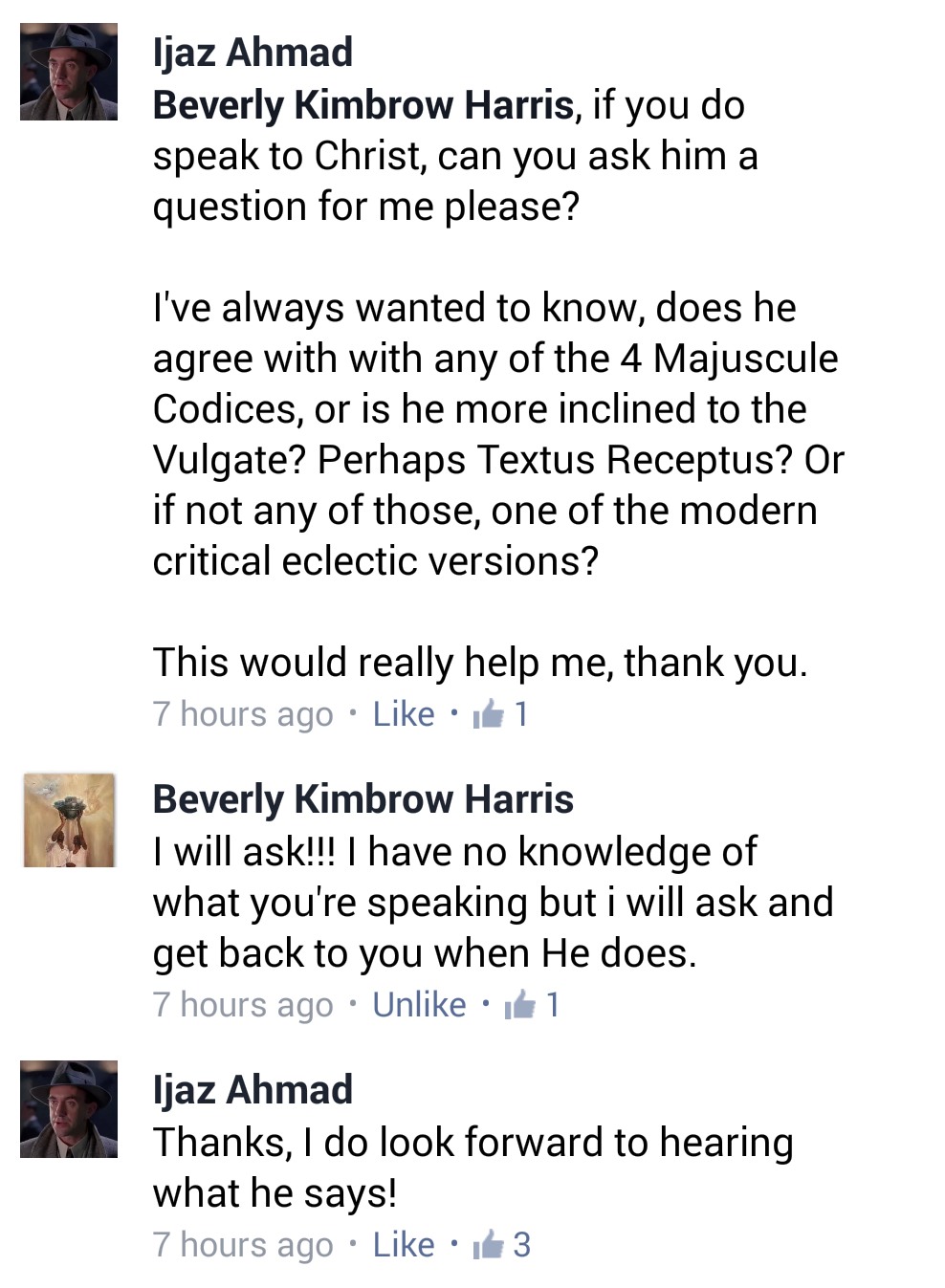
Missionary Mishap: Missionary Talks to Jesus – Will Help Us Solve the Bible’s Textual Problems

wpid-2015-01-21-19.08.10.png.png

So, I meet this lady who says she talks to Jesus all the time! I decide to ask for her expertise since she has a direct line to the one guy that can help us solve our textual challenges with the New Testament. She says she’ll ask him about it. What are the chances I should expect a reply?

Note: For those pedantic types, I meant the Latin Vulgate and the later “Greek Textus Receptus”. The Latin is not the same as the Greek.

and Allah knows best!

Christianity’s Shari’ah Law: Theonomy & Catechism

Laws are meant to be guides on living a morally acceptable lifestyle. For example, the term Torah quite literally means, “the guide/ teaching”. In the Abrahamic faiths of both Islam and Judaism they offer a body of law that spans from personal practise to the governance of the Muslim and Jewish nations. In Islam this is the Shari’ah and in Judaism it is the Halacha. In terms of religious belief, one has to live a morally acceptable lifestyle and to do so means to obey the commands of God. For a Muslim and a Jew, doing “good” is to say that one adheres to the delimits which God has set. If God says that consuming alcohol is wrong, then it would be morally reprehensible to commit that sin. If God says that giving charity is good, then to give charity would be morally recommended. It’s a fairly simple and straightforward concept to understand, if I do what God says is good to do, then I’d live  a “good” life. Both Islam and Judaism accept this notion of practising God’s law as part of their soteriological outlook. In other words, we can attain salvation by adhering to the commands of God. For a Muslim or a Jew, being good and living a life led by God is spelled out for us, all we have to do is adhere to God’s laws.

For Christianity though, it isn’t as clear. The religion of Christianity is morally insufficient, it lacks a moral structure to adhere to. To be “saved”, one merely has to have belief in a series of doctrines developed over a number of centuries. Doing “good” or to live a “Christian lifestyle” is to be led by the Holy Spirit, which is often reduced to one’s adherence to the 10 Commandments. Christians don’t believe that they need to do “works” to attain salvation, but the consequence of such thinking has led Christians to live rather unstructured moral lives that have left many feeling spiritually unfulfilled as will be explained shortly. How does one exactly live a good life, or how does one define what a Christian community is, if there are no guidelines to follow? For example, is the clothing I wear acceptable to God, or is the food I’m eating approved by God? How does one begin to define a “good” Christian lifestyle? For Christians, this has been a difficult question to answer and over the centuries churches have developed different solutions to this inherent problem with the Christian religion and its moral insufficiencies.

For the Catholics, they developed the Cathecism which is a collection of principles that Catholics should adhere to if they want to be considered as “good Christians”. Some Protestant groups like the 7th Day Adventists try to adopt some of the 613 commandments in the Old Testament by following dietary restrictions and a quasi-Sabbath. However, in the 20th century a movement arose in the Protestant sect which is known as “Christian Reconstructionism” or “Theonomy”; which often means ‘to be ruled by God’s law’. In essence, they are trying to fill this moral gap, this moral absence from the daily life left by the inadequacies of the Christian faith by calling for adherence to the Mosaic law, i.e. the law of the Old Testament. Christians often mock both Muslims and Jews for rigidly practising ritualistic law, but they fail to realise that it is impossible to live a lifestyle according to God’s moral approval if there are no commands or guidelines to follow. One can’t live a good life if one does not know “how” to be good. Sure it’s acceptable to not lie, cheat, steal or murder, there’s some moral compass innate in all of us but we’re looking at the bigger picture here. How does one manage their home to be acceptable according to God? Or manage a country in a way God would approve of?

Christianity can’t answer that question because of it’s vitriolic stance against the ritual practise of law. With the growing calls for Christianity to re-adopt the Mosaic law from Christian groups, this is more or less a concession as to the moral inadequacy of the Christian faith. Salvation is dependent on law, it is dependent on obeying God’s guidelines and despite centuries of denying this, the Christian religion is now beginning to accept this. There can be no salvation by faith alone.

and God knows best.

The Gnostic Sources of the Gospel of John

One of the most important books ever written on the Gospel of John, is the Commentary by Rudolf Bultmann. I’ve taken the liberty of transcribing some of his quotes, they are as follows:

cc-2015-johngnosticism

Summarily, he’s arguing that the Gospel of John borrows a lot of Gnostic ideas, beliefs and terminologies. The Manadaeans are described as follows in the Catholic Encyclopedia:

Manichæism is a religion founded by the Persian Mani in the latter half of the third century. It purported to be the true synthesis of all the religious systems then known, and actually consisted of Zoroastrian Dualism, Babylonian folklore, Buddhist ethics, and some small and superficial, additions of Christian elements. As the theory of two eternal principles, good and evil, is predominant in this fusion of ideas and gives color to the whole, Manichæism is classified as a form of religious Dualism. It spread with extraordinary rapidity in both East and West and maintained a sporadic and intermittent existence in the West (Africa, Spain, France, North Italy, the Balkans) for a thousand years, but it flourished mainly in the land of its birth, (Mesopotamia, Babylonia, Turkestan) and even further East in Northern India, Western China, and Tibet, where, c. A.D. 1000, the bulk of the population professed its tenets and where it died out at an uncertain date.


Mandæan (mndaya) is a Babylonian-Aramaic word in dialectic form, meaning: Gnostics, gnostikoí, “those who are good at knowing”. The Hebrew for knowledge md‘ Madda is of the same root and is the noun from which the adjective Mandaya is derived. It is the name adopted by the sect itself, being employed in their sacred books, and is characteristic of their worship of the mnds dhya gnôsis tês doês or “knowledge of life”. Another name also found in their sacred books is that of Sabians (sbya) which means Baptists (sb‘ to baptize in Syriac and Aramaic).


Alternatively, they can be read about in the Encyclopedia Britannica. He presents numerous examples of the resemblance between this pre-Christian religion and early Greek-Christian beliefs found in the Gospel of John and in the writings of the early Patristics (Church Fathers). It is quite apparent that the early Greek Christians borrowed heavily from this pagan religion. Ironically, Christians have for centuries demonized Gnosticism without realising how similar their beliefs truly are. In most of my writings I have consistently referred to Christianity as Graeco-Roman Jewish Syncretism. This belief of mine is shared by many Christian scholars and is known as the Bauer Hypothesis.

This hypothesis holds to the view that early Christianity existed as a plurality of various forms of early Messianic Jewish syncretism with the prevailing religious cultural and spiritual traditions of the varying locales contemporary to the 1st century CE. If you’d like to see more of what Rudolf Bultmann says on the Gospel of John and its borrowing from pre-Christian religions, leave a comment below or share this post on Facebook and other social media websites.

and Allah knows best.


Did the Disciples View Jesus as a Deity?

Introduction

There is no doubt that the disciples of Christ saw him as a man of religious and spiritual authority. It is the status quo to use the statement of Thomas, known as “Doubting Thomas” to illustrate the belief that the disciples viewed Jesus as a deity. In this article, we’re going to employ the same methodology to examine two specific incidents that chronologically follow each other which paints Jesus in a completely human light. The testimony, or rather the alleged testimony of the disciples of Christ in regard to their reactions of Jesus’ statements is perhaps often abused by our evangelical counterparts to enforce the perception of deity. It is in this light, that if we were to use the same line of methodology we’d develop a startling realization due to the disciples’ reactions.

The two incidents we’re going to be examining are those of the “Denial of Peter” and the “Sleeping at the Garden of Gethsemane”. We’ll be basing our study off of Mark 14:31-42, Matthew 26:34-46 and Luke 22:34-47. In summation, in gauging the disciple’s reactions to Christ’s statements, while examining the inter-textual development of the Gospel’s narrating of these incidents, we will then be able to draw an educated understanding of the disciple’s perception of Christ.

Textual Analysis

The synoptic Gospels of Matthew, Mark and Luke have an integrated textual legacy. Modern scholarship agrees that the contents of Mark were used as a source for both Matthew and Luke. Similarly, another plausible source would be the Q Source Material, that is the information not found in Mark but found in both Matthew and Luke. The diagram below illustrates this textual phenomenon:

cc-2015-intertextualegacymmlThe variations in the accounts inter-textually do not present any major conflicts, but we do see a correction due to possible embarrassment in both Matthew and Luke. The text in Mark[1] is as follows:

30 “Truly I tell you,” Jesus answered, “today—yes, tonight—before the rooster crows twice you yourself will disown me three times.”

31 But Peter insisted emphatically, “Even if I have to die with you, I will never disown you.” And all the others said the same.

In this scenario we are presented with a peculiar incident. If we assume Peter believes that Jesus is God, here we witness God telling Peter about something which will happen and Peter denying that God’s knowledge is correct. Peter is in essence, standing before God and telling God that he’s wrong. Yet, he’s not merely telling God that God is wrong, he’s emphatically doing so! The anonymous authors of Matthew and Luke saw this as a problem and so we find this same incident purposely altered. This embarrassing scenario could not have happened if Peter truly believed that Jesus was God, for Jesus is the truth, the way and the life[2]. The incident is then tailored to absolve Peter of his blasphemy and/or to deify Christ; if Peter believed Jesus to be a God then he would not have challenged him.

In the Gospel according to Matthew[3], we read the same incident but with a minor change:

34 “Truly I tell you,” Jesus answered, “this very night, before the rooster crows, you will disown me three times.” 35 But Peter declared, “Even if I have to die with you, I will never disown you.” And all the other disciples said the same.


Peter is no longer emphatically challenging the man whom he believes to be a God. This one alteration of a single word transforms this event. In Mark’s version, it is Peter emphatically challenging God. In Matthew’s version, Peter still challenges Christ, but the context now transforms itself into an emotional retort thus making Peter appear to be submissive to Christ’s words. This however, is still a problem. Peter cannot be challenging God, he cannot be telling Jesus that He is wrong. Luke then, removes Peter’s words altogether[4]:

34 Jesus answered, “I tell you, Peter, before the rooster crows today, you will deny three times that you know me.” 35 Then Jesus asked them, “When I sent you without purse, bag or sandals, did you lack anything?”

Peter’s challenging of God now never happened! Luke completely removes this incident from ever happening. We must also remember that the Gospel According to Luke, begins with the author declaring that he’s producing a truthful, a more accurate, an orderly account of the events of Christ’s mission[5]. Thus, Luke’s account is a correction of the inaccurate information in the other Gospel accounts. This would then lead us to believe that Luke removes this scenario from his Gospel due to its negative and embarrassing implications. If Peter truly believed that Christ was God, he’d never challenge him and definitely not “emphatically” so. In the Greek of the NA 28, we can see the gradual removal of the word, “emphatically” and then the removal of Peter’s response altogether.

In Mark’s Gospel we find the term emphatically[6]:

31ὁ δὲ ἐκπερισσῶς ἐλάλει· ἐὰν δέῃ με συναποθανεῖν σοι, οὐ μή σε ἀπαρνήσομαι. ὡσαύτως δὲ καὶ πάντες ἔλεγον.


In Matthew’s Gospel the term emphatically has been removed[7]:

 35λέγει αὐτῷ ὁ Πέτρος· κἂν δέῃ με σὺν σοὶ ἀποθανεῖν, οὐ μή σε ἀπαρνήσομαι. ὁμοίως καὶ πάντες οἱ μαθηταὶ εἶπαν.

In Luke’s Gospel, the entirety of Peter’s challenging of God is removed altogether[8]:

34ὁ δὲ εἶπεν· λέγω σοι, Πέτρε, οὐ φωνήσει σήμερον ἀλέκτωρ ἕως τρίς με ἀπαρνήσῃ εἰδέναι. 35Καὶ εἶπεν αὐτοῖς· ὅτε ἀπέστειλα ὑμᾶς ἄτερ βαλλαντίου καὶ πήρας καὶ ὑποδημάτων, μή τινος ὑστερήσατε; οἱ δὲ εἶπαν· οὐθενός.

The same pattern of amendment is found regarding the disciples in the Garden of Gethsemane. In Mark 14:32-42, Jesus finds the disciples disobeying him three times. In Matthew 26:36-46, Jesus also finds them disobeying him three times. Yet, in Luke 22:39-46, he finds them once disobeying his command and that’s it. There is no other mention of Jesus returning to find the disciples disobeying God three times, after God had scolded them.

Why then, for a second time does Luke remove entire scenarios of the disciples openly disregarding, disobeying and ignoring Jesus, whom we are expected to believe they viewed as a God?

Gauging the Disciple’s Reactions

We must critically assess Peter’s actions when Jesus informs him that he will deny Him. If Peter viewed Christ as a God, and God is telling Peter what will happen in the future; on what basis can Peter deny God’s knowledge and emphatically reply that God’s wrong? This seems to be quite absurd. There can be no justification for Peter’s challenging of God, to God’s face. The issue here, is that Peter’s not only disagreeing with Jesus whom he believes to be God, but that he’s emphatically insisting that God is wrong. This would not be a problem, had it not been for the other Gospel authors taking issue with this incident. Both Matthew and Luke were surely embarrassed by this scenario. Surely, Peter whom the Church is built upon as Christ himself declared[9], must be submissive to God’s commands. Peter cannot be dismissive, he cannot be seen challenging God to his very face. Thus, this incident is embarrassing because it gives the impression that either Peter does not see Christ as a deity (as Peter would never challenge God) or it gives the impression that the disciples were of absolutely weak or little faith and the Church cannot be built upon unfaithful, unbelieving, sinful persons.

This issue is only exacerbated by the disciples in the Garden of Gethsemane. It is very difficult to accept that the disciples could have God stand before them, live with them, eat with them and then disobey him. Moments before this incident occurs the disciples all profess their love and swear never to abandon or deny Christ as both Mark and Matthew mentioned[10][11]:

31 But Peter insisted emphatically, “Even if I have to die with you, I will never disown you.” And all the others said the same.


35 But Peter declared, “Even if I have to die with you, I will never disown you.” And all the other disciples said the same.

It is highly unbelievable that in the span of a few minutes the disciples would profess their obedience to a man they considered to be God, would then change their minds and disobey him three times even after he scolded them. They essentially all changed their emotions in regard to him in the span of a few minutes. If God stands before you, commands you to do something, then scolds you for not doing it, then as a person of faith, a person of strong faith, you’d do your utmost best to fulfill God’s commands. Yet the disciples do exactly the opposite, they reject God’s commands and seeing that Christ is in need they all went to sleep. A loved one, the Holy of Holies, God Incarnate stands before you, imploring you to do something and we are expected to believe the disciples decided that sleep was more important?

If we were to gauge them by their reactions to Christ’s words and commands, then they clearly seem to be responding to the words of a man and not God. No believer in God would challenge God’s knowledge, no believer in God would listen to God’s commands and then decide to sleep at a time of great importance. If we are to believe that the disciples viewed Jesus as a God, then their reactions teach us the exact opposite, we can quite clearly see they did not have the fear or love of God in them.

Conclusion

By examining the inter-textual legacy of the synoptical Gospels, using the evangelical criteria of embarrassment we find clear textual emendation to absolve the disciple’s humanizing, disobeying, rejecting and disbelieving actions and words in regard to Jesus the Christ. The very reactions of the disciples to Christ’s words give the impression that they did not view him as a deity; this is in large part to their challenging of his statements and in their refusal to obey his requests even during his time of need. This is not what we would expect from men who believed God sat among them, lived with them, ate with them and suffered with them. Instead, we find a human Jesus, one whom the disciples could challenge, could disagree with and a Jesus whom they could disrespect and ignore. The very behaviour of the disciples is akin to the disbelieving Pharisees who rejected the Christ who disobeyed him, ignored him and challenged him (cf. Mark 7, Matthew 15, John 8 etc).

In conclusion, there are two perspectives we can walk away with after having looked at these incidents from several angles. Either the disciples were men weak of faith, who rejected the Christ and whose behaviour emulated that of the Pharisees or the disciples did not view Christ as a deity as demonstrated by their challenging, disobeying and disregarding of Christ’s commands.

and Allah knows best.

Sources:

  1. Gospel According to Mark: 14:30-31 (NIV).
  2. Gospel According to John: 14:6 (NIV).
  3. Gospel According to Matthew: 26:34-35 (NIV).
  4. Gospel According to Luke: 22:34-35 (NIV).
  5. Gospel According to Luke: 1:1-4 (NIV).
  6. Gospel According to Mark: 14:31 (NA 28).
  7. Gospel According to Matthew: 26:35 (NA 28).
  8. Gospel According to Luke: 22:34-35 (NA 28).
  9. Gospel According to Matthew: 16:18 (NIV).
  10. Gospel According to Mark 14:31 (NIV).
  11. Gospel According to Matthew: 26:35 (NIV).


Do Muslims Assume Unitarianism in Discussing the Trinity

Question:

Popular Christian speakers like James White have repeatedly said that Muslims assume Unitarianism when discussing and debating the doctrine of the Trinity. Is this true? What is Unitarianism?

Answer:

Unitarianism, refers to the belief that God exists as one person. This is in contrast to Trinitarianism which teaches that there is one God who exists in three “persons”, all of whom are distinct from the other persons, but co-equal in nature. Unitarianism argues that there is only one person. The most popular believers in this doctrine are those who believe in modalistic monarchianism or monarchianism. Modalism refers to the believe that the one person who is God, moves between varying roles; these roles are the Father, Son and Holy Spirit.

Apologists like James White believe that Muslims argue from the belief of Unitarianism because many Muslim speakers argue against the Trinity by arguing that Jesus who is the Son, is not the Father and thus this is polytheism, not monotheism. Christians would then argue that this proves the Trinity since they do not believe the Son is the Father (that’s Unitarianism), they believe that the Son is a distinct person from the Father and so arguing that they are distinct is already a belief they hold. Therefore, when Muslims do so, they are arguing in futility. This however, does not take the Muslim’s argumentation as a whole. Muslims argue using sequential logic, they start with one point and then from this point argue another second rational point. The second point follows from the first point, thus it is sequential (in a specific order) and sequitur (one point follows from the other point, they are connected to each other. In Discrete Mathematics, a point is referred to as a premise and the symbol used to demonstrate that they are sequitur can either be -> [if this, then that] or <-> [it follows both ways, i.e. vice versa]). I am not saying that James White is the only person to commit this error, but since the questioner mentioned him specifically, and since I am familiar with him having argued as such, I will subsequently refer to him in this article.

The misunderstanding thus begins when Christian apologists isolate one of the premises or arguments, while ignoring the entire logical sequence being drawn out. So what is the Muslim’s entire argument? Trinitarians believe, as previously mentioned that each “person” of the Trinity is co-equal and absolute in their nature (i.e. perfect beings). The Muslim argument demonstrates that they are not equal and as a consequence of this, they are in a hierarchy, since there is a hierarchy and one is weaker than the other it means two of the three are not absolute in their natures and thus not God. A God is defined as a being absolute in its nature, if a God is not, such as if it does not have absolute knowledge (i.e. the knowledge of everything; see Mark 13:32), then it can no longer be considered a God. The Muslim argument, therefore also follows through to the position that this is polytheism, since Christians are deifying three non-equal beings with one absolute being, and two “partners” who are deficient in nature.

In conclusion, the next time a Christian speaker mentions that Muslims assume or argue from a position of Unitarianism, kindly stop them and ask that they listen to the entire argument and not cherry pick isolated premises from a complete argument. If they insist that they are not, kindly ask them to list the premises being postulated by the Muslim sequentially, this should only be four sentences at the very least. If they can’t articulate the Muslim’s argument, then it is clear they do not grasp it. Since they can’t grasp it, this explains why they fail to respond to it and thus have to create red herrings.

and Allah knows best.

Allah the Moon God – Myth or Reality?

Bismillahir Rahmanir Raheem
بِسۡمِ ٱللهِ ٱلرَّحۡمَـٰنِ ٱلرَّحِيمِ ,

An oft repeated stigma against Islam, is the understanding that Muslims worship the moon. This argument is further justified by linking the use of the crescent and star on Masjids as a sign of our pagan moon worship. Lastly, the argument is further qualified by the claim that ‘Allah’ was the name used by pagan Makkans to describe the ‘moon God’. It is unfortunate that many persons sought to answer this through complex and vast arguments, when the answer in itself is quite simple.

‘Allah’, the Name of a Pagan God?

Initiated by Dr. Robert Morey, an Islamophobic missionary, the claim that ‘Allah’ refers to a pagan God is based upon nothing more than wishful thinking. I’ll demonstrate this with the English language:

  1. In English, Allah is known as God.
  2. In English, Jesus is known as God.

God is the default English term for referring to a religious deity, it could be Shiva, Ashera, Zeus, Mithra, in English these are all considered to be ‘Gods’. Therefore the term ‘God’ is the label for a generic term to refer to a religious deity. This does not mean however, that if a Muslim calls Allah as ‘God’, that he’s referring to the ‘God’ of the Christian faith. Although the same label is used, the concepts, beliefs and ideologies about each respective deity is vast and incomparable.

Likewise, in the Arabic language, the generic term for a religious deity is ‘Al Ilah’ (literally: The God). So to the Arab Muslim, Al Ilah is ‘Allah’ and to the Arab Christian Al Ilah is, ‘Allah’. Yet the Muslim will describe his ‘Allah’ as ‘Ahad’ (one) and the Christian would describe his ‘Allah’ as ‘thalatha’ (three). Even though both Arab Christians and Arab Muslims use the same term for God, ‘Allah’, it does not mean that we worship the same concept or belief of ‘Allah’. Likewise, whether or not ‘Allah’ was used by the Pagans to refer to a moon God is irrelevant, as the Muslims and Christians both refer to God as ‘Allah’, yet neither group worships the moon.

To claim that because Muslims call God ‘Allah’, it means we worship an ancient Pagan God, is equitable to saying that because Muslims in English refer to their religious deity as ‘God’, and because Christians also in English refer to their religious deity as ‘God’, that we are both referring to the same God. It is obvious that no missionary will concede to worshipping the same God which Muslims worship, and this succinctly refutes such absurd logic.

The Use of the Crescent is akin to Worshipping It.

This argument has no basis, although a Masjid may have a crescent and star, just as how a Church has a cross, it does not mean that Muslims prostate to or worship the moon and star. Likewise, just because a Christian may have a cross on their Church or even in their Church it does not mean that the Christian worships a cross. This argument in itself is suitable for debunking this myth as it is.

We can examine one final example, Jews use the Star of David as a symbol of their religious identity, does this mean that Jews worship the stars? Of course not, it’s simply a symbol through which their faith is identified.

The Final Argument.

As opposed to examining the historical aspect of this claim, it is much easier to examine the logical aspect of it. You must understand that the claim itself is fraudulent and if we can demonstrate that the claim is fraudulent, then by default the person promoting such an argument will be stopped in their tracks. The claim is:

  • ‘Allah is a Pagan Moon God’

Therefore the question to be asked is, “where does the Qur’an command us to bow to the moon or stars?“. What we mean is, if the Missionary is claiming that our religion commands us to worship a Pagan Moon God, then we’d like to see where the Qur’an or Ahadith indicate this. Offer a Qur’an to the Missionary and have them locate a verse which qualifies their argument. It is quite obvious that they will not be able to find such a verse. Thus logically, we’ll now employ the use of, “proof by contradiction“.

Proof by contradiction, works by negating your opponents claim. For example if someone says your right hand has 3 fingers and you demonstrate to them that you have 5, this means you have contradicted their claim therefore proving them wrong. Likewise, if we can show that their is a verse in the Qur’an which contradicts the claim that it is a religious duty to worship the moon, then by all means we’ve thoroughly refuted the Missionary’s claim:

And of His signs are the night and day and the sun and moon. Do not prostrate to the sun or to the moon, but prostate to Allah, who created them, if it should be Him that you worship. – Qur’an 41:37.

Therefore in order to refute the missionary claim, all you have to do is whip out this verse and then ask, “If Allah is the moon God, why does He command us not to worship the Moon?“.

Conclusion.

Historically speaking, this claim has no basis. Logically speaking it is simple to refute. At the end of the day, all you need to remember is the reference for this verse and you’d be able to refute any missionary who tries to use this clam against you. It takes less than 1 minute to locate the verse and then read it for the missionary. Therefore I suggest that this is the most simple, yet most effective response to this specific missionary claim.

wa Allaahu Alam,
and God knows best.

Rights of a Wife in Islam

Women’s rights are a hot topic when it comes to the religion of Islam. In an ideal video on this topic, Mufti Hussain Kamani discusses the rights of the Muslim wife. He covers a majority of points and details many insights that we often don’t hear about. Instead of learning about Muslim women’s rights from anyone but Muslims, let’s make an effort to see what Muslim law actually states about them:


and God knows best.

« Older Entries Recent Entries »