Author Archives: Ijaz Ahmad

Baptism is Needed for Salvation but Jesus Baptised No One

بِسۡمِ ٱللهِ ٱلرَّحۡمَـٰنِ ٱلرَّحِيمِ ,

One of the most important themes of the New Testament is the baptism of Jewish believers into the Christian faith, thus heralding the Spirit into their lives. In one of the more contentious passages of the Bible, Jesus allegedly made the following statement [1]:

Whoever believes and is baptized will be saved, but whoever does not believe will be condemned.

This verse ties salvation to being two fold, of belief and of baptism. It is known that baptism began with John the Baptist, hence his title and that Jesus himself was baptised by John in the river Jordan. This idea of being dunked in water for a ‘rebirth’ gained providence among the followers of Christ and thus the tradition of being ‘overwhelmed/ dunked in water’, literally: to be baptised, became a pillar of the Christian faith. However, when we read the New Testament, although Christ himself tied baptism to salvation, he did not baptise anyone [2]:

although in fact it was not Jesus who baptized, but his disciples.

It is of utmost importance to understand why Christ did not himself baptise anyone. You see, it’s a bit of a problem, as being baptised with water is a tradition that was not supposed to continue. When John the Baptist was questioned by the Pharisees concerning his baptism he stated [3]:

questioned him, “Why then do you baptize if you are not the Messiah, nor Elijah, nor the Prophet?”

According to the Jewish leaders, only the Messiah was to baptise (literally: overwhelm) the people. Upon finding John doing this strange practise of baptising with water, a practise not found in the Old Testament, they challenged him. In another Gospel, John the Baptist says:

baptize you with water, but he will baptize you with the Holy Spirit.”

Therefore, it is interesting to note that when the Messiah came, he would not baptise with water, but with the Spirit. Hence, when Jesus came, as the Bible rightfully says, he baptised no one with water, but some Christians did continue this tradition. We must ask ourselves two important questions:

  1. If John expected the Messiah to baptise with the Spirit and not with water, why do Christians still baptise with water?
  2. If Christ himself baptised no one with water, why do Christians still baptise with water?

It would then seem that baptism by water is not only an archaic process, but one which was and should have been absolved with the appearance of the Christ. One exegete says of this practise [4]:

And therefore as Nonnus observes, it was a false report that was made to the Pharisees; at least in part, so far as concerns the act of baptizing: though it may be this is observed, not so much to show the falsehood of that report, as to correct what is said of Christ’s baptizing; lest it should be understood, as if he baptized in his own person; whereas he did not, that not so, well comporting with his greatness and majesty: wherefore “the king did not baptize in water“, as Nonnus expresses it.

The Persic version indeed suggests, as if both Christ and his disciples baptized, rendering the words thus, “Jesus was not alone who baptized, but the disciples also baptized”: whereas the truth of the matter is, that Christ did not baptize in water at all.

Funnily enough, I came across one lexicon which explicitly declares that baptism by water is akin to an ancient Greek practise of dunking a pickle in a water solution:

to dip repeatedly, to immerse, to submerge (of vessels sunk) to cleanse by dipping or submerging, to wash, to make clean with water, to wash one’s self, bathe, to overwhelm.

Not to be confused with 911, bapto. The clearest example that showsthe meaning of baptizo is a text from the Greek poet and physician Nicander, who lived about 200 B.C.

It is a recipe for making picklesand is helpful because it uses both words. Nicander says that inorder to make a pickle, the vegetable should first be ‘dipped'(bapto) into boiling water and then ‘baptised’ (baptizo) in the vinegar solution. Both verbs concern the immersing of vegetables in asolution. But the first is temporary. The second, the act of baptising the vegetable, produces a permanent change. When used in the New Testament, this word more often refers to our union and identification with Christ than to our water baptism. e.g.Mark 16:16. ‘He that believes and is baptised shall be saved’. Christ is saying that mere intellectual assent is not enough. There must be a union with him, a real change, like the vegetable to the pickle!

Remember kids, when you’re baptised, it’s like being a pickle! We should also recall, that when you are baptised, according to the above quoted lexicon you are like a pickle, a vegetable. As it is commonly known and ironically so, to be a ‘vegetable’ in medical terms is to be, “One who is severely impaired mentally and physically, as by brain injury or disease.” [6]

Still however the answers as to why Christians still dunk themselves in water when (1) John the Baptist declared it would be archaic, and (2) Jesus himself never did it, are left to be desired.

wa Allaahu ‘Alam.

Sources:

[1] – Mark 16:16, Bible.
[2] – John 4:2, Bible.
[3] – John 1:25, Bible.
[4] – “John 4:2” – The New John Gill Exposition of the Entire Bible.
[5] – “Baptize” – NT Greek Lexicon, KJV.
[6] – “Vegetable” – The Free Dictionary.

Free Islamic Courses for New Muslims

بِسۡمِ ٱللهِ ٱلرَّحۡمَـٰنِ ٱلرَّحِيمِ ,

SeekersGuidance is offering classes for new Muslims that cover the basics of the Islamic faith. They are indepth, but simple enough for the newest of reverts to learn from. Free of charge, dedicated teachers and a simple registration/ courses system makes this an unmissable course. Check these links for more information New Muslim Series Part 1 and New Muslim Series Part 2. Share among your friends, especially among New Muslims as this knowledge will benefit them greatly!

Christian Missionaries Prove the Qur’an to be True

بِسۡمِ ٱللهِ ٱلرَّحۡمَـٰنِ ٱلرَّحِيمِ ,

The Jews will never be pleased with you, nor will the Christians, unless you follow their faith. Say: “Guidance of Allah is, indeed, the guidance.” Were you to follow their desires despite the knowledge that has come to you, there shall be no friend for you against Allah, nor a helper. – Qur’an 2:120.

greg williams


Shall I remind them that there are also prominent Christians who have come to Islam:

  • Yusuf Estes.
  • Bilal Phillips.
  • Dr. Jerald Dirks.
  • Dr. Jeffrey Lang.

They can dream as much as they want, each day they spend fantasizing about me becoming a Christian because they know my worth. However, while I recognize that I am of some value in this world, I am worth nothing without Allaah ta ‘aala who has made all things possible. So to these Christians who hope I convert, keep dreaming!

wa Allaahu ‘Alam.

Why Did Paul Preach to the Gentiles?

بِسۡمِ ٱللهِ ٱلرَّحۡمَـٰنِ ٱلرَّحِيمِ ,

At Paul’s time there were two primary groups of which he could have targeted to preach his new self developed brand of soteriology to; the Jews and the Gentiles. However, as history dictates, Paul chose the gentiles and quickly won favour among their peoples. So much so, that he eventually entitled himself with the position of the ‘Apostle of the Gentiles‘:

For I speak to you Gentiles, inasmuch as I am the apostle of the Gentiles, I magnify mine office – Romans 11:13.

The question therefore begs itself, why did Paul choose to preach to the gentiles over the Jews? After all, he was a Pharisee and would have been familiar with the knowledge, teachings, methodologies and mistakes of his Pharasaic brothers. Thus, he would have been the best person to preach to them his interpretation of soteriology. Yet he did not do so.  He left the task to James, Peter and the rest, dubbing them as the ‘super apostles’.

The real reason Paul preached to the gentiles is because they were ignorant. They did not know the Torah. They did not possess intimate knowledge of Judaism, its scripture or its doctrine. Therefore Paul was not presenting his new religion to his own brethren because they would be able to debunk him. Due to this, logically speaking, he preached to those who would find his new faith appealing. The gentiles would not argue about Christ’s deity, or about the new doctrine of salvation, but the Jews would and vehemently so. Thus the path of least resistance is among the gentiles who would eventually see him as an authoritative figure, as opposed to the Jews who would see him as a heretic and shame him. Yet with the gentiles, he is able to avoid these problems and ascend to power and authority very quickly.

wa Allaahu ‘Alam.

Debate with CL Edwards Update

بِسۡمِ ٱللهِ ٱلرَّحۡمَـٰنِ ٱلرَّحِيمِ ,

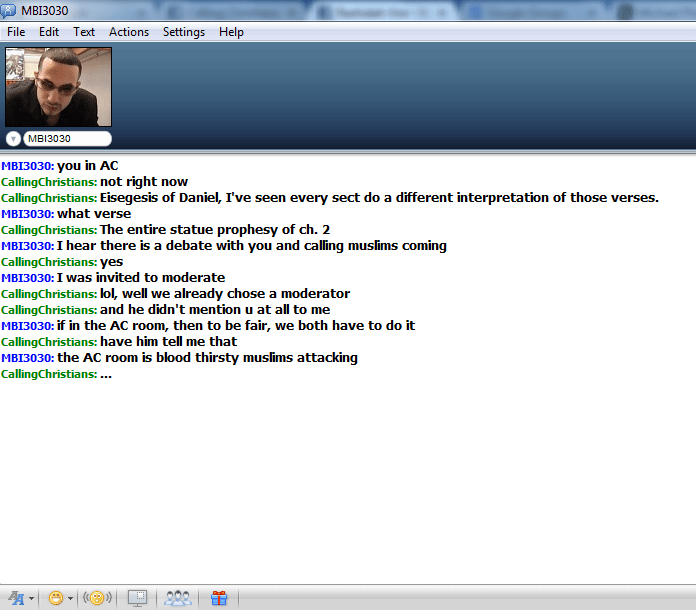
No debate is without a little controversy. A day before I had released the information about the debate, CL Edwards posted the information on his website. Later that evening I was approached by one of his friends, Antonio Santana, a Christian Missionary Polemic.


cl-debate-mbi

[Click Image to Zoom for Bigger Size]

Antonio deceptively came to ask me about a discussion in which the statue in Daniel was being discussed. I gave my opinion on this discussion and was about to exit the conversation when he brought up the debate. What was disturbing to me was the fact that he stated that CL Edwards invited him to moderate. I want to make it explicitly clear that I have all my email correspondences saved with CL and at no point in time did we discuss the possibility of Antonio (MBI3030) to be considered as a moderator. Now either it is that Antonio is lying or he is simply stirring trouble for CL.

When Antonio realised he would not get his way with me, he then insulted a significant portion of my friends by labelling them as blood thirsty Muslims. I must remind him that we Muslims do not ‘drink‘ the blood of any saviour, but he does, therefore when it comes to being blood thirsty, the label applies directly to him. I publicly call for CL Edwards to deal with his friend and proclaim that he does not endorse the violent and deceptive rhetoric of Antonio. I have agreed to debate CL, but I have not agreed to babysit his friends while they attempt to disturb our most exciting event.

wa Allaahu ‘Alam.

I Broke Another Missionary

بِسۡمِ ٱللهِ ٱلرَّحۡمَـٰنِ ٱلرَّحِيمِ ,

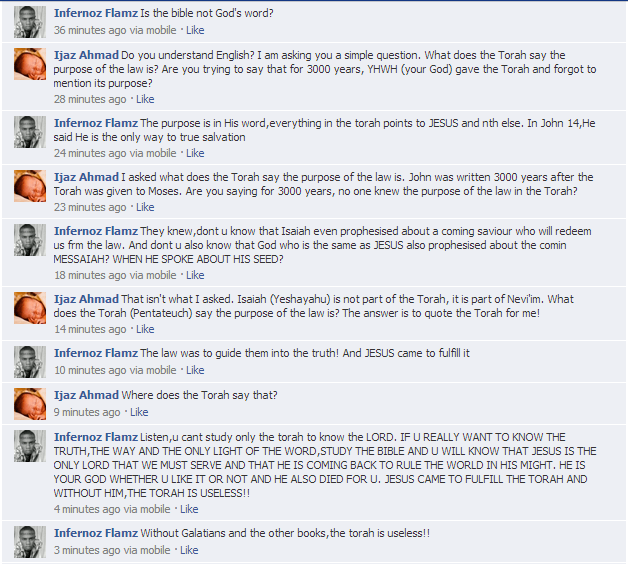
This morning I turned into a missionary’s worse nightmare. I’m sort of like the chap that comes to the car dealership, tests drives the car and it fails on me, I return to test drive another and it fails as well. Thus, it would appear that I’m not good for the dealership business. Similarly, I’m not good for missionaries either. After my initial run this morning, I decided to approach a Christian who has been on my list for sometime. As you will see:

  1. I asked a question that he could not answer.
  2. He knows he had no answer.
  3. So he repeated his wrong answer in hopes I’d stop asking.

Enjoy:

flamztotal


As you would eventually see, his patience finally ran out and he began typing in all caps. Clearly I’ve gotten on his nerves, I guess that whole ‘love your enemy’ mantra doesn’t seem to be working right about now…


flamz3

I’ve been told that the antidote to my questions is a dose of Islam, available everywhere and best of all, free of charge!

wa Allaahu ‘Alam.

A Christian Learns that Muslims do not Succumb to Childish Tactics [Updated!]

بِسۡمِ ٱللهِ ٱلرَّحۡمَـٰنِ ٱلرَّحِيمِ ,

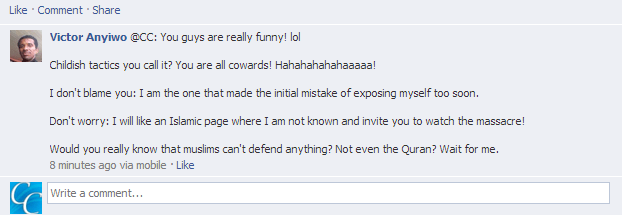
Missionaries have employed a vast variety of tactics to drag the Muslim into debate, solely for the purpose of taking control of the conversation, negating the Muslim’s belief and establishing Christianity as the dominant faith. Many do not understand that this is a reality, they think that these missionaries are innocent minded. However, a missionary on our very own page, despite his explicit arrogance, outed himself in a cry of frustration. He explains that despite all of his manoeuvring to drag me into a submissive position of argument, he’s failed constantly. What he does not understand is that I am no child. Despite being 20, I am familiar with the missionary mentality. Not only that, due to my Islamic upbringing, I also have developed a thick skin and a knack for being patient with confrontational people.

victorfb

He mistakenly assumes that by not being able to capture me in debate, it is due to me backing out. The truth is, he hasn’t been able to capture me in petulant and low level thought arguments because I cut him off at every chance he gets. Essentially, foresight is key and so is socratic thinking. In layman’s terms, I know what arguments he will use and the string of logic which follows, so I negate his premises, thus rendering his argument null and void. Since his argument has been refuted, he’s unable to move forward and thus he’s cut off from preaching to me.

He speaks so candidly, that he even admits to assuming I have a camera in his mind so I can see his thoughts. Surely, this is a sign from Allaah that I’m atleast doing something right. Knowledge is key and in my few years of discussion and dialogue, Christians have few intelligible arguments. I read their texts, studied and understood their reasoning and because of this, I became able to foresee their train of thought and as I have aforementioned, I am now able to shut them down in an elegant and precise manner. He thought that being loud and abrasive would help, but my patience persevered over his stone age tactics. He thought that by insulting my pride, I would have no choice but to respond, what he does not understand is that in Islam we are taught humility and we are humble to all due to our submission to our Lord, Allaah ta ‘aala.

Finally, he says that he tried to portray himself as a liar so that I would jump at the chance to attack and embarrass him, but this too did not work. He does not yet understand that we do not do this to attack, or hate on anyone, but to sincerely guide them to the truth. The missionary mind is very close minded, and this is a rear glimpse into what effective da’wah does to the Missionary. He is unable to think properly, his methods have failed, his arguments have backfired. He’s unable to evoke an emotional response from the Muslim. So what is he to conclude? That I am unlearned and unstable! Funny and ironic as it may be, his own words are testament to my character. I’m not unlearned, nor unstable, I am a Muslim who understands Islam and because of this, I recognize the reality of Christian missionary work, subsequently, I am able to decommission missionaries by doing little and causing them much frustration!

Allaah is indeed the Most Merciful!

Addendum:

Shortly after this post, our friend Victor decided to comment once more:

victorfb1

This is what I call the emotional self affirmation,  the missionary has now presented himself with a precarious situation. He decides that although he admitted to being deceitful, that he willingly attacked my pride, that he pretended to be ignorant, in the end I am the one who is the coward. To compensate for such a lame argument he added a bout of laughter that really shows his nervous reaction to the mess he’s found himself in. Then he sought to once again, admit that he exposed himself. It’s good that he realised what he’s done, but then he shoots himself in the foot again by explaining more of his method.

He’s decided to go to another Muslim page and ‘perform a massacre’, such violent rhetoric is abhorrent and quite distasteful, certainly Christ did not usher and motivate the disciples by telling them to massacre the Jews! Alas, we must differentiate between the Christians of today and the faithful disciples of Christ. Lastly, he concludes that us Muslims cannot defend anything and then ends with saying we should wait for him. Most certainly we shall wait for him and we will enjoy watching him fumble once more. I think I’ve broken this missionary, thank God there are a couple million more for me to enjoy.

wa Allaahu ‘Alam.

Paul’s Contradictions on Salvation are Vast

بِسۡمِ ٱللهِ ٱلرَّحۡمَـٰنِ ٱلرَّحِيمِ ,

Paul’s gripes with the law are prominent throughout Galatians, Philippians and Romans. The content of most of these Epistles are filled with Paul’s intra-spiritual conflicts on soteriology given his Pharisaical past and Christian future, a battle not only with himself, but with his ‘super-apostle’ counterparts whom he proclaims equity with in authority and rank, yet they have never indicated such spiritual contradictions in their alleged writings[1][2]. To the contrary the ‘super apostles’ seemed to have it all figured out[3]. Paul says in his Epistle to the Philippians where he is boasting of his character[4]:

If someone else thinks they have reasons to put confidence in the flesh, I have more circumcised on the eighth day, of the people of Israel, of the tribe of Benjamin, a Hebrew of Hebrews; in regard to the law, a Pharisee;  as for zeal,persecuting the church; as for righteousness based on the law, faultless.

According to the exegetes [5], Paul claims to be faultless, that he had followed the law to the dot. If one follows the law without fault, then they are faultless, without sin. As a sin is to disobey God’s law. Yet, contradictingly, Paul says in another Epistle, this one to the Romans [6]:

We know that the law is spiritual; but I am unspiritual, sold as a slave to sin.

Paul only demonstrates his perpetual confusion, he cannot reconcile his new doctrine of salvation through the Messiah, with that of the law as given by God. For if God gave the law and the law would not save, then God failed, made a mistake in giving the law and had to recompense by giving His son. E.P Sanders’ says on this notion[7]:

Paul here, separates “God’s will” from “what actually happened”. In Paul’s world, the last position is the most surprising: that God failed, that his original intention in giving the law was not achieved.

Why do Christians expect us to follow such a muddled doctrine on salvation? Am I to accept that God failed in His plans for mankind’s salvation? Am I to accept that the apostle God chose to usher in His new faith, himself did not grasp it? Am I to accept that God killed His ‘son’, because God screwed up and needed a quick-save plan? As confusing and problematic Paul’s position is, the doctrine of soteriology in Christianity is far more complicated, for if Paul’s works are the foundation for it, given that it’s already so confusing, shall we expect anything derived of it to be void of such issues? Wishful thinking at its best for out Christian brothers.

wa Allaahu ‘Alam.

[1] – 2 Corinthians 11:5, Bible.
[2] – 2 Corinthians 12:11, Bible.
[3] – James 2:14-16, Bible.
[4] – Philippians 3:4-6, Bible.
[5] – “Philippians 3:6”, Adam Clarke’s Commentary.
[6] – Romans 7:14, Bible.
[7] –  “Paul, the Law and the Jewish People”, by E.P. Sanders, Kindle Edition, Location 1394 – 1395.

Refutation: The Quran on Muslims Entering Hell

بِسۡمِ ٱللهِ ٱلرَّحۡمَـٰنِ ٱلرَّحِيمِ ,

Missionaries often like to claim that the Qur’an says all Muslims will go to hell. There is one Missionary/ Christian polemic who bases a significant portion of his writings on this argument. Sam Shamoun not only things that the Qur’an says this[1][2], he also claims the Qur’an contradicts itself about this particular verse[3], it reads:

And not one of you but shall pass over it: it is for thy Lord an ordinance decreed.

There are two opinions on this verse, namely:

  1. The believers and disbelievers will go across a bridge above the fire, the disbelievers will fall in (thus the bridge is the entry to the fire), and the believers will cross without punishment.
  2. The believers and disbelievers may have to enter the fire, but the believers will walk away without damage, as Abraham [alayhi as salaam] walked away from the fire of Nimrod without any mark, pain, or suffering.

Muslims are also aware that according to Sunni sources [4][5], Muslims who have less good deeds than bad, may be sent to the fire to pay for their sins, upon which they will then be allowed to enter Jannah, there acceptance into heaven dependant upon their levels of ‘Iman:

Then it will be said, ‘O Muhammad, raise your head and speak, for you will be listened to; and ask, for your will be granted (your request); and intercede, for your intercession will be accepted.’ I will say, ‘O Lord, my followers! My followers!’ And then it will be said, ‘Go and take out of Hell (Fire) all those who have faith in their hearts, equal to the weight of a barley grain.’ I will go and do so and return to praise Him with the same praises, and fall down (prostrate) before Him. Then it will be said, ‘O Muhammad, raise your head and speak, for you will be listened to, and ask, for you will be granted (your request); and intercede, for your intercession will be accepted.’ I will say, ‘O Lord, my followers! My followers!’ It will be said, ‘Go and take out of it all those who have faith in their hearts equal to the weight of a small ant or a mustard seed.’ I will go and do so and return to praise Him with the same praises, and fall down in prostration before Him. It will be said, ‘O, Muhammad, raise your head and speak, for you will be listened to, and ask, for you will be granted (your request); and intercede, for your intercession will be accepted.’ I will say, ‘O Lord, my followers!’ Then He will say, ‘Go and take out (all those) in whose hearts there is faith even to the lightest, lightest mustard seed. (Take them) out of the Fire.’ I will go and do so.”‘

From this, we understand that Muslims, even with a mustard’s seed of ‘Iman will be allowed into Jannah due to the intercession of the Prophet Muhammad [sallalahu alayhi wa sallam]. Sam Shamoun however, concludes otherwise:

These traditions demonstrate the plausibility of interpreting 19:71 to mean that every Muslim will enter hell. After all, if Allah allows bad Muslims to enter hell and then come out due to Muhammad’s intercession, then he can also allow good Muslims to enter there as well. More importantly, these hadiths do not necessarily state that Muhammad is interceding simply for bad Muslims.

Unfortunately, Sam logic betrays his arguments. These ahadith demonstrate the opposite of Sam’s claim, you will notice that the ahadith specifically mentions the level of ‘Iman of which those people in the fire possess. What happens to those with a higher level of ‘Iman? The level of ‘Iman for which those Muslims entered the fire, was equal or less than to the first mentioned criteria: a grain of barley, other narrations mention the weight of a dinar. Therefore Sam’s argument is debunked by simply understanding the hadith. Does Sam believe that Muslims will a barley’s grain of faith, are not bad Muslims? Logic contradicts Sam’s claim. Up to this point, what can we conclude?

  1. Some Muslims will not enter hell (the will cross the entrance – the bridge across hell), the fire will not burn them while they cross into heaven.
  2. Some Muslims will enter hell, these are essentially weak Muslims who have sinned, the minimum criteria is considered to have a barley grain’s worth of ‘Iman.

Sam is therefore proposing a gross generalization, in his mind he thinks that if a hadith or ayah says some Muslims go to hell, that it means all Muslims go to hell. He is essentially forcing his understanding upon the sources which directly claim otherwise as I have duly demonstrated. We will now read what some of the commentators of the Qur’an have to say:

Ibn Kathir [6] says in his Tafsir:

Ibn Jarir reported from `Abdullah that he said concerning Allah’s statement,

﴿وَإِن مِّنكُمْ إِلاَّ وَارِدُهَا﴾

(There is not one of you but will pass over it.) “The bridge over Hell is like the sharp edge of a sword. The first group to cross it will pass like a flash of lightning. The second group will pass like the wind. The third group will pass like the fastest horse. The fourth group will pass like the fastest cow. Then, the rest will pass while the angels will be saying, `O Allah save them, save them.’ ” This narration has supporting narrations similar to it from the Prophet in the Two Sahihs and other collections as well. These narrations have been related by Anas, Abu Sa`id, Abu Hurayrah, Jabir and other Companions, may Allah be pleased with them all. Ahmad also recorded that Umm Mubashshar, the wife of Zayd bin Harithah, said, “The Messenger of Allah was in the house of Hafsah when he said,

«لَا يَدْخُلُ النَّارَ أَحَدٌ شَهِدَ بَدْرًا وَالْحُدَيْبِيَّة»

(No one who was present at the battles of Badr and Hudaybiyyah (of the Muslims) will enter into the Hellfire.) Then, Hafsah said, “Doesn’t Allah say,

﴿وَإِن مِّنكُمْ إِلاَّ وَارِدُهَا﴾

(There is not one of you but will pass over it (Hell);) The Messenger of Allah replied by reciting,

﴿ثُمَّ نُنَجِّى الَّذِينَ اتَّقَواْ﴾

(Then We shall save those who had Taqwa.) In the Two Sahihs there is a Hadith reported from Az-Zuhri, from Sa`id from Abu Hurayrah that the Messenger of Allah said,

«لَا يَمُوتُ لِأَحَدٍ مِنَ الْمُسْلِمِينَ ثَلَاثَةٌ مِنَ الْوَلَدِ تَمَسُّهُ النَّارُ إِلَّا تَحِلَّةَ الْقَسَم»

(No one of the Muslims who has had three children, who all died, will be touched by the Hellfire, except for an oath that must be fulfilled.) `Abdur-Rahman bin Zayd bin Aslam commented on Allah’s statement,

﴿وَإِن مِّنكُمْ إِلاَّ وَارِدُهَا﴾

(There is not one of you but will pass over it;) “The passing of the Muslims (over the Hellfire) means their passing over a bridge that is over it. But the passing of the idolators over the Hellfire refers to their admission to the Fire.” As-Suddi reported from Murrah, from Ibn Mas`ud, that he said concerning Allah’s statement,

﴿كَانَ عَلَى رَبِّكَ حَتْماً مَّقْضِيّاً﴾

(this is with your Lord; a Hatman decree.) “An oath that must be fulfilled.” Mujahid said, “Hatman means preordainment.” Ibn Jurayj said the same. Concerning Allah’s statement,

﴿ثُمَّ نُنَجِّى الَّذِينَ اتَّقَواْ﴾

(Then We shall save those who had Taqwa. ) When all of the creatures passed over the Hellfire, and those disbelievers and the disobedient people who are destined to fall into it because of their disobedience, Allah will save the believers and the righteous people from it because of their deeds. Therefore, their passing over the bridge and their speed will be based upon their deeds that they did in this life. Then, the believers who performed major sins will be allowed intercession. The angels, the Prophets and the believers will all intercede. Thus, a large number of the sinners will be allowed to come out of Hell. The fire will have devoured much of their bodies, except the places of prostration on their faces. Their removal from the Hellfire will be due to the faith in their hearts. The first to come out will be he who has the weight of a Dinar of faith in his heart. Then, whoever has the next least amount after him. Then, whoever is next to that after him, and so forth. This will continue until the one who has the tiniest hint of faith in his heart, equal to the weight of an atom. Then, Allah will take out of the Fire whoever said “La ilaha illallah,” even one day of his entire life, even if he never performed any good deed. After this, no one will remain in the Hellfire, except those it is obligatory upon to remain in the Hellfire forever. This has been reported in many authentic Hadiths from the Messenger of Allah.

Mufti Shafi Uthmani [alayhi rahma] says in his Tafsir [7]:

This means that everybody – be he a believer or an infidel – will go across Hell. However, this does not mean that they would go to stay in it; they would only go across it. But even if the word means “entry, then the pious believers on entry into Hell will feel no discomfort because its fires will cool down and will do no harm to them. Sayyidna Abu Sumayya has related that The Holy Prophet once said that:

“Everybody whether he is a pious man or a sinner will initially enter Hell, but for the pious believers the fire will cool down just as the fire of Namrud cooled down when Sayyidna Ibrahim (A.S) was cast into it. Thereafter, the believers will be taken to Paradise.”

Tanwir al Miqbas min Tafsir Ibn ‘Abbas [8]:

(There is not one of you but shall approach it) there is not a single one of you, to the exclusion of prophets and messengers, save that he will enter it, i.e. hell. (That is a fixed ordinance of your Lord) it is a decree that must necessarily take place.

Author’s comments: This tafsir takes the second view as presented above in Maar’iful Qur’an, that if the believers do enter, no harm will come to them. 

Tafsir al Qurtubi and Tafsir at Tabari were also referenced by Sam Shamoun, but they also hold on to the second opinion as indicated in Tafsir Maar’iful Qur’an. Commenting on these tafsirs, Shaykh Gibril says [9]:

Yes, it is the madhhab of al-Hasan al-Basri, Qatada and a group of the lexicographers, strengthened by certain authentic hadiths, that the “wurud” mentioned in verse 19:71 does not denote “entering” (which is the madhhab of Ibn `Abbas and is related from him and other Companions, yet none of the 23 English translations I consulted dared translate it this way) but either “crossing over”, in order to agree with the hadith of the believers crossing the bridge over hellfire at various speeds, some like light and others slower, or “coming into sight of and approaching”.

Others said the verse refers only to the disbelievers; others said the entering of the believers is not antithetical to their safety from the greater harm therein. The Holy Prophet, upon him blessings and peace, himself explained the verse: “All people shall ‘yariduha’, then they shall be blocked from it by their works”, as narrated in the Musnad of Imam Ahmad and the Sunan of Imam al-Tirmidhi, Allah have mercy on them. The “then” can mean that they enter it first, and it can mean that they come into sight of it only, and Allah knows best.

Al-Qurtubi discussed this in his Tafsir and, more at length, in al-Tadhkira. Shaykh Muhammad al-Amin al-Shinqiti gave a magisterial treatment to this controversial issue in his great Tafsir entitled Adwa’ al-Bayan fi Idah al-Qur’an bil-Qur’an (4:436-443). In his view the Quranic context most frequently provided by other verses mentioning such wurud confirms Ibn `Abbas’s position that the meaning here is “to enter.” At the very least some will enter it, as evinced by the countless authentic hadiths on intercession, by means of which they shall be brought out in droves, and this very verse was used by Ibn `Abbas, Allah be well-pleased with him and his father, as a proof for the doctrine of Ahl al-Sunna against the Khariji Nafi` b. al-Azraq, since Kharijis believe once in, never out. The angels’ dua on that day is: “Allahumma sallim, sallim!” (grant safety) on behalf of the believers, for which we ask here and hereafter.

Summary:

Based on this, we can conclude the following –

  1. Some will cross over the bridge over the fire quickly into heaven.
  2. Some will have difficulty crossing the bridge and may approach the fire where they will not be burned by it.
  3. Some will enter the fire, be burned for a while and based on their level of ‘Iman are removed from it and enter heaven.
  4. Some will enter into it and never leave {disbelievers}.

An Alleged Contradiction:

I’m not sure if Sam Shamoun knows what the word ‘contradiction’ meant, but it is evident from his usage in the aforementioned article that he does not truly understand the meaning of the world. He claims that Qur’an 3:192 means the following:

“According to the Quran, entering the fire is a sign of a person being shamed, humiliated, disgraced by Allah. Since the Quran says that Muslims shall enter hell, this means that Allah has decreed that all Muslims must experience shame, humiliation, and disgrace!

Note the implications here:

  • Entering hell is a sign of disgrace, humiliation and shame.
  • Allah has decreed that all Muslims will enter hell.
  • Therefore, all Muslims will be disgraced, humiliated and shamed by Allah.

Allah obviously delights in humiliating his followers since he has decreed their descent into hell.”

It is strange that he only partially quoted the verse, and unlike the other verses, he did not quote a tafsir/ commentary in this case. The verse actually says [10]:

Our Lord verily whomsoever Thou makest to enter into the Fire, him Thou hast surely humiliated and for the wrong-doers there shall be no helpers.

Rather, the context of the verse is removed by the deceptive misquote by Sam Shamoun (which is expected of him). The entering of the fire as referred to in the above verse, is contextualised by the verse preceding it which reads [11]:

Those who remember Allah when standing, sitting, and on their sides, and contemplate upon the creation of the heavens and the earth (saying:) ‘Lord, You have not created these in falsehood. Exaltations to You! Guard us against the punishment of the Fire

Therefore the context is that those who will enter into the fire for punishment, will be disgraced and humiliated and those who were not entered for punishment, i.e. going over the bridge (recall: the bridge is the entrance as from the bridge you either fall into the fire or cross into heaven), will not be burned from the fire. In fact Sam made a grave error in judgement, he jumped to Qur’an 66:7-8 which reads according to Sam’s article[12]:

“… the Day that God will not permit to be humiliated the Prophet and those who believe with him… Y. Ali”

If he had stuck with a thorough reading of 3:192 and onwards, he would not have need to invent a contradiction, for the verses after it state [13]:

Our Lord, give us what You promised us by Your Messengers, and do not abase us on the Day of Resurrection. You do not break Your promise‘. And indeed their Lord answers them: ‘I do not waste the labor of any that labors among you, male or female you are from each other. And those who emigrated, and were expelled from their houses, those who suffered hurt in My way, and fought, and were killed those I shall surely acquit of their evil deeds, and I shall admit them to Gardens underneath which rivers flow’ A reward from Allah, and Allah with Him is the best reward.

According to the context of the verse, God will surely save them from humiliation by forgiving them of their sins and allowing them to enter into the heaven. Thus they are the people who will cross over the bridge into heaven. If Sam had stuck with the continuing of the verses, he would not have forced his incorrect understanding upon them. Sadly, this is the deception that missionaries like him must employ to appease his Lord. To rework and correct Sam’s argument, the true argument can thus be laid out as such:

  • Entering and being punished by the fires of hell is a sign of disgrace humiliation and shame.
  • Some Muslims will be disgraced because of their evil sins and bad deeds by the punishment of hell.
  • Therefore those evil Muslims will be shamed but eventually forgiven and sent to heaven.

In the second part of this article we will examine the case of Christians and their place in hell according to the Bible.

wa Allaahu ‘Alam.

[1] – “Will All Muslims Go to Hell”, Qur’an Contradiction, Sam Shamoun.
[2] – “The Quran on Muslims Entering Hell”, Sam Shamoun.
[3] – Qur’an 19:71.
[4] – Sahih al Bukhari, Book #93, Hadith #601. Sahih al Muslim (Ibid), Book #1, Hadith #377. Hadith Qudsi #36.
[5] – According to the Interpretation of Shaykh Salih al Munajjid, Islamqa. It is a must read in understanding this topic.
[6] – “Qur’an 19:71-72“, Tafsir Ibn Kathir, by Imam Ibn Kathir [alayhi rahma].
[7] – “Qur’an 19:71“, Tafsir Mar’iful Qur’aan, by Mufti Shafi Uthmani [alayhi rahma].
[8] – “Qur’an 19:71“, Tanwir al Miqbas min Tafsir ibn Abbas, allegedly by Ibn ‘Abbas [radi allahu anhu].
[9] – “Will the Believer Enter the Fire or Just See It?“, Seeker’s Guidance, Shaykh Gibril.
[10] – Qur’an 3:192.
[11] – Qur’an 3:191.
[12] – “The Quran on Muslims Entering Hell”, Sam Shamoun.
[13] – Qur’an 3:194-195.

Wishing ‘Merry Christmas’

بِسۡمِ ٱللهِ ٱلرَّحۡمَـٰنِ ٱلرَّحِيمِ ,

This is no means a fatwa (scholarly edict), but this is an explanation of the reasoning, usage and meaning of the phrase, ‘Merry Christmas‘. The overwhelming majority of scholars have agreed that it is not proper to congratulate the Christians on this celebration as it is an implicit endorsement of their kufr (disbelief).

The term ‘Merry Christmas’ in itself, is meant to be conveyed as, ‘Merry Christ mass’ and is more properly understood as, ‘Happy Celebration of Christ’. Now, we as Muslims have no qualms with celebrating or sending salawat upon our Prophets. Hence after a Prophet’s name is spoken we rejoice and gladly convey our prayers upon them, God’s prayers upon them. We say, ‘alayhi as salaam‘ (May God’s peace be upon him) or ‘alayhi as salaatu wa salaam‘ (May God’s mercy and peace be upon him). When it comes to Christmas however, we must understand several notions about the day and celebration in itself:

  • This is not merely a birthday celebration.
  • This is primarily about a God becoming incarnate.
  • This is secondarily the birth of a God who has no beginning or end, understandably contradictory.

Therefore, when you wish a Christian, ‘Merry Christmas’, as a Muslim you are not celebrating Christ, but you are celebrating the incarnation of God, i.e. God assuming a human form. Thus, it should now be clear why we as Muslims do not endorse such a greeting or pleasantry. It is because this is considered shirk to us Muslims. It is clearly stated in the Catholic Encyclopaedia:

For the first coming of Our Lord in the flesh [in which He has been begotten], in Bethlehem, took place [25 December, the fourth day] in the reign of Augustus [the forty-second year, and] in the year 5500 [from Adam]. And He suffered in His thirty-third year [25 March, the parasceve, in the eighteenth year of Tiberius Cæsar, during the consulate of Rufus and Rubellio].”

Thus, it is not that Muslims want to be rude, or that we are ill mannered, it is because conveying such a greeting implies that we are embracing the incarnation of Christ and as such, we wholly disagree with such a notion. Even the Catholic Encyclopaedia accepts that gift giving and card giving on this day, or for this season are based on Pagan rituals:

Pagan customs centering round the January calender gravitated to Christmas. Tiele (Yule and Christmas, London, 1899) has collected many interesting examples. The strenæ (eacute;trennes) of the Roman 1 January (bitterly condemned by Tertullian, de Idol., xiv and x, and by Maximus of Turin, Hom. ciii, de Kal. gentil., in P.L., LVII, 492, etc.) survive as Christmas presents, cards, boxes.”

Therefore, if you are a Muslim and you thought that the scholars were perhaps being a bit too stringent in their rulings, this is not so. The information I have presented is clear and to the point, while you may intend to simply convey pleasantries, the day, its history and its significance in the Christian faith is in complete opposition to the fundamental teachings of tawhid (monotheism), as even the Christians regard it as pagan tradition. In closing, I leave you with an actual fatwa that explains the Islamic ruling on the issue (Darul Fiqh):

Greeting Non Muslims with -MERRY CHRISTMAS? 

Question: Is it ok to say to a colleague at work phrases like merry Christmas or have a nice Christmas party?

Answer:

In the Name of Allah, the Most Gracious, the Most Merciful.

As-salāmu ‘alaykum wa-rahmatullāhi wa-barakātuh.

Imān is the greatest commodity a Muslim possesses. Salvation in this world and especially in the hereafter is dependent on nothing but Imān. A billionaire without Imān will not be spared from the painful punishment despite his millions and billions. A beggar with Imān will have access to the Eternal Gardens of Paradise despite his poverty. Imān is the key.

All the dollars and pounds of the world do not equate to the value of Imān. The price and worth of Imān is greater than all the gold, silver and diamonds put together. Our life revolves around the security of our Imān. Preservation of Imān until one’s last breath is obligatory on us. Imān equivalent to the size of a mustard seed is sufficient to purchase the everlasting gardens of Paradise.

Anything which compromises our Imān or contradicts our Imān is hazardous for us. Other faiths contradict our faith. Showing happiness for another faith’s festival is extremely hazardous. Greeting adherents of other faiths well or happiness in their festivals in essence is verbal acknowledgement, recognition and approval of their festival. The Jurists have stated that there is fear of one losing his Imān if he wishes others well in their festivities.[1]

A Muslim should not forsake his principles and beliefs merely to be friendly. Friendliness and foolishness are two poles apart. Friendliness is to be courteous and well-mannered whilst adhering to one’s belief and principles. Foolishness is to risk one’s belief and principles merely to please or to ‘fit in’ to a society.

Thus, greeting others with any phrase indicating a greeting for the Christmas festival is impermissible.

This does not mean we do not be kind and courteous. We must be kind, caring, loving and compassionate to the whole of creation. The Prophet salallahu alaihi wasallam was an embodiment of compassion. He was a fountain of mercy. We must be friendly with all and not foolish with ourselves.

And Allah Ta’ālā Knows Best

Mufti Faraz

——————————————————————————–

[1] اجتمع المجوس يوم النيروز فقال مسلم خوب رسم نهاده اند أو قال نيك أثرنهاده اند خيف عليه الكفر. (جامع الفصولين ج 2 ص 230 إسلامي كتب خانه)

فتاوى محمودية ج 19 ص 267 إدارة القرآن

For those who would like a video to understand the issue a bit more, here is Shakyh Mumtaz ul Haqq [db] on the issue:

wa Allaahu ‘Alam

« Older Entries Recent Entries »