Author Archives: Ijaz Ahmad

Pastor Claims the Holy Spirit is in his Genitals, Convinces Congregation to Perform Sexual Acts

بِسۡمِ ٱللهِ ٱلرَّحۡمَـٰنِ ٱلرَّحِيمِ ,

At Calling Christians, we’ve read some disturbing stuff but this incident takes the cake. 2013 is off to a very sadistic start. Evangelical Pastor Sobrino Valdeci Picanto from Brazil convinced his congregation that the Holy Spirit was in his genitals and the only way to please God and to receive the Holy Spirit was to allow him to ejaculate on the members of his congregation. Referring to his sexual secretions as ‘divine milk from the Holy Spirit‘, eager to please Jesus, many performed sexual acts to ‘receive the divine milk of the Holy Spirit‘.

cc-pastor

He had effectively duped his congregation to believe that the Holy Spirit would only come onto the Church members, through his ejaculation of the divine milk. The Spanish News Website, QUE! says the following:

” He convinced us that only God could come into our lives through the mouth and why he was going to do what he did. Often, after worship, Pastor Valdeci arrived to take us to the part of the funds back to the church and asked us to do oral sex on him until the Holy Spirit comes through ejaculation “.

If that’s not horrible, this would make you sick:

“The truth is that this man is now in jail where he said when he was arrested, intends to continue watering with sacred milk to his cellmates.”

You can read the original article here in Spanish. Parental oversight is advised before visiting this website. This sort of behaviour comes as no surprise as it is a fact that Christianity has always had a fascination with genitalia, specifically male genitalia, as is noted in their vast history. Wonder what David Wood and Sham Shamoun would have to say about this!

wa Allaahu ‘Alam.

The Apostle Paul’s Disobedience of Jesus in Matthew 5:22

بِسۡمِ ٱللهِ ٱلرَّحۡمَـٰنِ ٱلرَّحِيمِ ,

In the alleged Gospel of Matthew we read the following:

But I say to you that everyone who is angry with his brother will be liable to judgment; whoever insults his brother will be liable to the council; and whoever says, ‘You fool!’ will be liable to the hell of fire.

But I say unto you, That whosoever is angry with his brother without a cause shall be in danger of the judgment: and whosoever shall say to his brother, Raca, shall be in danger of the council: but whosoever shall say, Thou fool, shall be in danger of hell fire.

But I tell you that anyone who is angry with his brother will be subject to judgment. Again, anyone who says to his brother, ‘Raca,’ is answerable to the Sanhedrin. But anyone who says, ‘You fool!’ will be in danger of the fire of hell. – Matthew 5:22.

Clearly, Jesus is allegedly saying this verse as a warning not to call someone a fool. If you do call someone a fool, you’d be liable to enter the fires of hell. That’s a serious punishment. However, everyone’s favourite pseudo Apostle somehow decided he was brave enough to disobey Christ, his alleged deity and saviour. We read in 2 Corinthians the following:

 I repeat, let no one think me foolish. But even if you do, accept me as a fool, so that I too may boast a little. What I am saying with this boastful confidence, I say not as the Lord would but as a fool. Since many boast according to the flesh, I too will boast. For you gladly bear with fools,being wise yourselves! For you bear it if someone makes slaves of you, or devours you, or takes advantage of you, or puts on airs, or strikes you in the face. To my shame, I must say, we were too weak for that! But whatever anyone else dares to boast of—I am speaking as a fool—I also dare to boast of that. – 2 Corinthians 11:16-21.

 I have been a fool! You forced me to it, for I ought to have been commended by you. – 2 Corinthians 12:11.

Either it is that Paul intentionally disobeyed Christ, or he intentionally disobeyed Christ by calling himself a fool. If Paul saw himself as a Christian, then he would have known that Christ forbade such labelling upon any Christian! This presents us with an issue, as the reason Christ forbade anyone from using such a term is because it was commonly used to describe idolaters:

Thou fool – This term expressed more than want of wisdom. It was expressive of the highest guilt. It had been commonly used to denote those who were idolaters Deuteronomy 22:21, and also one who is guilty of great crimes,Joshua 7:15; Psalm 14:1. – Barne’s Notes on the Bible, Matthew 5.

Paul therefore has done the following:

  1. Paul sees himself as a Christian.
  2. Paul is  a Pharisee and knows the Old Testament well.
  3. Jesus forbids calling a Christian by the title of fool.
  4. The title of fool is commonly attributed to idolaters in the Old Testament.
  5. Since #1 is true, then Paul willingly disobeys Christ’s command in #3.
  6. Since #5 is true, then Paul is an open sinner against Christ.
  7. Since #2 and #4 is true, then Paul knows he is attributing the title of ‘idol worshipper’ to himself.
  8. Since #5, #6 and #7 is true we can logically conclude that Paul is openly rejecting the words of Christ, and knowingly calling himself as an idolater and rejects the title of being a Christian.

This therefore leaves Christians in a precarious position, for if they continue to believe that Paul is a Christian, they are contradicting his own words where he calls himself by a title commonly reserved for idol worshippers and are thus rejecting Paul’s description of himself. Another problem is if they endorse Paul’s use of the title and his writing’s inclusion in the New Testament as a scripture, then they are endorsing the work of an idolater who openly opposes Christ. Either Christians must reject Paul for what he calls himself, or they reject Christ in lieu of Paul. Whichever choice they make, they have no conclusion but to realise that Paul is in clear error.

wa Allaahu ‘Alam.

The Problem of Colossians 4:16

بِسۡمِ ٱللهِ ٱلرَّحۡمَـٰنِ ٱلرَّحِيمِ ,

In the following quote, we read that the alleged Apostle Paul, commands his followers to read one of his epistles that he sent to another town:

And when this letter has been read among you, have it also read in the church of the Laodiceans; and see that you also read the letter from Laodicea. – Colossians 4:16.

The problem with this verse is that the Epistle to Laodicea no longer exists, therefore the scripture (according to Christians) of Colossians 4:16 is commanding the impossible. This raises a bigger issue, and to explain it we need another quote from New Testament:

“All Scripture is breathed out by God and profitable for teaching, for reproof, for correction, and for training in righteousness, that the man of God  may be complete, equipped for every good work.” – 2 Timothy 3:16-17.

According to Sham Shamoun, this verse refers to Paul’s letters in general as scripture:

“Since all the letters where Paul claimed inspiration preceded the writing of 1 and 2 Timothy, we can safely infer that these epistles would have also been included among the Scriptures that Paul said were breathed out by God; an inference which the apostle Peter himself makes:

“Bear in mind that our Lord’s patience means salvation, just as our dear brother Paul also wrote you with the wisdom that God gave him. He writes the same way in all his letters, speaking in them of these matters. His letters contain some things that are hard to understand, which ignorant and unstable people distort, as they do the other Scriptures, to their own destruction.” 2 Peter 3:15-16″

This reasoning therefore exacerbates the problem of scriptural self contradiction, emendation and rejection. How so? To be quite honest, if Paul’s words are inspired by God and are therefore scripture and as scripture it is commanding Christians to read a certain letter, yet that letter does not exist, we’re in a bit of a conundrum here. If we consider the letter of Laodicea to be scripture according to Sam’s interpretation of 2 Timothy and in light of 2 Timothy itself, then the Christian faith has dug itself into a ditch. Allow me explain:

  1. Paul’s words are seen as scripture.
  2. All scripture is profitable and useful for teaching and guidance, according to 2 Timothy.
  3. If #2 is true, then Colossians 4:16 is false as it is not profitable as the Epistle to Laodicea does not exist.
  4. Since Colossians 4:16 is false, then #1 cannot be true since it does not fulfil the condition of #2.
  5. Since #1 and #2 are false, then the New Testament thus far cannot be seen as scripture.
  6. Since #3 is true, then why do Christians continue to believe it to be scripture?

Considering that logic is not the best friend of our friends at Answering Islam or Answering Muslims, I need to establish my point a bit more simply. In context of 2 Tim. 3:16, Paul’s letters are scripture and are therefore useful for teaching. Paul’s letter commands the impossible and thus is useless. Since it is useless than 2 Tim. 3:16 is false. Since 2 Tim. 3:16 is false, then as a whole, the New Testament is not trustworthy as it contradicts the very criteria under which it exists. Now, I’m assuming that I’m dealing with some thick headed people, so I’m going to bring to the forefront an even simpler argument. Colossians 4:16 commands us to read a scripture known as the Epistle to Laodicea, since Colossians 4:16 made it into the canon by YHWH’s will, then we have some bigger issues:

  1. YHWH was ignorant of what would happen to the Epistle to Laodicea.
  2. YHWH knew what would happen and chose to have 2 Tim. 3:16 contradict Paul.
  3. If #2 is true, then YHWH is deceitful as he is not the author of confusion see 1 Cor. 14:33.
  4. Since #3 is true, then the YHWH of the New Testament is not a true God by his own criteria/ Paul’s inspired writings.

So where does this leave the Christian religion? Either they have to forego Paul’s letters as worthless garbage in order to protect the dignity of YHWH, or they reject both YHWH as he contradicts the criteria of not being a God of confusion. If not, then rejecting both YHWH and Paul is the best solution as both contradict each other and themselves, as demonstrated above. Therefore due to simple logic, according to the Bible, Christians must reject the Bible, YHWH and Paul.

wa Allaahu ‘Alam.  

Pope Benedict’s 7 Biggest Scandals

بِسۡمِ ٱللهِ ٱلرَّحۡمَـٰنِ ٱلرَّحِيمِ ,

cc-popebenedictevil

The Huffington Post (UK) has released an article, reviewing the 7 greatest scandals, mishaps and mistakes by Pope Benedict/ Joseph Ratzinger. The list covers:

  1. His time in the Hitler Youth.
  2. Child Sex Abuse Scandals.
  3. Vatileaks/ Butler Scandal.
  4. Pissing of the Jews.
  5. Pissing of the Muslims.
  6. Photoshopped Image Kissing Muslim Leader.
  7. His Prada Slippers.

It’s one great read and in light of his resignation, it really makes sense why he’d not want to be the Pope any more. After all, you can only screw up so many times! Read the full list here.

wa Allaahu Alam.

Pope Benedict’s Career: Insightful Article by Christopher Hitchens

بِسۡمِ ٱللهِ ٱلرَّحۡمَـٰنِ ٱلرَّحِيمِ ,

cc-popebenedict

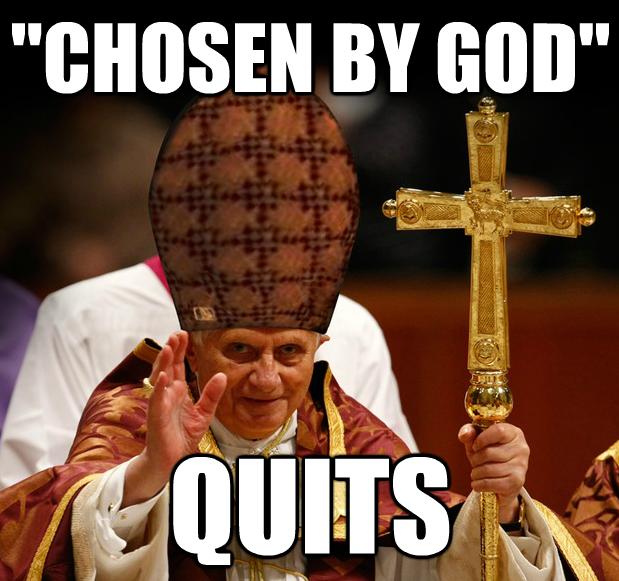
In light of the Pope’s resignation of being Christ’s representative in earth, a first in over 600 years, an article by the recently deceased Christopher Hitchens comes to mind. In 2010 when the growing public outrage at the Pope’s blatant ineptitude to deal with the rising sexual abuse/ assault cases came to never before seen heights, then writer for SLATE.COM, journalist Christopher Hitchens wrote an extensive piece on the moral decadence and evil as has been perpetrated by Pope Benedict. You can read the full article here and some interesting quotes below:

On March 10, the chief exorcist of the Vatican, the Rev. Gabriele Amorth (who has held this demanding post for 25 years), was quoted assaying that “the Devil is at work inside the Vatican,” and that “when one speaks of ‘the smoke of Satan’ in the holy rooms, it is all true—including these latest stories of violence and pedophilia.” This can perhaps be taken as confirmation that something horrible has indeed been going on in the holy precincts, though most inquiries show it to have a perfectly good material explanation.

Concerning the most recent revelations about the steady complicity of the Vatican in the ongoing—indeed endless—scandal of child rape, a few days later a spokesman for the Holy See made a concession in the guise of a denial. It was clear, said the Rev. Federico Lombardi, that an attempt was being made “to find elements to involve the Holy Father personally in issues of abuse.” He stupidly went on to say that “those efforts have failed.”

This is common or garden stuff, very familiar to American and Australian and Irish Catholics whose children’s rape and torture, and the cover-up of same by the tactic of moving rapists and torturers from parish to parish, has been painstakingly and comprehensively exposed. It’s on a level with the recent belated admission by the pope’s brother, Monsignor Georg Ratzinger, that while he knew nothing about sexual assault at the choir school he ran between 1964 and 1994, now that he remembers it, he is sorry for his practice of slapping the boys around.

Not content with shielding its own priests from the law, Ratzinger’s office even wrote its own private statute of limitations. The church’s jurisdiction, claimed Ratzinger, “begins to run from the day when the minor has completed the 18th year of age” and then lasts for 10 more years. Daniel Shea, the attorney for two victims who sued Ratzinger and a church in Texas, correctly describes that latter stipulation as an obstruction of justice. “You can’t investigate a case if you never find out about it. If you can manage to keep it secret for 18 years plus 10, the priest will get away with it.”

While many Catholics will call his resignation, an act of undisputed humility, I think a very important question has been largely ignored. How morally justifiable is it to be God’s representative on earth and then quit that position. If Ratzinger’s issue is his age, then why didn’t Peter, the first alleged Pope not quit when he got old? Why didn’t Pope John Paul quit when he realised he was dying? Either those people who died in their Papacy had no humility or the masses are simply making excuses for what is one of the worst Pope’s the world has ever seen. After all, he screwed up relations with the Muslim world, was an avid and proactive member of the Hitler Youth, and last but not least, failed to manage the greatest scandal to hit the Papacy since its existence, the sex abuse incidents. Clearly he’s left a legacy the Church and Catholic Christians alike, would love to sweep under the rug and move on. Can’t blame them.

wa Allaahu Alam.

Br. Ibn Anwar of Unveiling Christianity Joins Calling Christians!

بِسۡمِ ٱللهِ ٱلرَّحۡمَـٰنِ ٱلرَّحِيمِ ,

We’re proud to announce that the esteemed owner and author of Unveiling Christianity, Br. Ibn Anwar has officially joined the Calling Christians team as an author. Br. Ibn Anwar is renowned for his indepth scholarly articles that are well researched, studied and academically cited. His joining with us signals our continued efforts to make 2013 a blockbuster year for Calling Christians. Alongside our other authors, Br. Ibn Anwar expands our already growing team of young and talented Muslims who continue to be a thorn in the side of Christian missionaries worldwide. We look forward to his future contributions while we gather and post his previous articles on to the Calling Christians website. Some of our ‘fans’ though, will not be happy, case in point:

cc-shamoun-idiot

wa Allaahu ‘Alam.

[Postponed] Upcoming Lecture: Unveiling Missionary Tactics

بِسۡمِ ٱللهِ ٱلرَّحۡمَـٰنِ ٱلرَّحِيمِ ,

POSTPONED TO SATURDAY NIGHT (9th).

In continuing with our monthly lectures (atleast once a month), this week I’ll be focusing on Missionary Tactics on the street, and if time permits, on the internet as well. Last week’s talk on Allaah’s love in Christianity and Islam lasted for an hour whereas it was carded for only 20 or 30 minutes, so I’d say to expect this talk to last for an hour or so as well. Unfortunately we had a recording issue with the first lecture but that will be sorted out, inshaAllaah (God willing) for this week’s talk.

cc-tactics

Hope to see you all there.

wa Allaahu ‘Alam.

Jesus in Islam and Christianity, by Br. Paul Williams and Rowan Williams

بِسۡمِ ٱللهِ ٱلرَّحۡمَـٰنِ ٱلرَّحِيمِ ,

Our beloved Br. Paul is having a two part lecture with Dr. Rowan Williams concerning the personhood and deity of Jesus the Christ as it exists in Islam and Christianity. Below are the details taken from his website.

The-archbishop-of-Canterbury


Date: Thursday 21st February

Time: 5-7 PM
Format: Talk by Rowan Williams, followed by a talk by Paul Williams. Q&A.
Venue:
Queen’s Lecture Theatre
Emmanuel College
Cambridge
CB2 3AP

Cambridge University Islamic Society are hosting an exciting new event featuring two presentations about ‘Jesus in Islam and Christianity’. The aim is to give a ‘overview of the similarities of the beliefs in Jesus in Christianity and Islam.’ I have been invited to approach the topic from the Islamic perspective, and the other speaker, The Rt Revd and Rt Hon Dr Rowan Williams, will be approaching the topic from the Christian side (in a manner of information/discussion and not debate). Dr Williams was the Archbishop of Canterbury until last month. Emmanuel College, Cambridge will be the venue. Both speakers and the venue have been confirmed. Further details to follow…

I feel humbled, privileged and quite unworthy to have been invited to share a platform with such an eminent person.

A Case Study of Peter’s Denial

بِسۡمِ ٱللهِ ٱلرَّحۡمَـٰنِ ٱلرَّحِيمِ ,

Note: This article by sister Elisabeth Strout, a female revert from the depths of Christianity to the heights of Islam, read her story here.

While getting ready to teach a Sunday School class on the crucifixion and resurrection of Jesus, my mother asked me what Islam teaches about these issues. Honestly, I responded that the Qur’an simply states categorically that Jesus didn’t die, the Jews only thought they killed him. While that leaves room for countless theories, from the switching of bodies with a look-alike, to the swoon theory, the basic teaching is that Jesus did not die and come back to life, but rather ascended to heaven without dying. I concluded with the assertion that Christians themselves cannot trust their own Bible’s teaching, as it’s riddled with contradictions. My parents confidently disavowed any possibility of discrepancy between the Bible’s four accounts of the event, and as a result, I’ve spent the last few days studying the four Biblical crucifixion and resurrection narratives closely, to analyze the contradictions between them.

There are quite a few, and while some may be written off with the “inclusive” explanation (i.e. Matthew and Mark recount Jesus’ last words as being “my God, my God why have you forsaken me”, Luke claims they were “into thy hands I commit my spirit”, while John says they were “it is finished”, and Christians generally claim that Jesus said all three in succession, “my God, my God why have you forsaken me, into your hands I commit my spirit, it is finished”.), there are some narratives that cannot be reconciled, no matter how you superimpose them.

Rather than posting them all here at once and leave readers floundering in all the references, I decided to start with a case study of one particular event in the story, namely Peter’s denial of Christ. While the wording differs insignificantly between the three questioners who point Peter out, that is not primarily of interest. Take a look at Matthew and Luke’s accounts, which are almost identical, and then compare them with John, and then Mark, and notice the incompatible details:

Matthew 26:69-75

  • All disciples flee upon Jesus’ arrest, Peter follows at a distance.

  • A servant girl in the courtyard says, “You also were with Jesus the Galilean,” Peter responds, “I do not  know what you mean”.

  • A different servant girl at the gate says, “This man was with Jesus of Nazareth,” Peter responds with an oath, “I do not know the man”.

  • The bystanders say, “Certainly you are one of them, your accent betrays you,” Peter responds again with an oath, “I do not know the man.”

  • The rooster crows, Peter remembers Jesus’ prediction, and weeps bitterly.

Luke 22:55-62

  • Jesus is arrested (no mention made of disciples fleeing), Peter follows at a distance.

  • A servant girl in the courtyard says, “This man also was with him,” Peter responds, “Woman, I do not know him.”

  • Another person says, “You also are one of them,” Peter responds, “Man, I am not.”

  • Another person says, “Certainly this man also was with him, for he too is a Galilean,” Peter responds, “Man, I do not know what you are talking about.”

  • The rooster crows, Peter remembers Jesus’ prediction, and weeps bitterly.

So far, so good. Again, there is a slight difference of wording, but that can be overlooked. Take note of the emphasized words in Matthew, and now watch how in John, the story takes on a lot more detail (though John was written decades later), and the contradictions begin.

John 18:15-27

  • Jesus is arrested (no mention made of disciples fleeing), Peter and another disciple follow. The other disciple gets into the courtyard because he knows an official. Peter doesn’t get into the courtyard, so the disciple sends a servant girl to open the gate for him.

  • The servant girl at the gate says, “You also are not one of this man’s disciples, are you?” and Peter responds, “I am not.”

  • The officers and servants around the fire in the courtyard say, “You also are not one of his disciples, are you?” and Peter responds again, “I am not.”

  • A relative of the man whose ear Peter cut off asks, “Did I not see you in the garden with him?” and Peter denies it.

  • The rooster crows (no mention is made of his weeping).

So now, apart from the general wording and the location of the questioners (he goes from courtyard to gate in Matt., and from gate to courtyard in John), we have several distinct differences. First, the identity of the following disciples. Matt. claims all the disciples fled except Peter, and Peter alone followed from a distance. John makes no mention of the disciples fleeing, and claims both Peter and another disciple followed. Typical of John, the other disciple remains anonymous leaving Christians to speculate that it was probably John himself. Either way, either they all fled except Peter, or they all fled except Peter and John. It can’t be both.

Secondly, the identity of the questioners. Other than the first, the servant girl, Luke leaves the second two questioners anonymous, so his version is fairly compatible with the others. Matthew on the other hand, states that the questioners were (1) a servant girl in the courtyard, (2) a different servant girl at the gate, and (3) the bystanders (identified in John as officials and servants). John claims they were (1) a servant girl at the gate, (2) the by-standing officers and servants, and (3) a relative of the man whose ear Peter cut off.

While some may be tempted to generalize “bystanders” to mean anyone, including servant girls and relatives of earless men, the gospels purposely distinguish between the two, and the relative’s words in John set him apart even further from the bystanders of Matt., Mark, and Luke. While the three synoptics list, with slightly different wording, the third questioner as having recognizing Peter as a Galilean (because of his accent in Matt.), John’s third questioner (the relative of the man whose ear Peter cut) recognizes Peter because he saw him in the garden, during the arrest. It can’t be both.

Finally, we come to Mark’s account, which has yet another notable difference. While agreeing with Matthew about all the disciples fleeing except Peter, and the third question from the bystanders about Peter being Galilean, there are a few details that don’t match up.

Mark 14:66-72

  • All disciples flee upon Jesus’ arrest, Peter follows at a distance.

  • A servant girl at the fire in the courtyard says, “You also were with the Nazarene, Jesus,” Peter responds, “I neither know nor understand what you mean.”

  • Peter goes out to the gate and the rooster crows.

  • The same servant girl sees him there and says, “This man is one of them,” and Peter denies it.

  • The bystanders say, “Certainly you are one of them, for you are a Galilean,” Peter responds with an oath, “I do not know this man of whom you speak.”

  • The rooster crows a second time, Peter remembers Jesus’ prediction, and weeps bitterly.

While Matthew specifies that the first two accusations were leveled by two different servant girls, Mark goes to the trouble of telling us they were spoken by the same servant girl. It can’t be both. The second, and more noticeable aberration, is that Mark’s account of the story, as well as his account of Jesus’ prediction, differ in the number of times the rooster crows. While Peter is told he will deny three times, and does deny three times, in all accounts, Jesus predicts it will be “before the rooster crows”, in Matt., Luke, and John, and “before the rooster crows twice”, in Mark. And sure enough, in Matt., Luke and John, Peter denies thrice before the rooster crows, while in Mark, he denies, the rooster crows (the sound of it doesn’t bring him to his senses yet), he denies twice more, and the rooster crows again. So which was it, before the rooster crows, or before it crows twice? It can’t be both.

It seems like a silly, insignificant story. Same servant girl or different one, courtyard or gate, bystanders or relative, all but one disciple or all but two disciples, Galilean accent or previous encounter in the garden, one crow or two; does it really matter? For the Christians who claim there’s not a single contradiction in the entire Bible, it does matter. You can’t get around these, and you can’t get around the dozens, if not hundreds more in the Bible, no matter how insignificant. For the more reasonable Christians who openly admit that sure, they’re ancient documents, there’s the occasional slip-up, but nothing major that affects doctrine, their intellectual honesty is refreshing, but it begs the question, can God’s divine revelation be anything less than perfect? When God sends a final text for all of mankind, shouldn’t it be held to the same standards of holiness and perfection as He himself? Others maintain that as God’s Word incarnate, Jesus himself was the final revelation, and it’s his person that matters, not the text. Yet the text is all we have of him today, and if it contradicts itself, if it can’t be trusted to deliver the truth about the small events, how can we trust its claims about matters as weighty as death and resurrection?

« Older Entries Recent Entries »