Author Archives: Ijaz Ahmad

‘Oldest’ Qur’an fragments found in Birmingham University

According to a just published BBC News article, a recent re-dating of manuscripts of the Mingana collection at the University of Birmingham (UK), has led to another re-dating that places the manuscripts to between 568 CE and 645 CE with a 95% probability:

Radiocarbon dating found the manuscript to be at least 1,370 years old, making it among the earliest in existence.

The tests, carried out by the Oxford University Radiocarbon Accelerator Unit, showed that the fragments, written on sheep or goat skin, were among the very oldest surviving texts of the Koran.
These tests provide a range of dates, showing that, with a probability of more than 95%, the parchment was from between 568 and 645.

“They could well take us back to within a few years of the actual founding of Islam,” said David Thomas, the university’s professor of Christianity and Islam.

“According to Muslim tradition, the Prophet Muhammad received the revelations that form the Koran, the scripture of Islam, between the years 610 and 632, the year of his death.”

Prof Thomas says the dating of the Birmingham folios would mean it was quite possible that the person who had written them would have been alive at the time of the Prophet Muhammad.

“The person who actually wrote it could well have known the Prophet Muhammad. He would have seen him probably, he would maybe have heard him preach. He may have known him personally – and that really is quite a thought to conjure with,” he says.

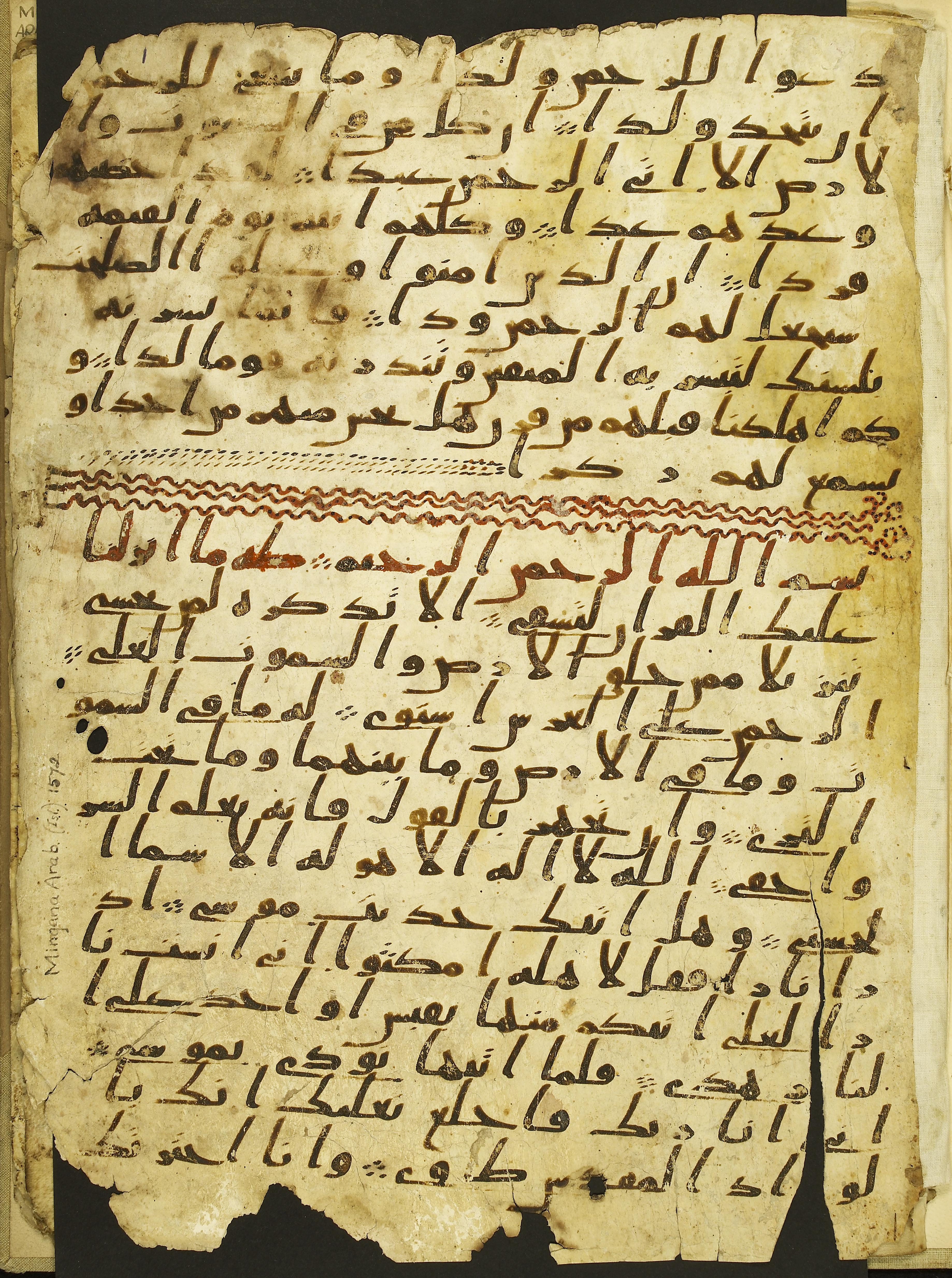
The collection consists of 9 folios, they are written in Hijazi script and have been carbon and palaeographically dated.

The collection has been split in two collections, now known as Mingana Arabic 1572a and Mingana Arabic 1572b. The collection that this article is about, is Mingana Arabic 1572a. The University has just updated the collection’s codifiction (classification). The “oldest” manuscripts, are 2 leaves (folios, pages) of the original 9 leaf (folio, page) collection. They have been both carbon and palaeographically dated.

The collection was re-dated several months ago to 1st century Hijri, and this is the second re-dating within a year, confirming it’s early dating.

Mingana Collection at Birmingham Uni. - Folio 1

Mingana Collection at Birmingham Uni. – Folio 1

More Information:

  • Mingana Collection (1572) before today’s latest re-dating can be found on Islamic Awareness.
  • Birmingham University’s scans of the Mingana Collection (1572), without updated information on re-dating, can be found here.
  • Birmingham University has updated the codification/ classification of the collection. The collection we are concerned with is now known as Mingana Arabic 1572a, which can be found here, and the other 7 leaves/ pages/ folios of the original 9 leaf/ page/ folio collection is now known as Mingana Arabic 1572b and can be found here.

I’d like to thank Br. Kaleef from Discover the Truth for bringing the BBC article to my attention, may Allah reward him accordingly, Ameen.

Article in Arabic (Br. Ahmed Shaker):

من جديد أخبار المخطوطات القرآنية المبكرة:

أوراق قرآنية مكتوبة بالخط الحجازي من مجموعة ألفونس منجانا بجامعة برمنجهام تم إخضاعها لفحص الكربوني المشع (C14) في أحد معامل جامعة أوكسفورد فكانت النتيجة أنه من المرجح بنسبة 95% أن تكون هذه الأوراق قد نشأت في الفترة ما بين 568م و645م = 56 قبل الهجرة إلى 24 هجرية.

تعليقات (ديفيد توماس) أستاذ المسيحية والإسلام في جامعة برمنجهام:
هذه الأجزاء من القران التي كتبت على هذه الرقائق، يمكن، وبدرجة من الثقة، إعادة تاريخها إلى أقل من عقدين بعد وفاة النبي محمد. إن الشخص الذي كتب هذه الصفحات لابد أنه عرف النبي محمد، وربما رآه واستمع إلى حديثه، وربما كان مقربا منه، وهذا ما يستحضره هذا المخطوط.

إن هذه الصفحات قريبة جدا من القرآن الذي نقرأه اليوم، وهو ما يدعم فكرة أن القرآن لم يعرف إلا تغييرا طفيفا، أو أنه لم يطرأ عليه أي تغيير، ويمكن اعادة تاريخها الى لحظة زمنية قريبة جدا من الزمن الذي يعتقد بنزوله فيه.

and Allah knows best.

The Bible says God was Imperfect, Ignorant and Disobedient

Theists tend to believe that God is perfect and without flaw, and this is a belief that many Christians share. The New Testament expresses this belief, it mentions:

“Be perfect, therefore, as your heavenly Father is perfect.” – Matthew 5:48.

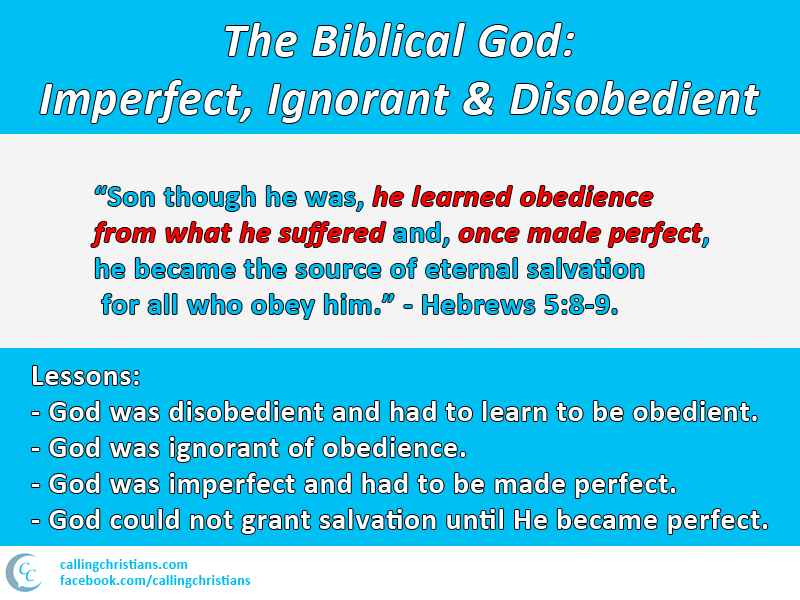
It should be noted that this verse specifies that only one person of the three persons of the Trinity is perfect. I found this to be odd. Why doesn’t the verse say, “as the Son, Holy Spirit and Father are perfect?” Why does the verse only declare the Father to be perfect? Does this mean that the Son, is imperfect? As it turns out, it does mean that. The Bible explicitly teaches that the Son, who is a God, is imperfect and had to be made perfect, God had to become perfect. That’s quite a strange idea. How can God be flawed? When we read Hebrews 5:8-9, this is exactly what it teaches. The passages say:

Son though he was, he learned obedience from what he suffered and, once made perfect, he became the source of eternal salvation for all who obey him.

There are quite a few things we learn from this passage.

  • God the Son, had to learn to be obedient and was thus disobedient at first.
  • God the Son, was imperfect and had to become perfect.
  • God the Son, could not grant salvation until He became perfect.

We should take note, that the passage begins with “Son though he was”, therefore qualifying that despite he is a God, these things happened. The author specifically uses this phrase to denote that the deity is being referred to, and that it is the deity of the Son which had to learn and become perfect. What is problematic is that according to the Trinitarian dogma, each person in the Godhead is co-equal. Therefore, if the Father is perfect, then the Son should be perfect too.

cc-2015-hebrews589

However, as we have just learned, this is not the case. The New Testament explicitly states that the Son was imperfect, had to be made perfect, had to suffer and only when he suffered, then he was able to grant salvation. The New Testament teaches that God could not grant salvation of His own will, because He was flawed and imperfect.

and Allah knows best.

Clarification by Wallace on Using Patristic Witnesses to Re-Construct the New Testament

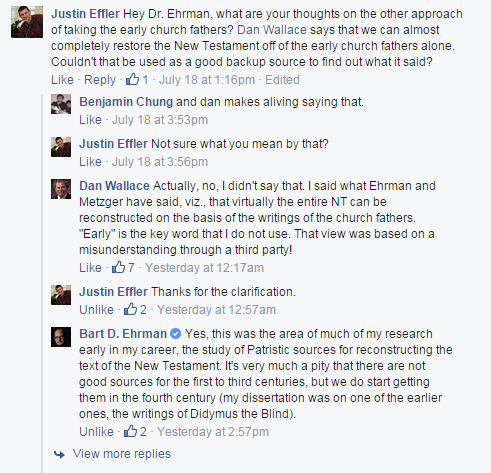
Many evangelical Christian apologists use an argument attributed to the Executive Director of the Center for the Study of New Testament Manuscripts, which goes as follows:

We can almost completely restore the New Testament off of the early church fathers alone.

This argument posits that based on the writings of the early Church Fathers (Patristics), in their quotations, we can use those quotations of the New Testament to reconstruct the entire New Testament. However, as Dr. Dan Wallace clarifies, this is not a claim he makes, and he specifically qualifies that although such a reconstruction can be done, it cannot be done using the early Patristics:

cc-2015-wallaceonpatristictc

As Dr. Ehrman points out, this cannot be done using the early Patristic writings (1st to 3rd centuries). Unfortunately, this is quite a popular argument used by Christian apologists, and it’s long overdue that either Dr. Wallace or Dr. Ehrman corrected lay Christians on their use and abuse of alleged arguments by scholars.

and God knows best.

Major Scholar of Qur’an Passes Away: Shaykh Shukri al Luhafi

You won’t find mention of him in any Orientalist University or Orientalist published worked, but among the scholars of the Qur’an, he is perhaps one of the greatest to have ever lived. Today, he has passed away and with him, a wealth of knowledge which has been disseminated to thousands of Muslims globally. Shaykh Luhafi was one of the greatest scholars of the Qur’an, having specialized in the 10 Qira’at:

Shaykh Shukrī read the Ten Qira’āt in the way of Shātibiyya and Durra with Shaykh Yūsuf Abū Dayl, may Allah be pleased with him, and received the ijāza from Shaykh Abū al-Hasan al-Kurdī (d. 2009), may Allah be pleased with him. He also received the ijāza of the Ten Qira’at in the way of Shātibiyya and Durra from Shaykh Kurayyim Rājih, may Allah preserve him. He memorized the entire Qur’ān with Shaykh ‘Izz al-Dīn al-’Irqsūsī, may Allah be pleased with him, and was given the ijāza of the riwāya of Hafs from ‘Āsim.

In 1966 CE (1385 H) he began preparing his book titled Tu fat al-‘Asr fī ‘Ilm al-Qira’āt al-Mutawātirat al-Ashr. In the book he mentioned the ten Qurrā’ and their respective narrators and the variations in the recitations.

The Qur’an says:

إِنَّا نَحْنُ نَزَّلْنَا الذِّكْرَ وَإِنَّا لَهُ لَحَافِظُونَ

Indeed, it is We who sent down the Qur’an and indeed, We will be its guardian.

By Allah, Shaykh al Luhafi was one of the means through which the Qur’an was preserved. Yet, we will not see a single mention of his work, his teaching or his scholastic capabilities by any Orientalist school or publication, only those familiar with the great scholars of Islam in Damascus would know of and take knowledge from this man. We can read Deroche, but Deroche does not compare and cannot be compared to the giant that is Shakh Luhafi.

At this time of mourning we say:

إِنَّا لِلَّـهِ وَإِنَّا إِلَيْهِ رَاجِعُونَ

To read more about Shaykh Luhafi and his life, see this link.

and Allah knows best.

Four Free Books by Louay Fatoohi! (Kindle Editions)

Louay Fatoohi is an internationally renowned scholar of religious studies, and he’s just announced that for two days only: Thursday 16th July and Friday 16th July 2015 until Midnight Pacific Standard Time (on the 16th), four of his books are available for free on Amazon Kindle! Amazon Kindle books can be read on smartphones (iOS and Android), tablets (iOS and Android), PC (Windows) and Mac (OS X) computers. Get the Apps for those devices for free here.

The Mystery of Israel in Ancient Egypt: The Exodus in the Qur’an, the Old Testament, Archaeological Finds, and Historical Sources.

The Mystery of the Crucifixion: The Attempt to Kill Jesus in the Qur’an, the New Testament, and Historical Sources.

The Mystery of the Messiah: The Messiahship of Jesus in the Qur’an, New Testament, Old Testament, and Other Sources.

Jihad in the Qur’an (Third Edition): The Truth from the Source.

Pick them up while you can.

Comparison: Scribes of The Qur’an vs Scribes of the New Testament (Part 2)

Last week we took a cursory look at the known scribes of the Qur’an, in comparison with the known scribes of the New Testament. This week, we’re going to venture a little deeper into understanding why the identity of the authors and scribes (amanuenses and copyists) is of concern to the modern reader. Unlike the Qur’an, the veracity of the New Testament is based on the claim that it is from eyewitnesses:

For almost seventeen hundred years, Christians regarded the four canonical Gospels as being, among other things, records of what actually happened. Divine inspiration seemed to guarantee historical veracity, as did the belief that the purported authors of those Gospels, Matthew, Mark, Luke, and John, were either eyewitnesses or friends of eyewitnesses.[1]

It is therefore touted as a historical work, based on the witness of contemporaneous sources. However, both early sources and later sources agreed throughout Church history that the New Testament was ahistorical in many cases and as one Church Father would put it, based on “material falsehood”:

Even more clear-eyed was Origen, who in the third century anticipated modern criticism by candidly observing that at “many points” the four Gospels “do not agree.” He inferred that their truth cannot reside in “the material letter:” The Evangelists “sometimes altered things which, from the eye of history, occurred otherwise.” They could “speak of something thing that happened in one place as if it had happened in another, or of what happened at a certain time as if it had happened at another time,” and they introduced “into what was spoken in a certain way some changes of their own.” “The spiritual truth was often preserved, one might say, in the material falsehood.”[2]

The issue of scribes altering original works is not alien to the New Testament itself. A warning in Revelation 22, the last book of the Bible was placed there to very specifically warn scribes from altering the work, the author(s) of this work then, at the very least were aware of the fate that had befallen other Christian works of that time and prayed that this would not happen to their own:

“I warn everyone who hears the words of the prophecy of this scroll: If anyone adds anything to them, God will add to that person the plagues described in this scroll. And if anyone takes words away from this scroll of prophecy, God will take away from that person any share in the tree of life and in the Holy City, which are described in this scroll.”[3]

For those who argue that this book was written early, this quote demonstrates that at the time it was written scribes were altering works at such a scale of worry that the author(s) had to invoke a curse and warn them from altering their own work! Commenting on this passage, Phillip Comfort states:

“Since writers in antiquity were well aware that their books could be changed by scribes in successive copies, they made these warnings. Undoubtedly, they knew that there would be unintentional mistakes, which come through the course of making manuscripts. What they were hoping to protect against was intentional alteration of the writing.”[4]

What kind of intentional changes do we find in the New Testament manuscript tradition?

“Those who study the text and the history of its transmission realize that most of the substantive changes were made in the interest of “improving” the text. Various scribes were motivated to make changes in the text for the sake of harmonizing Gospel accounts, eliminating difficult doctrinal statements, and/or adding accounts from oral tradition.”[5]

“Whereas readers do this gap-filling in their imaginations only, scribes sometimes took the liberty to fill the unwritten gaps with written words. In other words, some scribes went beyond just imagining how the gaps should be filled and actually filled them. The historical evidence shows that each scribe who made a text created a new written text. Although there are many factors that could have contributed to the making of this new text, one major factor is that the text constantly demands the reader to fill in the gaps. During the reading process, the reader must concretize the gaps by using his or her imagination to give substance to textual omission and/or indefiniteness. Since this substantiation is a subjective and creative act, the concretization will assume many variations for different readers.”[6]

“Metzger considered the early Western text to be the work of a reviser “who was obviously a meticulous and well-informed scholar, [who] eliminated seams and gaps and added historical, biographical, and geographical details. Apparently the reviser did his work at an early date, before the text of Acts had come to be generally regarded as a sacred text that must be preserved inviolate.”[7]

“More often than not, the editors of the UBS/NA text considered the Alexandrian text, as the shorter text, to have preserved the original wording in Acts. My view is that in nearly every instance where the D-text stands alone (against other witnesses—especially the Alexandrian), it is a case of the Western scribe functioning as a reviser who enhanced the text with redactional fillers. This reviser must have been a well-informed scholar, who had a penchant for adding historical, biographical, and geographical details (as noted by Metzger). More than anything, he was intent on filling in gaps in the narrative by adding circumstantial details. Furthermore, he shaped the text to favor the Gentiles over the Jews, to promote Paul’s apostolic mission, and to heighten the activity of the Holy Spirit in the work of the apostles.”[8]

In Uloom al Hadeeth or the Science of Hadeeth, criticism of a transmitter is necessary for validating or verifying the information they are transmitting. This type of criticism is known as Rijal al Hadeeth, in which the character of the transmitter is examined. One might wonder, how detailed is this science in Islam? The following text should clarify the extent to which our methodology goes in order to validate information on a transmitter:

“A man bore witness in the presence of `Umar ibn al-Khattaab -radiyallaahu `anhu, so `Umar said to him: “I do not know you, and it does not harm you that I do not know you, but bring someone who does know you.”

So a man said: ‘I know him, O Chief of the Believers.’
He said: “What do you know of him.”

He said: ‘Uprightness.’
He said: “Is he your closest neighbour; so that you know about his night and his day, and his comings and goings?”

He said: ‘No.’

He said: “So have you had (monetary) dealings with him involving dirhams and deenars, which will indicate his piety?”

He said: ‘No.’

He said: “Then has he been your companion upon a journey which could indicate to you his good character?”

He said: ‘No.’

He said: “Then you do not know him.”

Then he said to the man: “Bring me someone who knows you.”[9]

Such a detailed criticism of any transmitter (whether orally or textually) in early Christianity has never been done, nor had such a science been developed in the Christian tradition. Rather, the most critical methodology of verifying information in the Christian tradition has been one of assumption. Rather than critically examining the characters of scribes, and transmitters, it is assumed that the earliest witnesses would have corrected misinformation from being shared:

“The primary reason is that the writers (or their immediate successors) were alive at the time and therefore could challenge any significant, unauthorized alterations. As long as eyewitnesses such as John or Peter were alive, who would dare change any of the Gospel accounts in any significant manner? Any one among the Twelve could have testified against any falsification.”[10]

We’ve already seen just how unreliable the early scribes were, and now that we know that there was no methodology to verify early transmitting of information, how can we be certain that if we assume the disciples were around, that they would be able to correct and thus stop misinformation from spreading? We cannot be certain of this, in fact, this assumption is erroneous given that the very Gospels themselves which are alleged to have been written during the time of the 12 disciples can’t even get the origin of Jesus meeting some of his most important disciples correct! In the origin story of the disciple Phillip, Jesus meets Philip in the city of Bethsaida. This is anachronistic, as Bethsaida only became a city after the ministry of Jesus ended. Therefore when Jesus met Philip in Bethsaida, it was considered a village. The Gospel of Mark in 8:23 correctly identifies it as a village (Greek: kome), but John in 1:44 refers to it as a city (Greek: polis). Considering that three disciples, Philip, Andrew and Peter were from Bethsaida, then how is it possible that all three of them let such a minor detail in one of the twelve’s origin stories be incorrect?

So that’s a minor detail, what about the origin stories for both Peter and Andrew?

In Matthew 4:18, Jesus meets Peter and Andrew on the seashore while fishing with nets. At that time the poorer fishermen did not have boats and so they would cast nets from the shoreline and catch whatever they could have. Just three verses later in 21 – 22, Jesus meets James and John with their father, who unlike Peter and Andrew, have a boat and are mending their nets. So Jesus in 5 verses, meets four of his most prominent disciples. In Mark 1:16 – 20, he tells us the same story in Matthew, but with a big difference, the third man in the boat when Jesus meets James and John for the first time is a hired servant and not their father, thus showing their wealth in comparison with Peter and Andrew. He makes the distinction between their places in society more noticeable.

In Luke though, it’s a different story. Jesus when he first comes to Capernaum, goes to Peter’s house and cures his mother in law (Luke 4:38). Then later, he stumbles across Peter on the shore of the lake, but they have a boat and he finds Peter mending a net, not using it to fish, a different story from Matthew. Jesus then proceeds to embark on Peter’s boat, perform a miracle in the lake and it is then that James and John notices the miracle and joins Peter. Again, this contradicts both Matthew and Mark’s story in which Peter, Andrew and Jesus while walking on the shoreline, spots James and John, then they leave their boat and follow Jesus on the shore. Have you noticed Luke never mentions Andrew? That’s a problem because in John’s account, Andrew met Jesus when Jesus was at the River Jordan with John the Baptist. Then Andrew finds Peter and takes him to meet Jesus (John 1:39-42). Then they go to Galilee in the region of Bethsaida. No mention of meeting on a boat, by a boat, because of a boat, or because of fishing, a completely different narrative. Definitely no mention of either James or John, the sons of Zebedee.

All four Gospels, have contradictions, errors and in some cases, a completely different narrative regarding the origin of Jesus meeting four of his twelve disciples. As we read earlier, according to Christian scholarship, if the disciples were alive they would have corrected any falsification, as we have just seen, either the disciples were complicit in falsifying information or the Gospel stories as we currently possess them were not verified by the disciples themselves. In fact, the reason that we cannot critically assess the character of any of the early transmitters in Christianity, or its disciples is because we know so little about them. Take for example, the rock on which Jesus is alleged to have built his Church, the disciple Peter, the most important disciple. What do we know about Peter?

“It is one of the inscrutable ironies of Christianity’s humble beginnings that we know so little about Jesus of Nazareth’s leading disciple— the one identified in the Gospel of Matthew as the “rock” on whom Jesus would build his church, listed in later Christian tradition as Rome’s first bishop, and one of its two apostolic martyrs at the hands of Emperor Nero. But who was this man, and what happened to him? Any conventional quest for a “historical Peter” runs into the ground rather swiftly.”[11]

“Yet they remain remarkably vague or silent about many of the things we would like to know about this apostle’s origin, character, missionary career, and death. Why would these sources show such a lack of interest in the fate of such a prominent apostle? This can only leave the modern reader frustrated and mystified. The historical Peter himself left virtually nothing in writing, and even less of archaeological interest— whether in his native Galilee, in Jerusalem or Caesarea, in Antioch or Corinth.”[12]

“Among the numerous extant writings in his name, there are of course two short and remarkably different letters of uncertain date and origin in the NT. Beyond that, we have a bewildering range of apocryphal sources, styled as written by or about him, dating from the second through (at least) the sixth century. The authenticity of these documents remains contested among scholars of diverse critical presuppositions. On perusing the scholarly secondary literature, it seems hard to dispel the impression that the vast majority of leading specialists on both sides of the Atlantic now regard neither of the NT’s two Petrine letters as coming from Peter’s own pen.”[13]

It is amazing that Christians would like to tell us what the disciples believed about Jesus, but the reality is that they themselves do not know much, if anything about Peter. Moreso, not only do they know nothing about Peter, they have very little to tell us about the origins, or ends of any of the disciples. Therefore, when Christians claim that the New Testament is based on eyewitness testimony and that the New Testament is historically accurate, on what basis are they making these claims? The early Church had no methodology for verifying and validating information made about Jesus, the one theory Christian scholarship offered about the disciples correcting information did not stand up to scrutiny, historically we know nothing about the earliest witnesses, therefore by every criteria they claim to stand on, the New Testament fails every one of them.

In contrast to the disaster that is the Christian transmission of information, the sciences of Uloom al Hadeeth and Uloom al Qur’an, are far more detailed and critical of transmitters. More critical, than any methodology ever offered by the Christian tradition. It is often claimed that our hadeeth corpus is on par with the New Testament’s authenticity, but as demonstrated last week, this cannot be the case. Pursuant to this, if one of the sub-sciences of Uloom al Hadeeth, Rijal al Hadeeth, is more demanding and critical than any methodology ever used in Christian scholastic history to validate or verify the New Testament, then it stands to reason that our weakest narrations from the hadeeth corpus are more authentic, valid and historically viable than the entire New Testament.

and Allah knows best.

Sources:

  1. Allison, Dale C., Jr.. The Historical Christ and the Theological Jesus (Kindle Locations 32-34). Kindle Edition.
  2. Allison, Dale C., Jr.. The Historical Christ and the Theological Jesus (Kindle Locations 42-46). Kindle Edition.
  3. Unknown. The Book of Revelation, 22:18-19. NIV 2011.
  4. Comfort, Phillip (2010-07-19). Encountering the Manuscripts (Kindle Locations 6833-6835). B&H Publishing. Kindle Edition.
  5. Comfort, Phillip (2010-07-19). Encountering the Manuscripts (Kindle Locations 6890-6892). B&H Publishing. Kindle Edition.
  6. Comfort, Phillip (2010-07-19). Encountering the Manuscripts (Kindle Locations 8023-8028). B&H Publishing. Kindle Edition.
  7. Comfort, Phillip (2010-07-19). Encountering the Manuscripts (Kindle Locations 8691-8694). B&H Publishing. Kindle Edition.
  8. Comfort, Phillip (2010-07-19). Encountering the Manuscripts (Kindle Locations 8702-8708). B&H Publishing. Kindle Edition.
  9. Reported by al-Bayhaqee and others, and it was declared to be ‘saheeh’ (authentic) by Ibnus-Sakan, and our Shaykh (Muhammad Naasiruddeen al-Albaanee) agreed; and refer to ’al-Irwaa’ no. 2637. As recommended by the blog’s owner, Br. Omar.
  10. Comfort, Phillip (2010-07-19). Encountering the Manuscripts (Kindle Locations 6801-6803). B&H Publishing. Kindle Edition.
  11. Bockmuehl, Markus (2012-11-01). Simon Peter in Scripture and Memory: The New Testament Apostle in the Early Church (p. 3). Baker Publishing Group. Kindle Edition.
  12. Bockmuehl, Markus (2012-11-01). Simon Peter in Scripture and Memory: The New Testament Apostle in the Early Church (p. 3). Baker Publishing Group. Kindle Edition.
  13. Bockmuehl, Markus (2012-11-01). Simon Peter in Scripture and Memory: The New Testament Apostle in the Early Church (p. 4). Baker Publishing Group. Kindle Edition.

Comparison: Scribes of the Qur’an vs Scribes of the New Testament (Part 1)

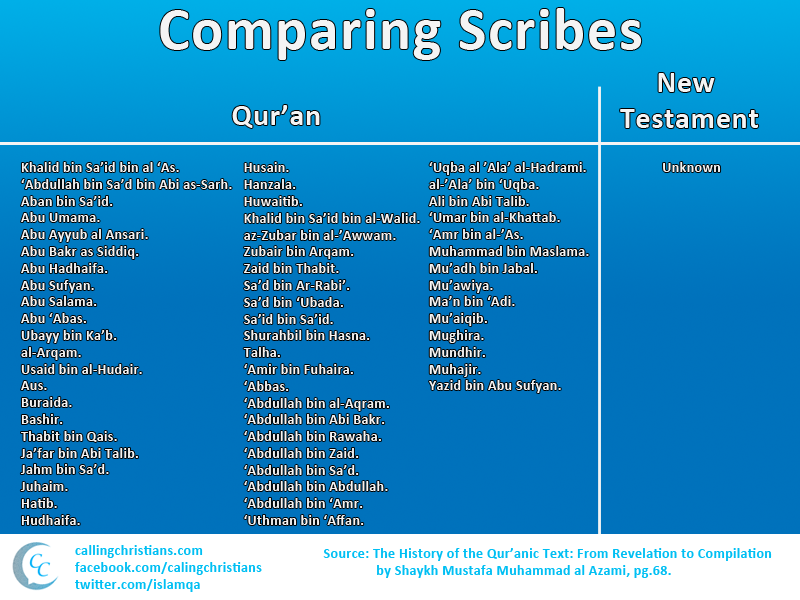
A quick comparison on the identities of the scribes of the Qur’an and the scribe(s) of the New Testament. Quite the disparity!

cc-2015-qscribesvsntscribes

Click to Enlarge

The list of names of the Qur’anic scribes was transcribed from Shaykh Muhammad Mustafa al Azami’s work on the Qur’an’s preservation[1]. To understand why the New Testament has unknown scribes, it should be noted that Irenaeus in 185 CE, was the first to name the authors of the New Testament gospels[2][3]. Prior to this, no name was attached to them and none of their authors were known. Moreover, since none of their authors were known, we know of none of their scribes. Comparisons are usually made between the hadith corpus and that of the New Testament. However, this is the fallacy of false equivalency, as the conditions for establishing a narration as da’eef, or weak is not met by the New Testament literature:

The Riwaayah of an unknown person is not acceptable because if his name is not known then his Haal (condition) cannot be defined (as to whether he is reliable or not). The Saheeh (correct) verdict is that a Mubham (unknown) Raawi cannot be declared as Aadil (reliable).[4]

On this basis, at the very least, the New Testament does not compare to a single weakly graded tradition from the hadith corpus.

Note: Yazid ibn Abi Sufyan (d. 640 CE), is not to be confused with Yazid ibn Mu’awiyah (d. 683 CE), they are two different persons.

and Allah knows best.

Sources:

  1. Al Azami, Muhammad Mustafa. The History of the Qur’ānic Text: From Revelation to Compilation : A Comparative Study with the Old and New Testaments. Leicester: UK Islamic Academy, 2003. 68. Print.
  2. Ehrman, Bart. “The Gospels Are Finally Named! Irenaeus of Lyons.” The Gospels Are Finally Named! Irenaeus of Lyons. – Christianity in Antiquity (CIA): The Bart Ehrman Blog. 18 Nov. 2014. Web. 3 July 2015.
  3. Irenaeus, Saint. Adversus Haereses. Vol. 3. Print.
  4. Al Asqalani, Ibn Hajr. Nukhbat Al-Fikar Fī Muṣṭalaḥ Ahl Al Athar. 62. Print.

Announcement: Temporary Delay in our Messaging Services

As Salaam ‘Alaykum wa As Salaamu ‘Ala Man Ittaba al Huda,

There is currently a backlog of emails and messages in the Calling Christians inbox. While we do wish we had the time to be able respond to all of these messages, we are unable at the moment, to cater to the needs of the thousands of you that engage with us frequently. As such, for the moment we are asking that you remain patient with us and at the most, expect a one month delay in replies from our question and answer service.

In mid July, when the month of Ramadan has been completed, we intend to make a few changes and several announcements regarding new additions to our team. We apologize for the delay in service. Thank you for your continued patience.

Regards,

Br. Ijaz.

Ramadan: The Month of the Qur’an

The Qur’an is a book with which most people know about, but of which many are not intimated with. This month is perhaps the best month in which we can dedicate the time to learning and understanding the Qur’an. Learning about, and understanding Islam is necessary for every Muslim (fard al ‘ayn), and moreso for the Muslims amongst us who do da’wah and engage in apologetics (the intellectual defense of Islam). A good place to start in our study of Islam, is in the passages of the Qur’an. Islam’s scripture. To kick off your engaging with the Qur’an, I’ve assembled a list of links that I think would help both Muslims and non-Muslims understand the Qur’an:

I’ll update this list as the month of Ramadan progresses.

“كِتَابٌ أَنزَلْنَاهُ إِلَيْكَ لِتُخْرِجَ النَّاسَ مِنَ الظُّلُمَاتِ إِلَى النُّورِ بِإِذْنِ رَبِّهِمْ إِلَىٰ صِرَاطِ الْعَزِيزِ الْحَمِيدِ”

“[This is] a Book which We have revealed to you, [O Muhammad], that you might bring mankind out of darknesses into the light by permission of their Lord – to the path of the Exalted in Might, the Praiseworthy.” – Qur’an 14:1.

and Allah knows best.

New Testament Inconsistency: The Secrets of the Kingdom of Heaven

Matthew 13 presents a very peculiar problem for Christianity, in verse 10-11 it says:

The disciples came to him and asked, “Why do you speak to the people in parables?” He replied, “Because the knowledge of the secrets of the kingdom of heaven has been given to you, but not to them.”

From this, we learn that the masses were not able to understand Jesus when he spoke, apparently only those who were given the secrets of the kingdom of heaven would be able to understand what Jesus was saying. Who was given that knowledge? Just the twelve disciples. Therefore, according to the New Testament, Jesus went around preaching unintelligible sermons to masses of people (cf. Matthew 13:2, John 6:60), when the only people who could have possibly understood him were only the twelve because they possessed the “secret knowledge”. This however, is a compounded problem, as the secret knowledge (of the kingdom of heaven) that unlocked Jesus’ unintelligible sermons, didn’t seem to work. On more than one occasion the disciples had to stop Jesus and ask him to speak intelligibly to them:

“The disciples did not understand any of this. Its meaning was hidden from them, and they did not know what he was talking about.” – Luke 18:34.

So let’s recap. Jesus speaks unintelligibly to the masses. Of the masses, 12 disciples have the “secret knowledge (of the kingdom of heaven)” which would enable them and only them to understand what Jesus was saying. Of these twelve, none of them understood what Jesus was saying according to Luke 18:34, because the meaning of what Jesus was saying was hidden from them. What this means is that Jesus did a lot of talking to a lot of people and no one was able to understand what he was saying. To explain this Monthy Python-esque scenario, I’ve developed a parable of my own:

Sam is a wealthy king. He called his entire kingdom together and said to the large crowd before him, that behind that door there was a million gold coins. He then invited the crowd to open the door. The crowd rushed to the door and tried opening it. The door was locked! Sam approached his close friends and said, “to unlock the door you need a secret key, I will give each of you a secret key so you may enter the room with a million goal coins!” What Sam did not tell them, was that they keys were fake and would not work. Sam’s friends ran to the door and each of them tried their keys, none of the keys were able to open the door. David, one of Sam’s friends returns to him and says that the keys are not unlocking the door. Sam the wealthy king is surprised, and tells them that he has given the keys for the door and it is their fault the keys are not working.

Then imagine that 2000 years later there were still people claiming to have that key, with the door still remaining forever locked. That’s exactly the scenario we are left with. What’s the use of giving them secret knowledge that’s supposed to explain what he’s been saying all along, when the knowledge is still hidden from them? You might be saying to yourself, this doesn’t sound right, there must be an explanation. Well, no less than 2 chapters later in Matthew 15:15-16 we read:

“Peter said to Him, “Explain the parable to us.” Jesus said, “Are you still lacking in understanding also?”

In this case, Jesus of all people seems to be surprised that the secret knowledge he gave them (cf. Matthew 13:10-11, Luke 8:9-10), which he then hid from them (Luke 18:34), leaves them still unable to understand what he’s saying. In other words, Jesus is surprised they still don’t understand him, even though he is the one that hid its meaning from them.

and God knows best.

« Older Entries Recent Entries »