Tag Archives: islam

Christian Honour Killing Inside of Church

بِسۡمِ ٱللهِ ٱلرَّحۡمَـٰنِ ٱلرَّحِيمِ ,

My own homeland of Trinidad is rife with domestic violence, especially those which target women. Here’s the shocker for most Islamophobes, I live in a Christian majority nation where most of these criminals are brazen enough to kill inside their own Churches. A recent report by the Guardian (Trinidad) Newspaper documented the honour killing by a male relative of the woman seeking a divorce from her husband:

Death threats made against Fabiola Ramona Chacon became reality on Thursday evening when she was stabbed to death in the bathroom of a church at Longdenville, where she had gone to seek counselling for her troubled marriage. Chacon, 36, had gone with a male companion to the Apostle Ministries at Amarsingh Street, Longdenville.

While the pastor was speaking to the couple they had an argument. Chacon reportedly left the room to defuse the situation and went to the washroom. But she was followed by a man who stabbed her several times. She died on the spot and the man fled the scene. – Guardian (Trinidad).

Here’s the video report:

wa Allaahu ‘Alam.


Review: Jesus the Christ, Man, God or Both? – Ijaz Ahmad vs CL Edwards

Note: This is a review done by Br. Paul Bilal Williams via his website, ‘Blogging Theology‘. Br. Paul is a well established orator and debater from the United Kingdom and has studied Christianity and Islam for several years.

Jesus the Christ, Man, God or Both? – Ijaz Ahmad vs CL Edwards

A Review of the Debate by Paul Williams 

Ahmad’s opening statement threw down the gauntlet:

‘If we are to be fair and objective in our study of who the Messiah was, then we can’t work backwards, that is to start with the bias we already have and then look at the previous scriptures to justify our claims and beliefs. This is a form of revisionism.‘

He has in mind here a favourite methodology adopted by Christians: that of reading into Jewish texts their own later beliefs about Jesus. Scholars call this practice ‘eisegesis’.

Though Ahmad did not mention well known Christian apologist Dr Craig in his opening presentation, he could have called him as a witness for his defense as Dr. William Lane Craig would agree with him! Though Craig’s comments focus on Jesus’ alleged death and resurrection, they perfectly demonstrate how Christians read back into the Jewish Bible beliefs that no Jew ever held about their Messiah.

Craig writes:

‘Early Christians were convinced that Jesus’ resurrection, like his crucifixion, was, in the words of the old tradition quoted by Paul in 1 Corinthians 15. 3-5, “in accordance with the Scriptures.” In Luke’s story of Jesus’ appearance on the road to Emmaus, the risen Jesus chastises the two travelers: ” ‘Was it not necessary that the Messiah should suffer these things and enter into his glory?’ And beginning with Moses and all the prophets, he interpreted to them in all the Scriptures the things concerning himself” (Luke 24. 26-27).

The difficulty is that when we ask, “What Scriptures are they thinking of?”, we come up with sparse results. Hosea 6.2 ‘ “After two days he will revive us; on the third day he will raise us up, that we may live before him” – has been suggested because it mentions the “third day” motif found in the old formula cited by Paul.

But Hosea 6.2 is never explicitly cited by any New Testament author, much less applied to Jesus’ resurrection. In the apostolic sermons in the Acts of the Apostles, we find Psalm 16.10 interpreted in terms of Jesus’ resurrection: “For thou dost not give me up to Sheol, or let thy godly one see the Pit.” But if we look at the principal Old Testament passage cited in the Gospels with respect to Jesus’ resurrection, we find the story of Jonah and the whale. “For as Jonah was three days and three nights in the belly of the whale, so will the Son of Man be three days and three nights in the heart of the earth” (Matthew 12.40).

Now the problem for the theory in question is that nobody, especially a first century Jew, reading the story of Jonah and the whale would think that this has anything whatsoever to do with Jesus’ burial and resurrection! Similarly for Psalm 16.10; this has to do with David’s confidence that God will not allow him to see defeat and death. And as for Hosea 6.2, this has nothing to do with resurrection of the dead but with the restoration of the national fortunes of Israel.

The point is that no one who did not already have a belief in Jesus’ resurrection would find in these Scriptures any impetus to think that Jesus had been raised from the dead. To this we may add the fact that in Jewish belief the resurrection of the dead was always an event at the end of the world involving all the people, an event which obviously had not yet taken place.

Once the disciples came to believe in Jesus’ resurrection, then they could go to the Scriptures looking for verses to validate their belief and experience, and passages like Jonah and the whale and Psalm 16.10 could be re-interpreted in light of Jesus’ resurrection. But to think that the belief in Jesus’ resurrection was derived from the Old Testament is to put the cart before the horse; it gets things exactly backwards.’

***

What a stunning admission by Craig! At a stroke all those much vaunted “prophesies” in the OT about Jesus the Messiah turn out to be entirely absent from the Jewish Bible and can only be ‘discovered’ there if you artificially graft Christian beliefs onto the texts, in disregard of the original context and original meaning of the passages. But this is the standard ‘orthodox’ way Christians use the Bible to justify their beliefs.

Ahmad convincingly demonstrates that the Jewish Messiah was never considered to be divine or God at any time but was always expected to be only a man like other mortals.

Therefore the Christian belief in a Divine Messiah is unJewish and alien to the Torah. The final Prophet to mankind Muhammad (pbuh) was sent to correct these blasphemous excesses by Christians. Today 1.6 billion of his followers have learnt this lesson well.

***

A few comments on the opening statement by CL Edwards

Edwards boldly states:

After seriously studying the first century evidences concerning Christ, while being logically consistent, I had to change my position, and I now hold to the hypostatic union i.e the belief  Jesus had two natures. There is no historical proof anyone during this time held Jesus to be just a man.

He might need change his position once more as scholars have long realized that the earliest Christians did not believe Jesus was divine. Read Peter’s sermons in Acts and ask yourself did he consider Jesus to be God (see Acts 2:22 & 2:36 for example)? Read Mark’s gospel: Jesus prays to God; is ignorant about various matters; denies he is ”good”;  feels abandoned by God on the cross. Does such a man seem like God in the flesh to you?

Much of Edwards presentation is simply a list of proof texts culled from the Bible. He does not show any critical awareness of how Christology developed in the New Testament, and just how radically different Mark’s gospel is from John’s gospel in its portrayal of Jesus.

As every undergraduate in Bible studies knows, it is clear that there has been a development in the way Jesus is presented in the pages of the New Testament. Look at the earliest gospel to be written, that of Mark.

This shows us a very human figure. Here are 7 examples:

1) Jesus is a man who prays to God (1:35)

2) Jesus is unable to work miracles in his own town (6:5) – but see Matthew’s redaction of Mark in 13:57-58.

3) Jesus confesses his ignorance about the date of the End of the world (13:32).

4) Jesus did not know the identity of a woman who touched him and had to ask his   disciples for help (Mark 5:30) – but see Matthew’s redaction in 9:20-21.

5) Jesus was so irritated by the absence of figs he cursed a fig tree even though it was not the season for figs (Mark 11:14) – but see Matthew’s redaction in 21:18-22.

6) Jesus even denies that he is perfectly good (Mark 10) – but see Matthew’s redaction of Mark in 19:17.

7) Mark portrays Jesus despairing of God’s help at the crucifixion as he cries: ‘My God my God why have you abandoned me?’ (15:34) – Luke and John both omit this.

So it seems clear that in the earliest gospel Jesus does not exhibit any of the attributes of God that Jews, Christians and Muslims commonly accept: unlike God, Jesus is not all knowing; he is not omnipotent; he is not perfectly good; he is not eternal; he is notimmortal; he is not unchanging. Therefore it seems obvious that he cannot be God.

If we read the last of the four gospels to be written, the gospel of John, we move into a different world. Here Jesus seems to move effortlessly through his ministry, he is clearly portrayed as a divine figure, indeed as “God” himself.

Instead of Jesus saying in Mark’s gospel “Why do you call me good – no-one is good but God alone”, John has Jesus say: ‘Before Abraham was I am’.

In the very first chapter of the gospel according to John, the Prophet John the Baptist proclaims Jesus to be ‘The Lamb of God who takes away the sin of the world’ when he first meets him.  But in the earlier synoptic gospels, John the Baptist not only does not say this but half way through Jesus’ ministry sends messengers to Jesus asking “Are you the Messiah we’ve been expecting, or should we keep looking for someone else?” (Matthew 11:2)

So even this brief survey has shown the enormous evolution of the story of Jesus which occurred in less than two generations after Jesus was taken up by God.

Unlike in the earlier gospels of Mark, Matthew and Luke, in John Jesus speaks with a clear awareness of his divine existence with God from before his time on earth (5.19ff and 8.12ff make this clear). But the question cannot be ducked: whether the Jesus of the fourth gospel was intended to be historical, whether Jesus of Nazareth actually spoke in the terms used by John. Were the claims about Jesus in John’s gospel already in place from the beginning of Christianity? It seems hardly likely.

Few scholars today would regard John as a source for information regarding Jesus’ life and ministry in any degree comparable to the Synoptics gospels of Matthew, Mark and Luke. It is worth noting briefly the reasons why scholars think this:

One is the very different picture of Jesus’ ministry, both in the order and the significance of events and the location of Jesus’ ministry. For example, the cleansing of the temple happens at the beginning of Jesus’ ministry in John but occurs at the end of Jesus’ ministry in the synoptic gospels. A clear contradiction.

Another is the striking difference in Jesus’ style of speaking – much more discursive and theological in John, in contrast to the aphoristic and parabolic style of the Synoptic gospels. Jesus’ way of speaking is the same, whether Jesus speaks to Nicodemus, or to the woman at the well, or to his disciples, and very similar to the style of John the Baptist, and indeed very similar to the 1st Letter of John. The conclusion is unavoidable that the style is that of the author of the gospel of John rather than that of Jesus himself.  

Probably most important of all, in the synoptic gospels Jesus’ main message is the Kingdom of God and he rarely speaks of himself, whereas in John the Kingdom of God hardly features and the discourses are largely about Jesus’ own self-consciousness andself proclamation. To put it simply, in the earlier gospels Jesus does not preach about himself but God and his kingdom. In John, Jesus speaks about himself and his Father. Had the striking ‘I am’ claims of John been remembered as spoken by Jesus, how could any gospel writer have ignored them so completely as the Synoptics gospels do?

In conclusionEdwards could benefit from an introductory course in New Testament studies to bring him up to speed with what his own scholars are teaching!

Free Islamic Courses for New Muslims

بِسۡمِ ٱللهِ ٱلرَّحۡمَـٰنِ ٱلرَّحِيمِ ,

SeekersGuidance is offering classes for new Muslims that cover the basics of the Islamic faith. They are indepth, but simple enough for the newest of reverts to learn from. Free of charge, dedicated teachers and a simple registration/ courses system makes this an unmissable course. Check these links for more information New Muslim Series Part 1 and New Muslim Series Part 2. Share among your friends, especially among New Muslims as this knowledge will benefit them greatly!

Christian Missionaries Prove the Qur’an to be True

بِسۡمِ ٱللهِ ٱلرَّحۡمَـٰنِ ٱلرَّحِيمِ ,

The Jews will never be pleased with you, nor will the Christians, unless you follow their faith. Say: “Guidance of Allah is, indeed, the guidance.” Were you to follow their desires despite the knowledge that has come to you, there shall be no friend for you against Allah, nor a helper. – Qur’an 2:120.

greg williams


Shall I remind them that there are also prominent Christians who have come to Islam:

  • Yusuf Estes.
  • Bilal Phillips.
  • Dr. Jerald Dirks.
  • Dr. Jeffrey Lang.

They can dream as much as they want, each day they spend fantasizing about me becoming a Christian because they know my worth. However, while I recognize that I am of some value in this world, I am worth nothing without Allaah ta ‘aala who has made all things possible. So to these Christians who hope I convert, keep dreaming!

wa Allaahu ‘Alam.

Refutation: The Quran on Muslims Entering Hell

بِسۡمِ ٱللهِ ٱلرَّحۡمَـٰنِ ٱلرَّحِيمِ ,

Missionaries often like to claim that the Qur’an says all Muslims will go to hell. There is one Missionary/ Christian polemic who bases a significant portion of his writings on this argument. Sam Shamoun not only things that the Qur’an says this[1][2], he also claims the Qur’an contradicts itself about this particular verse[3], it reads:

And not one of you but shall pass over it: it is for thy Lord an ordinance decreed.

There are two opinions on this verse, namely:

  1. The believers and disbelievers will go across a bridge above the fire, the disbelievers will fall in (thus the bridge is the entry to the fire), and the believers will cross without punishment.
  2. The believers and disbelievers may have to enter the fire, but the believers will walk away without damage, as Abraham [alayhi as salaam] walked away from the fire of Nimrod without any mark, pain, or suffering.

Muslims are also aware that according to Sunni sources [4][5], Muslims who have less good deeds than bad, may be sent to the fire to pay for their sins, upon which they will then be allowed to enter Jannah, there acceptance into heaven dependant upon their levels of ‘Iman:

Then it will be said, ‘O Muhammad, raise your head and speak, for you will be listened to; and ask, for your will be granted (your request); and intercede, for your intercession will be accepted.’ I will say, ‘O Lord, my followers! My followers!’ And then it will be said, ‘Go and take out of Hell (Fire) all those who have faith in their hearts, equal to the weight of a barley grain.’ I will go and do so and return to praise Him with the same praises, and fall down (prostrate) before Him. Then it will be said, ‘O Muhammad, raise your head and speak, for you will be listened to, and ask, for you will be granted (your request); and intercede, for your intercession will be accepted.’ I will say, ‘O Lord, my followers! My followers!’ It will be said, ‘Go and take out of it all those who have faith in their hearts equal to the weight of a small ant or a mustard seed.’ I will go and do so and return to praise Him with the same praises, and fall down in prostration before Him. It will be said, ‘O, Muhammad, raise your head and speak, for you will be listened to, and ask, for you will be granted (your request); and intercede, for your intercession will be accepted.’ I will say, ‘O Lord, my followers!’ Then He will say, ‘Go and take out (all those) in whose hearts there is faith even to the lightest, lightest mustard seed. (Take them) out of the Fire.’ I will go and do so.”‘

From this, we understand that Muslims, even with a mustard’s seed of ‘Iman will be allowed into Jannah due to the intercession of the Prophet Muhammad [sallalahu alayhi wa sallam]. Sam Shamoun however, concludes otherwise:

These traditions demonstrate the plausibility of interpreting 19:71 to mean that every Muslim will enter hell. After all, if Allah allows bad Muslims to enter hell and then come out due to Muhammad’s intercession, then he can also allow good Muslims to enter there as well. More importantly, these hadiths do not necessarily state that Muhammad is interceding simply for bad Muslims.

Unfortunately, Sam logic betrays his arguments. These ahadith demonstrate the opposite of Sam’s claim, you will notice that the ahadith specifically mentions the level of ‘Iman of which those people in the fire possess. What happens to those with a higher level of ‘Iman? The level of ‘Iman for which those Muslims entered the fire, was equal or less than to the first mentioned criteria: a grain of barley, other narrations mention the weight of a dinar. Therefore Sam’s argument is debunked by simply understanding the hadith. Does Sam believe that Muslims will a barley’s grain of faith, are not bad Muslims? Logic contradicts Sam’s claim. Up to this point, what can we conclude?

  1. Some Muslims will not enter hell (the will cross the entrance – the bridge across hell), the fire will not burn them while they cross into heaven.
  2. Some Muslims will enter hell, these are essentially weak Muslims who have sinned, the minimum criteria is considered to have a barley grain’s worth of ‘Iman.

Sam is therefore proposing a gross generalization, in his mind he thinks that if a hadith or ayah says some Muslims go to hell, that it means all Muslims go to hell. He is essentially forcing his understanding upon the sources which directly claim otherwise as I have duly demonstrated. We will now read what some of the commentators of the Qur’an have to say:

Ibn Kathir [6] says in his Tafsir:

Ibn Jarir reported from `Abdullah that he said concerning Allah’s statement,

﴿وَإِن مِّنكُمْ إِلاَّ وَارِدُهَا﴾

(There is not one of you but will pass over it.) “The bridge over Hell is like the sharp edge of a sword. The first group to cross it will pass like a flash of lightning. The second group will pass like the wind. The third group will pass like the fastest horse. The fourth group will pass like the fastest cow. Then, the rest will pass while the angels will be saying, `O Allah save them, save them.’ ” This narration has supporting narrations similar to it from the Prophet in the Two Sahihs and other collections as well. These narrations have been related by Anas, Abu Sa`id, Abu Hurayrah, Jabir and other Companions, may Allah be pleased with them all. Ahmad also recorded that Umm Mubashshar, the wife of Zayd bin Harithah, said, “The Messenger of Allah was in the house of Hafsah when he said,

«لَا يَدْخُلُ النَّارَ أَحَدٌ شَهِدَ بَدْرًا وَالْحُدَيْبِيَّة»

(No one who was present at the battles of Badr and Hudaybiyyah (of the Muslims) will enter into the Hellfire.) Then, Hafsah said, “Doesn’t Allah say,

﴿وَإِن مِّنكُمْ إِلاَّ وَارِدُهَا﴾

(There is not one of you but will pass over it (Hell);) The Messenger of Allah replied by reciting,

﴿ثُمَّ نُنَجِّى الَّذِينَ اتَّقَواْ﴾

(Then We shall save those who had Taqwa.) In the Two Sahihs there is a Hadith reported from Az-Zuhri, from Sa`id from Abu Hurayrah that the Messenger of Allah said,

«لَا يَمُوتُ لِأَحَدٍ مِنَ الْمُسْلِمِينَ ثَلَاثَةٌ مِنَ الْوَلَدِ تَمَسُّهُ النَّارُ إِلَّا تَحِلَّةَ الْقَسَم»

(No one of the Muslims who has had three children, who all died, will be touched by the Hellfire, except for an oath that must be fulfilled.) `Abdur-Rahman bin Zayd bin Aslam commented on Allah’s statement,

﴿وَإِن مِّنكُمْ إِلاَّ وَارِدُهَا﴾

(There is not one of you but will pass over it;) “The passing of the Muslims (over the Hellfire) means their passing over a bridge that is over it. But the passing of the idolators over the Hellfire refers to their admission to the Fire.” As-Suddi reported from Murrah, from Ibn Mas`ud, that he said concerning Allah’s statement,

﴿كَانَ عَلَى رَبِّكَ حَتْماً مَّقْضِيّاً﴾

(this is with your Lord; a Hatman decree.) “An oath that must be fulfilled.” Mujahid said, “Hatman means preordainment.” Ibn Jurayj said the same. Concerning Allah’s statement,

﴿ثُمَّ نُنَجِّى الَّذِينَ اتَّقَواْ﴾

(Then We shall save those who had Taqwa. ) When all of the creatures passed over the Hellfire, and those disbelievers and the disobedient people who are destined to fall into it because of their disobedience, Allah will save the believers and the righteous people from it because of their deeds. Therefore, their passing over the bridge and their speed will be based upon their deeds that they did in this life. Then, the believers who performed major sins will be allowed intercession. The angels, the Prophets and the believers will all intercede. Thus, a large number of the sinners will be allowed to come out of Hell. The fire will have devoured much of their bodies, except the places of prostration on their faces. Their removal from the Hellfire will be due to the faith in their hearts. The first to come out will be he who has the weight of a Dinar of faith in his heart. Then, whoever has the next least amount after him. Then, whoever is next to that after him, and so forth. This will continue until the one who has the tiniest hint of faith in his heart, equal to the weight of an atom. Then, Allah will take out of the Fire whoever said “La ilaha illallah,” even one day of his entire life, even if he never performed any good deed. After this, no one will remain in the Hellfire, except those it is obligatory upon to remain in the Hellfire forever. This has been reported in many authentic Hadiths from the Messenger of Allah.

Mufti Shafi Uthmani [alayhi rahma] says in his Tafsir [7]:

This means that everybody – be he a believer or an infidel – will go across Hell. However, this does not mean that they would go to stay in it; they would only go across it. But even if the word means “entry, then the pious believers on entry into Hell will feel no discomfort because its fires will cool down and will do no harm to them. Sayyidna Abu Sumayya has related that The Holy Prophet once said that:

“Everybody whether he is a pious man or a sinner will initially enter Hell, but for the pious believers the fire will cool down just as the fire of Namrud cooled down when Sayyidna Ibrahim (A.S) was cast into it. Thereafter, the believers will be taken to Paradise.”

Tanwir al Miqbas min Tafsir Ibn ‘Abbas [8]:

(There is not one of you but shall approach it) there is not a single one of you, to the exclusion of prophets and messengers, save that he will enter it, i.e. hell. (That is a fixed ordinance of your Lord) it is a decree that must necessarily take place.

Author’s comments: This tafsir takes the second view as presented above in Maar’iful Qur’an, that if the believers do enter, no harm will come to them. 

Tafsir al Qurtubi and Tafsir at Tabari were also referenced by Sam Shamoun, but they also hold on to the second opinion as indicated in Tafsir Maar’iful Qur’an. Commenting on these tafsirs, Shaykh Gibril says [9]:

Yes, it is the madhhab of al-Hasan al-Basri, Qatada and a group of the lexicographers, strengthened by certain authentic hadiths, that the “wurud” mentioned in verse 19:71 does not denote “entering” (which is the madhhab of Ibn `Abbas and is related from him and other Companions, yet none of the 23 English translations I consulted dared translate it this way) but either “crossing over”, in order to agree with the hadith of the believers crossing the bridge over hellfire at various speeds, some like light and others slower, or “coming into sight of and approaching”.

Others said the verse refers only to the disbelievers; others said the entering of the believers is not antithetical to their safety from the greater harm therein. The Holy Prophet, upon him blessings and peace, himself explained the verse: “All people shall ‘yariduha’, then they shall be blocked from it by their works”, as narrated in the Musnad of Imam Ahmad and the Sunan of Imam al-Tirmidhi, Allah have mercy on them. The “then” can mean that they enter it first, and it can mean that they come into sight of it only, and Allah knows best.

Al-Qurtubi discussed this in his Tafsir and, more at length, in al-Tadhkira. Shaykh Muhammad al-Amin al-Shinqiti gave a magisterial treatment to this controversial issue in his great Tafsir entitled Adwa’ al-Bayan fi Idah al-Qur’an bil-Qur’an (4:436-443). In his view the Quranic context most frequently provided by other verses mentioning such wurud confirms Ibn `Abbas’s position that the meaning here is “to enter.” At the very least some will enter it, as evinced by the countless authentic hadiths on intercession, by means of which they shall be brought out in droves, and this very verse was used by Ibn `Abbas, Allah be well-pleased with him and his father, as a proof for the doctrine of Ahl al-Sunna against the Khariji Nafi` b. al-Azraq, since Kharijis believe once in, never out. The angels’ dua on that day is: “Allahumma sallim, sallim!” (grant safety) on behalf of the believers, for which we ask here and hereafter.

Summary:

Based on this, we can conclude the following –

  1. Some will cross over the bridge over the fire quickly into heaven.
  2. Some will have difficulty crossing the bridge and may approach the fire where they will not be burned by it.
  3. Some will enter the fire, be burned for a while and based on their level of ‘Iman are removed from it and enter heaven.
  4. Some will enter into it and never leave {disbelievers}.

An Alleged Contradiction:

I’m not sure if Sam Shamoun knows what the word ‘contradiction’ meant, but it is evident from his usage in the aforementioned article that he does not truly understand the meaning of the world. He claims that Qur’an 3:192 means the following:

“According to the Quran, entering the fire is a sign of a person being shamed, humiliated, disgraced by Allah. Since the Quran says that Muslims shall enter hell, this means that Allah has decreed that all Muslims must experience shame, humiliation, and disgrace!

Note the implications here:

  • Entering hell is a sign of disgrace, humiliation and shame.
  • Allah has decreed that all Muslims will enter hell.
  • Therefore, all Muslims will be disgraced, humiliated and shamed by Allah.

Allah obviously delights in humiliating his followers since he has decreed their descent into hell.”

It is strange that he only partially quoted the verse, and unlike the other verses, he did not quote a tafsir/ commentary in this case. The verse actually says [10]:

Our Lord verily whomsoever Thou makest to enter into the Fire, him Thou hast surely humiliated and for the wrong-doers there shall be no helpers.

Rather, the context of the verse is removed by the deceptive misquote by Sam Shamoun (which is expected of him). The entering of the fire as referred to in the above verse, is contextualised by the verse preceding it which reads [11]:

Those who remember Allah when standing, sitting, and on their sides, and contemplate upon the creation of the heavens and the earth (saying:) ‘Lord, You have not created these in falsehood. Exaltations to You! Guard us against the punishment of the Fire

Therefore the context is that those who will enter into the fire for punishment, will be disgraced and humiliated and those who were not entered for punishment, i.e. going over the bridge (recall: the bridge is the entrance as from the bridge you either fall into the fire or cross into heaven), will not be burned from the fire. In fact Sam made a grave error in judgement, he jumped to Qur’an 66:7-8 which reads according to Sam’s article[12]:

“… the Day that God will not permit to be humiliated the Prophet and those who believe with him… Y. Ali”

If he had stuck with a thorough reading of 3:192 and onwards, he would not have need to invent a contradiction, for the verses after it state [13]:

Our Lord, give us what You promised us by Your Messengers, and do not abase us on the Day of Resurrection. You do not break Your promise‘. And indeed their Lord answers them: ‘I do not waste the labor of any that labors among you, male or female you are from each other. And those who emigrated, and were expelled from their houses, those who suffered hurt in My way, and fought, and were killed those I shall surely acquit of their evil deeds, and I shall admit them to Gardens underneath which rivers flow’ A reward from Allah, and Allah with Him is the best reward.

According to the context of the verse, God will surely save them from humiliation by forgiving them of their sins and allowing them to enter into the heaven. Thus they are the people who will cross over the bridge into heaven. If Sam had stuck with the continuing of the verses, he would not have forced his incorrect understanding upon them. Sadly, this is the deception that missionaries like him must employ to appease his Lord. To rework and correct Sam’s argument, the true argument can thus be laid out as such:

  • Entering and being punished by the fires of hell is a sign of disgrace humiliation and shame.
  • Some Muslims will be disgraced because of their evil sins and bad deeds by the punishment of hell.
  • Therefore those evil Muslims will be shamed but eventually forgiven and sent to heaven.

In the second part of this article we will examine the case of Christians and their place in hell according to the Bible.

wa Allaahu ‘Alam.

[1] – “Will All Muslims Go to Hell”, Qur’an Contradiction, Sam Shamoun.
[2] – “The Quran on Muslims Entering Hell”, Sam Shamoun.
[3] – Qur’an 19:71.
[4] – Sahih al Bukhari, Book #93, Hadith #601. Sahih al Muslim (Ibid), Book #1, Hadith #377. Hadith Qudsi #36.
[5] – According to the Interpretation of Shaykh Salih al Munajjid, Islamqa. It is a must read in understanding this topic.
[6] – “Qur’an 19:71-72“, Tafsir Ibn Kathir, by Imam Ibn Kathir [alayhi rahma].
[7] – “Qur’an 19:71“, Tafsir Mar’iful Qur’aan, by Mufti Shafi Uthmani [alayhi rahma].
[8] – “Qur’an 19:71“, Tanwir al Miqbas min Tafsir ibn Abbas, allegedly by Ibn ‘Abbas [radi allahu anhu].
[9] – “Will the Believer Enter the Fire or Just See It?“, Seeker’s Guidance, Shaykh Gibril.
[10] – Qur’an 3:192.
[11] – Qur’an 3:191.
[12] – “The Quran on Muslims Entering Hell”, Sam Shamoun.
[13] – Qur’an 3:194-195.

Women’s Intelligence Hadith

بِسۡمِ ٱللهِ ٱلرَّحۡمَـٰنِ ٱلرَّحِيمِ ,

TEXT AND SOURCING

The hadith states that the Prophet upon him blessings and peace, addressed a group of women in the mosque, saying:

“I have not seen any one more deficient in intelligence and religion than you. A cautious, sensible man could be led astray by some of you.” The women asked: “O Allah’s Apostle, what is deficient in our intelligence and religion?” He said: “Is not the evidence of two women equal to the witness of one man?” They replied in the affirmative. He said: “This is the deficiency of your intelligence”… “Isn’t it true that a woman can neither pray nor fast during her menses?” The women replied in the affirmative. He said: “This is the deficiency in your religion.”

It is related in al-Bukhari and Muslim.

ITS MEANING IS NOT LITERAL

The hadith here uses two figures of speech: the first is hyperbole (mubalagha) meaning exaggeration in the words “even a prudent, sensible man might be led astray by some of you” i.e. a fortiori an ordinary man.

The second figure is synechdoche (majaz mursal) consisting in using the whole for the part: intelligence to mean the specific legal testimony of a woman, and religion to mean the prayer and fast at the time of menses.

Numerous verses and other narrations stress that the reward of women equals that of men even if their acts differ. So this particular narration is not meant literally but as an acknowledgment of the inordinate power women wield over men while ostensibly less active in the public and spiritual spheres.

THREE ADDITIONAL BACKGROUND MEANINGS

Three additional meanings provide an indispensable completion of the picture of this hadith. These meanings revolve around fundraising for jihad, the blame of women’s cursing of their husbands, and the playfulness of the Prophet, upon him blessings and peace, with his female public.

1. FUNDRAISING

The real import of the hadith – spoken at the Farewell Pilgrimage – and its actual context was that the Prophet, upon him blessings and peace, challenged the women that were present to realize that unless they helped raise money with their gold and jewelry, they would miss the reward of men waging jihad as well as show ingratitude.

2. BLAME OF CURSING

In the full version of the hadith the Prophet upon him blessings and peace, also orders the women to ask forgiveness and desist from frequently cursing their husbands. All this was spoken at a time of (1) the impending departure of the latter on jihad; (2) the impending departure of the Prophet, upon him blessings and peace, from this world; and (3) the fact that “Cursing the believer is like killing him.”

3. PLAYFULNESS

The Prophet upon him blessings and peace, was also being playful in his use of strong terms to impress this teaching on the listeners. Ruqayyah Waris Maqsud writes:

“After the Farewell Pilgrimage at the Eid prayer, the Prophet (Allah bless him and give him peace) walked past the men leaning on Bilal’s arm, and came to the rows of women behind them. Bilal spread out a cloth and the Prophet (Allah bless him and give him peace) urged the women to be generous with their gifts of charity, for when he had been allowed a glimpse into the flames of Hell, he had noted that most of the people being tormented there were women. The women were outraged, and one of them instantly stood up boldly and demanded to know why that was so. ‘Because,’ he replied, ‘you women grumble so much, and show ingratitude to your husbands! Even if the poor fellows spent all their lives doing good things for you, you have only to be upset at the least thing and you will say, ‘I have never received any good from you!’ (Bukhari 1.28, recorded by Ibn Abbas – who was present on that occasion as a child). At that the women began vigorously to pull off their rings and ear-rings, and throw them into Bilal’s cloth.”

In conclusion, we need to remove the meaning of the words of the Prophet upon him blessings and peace, from our contemporary context of sour feminism and the clash of the sexes, and replace it into its proper context: namely, a parting, wartime exhortation using certain figures of speech which are not meant literally, nor are women the issue although they are addressed pointedly and, as it were, by the scruff of their gender; but rather, to trigger among wealthy and sensible citizens acts of generosity for the greater good while reminding them that life is fleeting and thankfulness a surer way to Paradise than despair.

And Allah knows best.

gibril
[2006-05-30]

Note: This article by Shaykh GF Haddad as read on www.livingislam.org

I am a Trinitarian Muslim

بِسۡمِ ٱللهِ ٱلرَّحۡمَـٰنِ ٱلرَّحِيمِ ,

Today I’d like to publicly confess that I am a Trinitarian Muslim. I cannot change what I am, and I hope that the Muslim community will accept me for what I am, because at the end the day, I’m still a Muslim. You must understand that this is not a choice of my own doing. Allow me to explain.

In 1498, Christopher Columbus rediscovered my home island, the island wherein I have lived all of my life. He dedicated this island to the Trinity, and thus named it after the Trinity, the island was therefore known as ‘La Trinidad‘, or ‘the Trinity‘. By his doing, I am now known, as is the rest of my people, as Trinidadians, or, if I were to appropriate it to its original meaning, we are by our historical name, ‘Trinitarians‘. Therefore, due to Christopher Columbus, my nationality is that of a Trinitarian. How unique it is, that my nationality is named after a religious doctrine that, just like my tiny Caribbean island home, is shrouded in conflict, mystery/ secrecy, and absurdity. It’s ironic to me, that my island’s name reflects upon the doctrine it was named after, and in doing so, the doctrine itself reflects upon the nature of my island home.

Just like the Trinity, this island is home to many internal conflicts. Similarly in the religious Trinity, the Father who is God, gave authority to the Son who is also a God (Matthew 28:18), thus leaving the conflicting question, how can God, give God something God is already supposed to have? The conflicts do not end there. According to Christian Theology (a la James White, David Wood and Sham Shamoun), all members of the Godhead are co-equal to each other, yet one member decided that God – the Father, was greater than Him, God – the Son (John 14:28). If each member is co-equal to the other, how can one God – person, be greater than another God – person?

Well, the answer to that is a mystery, which my country is also, as it’s namesake suggests is also familiar with. See, the Trinity, isn’t really full of contradictions, Trinitarians (the religious ones!), refer to it as Holy Mysteries (see #234), they don’t like that whole contradiction word, it makes them look bad. You must understand, you can’t question something if it’s a mystery, especially a holey one. I sometimes like to think of the Trinity’s Holey Mysteries as contradictions we’re not allowed to think much about.

Perhaps the one place that we Trinitarians by nationality have been beaten, is in the way which we express our local culture, that is to say, who we are. I might be mistaken though, as Christians when explaining the Trinity have also had problems in explaining and expressing what it truly is. We’ve had the egg analogy, the water analogy and eventually we had the laughable, three headed dog from hell analogy. If I were to judge, I’m not sure what’s worse, a Trinitarian by nationality dancing in the streets half naked to express his/ herself, or a Trinitarian by religious belief, thinking that God (glorified and exalted is He) is like a three headed dog from hell.

In conclusion, I’m a Trinitarian Muslim, and there are a few thousand others like me. We also have Trinitarian Rastafarians, Shouter Baptists, Atheists etc. I’m unique, and I like that I can claim I’m a Trinitarian Muslim. It’s sad to see though, that the doctrine we are named after, has sadly reflected badly upon the people of my nation and our national identity. Conflicting, Holey, Absurd and Expressionless, I only pray that God saves us from further embodying the madness that is the Trinity.

Sincerely,
Your Trinitarian Muslim Brother Ijaz.

wa Allaahu ‘Alam.

Does God call Jesus God? [Hebrews 1:8-12]

بِسۡمِ ٱللهِ ٱلرَّحۡمَـٰنِ ٱلرَّحِيمِ ,

When asking a Christian where Christ said he was a God, it is impossible to find a first person statement on this issue. Therefore, it becomes problematic, as no such Biblical quote exists. What they turn to however, is third person accounts, from which there are many in the Bible. This presents a problem, for Jesus allegedly stated:

“I have spoken openly to the world,” Jesus replied. “I always taught in synagogues or at the temple, where all the Jews come together. I said nothing in secret.” (John 18:20)

If Jesus had said that he was God, then there would be no need to seek out second and third party accounts, to that effect of being a self claimant to divinity. Thus it is clear from the verse above (John 18:20), that his claiming to be God would be explicit and quite extant as demonstrated by the persona of the Old Testament God. To understand the difference between the personas of the Old Testament God and the New Testament God, I suggest reading my article on the topic: Non Compos Mentis. Therefore, by seeking a 3rd person account to validate their claim of Christ’s divinity, that person has already failed to meet the mark. Looking beyond this, one must study a very important group of verses pertaining to Christ’s divinity as used by missionaries:

“8But about the Son he says, “Your throne, O God, will last for ever and ever,
and righteousness will be the scepter of your kingdom.

9 You have loved righteousness and hated wickedness; therefore God, your God, has set you above your companions by anointing you with the oil of joy.”[a]

10He also says, “In the beginning, O Lord, you laid the foundations of the earth,
and the heavens are the work of your hands.

11 They will perish, but you remain; they will all wear out like a garment.

12 You will roll them up like a robe; like a garment they will be changed.
But you remain the same, 
and your years will never end.[b]”

(Hebrews 1:8-12)

Christians get very excited about these verses, God has called Jesus God, thus proving that in the Bible, Jesus is God. So that’s it, the Christians win, Jesus is God, because God said so……

Alas! Wait! Do you see  the two citations of [a] and [b], what do they say?

  • Hebrews 1:9 Psalm 45:6,7
  • Hebrews 1:12 Psalm 102:25-27
Let’s take a look at these verses from the Hebrew Old Testament, JPS Translation:
Your arrows are sharpened, nations shall fall under you, in the heart of the king’s enemies. Your throne, O judge, [will exist] forever and ever; the scepter of equity is the scepter of your kingdom.” (Psalms 45:6-7)
The throne, being the throne of the Messiah who is to rule from the throne of David for all time (according to Judaic doctrine). The Messiah is undoubtedly a judge, one who comes to judge people in righteous and guide them, as he himself stated:
By myself I can do nothing; I judge only as I hear, and my judgment is just, for I seek not to please myself but him who sent me.” (John 5:30)
Judge to please who? Himself? No. To please God. The one who sent him. Therefore, Jesus judging according to the laws of God is something we Muslims accept and agree with. Continuing with the other footnote which cited Psalms again:
I say: to the Lord, “You are my God, do not take me away in the middle of my days, You Whose years endure throughout all generations. In the beginning You founded the earth, and the heavens are the work of Your hands. They will perish but You will endure, and all of them will rot away like a garment; like raiment You will turn them over and they will pass away.” (Psalms 102:25-27)
In the New Testament, again, it reads vastly differently, the Jewish texts places it into context, that the judge, who is the Messiah Jesus, is saying this about God. God is not saying this about Jesus. This is one of many examples where Christians have abused and manipulated to the Judaic Scriptural tradition in order to derive easily refutable arguments about Christ’s deity.
wa Allahu ‘Alam.
Note: Originally published on July 5th, 2010 @ 3:34.

10’s of Thousands of Pakistanis Protest For Malala Yousafzai

Bismillahir Rahmanir Raheem
بِسۡمِ ٱللهِ ٱلرَّحۡمَـٰنِ ٱلرَّحِيمِ ,

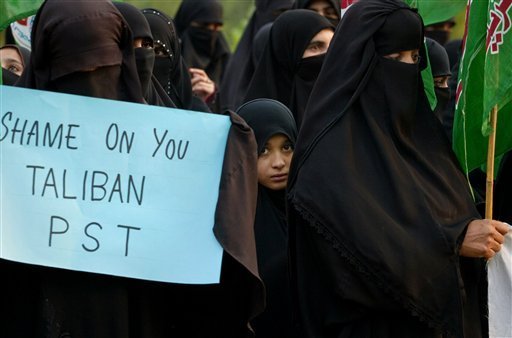
Here’s something that David Wood, Pamela Geller and Ali Sina won’t show you. Tens of thousands of Muslim Pakistanis gathered to show support for Malala Yousafzai in numerous protests throughout Pakistan. The US based Miama Herald Newspaper says:

Pakistanis have held rallies for Malala throughout the country, but most have only numbered a few hundred people. The largest show of support by far occurred Sunday when tens of thousands of people held a demonstration in the southern party city of Karachi organized by the most powerful political party in the city, the Muttahida Quami Movement.

As previously mentioned on my last article on this issue, Pakistan’s schools, Masjids and various state institutions also held a ‘Day of Prayer’, for Malala Yousafzai according to the UK based BBC News Network:

On Friday, school children dedicated prayers to her recovery in morning assemblies and she was also remembered during weekly prayers at mosques across the country. Many prayer leaders condemned the attack, including the chief cleric of Pakistan’s largest mosque, Shahi Masjid, in Lahore. He called the young activist an “ambassador of peace and knowledge’”. Schools in the Swat Valley closed on Wednesday – the day after the shooting – in protest at the attack. Rallies have also been held in Islamabad, Peshawar, Lahore, Multan as well as in Malala’s hometown of Mingora.
If you still believe that Malala’s shooting is endorsed by Islam, I suggest you sincerely read my other article, “Malala Yousafzai and the Taliban“, for a comprehensive understanding of Islam and its view on educating women, as well as the silence of American Christians and Humanitarian organizations of the deaths of a US bomb attack on a school which massacred 69 children.
wa Allaahu Alam,
and Allaah knows best.
« Older Entries Recent Entries »