Tag Archives: Christianity

Debate Review: What Was the True Faith of Jesus’s Disciples? – Br. Yahya Snow

I review a debate entitled “What Was The True Faith of Jesus’ Disciples?

The Debaters:

  • Br. Ijaz Ahmad of Calling Christians
  • Rev. Steven Martins of Nicene International Ministries Canada.

Note: I did the bulk of the review a while ago but never managed to finish it in the detail I would have liked but never got back to it through procrastination and other priorities I’ve quickly tidied up what I had and rolled it out.

“None of the Apostles could have written or sanctioned these stories about themselves” – Br. Ijaz Ahmad

Were the Gospel Accounts eye-witness reports

Steven Martins’ approach was to draw upon the New Testament in his attempt to present what he believes the disciples believed. Steven believes the Gospels are the historical eye-witness records of  the disciples. This was rejected outright by Ijaz Ahmad who pointed out the 4 Gospels were not contemporary to Jesus p and nor are the writers of these Gospels known so how can somebody take these works as eye-witness accounts? None of the authors of the documents which make up the NT were eye-witnesses. Paul himself indicates this of himself (and his writings are the earliest written amongst the NT writings). On top of this the authors of the 4 Gospels are anonymous (these names Mark, Matthew, Luke and John were later given to the anonymous authors). So weighing up all these points it’s sad to hear Steven insist these writings were eye-witness accounts. Perhaps this is what he was taught by his mentors and other Christian apologists but that does not make it true.

Also, just knowing these two basic facts would preclude one from claiming the authors were eye-witnesses – the Gospels are written by highly literate Greek speakers while the companions of Jesus were considered to be illiterate and Aramaic speakers (these people were lower class men). This suggestion they were unschooled is backed up by the writer of Acts as Ijaz cites:

When they saw the courage of Peter and John and realized that they were unschooled, ordinary men, they were astonished and they took note that these men had been with Jesus. [Acts 4:13]

This may seem odd to us folk living in the 21st Century but the vast majority of the ancient world did not know how to read and write.

Ijaz Ahmad offers an analysis that many may have never come across – the alleged chains of transmission of the Gospel accounts. 4 out of the 6 lead to what Trinitarians would call heretical beliefs and the other two are anonymous – further highlighting the range of differing beliefs amongst early Christians. Ijaz states these chains of transmission indicate Peter, Matthew and John rejected a belief in the death of Jesus (which as Ijaz says, it sounds like they had an Islamic belief!).

Do the Gospels contain myths and legends

Ijaz argues there are erroneous stories in the Gospels. One of Steven Martins’ arguments against the claim the Gospels contains myth and legend is that there was not enough time between Jesus’ life and the recording of the Gospels for myth and legend to enter. He then concludes the Gospels are historical based on this.

Has Steven considered William Lane Craig’s unease at the biggest resurrection story in all of Christian literature – that of the resurrection of the many saints in Matthew. He finds it difficult to accept as a literal event, see here:

William Lane Craig Doubts Resurrection Story is Historical (‘The Resurrection of the Saints’) Matthew 27

Now, if Steven Martins believes this story literally then why does nobody else mention it? A story of many dead people coming out of their graves, is that not something that would get people writing according to Steven? Or does he think this is a myth that was added to the account?

However, a point that it is not unrelated to Steven’s theory, Ijaz Ahmad ran through early Christian history pointing out there were multiple competing Christian traditions which all differed from each other – there were even Gospels which differed from each other. So if at the time of Paul there were different Gospels (now lost) then how can Steven be so confident to believe there are no myths and legends in the four Gospels he has ended up with?

In addition the theology amongst various Christian groups in early Christianity was radically different to the Trinitarian theology the majority of modern-day Christians subscribe to.

There were Christian groups which believed in 2 gods, 12gods and 365 gods. Ijaz Ahmad mentions the Arian controversy as a case in point to demonstrate rival factions were competing with each other. This is a good example to highlight as Arianism is Non-Trinitarian and it drew upon the same scriptures as the Trinitarian faction/s as well as it being a good demonstration of how popularity and a sympathy with the ruling elite promoted one faction over another

Arianism taught that Jesus was created by God and was distinct from God. This belief had it’s scriptural basis in John 14:28

These varying theologies within early Christianity should be something Steven should look into further.

Ijaz taught Paul did not mention or use the four Gospels which modern-day Christians use today so even Paul did not sanction these Gospels. Is it possible Paul was unaware of these Gospels? Not that Paul is a criterion of right and wrong but is it possible Paul would have considered some of the writings in the four Gospels spurious?

Another point mentioned, by Steven I think, Paul abolished circumcision. The question is, who gave him authority to do so?

These are further points for Steven to consider.

Object of worship?

Steven Martins claims throughout the Gospels Jesus is the object of worship – paradoxically he mentions this in the same breath as his mentioning of Satan tempting Jesus p. Think about it, he effectively claimed Jesus was God and Jesus was tempted by Satan. Playing games with the belief of the hypostatic union is not going to get the Bible believing Trinitarian away from this problem. Ijaz Ahmad refers to original language of the scripture to show Steven that the word he uses does not denote the type of worship God receives.

‘Son of God’ title

Steven emphasises the ‘Son of God’ attribution given to Jesus in one of the Gospel narratives after Jesus performed a miracle (walked on water) but this just simply meant somebody who was chosen by God – as taught by Prof. Bart Erhman.

The Gospel of John


Rather predictably, Martins in his attempt to prove Jesus was divine, leans heavily on the Gospel of John. Almost as though the Gospel of Mark (the earliest Gospel) does not exist!

The irony is, Steven Martins tells Ijaz Ahmad to give priority to the earlier sources (Gospels) when Ijaz brought up the church history. Sadly, many Christians don’t do this with the Gospels and they lean disproportionately to the last Gospel – John’s Gospel.

Another Christian apologetics argument presented is that some doubted in the story where Jesus is said to have been worshipped. Martins claims the story must be true because it mentions ‘doubt’. I guess he’s utilizing the idea of a criterion of embarrassment argument here.

Martins rattles off the ‘he who has seen me has seen the Father’ argument in his attempt to prove Jesus was divine. Similarly Martins uses the Gospel teaching of  Jesus pre-existing before his birth and the ‘I am’ statements.

Martins states Jesus was omnipotent and omniscient as well as being capable of forgiving sins in order to prove his Trinitarian case. Martins also claims Jesus was called by the name of God, ‘my Lord my God’

Steven Martins would do well to look at where these things are written. Are they written in the Gospel of Mark, the earliest Gospel, or the latest one which is the most Christologically developed whose author is effectively described as a liar by Christian apologist Mike Licona (accused of changing stories to make theological points – thus he was forging stories to get his theology across).This anonymous author (later named John) is not the person Steven wants to be going to to get important aspects of theology or proof texts!

What Every Christian Should Know About The Gospel Of John

Peter
Gleeson Archer is cited by Martins to support the claim that the authorship of 2 Peter should not be corrected. Bart Ehrman teaches us that virtually all scholars (with the exception of conservative evangelicals) are unified that 2 Peter is not from Peter. The bombshell is that Prof.Ehrman does not believes 1 and 2 Peter are not written by Peter at all as hebelieves Peter was illiterate.

And would Ijaz’s citation of Acts not support the view that disciples were illiterate?

When they saw the courage of Peter and John and realized that they were unschooled, ordinary men, they were astonished and they took note that these men had been with Jesus. [Acts 4:13]

Miracles
Martins acknowledges other Prophets performed miracles but he tries to draw a distinction between the miracles performed by Jesus and the other Prophets. Martins intimates, erroneously, that these were done by Jesus independently while the miracles of the other Prophets were done by the authority of God. Has Steven got any proof of this? Does he even have a quotation attributed to Jesus to this effect?
There is something in the Gospel of John that militates against Steven’s claim:
but Jesus said to them, “I have shown you many good works from the Father. For which of these do you stone me?” [10:32]
Steven Martins starts talking about the Quran
I’m not sure why he did this but he just presented dated and already refuted Christian missionary material.
Martins mentions the Quran 10:94 and 5:47. Martins claims the Bible was already in existence at the time of the Quran revealed. Martins just presents the standard intellectually dishonest and shallow Christian apologist material on this.
Ijaz touches on this here:

https://callingchristians.com/2013/02/14/does-quran-validate-bible/

Bassam Zawadi here:

http://www.call-to-monotheism.com/refuting_the_argument_regarding_the_qur_an_ordering_the_jews_and_christians_to_judge_by_their_scriptures

I think Steven Martins also used one of these missionary arguments too:

http://www.call-to-monotheism.com/does_the_quran_affirm_the_teachings_of_paul_

Steven Martins and IjazAhmad on Paul of Tarsus
Ijaz Ahmad focuses on the historicity of multiple traditions within early Christianity which were competing against each other contemporaneously. To support this claim, Ijaz cites Paul twice

Galatians 1:6

I am astonished that you are so quickly deserting him who called you in the grace of Christ and are turning to a different gospel [ESV]

Romans 2:16

on that day when, according to my gospel, God judges the secrets of men by Christ Jesus. [ESV]

Ijaz makes a point worthy of consideration, when Paul mentions ‘gospel’ he’s not referencing the 4 we see in the New Testament as he wrote his letters prior to those 4. Ijaz supports this conclusion through the absence of references from those 4 Gospels within Paul’s letters. So here, ‘my gospel’ is referring to ‘my teachings of Christ’.
Steven Martins offers his argument for Paul being truthful, yet if Steven thinks about it, the throwing yourself into hardship from comfort argument can be used with much greater force to show Prophet Muhammad (p) was truthful. Think about it, just read his life  – the Prophet risked his life and was rejected by his tribe. The argument Steven presents is better suited for Prophet Muhammad (p). If Steven is consistent and objective he would accept Prophet Muhammad (p).
When Reverend Steven Martins wrongly claimed Paul’s writing constituted 75% of the NT it suggested to me that Reverend Steven Martins WAS just eager to deliver a response to defend his already-held world view. Is Steven at home thinking about the points presented deeply and re-evaluating his beliefs, is he searching for the truth or is he simply searching for material to offer in defence of his already-held beliefs?
Ijaz argues Paul turned towards the Gentiles in his preaching because he was weak in his arguments and thus was rejected by the Jews, hence why he turned towards the Gentiles – whom Ijaz believes Paul considered to be an easier audience. Interestingly enough, the Gentiles came from pagan backgrounds where mythology was rampant, this fits in with why the stories about Jesus (p) would have presented him as a god-man, the pagans were accustomed to such stories.
This also ties in with the discussion Ijaz and Steven have on why Paul did not quote from the Gospels. The hardest hitting point as made by Ijaz: Paul was being rejected by the Jews yet he never quoted from the Gospels, why would he not quote something that he believes to be authority to people who were rejecting him?

Disingenuous claim by Christians about Bart Ehrman
I’ve heard this before from Christian apologists. Steven Martins makes the same appeal, claiming even Ehrman believed in the death of Jesus p. However, what Christian apologists always do, they never mention that Ehrman is not accepting miracles and thus is of course going to believe a man who was born over 2000 years ago has died. Thus Ehrman, as a historian, accepts the most popular early story about Jesus p and thus he believes he died. Christians really should stop making this point, it’s not like Ehrman believes in the resurrection belief despite the story of the resurrection is in the same account as the death by crucifixion story.
Controlled or Uncontrolled Texts
Ijaz Ahmad offers a good rebuttal to the James White-style attempt in trying to take a positive out of the lack of a controlled text within early Christianity. The Quran, which was controlled in it’s copying, was scribed in a more suitable environment for accuracy. Chunks were being added to the Gospels by dishonest scribes, so clearly the environment in which the scribes were operating in did not offer restrictions against such doctoring of texts.
If I recall correctly Steven mentioned Uthman. Many Christians are fed misinformation regarding Uthman’s burning of manuscripts. Here’s an expert to explain it:

Why did the Third Caliph Uthman Burn the Copies of Quran?

A really bad argument by Steven pounced on by Ijaz
Martins appeals to the fact that Herod, Pontius Pilate, the pool of Siloam are mentioned in the Gospel accounts as being testimony to the historicity of the Gospels. This is an odd argument – it’s absurdly odd.
To be honest, Steven opened himself up to ridicule when he continued with the argument that geographical locations being mentioned in the Gospels as being evidence for their authenticity. Ijaz hit back by pointing out that the same argument could be used on Harry Potter as it includes King’s Cross station (London). What I’d like to know is, from where did Steven get this line of argumentation? Was it an argument from a Christian apologetics school which he accepted blindly?  And would Steven be consistent enough to now claim Islam is true because in Islamic sources real people and real places are mentioned?

The Christian tradition in 7th century Arabia
I feel it’s misleading when Christian apologists bang on about how their canon was formed by this time and thus assume people in Arabia had the modern-day Bible in their possession in the 7th century as though they were Trinitarian Pauline Christians exactly as we find them in a Baptist church somewhere in Texas.

Christians really need to stop making this assumption and they need to stop basing arguments on this erroneous assumption that all Christians had the same books.
Ijaz Ahmad refutes the superficial (and intellectually dishonest) argument It’s obvious this is not the case. Ijaz mentions Christians and Jews converting to Islam during the time of Prophet Muhammad. I would recommend Reverend Steven Martins looks into the story of Salmam Al Farsi, who converted to Christianity, before the coming of Prophet Muhammad, from a Zoroastrian tradition.
Salman Al-Farsi, the son of a Zoroastrian priest, met a Christian monk inPersia and converted to Christianity at the hands of the monk. Salman Al-Farsi ran away to Syria and joined the monk’s Christian sect which was dying sect. Salman Al-Farsi learned, from his Christian sect, of a Prophet to come who was predicted by Jesus (p). He was told of three signs the Prophet would meet:

He shall appear in a land full of dates.

He will have a physical mark on his back.

This man will accept gifts but never accept charity.
From Syria, Salman Al-Farsi ended up in Yathrib after being enslaved. He wound up toiling away as a slave for decades. A time came when talk spread about Prophet Muhammad (p) emigrating to Medina. Salman Al-Farsi heard of this talk and came to Prophet Muhammad (p), he soon realised Prophet Muhammad (p) fulfilled all three signs and converted to Islam.
Salman’s story indicated how few real Christians were left at the time of Prophet Muhammad (p).

Another story illustrating this was that of the Emperor Heraclius, who received a letter from Prophet Muhammad (p). In the account, Heraclius mentions that there are Scriptures in which a Prophet is predicted to come after Jesus (p) and that Prophet Muhammad (p) fits the description.

Both stories indicate that there were Scriptures that the majority of Christians at the time did not have access.

http://thefactsaboutislam.blogspot.co.uk/2015/01/christianity-before-islam-in-arabia.html

City of Village?

The difference between a village of a city – the village of Bethsaida. Ijaz Ahmad picks on the author of John for making an error of anachronism. Luke also calls it a city. Perhaps it was one of those loose Gospel scribes writing after it was changed to a city. Whatever the case may well be (the Gospel authors or the scribes), it’s an interesting point raised by Ijaz Ahmad to possibly further impugn the reliability of those texts.
Ijaz accuses the author of John of an anachronistic error regarding the city of Bethsaida and Ijaz spends some time relaying discrepancies concerning the Gospel accounts. I think he could have offered more examples to the audience of discrepancies but perhaps he wanted to focus on stories involving companions of Jesus rather than the standard show of contradictions between the Gospels such as what Barth Ehrman presents here:

https://www.youtube.com/watch?v=CuvEmajcaiQ
If clear evidence is shown of discrepancies and changes within the Gospels then the question the truth-seeker may ask is, how can these texts be trusted to think they weren’t changed in other ways to the extent that the texts do not even represent the theology of Jesus?

Conclusion

What’s established from the debate, the Trinitarian narrative is not sound. The Gospels are not reliable. There were competing Gospels and traditions. Basing one’s beliefs entirely on the New Testament is effectively accepting conjecture.

Ijaz Ahmad

Clearly he, for such a young man, has a burgeoning apologetics CV. He and Zakir Hussain could well be the mainstay of Muslim debates with Christians for the next few decades.
It’s also nice to hear an accent other than a North American or British accent.
I think Ijaz rushed his positive case for the disciples being Muslims. Ijaz shows links between Jewish Christianity and Islam. His focus was heavily leaning on refuting Reverend Steven Martins and the Trinitarian narrative – this he achieved easily in clearly demonstrating the Trinitarian narrative is not sound.
Another point I would pick on here, Ijaz went for the more complex points which for an audience tuned in to apologetics may well have been suitable but I’d imagine the majority of the live audience and those viewers of the recorded debate are not too familiar with the bread and butter points regarding Gospel contradictions and textual criticism.

Ijaz possesses faith shattering information for the Christian, it would be wise to always ensure the audience is invited to Islam at the end of the debate. Most apologists and debaters don’t do this but surely we want them to come to the truth of Islam rather than not invite them to the truth after effectively destroying their faith.

Where does Ijaz go from here? Well, I’d imagine on his island the scope for engaging with seasoned apologists is quite limited so I’d personally like him to debate local pastors. People want to see apologists debate but let’s see Muslims go to churches to dialogue with pastors (who have flocks of people following them). I would also hope the pastors aren’t marred by some of the dishonest arguments Christian apologists are plagued with today so the discussion is easier – less rubbish to wade through before engaging the Christians productively.
Ijaz has charisma and seems like a nice guy too so these qualities could well endear him to Christians which can only be a good thing in witnessing the truth of Islamic monotheism to Christians

Steven Martins of Nicene International Ministries

For me, Steven was visibly struggling in this debate. This should be a sign to Steven that he’s not on the right side of the fence.

I think he’s a victim of bad information from those who has learned from. The person who gave him the argument he was making based on the mention of geographical locations should be banned from apologetics!

I really think Steven should not debate again. He’s better off just remove himself from Christian apologetics and begin a search for the truth. Think about some of the questions raised. Think about why Jesus p never mentioned a man called Paul or 4 books that he wanted people to believe were ‘Gospels’.

Research Islam with an open heart and mind.

From my experience with Christians, it appears many have been hooked by emotional preaching. It’s not that they have been convinced intellectually to accept the idea of the Trinity or the god-man concept.

Think deeper.

Reverend Steven Martins on the History of Mecca

Rebuking Rev. Steven Martins of Evangelium & Apologia Ministries – ‘Western Values’

Christian apologetics to Muslims, more women in Hell Hadith

Tackling Christian Apologetics on Polygamy (Polygyny) in the Bible and the Quran

More about the Paraclete

Prophecies of the Messiah – Reza Aslan

Christians having dreams and converting to Islam

Learn about Islam

Email: yahyasnow@yahoo.co.uk

Comparison: Scribes of The Qur’an vs Scribes of the New Testament (Part 2)

Last week we took a cursory look at the known scribes of the Qur’an, in comparison with the known scribes of the New Testament. This week, we’re going to venture a little deeper into understanding why the identity of the authors and scribes (amanuenses and copyists) is of concern to the modern reader. Unlike the Qur’an, the veracity of the New Testament is based on the claim that it is from eyewitnesses:

For almost seventeen hundred years, Christians regarded the four canonical Gospels as being, among other things, records of what actually happened. Divine inspiration seemed to guarantee historical veracity, as did the belief that the purported authors of those Gospels, Matthew, Mark, Luke, and John, were either eyewitnesses or friends of eyewitnesses.[1]

It is therefore touted as a historical work, based on the witness of contemporaneous sources. However, both early sources and later sources agreed throughout Church history that the New Testament was ahistorical in many cases and as one Church Father would put it, based on “material falsehood”:

Even more clear-eyed was Origen, who in the third century anticipated modern criticism by candidly observing that at “many points” the four Gospels “do not agree.” He inferred that their truth cannot reside in “the material letter:” The Evangelists “sometimes altered things which, from the eye of history, occurred otherwise.” They could “speak of something thing that happened in one place as if it had happened in another, or of what happened at a certain time as if it had happened at another time,” and they introduced “into what was spoken in a certain way some changes of their own.” “The spiritual truth was often preserved, one might say, in the material falsehood.”[2]

The issue of scribes altering original works is not alien to the New Testament itself. A warning in Revelation 22, the last book of the Bible was placed there to very specifically warn scribes from altering the work, the author(s) of this work then, at the very least were aware of the fate that had befallen other Christian works of that time and prayed that this would not happen to their own:

“I warn everyone who hears the words of the prophecy of this scroll: If anyone adds anything to them, God will add to that person the plagues described in this scroll. And if anyone takes words away from this scroll of prophecy, God will take away from that person any share in the tree of life and in the Holy City, which are described in this scroll.”[3]

For those who argue that this book was written early, this quote demonstrates that at the time it was written scribes were altering works at such a scale of worry that the author(s) had to invoke a curse and warn them from altering their own work! Commenting on this passage, Phillip Comfort states:

“Since writers in antiquity were well aware that their books could be changed by scribes in successive copies, they made these warnings. Undoubtedly, they knew that there would be unintentional mistakes, which come through the course of making manuscripts. What they were hoping to protect against was intentional alteration of the writing.”[4]

What kind of intentional changes do we find in the New Testament manuscript tradition?

“Those who study the text and the history of its transmission realize that most of the substantive changes were made in the interest of “improving” the text. Various scribes were motivated to make changes in the text for the sake of harmonizing Gospel accounts, eliminating difficult doctrinal statements, and/or adding accounts from oral tradition.”[5]

“Whereas readers do this gap-filling in their imaginations only, scribes sometimes took the liberty to fill the unwritten gaps with written words. In other words, some scribes went beyond just imagining how the gaps should be filled and actually filled them. The historical evidence shows that each scribe who made a text created a new written text. Although there are many factors that could have contributed to the making of this new text, one major factor is that the text constantly demands the reader to fill in the gaps. During the reading process, the reader must concretize the gaps by using his or her imagination to give substance to textual omission and/or indefiniteness. Since this substantiation is a subjective and creative act, the concretization will assume many variations for different readers.”[6]

“Metzger considered the early Western text to be the work of a reviser “who was obviously a meticulous and well-informed scholar, [who] eliminated seams and gaps and added historical, biographical, and geographical details. Apparently the reviser did his work at an early date, before the text of Acts had come to be generally regarded as a sacred text that must be preserved inviolate.”[7]

“More often than not, the editors of the UBS/NA text considered the Alexandrian text, as the shorter text, to have preserved the original wording in Acts. My view is that in nearly every instance where the D-text stands alone (against other witnesses—especially the Alexandrian), it is a case of the Western scribe functioning as a reviser who enhanced the text with redactional fillers. This reviser must have been a well-informed scholar, who had a penchant for adding historical, biographical, and geographical details (as noted by Metzger). More than anything, he was intent on filling in gaps in the narrative by adding circumstantial details. Furthermore, he shaped the text to favor the Gentiles over the Jews, to promote Paul’s apostolic mission, and to heighten the activity of the Holy Spirit in the work of the apostles.”[8]

In Uloom al Hadeeth or the Science of Hadeeth, criticism of a transmitter is necessary for validating or verifying the information they are transmitting. This type of criticism is known as Rijal al Hadeeth, in which the character of the transmitter is examined. One might wonder, how detailed is this science in Islam? The following text should clarify the extent to which our methodology goes in order to validate information on a transmitter:

“A man bore witness in the presence of `Umar ibn al-Khattaab -radiyallaahu `anhu, so `Umar said to him: “I do not know you, and it does not harm you that I do not know you, but bring someone who does know you.”

So a man said: ‘I know him, O Chief of the Believers.’
He said: “What do you know of him.”

He said: ‘Uprightness.’
He said: “Is he your closest neighbour; so that you know about his night and his day, and his comings and goings?”

He said: ‘No.’

He said: “So have you had (monetary) dealings with him involving dirhams and deenars, which will indicate his piety?”

He said: ‘No.’

He said: “Then has he been your companion upon a journey which could indicate to you his good character?”

He said: ‘No.’

He said: “Then you do not know him.”

Then he said to the man: “Bring me someone who knows you.”[9]

Such a detailed criticism of any transmitter (whether orally or textually) in early Christianity has never been done, nor had such a science been developed in the Christian tradition. Rather, the most critical methodology of verifying information in the Christian tradition has been one of assumption. Rather than critically examining the characters of scribes, and transmitters, it is assumed that the earliest witnesses would have corrected misinformation from being shared:

“The primary reason is that the writers (or their immediate successors) were alive at the time and therefore could challenge any significant, unauthorized alterations. As long as eyewitnesses such as John or Peter were alive, who would dare change any of the Gospel accounts in any significant manner? Any one among the Twelve could have testified against any falsification.”[10]

We’ve already seen just how unreliable the early scribes were, and now that we know that there was no methodology to verify early transmitting of information, how can we be certain that if we assume the disciples were around, that they would be able to correct and thus stop misinformation from spreading? We cannot be certain of this, in fact, this assumption is erroneous given that the very Gospels themselves which are alleged to have been written during the time of the 12 disciples can’t even get the origin of Jesus meeting some of his most important disciples correct! In the origin story of the disciple Phillip, Jesus meets Philip in the city of Bethsaida. This is anachronistic, as Bethsaida only became a city after the ministry of Jesus ended. Therefore when Jesus met Philip in Bethsaida, it was considered a village. The Gospel of Mark in 8:23 correctly identifies it as a village (Greek: kome), but John in 1:44 refers to it as a city (Greek: polis). Considering that three disciples, Philip, Andrew and Peter were from Bethsaida, then how is it possible that all three of them let such a minor detail in one of the twelve’s origin stories be incorrect?

So that’s a minor detail, what about the origin stories for both Peter and Andrew?

In Matthew 4:18, Jesus meets Peter and Andrew on the seashore while fishing with nets. At that time the poorer fishermen did not have boats and so they would cast nets from the shoreline and catch whatever they could have. Just three verses later in 21 – 22, Jesus meets James and John with their father, who unlike Peter and Andrew, have a boat and are mending their nets. So Jesus in 5 verses, meets four of his most prominent disciples. In Mark 1:16 – 20, he tells us the same story in Matthew, but with a big difference, the third man in the boat when Jesus meets James and John for the first time is a hired servant and not their father, thus showing their wealth in comparison with Peter and Andrew. He makes the distinction between their places in society more noticeable.

In Luke though, it’s a different story. Jesus when he first comes to Capernaum, goes to Peter’s house and cures his mother in law (Luke 4:38). Then later, he stumbles across Peter on the shore of the lake, but they have a boat and he finds Peter mending a net, not using it to fish, a different story from Matthew. Jesus then proceeds to embark on Peter’s boat, perform a miracle in the lake and it is then that James and John notices the miracle and joins Peter. Again, this contradicts both Matthew and Mark’s story in which Peter, Andrew and Jesus while walking on the shoreline, spots James and John, then they leave their boat and follow Jesus on the shore. Have you noticed Luke never mentions Andrew? That’s a problem because in John’s account, Andrew met Jesus when Jesus was at the River Jordan with John the Baptist. Then Andrew finds Peter and takes him to meet Jesus (John 1:39-42). Then they go to Galilee in the region of Bethsaida. No mention of meeting on a boat, by a boat, because of a boat, or because of fishing, a completely different narrative. Definitely no mention of either James or John, the sons of Zebedee.

All four Gospels, have contradictions, errors and in some cases, a completely different narrative regarding the origin of Jesus meeting four of his twelve disciples. As we read earlier, according to Christian scholarship, if the disciples were alive they would have corrected any falsification, as we have just seen, either the disciples were complicit in falsifying information or the Gospel stories as we currently possess them were not verified by the disciples themselves. In fact, the reason that we cannot critically assess the character of any of the early transmitters in Christianity, or its disciples is because we know so little about them. Take for example, the rock on which Jesus is alleged to have built his Church, the disciple Peter, the most important disciple. What do we know about Peter?

“It is one of the inscrutable ironies of Christianity’s humble beginnings that we know so little about Jesus of Nazareth’s leading disciple— the one identified in the Gospel of Matthew as the “rock” on whom Jesus would build his church, listed in later Christian tradition as Rome’s first bishop, and one of its two apostolic martyrs at the hands of Emperor Nero. But who was this man, and what happened to him? Any conventional quest for a “historical Peter” runs into the ground rather swiftly.”[11]

“Yet they remain remarkably vague or silent about many of the things we would like to know about this apostle’s origin, character, missionary career, and death. Why would these sources show such a lack of interest in the fate of such a prominent apostle? This can only leave the modern reader frustrated and mystified. The historical Peter himself left virtually nothing in writing, and even less of archaeological interest— whether in his native Galilee, in Jerusalem or Caesarea, in Antioch or Corinth.”[12]

“Among the numerous extant writings in his name, there are of course two short and remarkably different letters of uncertain date and origin in the NT. Beyond that, we have a bewildering range of apocryphal sources, styled as written by or about him, dating from the second through (at least) the sixth century. The authenticity of these documents remains contested among scholars of diverse critical presuppositions. On perusing the scholarly secondary literature, it seems hard to dispel the impression that the vast majority of leading specialists on both sides of the Atlantic now regard neither of the NT’s two Petrine letters as coming from Peter’s own pen.”[13]

It is amazing that Christians would like to tell us what the disciples believed about Jesus, but the reality is that they themselves do not know much, if anything about Peter. Moreso, not only do they know nothing about Peter, they have very little to tell us about the origins, or ends of any of the disciples. Therefore, when Christians claim that the New Testament is based on eyewitness testimony and that the New Testament is historically accurate, on what basis are they making these claims? The early Church had no methodology for verifying and validating information made about Jesus, the one theory Christian scholarship offered about the disciples correcting information did not stand up to scrutiny, historically we know nothing about the earliest witnesses, therefore by every criteria they claim to stand on, the New Testament fails every one of them.

In contrast to the disaster that is the Christian transmission of information, the sciences of Uloom al Hadeeth and Uloom al Qur’an, are far more detailed and critical of transmitters. More critical, than any methodology ever offered by the Christian tradition. It is often claimed that our hadeeth corpus is on par with the New Testament’s authenticity, but as demonstrated last week, this cannot be the case. Pursuant to this, if one of the sub-sciences of Uloom al Hadeeth, Rijal al Hadeeth, is more demanding and critical than any methodology ever used in Christian scholastic history to validate or verify the New Testament, then it stands to reason that our weakest narrations from the hadeeth corpus are more authentic, valid and historically viable than the entire New Testament.

and Allah knows best.

Sources:

  1. Allison, Dale C., Jr.. The Historical Christ and the Theological Jesus (Kindle Locations 32-34). Kindle Edition.
  2. Allison, Dale C., Jr.. The Historical Christ and the Theological Jesus (Kindle Locations 42-46). Kindle Edition.
  3. Unknown. The Book of Revelation, 22:18-19. NIV 2011.
  4. Comfort, Phillip (2010-07-19). Encountering the Manuscripts (Kindle Locations 6833-6835). B&H Publishing. Kindle Edition.
  5. Comfort, Phillip (2010-07-19). Encountering the Manuscripts (Kindle Locations 6890-6892). B&H Publishing. Kindle Edition.
  6. Comfort, Phillip (2010-07-19). Encountering the Manuscripts (Kindle Locations 8023-8028). B&H Publishing. Kindle Edition.
  7. Comfort, Phillip (2010-07-19). Encountering the Manuscripts (Kindle Locations 8691-8694). B&H Publishing. Kindle Edition.
  8. Comfort, Phillip (2010-07-19). Encountering the Manuscripts (Kindle Locations 8702-8708). B&H Publishing. Kindle Edition.
  9. Reported by al-Bayhaqee and others, and it was declared to be ‘saheeh’ (authentic) by Ibnus-Sakan, and our Shaykh (Muhammad Naasiruddeen al-Albaanee) agreed; and refer to ’al-Irwaa’ no. 2637. As recommended by the blog’s owner, Br. Omar.
  10. Comfort, Phillip (2010-07-19). Encountering the Manuscripts (Kindle Locations 6801-6803). B&H Publishing. Kindle Edition.
  11. Bockmuehl, Markus (2012-11-01). Simon Peter in Scripture and Memory: The New Testament Apostle in the Early Church (p. 3). Baker Publishing Group. Kindle Edition.
  12. Bockmuehl, Markus (2012-11-01). Simon Peter in Scripture and Memory: The New Testament Apostle in the Early Church (p. 3). Baker Publishing Group. Kindle Edition.
  13. Bockmuehl, Markus (2012-11-01). Simon Peter in Scripture and Memory: The New Testament Apostle in the Early Church (p. 4). Baker Publishing Group. Kindle Edition.

Debate Release: What is the True Faith of Jesus’ Disciples – Br. Ijaz vs Rev. Steven Martins

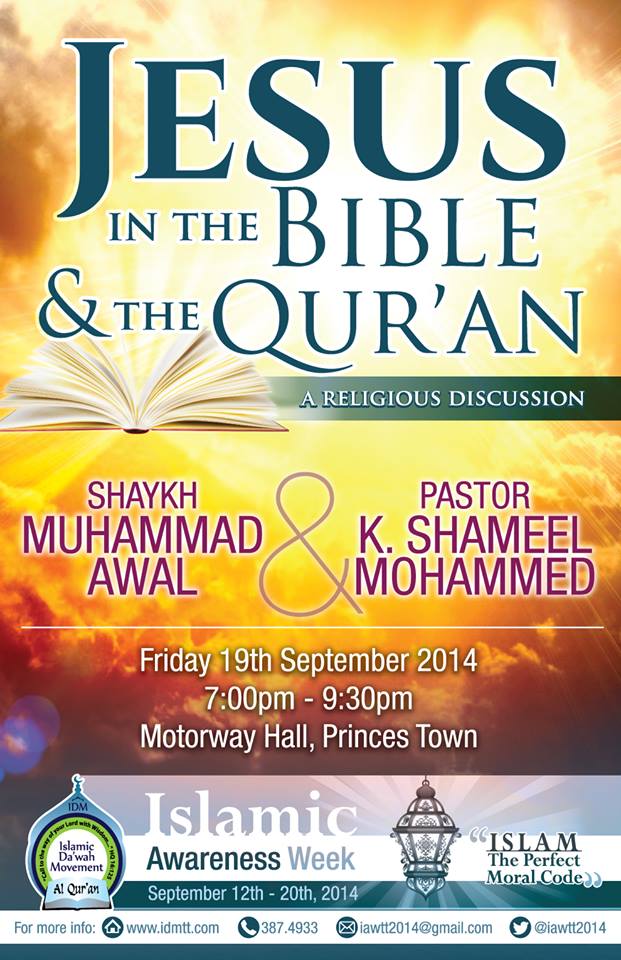
We’re happy to announce that the first debate between myself and Rev. Steven has been published online. The topic, “What is the True Faith of Jesus’ Disciples?,” featured a lot of discussion on the early Christology of the proto-orthodox Christian tradition. There was also discussion on the New Testament manuscript tradition however the Reverend chose not to pursue that course of argument (I had with me several papyrological studies on hand but the debate did not follow that path). The claim that the disciples were eyewitnesses or the authors of the NT textual tradition was deeply discussed and the Reverend makes quite the statement during the debate, “it’s all hypothetical!,” which then led to some even more interesting remarks.

I focused on the chains of transmission as claimed by Church tradition, and examined them in light of the deutero-canonical traditions, the results would surprise many. I also compared and contrasted several “claims” by the early Church fathers as to from whom they took their testimony from about Christ, which led to quite a major contradiction given Papias’ witness. All in all, this was an extremely enjoyable debate and the audio is 100% clear. Again, I’d like to thank Br. Haseeb from IBN for the recording, Br. Asad (of Motorway Hall) and the MYTT for hosting the event, Br. Nazam for stitching the video together and then uploading to his channel, Pastor Kris for moderating the event and especially Rev. Steven for being my gracious interlocutor. The event was extremely well attended and I must thank the community for their participation.

Enjoy the recording!

and Allah knows best.


Islamic Response to ISIS/ Daesh’s Book Burning

According to an article by the National Post, Daesh has massacred a significant quantity of books they deemed to be “unIslamic”:

BAGHDAD — When Islamic State group militants invaded the Central Library of Mosul earlier this month, they were on a mission to destroy a familiar enemy: other people’s ideas. Residents say the extremists smashed the locks that had protected the biggest repository of learning in the northern Iraq town, and loaded around 2,000 books — including children’s stories, poetry, philosophy and tomes on sports, health, culture and science — into six pickup trucks. They left only Islamic texts.

Mideast Iraq Libraries In Danger

I have a great disgust for those people who burn literature, whether they agree with its contents or not. The hallmark of an intellectual society is one that can harbour ideas and beliefs they don’t agree with. As a Muslim, I study Christianity and Judaism, I don’t agree with everything those faiths teach but it is my job to entertain differing arguments and to approach them in a sensible manner. Acts like these seem more Christian to me than Islamic, as book burning is something condoned by the New Testament:

Large numbers of those who had practiced magic (περίεργα, περίεργος) collected their books and burned them up in the presence of everyone. When the value of the books was added up, it was found to total fifty thousand silver coins. – Acts 19:19 (NET).

Most New Testaments carry the translation of magic, but the primary meaning of “περίεργος” according to Strong’s Lexicon is:

of persons: over-careful; curious, meddling, a busy-body; of things: over-wrought; superfluous; curious, uncanny; subst: curious arts

A more English friendly translation according to Helps Ministries Word Studies is:

spending excessive time (effort) where it doesn’t belong (or should not happen).

Dr. James Dunn explains this term a bit more concretely, he says:

‘not doing any work but meddling/ being busy bodies’ (BDAG 800). The inference is probably that the individuals referred to were so caught up with their convictions that they spent time disrupting the work of other believers by their continual attempts to propagate their views. – ‘Beginning from Jerusalem: Christianity in the Making’, p. 717.

In other words, not sorcery or magic, but whatever Christians found to be challenging of their own views. Which is exactly what Daesh/ ISIS is doing, burning books which challenge their rhetoric. In response to this, Ibn Hazm states:

دعوني من إحراق رق و كاغد
و قولوا بعلم كي يرى الناس من يدري

Leave this (ridiculous) burning of books and texts,
Articulate your arguments and let the people decide (who is upon falsehood). – Ibn Hazm as quoted by Mufti Abu Layth al Maliki.

and Allah knows best.

Do Muslims Assume Unitarianism in Discussing the Trinity

Question:

Popular Christian speakers like James White have repeatedly said that Muslims assume Unitarianism when discussing and debating the doctrine of the Trinity. Is this true? What is Unitarianism?

Answer:

Unitarianism, refers to the belief that God exists as one person. This is in contrast to Trinitarianism which teaches that there is one God who exists in three “persons”, all of whom are distinct from the other persons, but co-equal in nature. Unitarianism argues that there is only one person. The most popular believers in this doctrine are those who believe in modalistic monarchianism or monarchianism. Modalism refers to the believe that the one person who is God, moves between varying roles; these roles are the Father, Son and Holy Spirit.

Apologists like James White believe that Muslims argue from the belief of Unitarianism because many Muslim speakers argue against the Trinity by arguing that Jesus who is the Son, is not the Father and thus this is polytheism, not monotheism. Christians would then argue that this proves the Trinity since they do not believe the Son is the Father (that’s Unitarianism), they believe that the Son is a distinct person from the Father and so arguing that they are distinct is already a belief they hold. Therefore, when Muslims do so, they are arguing in futility. This however, does not take the Muslim’s argumentation as a whole. Muslims argue using sequential logic, they start with one point and then from this point argue another second rational point. The second point follows from the first point, thus it is sequential (in a specific order) and sequitur (one point follows from the other point, they are connected to each other. In Discrete Mathematics, a point is referred to as a premise and the symbol used to demonstrate that they are sequitur can either be -> [if this, then that] or <-> [it follows both ways, i.e. vice versa]). I am not saying that James White is the only person to commit this error, but since the questioner mentioned him specifically, and since I am familiar with him having argued as such, I will subsequently refer to him in this article.

The misunderstanding thus begins when Christian apologists isolate one of the premises or arguments, while ignoring the entire logical sequence being drawn out. So what is the Muslim’s entire argument? Trinitarians believe, as previously mentioned that each “person” of the Trinity is co-equal and absolute in their nature (i.e. perfect beings). The Muslim argument demonstrates that they are not equal and as a consequence of this, they are in a hierarchy, since there is a hierarchy and one is weaker than the other it means two of the three are not absolute in their natures and thus not God. A God is defined as a being absolute in its nature, if a God is not, such as if it does not have absolute knowledge (i.e. the knowledge of everything; see Mark 13:32), then it can no longer be considered a God. The Muslim argument, therefore also follows through to the position that this is polytheism, since Christians are deifying three non-equal beings with one absolute being, and two “partners” who are deficient in nature.

In conclusion, the next time a Christian speaker mentions that Muslims assume or argue from a position of Unitarianism, kindly stop them and ask that they listen to the entire argument and not cherry pick isolated premises from a complete argument. If they insist that they are not, kindly ask them to list the premises being postulated by the Muslim sequentially, this should only be four sentences at the very least. If they can’t articulate the Muslim’s argument, then it is clear they do not grasp it. Since they can’t grasp it, this explains why they fail to respond to it and thus have to create red herrings.

and Allah knows best.

Jay Smith Runs Away from Debate Challenges

Two Sundays ago, prominent Muslim debaters, Br. Zakir Hussain and Br. Ayaz Uddin, met Jay Smith at Hyde Park and challenged him to two debates. Smith refused to debate on the topic whether Jesus is God or not, his reasoning as he states is that it’s clearly obvious and thus not debatable. Well, can’t Brs. Zakir and Ayaz reply the same, that the Prophet’s prophethood is obvious and thus, not debatable?

I find it very odd, that Jay Smith, religiously goes to Hyde Park to debate about Islam & Christianity, and when challenged with an actual debate, he refuses to do so. What is the point of screaming at people every Sunday, and boasting about your debate skills, if you’re refusing to debate on a stage, for a scheduled and moderated debate?

Please enable subtitles to see what each person is saying in the videos.

What is Jay afraid of? Why is he running from Muslims? Can any Christian tell us?

and God knows best!

Release: A Critical Analysis of Jay Smith’s Mistakes About the Qur’an [Update]

Update: I have been made aware that some persons are unable to access the paper via Scribd, you can therefore click this link and download the PDF directly: Response to Jay Smith’s Mistakes.

All Praise is due to Allah alone. The paper has undergone some minor changes, which are listed in the paper under the title of, “Structure of the Paper”. A formatting error for some headers were corrected, especially for Appendix B.

and Allah knows best.

Originally Published: 12/11/14, 6:46 a.m.

Missionary Mishap: Catholics at the time of King Solomon

Muslims (of the Ummah of Muhammad salallaahu ‘alayhi wa salam), Catholics at the time of King Solomon. I had to re-read this missionary’s comment a few times before I could have established that I was seeing correctly. I did correct him on his statements, but I doubt he’s going to change his mind. A bit shocking, weird and silly – but I’ve seen worse….

cc-2014-arnoldsags


and God knows best.

« Older Entries Recent Entries »