Tag Archives: callingmuslims.com

Christmas: The Origins [Shaykh Abdullah Hakim Quick]

Bismillahir Rahmanir Raheem
بِسۡمِ ٱللهِ ٱلرَّحۡمَـٰنِ ٱلرَّحِيمِ ,

What are the origins of Christmas? See what a historian, social activist and modern explorer has to say on this subject. It’s a pleasant introduction into a 25 minute video that goes indepth into the history, politics and theology behind the day of Christmas. Shaykh Abdullah’s speaking style is both simple and extant (to the point), yet his speech is not condemning, in fact it’s quite inviting, with that we invite both Muslims and Christians to watch his video:

For the more enthusiastic seeker with a few minutes extra to spare, the Shaykh has authored a wonderfully written article:

Since earliest times the inhabitants of the Northern countries have observed that there is a period during the year when the days begin to lengthen and the cold begins to strengthen.  This event is the Winter Solstice, the turning point when winter having reached its zenith, has also reached the point when it must decline again towards spring.  Thus, December 21st is the shortest day of the year.
It was on or about December 21st that the Ancient Greeks celebrated the Bacchanalia or festivities to honour Bacchus the god of wine.  In Ancient Rome the Saturnalia of festivals in honour of Saturn, the god of time, began on December 17th and continued for seven days.  Both festivals ended in drunkenness, obscenity and disorder.  The Druids observed this season in their great roofless temples at Stonehenge and Avebury in England.  Torches were lit and strange pagan ceremonies were enacted in honour of the Sun god and to cut the Mysterious Mistletoe to which they gave god-like powers.  Even the Ancient Egyptians celebrated this mid-winter in honour of Horus, the son of Isis, born at the close of December.

The Ancient Germanic tribes celebrated the pagan feast of the 12 Night from Dec. 25th to Jan. 6th.  The conflicts between the active forces of nature were represented as battles between the gods and plants.  The winter was the Ice-Giant, cruel and unruly, and darkness and death followed him.  The Sun god and the South Wind were symbols of light and life.  At last Thor, the god of the Thunderstorm riding on the wings of the air hurled his thunderbolt at the winter castle and demolished it.

In Scandinavian countries, great fires were kindled to defy the Frost King.  The followers of Mithra, throughout the Northern countries, called this period sol invictus representing the time of the victory of light over darkness.  Mithra, for them, was not only the Sun god, but the Mediator between mankind and the Supreme Being.  His birthday was celebrated on the 25th of December.  Sunday, the seventh day of the week (for seven was his number) was consecrated to him, and known as the Lord’s Day long before the Christian Era.

The roots of the Christmas observance, therefore, go deeply into the folklore of the early pagan traditions.  What we may read of Christmas in ancient days finds its flower in the past  and present customs of Western Civilization.  We should clearly understand one important fact.  Christmas is not the actual date of the birth of Jesus (p.b.u.h), but a compromise with paganism.  The Gospels say nothing about the seasons of the year when Jesus was born.  On the other hand, they do tell us that shepherds were guarding their flocks in the open air.  Hence, many of the early leaders of the Church considered it most likely that the nativity took place either in the late summer of early Fall.

This and countless facts point to the conclusion that Christmas (Dec. 25th) actually has nothing to do with Jesus (p.b.u.h.) and Mary (p.b.u.h.), the humble of servants of Allah who abstained from the world and submitted entirely to their lord. Christmas has actually incorporated into itself all the pagan festivals; Greek, Roman, Druid, German, Scandinavian, etc., and given them new meaning.  The wild revels of the Bacchanalia, the Saturnalia, and the Twelve Nights survive in a milder form in the merriment that marks the season of Christmas today.

“Christmas gifts themselves remind us of the presents that were exchanged in Rome during Saturnalia.  In Rome, it might be added, the presence usually took the form of wax tapers (candles) and dolls – the latter being in turn a survival of human sacrifices once offered to Saturn.  It is a queer thought that in our Christmas presents we are preserving under another form one of the most savage customs of our barbarian ancestors!  The shouts of ‘Bona Saturnalia’, which the Roman people exchanged among themselves are the precursors of ‘Merry Christmas!’ The decorations and illuminations of our Christians churches recall the temples of Saturn, radiant with burning taper and resplendent with garlands”

SANTA CLAUS
Today, when Christmas is mentioned, most people immediately think of Santa Claus. The image of Jesus, the son of Mary ((Peace be upon them) is secondary and sometimes lost in the merriment and materialism. The prices in the market place go up and we find that people are spending thousands in order to buy gifts for their friends and neighbours. Most Christians fall into debt that can last for the greater part of the year.
The problem that comes during the Christmas season for Muslims and non-Christians is that there are a number of contradictory symbols. Some of these symbols reveal an animistic religious base but others appear to be monotheistic. At the top of all of them is Santa Claus. One might then ask ‘What do pagan festivals have to do with the innocent, loveable Santa Claus?’

“Actually, in every one of these festivals, the leading figure was an old man with a large, white beard.  In the Bacchanalia, the chief god was not actually the young Bacchus, but the aged, cheery and decidedly disreputable Silenus, the chief of the Satyrs (Half man, half animal figures of Greek mythology) and the god of drunkards.  In the Saturnalia, it was Saturn, a dignified and venerable old gentleman, the god of Time.  In the Germanic feasts it was Thor, a person of patriarchal aspect, and a warrior to boot.” So, although the main figure of the Christian festival was supposed to be Jesus, the child-god born to an innocent woman, the pagan ways of the past were too strong in the hearts of the Christians to be easily dismissed.  The earlier gods were replaced by Saint Nicholas, an austere Christian Bishop who was born in Turkey in the 4th Century A.D., and became the patron Saint of children throughout the Western World.  The name Saint Nicholas has now been abbreviated to Santa Claus and even his image has changed, but one fact remains crystal clear; this merry, mystical figure that flies through the air in a reindeer-drawn sleigh is the re-incarnation of a pagan deity that is very much alive today in the minds of men.

WHY DOES SANTA COME DOWN THE CHIMNEY?
“The early Germans considered the Norse Hertha or Bertha, the goddess of domesticity and the home.  During the winter solstice, houses were decked with Fir and Evergreens to welcome her coming.  When the family and the serfs gathered to dine, a great alter of flat stones was erected and here a fire of Fir bough was laid.  Hertha descended through the smoke, guiding those who were wise in Saga to foretell the fortunes of those persons at the feast.  We learn from this story of Hertha and the reason why Santa Claus comes down the chimney instead of in at the door.”

THE CHRISTMAS TREE AND THE YULE LOG
In just about all times and continents, we find records of the worship, at some former period, of a tree as a divine object.  The Pagan Scandinavians called their greatest and most famous tree (the Ash tree) Yggdrasil.  Nobody had ever seen it, but everybody believed in it.  It was supposed to have been so big that it had three roots, one in heaven, one in hell, and one on earth.  According to Scandinavian mythology, when the roots of Yggdrasil are eaten through, the tree will fall over and the end of all things will have arrived.  The Anglo-Saxon Druids adopted this mythology and during Christmas period chose Yule log which they blessed an proclaimed that it should be ever burning.  This custom has survived and the Yule log is burnt throughout England.  The origin if he sacred tree may have been developed in Ancient Egypt and other older societies.”  Egypt had one in the palm, which puts forth a shoot every month.  From Egypt the custom reached Rome, where it was added to the other ceremonies of the Saturnalia.  But as palm trees do not grow in Italy, other trees were used in its stead.  A small fir tree, or the crest of a large one was found to be the most suitable because it is shaped like a cone or pyramid.  This was decorated with twelve burning tapers lit in honour of the god of Time.  At the very tip of the pyramid blazed the representation of a radiant sun placed there in honour of Apollo, the sun-god to whom the three last days of December were dedicated.”

HOLLY
“Some people believe that the word “Holly” is a form of the word “Holy” because of the association of these evergreens with Christmas.  This is not the true derivation, however.  Holly is merely a variation of Holin, Hollin, or Holm.  The name Holme is now used for a kind of oak.  This tree was admired by the Druids who believed that its evergreen leaves attested to the fact that the sun never deserted it. It was therefore, sacred.  It was also believed to be hateful to witches and is therefore, placed on doors and windows to keep out the evil spirits.”

CONCLUSION
This is only a glimpse at the incredible amount of distortion and paganism that has been incorporated into the Christmas doctrine and disseminated throughout the world in the name of love, giving, and the purity of the Virgin Mary and Jesus (Peace be upon them). Somewhere along the line when the Christians were being tortured and killed in Roman coliseums, somebody made the decision to make it easy for the northern people to accept these teachings. So what comes about is an adaptation and a change so that you actually have the Christmas ceremony which once represented Pagan images of nature, images based upon the worship of the sun, or the worship of the created things, now in the monotheistic religion.

It is interesting to note that as late as 1647, Britain’s Puritan Parliament had Christmas ceremony banned as pagan. St. Nicholas appeared in early European folklore as another character, sometimes known as Beowulf , or Nick or Nikker. He was said to be a demon or the evil spirit of the north. Descriptions of him show him when humanoid as an aged creature with a flowing white beard. By The 16th century, the term had become more specific, the Chrisitianized:”Old Nick” or even “St. Nicholas” meant the devil proper. In the Bible, Isaiah 14:13, the devil’s throne was in the north. Satan presided over the winter’s darkness. So the character representing evil for the northern Christians was transferred into the figure of Santa Claus. He was often covered with red fur or driven in a sleigh by winged snakes.

If Santa Claus now is flying all over the world giving gifts to children what happened to the labour of their mother and the father?  Why is Santa Claus coming down the chimney? That is because there was a belief in ancient Scandinavia that a goddess of flames would come into the home.  And so this confusion now is all put together on the Christmas occasion and people have forgotten about Isa (p.b.u.h).

In the Islamic understanding, Isa or Jesus (p.b.u.h), the son of Mary (p.b.u.h)was a very humble person who possessed only one or two changes of clothing. He used to walk bare foot most of the time. He renounced the life of materialism and wanted people to move away from focussing on gold and silver. He encouraged the Children of Israel to have spirituality and to remember the Creator.  According to most Christian and Muslim theologians, the actual birth of Jesus the son of Mary (p.b.u.h) was in the summer.  In a Qur’anic chapter called Maryam ( Quran 19:16-40), there is a detailed discourse on Mary (p.b.u.h).  She is depicted as a very pious individual who spent most of her life fasting.  When the angel Gabriel told her that she would have a son, she couldn’t believe it. He informed her that it would happen by the power of God who would breath his spirit into her she would become pregnant; and she did.  She went out of the city to a remote area.  In the Quran, 19:24-25, Allah (swt) sent the angel to tell her that water will come under her and then to shake the palm tree and rutuban janniyya, the ripe dates, will fall down from the tree.  The Arabs knew that the ripe dates come in the summer time. Even the Christians agreed with this because, according to their traditions, the shepherds were putting their flocks outside.  And in the area of Bethlehem and Nazarath this could only be done in the warm weather.

Therefore, it is basically agreed upon that Jesus (p.b.u.h.) was a humble, simple, non- materialistic person who was born in the summer.  What is happening now is a cleverly contrived mixture that is moving more towards the celebration of immorality and materialism than piety and God-consciousness.

Allah has revealed in the Blessed Qur’an , Surah An-Nisaa (157-9), the following verses:

…And because of their sayings: We killed the Messiah Jesus son of Mary, Allah’s messenger, but they killed him not nor crucified him. It appeared so to them. And lo, those who disagree concerning it are in doubt thereof; they have no knowledge thereof save pursuit of a conjecture. They killed him not for certain. But Allah took him unto Himself.  And Allah is ever Mighty, Wise.  There is not one of the People of the Book but will believe in him before his death, and on the Day of Resurrection he will be a witness against them.

In Surah Al Ma’idah is the following:

The Messiah, son of Maryam is but an Apostle; Apostles before him have Indeed passed away. And his mother was a truthful woman. They both used to eat food.  See how We make the communications clear to them, then behold, how they are turned away. Say: Do you serve besides Allah that which does not control for you any harm, or any profit? And Allah is the All Hearing, the All Knowing.

Say: O followers of the Book! Be not unduly immoderate in your religion, and do not follow the low desire of people who went astray before and led many astray and went astray from the right path.

Shaykh Abdullah Hakim Quick : Source

wa Allaahu Alam.
[and God knows best.]

CL Edwards Responds, Again

Bismillahir Rahmanir Raheem
بِسۡمِ ٱللهِ ٱلرَّحۡمَـٰنِ ٱلرَّحِيمِ ,

Earlier today I received a notification that a comment had been posted on this website. It wasn’t really a surprise to see who had written it, but I couldn’t keep a straight face after reading it. I’m still coping with the amount of humour this guy brings to the table. Naturally, I’m a bit perplexed though. You see, earlier yesterday evening, Mr. Edwards decided to author a post about me, “Pulling the cloak off the self appointed Da’ee“, which was fun and all to refute, which you can find here and here. However, as it seems, our respected opponent has a problem with the refutations. He thinks it’s creepy that I’m refuting his attacks on Islam and against me:

It’s always nice to have him comment on my posts, alteast that way I know he’s read something and can’t respond to it, so he leaves a comment to show it “just isn’t worth his time” (although he does have time to send me inbox messages, comments and links on FB), which really just signals to me, he doesn’t have the intellectual capacity to give a rebuttal to my writings. In fact, Mr. Edwards does have a creepy stalker like obsession with me, while I was a legal minor (that is according to most international law declarations), he would message me constantly on FB, until finally, a few months ago I sent him a reply that really must’ve knocked the wind out of him:

I say it must’ve knocked the wind out of him because he stopped sending me messages asking me about my personal life, that being in terms of religion. It’s sad to say he’s at it again, I’m legal now, so he must be rearing to have a chance at me (in what way, I can’t say), otherwise I’m not quite sure why he has the need to message me on FB, post comments on threads I’ve used, comment on my website or write entire articles about me.

As you can see for yourselves, just how many comments I’ve received from this man total atleast 100 +:

1 + 33 + 40 + 11 + 21 = 106

May God guide him from whatever evil he intends towards me, or any other young Muslims on the internet, Ameen.

wa Allaahu Alam.
[and God knows best.]

Refutation: Pulling the cloak off the self appointed Da’ee [Part 2]

Bismillahir Rahmanir Raheem
بِسۡمِ ٱللهِ ٱلرَّحۡمَـٰنِ ٱلرَّحِيمِ ,

Continuing from part one, which focused on his petulant tirade due to his own actions, let’s see what else Mr. Edwards has decided to throw at us:

“Here are the questions Hijaz refused to answer that I have referenced on the comments page of the last post on the site.”
Note: He’s referring to the comments on his own website, where yes, I did respond to his claims, but alas, the comments were not approved for display. Next, he questions me on this post, referring to Suratul Baqarah (2) : 2 – 5. Also note, he can’t spell my name, yet again, he’s lowered himself to childish antics by mocking my name. This is the kind of “man” we’re dealing with, when he’s challenged and he can’t meet said challenge, his mind recesses into a despotic and incoherent rage where all he can do is regurgitate childish insults from among his anti-Islamic peers.
There are 6 things in this ayah that you say assures one of salvation
Fear of Allah, Believe in the Unseen, steadfast in prayer, spend out of provisions, Believe in the revelation sent before and after, have assurance of the hereafter in the heart.
Yes, that’s what the ayats say. Then he goes on to question me on the meaning of those ayat, which were again, answered with full references here, however I did not expect him to read my initial response, which is why he needs to ask the same questions atleast a couple more times before he can actually grasp it. Remember folks, he’s slow, whether intentional or otherwise and we do intend to cater for his special needs:
Questions:
What is the definition of each one of these points, or how does one know they achieved them?
How does one achieve these things?
In what measure must these things be achieved before you know for certain you have assured salvation?
By you citing this am I to take it that you hold that salvation in Islam is based on the effort of the creature ? “
Answers:
(1) Definition is given in this post, which I will quote for our friend:
The Qur’aan does not make it difficult though, so what does a Muslim need to act upon and believe to gain heaven?

This is the Book; in it is guidance sure, without doubt, to those who fear Allah;

Believe in the Qur’aan, use it as a form of guidance, so that we develop taqwa (God consciousness).

Who believe in the Unseen, are steadfast in prayer, and spend out of what We have provided for them;

Believe in what Allaah has ordained for us and what He has told us, but which we have yet to know or experience. Perform praise and worship of God and live life within the means He has provided for us in a righteous way.

And who believe in the Revelation sent to thee, and sent before thy time, and (in their hearts) have the assurance of the Hereafter.

Belief in the Qur’aan, Injil, Tawrah Zabur, Suhuf al Ibrahim. As for assurance of the hereafter:

(And in the Hereafter they are certain) that is the resurrection, the standing (on the Day of Resurrection), Paradise, the Fire, the reckoning and the the Scale that weighs the deeds (the Mizan). The Hereafter is so named because it comes after this earthly life. – Tafsir ibn Kathir : Suratul Baqarah (2) : 4.

Lastly:

They are on (true) guidance, from their Lord, and it is these who will prosper.

Meaning:

(They are) refers to those who believe in the Unseen, establish the prayer, spend from what Allah has granted them, believe in what Allah has revealed to the Messenger and the Messengers before him, believe in the Hereafter with certainty, and prepare the necessary requirements for the Hereafter by performing good deeds and avoiding the prohibitions.(And they are the successful) meaning, in this world and the Hereafter. They shall have what they seek and be saved from the evil that they tried to avoid. Therefore, they will have rewards, eternal life in Paradise, and safety from the torment that Allah has prepared for His enemies. Tafsir ibn Kathir : Suratul Baqarah (2) : 4.

Therefore the Qur’aan is extremely clear, it essentially spells it out for all Muslims, that sincere belief and God sanctioned actions would secure one a place in heaven.
(2) One achieves these things by sincerely believing in what those ayat say to believe in and by sincerely practising upon what those ayat say to practise. Note, he repeats question 1 in question 2. Clearly the man has literacy issues.
(4) No. That’s your assertion, Salvation on Islam is dependant upon two things:
  • Your own actions and beliefs.
  • Mercy of God.
If you don’t do as God commanded, then that’s sinning, if you don’t believe in what God has commanded you to believe, that is sinning. Likewise, the converse of this statement is also true. However although one is a sinner, God’s mercy is what is needed. If a man is a sinner and repents, then it’s God’s mercy that assures him salvation. Salvation, is to be free from sin and the punishment of sin. For Mr. Edwards to claim he has salvation is to claim he isn’t a sinner nor will God punish him, which is ironic, since all humans, by their very nature are prone to sin as the Bible says. Circular reasoning at its best.
Lastly, I’d like to point out how hilarious this guy is. I’m going to show you why I can’t take him seriously, I do believe he is a student of a clown college of some sorts, look at this guy’s poor, if not absolutely laughable authorship skills:
He spells my name wrong, twice, each right after the other. If this is any indication of his lack of consistency, integrity and literacy, I must express my condolences for his viewership, given how abysmal and dismal it may be. Before he claims I didn’t answer anymore of his questions, let’s see what else his incoherent post says:
” I would like to make clear Islamic salvation is it purely a work of the creature, is it purely a work of God or is it synergistic a combination of the two? “
Which was already answered above:
(4) No. That’s your assertion, Salvation on Islam is dependant upon two things:
  • Your own actions and beliefs.
  • Mercy of God.
If you don’t do as God commanded, then that’s sinning, if you don’t believe in what God has commanded you to believe, that is sinning. Likewise, the converse of this statement is also true. However although one is a sinner, God’s mercy is what is needed. If a man is a sinner and repents, then it’s God’s mercy that assures him salvation. Salvation, is to be free from sin and the punishment of sin. For Mr. Edwards to claim he has salvation is to claim he isn’t a sinner nor will God punish him, which is ironic, since all humans, by their very nature are prone to sin as the Bible says. Circular reasoning at its best.
He isn’t difficult to respond to. His incredulous behaviour is a sign that he’s slowly losing grip on reality:
  • Reads my name wrong.
  • Spells it wrong, one right after the other.
  • Repeats himself.
  • Can’t follow his own rules.
  • Incoherent and incosistent posts.

If someone knows what these are symptoms of, perhaps dementia or some other psychological disorder, please inform us so that we may take other methods to comforting and aiding our ailing opponent. He is in our prayers.

wa Allaahu Alam.
[and God knows best.]

Refutation: Pulling the cloak off the self appointed Da’ee [Part 1]

Bismillahir Rahmanir Raheem
بِسۡمِ ٱللهِ ٱلرَّحۡمَـٰنِ ٱلرَّحِيمِ ,

He’s at it again, Mr. Edwards is back at it. After several back and forth arguments over Facebook, Website comments and Article posts, his mind has finally cracked. There is no other logical explanation, save that he may be drunk off of communion wine, but I always try to find the best in my opponents, so I shall regard his latest post as a blunder for which he will develop a grand learning experience from. I do sympathize with his meager post, sure it lacks consistency and really is just an attack on me, but that’s expected when you’re old and slow and can’t keep up with a new, significantly younger generation of enthusiastic Muslims. I do not hold him responsible for his dishonesty or for his ironed fisted tactics, after all he is a Christian, but then that would mean doing as he does and the truth is, as a Muslim it is irresponsible for me to generalize groups of people. Therefore I accept that Mr. Edwards does not represent a significant part of the Christian community, nor of the rest of the human population and that honestly makes me feel better. The world suddenly looks just a tad bit brighter. So, what’s our favourite comedian (sorry, I meant “educated theologian”) up to today?

Well he’s decided to be hypocritical, from his post, he calls me out demanding to know why his comments on my website (this one) are now being censored:

Hijaz of callingchristians has made a big fuss over me implementing moderation on comments …oh the hypocrisy!!! You see in the screen shot below he is holding one of my comments up for moderation, yet posts a comment to a earlier comment of mines!!

At this point, I’m not sure if he’s realised what he’s written but he simply has gotten himself in a bit of a fancy. Yes, I did make a post about him moderating my comments on his “blog”, which you can read here. As one can see,  I was honest and kind enough to update the post when he did let a few of my comments through:

However, since he continued to moderate my comments on his website, I made it clear to him that in reciprocation I would do the same to him, in fact I informed him of this on both my website and his “blog”, that comment, still isn’t available for viewing on his blog, but it is on mines:

He was clearly told, if he continued to cry wolf, his comments would be removed. Subsequently, when he refused to allow our comments to be displayed on his website, we decided to moderate his. You see, he’s like a child, he doesn’t like when he’s being given a taste of his own medicine. He’s fine with prohibiting us from commenting on his “blog”, but he isn’t man enough to have his own comments moderated on our website. If he does have a problem with us following his lead, then please take it up with the Bible:

Do to others as you would have them do to you. – Bible : Luke (6) : 31.

It’s simple, if you can’t hold yourself to your own standards (however lowly they may be), don’t expect us to satiate your petulant needs, we aren’t your parents, don’t expect us to forgo your own inequities, for we’ll with a surety wage them against you. Also, we do ask, if anyone can help Mr. Edwards (which you can see I’ve always addressed him as), he seems to have a disability, he is currently unable to write my name correctly. In fact I’m beginning to think this explains quite clearly why he’s such an angry little man, perhaps his literacy issue has driven him to always attack others. We can offer him help, but in the meantime we do request that he does learn to spell my name correctly, there’s no “H” in Ijaz.

wa Allaahu Alam.
[and God knows best.]

[Updated: x2] CL Edwards Censors CallingChristians Comments on his Website

Bismillahir Rahmanir Raheem,
بِسۡمِ ٱللهِ ٱلرَّحۡمَـٰنِ ٱلرَّحِيمِ ,

After several bouts of severe public humiliation, CL Edwards has decided to censor and ban all comments of CallingChristians on his website. You can view every single one of his comments on our blog, none have been removed, yet he has the audacity and insincerity to censor responses to him. Christianity does not allow free speech, which is why, with following in his father’s footsteps he needs to attack truth and prohibit the distribution of it:

Do you think he will be honest enough with his viewers and himself to let free speech reign on his website?

The comment up until post time has not been approved.
[UPDATE:] The comment has now bee approved!
[UPDATE x2:] Comments banned from his website, unless he approves they won’t be shown, all of his however are shown on ours.

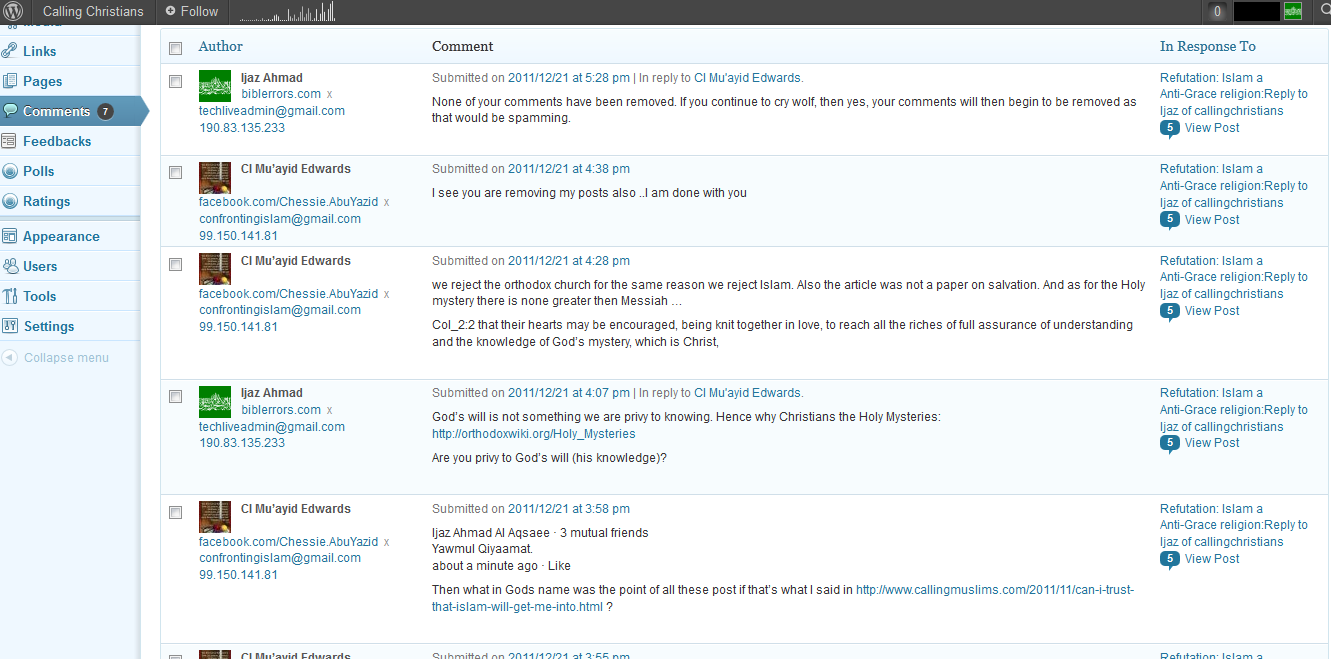
Before he claims his comments have been removed from our website, here is the administration page, this is a screenshot, which of your comments are missing?

wa Allaahu Alam.
[and God knows best.]

CL. Edwards Claims Divinity/ Prophetic Powers

Bismillahir Rahmanir Raheem
بِسۡمِ ٱللهِ ٱلرَّحۡمَـٰنِ ٱلرَّحِيمِ ,

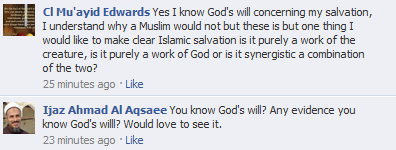
In his most damning post yet, Mr. Edwards now claims he has the Divine knowledge of God, that he knows God’s will, that he knows God’s will towards salvation. God’s will essentially is divine knowledge, meaning while we are existing in the, “now”, God already knows our past, present and future, we’re merely finding out what this divine will entails as we go along with out lives. However, since time immemorial, lots of people have claimed to have divine powers of being able to see into the past, look into the future, some even professing they’re able to know who God’s people are, others end up predicting the end of the world twice and failing.

It honestly does take a special breed of idiot to believe in such fanciful things, when especially both the Bible and Qur’aan condemn these people as soothsayers. Lo and behold, enters the newest act that this freak show has to offer. None other than CL Edwards of Calling Muslims. During a debacle on Facebook, he decided to attribute divinity to himself:

He says, and I quote, “Yes I know God’s will concerning my salvation…“, sir, we have the following questions for you based on that statement:

(1) How did you attain this ability of gaining this divine knowledge?
(2) What evidence do you have to suggest you posses such divine knowledge?
(3) On what basis can you claim to know the divine will of God?
(4) Is there a method to obtaining God’s divine knowledge?
(5) What indicators are there to know that a person has successfully Googled God’s knowledge?

Since he knows God’s will, particularly in light of being saved from sin and the penalty of sin (salvation):

(1) What sins does God intend to protect you from?
(2) What sins has He protected you from?
(3) Why did he choose to grant you salvation?
(4) Want penalties of sin did he save you from?
(5) Why did he choose you to share His divine knowledge?

I am certain you saw this with the “divine knowledge” you posses. Therefore I assume you already have the answers to my questions, as God would have wanted to save you from having to defend yourself from, as you put it, “an anti-Grace Religion”. I do look forward to your contribution to this topic of discourse. However, I would now like to point out that divine knowledge concerning the salvation of mankind was not even given to Jesus:

“No one knows about that day or hour, not even the angels in heaven, nor the Son, but only the Father.” – Bible : Matthew (24) : 36.

Seeing as Jesus himself, claimed not to have divine knowledge concerning the salvation of the world when it ends, how can Mr. Edwards claim such a rank? He himself may just be claiming to be superior to his own God, which I must say is not unusual for his superiority complex and arrogant attitude. We do hope he can humble himself and return to either Christian Orthodoxy (which contends the divine will of God is among His Holy Mysteries) or that he accepts Islam.

Either way, we must congratulate him on his elevation from Orthodox Christianity by claiming to know of the divine will of the grace of God (salvation) and we must congratulate him on his outstanding theatrical performance thus far, as without a doubt, I cannot fathom from the depths of my mind that a person can be so conceded, if however this is the case, I am ashamed and saddened at his behaviour.

wa Allaahu Alam.
[and God knows best.]
Refutation: Islam a Anti-Grace religion:Reply to Ijaz of callingchristians

Bismillahir Rahmanir Raheem
بِسۡمِ ٱللهِ ٱلرَّحۡمَـٰنِ ٱلرَّحِيمِ ,

I must say that I am quite impressed by Mr. Edwards’ post. It’s truly quite remarkable that any critically thinking hominid could possibly call that disaster of a post, a “response” to my articles here and here. I’m not sure if he’s wanting attention or perhaps he couldn’t afford to not reply, so he’s having to save face here, but it’s absolutely hilarious on his part to assume he has any form of any argument. One of the basic flaws of a failed academic and pseudo intellectual is that they would try to appeal to a few fallacies/ argument inconsistencies:

(1) Fallacy of Reading Between the lines.
(2) Being Overtly Pedantic.
(3) Arguing over Semantics.

He begins his barbaric tirade by implying I did not answer his question(s):

The short of it is He refuses to directly answer the question but we can gather from the above reply he doesn’t, nor does any Muslim for that matter…

However, I suggest you read this article, where not only is my answer a clear and resounding, “Yes”, it’s even in bold and big bright, red lettering for his convenience. If I didn’t reply, then why did he comment on my post? Self contradicting statements are always funny. The deceit of an ignoramus knows no end indeed. He sums up his post by saying his response to me is the above quoted statement:

And that was the point of my post.

So after saying I didn’t provide a response, he then decides to magically see my response, which was:

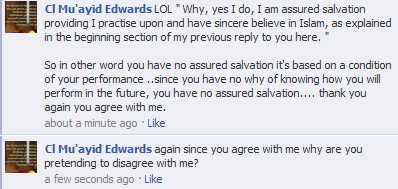
” Why, yes I do, I am assured salvation providing I practise upon and have sincere believe in Islam, as explained in the beginning section of my previous reply to you here. “

To which his reply was:

“Proving you practise is a condition, something with a condition is not assured, because He vary well my not live up to the condition.  If it was truly assurd it would be with out condition.”

So what exactly is his argument? Let me break it down:

(1) He says he will go to heaven.
(2) I say we can only go to heaven depending on God’s will, we cannot tell God we’re going to heaven.
(3) He says he agrees with me:

(4) After saying he agrees with me, he decides that he doesn’t agree, as his blog post now says:

“As for me I have no shame in declaring to the world that I am saved by Grace through Faith in Jesus Christ, He has given me eternal Life, and I rest in Christ with perfect peace because of this salvation He has achieved for me.”

So sir, can you please make up your mind? On one end you’re saying I’m right (you agree with me), the other you’re saying you don’t, as you can self claim going to heaven.

wa Allahu Alam,
[and God knows best.]

[Updated x3!] CL. Edwards Caught Lying: Can’t Make Up His Mind!

Bismillahir Rahmanir Raheem
بِسۡمِ ٱللهِ ٱلرَّحۡمَـٰنِ ٱلرَّحِيمِ ,

After posting this article, Mr. Edwards decided to publicly shame himself, I’m not sure why he decided to do so, but I must say it was a pleasure to see his act. To begin with, his response to said article was:

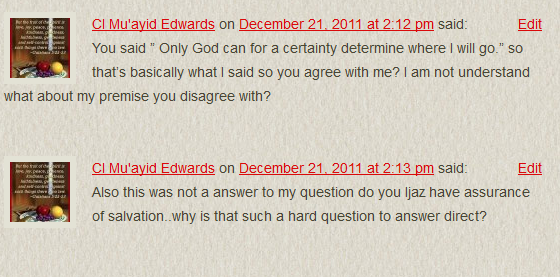
Mr. Edwards, sir, you did not say, “Only God can for a certainty determine where I will go”. Sir you actually said the following, let me refresh your mind for you:

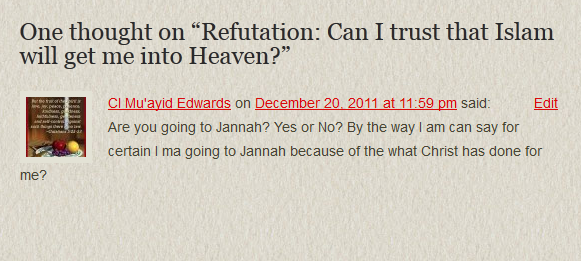
You actually said the opposite,”By the way I can say for certain I ma going to Jannah because of what the Christ has done for me…“.

Mr. Edwards, at this point, I must ask you, which is it?
(1) You can say for sure you’re going to heaven.
(2) You let God decide where you go.

You’re singing two songs here sir, does your own deceit know no end? What I must admit, is that this guy cannot stop fumbling, if we take a look at the second comment from the first photo, he proposes a question to me:

“…do you Ijaz have assurance of Salvation..”

Why, yes I do, I am assured salvation providing I practise upon and have sincere believe in Islam, as explained in the beginning section of my previous reply to you here.

Please learn to read Mr. Edwards, I don’t have the time to have to constantly fix your inequities.

[Updated:]

After showing Mr. Edwards this post, he still couldn’t find the answer to his question, which I have now put in red and bold for his viewing pleasure. Here you can see that I clearly linked to him the post, with his answer being in the second to last line of this very response [article, see in red above]:

[Updated x2:]

I’m not sure if he’s colorblind or illiterate, but this was his response, he still could not find my answer which was in bold and red letters:

[Updated x3]:

Again, Mr. Edwards is simply grasping for straws, after answering his question above, which was not only in this post and my previous post, he decided to create a strawman and attack it. What was my answer to his question?

Why, yes I do, I am assured salvation providing I practise upon and have sincere believe in Islam, as explained in the beginning section of my previous reply to you here.

Do you all see the word, “YES“, in that quote, because I do, unfortunately Mr. Edwards sees the word no, so I’m not sure if he’s being petulant or simply can’t accept the YES which I gave:

wa Allaahu Alam.
[ and God knows best.]

CL. Edwards Responds: Certainty in Jannah

Bismillahir Rahmanir Raheem
بِسۡمِ ٱللهِ ٱلرَّحۡمَـٰنِ ٱلرَّحِيمِ ,

Mr. Edwards decided that he wouldn’t respond to the entire post, so he’d just post a comment because as in his own words, my exposition was “too long”. Not a problem, let’s see what estranged concept he brings to the table this time:

Edwards' Comment

His question is rather absurd, but to humour him, the answer is quite simple. Only God can for a certainty determine where I will go. I do not know the future and I don’t speak on behalf of God. However, the Qur’aan tells us what we need to believe in and what we need to practise upon to gain Jannah and as Muslims we strive towards that, knowing that God’s mercy is greater than His anger. It’s absurd to say, “yes”, because I am not God, I do not know the future and I do know what God’s judgement upon me will be, as I, like all other humans, are a sinner.

The Qur’aan does not make it difficult though, so what does a Muslim need to act upon and believe to gain heaven?

This is the Book; in it is guidance sure, without doubt, to those who fear Allah;

Believe in the Qur’aan, use it as a form of guidance, so that we develop taqwa (God consciousness).

Who believe in the Unseen, are steadfast in prayer, and spend out of what We have provided for them;

Believe in what Allaah has ordained for us and what He has told us, but which we have yet to know or experience. Perform praise and worship of God and live life within the means He has provided for us in a righteous way.

And who believe in the Revelation sent to thee, and sent before thy time, and (in their hearts) have the assurance of the Hereafter.

Belief in the Qur’aan, Injil, Tawrah Zabur, Suhuf al Ibrahim. As for assurance of the hereafter:

(And in the Hereafter they are certain) that is the resurrection, the standing (on the Day of Resurrection), Paradise, the Fire, the reckoning and the the Scale that weighs the deeds (the Mizan). The Hereafter is so named because it comes after this earthly life. – Tafsir ibn Kathir : Suratul Baqarah (2) : 4.

Lastly:

They are on (true) guidance, from their Lord, and it is these who will prosper.

Meaning:

(They are) refers to those who believe in the Unseen, establish the prayer, spend from what Allah has granted them, believe in what Allah has revealed to the Messenger and the Messengers before him, believe in the Hereafter with certainty, and prepare the necessary requirements for the Hereafter by performing good deeds and avoiding the prohibitions.

(And they are the successful) meaning, in this world and the Hereafter. They shall have what they seek and be saved from the evil that they tried to avoid. Therefore, they will have rewards, eternal life in Paradise, and safety from the torment that Allah has prepared for His enemies. Tafsir ibn Kathir : Suratul Baqarah (2) : 4.

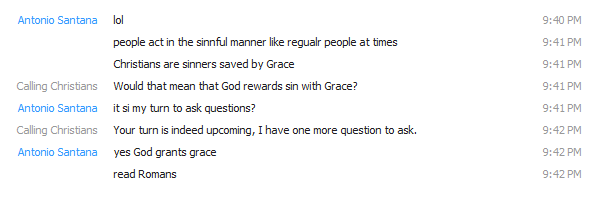
Therefore the Qur’aan is extremely clear, it essentially spells it out for all Muslims, that sincere belief and God sanctioned actions would secure one a place in heaven. Of course Mr. Edwards doesn’t believe in this doctrine. He believes that no matter what he does, he gets to go to heaven, which brings up the question, does God reward sin? Funny enough, his friend and long time partner in crime (of deceit), Antonio Santana did admit to us that God rewards sinning in Christianity:

Antonio - Skype Convo

It’s absolutely nonsensical for one to say he knows where he is going in the afterlife merely based on some inconsistent and incoherent belief of “salvation in Christianity”, which has been thoroughly refuted here. They’re self claimants to their own misigivings, even the Jesus of the Bible lets it be known that merely believing in him will not benefit you in the least:

Not everyone who says to me, ‘Lord, Lord,’ will enter the kingdom of heaven, but only the one who does the will of my Father who is in heaven. – Bible : Matthew (7) :21.

So who are these people who won’t go to heaven then?

The sense of this verse seems to be this: No person, by merely acknowledging my authority, believing in the Divinity of my nature, professing faith in the perfection of my righteousness, and infinite merit of my atonement, shall enter into the kingdom of heaven, shall have any part with God in glory. – Adam Clarke’s Exegesis : Matthew (7) : 21.

In fact, the Bible wages sin and deceit for the one who speaks on God’s behalf, specifically when it comes to God’s will (judgment, doings etc):

Will you speak wickedly on God’s behalf?  Will you speak deceitfully for him?- Bible : Job (13) : 7.

The meaning of this verse is made much clearer by a scholarly Christian’s commentary:

“In order to support your own cause, in contradiction to the evidence which the whole of my life bears to the uprighteousness of my heart, will ye continue to assert that God could not thus afflict me, unless fragrant iniquity were found in my ways; for it is on this ground alone that ye pretend to vindicate the providence of God. Thus ye tell lies for God’s sake, and this ye wickedly contend for your maker.” – Adam Clarke’s Exegesis : Job (13) : 7.

See, Job in this verse or rather, this chapter, is condemning the people to whom he was sent to preach. It is because they began to play God and judge who is righteous and sinful among themselves. Decided who God afflicted and whom God did not afflict with punishment. They claimed because Job was afflicted, that he was a sinful man (yet it was not the case, he was purer than them all), whereas they perverted the truth (much like Mr. Edwards) and cast righteous judgement on themselves:

“Will you speak wickedly for God?
As he suggests they did, they spoke for God, and pleaded for the honour of his justice, by asserting he did not afflict good men, which they thought was contrary to his justice; but: then, at the same time they spoke wickedly of Job, that he being afflicted of God was a bad man, and an hypocrite; and this was speaking wickedly for God, to vindicate his justice at the expense of his character, which there was no need to do, and showed that they were poor advocates for God…”- The New John Gill Exposition of the Entire Bible : Job (13) : 7.

Well, atleast through Biblical means, his own scripture and by extension his own God, has deemed him a wicked and hypocritical man. Casting judgement on himself (for righteousness) whereas condemning others, when he does now know what God knows is in their hearts. I suppose he needs to be rewarded with Grace for his sin. God rewarding sin, what a joke.

wa Allaahu Alam.
[and God knows best.]

Refutation: A clear Quranic contradiction in Ta-Ha surah 20 verses 83-97

Bismillahir Rahmanir Raheem
بِسۡمِ ٱللهِ ٱلرَّحۡمَـٰنِ ٱلرَّحِيمِ ,

Response to: A clear Quranic contradiction in Ta-Ha surah 20 verses 83-97
By: C.L. Edwards from Calling Muslims website.

The ill reputed author, Mr. Edwards is at it again. This time he is claiming a contradiction in the Qur’aan and quite funnily, borrows the argument of Abraham Geiger which most Orientalists have used against Islam, since some 200 odd years ago. His argument isn’t new or is it of any academic value. However in the name of exposing his indecent affinity towards absurdity, we shall engage his argument step by step and refute him. He begins by asserting that these verses supposedly have a contradiction:

“(When Moses was up on the Mount, Allah said:) “What made thee hasten in advance of thy people, O Moses?”He replied: “Behold, they are close on my footsteps: I hastened to thee, O my Lord, to please thee.”  (Allah) said: “We have tested thy people in thy absence: the Samiri has led them astray.” So Moses returned to his people in a state of indignation and sorrow. He said: “O my people! did not your Lord make a handsome promise to you? Did then the promise seem to you long (in coming)? Or did ye desire that Wrath should descend from your Lord on you, and so ye broke your promise to me?” They said: “We broke not the promise to thee, as far as lay in our power: but we were made to carry the weight of the ornaments of the (whole) people, and we threw them (into the fire), and that was what the Samiri suggested. “Then he brought out (of the fire) before the (people) the image of a calf: It seemed to low: so they said: This is your god, and the god of Moses, but (Moses) has forgotten!” Could they not see that it could not return them a word (for answer), and that it had no power either to harm them or to do them good? Aaron had already, before this said to them: “O my people! ye are being tested in this: for verily your Lord is (Allah) Most Gracious; so follow me and obey my command.” They had said: “We will not abandon this cult, but we will devote ourselves to it until Moses returns to us.” (Moses) said: “O Aaron! what kept thee back, when thou sawest them going wrong, “From following me? Didst thou then disobey my order?” (Aaron) replied: “O son of my mother! Seize (me) not by my beard nor by (the hair of) my head! Truly I feared lest thou shouldst say, ‘Thou has caused a division among the children of Israel, and thou didst not respect my word!'” (Moses) said: “What then is thy case, O Samiri?” He replied: “I saw what they saw not: so I took a handful (of dust) from the footprint of the Messenger, and threw it (into the calf): thus did my soul suggest to me.” (Moses) said: “Get thee gone! but thy (punishment) in this life will be that thou wilt say, ‘touch me not’; and moreover (for a future penalty) thou hast a promise that will not fail: Now look at thy god, of whom thou hast become a devoted worshipper: We will certainly (melt) it in a blazing fire and scatter it broadcast in the sea!” – Suratul Ta-Ha (20) : 83 – 97.

So what is his argument? In summation:

“There are many details in the Quran that differ or are missing from the original account in the Bible, one of which is a person named al Samari. Now the name as-Samari literally means “The Samaritan a person who comes from Samaria”……..The problem in all this is this event in the history of the nation Israel happened over 600 years before the area of Samaria came into existence. To add to this colossal blunder early Muslims(the Salaf) are recorded as explaining that this as-Samari came from a Israelite tribe called Samaria…no such tribe has ever existed.

To begin with, he implies that the original account is from the Bible, one must point out that he is referring to the Old Testament, therefore that begs the question, which Canon or Codex of the Old Testament is he appealing to this time? Here’s a short list for him to choose from:

(1) Samaritan Scrolls.
(2) Qumran/ Essene’s Scrolls.
(3) Greek Septuagint (LXX).
(4) Masoretic Text.
(5) Massorah Oral Tradition.
(6) Eastern Orthodoxy’s varying Canon’s (Coptic Canon versus Ethiopian Canon….etc).

After he’s played a game of lottery with “God’s word”, the next step is to determine if the Bible’s historical accounts are valid to establish the veracity of a particular historical event. This of course is easily laid to rest with a resounding no, by consensus of most Biblical scholars, to validate this claim, here’s a few quotes:

The original copies of the NT books have, of course, long since disappeared. This fact should not cause surprise. In the first     place, they were written on papyrus, a very fragile and persihable material. In the second place, and probably of even more importance, the original copies of the NT books were not looked upon as scripture by those of the early Christian communities. – (George Arthur Buttrick (Ed.), The Interpreter’s Dictionary Of The Bible, Volume 1, p 599 “Text, NT”.)

To begin with, how can it be logically sound, that if the people at the time of the Bible’s authoring, rejected it as a scripture (inspired by God, contains absolute truth), much less as a historical document (if it isn’t an absolute truth, then it’s fickle truth), how can you expect us, some 2000 years or so later to accept such historical claims?

He says: Complaints about the adulteration of texts are fairly frequent in early Christian literature. Christian texts, scriptural and nonscriptural, were no more immune than others from vicissitudes of unregulated transmission in handwritten copies. In some respects they were more vulnerable than ordinary texts, and not merely because Christian communities could not always command the most competent scribes. Although Christian writings generally aimed to express not individual viewpoints but the shared convictions and values of a group, members of the group who acted as editors and copyists must often have revised texts in accordance with their own perceptions. This temptation was stronger in connection with religious or philosophical texts than with others simply because more was at stake. A great deal of early Christian literature was composed for the purpose of advancing a particular viewpoint amid the conflicts of ideas and practices that repeatedly arose within and between Christian communities, and even documents that were not polemically conceived might nevertheless be polemically used. Any text was liable to emendation in the interest of making it more pointedly serviceable in a situation of theological controversy. – (H. Y. Gamble, Books And Readers In The Early Church: A History Of Early Christian Texts, 1995, Yale University Press: New Haven & London, pp. 123-124.)

The Bible, clearly as a historical document is said to have been emendated (improved with bias) according to each sect’s understanding of it. What’s worse is that the first person to ever canonize and codify the Bible (canonize – to say what is scripture, codify – collected to be arrange in some order) emendated his own version, enough for him and his followers to be persecuted (see: Marcion’s Canon). With the above quotes and subsequent historical lesson, there is no basis for us to accept the account of the Bible, none whatsoever. It is merely wishful thinking and an appeal to emotion that CL Edwards seeks.

His second error, is that he incorrectly, which was his purpose, defines the term: “As-Samiri” (السَّامِرِ‌يُّ).

We do ask Mr. Edwards, on what authority do you have to give the absolute definition of the term above? Are you an expert in the field of Arabic or Hebraic Etymology? From where is your certification in these fields derived? To answer on his behalf and rightly so, nowhere! Therefore we assume he’s probably appealed to the fallacy of appeal to authority (to Orientalist Christian Scholarship). In his desperation for trying to find an error in Al Qur’aan ul Kareem, he has inadvertently exposed his lack of honesty, integrity and self respect. Thus, we do request that he come to terms with these self deficiencies.

Let’s continue by trying to grasp the history of this Samiri, so we can know who he was or from where he came:

“Samiri’s name as generally believed, was Musa Ibn Zafar. Ibn Jarar has narrated from Sayiddina Ibn ‘Abbas {ra} that Samiri was born in the year when under the orders of Pharaoh all male Israili children were to be killed. His mother, fearing the worst, put him in the hallow of a cave and covered its mouth.” – Tafsir Maa’riful Qur’aan, page 144.

Now that we’ve established some form of historical context to this person, his lineage does go back to the time of Moses (Musa alayhi as salaam), so this person did exist at the time of Moses. In that context, why is he called “As Samiri”, well, there are two probablities here:

(1) It could be a place from which he came.
(2) It could be a title due to his beliefs.

Earlier Islamic sources tend to cite both (1) and (2) as their understanding of the person named As-Samiri, that being, he came from a people who were worshipers of the cows:

Sayiddina Ibn ‘Abbas {ra} says that he belonged to a nation of cow-worshippers who somehow reached Egypt and pretended to join the religion of Bani ‘Israil whereas in actual fact he was a hypocrite. (Qurtubi) – Tafsir Maa’riful Qur’aan, page 143.

Where did they come from, if they were not from around Egypt?

“According to Sayddina Sa’id ibn Jubair {ra} he was a Persian from the Kirman province.” – Tafsir Maa’riful Qur’aan, page 143.

Now this logically makes sense.

(1) The Samiri was born during the time of Moses.
(2) The Samiri was from Persian (Mesopotamia) and was brought to or near Egypt when a group of Persians migrated.
(3) Persia is near the Indus Valley River Civilization (known cow worshipers), in fact, they share similar cultural traits (languages, religions, dress).

Therefore it is logical to assume that the Samiri is a person who was from among a people who worshiped cows, and who had migrated to near Egypt. The entire narration from the Qur’aan makes sense when compared to basic history. Of course one had to be objective and look outside the inconsistent and incoherent Biblical tradition and really accept the historical narrative as it exists through modern historical interpretations.

The historical context is easy to grasp, the Samiri was a cow worshiper with Mesopotamian origins (from which his religion came) through the Indian peoples (Indus Valley Civilization – known cow worshipers):

In the case of Egyptian and Harappan civilizations, there exists considerable evidence that the two societies, which flanked Mesopotamia on the west and east, respectively, had continuous trade contact with the cities of Sumer and, in the case of Egypt, political and military contacts as well. So the channels for the diffusion of technology and ideas certainly were there. It should probably be stressed at this point that a certain amount of diffusion and cross-fertilization is critical to the development of any civilization and no society has developed in total isolation. Whatever the degree of borrowing, however, every civilization adapts and applies ideas, technologies and institutions to its own physical environment and cultural heritage. – (The World’s History (Volumes 1 and 2 – 2nd Edition), Chapter 3 (River Valley Civilizations), Page 11 – by Howard Spodek.)

Therefore in conclusion, the Biblical claim is that a city known as Samaria did not exist until some 700 years after Moses, therefore the Samiri people could not have existed. Whereas historical knowledge (go figure, the Bible contradicts history) indicates that the Mesopotamian, Harappan (Indus Valley Civilization) and the Egyptians all shared a common and integrated history some 1500 years before Moses (Civlizations from 3000 BCE, Moses from 1500 BCE) and the incident of Pharaoh.

We therefore propose that Mr. Edwards rescinds his absurd, infantile, petulant, irrational and ignorant arguments and perhaps, for the good will of his humanity, cease to embarrass himself and his archaic faith.

wa Allaahu Alam.
[and God knows best.]
« Older Entries Recent Entries »