Tag Archives: Allah

Refutation: The Quran’s View of the Holy Bible Revisited Pt. 1

Bismillahir Rahmanir Raheem
بِسۡمِ ٱللهِ ٱلرَّحۡمَـٰنِ ٱلرَّحِيمِ ,

Sam Shamoun continues to betray intellectual responsibility, especially in light of the Christian method of scriptural exegesis. This week he falls prey to the Word Study Fallacy:

Word studies are popular, easily obtained from available resources, and an easy way to procure sermon content. However, word studies are also subject to radical extrapolations and erroneous applications. It is not always possible to strike exegetical gold by extracting a word from the text for close examination. Word studies alone will not suffice. Indeed, over-occupation with word studies is a sign of laziness and ignorance involved in much of what passes for biblical exposition in our times. – Exegetical Fallacies: Common Mistakes Every Student of the Bible Must Avoid by William D. Barrick, page 3.

and to the Fallacy of Reading Between the Lines:

The unwarranted associative fallacy “occurs when a word or phrase triggers off an associated idea, concept, or experience that bears no close relation to the text at hand, yet is used to interpret the text.” – Exegetical Fallacies: Common Mistakes Every Student of the Bible Must Avoid by William D. Barrick, page 5.

We must also recall Sam Shamoun’s famous five step program to misrepresenting anything and everything:

(1) Quote a text (matn).
(2) Give a citation for said text (matn).
(3) Emphasize certain words or phrases from said text.
(4) Base entire argument on the emphasized phrase or word.
(5) Derive a conclusion from straw man argument of (4) based on selected phrase or word from (3).

Sam Shamoun begins his attack on rationalism, by first implying the Qur’aan is in agreement with him:

How does the Quranic revelation see itself in relation to previous books like the Bible?

God speaks to his prophet, Muhammad, in the Quran saying:

And unto thee O Prophet have We vouchsafed this divine writ, setting forth the truth, confirming the truth of whatever there still remains of earlier revelations and determining what is true therein.

Judge, then, between the followers of earlier revelation in accordance with what God has bestowed from on high, and do not follow their errant views, forsaking the truth that has come unto thee.

Unto every one of you have We appointed a different law and way of life.

And if God had so willed, He could surely have made you all one single community: but He willed it otherwise in order to test you by means of what He has vouchsafed unto you.

Vie, then, with one another in doing good works! Unto God you all must return; and then He will make you truly understand all that on which you were wont to differ.

(Surah 5:48)

What he’s trying to imply from the Qur’aan is that the Qur’aan gives precedence to the authenticity of the current Biblical canon and codex. As we continue you shall see how he slowly deceives himself into thinking this argument is actually valid in relation to the Qur’aanic text.

And We descended to you The Book with the truth, confirming to WHAT (IS) BETWEEN HIS HANDS from The Book (musaddiqan lima bayna yadayhi), and guarding/protecting on it, so judge/rule between them with what God descended and do not follow their self attractions for desires about what came to you from the truth, to each from you We made/put God’s decreed way of life/method/law and order, and a clear/easy/plain way, and if God wanted/willed, He would have made you one nation/generation, and but to test you in what He gave you, so race/surpass (to) the goodnesses/generosity (good deeds), to God (is) your return altogether, so He informs you with what you were in it differing/disagreeing (P).

He decides that the translation he initially references from Br. Paul Williams does not help him with his word study fallacy, so he then appeals to the authority (which by itself is another fallacy) of another translation to aid him in his butchering of honesty. Notice, he emphasizes the term, “what is between his hands“. So in light of his 5 step program to misrepresenting and misunderstanding everything:

Did he quote a text? ✔
Did he emphasize a certain word or phrase? ✔
Did he try to derive an argument based on word or phrase? ✔

So far, he hasn’t skipped a single step, already violating exegetical rules his own brethren would consider horrendous, Sam goes on to lay his entire argument on the phrase, “what is between his hands”. In that light, let’s examine the actual contents of that Qur’aanic ayat:

وَأَنْزَلْنَا إِلَيْكَ الْكِتَابَ بِالْحَقِّ مُصَدِّقًا لِمَا بَيْنَ يَدَيْهِ مِنَ الْكِتَابِ وَمُهَيْمِنًا عَلَيْهِ ۖ فَاحْكُمْ بَيْنَهُمْ بِمَا أَنْزَلَ اللَّـهُ ۖ وَلَا تَتَّبِعْ أَهْوَاءَهُمْ عَمَّا جَاءَكَ مِنَ الْحَقِّ ۚ لِكُلٍّ جَعَلْنَا مِنْكُمْ شِرْ‌عَةً وَمِنْهَاجًا ۚ وَلَوْ شَاءَ اللَّـهُ لَجَعَلَكُمْ أُمَّةً وَاحِدَةً وَلَـٰكِنْ لِيَبْلُوَكُمْ فِي مَا آتَاكُمْ ۖ فَاسْتَبِقُوا الْخَيْرَ‌اتِ ۚ إِلَى اللَّـهِ مَرْ‌جِعُكُمْ جَمِيعًا فَيُنَبِّئُكُمْ بِمَا كُنْتُمْ فِيهِ تَخْتَلِفُونَ

Translation (Mufti Taqi Uthmani [db])
We have sent down to you the Book with truth, confirming the Book before it, and a protector for it. So, judge between them according to what Allaah has sent down, and do not follow their desires against the truth that has come to you. For each of you We have made a law and a method. Had Allaah willed, He would have made a single community of people, but (He did not), so that He may test you in what He has given to you.

The phrase Sam isolates in his word study fallacy is:

مُصَدِّقًا

Essentially he pushes the premise that this word means: Confirmed what is between his (Muhammad [saw]) hands. i.e. the Bible. As he has said himself:

Muhammad had to testify that the Jewish and Christian Scriptures which were available to him were the uncorrupt revelations of God.

The problem with Sam’s statement is that he focused intensely on one phrase trying to make it into something it is not, thus negating the proper context of the scripture and the message it was trying to convey. To begin with, what does the Ayat firstly state?

We have sent down to you the Book with truth

Allaah is saying, that He has sent down the book, so which book is Allaah referring to here? The Qur’aan. Allaah is saying He has sent the Qur’aan to Muhammad {saw}. What is this Qur’aan doing in relation to the previous revelations?

confirming the Book before it

The Qur’aan is confirming the book before it, i.e. the Injil min Allaah.

So the Qur’aan is confirming that it is from Allaah and it is also confirming that Allaah had revealed the Injil and that the Qur’aan protects the Injil. However Sam’s specially chosen translation paints a slightly different picture, but one which argues against him:

And We descended to you The Book with the truth, confirming to WHAT (IS) BETWEEN HIS HANDS from The Book (musaddiqan lima bayna yadayhi)

Initially the ayat says that Allaah sent a book to Muhammad {saw}, a revelation. This revelation is confirming what is between Muhammad’s {saw} hands [The Qur’aan] from the previous revelation [Injil]. Since Sam is a bit dense, I shall break this down step by step for him:

(1) Allaah says He revealed scripture to Muhammad {saw}.
(2) He says this scripture, that He has revealed which Muhammad {saw} has (presently) in his hands (possession – the Qur’aan) confirms the previous scripture.
(3) The previous scripture’s message is confirmed in what is in Muhammad’s {saw} book now, (1) – the Qur’aan.

Notice his provided translation says what is between his hands from the book. The ayat presents the case of two books being revealed, but one is presently in the hands of Muhammad {saw} and that is the one Allaah has revealed. This book presently in Muhammad’s {saw} hands confirm what was from the book, previously revealed. Let’s see what Shaykh Rafi Uthmani [db] had to say on this ayat:

In the fifth (48) and sixth (49) verse, the address is to the Holy Prophet Muhammad {saw} saying that to him Allaah has revealed the Qur’aan which confirms the Torah and Injil, Books previous to it, and is their custodian as well. This is because, after the people of the Torah altered the Torah and the people of the Injil made changes in the Injil, it was the Qur’an alone which turned out to be the overseer and protector which exposed the alterations made by them, lit up truth and reality in their proper persepctive. Even today, the true teachings of the Torah and Injil still survive through the Qur’aan, while those who inherited them and those who claim to follow them have disfigured them to the extent that it has become impossible to distinguish truth from untruth. – Tafsir Maar’iful Qur’aan, Mufti Rafi Uthman, page 181.

To make sense of Sam’s argument is a bit hilarious, but if we take his understanding into consideration from what he has provided as a suitable translation for his argument we get the following:

(1) Allaah has revealed a book to Muhammad {saw}.
(2) Forget (1) for now.
(3) The book in your hands, which is not (1) confirms…
(4) What was from another book previously revealed.

So then, the question begs itself, if it’s confirming a previous scripture (لِمَا بَيْنَ يَدَيْهِ – that which preceded it), then what currently is in Muhammad’s {saw} hands? What is in his hands now that’s confirming the previous revelation? Sam is saying the answer to this, is the previous revelation. If that makes no sense to you, as much as it does to us, then we’re on the right track. How exactly can the verse be saying that God has presently sent confirmation and that the confirmation He has sent is currently in Muhammad’s {saw} hands but the confirmation is the previous scripture, not the scripture God currently revealed to Muhammad {saw}? That leads us into a circular argument, more academically, to the fallacy of circular thinking:

Sam is saying the previous revelation is the book in Muhammad’s {saw} hands and it refers to itself as a previous revelation being confirmed by God.

How exactly Sam, is the previous revelation referring to itself as “previous”, shouldn’t it be…..current? Shouldn’t it, logically speaking, refer to itself as the current revelation to make complete sense of the ayat? Essentially, his argument is based upon a world play upon the word study fallacy and does not it into the context of the ayat (verse). The explanation which he proposes ignores rational thought, edifies non-sequitur arguments, i.e. it does not logically follow through, to be true.

He then goes on to make another word study fallacy, this time he quotes numerous places where the word, Kitab is translated as Bible in the English versions of the Qur’aan:

Asad himself translated the word Kitab as Bible and Torah as Old Testament:………….
The following Muslim translators did the same thing:………

He’s basing his argument on a translation and we can easily refute this. The word Kitab literally means Book. The word Bible does not mean Book. The word Bible comes from the Greek word:

βίβλος – A collection of papyri.

A bit more research would have you know that it refers to books:

early 14c., from Anglo-Latin biblia, O.Fr. bible (13c.) “the Bible,” also any large book generally, from Medieval and Late Latin biblia (neuter plural interpreted as feminine singular), in phrase biblia sacra “holy books,” a translation of Greek ta biblia to hagia “the holy books,” – Etymology Online.

In that light the word “Holy Bible” would have two representations in classical Arabic:

(1) Majmu ul Kutub (a collection of papyri/ books).
(2) Kitab ul Muqaddas (holy book).

Neither phrase is to be found in the Qur’aan and if he is to appeal to the fallacy of hasty generalization as we see above, then anywhere the Qur’aan says the word, “Kitab” it has to refer to the New Testament/ Old Testament, otherwise his theory fails. So let’s put that to test:

ذَٰلِكَ الْكِتَابُ لَا رَ‌يْبَ ۛ فِيهِ ۛ هُدًى لِلْمُتَّقِي

Translation:

This is the Book about which there is no doubt, a guidance for those conscious of Allah –

Editting for Sam’s theory:

This is the New Testament about which there is no doubt, a guidance for those conscious to Allaah –

Therefore since according to Sam’s theory, the Qur’aan is the New Testament Bible, then he has no choice but to accept the Qur’aan as a word from God and become a Muslim. Otherwise he has to publicly rectify his mistake and apologize for this theological blunders. If not, then he continues to display his ignorant sense of intellectual disability.

Sam then goes on to quote, out of all people, Ibn Ishaq, which Sam goes on to say:

In fact, one of the earliest sources on the life of Muhammad even goes so far as to identify John’s Gospel as the written record of the very Gospel which God gave Jesus to pass on to his followers!……The above Muslim biographer quotes John 15:23-16:1 and says that it is taken from the Gospel of Christ which John wrote down for Jesus’ followers! And do notice that he never once states that this particular Gospel is corrupt or unreliable.

Actually, what Sam has done is proven that John 15:23 is referring to Muhammad {saw} as the comforter which Christ promised (as is what Ibn Ishaq’s statement is referring to), this is a direct quotation from Sam’s article:

‘He that hateth me hateth the Lord. And if I had not done in their presence works which none other before me did, they had not sin: but from now they are puffed up with pride and think that they will overcome me and also the Lord. But the word that is in the law must be fulfilled, “They hated me without a cause” (i.e. without reason). But when the Comforter has come whom God will send to you from the Lord’s presence, and the spirit of truth which will have gone forth from the Lord’s presence he (shall bear) witness of me and ye also, because ye have been with me from the beginning. I have spoken unto you about this that ye should not be in doubt.’

This quote from Ibn Ishaq’s work is based on the premise that Muhammad {saw} is the comforter promised:

“The Munahhemana (God bless and preserve him!) in Syriac is Muhammad; in Greek he is the paraclete.

Sam’s authority is Ibn Ishaq. His claim is that Ibn Ishaq says John’s Gospel is from God, however in Sam’s own quotation of Ibn Ishaq, the author himself expresses why he’s quoting John’s Gospel: to prove from the Bible that Muhammad {saw} is promised as a Prophet/ the Comforter! Sam’s own source of authority, is claiming this particular set of verses is true and from God because it confirms Muhammad {saw} as a Prophet. So the question begs itself, if the reason Ibn Ishaq has quoted this section of the Gospel of John to be true because it refers to Muhammad {saw}, does Sam accept that the verses refer to Muhammad {saw}? If not, then Sam has no right, intellectually speaking, or rather academically to state that Ibn Ishaq agrees the Gospel of John is true. As he only quotes those New Testament verses to show Muhammad {saw} is promised in the Bible.

Part 2 can be viewed here.

wa Allaahu Alam.
[and God knows best.]

Boko Haram: Nigerian Group Infiltrated by Criminal Elements

Bismillahir Rahmanir Raheem
بِسۡمِ ٱللهِ ٱلرَّحۡمَـٰنِ ٱلرَّحِيمِ ,

“Meanwhile, Boko Haram has evolved into a franchise that includes criminal groups claiming its identity. Revealingly, Nigeria’s State Security Services issued a statement on Nov. 30, identifying members of four “criminal syndicates” that send threatening text messages in the name of Boko Haram. Southern Nigerians — not northern Muslims — ran three of these four syndicates, including the one that led the American Embassy and other foreign missions to issue warnings that emptied Abuja’s high-end hotels. And last week, the security services arrested a Christian southerner wearing northern Muslim garb as he set fire to a church in the Niger Delta. In Nigeria, religious terrorism is not always what it seems.

Read more on this development from The New York Times.

wa Allaahu Alam.
[and God knows best.]

Refutation: Muslim Dawagandist Paul Williams Asks A Question

Bismillahir Rahmanir Raheem
بِسۡمِ ٱللهِ ٱلرَّحۡمَـٰنِ ٱلرَّحِيمِ ,

Sam Shamoun who is renowned for intellectual fraud, deplorable public decorum and abusive tirades has once again fallen into the old age Christian tradition of appealing to the word study fallacy. What this essentially promotes is the purposeful misinterpretation of terms due to one’s own ignorance of cherry picking a particular phrase or word from a statement to derive an overall biased conclusion. Quite popular in Christian circles, it has been deemed as a gross abuse of the interpretation of texts, whether in the original or translated language:

Just as a sentence is more revealing than a single word, so the examination of a writer’s syntax and style is that much more important to a biblical commentator. It is not surprising that fewer books have been written on this subject than on vocabulary, because whereas students of vocabulary can quickly look up lists of words in concordances and indices, in the field of syntax the study is more circuitous. There is no help except in a few selective grammars and monographs, so that the worker really must work his way through all the texts in Greek. – (Nigel Turner, Grammatical Insights into the New Testament (Edinburgh: T. & T. Clark, 1965), 2-3.)

This is a common tactic employed by propagandists and laymen who are not well educated in scriptural analyses. It’s quite commonly used by Sam Shamoun as it’s an easy way to mask his faulty cognitive thinking abilities. It’s easy for anyone to take a phrase out of context, and Sam’s method is quite extant.

Sam Shamouns 5 Step Method to Misinterpreting Anything and Everything:

(1) Quote a text (matn).
(2) Give a citation for said text (matn).
(3) Emphasize certain words or phrases from said text.
(4) Base entire argument on the emphasized phrase or word.
(5) Derive a conclusion from straw man argument of (4) based on selected phrase or word from (3).

Our Br. Paul Williams has authored an excellent piece, which can be viewed here, questioning the logic and rationality of the Christian theological framework of the atonement of sins. Sam’s reply, indicates a lack of public decorum and debate etiquette, he begins (as expected) with insults and character defamation:

Muslim taqiyyist Paul Williams has a question concerning the Christian understanding of Jesus dying on the cross in order to make atonement for our sins.

It isn’t strange for Sam Shamoun to stoop to such low tactics, he’s clearly frustrated at being refuted so often by so many Muslim academics, that he needs to release some of his frustration. After all, the alcohol and Church songs can’t keep one sane minded for too long. Sam continues into his intellectual clown juggling by first interpreting a hadith and then by following the five step program as aforementioned:

Muhammad taught that Allah will ransom Muslims from their sins by sending Jews and Christians into hell to suffer the punishment they deserve for their wickedness and transgressions:

We’ll soon realise that this is not what Allaah or what Nabi ul Ummi il Kareem, Muhammad {saw} has taught us and why it is intellectually and academically dishonest to interpret ahadith without proper contextual analysis. To begin with, the Qur’aan from Allaah makes it clear that each man (men and women) are responsible for their own sins:

وَلَا تَزِرُ‌ وَازِرَ‌ةٌ وِزْرَ‌ أُخْرَ‌ىٰ ۚ وَإِنْ تَدْعُ مُثْقَلَةٌ إِلَىٰ حِمْلِهَا لَا يُحْمَلْ مِنْهُ شَيْءٌ وَلَوْ كَانَ ذَا قُرْ‌بَىٰ
Nor can a bearer of burdens bear another’s burdens if one heavily laden should call another to (bear) his load. Not the least portion of it can be carried (by the other). Even though he be nearly related.  – Qur’aan : Suratul Fatir (35) : 18.

Therefore Sam’s initial claim is refuted by the Qur’aan which implies that his interpretation from the onset is outside of Islamic aq’aid (creed beliefs, core beliefs). Therefore we have clearly established that he has purposefully misrepresented Islamic belief (step 5) by deriving a conclusion from a source he’ll intentionally misinterpret for his own benefit (step 4). He then quotes this hadith:

‘Ubada ibn as-Samit reported that the Messenger of Allah said, “Whoever testifies that there is no god but Allah alone with no partner and that Muhammad is His slave and Messenger and that ‘Isa is the slave of Allah and His Messenger and a word which He cast into Maryam and a spirit from Him and that the Garden is real and the Fire is real will enter the Garden WHATEVER HIS ACTIONS.” [Agreed upon] (Al-Imam Abu Zakariya Yahya bin Sharaf An-Nawawi Ad-Dimashqi, Riyad as-Salihin (The Meadows of the Righteous), 51. Chapter: On Hope; capital emphasis ours)

Notice that he admits adding emphasis to derive his conclusion, I’ve bold said part. What is striking is that this hadith, in no way mentions what Sam had stated earlier, some questions must be asked of him:

(1) Where does this hadith speak of ransom?
(2) Can he quote the part where it speaks of ransom of sins and place in the fire?
(3) Since neither of the above two (1) and (2) can be seen from the hadith, what was the point of capitalizing the words he did?
(4) Since neither (1), (2) or (3) can be demonstrated from the hadith, what was the point of quoting it?

We’ll answer number (4) for him, by referencing his 5 step program:

(3) Emphasize certain words or phrases from said text.
(4) Base entire argument on the emphasized phrase or word.
(5) Derive a conclusion from straw man argument of (4) based on selected phrase or word from (3).

It is clear that he needs to play word games in order to justify his misrepresentations of Islam. What this hadith in question refers to, is the Islamic belief that a believer who sins, more than he does good, will actually be punished in the fire (which will be a form of expiation of sins for him), for which after he has been punished for his sins, he will be rewarded with Jannah (heaven). This is so because the Muslim who entires the fire has more sins than good deeds, but since he is a (sincere) believer, Allaah has granted him a mercy and while the fire punishes him, the sin for which he is punished is expiated (paid for, forgiven). Therefore his good deeds will eventually out number his sins:

“…….. Then when Allah had finished from the Judgments amongst his creations, one man will be left between Hell and Paradise and he will be the last man from the people of Hell to enter paradise. He will be facing Hell, and will say, ‘O Allah! Turn my face from the fire as its wind has dried me and its steam has burnt me.’ Allah will ask him, “Will you ask for anything more in case this favor is granted to you?’ He will say, “No by Your (Honor) Power!” And he will give to his Lord (Allah) what he will of the pledges and the covenants. Allah will then turn his face from the Fire. When he will face Paradise and will see its charm, he will remain quiet as long as Allah will. He then will say, ‘O my Lord! Let me go to the gate of Paradise.’ Allah will ask him, ‘Didn’t you give pledges and make covenants (to the effect) that you would not ask for anything more than what you requested at first?’ He will say, ‘O my Lord! Do not make me the most wretched, amongst Your creatures.’ Allah will say, ‘If this request is granted, will you then ask for anything else?’ He will say, ‘No! By Your Power! I shall not ask for anything else.’ Then he will give to his Lord what He will of the pledges and the covenants. Allah will then let him go to the gate of Paradise. On reaching then and seeing its life, charm, and pleasure, he will remain quiet as long as Allah wills and then will say, ‘O my Lord ! Let me enter Paradise.’ Allah will say, May Allah be merciful unto you, O son of Adam! How treacherous you are! Haven’t you made covenants and given pledges that you will not ask for anything more that what you have been given?’ He will say, ‘O my Lord! Do not make me the most wretched amongst Your creatures.’ So Allah will laugh and allow him to enter Paradise and will ask him to request as much as he likes. He will do so till all his desires have been fulfilled . Then Allah will say, ‘Request more of such and such things.’ Allah will remind him and when all his desires and wishes; have been fulfilled, Allah will say “All this is granted to you and a similar amount besides.” Abu Said Al-Khudri, said to Abu Huraira, ‘Allah’s Apostle said, “Allah said, ‘That is for you and ten times more like it.’ “Abu Huraira said, “I do not remember from Allah’s Apostle except (his saying), ‘All this is granted to you and a similar amount besides.” Abu Sahd said, “I heard him saying, ‘That is for you and ten times more the like of it.” – Sahih al Bukhari : Characteristics of Prayer (12) : Hadith 770.

Sam then goes on to display a complete ignorance of Islamic belief when it comes to the anbiya (Messengers of Allaah – May He be pleased with them all):

Notice carefully Muhammad’s assertion that confessing Jesus as the Word and Spirit of Allah is necessary in order to be saved. This shows that it is simply not enough to bear witness that Allah is god or that Muhammad is his messenger for salvation.

This is called the fallacy of a hasty generalization. He’s trying to generalize the hadith to make it seems as if it is of the utmost importance to affirm the place of Isa (Jesus – alayhi as salaatu wa salaam) as the word and spirit of Allaah. Whereas, this is not something new to Muslims, the belief that we have to affirm the place of all the prophets is called one of the six articles of faith (if one disbelieves in one of the 6 articles, he is not a Muslim). It is as mentioned in the Qur’aan:

آمَنَ الرَّ‌سُولُ بِمَا أُنْزِلَ إِلَيْهِ مِنْ رَ‌بِّهِ وَالْمُؤْمِنُونَ ۚ كُلٌّ آمَنَ بِاللَّـهِ وَمَلَائِكَتِهِ وَكُتُبِهِ وَرُ‌سُلِهِ لَا نُفَرِّ‌قُ بَيْنَ أَحَدٍ مِنْ رُ‌سُلِهِ ۚ وَقَالُوا سَمِعْنَا وَأَطَعْنَا ۖ غُفْرَ‌انَكَ رَ‌بَّنَا وَإِلَيْكَ الْمَصِيرُ‌
The Messenger believeth in what hath been revealed to him from his Lord, as do the men of faith. Each one (of them) believeth in Allah, His angels, His books, and His messengers. “We make no distinction (they say) between one and another of His messengers.” And they say: “We hear, and we obey: (We seek) Thy forgiveness, our Lord, and to Thee is the end of all journeys.”  – Qur’aan : Suratul Baqarah (2) : 285.

He then draws an illogical conclusion from the hadith in Riyadus Saliheen:

Also notice that according to Muhammad whoever makes such a confession will enter paradise no matter what actions they have committed. This means that a person could have committed the most evil sins imaginable and yet still enter heaven simply because of making this profession!

Yet, we have already placed the hadith into context, the person gains Jannah after being punished for their sins:

“…….. Then when Allah had finished from the Judgments amongst his creations, one man will be left between Hell and Paradise and he will be the last man from the people of Hell to enter paradise…….”

Sam then goes on to misrepresent and intentionally pervert the meaning and context of other ahadith:

Abu Musa’ reported that Allah’s Messenger said: When it will be the Day of Resurrection Allah would deliver to every Muslim a Jew or a Christian and say: That is your RESCUE from Hell-Fire. (Sahih Muslim, Book 037, Number 6665*)

Abu Burda reported on the authority of his father that Allah’s Apostle said: No Muslim would die but Allah would admit IN HIS STEAD a Jew or a Christian in Hell-Fire. ‘Umar b. Abd al-‘Aziz took an oath: By One besides Whom there is no god but He, thrice that his father had narrated that to him from Allah’s Messenger. (Sahih Muslim, Book 037, Number 6666*)

Abu Burda reported Allah’s Messenger as saying: There would come people amongst the Muslims on the Day of Resurrection with AS HEAVY SINS AS A MOUNTAIN, and Allah would FORGIVE THEM and He would PLACE IN THEIR STEAD the Jews and the Christians. (As far as I think), Abu Raub said: I do not know as to who is in doubt. Abu Burda said: I narrated it to ‘Umar b. ‘Abd al-‘Aziz, whereupon he said: Was it your father who narrated it to you from Allah’s Apostle? I said: Yes. (Sahih Muslim, Book 037, Number 6668*)

The problem here, is that he appeals to the fallacy of reading between the lines, this is described as such:

This fallacy falls into the category of logical fallacies that Carson discusses in Exegetical Fallacies. The unwarranted associative fallacy “occurs when a word or phrase triggers off an associated idea, concept, or experience that bears no close relation to the text at hand, yet is used to interpret the text.” – [Carson, Exegetical Fallacies, 117 (perhaps an “unwarranted associative jump”)].

This is another common fallacy of Sam. He constantly tries to reinterpret Islamic texts to comply with Christian theology, to therefore show that Islamic works agrees with, in principle to Christian doctrine. He sees the words “in his place” and automatically assumes that one person pays for the sin of another. He tries to liken his hilarious beliefs with our theological doctrine. To begin with answering this claim, the Qur’aan as quoted above, refutes him:

وَلَا تَزِرُ‌ وَازِرَ‌ةٌ وِزْرَ‌ أُخْرَ‌ىٰ ۚ وَإِنْ تَدْعُ مُثْقَلَةٌ إِلَىٰ حِمْلِهَا لَا يُحْمَلْ مِنْهُ شَيْءٌ وَلَوْ كَانَ ذَا قُرْ‌بَىٰ
Nor can a bearer of burdens bear another’s burdens if one heavily laden should call another to (bear) his load. Not the least portion of it can be carried (by the other). Even though he be nearly related.  – Qur’aan : Suratul Fatir (35) : 18.

Furthermore those ahadith should be placed into context, for now we’ll educate Sam and let him know that this is termed, “contextual analysis”. In light of Islamic doctrine, what exactly are these ahadith referring to? If the Qur’aan says no man pays for the sin of another, how do we derive the context of the ahadith and the Qur’aanic statement? Simple. We negate Sam’s conclusion and we start from scratch. Instead of copying his method of appealing to fallacies, let us actually try to understand what Islam says. The ahadith refer to what we Muslims call “Qadr/ Taqdeer”, or “Predestination”. Sam should know what this is, as his close ally in Islamophobia, “Dr.” James White is a staunch Calvinist. Calvinism, like Islam, holds true to the belief in Predestination ( Allaah is Al – Alim [All Knowing], He knows the past, present and future, therefore He knows what we will do, how we’ll do it, why and when etc). In this light we must then grasp the reality that every person is destined for a place in hell or a place in paradise (as God knew what actions they would do and where it would lead them).

With this in mind, the ahadith mention that a slave (servant of Allaah – a Muslim) is being judged on Yawmul Qiyamaat (day of Judgement), for him a place is destined in heaven (due to his actions). So if that servant could either go to heaven or hell, but his actions have gained him access to heaven, what happens to what could have been his place in hell? That logically implies that if a person has two places and we use one for heaven, then there is one place remaining (hell). As Muslims and Christians believe, who goes to hell? Disbelievers. So the hadith is simply saying, for every Muslim that goes to Jannah (heaven) in what could have been his place in Jahanum (hell), a disbeliever (Christian or Jew) would take that place. This makes sense as there is a hadith which says for every 1 person who gains Jannah (paradise), 999 will go to hell:

Narrated Abu Huraira:  The Prophet {saw} said, “The first man to be called on the Day of Resurrection will be Adam who will be shown his offspring, and it will be said to them, ‘This is your father, Adam.’ Adam will say (responding to the call), ‘Labbaik and Sa’daik’ Then Allah will say (to Adam), ‘Take out of your offspring, the people of Hell.’ Adam will say, ‘O Lord, how many should I take out?’ Allah will say, ‘Take out ninety-nine out of every hundred.” They (the Prophet’s {saw} companions) said, “O Allah’s Apostle! If ninety-nine out of every one hundred of us are taken away, what will remain out of us?” He {saw} said, “My followers in comparison to the other nations are like a white hair on a black ox.
Sahih al Bukhari : Book 76 : Hadith 536.

I’ve even drawn up an image here to make things easier to understand, by God’s will:

Those ahadith, have nothing to do with one person atoning for the sins of another. They simply refer to a common principle, that if a person could go to heaven or hell and a believer goes to heaven, then it logically implies the anti-thesis to a believer is a disbeliever and the anti-thesis to heaven is hell, so the believer goes to heaven and the disbeliever goes to hell.

We hope that Sam discontinues his appeal to the fallacy of reading between the lines and that sometime in the near future he can uphold himself to a degree of academic and intellectual responsibility while retaining a standard of acceptable public decorum.

wa Allaahu Alam
[and God knows best.]

The Preservation of Islam through Female Scholarship

Bismillahir Rahmanir Raheem
بِسۡمِ ٱللهِ ٱلرَّحۡمَـٰنِ ٱلرَّحِيمِ ,

And Allâh has brought you out from the wombs of your mothers while you know nothing. And He gave you hearing, sight, and hearts that you might give thanks (to Allâh)” – Qur’aan : Surat al-Nahl (16) : 78.

Islam has always emphasized the place of education in our religion. In fact the Qur’aan commands us to seek knowledge:

“It is only those who have knowledge among His slaves that fear Allâh” – Qur’aan : Surat Faatir (35) : 28.

The religion of Islam as we know it, has been preserved by God’s will through the believers, both men and women. We often hear about the men, but not so often of the women. It is in this light that there is a small discussion by Shaykh Abdul Hakim Murad on this very issue. He delicately points out the great role that female Islamic scholarship played in the preservation of the religion, by God’s will. It’s only 10 minutes in length but it is truly inspiring to hear of the great reverence we should have for the women scholars:

In Islam we have many women scholars, judges, Qur’aan recitors and memorizers, hadith scholars, the list goes on and on. It’s very much well known the extent to which we have Shaykhas and Ustadhas. However what does Christianity say about the role of women?

Ulpian (Dig., I, 16, 195) gives a celebrated rule of law which most canonists have embodied in their works: “Women are ineligible to all civil and public offices, and therefore they cannot be judges, nor hold a magistracy, nor act as lawyers, judicial intercessors, or procurators.”

Women, however, are not capable of certain functions pertaining to religion. Thus, a woman is not capable of receiving sacred orders (cap. Novae, 10 de poen.). Certain heretics of the early ages admitted females to the sacred ministry, as the Cataphrygians, the Pepuzians, and the Gnostics, and the Fathers of the Church in arguing against them declare that this is entirely contrary to the Apostolic doctrine. Later, the Lollards and, in our own time, some denominations of Protestants have constituted women ministers. Wyclif and Luther, who taught that all Christians are priests, would logically deny that the sacred ministry must be restricted to the male sex. In the early Church, women are sometimes found with the title bishopess, priestess, deaconess, but they were so denominated because their husbands had been called to the ministry of the altar. There was, it is true, an order of deaconesses, but these women were never members of the sacred hierarchy nor considered such. St. Paul (1 Corinthians 14:34) declares: “Let women keep silence in the churches: for it is not permitted them to speak, but to be subject, as also the law saith. But if they would learn anything, let them ask their husbands at home. For it is a shame for a woman to speak in the church”.

It is not allowed to women, however learned and holy, to teach in monasteries (cap. Mulier, 20 de consec.). Ministering at the altar, even in a subordinate capacity, is likewise forbidden. A decree says: “It is prohibited to any woman to presume to approach the altar or minister to the priest” (cap. Inhibendum, 1 de cohab.); for if a woman should keep silence in church, much more should she abstain from the ministry of the altar, conclude the canonists. – Excerpts from the Catholic Encyclopedia, Women in Canon Law, Rössler, A., & Fanning, W. (1912).

wa Allaahu Alam.
[and God knows best.]
 

Refutation: Islamic Spain was not Utopia for everyone

Bismillahir Rahmanir Raheem
بِسۡمِ ٱللهِ ٱلرَّحۡمَـٰنِ ٱلرَّحِيمِ ,

After some serious academic insight brought about by a 3 minute youtube video, self appointed Christian Scholar and “Biblist” Chessie Edwards has decided to launch an attack on common sense and basic history. This time he focuses his ignorance towards Islamic Spain. So what exactly does he state?

It is said the victors get to write history, well boy who ever said that never lied!

His argument here is that most of the history of Islamic Spain (Al Andalus) comes from Muslims, therefore it is innately biased towards Islam. What he seems to not know, is that the blood thirsty, genocidal barbarian Christian soldiers who invaded Al Andalus destroyed almost all Islamic written literature:

In 1490 a number of Hebrew Bibles and other Jewish books were burned at the behest of the Spanish Inquisition. In 1499 about 5000 Arabic manuscripts were consumed by flames in the public square at Granada on the orders of Ximénez de Cisneros, Archbishop of Toledo.(The Spanish Inquisition, Henry Kelsea, London, White Lion, 1965, p.98) and (Eastern Wisdome and Learninge. The Study of Arabic in Seventeenth-Century England, G. J. Toomer, Oxford, 1996, p.17)

Which by all means was sanctioned by the Bible:

When this became known to the Jews and Greeks living in Ephesus, they were all seized with fear, and the name of the Lord Jesus was held in high honor.  Many of those who believed now came and openly confessed what they had done.  A number who had practiced sorcery brought their scrolls together and burned them publicly. When they calculated the value of the scrolls, the total came to fifty thousand drachmas. Bible : Acts (19) : 17 – 19.

Mr. Edwards goes on to state:

From the “Dawah” camp unsuspecting non-Muslims are bombarded with the wonders of Islamic Spain, and how Islam produced this tolerant advanced super Middle ages Atlantis. This is some how suppose to convince the public that Shariah improves societies it enters(instead of dragging them down to 3rd worldliness), and Islam is the true religion for mankind…see look at its track record. Yea…lets do that let’s look at the track record and see if Islam produced the Utopia the Dawahist claim.

This entire post thus far, has not used a single Islamic source! I’ve used the Bible and a few European authors, yet Mr. Edwards insists that it’s Muslims who wrote the history of Islamic Spain, whereas we can see that after his own brothers in Christian bred intolerance burned Islamic and Jewish books, they themselves recorded the great history of Islamic Spain. So what do Jews say about Christian Spain?

Under Recared.

The position of the Jews became even less favorable when King Recared (586-589), for political reasons, abjured the Arian faith before the third Council of Toledo and entered the Catholic Church. In order to confirm the converted Arians in the Catholic faith and to win the clergy over to his side, he endeavored to prevent the Christians from associating with the Jews, who, as the allies of those opposed to his conversion, might have proved dangerous opponents of his religious plans. At the Council of Toledo in 589 he issued an order to the effect that Jews might not acquire or own Christian slaves, nor fill public offices, nor have intercourse with Christian women; the circumcision of a slave or of a Christian was punished with confiscation of property. Recared did not, however, succeed in enforcing his laws. The Arians, recently converted to the Catholic faith, were true allies of the Jews, who were oppressed like themselves; and the Jews were therefore protected by the Arian bishops and by the independent Visigothic nobility. The successors of Recared were, as a rule, better disposed toward the Jews, King Sisebut being the first who endeavored to enforce fully the laws enacted by Recared. He ordered that the Jews, on pain of the loss of their property, should release all their Christian slaves within a short time, and that in the future they might not hold any slaves.

Under the Visigoths.

Sisebut decreed the first persecution of the Jews in Spain. Whether he was influenced by Emperor Heraclius, or whether the clergy brought it about, is unknown, but he ordered that within a year all Jews should either submit to baptism or leave the Visigothic kingdom forever. Many Jews fled; but the greater number, more than 90,000, saved their property and their homes by embracing Christianity, though at heart they remained Jews. On account of this forcible conversion the king was severely criticized by Isidor of Seville, the most learned Spaniard of the time. During the reign of Suintala the fugitives returned to their country and the baptized Jews openly professed Judaism again. Forced to abdicate his throne, Suintala was succeeded by Sisenand. The latter was the tool of the clergy, and at the fourth Toledan Council (633) he ordered that the children of baptized Jews should be taken from their parents and given to Christians or to the cloisters for education. He ordered also that all Jews who had been forcibly baptized and who practised Jewish ceremonies should be given away as slaves.

The council called at Toledo by Chintila not only confirmed all the previously enacted anti-Jewish laws, but it ordained that no Jew might remain in the country, and that in the future every king at his accession should promise on oath to proceed with the greatest severity against all relapsing baptized Jews. The pseudo-Christians presented to the king a written statement declaring that they would live as good Catholics; but under Chindaswind they openly returned to the fold of Judaism. King Receswind was more severe than any of his predecessors. He ordered that Jews who practised the rites of their faith should be beheaded, burned, or stoned to death. The Jews of Toledo promised (653) to observe the Church regulations, including that ordering them not to abstain from eating pork. Nevertheless, they continued to observe the Jewish festivals and to ignore the Christian, so that the clergy at length insisted upon their celebrating the Christian holy days under the supervision of the Church authorities.

The severe measures taken by the Visigothic civil officers as well as by the councils were mainly directed against the secret Jews, whom the clergy considered more dangerous than the unbaptized ones; the latter were, therefore, left in peace. Erwig, however, attempted to force these to accept baptism, threatening them with the confiscation of their property or with expulsion if they refused; he pronounced the severest punishments for the reading of anti-Christian writings and for practising the rite of circumcision. All the anti-Jewish laws proposed by this king were accepted by the twelfth Toledan Council, presided over by Archbishop Julian of Toledo, who had published several writings against the Jews, although he was himself of Jewish origin and kept a Jewish servant.

Egica, the son-in-law and successor of Erwig, in the beginning of his reign showed himself mild toward the Jews. When, however, they allied themselves with the Arabs, who threatened the kingdom (which already was suffering from internal disturbances), the king confiscated all their property, and, in order to render them harmless for all time, declared all Jews, baptized or not, to be slaves and distibuted them as gifts among Christians. Jewish children over seven years of age were taken from their parents and similarly dealt with (end of 694).

The Arrival of the Moors.

Witiza, the son of Egica, is described sometimes as a paragon of virtue and sometimes as a veritable fiend; the latter description of him is the one generally given by ecclesiastical writers. Lucas de Tuy, Archbishop Rodrigo, Ambrosio de Morales, Juan do Mariana, and other Spanish historians hold that this king, to further heretical ends, misused the previous decisions of the councils, that he recalled the exiled Jews, granted them privileges, and even entrusted them with public offices. Whether this be true, or whether, as is more probable, he oppressed them as his predecessors had done, it remains a fact that the Jews, either directly or through their coreligionists in Africa, encouraged the Mohammedans to conquer Spain and that they greeted them as their deliverers. After the battle of Jerez (711), in which African Jews fought bravely under Kaula al-Yahudi, and in which the last Gothic king, Rodrigo, and his nobles were slain, the conquerors Musa and Ṭariḳ were everywhere victorious. The conquered cities Cordova, Malaga, Granada, Seville, and Toledo were placed in charge of the Jewish inhabitants, who had been armed by the Arabs. The victors removed the disabilities which had oppressed the Jews so heavily, and granted them full religious liberty, requiring them to pay only the tribute of one golden dinar per capita (Adolf do Castro, “Historia de los Judios en España,” pp. 33 et seq.; Rios, “Hist.” i. 106 et seq.; G. van Vlooten, “Recherches sur la Domination Arabe,” Amsterdam, 1894).

Chilling isn’t it? The praise of the Muslims by the Jews, whereas the crimes of the Christians are recorded in Jewish history, not Islamic. What does Mr. Edwards have to say to this? We leave him in his ignorance, but we leave our readers, not with a 3 minute YouTube video, appealing to the fallacy of, “appeal to emotion”. We’re going to leave you with a full length documentary on Islamic Spain by actual academia:

It was not a Utopia for everyone, under Christian theocratic genocide.

wa Allaahu Alam.
[and God knows best.]

Refutation: The History of the Qur’an Super Post

Bismillahir Rahmanir Raheem
بِسۡمِ ٱللهِ ٱلرَّحۡمَـٰنِ ٱلرَّحِيمِ ,

After becoming upset at our Bible post on Ezra and posting a tragedy of a response, Chessie Edwards decided to try to attack the Qur’aan, so here are the responses to his post:

Done by Professor Daniel Madigan:

Daniel Madigan S.J. is an Australian Jesuit priest who joined Georgetown’s Department of Theology in 2008, and where he is currently Director of Graduate Studies. He is also a Senior Fellow of The Al-Waleed Center for Muslim-Christian Understanding, and of the Woodstock Theological Center at Georgetown, where he is directing a project on Christian theologies that are responsive to Islam. Madigan is also Honorary Professorial Fellow of the Australian Catholic University’s Asia-Pacific Center for Interreligious Dialogue.

Before moving to Georgetown he taught in Rome (2000-7), where he was was the founder and director (2002-7) of the Institute for the Study of Religions and Cultures at the Pontifical Gregorian University. His main fields of teaching and research are Qur’anic Studies, Interreligious Dialogue and particularly Muslim-Christian relations. He has also taught as a visiting professor at Columbia University, Ankara University, Boston College and Central European University.

Mr. Edwards, also cheaply tries to use the “San’aa” manuscripts as problematic for the Qur’aan, see here what Dr. Gerd Puin has actually stated on that issue:

In 1972 a stock of old parchments manuscripts containing manuscripts of the Qur’an was discovered in the loft of the Great Mosque of San’a. in the early eighties the Yamani Antiquities Authority, particularly its President Qadi Isma’il al-Akwa’, ivited through the German Foreign Ministry two German experts, Dr. Gerd. R. Puin and H. C. Graf Von Bothmer, for the restoration and preservation of the manuscripts. They worked at San’a for some years in this project. It appears that besides being experts in restoration and preservation in manuscripts that had “orientalists” motives; for, it is reported that Bothmer make microfilm copies of some 35,000 sheets of the manuscripts and took them to Germany. In 1987 he wrote an article on these manuscripts mentioning, among other things, that one of them, no. 1033-32, could be assigned a date in the last quarter of the first hijri century.

More orientalist in nature was however the article which Puin wrote under title: “Observatons on Early Qur’an Manuscripts in San’a”. These writings attracted the attention of the orientalists to the San’a manuscripts and they held a seminar at Leiden in 1998 on “Qur’anic Studies” at which both Bothmer and Puin delivered lectures on the San’a manuscripts. It is not known what exactly they said there on the subject; but the above mentioned article of Puin clearly shows his intentions and conclusions on the subject. In the main he stresses three things in the article.

First, he refers to the attempts made previously by the orientalists like Jeffrey Arthur, Otto Pretzel, Anthony Spitaler and A. Fischer to collect the existing manuscripts of the Qur’an in order to prepare what they call a revised version by comparing any differences in them and regretfully mentions that the very large number of manuscripts collected for the purpose at the University of Munich, Germany, were destroyed by bombing during the Second World War.

He then expresses the hope that the San’a find offers an opportunity to resume that project of work.Second, he mentions what he has been able to note the “discrepancies” in the San’a manuscripts and says:

(a) In a number of manuscripts the letter alif (hamzah) is written in an incorrect way;
(b) there are some differences in the numbering of ‘ayahs in some surahs and
(c) in two or three sheets he has found surahs written not in the order as found in the Qur’an in circulation.

Third he recognises that these “discrepancies” are minor and they would not probably lead to any sudden and significant advance in the field of Qur’anic studies.

Nonetheless he asserts that the Qur’an, though it claims to be “clear” (mubin) is not so and that the existence of the above mentioned “discrepancies” show that the surahs of the Qur’an were not written down in their final form during the lifetime of the Prophet and that it is probable that a Qur’an with a different order of the surahs was in circulation for a long time.It must at once be pointed out that these statements and conclusions areclearly far-fetched and totally untenable. Before discussing this, however, it is necessary to point out that this writing of Puin (and also of Bothmer) gave rise to wide-spread and wild speculations in the orientalists circles if only because these fell on ready and willing ears. One of the orientalist writers, Toby Lester, held telephonic conversations with Puin on the subject and then put forth an article in the January 1999 issue of the Atlantic Monthly under caption: “What is the Qur’an?”.

The article is made up of three types of materials:

(a) information about the San’a find an the conclusions aid to have been arrived at by Puin and Bothmer;
(b) assumptions of the other orientalists like Wansborough, Cook , Crone, Nevo and J. A. Bellamy about the Qur’an and
(c) indications about what the orientalists are doing or propose to do in the field of Qur’anic studies.

As regards the San’a manuscripts Toby Lester inflates and reiterates the views of Puin and says that according to him the Qur’an came into being through a process of evolution over a long period; that it is not a book sent down from the heaven on the Prophet in the seventh Christian century; that it is not “clear” as it claims to be, every fifth of its ayahs being either unintelligible of inexplicable and that there are instances of palimpsests or overwriting of some words or expressions in some sheets of the manuscripts. Lester further alleges that the Yamani authorities are unwilling to allow detailed study of the manuscripts for fear of causing uneasiness in the Islamic world but, nonetheless, these manuscripts will help the orientalists in proving that the Qur’an has a “history” just as the Bible has a “history”.

As regards the assumptions of the other orientalists like Wansborough, Crone ad Cook, Lester sums up their view as already noted. Regarding the statements of J. A. Bellamy, we shall presently notice them.This article of Toby Lester, more than the articles of Puin and Bothmer, caused a wave of protests and anger against the Yamani authorities’ handling of the manuscripts, which in turn led to Puin and Bothmer to fear that their relationship with the latter would be adversely affected. Hence each of them hurried to write a letter to Qadi Isma’il al-Akwa to clarify their position. In his letter Puin defended himself as well as is colleague Bothmer and denied having said that there was among the manuscripts a different Qur’an than the one currently in circulation, that there was no basis of truth for what the American journal had alleged about their researches about the Qur’an and that the press campaign was intended to harm the academic relationship between he and the Yamani authorities.

This defence of Puin is in fact a mere twisting and turning of the words and it does not tally with what he actually says in his article. He says, as we have noticed, that the Qur’an, though it claims to be “clear” (mubin) is not so, that the alleged “discrepancies” show that the surahs of the Qur’an were not written down in their final form during the lifetime of the Prophet and that it is possible that a Qur’an with a different order of the surahs was in circulation for a long time. He also says that the San’a find offers an opportunity to the orientalists to resume the work of preparing a revised version of the Qur’an. It is therefore necessary to discuss briefly the discrepancies and inaccuracies in the statements of Puin himself.

First, in his reference to the collections of the Qur’anic manuscripts at the University of Munich and the efforts of the orientalists in that connection Puin omits to mention a very important fact. It is that, shortly before the outbreak of the Second World War the authorities in charge of those manuscripts had actually issued a statement on the basis of their study of them. That had said that a study and comparison of the manuscripts, though not complete, had not revealed any discrepancy and difference in the texts except minor spelling mistakes in some places which was natural and all of which did not, however, affect the correctness and integrity of the Qur’anic text as a whole. The “discrepancies” in the writing of ‘alif at some places to which Puin refers to belongs to this type of error or style in writing and they do not in any way affect the integrity and correctness of the text as a whole.

Second, slight difference in the numbering of ‘ayahs with regard to somesurahs which Puin notices with regard to a few surahs is quite natural. Such difference in the numbering of ‘ayahs is acknowledged even by some classical Muslim scholars and it does not affect the text at all. Even the well known orientalist Flugel’s numbering of the ‘ayahs of some surahs differs slightly from the standard numbering. Significantly enough, while speaking about the difference in numbering of ‘ayahs Puin does not at all indicate any difference in the text of the surahs.

Third, palimpsests or overwriting of words or expressions in a few places do not suggest anything more than correction of mistakes omitted in the writing of the words in the first instance. It cannot be a proof in support of the theory of revision of evolution of the text unless and earlier copy of the Qur’an containing different words and expressions in the same place is shown to exist. This has not been found in the San’a manuscripts nor shown by any other orientalist to have ever been existence.

Fourth, the conclusion that the surahs were not written down in their final form during the lifetime of the Prophet or that a Qur’an with a different ordering of the surahs was in circulation for a long time just because two or three sheets have been found where some surahs have been written in a different order, that is surahs from different places of the Qur’an in circulation have been put together, is hasty and untenable. It is important to note that is has been the habit of the Muslims since the very beginning to make collections of selected surahs in one compilation for purpose of study and memorisation, especially be students at madrasahs. And since mosques were invariably educational institutions, it is not at all strange that such collection of selected surahs should be found in a stock of Arabic manuscripts stored in a great mosque.

In any case, by the very admission of Puin, this is confined to two or three manuscript sheets only out of more than35,000 sheets. Before hazarding such a serious conclusion Puin and his sort should have got hold of copy of the Qur’an, or a considerable part of the existing Qur’an. Even the existence of a complete copy of the Qur’an with a different order of the surahs does not ipso facto prove that such a Qur’an prevailed among the Muslims unless it is proved that it was accepted and acted upon by them at ant given time; for it is well known that for academic and other purposes the Qur’an has been published from time to time with surahs arranged according to the order of their revelation.

Thus for instance, A. Rodwell published a English translation of the Qur’an in 1861 rearranging the surahs according to their order of publication under caption: The Coran : Translated from the Arabic, the surahs arranged in chronological order. And early in the twentieth century a Muslim of Bengal, Mirza Abul Fazl, issued a new translation arranging the surahs according to the order of their revelation. Similarly Richard Bell made another translation in the early thirties with what he called a “critical rearrangement of the surahs.” It has also been pointed out that the orientalists aim at preparing and publishing what they call a revised and corrected edition of the Qur’an. And of late, as Toby Lester has mentioned in his article, J. A. Bellamy has made this suggestion on the assumption that he has found a number of “mistakes” in the Qur’an.

The existence of a Qur’an with a different arrangement of the surahs or with what is called “corrections” and “revisions” cannot be cited as proof that such a Qur’an has ever been in use among the Muslims. – “The Qur’an & The Orientalists” by Mohar Ali

Here are further links on the Qur’aanic Manuscripts:

A Dissertation on the Preservation and Reliability of the Qur’aan by Brother Ibn Anwar.

An amazing collection of scholarly articles by numerous Islamic and Christian scholars on the preservation of the Qur’aan.

History of the Qur’aanic Text from Revelation to Compilation: Shaykh Mustafa Muhammad al Azami.

wa Allaahu Alam.
[and God knows best.]

Refutation: 1 Chronicles genealogy a contridiction?

Bismillahir Rahmanir Raheem
بِسۡمِ ٱللهِ ٱلرَّحۡمَـٰنِ ٱلرَّحِيمِ ,

I know what you must be thinking, how on earth can you spell ‘contradiction’ wrong? In an ironic twist of hilarity, Chessie Edwards has authored a piece about a contradiction in scripture. Unfortunately, he started off on the wrong foot as shown below:

He starts off a rebuttal by contradicting the spelling of the word contradiction. I guess we must take this as another sign of his ineptitude. After failing to respond to numerous posts of mines, he decides to take on a common contradiction from the Bible which we covered here. So what does Chessie say this time around?

It seems as if some of our Muslim dawahist(And yes I did coin the phrase) have reached deep down into the atheist materialist liberal grab bag for a argument to attack The Bible with. This time around its the variants found in the genealogy recorded in 1 Chronicles 8:29-35 and 1 Chronicles 9:35-44.

So, after deciding to call me names, “dawahist”, a phrase so intellectually profound, he actually had to “coin” it as it’s so unique and amazing. We congratulate him on what is to be his biggest contribution to the English language thus far, we certainly do look forward to see what other contridicting dawahist terms he can bring forth to our future discourses. Yes, that indeed was sarcasm. Moving along, he decides to label pointing out Biblical contradictions as being “atheist materialist liberal“. To help our clearly ignorant counterpart, you don’t have to be atheist to see a contradiction in the Bible, any person with normal cognitive and critical thinking skills can indicate to themselves when they see two contradictory statements. I also don’t seem to see how I’m a “materialist” for pointing out clear errors in his scripture. Let me just demonstrate the logic behind his statement:

(If) you can do basic comprehension (then) you are an atheist.
(If) you can point out contradicting statements (then) you are materialist.
This follows the basic logic implication (if) this (then) => (it implies) that.

Can someone buy Mr. Edwards a dictionary before he starts saying instead of coining new terms, he’s moved on to redefining words. Now, I do hear you, we did see him exposing his lack of foresight, after claiming that this “contradiction” in 1 Chronicles is reaching into “atheist liberal materialist arguments”, he then admits it’s a variant. Varying here, meaning not the same, or did he not realise that he “contradicted” himself within this opening paragraph so many times, it’s practically stupendous to assume he was sober upon authoring it. Moving on:

Some how the people of conspiracy theories(I coined that one also) want us to believe the son’s of Pigs and Monkeys “corrupted” Allah’s Torah by putting two conflicting versions of the same genealogy side by side in the same book. These dastardly Yahud either did this without noticing or on purpose for whatever strange diabolical “evil Jew” reason(Do evil Jews need a reason to be evil? com’on).

I’m not sure what his fascination with coining terms is, but it’s really appauling to see him trying this hard, to desperately make himself seem as a thinker. It’s hard to believe that on one end he “coins new terms” (creativity), while bashes questioning his scripture (arrogance and ignorance). He’s playing with a double edged sword and it really isn’t helping him. His own writings are the very arguments against himself. A bit funny, isn’t it? Don’t see why he thinks the children of pigs and monkeys wrote a book, or why he thinks that God, sanctioned the writing of the Islamic Tawrah. This has led me to believe he doesn’t seem to know much about the Tawrah. To educate our ignorant friend, Muslims do not believe that the current canon and codex of the Judaic or Christian Tanakh is from Allaah. Rather we believe it’s a version originating with Priest Hilkiah as the Judaica Encyclopedia willingly suggests, translated by Jews who faltered in there translation (purposefully) for a Pagan king, which Christians ended up believing in.

As for him asking if Jews need a reason to be evil, let’s see what the Bible says:

43Why[a] do you not understand my way of speaking? Because you are not able to listen to my message. 44 You are of your father the devil, and you want to do the desires of your father! That one was a murderer from the beginning, and does not stand firm in the truth, because truth is not in him. Whenever he speaks the lie, he speaks from his own nature,[b] because he is a liar and the father of lies.[c]45 But because I am telling the truth, you do not believe me. 46 Who among you convicts me concerning sin? If I am telling the truth, why[d] do you not believe me? 47 The one who is from God listens to the words of God. Because of this you do not listen—because you are not of God.”

48 The Jews answered and said to him, “Do we not correctly say that you are a Samaritan and have a demon?” – Bible : John (8) : 43 – 48.

Let’s see, they’re ignorant, children of satan, they do the desires/ works of satan, they’re murderers like their fathers, they don’t stand firm in truth, lying is their nature and they’re not of God. Very touching words. If Mr. Edwards has a problem with this quotation, please take issue with well…………… Christianity. So how does he try to explain the extant contradiction in the Bible?

First as I have said regrading such misunderstands of the Bible, the number one principle in exegesis is “AUTHORIAL INTENT”, i.e what was the author intending to communicate. Also another aspect of”AUTHORIAL INTENT” is how would the original audience have understood the text.  As usually dawahist could careless about trivial issues like “AUTHORIAL INTENT”.

So after spouting around some terms he just googled, for some reason he’s deduced (quite expectedly and unsurprisingly) that the reason the Bible contradicts with regards to the geneaology is because the author intended so. He’s trying do what we call, “appeal to authority” and appeal to a common fallacy in exegesis, i.e. “fallacy of reading between the lines”. One can view a few of those fallacies here. So let’s try to explain to him that these contradictions in genealogy do not exist because the author intended so, rather they exist because the manuscripts themselves contradict. What we’re saying here is that there are many manuscripts which indicate a difference in genealogies among the many scribes and authors of that time (i.e scriptural corruption):

as well as:

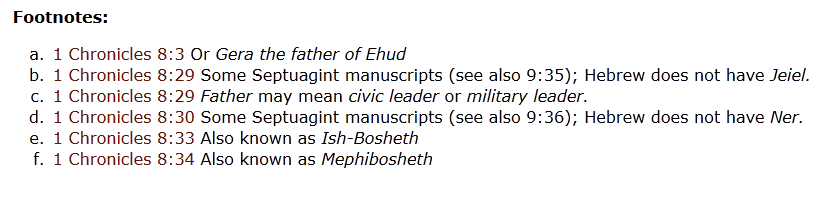
The corruption of these texts are clear to anyone who actually reads the Bible. Footnotes make it clear that variants, numerous as they are, quite clearly exist. In fact, the author and his intent is already known to us, unlike Mr. Edwards, most of you who would have read this previous post, would have seen this quote:

This passage to the end of the 38th verse is found with a little variety in the names, 1 Chronicles 9:35-44.

The rabbins say that Ezra, having found two books that had these passages with a variety in the names, as they agreed in general, he thought best to insert them both, not being able to discern which was the best.

His general plan was to collate all the copies he had, and to follow the greater number when he found them to agree; those which disagreed from the majority were thrown aside as spurious; and yet, in many cases, probably the rejected copies contained the true text.

If Ezra proceeded as R. Sol. Jarchi says, he had a very imperfect notion of the rules of true criticism; and it is no wonder that he has left so many faults in his text.

The reason that these two contradicting genealogies made it into the Bible’s codex (collection) is due to the fact that the author just didn’t know which one to include! He could not decipher the veracity of God’s holy word (according to the Exegesis quoted above). Hence, I don’t see how Mr. Edwards can say we ignored scholarly exegesis or refused to take it into consideration when it fact it was included in our first post on this topic. We do hope he can confess that he either did not read the initial post or come to terms with his selective amnesia. In fact, he goes so far as to claim it was on purpose that the genealogies contradict:

The chronological differing between the two genealogies of 1 Chronicles is a purposeful anachronism, and it is not the only incident of intentional gapping being used by Biblical writers, in fact it was quite a common device in oral cultures who routinely compressed information.

Yet, he later contradicts himself by quoting a scholar who says the only reason this contradiction existed, is due to manuscript and scribal errors:

” This register has already occurred in 1 Chron 8:29-38, along with those of other families of the tribe of Benjamin, and is repeated here only to connect the following history of the kingship with the preceding genealogical lists. It forms here the introduction to the narrative of Saul’s death in ch. 10, which in turn forms the transition to the kingship of David. The deviations of this register from that in 1 Chron 8:29-38, show that it has been derived from another document in more complete preservation than that in ch. 8, which had been handed down in connection with other genealogies of the Benjamite families..”[DELITZSCH BIBLE COMMENTARY – THE BOOK OF 1 CHRONICLES]

Apparently, unable to read what he’s quoting, Mr. Edwards presents two contradicting narratives:

(1) It was the author’s intent to have two contradicting genealogies, one chapter after the other.
(2) It was manuscript corruption and lack of preservation which caused the contradictions.

Unless the author some how magically intended to differ the genealogies by manuscript corruption, hundreds of years after the text was written, I can safely doubt Mr. Edward’s is rational.We would like to thank him for providing his contradicting arguments, or shall I say, “contridicting” arguments and the wonderful quote which proved that this contradicting genealogy exists due to manuscript corruption and lack of preservation.

wa Allaahu Alam.
[and God knows best.]

Qur’anic Miracle: The Best Opportunity to Destroy Islam

The Prophet (peace be upon him) had an uncle who was known by the nickname ‘Abu Lahab’ which means ‘Father of the flame’ because of his fiery temper. This uncle was one of the staunchest enemies of the Prophet and of Islam.

He would follow the Prophet (peace be upon him) and whenever he saw him speaking to a stranger, he would wait till they had parted and then ask the stranger,”What did Muhammad  (blessings and peace be upon him) tell you ? Did he say black? Its white! Did he say morning? It’s night!”. He would state the exact opposite of what the Prophet (peace be upon him) said.

There is a chapter in the Qur’an called Surah Al-Masad This chapter prophesied that Abu Lahab and his wife will perish in the hell fire – implying that he would never become a Muslim and therefore will enter the hell fire:

“Perish the two hands of Abu Lahab, and perish he! Neither his wealth benefited him, nor what he earned. He will soon enter a Fire, full of flames. And his wife as well, the wicked carrier of the firewood. Around her neck there is (a collar of iron, like) a well twisted rope.”

تَبَّتۡ يَدَآ أَبِى لَهَبٍ۬ وَتَبَّ (١) مَآ أَغۡنَىٰ عَنۡهُ مَالُهُ ۥ وَمَا ڪَسَبَ (٢) سَيَصۡلَىٰ نَارً۬ا ذَاتَ لَهَبٍ۬ (٣) وَٱمۡرَأَتُهُ ۥ حَمَّالَةَ ٱلۡحَطَبِ (٤) فِى جِيدِهَا حَبۡلٌ۬ مِّن مَّسَدِۭ (٥)

This Surah was revealed 10 years before Abu Lahab died as an unbeliever in the battle of Badr. Many of Abu Lahab’s friends and other disbelievers accepted Islam during those 10 years after this Surah was revealed. Abu Lahab was very intelligent and one of the staunchest enemy of Islam who was always eager to try and prove that the Qur’an was false and was a human invention. All that Abu Lahab had to do, to prove the Qur’an and Surah 111 (al Masad) wrong was to say ‘I am a Muslim’– and the Qur’an would have been proven wrong.

Abu Lahab had 10 years to think over it, but he never recited the Shahadah. He did not have to behave like a Muslim. Even if he had lied and said that he was a Muslim, the Qur’an would have been proved wrong, yet he never did! If the Qur’an was not from God, and as critics claim, authored by a man, how would they have known that Abu Lahab would never accept Islam or pretend to be a Muslim? Only someone who knows the future can know for certain that Abu Lahab would never accept Islam, and this someone is God. Thus proving that the Qur’an is from God.

and God knows best.

Refutation: Can a disciple of Christ be racist ?

Bismillahir Rahmanir Raheem
بِسۡمِ ٱللهِ ٱلرَّحۡمَـٰنِ ٱلرَّحِيمِ ,

Just in time before the new year, Chessie L. Edwards is back again, trying to defend the racism within his faith. Let’s see what ignorance he spews this time:

Considering that to this vary day at the close of 2011 black Africans can be purchased in Muslim majority nations such as Mali, Mauritania and Sudan, I would have thought that Muslim Dawahist’s would have wanted to avoid the topic of slavery at all costs.

It perplexes me as to why an adult man, would steep so low into academic dishonesty, shall we remind him that citing statements should be done to prevent intellectual fraud. To begin with, Mali has actually outlawed slavery. Funny enough, it’s the very first country he lists. What exactly is the problem if these countries are Muslim in majority? That’s called appealing to the fallacy of a hasty generalization, a commonly used fallacy. Meaning if one X does Y, then all X’s do Y. The problem here is that while Islam permits slavery, it does not permit Christian promoted slavery, also known as chattel slavery. Slavery in Islam is contractual agreement, a covenant of sorts between two parties, whereas in chattel slavery it is forced labour, something we shall discover later on the Bible endorses in great detail.

The notion is creeping up yet again that Christianity was the cause of the trans-atlantic slave trade and that the Bible is a book of White racist ideology, a throw back to more Biblical ignorant times of propagandist………..

This is the denial of basic history by a desperate man. My peoples, the children of slavery, my home, the results of slavery, are imbedded within my people’s culture. The streets I walk on, our capital city (Puerta de Espana – Port of Spain), the many forts we have, the many sugar estates which still exist are all evidences against this Chessie L. Edwards, but to protect his religion, this man has to stoop to low moral grounds. He’s not only denying the history we can experience today as left behind from my nation’s colonial rulers, but he’s denying history as acknowledged by the world:

The Church also supported the slave trade. The Spaniards saw in it an opportunity of converting the heathen, and the Jesuits, Dominicans and Franciscans were heavily involved in sugar cultivation which meant slave-holding. The story is told of an old elder of the Church in Newport who would invariably, the Sunday following the arrival of a slaver from the coast, thank God “that another cargo of benighted beings had been brought to a land where they could have the benefit of a gospel dispensation.” – [R. Terry, Some Old Papers relating to the Newport Slave Trade (Bulletin of the Newport Historical Society, July, 1927), 10.]

History speaks for itself and unlike my uneducated and cowardly counterpart, I am not afraid to cite my references from the numerous works authored on this massive topic. The next quote from his article really left me speechless. Sure, he’s already denied the historicity of Christian empowered slavery among my peoples, but it is low to distort his own scripture:

…………………..the egregious actions of the trans-atlantic slave traders were categorically condemned in the Holy Bible the only Word of God(before even the advent of Islam). A prime example of this can be found in 1 Timothy 1:8-10:

But we know that the law is good if one uses it lawfully, 9 knowing this: that the law is not made for a righteous person, but for the lawless and insubordinate, for the ungodly and for sinners, for the unholy and profane, for murderers of fathers and murderers of mothers, for manslayers, 10 for fornicators, for sodomites, for kidnappers, for liars, for perjurers, and if there is any other thing that is contrary to sound doctrine,

The problem with this argument, is that it backfires wholeheartedly on him. The Bible here is endorsing slavery as the Newport Slave Trade bulletin suggests, the Christians believed using slavery was as a means of gospel dispensation, they didn’t believe that slavery was an act of oppression, but a means of admittedly, spreading the religion of Christ, which is why the priest from the above quote, praised God for the “benighted beings”. In fact, Christianity and the Negro slave trade had become so synonymous that famous British authors and writers were documenting their close cohesion within their societal framework:

In 1750 Horace Walpole wrote scornfully of “the British Senate, that temple of liberty and the bulwark of Protestant Christianity,….pondering methods to make more effectual that horrid traffic of selling negroes. – [P. Cunningham (ed.), The Letters of Horace Walpole (London, 1891, II, 197. To Sir H. Mann, Feb. 25, 1750.)]

Mr. Chessie L. Edwards, the propagandist and denier of basic history that he is, then condemns himself in an abhorrent display of theological clown’s play:
 Yes slavery was in the Old Covenant law’s, it was governed and regulated but just as we see in the N.T an enslaver/manstealer/kidnaper was a Sinner in the Mosaic law as well.
Nowhere, does the New Testament outlaw slavery, in fact, I have demonstrated above where members of the Church were publicly endorsing Christianity, I’ll make it easier to refute Mr. Edwards by a brilliant quote:
……..another Liverpool slave trader, Foster Cunliffe, contributed largely. He was a pioneer in the slave trade. he and his two sons are listed as members of the Liverpool Committee of Merchants trading to Africa in 1752. Together they had four ships capable of holding 1,120 slaves, the profits from which were sufficient to stock twelve vessels on the homeward journey with sugar and rum. An inscription to Foster Cunliffe in St. Peter’s Church describes him this: “a Christian devout and exemplary in the exercise of every private and publick duty, friend to mercy, patron to distress, an enemy only to vice and sloth, he lived esteemed by all who knew him….and died lamented by the wise and good….” – [For Cunliffe, see Bourne, op. cit., II, 57, Botsford, op. cit., 122; Enfield, op. cit.,43, 49; Donnan, op. cit., II, 492, 497.]
Not only was this man praised by the Church for having the capability from one voyage to transfer 1, 120 slaves, he was praised for his service and deemed a friend to mercy, such to the extent this was inscribed on a Church! Unless Mr. Edwards has somehow developed amnesia, there is no excuse for his blatant disregard and misrepresentation of his faith when it’s this deeply related to slavery. To prove that the Bible does not endorse slavery, he refers to Shemot 21:16, what Christians call Exodus:
And whoever kidnaps a man, and he is found in his possession, shall surely be put to death.
Which sounds correct, until you read the beginning of the chapter and the meaning of this verse:
1. And these are the ordinances that you shall set before them. 2. Should you buy a Hebrew slave, he shall work [for] six years, and in the seventh [year], he shall go out to freedom without charge. 3. If he comes [in] alone, he shall go out alone; if he is a married man, his wife shall go out with him. 4. If his master gives him a wife, and she bears him sons or daughters, the woman and her children shall belong to her master, and he shall go out alone. 5. But if the slave says, “I love my master, my wife, and my children. I will not go free,” 6. his master shall bring him to the judges, and he shall bring him to the door or to the doorpost, and his master shall bore his ear with an awl, and he shall serve him forever.
Chessie L. Edwards was smart, he tried to deceive his readers by alienating the beginning of the chapter, where it promotes slavery, in fact it promotes slavery of a person forever as is clearly demonstrated above. What’s worse is that the verse he gave (16), does not mean that slavery means kidnapping, it actually means that a man cannot kidnap another man’s slave! For clarity, verse 16 is a law outlawing the kidnapping of another man’s slave, it’s okay to have slaves, just bad to take a slave from its owner, here is the Biblical commentary to support this:
Why is this said? Since it is said: “If a man be found to have stolen a person from among his fellow—men [he shall die]” I would know only [that this applies to] a man who stole another person.
By thus law every man-stealer, and every receiver of the stolen person, should lose his life; no matter whether the latter stole the man himself, or gave money to a slave captain or negro-dealer to steal for him. – Adam Clarke Biblical Commentary.
Isn’t it sad to see Mr. Edwards not only playing games with his scripture, but willingly misrepresenting it? If his character is this lowly, one must challenge this man’s credibility and sanity. In fact, he decides to say that the Bible only allows slavery, for economic purposes:
 Furthermore, slavery within the Old Testament context was sanctioned due to economic realities rather than racial or sexual prejudices….”
I shall question this logic by referring to Bamidbar (Numbers) 31 of the Old Testament, what economic problems or debts were the Israelites facing in order to commit this atrocity?
And Moses said to them: “Have you kept all the women alive?
Now therefore, kill every male among the little ones, and kill every woman who has known a man intimately. 18 But keep alive for yourselves all the young girls who have not known a man intimately.
and thirty-two thousand persons in all, of women who had not known a man intimately.
Were 32,000 virgin girls repaying some debt that Mr. Edwards would like to inform us of? I checked the chapter and you can too, right here. What economic problem or debt entails enslaving 32,000 virgins? Perhaps Mr. Edwards solution to his own debt problems is to get a virgin for himself to be intimate with? Mr. Edwards should probably work in wall street! He then goes on what I can assume is a drunken tirade, or probably drug driven rage of irrational, emotional, incoherent and inconsistent rabid ramblings:
Some of these dawahist desperate to give poor unsuspecting westerners “shahadah”(maybe to marry them?)
I checked the dictionary, I don’t know why he’s making up words again, it may be a side effect of a hangover, but what grown man, in an academic settings decides to sit down and make up words? “Dawahist”, sometimes I really wonder what’s in those bottles this man consumes.
may try to use Genesis 9:21-24 as proof that the Bible endorses racism. If anyone with at least half a bit of intellect would read the whole passage there is nothing in the text about Africa or African slavery.
Sure, there is nothing in the text about Africans or African slavery, the Bible is atleast in it’s complete form 700 years before the advent of African slavery, however Christians by and large (as demonstrated above) did in fact, use Bereishit (Genesis) 9:21-24 as a means of promoting slavery and distilling the gospel among the negro peoples:

The bells of the Bristol churches pealed merrily on the news of the rejection by Parliament of Wilberforce’s bill for the abolition of the slave trade. The slave trader, John Newton, gave thanks in the Liverpool churches for the success of his last venture before his conversion and implored God’s blessing on his next. He established public worship twice every day on his slaver, officiating himself, and kept a day of fasting and prayer, not for the slaves but for the crew. “I never knew,” he confessed, “sweeter or more frequent hours of divine communion than in the last two voyages to Guinea.” – [Larimer, op. cit., 100. & S. H. Swinny, The Humanitarianism of the Eighteenth Century.]

You read that correctly, while Mr. Edwards Genesis has anything to do with Biblical Slavery, the Christians in England were busy celebrating the prohibition of outlawing the slave trade. What a striking difference between Mr. Edward’s narrative and historical accounts. His drunken stupor then allowed him to state:

“The prophecy of Noah regrading Canaan was fulfilled in the Old Testament, there is no bases to apply it to anyone else or any other time period. If ignoramuses in the 1700’s tried to read their racist ideology into the text..”

Again, he finds himself at odds with missionaries and clergy men:

Many missionaries found it profitable to drive out Beelzebub by Beelzebub. According to the most recent English writer on the slave trade, they “considered that the best way in which to remedy abuse of negro slaves was to set the plantation owners a good example by keeping slaves and estates themselves, accomplishing in this practical manner the salvation of the planters and the advancement of their foundations.” The Moravian missionaries in the islands held slaves without hesitation; the Baptists, one historian writes with charming delicacy, would not allow their earlier missionaries to deprecate ownership of slaves.74 To the very end the Bishop of Exeter retained his 655 slaves, for whom he received over 12,700 compensation in 1833. Church historians make awkward apologies, that conscience awoke very slowly to the appreciation of the wrongs inflicted by slavery and that the defence of slavery by churchmen “simply arose from want of delicacy of moral perception.” – [ Mackenzie-Grieve, op. cit., 162., G. R. Wynne, The Church in Greater Britain (London, 1911), 120., H. of C. Sess. Pap., 1837-8, Vol. 48. The exact figure was 12,729.4.4 (pp. 19, 22)., Wynne, op. cit., 120; C. J. Abbey and J. H. Overton, The English Church in the Eighteenth Century (London, 1878), II, 107. and its results, in F. S. Marvin (ed.), Western Races and the World (Oxford, 1922), 130-131.]

He then begins to divert attention from his own Bible, by trying to claim the Qur’aan allows the chattel slavery of the Bible:

“…then they are no worst off then the Muslim slavers(many illiterate unable to read the Bible see Quran 62:2) who used the same misunderstandings to justify their own actions in Africa.”

So what does Qur’aan Surah 62, Ayat 2 say?

It is He Who has sent amongst the Unlettered a messenger from among themselves, to rehearse to them His Signs, to sanctify them, and to instruct them in Scripture and Wisdom,- although they had been, before, in manifest error;-

There’s a reason the clown didn’t quote it in his article, because the citation is bogus, it’s not only irrelevant to the topic of discourse but goes on to demonstrate how desperate he has become. To deflect from his own ignorance of the Qur’aan, history and Biblical teachings he has to cast a diversion to draw aspersions on a scripture he incorrectly referenced. May God help this jackal of a man. His own words continue to defile any form of intellectual responsibility and accountability:

Further more the reality is that Slavery was not nearly eradicated from the earth  by Mullahs, Ulamah, and Caliphs, but the abolitionist movements which were germinated and watered by many Christians who looked keenly into the Bible and saw that the enslavement of people of African decent was abhorrent and needed to be stopped. May I remind the reader that the only reason slavery is not as prevalent in the Muslim world as it was even 60 years ago is because the principles of the abolitionist movement enshrined in Western culture influenced(or just shamed) the Muslim world?

This is probably one of the dumbest statements a man can make. The Muslims (West African tribes) were the slaves, brought forcibly to the West Indies. How could a Muslim in Arabia free a slave in the Caribbean? Mr. Edwards is trying to claim that it wasn’t Muslims who abolished slavery, it was the English Christians. Whereas this isn’t the case. To begin with, the very first person to propose enslaving Africans was a Christian. Christian priest, Bartholomew de la Casas, whom himself had slaves, proposed the use of Africans to ease the suffering of the slavery of the Amerindians. Lest we digress, how could the Arabs who did not have colonies in the West Indies, abolish the slave colonies of the Christian world super powers of England, France and Spain? I demand to know what is the source of this man’s logic.

“…where is the Muslim world’s William Wiberforce? Where is the Islamic John Brownfighting slavery in Dar ul Sudan? When has there ever been any indigenous grassroots abolitionist movement in a Muslim land?”

Well to answer our ignorant friend’s question, roughly 1200 years before any of these figures existed, Muhammad (peace be upon him) commanded the freeing of slaves through the revelation of the Qur’aan:

Indeed We have created man (to live) in hard struggle. Does he think that no one has power over him? He says, “I have spent a lot of wealth.” Does he think that no one has seen him? Did We not make for him two eyes, And one tongue and two lips, And showed him the two ways? Yet he did not make his way through the steep course, And what may let you know what the steep course is? It is freeing the neck of a slave.

In fact the Qur’aan clearly details removing slavery:

…..And those who seek a contract [for eventual emancipation] from among whom your right hands possess – then make a contract with them if you know there is within them goodness and give them from the wealth of Allah which He has given you. And do not compel your slave girls to prostitution, if they desire chastity, to seek [thereby] the temporary interests of worldly life. And if someone should compel them, then indeed, Allah is [to them], after their compulsion, Forgiving and Merciful.

It was even the Muslims who compelled the British to remove slavery from being legal, they even did so themselves, leading by example in Morocco:

Moorish envoy to England, in 1813, from Mulai Sulaiman, Emperor of Morocco (1794-1822), in whose reign Christian slavery was abolished in Morocco. His son Meïr Cohen Machim visited England in the same capacity in 1827.

 All slaves should show full respect for their masters so they will not bring shame on the name of God and his teaching. 2 If the masters are believers, that is no excuse for being disrespectful. Those slaves should work all the harder because their efforts are helping other believerswho are well loved.
And that servant who knew his master’s will, and did not prepare himself or do according to his will, shall be beaten with many stripes.48 But he who did not know, yet committed things deserving of stripes, shall be beaten with few. For everyone to whom much is given, from him much will be required; and to whom much has been committed, of him they will ask the more.
wa Allaahu Alam.
[and God knows best.]

Christianity’s History of African Hate

Bismillahir Rahmanir Raheem
بِسۡمِ ٱللهِ ٱلرَّحۡمَـٰنِ ٱلرَّحِيمِ ,

As a young adult, growing up in the Caribbean we are educated deeply into the history of slavery. After all, slavery has left a unique footprint in the lives, culture, status, economy of the Caribbean peoples. The majority of inhabitants of the Caribbean isles (and some mainland states) are either of African or Indian descent. We all know that there was the African Triangular Slave Trade where estimates of 6 million to 65 million Africans were captured and brought to the Western hemisphere. What is lesser known is the slave trade of the Indian peoples, although termed “indentureship”, for which the Indian peoples willingly signed into contractual labour on the sugar estates, the purposeful lack of judicial oversight, in the end made indentureship into a fancy title for the term, “slavery”. Although the Indians had contracts with the British, and the legal system to govern these indenturers was to be a judicial system, bribery, bias and overall need for cheap labour caused the abuse of this “legal system” to manipulate the contracts of these labourers.

Less I digress, Christianity has played or is known to have played a major role in the African Triangular slave trade. The question begs itself though, is there or was there Biblical justification for such an act of human degradation and torture? The answer may shock you and it’s a yes! A resounding yes. Just as today it is normal for a Christian to attack a Muslim, revile Muslims, abuse, curse Muslims, the same mindset was imposed on the Christians of the colonial era. They believed Africans to be of an inferior and cursed race, sanctioned by the sins of their forefathers, God had placed a sacred curse on the Africans and therefore it was the right of the Caucasian Christian peoples to impose severe punishment on God’s cursed people. This curse is known as the Curse of Ham and a person who has the Curse of Ham is identified by his dark skin colour:

Son of Noah and progenitor of one of the three great races of men whose ethnographical table is given by Genesis 10. Wherever the three sons of Noah are enumerated in the Bible, Cham is placed between Sem and Japhet. We may gather, however, from Genesis 9:24 that this enumeration is not based on their age, since Cham is there spoken of as the “younger son” of Noah, as compared, apparently, with both his brothers. The only incident of the life of Cham after the deluge, which is recorded in the Bible, is that related in Genesis 9:21-24. Cham sees his father under the influence of wine lying naked in his tent. He tells his brothers, who respectfully cover the patriarch. The sequel makes it plain that Cham was, on this occasion, guilty of great irreverence. For when Noah hears of the conduct of his sons he blesses Shem and Japhet, with their posterity, and he pronounces a curse, not on Cham, but on his son Chanaan and his descendants, predicting that they will be the servants of their bretheren.

You see, the story can indeed be found in the Bible, but the above excerpt from the Catholic Encyclopedia makes it clear what the punishment was, that these “cursed peoples”, had to be “servants/ slaves of their brethren”. The Geneva Study Bible makes it a bit more clear as to the verse’s meaning:

(r) He pronounces as a prophet the curse of God against all those who do not honour their parents: for Ham and his posterity were cursed.
(s) That is, a most vile slave.

What is striking is that Christians Right Wingers in America, claim that America is a Christian nation and always was a Christian nation. One must not forget that African Americans were not seen as human, or recognized as equals to Caucasian Christian Americans until 1954 under the Supreme Court’s decision in the Brown vs. Board of Education ruling. This extremely disturbing video displays the lengths to which Christian Caucasian Americans tortured innocent African Americans for over 60 years:

The contrast in Islam however, is vast, see this series of lectures by Shaykh Zahir Mahmood [db]:

wa Allaahu Alam.
[and God knows best.]


« Older Entries Recent Entries »