Category Archives: Rebuttals

Refutation: The Honourable Way Out of “Honour Killings”

Bismillahir Rahmanir Raheem
بِسۡمِ ٱللهِ ٱلرَّحۡمَـٰنِ ٱلرَّحِيمِ ,

Introduction

It is almost absurd to believe that of all peoples, that Christendom has decided to become outspoken and condemn honour killings, when they are almost single handedly responsible for promoting this culture of honour killings, beliefs enshrined in their own scripture. Note, this is not a defense of honour killings as this sort of act is haram in Islam, as this is seen as murder, but this is a treatise on the issue as raised by the Answering Islam team. The Qur’an says on murder:

“Whoever kills a believer deliberately, his reward is Jahannam: he shall remain FOREVER therein, and Allah will be furious with him and will curse him, and will prepare for him a wretched torment”. – Qur’an Surah 4: Ayah 93.

The article on Answering Islam, demonstrates that this was an act common some 1075 years before Christ, credited to the Assyrian civilization, yet fails to recall, that this was an act that YHWH prescribed:

“‘If a priest’s daughter defiles herself by becoming a prostitute, she disgraces her father; she must be burned in the fire.” – Bible, Leviticus 21:9.

Oddly enough, this very act is defined as an honour killing according to the the definition as provided by Oskar’s article:

Honour killings regularly make media headlines. Clan or family members are brutally murdered by one or more relatives because they feel that their victims have brought shame upon them by what is perceived as unacceptable sexual behaviour, marriage partners or dress codes. In order to restore lost honour, blood has to flow.

Actually, to be a bit more explicit, the act in Leviticus, fulfils every criteria that the Answering Islam team has highlighted in their definition to label an act as an honour killing. Hold this example from Leviticus in mind, as Oskar of the Answering Islam team, completely ignores what his own scripture says in this regard and tries to pin some loosely based conjectural concept on honour killings and then tie it to Islam.

Conditions That Still Allow Honour Killings to Happen Today

Oskar then references, several ayat from the Qur’an, namely: 18:66-84, 24:2, 4:34-35, 3:110, some ahadith, such as in Sahih Bukhari, #2.413, #8.805, #814, and #819. The problem is however, that none of these ayat or hadith references permit or allow honour killings. They do however, do state that there are punishments for adultery and fornication:

“The fornicating woman and the fornicating man, flog each one of them with one hundred stripes. No pity for them should prevail upon you in the matter of Allah’s religion, if you really believe in Allah and the Last Day; and a group of believers must witness their punishment.” – Qur’an Surah 24, Ayah 2.

None of these ayat, or ahadith permit civilian justice, meaning then, that anyone can take it upon himself to carry out the injunctions as listed in them. In fact, I’d request that the Answering Islam team, demonstrate for me, one ayah or hadith from that which they have referenced in the aforementioned article where they are supposed to take the law into their own hands. The truth is, such an injunction does not exist and their evidences for trying to atleast imply so, are shoddy at best. Oskar and the Answering Islam team seem to have forgotten that Muslims have Shari’ah courts, where these laws are supposed to be applied. On one end you seem Christians condemning Shari’ah courts but on the other, in an article on the use of Islamic law, they seem to have intentionally forgotten the processes through which Islamic law is practised.

To begin with, the Shari’ah in Islam, when it comes to the Hudud (penal code) are relegated to a Mufti (legal jurist), or a Shura (judging council) or Qadhi (Islamic Judge) wherein a fatwa (legal opinion) is delivered. This is done after consultation, evidence discussion, witness reports etc. Mufti Ebrahim Desai [db], expounds upon the legal tradition/ methodology in Islam in the following excerpt:

1.       According to Shariah, Fatwa is defined as:

“Fatwa is to communicate the Law of Allah with regards to matters of Deen substantiated by validations stipulated in the Shariah to those who enquire with regards to matters of revelation in a general way and in manner that is not enforcing or compelling (Al Misbah Fi Rasmil Mufti Wamanahihil Ifta Vol.1 Page 16)”

The words “matters of Deen” has been used in the definition and not “Laws of Shariah” as sometimes a Mufti is questioned with regards to issues that do not pertain to Amal (actions) like Salah, Wudhu etc. for example issues of Tafseer, Aqeedah, Hadith, general advice etc.

Stipulated validations refers to those Masaa’il which are proven from the recognized sources of Shariah.

“In a general way” means that the Fatwa could be applied or practiced upon by more than one individual. If others are faced with the same situation of the questioner, the fatwa issued could be practiced by them as well. This draws a distinction between Iftaa and Qadhaa. A Fatwa is more general and could be practised upon by many individuals. However, a Qadhaa (decree) issued by a Qadhi (Judge) can only be practised upon by the specific person regarding whom judgement has been issued. In short, a Fatwa is more general while a Qadhaa is specific for an individual.

Another fundamental difference between Iftaa and Qadhaa is that a Fatwa is not enforceable. That is a Mufti cannot compel the Mustafti (questioner) to practice upon his Fatwa. However, a Qaadhi (Judge appointed by the Muslim Government) has the power of Infaaz (ability to enforce practice of his Decree). If a citizen does not practice upon the decree of a Qaadhi, he could be charged on violation of a Court Judgement.

2.       In former times a Mufti was regarded to be a Mujtahid (one who deduces ruling directly from the sources of Shariah). Nowadays the term Mufti has become common to those who specialize in the field of Islamic jurisprudence (Fiqh). In reality, a Mufti nowadays only makes reference to the books of our illustrious Fuqahaa (jurists) and issues rulings in their books.

This therefore, soundly refutes the claim that Muslims are to execute the commands of the Hudud by themselves without taking their issues before Islamic judges to receive punishment from an Islamic court. Muslims are never commanded to take the law into their own hands, especially when it comes to punishments were persons have to be killed.

The Biblical Origins Behind Honour Killings

Recall the verse from Leviticus:

“‘If a priest’s daughter defiles herself by becoming a prostitute, she disgraces her father; she must be burned in the fire.” – Bible, Leviticus 21:9.

The Old Testament, under the command of the Christian God, YHWH, commands more rulings of death, to be issued by every Tom, Dick and Harry (instead of appealing to a court for cases to be tried):

“And he that curseth his father, or his mother, shall surely be put to death.” – Bible Exodus 21:17.

“For every one that curseth his father or his mother shall be surely put to death: he hath cursed his father or his mother; his blood shall be upon him.” – Bible, Leviticus 20:9.

These are some of many verses, which clearly fit the exact definition as provided by the Answering Islam team. It is quite hilarious to note that they completely ignored the inspired teachings of YHWH’s violent laws, which were enforced by Him throughout the centuries. Here are a few more:

“Anyone who attacks their father or mother is to be put to death.” – Bible, Exodus 21:15.

This one, encourages YHWH’s servants to commit genocide of an entire town if they shame them by serving other Gods:

“that troublemakers have arisen among you and have led the people of their town astray, saying, “Let us go and worship other gods” (gods you have not known),  then you must inquire, probe and investigate it thoroughly. And if it is true and it has been proved that this detestable thing has been done among you, you must certainly put to the sword all who live in that town. You must destroy it completely,both its people and its livestock. You are to gather all the plunder of the town into the middle of the public square and completely burn the town and all its plunder as a whole burnt offering to the Lord your God. That town is to remain a ruin forever, never to be rebuilt, and none of the condemned things are to be found in your hands. Then the Lord will turn from his fierce anger, will show you mercy, and will have compassion on you. He will increase your numbers, as he promised on oath to your ancestors— because you obey the Lord your God by keeping all his commands that I am giving you today and doing what is right in his eyes.” – Bible, Deuteronomy 13:13-19.

One of the most popular reasons for honour killings, are due to sexual gratification or due to sexual shame. Well, the Christian Old Testament, certainly isn’t a stranger to this belief:

“But if this charge is true (that she wasn’t a virgin on her wedding night), and evidence of the girls virginity is not found, they shall bring the girl to the entrance of her fathers house and there her townsman shall stone her to death, because she committed a crime against Israel by her unchasteness in her father’s house.  Thus shall you purge the evil from your midst.” – Bible, Deuteronomy  22:20-21.

The Honourable Way Out of Honour Killings

Oskar spends a considerable amount of time telling us to go to Jesus to prevent honour killings, yet that doesn’t seem to work (see link), not even for the very people who are said to be the direct descendants of Christ and his disciples. In fact, the only logical way of dealing with honour killings is to remove this culture of self justice from among a civilian populace. Authority to punish persons should not be given to all members of society, as they may not be able to exercise just rulings in light of tribal relations, relationship statuses, and even confirmation bias. Therefore it is best to have a form of a tribunal or court where cases of family disputes can be tried before relevant authorities who are trained and well educated in such fields. This prevents any unlawful killings by family members, wherein this regulates the norms and values of the society in relation to punishing a close relative for some shameful action.

In following from further reading from Oskar’s article, I’m quite a bit puzzled as to how these verses from the Bible, as presented by Oskar will help solve the problem of persons killing each other due to crimes of passion or honour:

John saw Jesus coming toward him and said, “Look, the Lamb of God, who takes away the sin of the world!” (John 1:29)

The time has come, Jesus said. The kingdom of God is near. Repent and believe the good news! (Mark 1:15)

Does Oskar intend to tell the man who just killed his daughter because she married a Muslim man, that a lamb is going to make him sinless? I fail to see the logic in Oskar’s argument. To me, it seems as if Answering Islam isn’t being honest with us, they are using a societal deviance to gain website views, as opposed to actually dealing with a growing problem. A problem, which, as I have demonstrated, was introduced to the world, by the laws of their vengeful and violent God.

Conclusion

Oskar’s article has been soundly refuted. His evidences were weak and his argumentation was poor. He failed at any point to establish a connection between Islam, Islamic law and the unIslamic act of honour killings. To the contrary, I’ve explicitly defined what Islamic law is, who is supposed to rule by it and how it is supposed to be practise. I have also demonstrated that Oskar’s own book, in itself is a source of literature which encourages such violent acts, which we as Muslims do wholly condemn.

wa Allaahu Alam.
[and God knows best.]

Debate: Br. Ijaz Ahmad vs Anthony Rogers

Bismillahir Rahmanir Raheem
بِسۡمِ ٱللهِ ٱلرَّحۡمَـٰنِ ٱلرَّحِيمِ ,

On the 26th of April, 2012, I received an e-mail from one, Anthony Rogers, proposing a debate between ourselves. This is the e-mail I received:

“Hello,

This is Anthony Rogers. I am writing in response to your request to receive an official e-mail concerning my challenge to you to debate the following proposition: “The Old Testament Teaches that the Angel of the Lord is a Distinct, Divine Person in the Godhead.”

The aforementioned challenge was originally issued by me in light of your claim that Christianity is an innovation upon Old Testament religion in regard to the Trinity.

Accordingly, I will be arguing that the Old Testament does in fact teach that the Angel of the Lord is a distinct divine Person. By calling Him a “Divine Person” I mean that He is nothing less than Yahweh. By saying He is a “Distinct, Divine Person inthe Godhead,” I mean that He is also distinguished from another person (or persons) who is/are also identified as Yahweh.

Since this was in response to your charge of innovation, you will accordingly take the negative position in this debate.

As far as date and time go, sometime in the evening on May the 27th (a Sunday) is good for me. I live in Nevada (USA), so let me know where you are so we can coordinate the time. ”

The topic which was proposed by Anthony and agreed upon by myself and of which will be debated is,  “The Old Testament Teaches that the Angel of the Lord is a Distinct, Divine Person in the Godhead.”

Date:
27th May, 2012.

Time:
6 PM (PST).
9 PM (-04:00 UTC).

Location:
Answering Christianity Paltalk room.

(On information on how to use Paltalk or to access the room, I will provide a brief instructional guide soon, insha Allaah, the debate however will be recorded and posted by both Anthony and myself).

Format:

Opening Statements
Affirmative: 20 minutes
Negative: 20 minutes

Cross-Examination:
Negative: 3 questions (1 minute question, 2 minute response)
Affirmative: 3 questions (1 minute question, 2 minute response)

Rebuttals:
Affirmative: 10 minutes
Negative: 10 minutes

Cross-Examination (2):
Negative: 2 questions (same time constraints as above)
Affirmative: 2 questions (ditto)

Rebuttals (2):
Affirmative: 5 minutes
Negative: 5 minutes

Closing Statements:
Negative: 10 minutes
Affirmative: 10 minutes

 
wa Allaahu Alam.
[and Allaah knows best.]

Debate: Br. Ijaz Ahmad vs Anthony Rogers

Bismillahir Rahmanir Raheem

بِسۡمِ ٱللهِ ٱلرَّحۡمَـٰنِ ٱلرَّحِيمِ ,

Does, “The Old Testament Teaches That the Angel of the Lord is a Distinct Divine Person in the Godhead“? Anthony Rogers and Br. Ijaz Ahmad faced off on the 27th of May, 2012. A thrilling encounter with an exciting back and forth discourse that provoked the crowd to swell throughout the night.

Click Here for the Audio Stream of the Debate or to Download >>

Christians in Nigeria Distance Themselves from Violent Pastor

Bismillahir Rahmanir Raheem
بِسۡمِ ٱللهِ ٱلرَّحۡمَـٰنِ ٱلرَّحِيمِ ,

Isang Udo-Akagha, is a Pastor from within Nigeria who has been continuously shunned by the Christian community for his hate tirades and violent rhetoric against Muslims. Sometime ago, several Muslim brothers, answered some of his claims here. Even though to this date, he’s still challenging for Muslims to debate him, yet when challenged, he runs and hides:

Can anyone remind the Pastor that he should really stop being deceitful. Why does he continue to challenge Muslims to debates, if he’s only going to run away from debating them? Quite the joker he is, indeed. In his latest rant, he found himself at odds with many members of the Nigerian Christian community who accept that Islam has nothing to do with the actions of Boko Haram, a group which the government of Nigeria also indicates as nothing to do with Muslims or Islam.

I thank the Christians who defended Muslims against the violent rhetoric of the Christian war-lord, Isang. This is the conversation that he himself, posted to Facebook:

wa Allaahu Alam.
[and God knows best.]

Why Robert Spencer Cannot Be Trusted

1. Spencer is no scholar of Islam

Firstly, Spencer himself claims he is a scholar of Islam, so to make such a powerful statement must be backed up with credentials. Scholar, Ivan Jablonka, stated that Spencer lacks “academic seriousness.

This is indeed true, because once we look at Spencer’s academic achievements, biography and scholarly claims, we find that indeed, Spencer has no academic qualifications whatsoever to claim he is a scholar about Islam. His friends seem to do so and this is highlighted on his website.

Academically, Spencer has only a Master’s degree in the field of religious studies.

If he is certainly no scholar, then him and his friends are indeed lying about his claims to pass off as an intellectual individual. If he is indeed lying, how then, can he be trusted? His credentials, online presence, website and statements then carry little weight.

2. Spencer cannot understand Arabic

Spencer has written about Islam, the Quran, the hadith and other Islamic sources that have been originally compiled in the complex Arabic language. Little does he know that the Arabic language is full of meaning and interpretation. But this makes it easier for him to misinterpret passages, especially without the reader knowing.

Academically, Spencer has only a Master’s degree in religious studies and not once in his life has he completed or undertaken an Arabic course or degree.

Most Islamic scholars study Arabic, Spencer lacks this crucial understanding.

3. Spencer tries to market and seek profit from books

As we know, Spencer is an author and has written numerous books about Islam. But you can see below that Spencer has uses Twitter not only to promote his web links, but also to conjure up interaction with leading or controversial professionals to try and promote his book.

Whether he is trying to make people interested in his book can be questionable, but raising awareness about it is certainly a promotional marketing strategy.

Even Spencer’s friends have tried promoting his work, such as conspiracy promoting anti-Muslim, Bat Ye’or, who wrote a surprisingly great review of Spencer’s book on Amazon.

Pamela Geller, Spencer’s close friend (co-founder of Stop Islamization of America (SIOA) and the Freedom Defense Initiative) also wrote a positive review for the audience of her website trying to help promote his works.

4. Spencer uses conspiracy to sell books

Did Jesus exist? Did Moses exist? These have been famous conspiracy theories that have grasped people’s imaginations for centuries and allowed people to gain profit. Spencer recently worked on a new book titled “Did Muhammad Exist?: An Inquiry into Islam’s Obscure Origins”. And it seems to have sold.

Forgetting the fact that Muhammad’s life has been narrated by countless people, being recorded and recounted to hundreds if not thousands of people recollected in hadith, Spencer makes things very complex and shifts to small holes in which he regards as proof that Muhammad didn’t exist.

As an example, Spencer asks as to why the early Islamic coins fail to acknowledge Muhammad or the Muslim faith. The simple answer would be that it doesn’t matter and people didn’t have to do it. Nevertheless, these little irrelevant things show that Spencer has cherry picked certain ideas and made them into a big issue. Once all the small ideas are combined, they can be made into a controversial book that sells.

5. Spencer was named by Norwegian terrorist Anders Breivik in manifesto

Spencer was named a total of 64 times by name in the manifesto created by Norwegian terrorist Anders Breivik shortly before he killed more than 70 people.

Breivik was influenced by Spencer and even recommended Spencer’s blog posts in his manifesto. He even went on to say, ‘About Islam I recommend essentially everything written by Robert Spencer’

6. Spencer is closely linked to Pamela Geller who received an extremist email

Spencer himself co-founded hate-group Stop Islamization of America (SIOA) and the Freedom Defense Initiative with fellow friend and blogger Pamela Geller.

In 2007, Pamela Geller received a dangerous email from an anonymous Norwegian, who claimed he/she/or they, were “stockpiling weapons” on her blog AtlasShrugs. The email clearly read “We are stockpiling and caching weapons, ammunition and equipment. This is going to happen fast.” Bloggers quickly reacted, printscreened and Geller issued an article afterwards (because she most likely had to).

If this person was indeed Breivik, then Geller is to be investigated. If the person was not affiliated to Geller, then Geller is still to be investigated because this could be a potential terrorist case.

As we know, Spencer is very closely linked to this woman and ignoring this may result in devastating consequences.

Breivik even recommended Geller’s blog posts in his manifesto.

7. Spencer fear-mongers

Spencer and Geller together, have long been active in spreading the idea that the U.S. is going to ‘Islamized’, a conspiracy ideology that is also remnant in far-right groups such as the Netherlands Party for Freedom and the English Defence League. Together they founded Stop the Islamization of America group, who constantly preach about how the U.S. is being ‘Islamized’.

With his blog JihadWatch, Spencer aids his group and propagates the concept that Islam is slowly ‘creeping’ into the West, whilst also making people hateful of Islam and Muslims too. Here, we see how Spencer funds the association of honour killings and relating them directly to Islam.

This campaign was funded by the Stop the Islamization of America group around the U.S. Islam is clearly attacked and linked to honour killings even though mainstream Islamic scholars have condemned honour killings and have stated they have no place in Islam.

It must be understood that Spencer has less credibility than the majority of Islamic scholars who have studied Islam, the Quran, hadith, traditions and the language of Arabic. Spencer only has a Master’s in religious studies.

8. Spencer picks and chooses to support claims

Conservative scholar, pundit and author, Dinesh D’Souza, stated that “Spencer’s historical argument is dubious. Itemphasizes violent passages in the Koran, while downplaying the passages that urge peace and goodwill.

As we know, the Quran, as well as speaking of violence also speaks about peace, justice and tolerance. It is blatantly obvious, that Spencer hardly mentions these. He seems to simply reject them, without understanding the verses and passages are there. It’s like he deliberately picks and chooses to suit fit. He has done this technique in his books too, like how he omits the details of the Nakhla raid (further highlighted in LoonWatch’s Understanding Jihad Series).

In his works, he tends to pick out what ‘Islamists’ and extremists say, but fails to recognise the words and actions of mainstream Islamic scholars. He even admits this on his website.

Clearly, Spencer omits out important elements in his works (such as the concept of the inner Jihad and peace treaties during Muhammad’s time), hence giving readers the one side of the coin. By doing this, he can manipulate the reader.

Fairness and Accuracy in Reporting (FAIR) correctly stated that “by selectively ignoring inconvenient Islamic texts and commentaries, Spencer concludes that Islam is innately extremist and violent”.

So if he continues to pick and choose facts and omit details that misleads the reader, then his credibility and bias is to be held into account. Ex-Nixon Aide and author, Robert Crane, correctly highlighted that “Spencer’s readers are carefully steered away from all contact with the Islamic interpretative tradition”.

9. Blatant anti-Islamic views

Charles Johnson, a former ally, friend of Robert Spencer stated that “Robert Spencer is an anti-Muslim blogger…And yes, I do mean ‘anti-Muslim’ — Spencer long ago crossed the line from simply criticizing radical Islamists to relentlessly demonizing all Muslims. And the bigoted, hateful comments he allows at his website are beyond disgusting.”

Spencer has also referred the Quran to the ‘Mein Kampf’, similar to hate-preacher Pamela Geller, who seems to be Spencer’s partner in crime. Comparing a religious book to Nazism is downright inaccurate and also hateful.

That being said, Spencer aims to highlight Jihad on his website, but with stances opposing Islam and referring the Quran as the ‘Mein Kampf’, it is an attack on Muslims themselves (like how Charles Johnson described earlier). So despite trying to highlight Jihad, it seems clear that Spencer is merely trying to demonize Islam and Muslim themselves(also see section 7).

M. Cherif Bassiouni, law professor, scholar and humanitarian, found the same rhetoric when he viewed Spencer’s website, stating, “After looking at your website, I was quite surprised to see how much hate, venom and misunderstanding you are fostering.”

Even in his book, The Politically Incorrect Guide to Islam (and the Crusades), Spencer states that ‘Islam’s only overarching moral principle is “if it’s good for Islam, it’s right”…’ But what about the Islamic pillar of giving charity (zakat)? Clearly, Spencer forgets this and misleads the reader to believe nothing good ever comes out of Islam.

As a self-confessed scholar of Islam, we would expect he would know about this. But it seems his bias shines straight through his work too.

10. Blatant anti-Islamic views even in his works

The first chapter of ‘The Politically Incorrect Guide to Islam (and the Crusades)’ is “Muhammad: Prophet of War”. We know that Muhammad was indeed part of many battles, but he was also part of peace treaties, social justice, welfare and community work too. This is hidden from view in this book.

Muhammad is again attacked in Spencer’s book “The Truth About Muhammad: Founder of the World’s Most Intolerant Religion”. Again, Spencer hides facts about peace treaties, social justice, welfare and community work and focussing more on war and violence through omit and omission (highlighted in section 8).

11. Spencer preaches about Quranic violence and forgets Biblical violence

What’s strange is that Spencer is very enthusiastic to comment and write about violence mentioned in the Quran (perhaps its his job to do so, highlighted in section 12). But Spencer skips his own faith.

As mentioned earlier, Spencer has a Master’s degree in religious studies. So surely, he would know of all the violence mentioned in the Bible? Nevertheless, Philip Jenkins studied violence in the Bible and in the Quran, and found that the Bible is ‘far more violent.’

Spencer is quick to critic Islam, but doesn’t seem to critic his own faith. He’s even created a book named “Religion of Peace?: Why Christianity Is and Islam Isn’t”.

This further shows he has bias (highlighted in sections 7, 8, 9, 10).

12. Spencer is funded

In 2011, the Center for American Progress released a report (called Fear Inc: ‘The Roots Of the Islamophobia Network In America’) showing that almost $43 million from seven charitable groups since 2001 served as a main driver of anti-Islamic campaigns and works.

The report stated that money had flowed into the hands of five key “experts” and “scholars”. These “experts” and “scholars” were Frank Gaffney, David Yerushalmi, Daniel Pipes, Robert Spencer and Steven Emerson. It is said that these key players (with others working alongside them) have been helping spread the anti-Muslim rhetoric and propaganda. Page 7 of the report shows us the main network.

The report was even covered by Fox News.

Spencer and his close friend Geller simply reject the detailed report, with no proof provided as to why it might be fake. It is brushed off their shoulders.

Additionally, in October 2010, an investigative report by The Tennessean found that IRS filings from 2008 showed that Robert Spencer earned $132,537 from the David Horowitz Freedom Center (who help Spencer with his website), and Horowitz himself gained over $400,000 for himself in just one year.

Conclusion.

As this article highlights, Spencer cannot be trusted.

Islamic scholar, Carl Ernst, correctly stated that “the publications of Spencer belong to the class of Islamophobic extremism that is promoted and supported by right-wing organizations, who are perpetuating a type of bigotry similar to anti-Semitism and racial prejudice. They are to be viewed with great suspicion by anyone who wishes to find reliable and scholarly information on the subject of Islam.”

Upon analysis, we have seen that Spencer indeed, picks and chooses his words in his works (highlighted in section 8). He deliberately misses out key concepts of Islamic history and even relies on what ‘Islamic jihadists’ (section 8) say, and not even what other mainstream scholars have to say. Another example of representing one side of the coin is how Spencer highlights quotes of violence in the Quran and seems to forget the ones that urge peace and justice. This reflects a serious case of bias.

Spencer has a close association with hate-groups such as Stop Islamization of America (SIOA) and has even links to key figures (surprisingly also connected to the Islamophobia network). Pamela Geller, a prominent hate-blogger, received an email from a terrorist (highlighted in section 6). Even if the email at hand (section 6) is not indeed the Norwegian terrorist Anders Breivik, then it is indeed a potential terrorist case that needs to be investigated by the main authorities.

What we do know for certain, is that Anders Breivik was deeply influenced by the likes of Spencer (highlighted in section 5) and people are constantly being influenced by him, which can possibly lead to catastrophic consequences, as we’ve seen. With the use of fear mongering, Spencer and his group Stop Islamization of America (SIOA) are manipulating the minds of the public. Breivik was one of these individuals.

As this article has highlighted using two well-researched reports (section 12), Spencer shows to have been funded by individuals or groups who have been closely linked together. Studies and research would suggest that Spencer is merely paid to do what he does. That is, to spread hate and criticize Islam and Muslims by any means necessary, whether it be to market his own books and even make close friends support his scholarly claims (i.e. reviewing his books to promote them for him).

But as for Spencer’s scholarly claims, they are clearly over-exaggerated by what seems to be the majority of his close friends and allies. This makes him pass off as an intellectual, when in fact, all he has is a Master’s in religious studies. He has not studied Islamic history, the Quran, or the hadith, whilst mainstream Islamic scholars such as Dr. Tahir ul-Qadri have dedicated their whole lives to studying the religion of Islam. They have more credential, expertise and reliability than Spencer.

In conclusion, there is more to Robert Spencer and his ‘scholarly’ claims than what meets the eye.

Written by Mr. F.

Matt Solomon: Runs from Debate Challenge

Bismillahir Rahmanir Raheem
بِسۡمِ ٱللهِ ٱلرَّحۡمَـٰنِ ٱلرَّحِيمِ ,

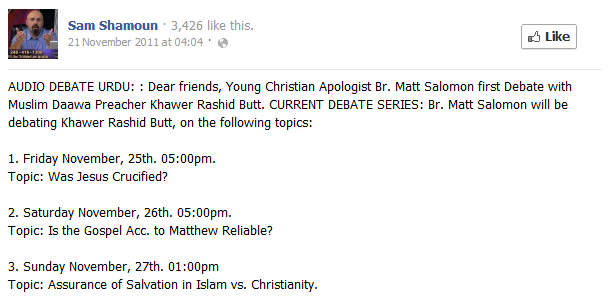
Sometime last year, I came across a young Christian apologetic (perhaps my age, he may be slightly older), challenging Muslims to debates. Here is Sam Shamoun advertising his debates:

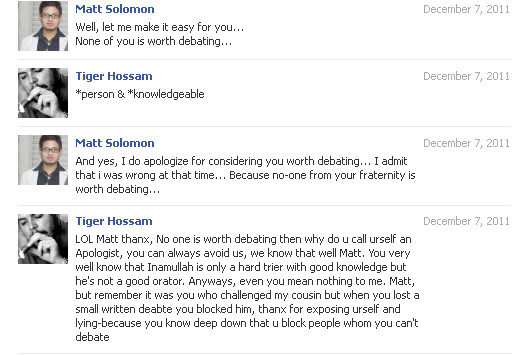
Now, one would assume, that after his debate, he would be ready to do another, well, it turns out, Matt’s afraid of facing defeat in debates again. He had one other debate with Muhammad Qaari Aalam and was thoroughly defeated a second time, to the extent we had Christians distancing themselves from his antics. Facing a failing Christian apologetics career, coupled with two humiliating public defeats, Matt decided he would no longer debate Muslims. The following is a Facebook conversation, where he was presented with a challenge to debate me:

There we have my first challenge to him, this was his response:

There we have it. Another missionary put to rest. Matt is running away from challenges, claiming no Muslim can face him. I personally intervened and sent Matt Solomon a message not too long after:

Matt Solomon never replied. I don’t know if it was simply a discourteous gesture or if he didn’t want his cowardice being promoted. He publicly argues with Muslims, claims to have debated scholars and claims again that no Muslim can defeat him or his ally Zia ul Masih, unfortunately, his claims are false and he’s another psuedo-scholar, who due to his own arrogance and public humiliations, will never be able to debate a Muslim again. In this light, I’m extending my hand to Matt Solomon, if he ever feels as if he needs a Muslim to debate, he can easily find me and accept my challenge to debate, after all we can’t let his “scholarly” education at CRC Bible Institute and at the Trinity Biblical University go to waste.

wa Allaahu Alam.
[and God knows best.]

Refutation: Where Did Jesus Say, “I Am God, Worship Me”? #2

Bismillahir Rahmanir Raheem
بِسۡمِ ٱللهِ ٱلرَّحۡمَـٰنِ ٱلرَّحِيمِ ,

After responding to David Wood’s article, located here, I came across Samuel Green’s addendum. In his presentation, he appealed to the Gospel narrative of Christ before the Sanhedrin located in Matthew 26:62-66, which reads:

“Then the high priest stood up and said to Jesus, “Are you not going to answer? What is this testimony that these men are bringing against you?” But Jesus remained silent. The high priest said to him, “I charge you under oath by the living God: Tell us if you are the Christ, the Son of God.” “Yes, it is as you say,” Jesus replied. “But I say to all of you: In the future you will see the Son of Man sitting at the right hand of the Mighty One and coming on the clouds of heaven.” Then the high priest tore his clothes and said, “He has spoken blasphemy! Why do we need any more witnesses? Look, now you have heard the blasphemy. What do you think?” “He is worthy of death,” they answered.”

Samuel’s point being that Jesus calls himself the son of God and therefore by admission, claims to be God:

“In a recent debate I was told that Jesus never said, “I am God worship me”. At that time I did not answer with the above verses but now I think I should have. The reason is that in these verses Jesus proclaims his divinity and that all people will worship him. First Jesus says he is the Christ/Messiah, the Son of God.”

The problem with this assertion, is that the title, “Son of God” is not a claim of divinity. It’s simple to prove, if we return to the Old Testament, specifically to Bereishit (Genesis), we have the exact phrase being used for the children of Adam:

” When human beings began to increase in number on the earth and daughters were born to them, the sons of God saw that the daughters of humans were beautiful, and they married any of them they chose. ” – Genesis 6:1-2 [NIV, same as Samuel’s version].

If therefore, the claim that anyone who is a son of God, is a God, then Moses, under inspiration from YHWH, when authoring the Book of Genesis claimed all the sons of Adam to be Gods. However, we know that this cannot be the case. Either it is that Samuel Green accepts the phrase, “Son of God” is not a title of divinity, or if he does assert that it is a title of divinity, then he must also bear witness that he worships Adam’s children. The case can even be furthered, if it is that the title, “son of God” is equivalent to being a God, then Samuel’s YHWH, has proclaimed to have many sons and therefore Samuel would have to accept he has many Gods:

“Then say to Pharaoh, ‘This is what the Lord says: Israel is my firstborn son” – Exodus (Shemot) 4:22.

“They will come with weeping;  they will pray as I bring them back. I will lead them beside streams of water  on a level path where they will not stumble, because I am Israel’s father, and Ephraim is my firstborn son.” – Jeremiah (Yirmiyahu) 31:9.

Mr. Green however, has seen it fit to distinguish Jesus’ claim to the son of Godship as something unique and prophesied to mean a divine Son of God. He does this by appealing to a version of Psalms 2:12, which reads:

Kiss the Son, lest he be angry and you be destroyed in your way, for his wrath can flare up in a moment. Blessed are all who take refuge in him.”

The problem with this however is that the phrase, “kiss the son”, is an interpolation, found in the Syriac MSS, however absent from the Septuagint, Masoretic Text, Vulgate, Ethiopic MSS and the Chaldee codices:

It is remarkable that the word son ( bar, a Chaldee word) is not found in any of the versions except the Syriac, nor indeed any thing equivalent to it.

The Chaldee, Vulgate, Septuagint, Arabic, and Ethiopic, have a term which signifies doctrine or discipline: “Embrace discipline, lest the Lord be angry with you,” and especially that in so pure a piece of Hebrew as this poem is, a Chaldeeword should have been found; bar, instead of ben, which adds nothing to the strength of the expression or the elegance of the poetry. I know it is supposed that bar is also pure Hebrew, as well as Chaldee; but as it is taken in the former language in the sense of purifying, the versions probably understood it so here. Embrace that which is pure; namely, the doctrine of God.” – Adam Clarke Biblical Exegesis, Psalms 2:12.

Seeing as that line of evidence for asserting Jesus’ divinity through sonship is faulty, if not wholly fraudulent, and with possibly knowing this, Samuel Green then attempts to qualify his eisegesis by appealing to Daniel 7:13-14, which reads:

“In my vision at night I looked, and there before me was one like a son of man, coming with the clouds of heaven. He approached the Ancient of Days and was led into his presence. He was given authority, glory and sovereign power; all peoples, nations and men of every language worshiped him. His dominion is an everlasting dominion that will not pass away, and his kingdom is one that will never be destroyed.” – Daniel 7:13-14.

Samuel interprets this passage as meaning the son of man (son of God) would be worshipped:

“Then Jesus says he is “the Son of Man sitting at the right hand of the Mighty One and coming on the clouds of heaven.” This language is again from the earlier prophets, the prophet Daniel, and is referring to the divine man who will receive the worship of God.”

The problem is, the word used in Daniel 7:14, doesn’t refer to worship, when we return to the Hebrew we find that the word used is פּלח, which means to revere, serve or minister. That is not to say that it can’t mean worship, but there is a contextual basis for this particular definition. It refers to authority, as persons have to revere, serve or minister to this person. Therefore to present it in a historical context, it is equivalent to the modern use of, “His worship the mayor”. A common term, referring to the respect and authority of a dignitary:

“often Worship Chiefly British Used as a form of address for magistrates, mayors, and certain other dignitaries: Your Worship.” – Dictionary Definition.

There is a distinction between the term used in Daniel, referring to power, authority, reverence and service/ ministering, and with this word שׁחה, which is used when referring to worship of a deity, as demonstrated below:

“Then the man bowed down and worshiped (שׁחה) the Lord” – Genesis 24:26.

 and I bowed down and worshiped (שׁחה) the Lord. I praised the Lord, the God of my master Abraham, who had led me on the right road to get the granddaughter of my master’s brother for his son.” – Genesis 24:48.

With these evidences having been presented, the texts and Hebrew examined, there is no doubt that Samuel Green has grossly misrepresented the Old Testament’s texts, as well as misinterpreting verses to project the view that Jesus is a God. Simple examination of his evidences, have rendered his argument void of any intellectual foundation, solely based on conjecture and most likely can be labelled as an act of gross desperation.

wa Allaahu Alam.
[and God knows best].

Refutation: Where Did Jesus Say, “I Am God, Worship Me”? [Updated]

Bismillahir Rahmanir Raheem
بِسۡمِ ٱللهِ ٱلرَّحۡمَـٰنِ ٱلرَّحِيمِ ,

David Wood of the Answering Muslims blog, has attempted to answer the age old question,”Where did Jesus say, ‘I am God, Worship Me‘?”. I say attempted, because as a person who studies the scriptures and the sciences related to understanding them, I must say that I am a bit bewildered by his methodology. However, before I begin dissecting his arguments I must address one noteworthy point. That is, none of the arguments nor any of the information he provides are new, rather they are oft repeated to the extent that they are void of any intellectual worth. The aim of this response therefore, is to merely provide a series of simple yet sufficient rebuttals to the points made.

The Fallacy of Reading Between the Lines:

From the onset, David relies on this particular fallacy, which can be defined as:

“The unwarranted associative fallacy “occurs when a word or phrase triggers off an associated idea, concept, or experience that bears no close relation to the text at hand, yet is used to interpret the text.”

A simple example would be:

John, a Christian, says he is a contractor.
Ahmad, a Muslim, says he is a contractor.
Ahmad is a Christian because he is a contractor.

This might sound utterly absurd to any remotely familiar with reason and logic. The implication being here, that the conclusion is void of basic comprehension skills. With this in mind, we’re going to up the ante of this argument by applying it to the reasoning from David’s article:

God of Christianity, says in Bible, I am X.
God of Islam, says in Qur’an, I am X.
The God of Islam is a Christian (or validates Christianity) because He says the same as the God of Christianity.

Following through with David’s logic, let’s replace X with “the truth”:

God of Christianity, says in Bible, I am the truth.
God of Islam says in Bible, I am the truth.
Therefore the God of Islam is a Christian (or validates Christianity) because he uses the same title as the God of Christianity.

At this point, one might be skeptical, that David does in fact make such an absurd assertion as the foundation for his response to the aforementioned question, “Where does Jesus say I am God?”. That he would try to prove this by associating the doctrine of one God with another from within two different scriptures and two entirely different religions, to validate his beliefs. Yet, if we read his article, this is exactly as he has done.

Judge by the Gospel?

David opens his argument, with the assertion that Christians, according to the Qur’an, must judge by the Bible or for that matter, the Christian Bible (Septuagint + NT) by referencing an ayah of the Qur’an:

Qur’an 5:47—“Let the people of the Gospel judge by what Allah hath revealed therein. If any do fail to judge by (the light of) what Allah hath revealed, they are (no better than) those who rebel.”

His mistake is clear from the onset, does David Wood truly believe that the God of Islam, Allaah, revealed the Bible, i.e. that it is Kalamullah, or does he subscribe to the belief that the Bible, is an inspired word of God as begotten from the articulated words of men? The latter would be his position, as he associates himself with the doctrine of the Answering Islam team[1].

He then proceeds once more to make another irrational claim, that the Qur’an commands Muslims to believe in the Greco-Roman New Testament and the Judeo-Christian Old Testament, claims which I have aptly refuted here and here. One must take into account, that the Qur’an never commands Muslims to believe in the alleged scripture of the Jews and Christians, which is known as the Bible, which in Arabic would either read, “Majmu ul Kutub”, or “Kitab al Muqaddas”, two terms which never occur in the Qur’an, thus through proof by contradiction, David’s assertion can be easily dismissed. However for a more indepth discussion, please see the two previous links. David then makes this statement:

“However, if Muslims are suggesting that Jesus could only claim to be God by uttering a specific sentence, we may reply by asking, “Where did Jesus say, ‘I am only a prophet, don’t worship me,’ in those exact words?”

We can negate the rationality of this argument, by conversing it.

From:
Where did Jesus say, I am only a prophet, don’t worship me?

To:
Where did Jesus not say, I am not only a prophet, worship me?

That brings us to the original question, where did Jesus claim to be anything more than a Prophet? If so, are we according to David’s logic, supposed to worship a person if they are more than a Prophet. If that is the case, is David Wood a polytheist? Demi-gods, are more than mere mortals who prophesy, would David, by applying his aforementioned reasoning (crossing religious doctrine with his own ideas), then bow to worship the Pagan Greco-Roman Gods? Of course, his answer would be an emphatic no, thus under his own reasoning, his very argument falls apart.

He then sought to summarize his argument, as such:

“Fortunately, we have a simple way to examine what Jesus said about himself. According to both the Bible and the Qur’an, there are certain claims that only God can truly make.”

If we take the above quote and we run it through the Reading Between the Lines Fallacy, as demonstrated above in my opening statement, we see that David arguments crumbles through various inconsistencies. It should be obvious to the reader, that the Qur’an and the Bible expound two clearly different doctrines of God, refer to two completely distinct forms of salvation and are fundamentally two distinct ideologies. However, David is asserting that if he finds two completely different deities making similar statements, then these deities are each other. In other words, if he can prove that Jesus makes a statement that Allaah (God) makes, then Jesus has to be God (Allaah).

With that in mind, let’s settle David’s argument with one final example:

Hercules says he is the son of the God, Zeus.
Jesus says he is the son of the God, YaHWeH.

Since Christians assert that Jesus claimed to be the son of God and Romans believe Hercules is the son of God, then this proves that Jesus is the son of God.

At this point, we can agree that this argument makes no valid sense. Yet, Christians both see Muslims and Roman polytheists as Pagans, yet David, seeks to prove his faith in Christ as a deity by using what he asserts is a pagan deity as evidences for his own God’s existence. We can even further refute his position by asking a simple question:

If Hindus believes that God is one, but represented in many forms and Christians believe God is one, but represented in many forms, does that mean that the Hindu religion is true?

The First and the Last.

Qur’an 57:3.
Isaiah 44:6.
Revelation 1:17.

His first line of evidence is to show that both the Old Testament and the Qur’an claim for God to be The First and The Last. Since both scriptures claim this is a title for God and Jesus “says” he is the First and the Last then,  this proves Jesus is God.

This is problematic for David, when one has read his article, he asserts that Isaiah 44:6, refers to the LORD or YaHWeH, for Christians that would be the Father. It’s a problem because if The Lord is the Father and the Trinitarian Godhead makes it clear that while both the Father and the Son are God, the Father isn’t the Son, nor is the Son the Father. Since this is the case it doesn’t matter what Jesus claims as he cannot be YHWH from Isaiah 44:6. Following from that logic, he also cannot be Allaah from Qur’an 57:3, because of Qur’an 112:3. The final question which begs itself, is this is all a dream from John, as he references the Book of Revelation or the Revelation of John (a dream), therefore I must ask David, if any Christian gets a dream about Jesus claiming something, would he also accept it as the truth? As an example, if I dreamed that Jesus claimed he wasn’t the first or the last, would he also accept it as divinely inspired revelation?

I ask this because David asks if a mere Prophet would claim these divine titles, in response, I am asking, how is Jesus making this claim? It isn’t. It’s a dream someone had, claiming Jesus said these things.

Who Forgives Sins?

Qur’an 3:135.
Psalm 51:4.
Daniel 9:9.
Mark 2:5-7.

From the passage in Mark, Jesus “forgives” a man of his sins. Since God alone can forgive sins, David asserts that Jesus is God. The problem is this, who is doing the forgiving? Is it Jesus, or is it the Lord? We read from Psalms itself:

“Praise the Lord, my soul, and forget not all his benefits—who forgives all your sins.” – Psalms 103:3.

Who forgives all sins? The Lord, or YHWH, or as Christians call him, the Father. Since the Son is not the Father and the Father is not the Son, then we have to conclude that the Father (The Lord, YHWH) is the one who forgives all sins. This is proven by another verse of the Bible:

“Fellow Israelites, listen to this: Jesus of Nazareth was a man accredited by God to you by miracles, wonders and signs, which God did among you through him, as you yourselves know.” – Acts 2:22.

Indeed, it was a miracle that the man was forgiven, but as the Bible rightly says, God alone forgives all sins and God did these acts through the person of Christ.

The Light.

Qur’an 24:35.
Psalm 27:1.
John 8:12.

The Qur’an calls Allaah the light of the heavens and the earth, David calls YHWH (The Father), the Light and Jesus “claims” to be the light in the Gospel.

There again, is another problem here. If the Father is not the Son and the Son is the Father, according to the Trinitarian Godhead that is, then how can the Son claim to have the same title as the Father?

If he has also read the verse of the Qur’an in comparison with the verse from John, how is it that someone who claims to be the light of the earth, is equal to one who is the light of the heavens and earth? Would he therefore claim that if I can light a room, but my brother can light a room and a car, that we are equal? Of course not.

The Truth.

Qur’an 22:6.
Psalm 31:5.
John 14:6.

There again, is another problem here. If the Father is not the Son and the Son is the Father, according to the Trinitarian Godhead that is, then how can the Son claim to have the same title as the Father? The two are distinct, yet David is asserting they are the same person.

I suggest he read James White’s The Forgotten Trinity which makes it clear there are three persons, distinct and co-equal, yet not each other, or one can read James White’s, “A Brief Definition of the Trinity“, wherein he writes:

“There are three eternal Persons described in Scripture – the Father, the Son, and the Spirit. These Persons are never identified with one another – that is, they are carefully differentiated as Persons.”

However, if we do read his example, what’s the context of Jesus’ statement?

“Jesus said to him, “I am the way, and the truth, and the life; no one comes to the Father but through Me.”

Jesus is saying here, that he is the truth, if one wants to come to the Father. In other words, he (Jesus) is the truth of the Father. Something Muslims can identify with, Jesus is indeed a sign of the truth of God, or as we would say, an Ayat ar Rahman (a sign of God).

The Final Judge.

Qur’an 22:56-57.
Psalm 9:7-8.
Matthew 25:31-32.

The problem is the same as above, if from Psalm 9:7-8, it is the Father who is judging and the Father is not the Son, yet the Son is doing the judging in Matthew 25:31-32, we must conclude that the Father is the Son. Which as we know, contradicts the Trinitarian doctrine of the Godhead and once again, David Wood, either displays that he isn’t a Trinitarian Christian or he is wholly ignorant of his very own doctrine. Quite funny, that he seeks to contradict his own faith, to prove Muslims wrong.

This situation of conflicting with the Trinitarian Godhead dogma doctrine, continues to conflict with his other two “evidences” of The Ressurection and God’s Glory.

Further Evidence.

He references Mark 2:28, which states that Jesus is the Lord of the Sabbath, that’s a problem however let’s just quote verse 27 and 28:

“Then he said to them, “The Sabbath was made for man, not man for the Sabbath. So the Son of Man is Lord even of the Sabbath.”

The context of this verse is that man is the master (the Greek word used for Lord is Kurios [κύριος]), which doesn’t refer to a divine being, it refers to a Master or a Sir, someone of authority, the word for a divine authority such as a God would be Theos. So the verse is generally saying that men are masters of the Sabbath because it was made for them. Referencing a Talmudic law, Rabbi Michael Skobac speaks about in this lecture .

Jesus demonstrates that man is the master of Sabbath, by referencing the story of David, wherein David’s men enter the Tabernacle and eat from the Holy Bread. A bread which they are not normally allowed to consume. In fact in the story of David, we read that the men are even called holy:

“The men’s bodies are holy even on missions that are not holy. How much more so today!”  So the priest gave him the consecrated bread, since there was no bread there except the bread of the Presence that had been removed from before the Lord and replaced by hot bread on the day it was taken away.” – 1 Samuel 21.

Therefore his argument that men are the masters of the Sabbath as been soundly defeated. According to Judaic law, certain laws can be broken in order to fulfil other rights of the Israelites, such as in both cases where they are starving. Something which Jesus himself references in Matthew 12:3-5:

 He answered, “Haven’t you read what David did when he and his companions were hungry?  He entered the house of God, and he and his companions ate the consecrated bread—which was not lawful for them to do, but only for the priests. Or haven’t you read in the Law that the priests on Sabbath duty in the temple desecrate the Sabbath and yet are innocent?”

David Wood, then references Matthew 22:41-45 where he claims Jesus is the Lord of David, again the word used here is master and indeed if Jesus was the Christ sent to Israel, then he was the Messiah of Israel, thus he would be also the master of David who was from Israel as well. If we ignore that fact, David Wood must be reminded that Matthew 22:41-45, contradicts Matthew 1:2.

David Wood, then proceeds by stating that Jesus claims to be greater than a temple of God, in Matthew 12:6. Which brings into question his reasoning, did he really believe that a building is holier than a Prophet? Poor reading of the scriptures gives bad study, and clearly he needs to read Malachi 3, which refers to the Messenger of God, the Messenger of the Covenant who will come to purify the Temple.

He then tries to demonstrate that Matthew 11:27 makes Jesus a God, because in this verse it reads, “No one knows the Son except the Father, and no one knows the Father except the Son“, this brings into question David’s understanding of the Trinity, as in verse 25 we read, “ At that time Jesus said, “I praise you, Father, Lord of heaven and earth“. The son therefore, in this scenario isn’t equitable or a co-equal with God, as he is praising (glorifying) the Father and is claiming his knowledge isn’t his own (isn’t God all knowing?), but that his knowledge is from the Lord (Father, YHWH). This verses proves the opposite, Jesus isn’t divine but dependent on God for his knowledge.

David Wood, then appeals to John 14:14, wherein Jesus is said to be able to answer prayers, rather, if we read verse 13, it states, “And I will do whatever you ask in my name, so that the Father may be glorified in the Son.“, a direct references to Acts 2:22, where it states, ““Fellow Israelites, listen to this: Jesus of Nazareth was a man accredited by God to you by miracles, wonders and signs, which God did among you through him, as you yourselves know“.

He then refers to Matthew 28:18 to demonstrate that Jesus is given power over earth and heaven by God, this is a problem for David, as the word used is εξουσία which as we can see refers to jurisdiction or authority. So what was Jesus given the authority to do? To command his disciples to preach to non-Jews, i.e gentiles as the following verses state, “ Therefore go and make disciples of all nations, baptizing them in the name of the Father and of the Son and of the Holy Spirit”, which contradicts Acts 15, wherein this was a debate raging between Paul and the disciples some 14 plus years after Jesus allegedly said those words.

John 5:21-23, is in accordance with Islamic theology, one must honor God and the one who brings God’s message (risalat), the one who brings God’s message is a rasul (messenger), so what does John 5:23 state why we should honor the messenger of God? Well it  says we should honor God by honoring the Messenger of God who was sent by God, “He who does not honor the Son does not honor the Father who sent Him“.

Further on he references areas where Jesus is worshipped in the New Testament in Matthew 2:11, 14:33, 28:17, Luke 24:52 and John 9:38. There is a problem however, the word does not exclusively mean to worship, in fact, it doesn’t mean to worship in the least. The word προσκυνέω as demonstrated in Strong’s Lexicon, means to bow to as the Orientals do to each other, to revere, to kiss or to even lick like a dog licking it’s master’s hand, yet never to worship as a deity. As for John 20:28, it is sufficiently refuted here and here.

Assessment.

As we can see, in all of the claims of David Wood, there are conflicts with his own Trinitarian Godhead doctrine, abuse of the translation of words from the Greek texts and improper reading of the New Testament by David. He has been unable to demonstrate a single case where Jesus himself, in an unequivocal, first person verbatim (Greek: Grapho) statement claims to be God. It is quite contrasting to the God of the Old Testament who had no problem in demonstrating that:

“I am Yahweh your God, who brought you out of the land of Egypt, out of the house of bondage. You shall have no other gods before me. You shall not make for yourselves an idol, nor any image of anything that is in the heavens above, or that is in the earth beneath, or that is in the water under the earth: you shall not bow yourself down to them, nor serve them, for I, Yahweh your God, am a jealous God, visiting the iniquity of the fathers on the children, on the third and on the fourth generation of those who hate me, and showing loving kindness to thousands of those who love me and keep my commandments.” – Exodus 20:2-6.

David Wood is almost giving the impression that the God of the New Testament is a muzzled God, unable to declare His deity. A God who so proudly claimed to be vehemently jealous, suddenly can’t claim his own deity. A God that destroyed entire nations for not worshipping Him, for worshipping the wrong God, suddenly is unable to clearly declare, as he once did, that he was a deity. It is shocking that David would like us to believe in such a timid God, a changed God, a reformed God, who is now meek and not jealous and insistent on declaring his identity.

Postscript: The Islamic Dilemma.

As it has been explicitly demonstrated, if it is that those statements which David chose are to represent the belief that Jesus was a deity, by making him the same person as the Father (YHWH), then he has to accede that the Trinitarian Godhead concept is wrong in that the two persons are not distinct, therefore conceding that he (David) is a Modalist. Something which his ally in Islamophobia, James White should have the guts to address, but then again, I wouldn’t expect either of them to correct each other publicly as it’s bad for business.

The concept that Islam believes that either the Masoretic Text/ LXX or the Greco-Roman New Testament texts are inspired by God and sanctioned by Islam as scripture, have been thoroughly refuted here and here.

wa Allaahu Alam.
[and God knows best.]

[1] – A Series of Answers to Common Questions, The Bible is Inspired but Paul Claimed Otherwise, by Sam Shamoun.

Update:

Derek Adams via the commenting section of Answering Muslim’s website, sought to defend David’s argumentation by supposing the following:

“Yeah you’re rebuttal doesn’t understand basic Christian doctrine. All three persons are LORD(YHVH). YHVH is not an exclusive name for the Father that cannot be applied to the Son.”

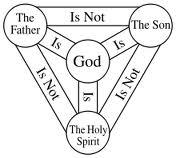
The problem with Derek’s statement, is that he is most likely not well studied in the doctrine of the Trinity, firstly, he should refer to this image which is used by most Evangelical groups to explain the Trinity to Muslims and Christians alike:

Secondly, to correct him:

The Father, The Son and The Holy Spirit are considered to be God (אלהים) in the Trinitarian Godhead. However The Father, The Son and The Holy Spirit are not all considered to be YHWH (יהוה) who is considered to be the Father, I shall qualify this with an example from the Old Testament:

“The Lord  (יהוה)  said to Abram after Lot had parted from him, “Look around from where you are, to the north and south, to the east and west.” – Genesis 13:14.

As opposed to:

“In the beginning God (אלהים) created the heavens and the earth.” – Genesis 1:1.

Wherein according to Christian dogma, The Father, Son and Holy Spirit are being referred to as Creators of the heavens and the earth in this verse. Yet, when YHWH is used it solely refers to the Father in the Old Testament, according to the Christian rendition of the Pentateuch (Greek Septuagint).

His confusion mostly stems from the English misuse of the word God in the Bible. It’s often easy to understand the plight of Christians, as even many Christian apologists have great difficulty in comprehending, if not teaching the dogma of the Godhead. This situation is worsened when the English renditions use the same words to refer to both a person of the Godhead and the Godhead’s unity in itself.

This understanding is qualified by one of Derek’s heroes or so to speak, Sam Shamoun in his article, “Jesus is indeed Yahweh God the Son!“, states:

“Moreover, since the Father can be identified as Yahweh in isolation from the others, the Son can therefore be identified as Yahweh’s Servant.”

Derek Adams then sought to reference that Allaah revealed to the Prophet [peace and blessings be upon him] the knowledge in dreams this therefore allows anyone with dreams to take their dreams as scripture. To correct Derek’s assertion, a Prophet in Islam is a Rasul who is the vessel through which the Risalat (Message) is revealed. So the Rasul can receive the Risalat in a variation of ways, as that is their purpose in this world, to deliver the revelation of God.

However, when it comes to John’s personal revelation (The Book of Revelation), he wasn’t a Prophet or Messenger and Christians acknowledge that in their doctrine, no other message was to come after the Gospel of Christ. Therefore Derek has again defamed himself and completely refuted his own arguments through appeal to ad ignorantium, what I like to commonly refer to as damnant quod non intelligunt, that being, they argue against that, which they do not understand.

wa Allaahu Alam.
[and God knows best.]
Refutation: Reading Deuteronomy 24:16 and Ezekiel 18:20 in context.

Bismillahir Rahmanir Raheem
بِسۡمِ ٱللهِ ٱلرَّحۡمَـٰنِ ٱلرَّحِيمِ ,

Samuel Green has sought to defend the Christian position of salvation by substitutional sacrifice. That being  that sin can be dispensed of through the death of another human being (Christ as the sacrificial lamb). At first, he references the two verses which negate such a teaching:

Fathers shall not be put to death for their children, nor children put to death for their fathers; each is to die for his own sin. (Deuteronomy 24:16, NIV)

The soul who sins is the one who will die. The son will not share the guilt of the father, nor will the father share the guilt of the son. The righteousness of the righteous man will be credited to him, and the wickedness of the wicked will be charged against him. (Ezekiel 18:20, NIV)

At this point, before I dissect the eisegesis of Samuel, we need to properly lay a foundation of the views which some of the more notable and erudite Christian exegetes themselves have taken, we read from Adam Clarke’s Exegesis the follow excerpt:

“None shall die for another’s crimes, none shall be saved by another’srighteousness. Here is the general judgment relative to the righteousness andunrighteousness of men, and the influence of one man’s state on that of another; particularly in respect to their moral conduct.”

We also read from Matthew Henry’s Complete Commentary on the Entire Bible that the persons who are punished are due to their own sinning brought about by themselves:

But this people that bore the iniquity of their fathers had not done that which is lawful and right, and therefore justly suffered for their own sin and had no reason to complain of God’s proceedings against them as at all unjust, though they had reason to complain of the bad example their fathers had left them as very unkind. “

Seeing as the Torah (Old Testament) is primarily the book of the Jews, it would be inappropriate to leave off their understanding of the verses referenced, we read from Rabbi Rashi’s commentary, the following excerpts from his exegesis of Devarim (Deuteronomy):

“Fathers shall not be put to death because of sons: [I.e.,] by the testimony of [their] sons. But, if you say [that it means that fathers shall not be put to death] because of the sins of their sons, it has already been stated, “each man shall be put to death for his own transgression.”

With these statements in mind, we now have a proper understanding from traditional Christian sources and Judaic sources as to the proper meaning of these verses. Samuel however, sought to circumvent the orthodox interpretations of these verses by claiming that he himself had a proper understanding based on Judaic principles:

“This, however, is not the case because both of these verses are referring to a person living under the covenant of the Torah (the Law of Moses). Deuteronomy 24:16 is part of the Torah itself and Ezekiel 18:20 is addressing the Israelites who were living under the Torah.”

Take note, that he’s claiming that he is representing the orthodox Judaic understanding/ context of the verses, yet nowhere, does he cite, reference or quote a single Rabbinic Judaic source to qualify his statements. It should be understood, that if he is attempting to represent the views of the people who lived under and held to the practise of the Torah, that he should atleast present one authoritative source from among these people to make extant their views. Instead, what he does is continue to quote verses, without referencing the Judaic interpretations. This therefore is a case of intentional decontextualization of a scripture by referencing a group of persons with specific beliefs, yet alienating their positions by transposing his own mendacious ideas about their belief on said scripture. He references the following verses as being representative of his position:

“(H)e must bring as his offering for the sin he committed a female goat without defect. He is to lay his hand on the head of the sin offering and slaughter it at the place of the burnt offering. Then the priest is to take some of the blood with his finger and put it on the horns of the altar of burnt offering and pour out the rest of the blood at the base of the altar. He shall remove all the fat, just as the fat is removed from the fellowship offering, and the priest shall burn it on the altar as an aroma pleasing to the LORD. In this way the priest will make atonement for him, and he will be forgiven. (Leviticus 4:28-31, NIV)

For the life of a creature is in the blood , and I have given it to you to make atonement for yourselves on the altar; it is the blood that makes atonement for one’s life. (Leviticus 17:11, NIV)”

He then interprets this in the following manner:

“This is why a lot of the Torah teaches about priests, sacrifices and the tabernacle/temple where the sacrifices were offered. The Torah teaches individual responsibility and forgiveness through a substitute sacrifice that bears our sin…..hese verses are not saying there is no sacrifice that can bear our sin. Instead they are saying that we are individually responsible for our sins and need to seek forgiveness through God’s provision of a substitute sacrifice that can bear our sin.”

Let’s examine his statements. To begin with, Samuel has mistakenly supposed that the animals bare the sin of the one who is doing the  sacrifice or of the one for whom the sacrifice is done. Recall, that nowhere is this stated in the verses he referenced. Note that the quotes he references makes it quite explicitly known that these sacrifices are an atonement. This is where his first problem begins, his understanding of what an atonement is, has been severely perverted. For example, if we follow through on his logic, then an act of atonement is one in which something bares the sin on behalf of the sinner:

“Make an atonement cover of pure gold—two and a half cubits long and a cubit and a half wide.” – Exodus 25:17.

In this scenario, we have a cloth, a cover becoming a source of atonement for the Jewish peoples. Nothing is being sacrificed, nor is anything perishing, suffering, or being tortured to bear the sin of a sinner. Rather a piece of cloth has become a means through which sins can be forgiven. Don’t take my word on it, Adam Clarke, the Christian exegete confirms this, he says:

“This propitiatory covering, as it might well be translated, was a type of Christ, the great propitiation, whose satisfaction fully answers the demands of the law, covers our transgressions, and comes between us and the curse we deserve. “

Note the conditions that are laid forth. The cloth has to accede to the demands of God’s law (that is, it has to be tailored, or exacted by those who are executing the criteria [law] as commanded by God), when that is done, those acts which fulfill the criteria as sent by God, then covers or atones for the sins of those who carry out the commands of God. From this we then see that the act of properly abiding by God’s command as an act of atonement, delivers us from His divine punishment. If we continue onwards, we read from Exodus (Shemot) 30:11-15, the following:

“Then the LORD said to Moses, “When you take a census of the Israelites to count them, each one must pay the LORD a ransom for his life at the time he is counted. Then no plague will come on them when you number them. Each one who crosses over to those already counted is to give a half shekel, according to the sanctuary shekel, which weighs twenty gerahs. This half shekel is an offering to the LORD. All who cross over, those twenty years old or more, are to give an offering to the LORD. The rich are not to give more than a half shekel and the poor are not to give less when you make the offering to the LORD to atone for your lives.”

In this case, Samuel’s God, is taking money as a form of expiation for sin. Note, no one is suffering, no one is being tortured, no one is being killed for sin. Money is being used as a form of expiation and as it is, in this case, just like the piece of cloth aforementioned, money is like a Christ here as well, being waged for the gift of life.

Where does this therefore leave us? What it does is indicate that Samuel’s understanding of what atonement is defined as, is incorrect. Atonement is not substitutional sacrifices, rather as I have demonstrated, atonement entails enacting certain criteria as set out by God in a way which sanctifies His divine commands. In the first scenario I presented, we see the stringent conditions for the cover, with God specifying what dimensions the cloth and gold have to be. In the second scenario we see that the certain condition to be undertaken is the amount of money to be  collected and from whom, that is, if they wished for their lives to be preserved.

Note, that nothing has to suffer or die, ergo, no blood is spilled, therefore nothing has died for the sins of anyone. Rather atonement as we can see, is not that something has bared the sin of another, but that atonement is a means through which one gains God’s forgiveness and mercy. Just like prayer, or fasting, these are also means of atonement, where we hold true to God’s divine commands, with whichever criteria He denotes as being the measuring stick to qualify our acts of repentance.

In conclusion, Samuel has not provided a strong argument to demonstrate that one object or person, or for the sake of argument, an animal can bear the sin of another. Rather what he has allowed us to demonstrate is that the sacrifices we make, whether with blood or gold, money or otherwise, are means of atonement because God has dictated them and they fulfil His criteria for forgiving us of our acts of inequity (sins).  In order for his point to be valid, he has to demonstrate that the proprietary cloth or the shekels collected by Moses had to suffer and die, blood had to magically spew from them, so that a price of sin was paid, as he clearly alludes to this in his referencing of the commands in Leviticus and with his mentioning of the alleged death of Christ.

wa Allaahu Alam.
[and God knows best.]

« Older Entries Recent Entries »