This is a response to David Wood’s article, which bears the aforementioned title. He says:
One of Allah’s 99 Names is al-Waddud, “the Loving.” Allah is called al-Waddud twice in the Qur’an. In 11:90, the prophet Shu’aib tells the people of Midian, “Ask pardon, then, from your Lord, then turn to Him; verily, my Lord is merciful, loving!” Likewise, in 85:12-16 we read:
Lo! the punishment of thy Lord is stern. Lo! He it is Who produceth, then reproduceth, and He is the Forgiving, the Loving, Lord of the Throne of Glory, Doer of what He will.
Nevertheless, other passages in the Qur’an qualify Allah’s love significantly. While Allah is said to love those who do good deeds (2:195), those who are pure (2:222), those who are righteous (9:7), and those who fight in his cause (61:4), the Qur’an is equally clear that Allah has no love for transgressors (2:190), ungrateful sinners (2:276), the unjust (3:57), or the proud (4:36).
David has a contention with God not loving those who transgress his law, although when we read the Bible, the God which David also believes in, punished transgression, He did not reward it:
The Lord our God is merciful and forgiving, even though we have rebelled against him; we have not obeyed the Lord our God or kept the laws he gave us through his servants the prophets. All Israel has transgressed your law and turned away, refusing to obey you.
“Therefore the curses and sworn judgments written in the Law of Moses, the servant of God, have been poured out on us, because we have sinned against you. You have fulfilled the words spoken against us and against our rulers by bringing on us great disaster. Under the whole heaven nothing has ever been done like what has been done to Jerusalem. Just as it is written in the Law of Moses, all this disaster has come on us, yet we have not sought the favor of the Lord our God by turning from our sins and giving attention to your truth. The Lord did not hesitate to bring the disaster on us, for the Lord our God is righteous in everything he does; yet we have not obeyed him. – Daniel 9:9-14.
According to this passage, transgressors and ungrateful sinners were promised to be punished by God, David’s God. If this is currently not the case, or David would appeal to the New Testament and ignore His God’s history, then David concedes one of two things, or both, those being:
YHWH was unloving, unmerciful, hateful at some point in His existence.
David has double standards and ignores YHWH’s pronouncements.
What’s worse for David is that his poor reading of the Bible, brings into question the love of YHWH, for even YHWH promises to destroy, torture and punish disbelievers, while on earth when Jesus returns in Zechariah 14. Where YHWH promises to rule ‘with an iron fist/ sceptre’ in Revelation 2:26-28, all of which I have covered extensively in my post concerning Christ’s Second Return According to the Bible. David also seemed to have a problem with God punishing the unjust and proud, yet his namesake, David of the Bible, prays to their God and asks Him to punish such people:
“Rise up, Judge of the earth; pay back to the proud what they deserve.” – Psalms 94:2.
The irony is staggering to say the very least. David goes on to say:
Even more significantly, the Qur’an states that Allah does not love non-Muslims:
Qur’an 3:31-32—Say [O Muhammad]: If you love Allah, then follow me, Allah will love you and forgive you your faults, and Allah is Forgiving, Merciful. Say: Obey Allah and the Apostle; but if they turn back, then surely Allah does not love the unbelievers.
Qur’an 30:43-45—Then turn thy face straight to the right religion before there come from Allah the day which cannot be averted; on that day they shall become separated. Whoever disbelieves, he shall be responsible for his disbelief, and whoever does good, they prepare (good) for their own souls, that He may reward those who believe and do good out of His grace; surely He does not love the unbelievers.
David’s inconsistency shines through once more, as even YHWH, as the Bible testifies, hates those who disobey Him and break His laws:
Ephraim’s glory will fly away like a bird— no birth, no pregnancy, no conception. Even if they rear children, I will bereave them of every one. Woe to them when I turn away from them!I have seen Ephraim, like Tyre planted in a pleasant place.
But Ephraim will bring out their children to the slayer.”
Give them, Lord—what will you give them? Give them wombs that miscarry and breasts that are dry. “Because of all their wickedness in Gilgal, I hated them there. Because of their sinful deeds, I will drive them out of my house. I will no longer love them; all their leaders are rebellious. Ephraim is blighted, their root is withered, they yield no fruit. Even if they bear children, I will slay their cherished offspring.” – Hosea 9:11-16.
According to David’s own God, He hates, He stops loving, disbelievers and sinners. In fact according to this verse, David’s God promises to never love Israel again. David’s own God, promises to damn an entire nation and stop loving them. Therefore, how can David say Allaah is wrong, when his own God, does the same?
Notice that 3:31-32 makes Allah’s love contingent on whether a person believes in Muhammad. This is similar to what we find in 19:46, which declares: “Lo! those who believe and do good works, the Beneficent will appoint for them love.”
How is this different to God dying for the sins of mankind (John 3:16) and then making this grace conditional on accepting Christ as a God? What’s the difference David? There is none.
Hence, although Allah is called “the Loving,” the Qur’an only means by this that Allah will love people once they believe in him and obey his prophet. The god of Islam has no love for sinners and unbelievers.
David seems to be forgetting that this is also the modus operandi of His God, as we saw in Zechariah 14, Revelations 2, Hosea 9, Psalms 94, and it is what his God promised in Deuteronomy Chapters 28, 29, 30 and 31.
Interestingly, the “Love me first and I’ll love you back” kind of love exhibited by Allah in the Qur’an is condemned by Jesus in Matthew 5:43-48:
“You have heard that it was said, ‘You shall love your neighbor and hate your enemy.’ But I say to you, love your enemies and pray for those who persecute you, so that you may be sons of your Father who is in heaven; for He causes His sun to rise on the evil and the good, and sends rain on the righteous and the unrighteous. For if you love those who love you, what reward do you have? Do not even the tax collectors do the same? If you greet only your brothers, what more are you doing than others? Do not even the Gentiles do the same? Therefore you are to be perfect, as your heavenly Father is perfect.”
Except that according to these verses, Jesus is condemning His ‘Father’s’ laws as demonstrated above. Which brings me to my conclusion. David seems to have ignored what YHWH has said about Himself in the Old Testament, what YHWH has promised to do to unbelievers, ungrateful sinners and the proud when he sends Jesus to return, and what YHWH declared as an eternal covenant to hate an entire nation of people because of their sins and transgressions against Him. Double standards, funny aren’t they David?
Mufti Abdur Rahman ibn Yusuf Mangera has an excellent video on the deification of Christ by Christians, wherein he also expounds upon the Islamic view of Jesus. It’s worth the watch, especially since the Mufti is hailed as being one of Islam’s most popular speakers and represents authentic scholarship:
Indepth, education and sensational, this lecture is simply brilliant and very informative for both the Muslim and Christian.
James White has done it again. It’s easy to spot the mistakes of a pretender, an actor and James White can’t stop making mistakes. This time, he embarrasses himself, his Arabic tutor and his ministry by demonstrating the ignorance of his Arabic tutor. If you haven’t subscribed to Br. Muslim By Choice’s videos as yet, you’re missing out on all the fun. Check out the video:
James and his mistakes just seem to be getting worse. Thank you for exposing James, Br. MBC!
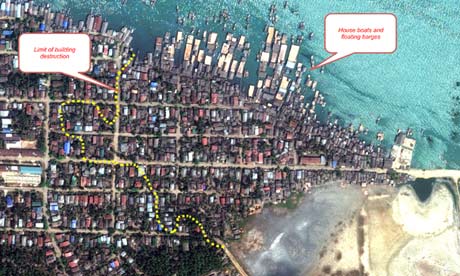
This image shows the vast amount of destruction done against an exclusively Muslim section of a Burmese town. In excess of 800 homes have been destroyed, 60+ killed and many injured. The follow article was sourced from the Guardian UK:
Burma’s president has admitted an unprecedented wave of ethnic violence has targeted his country’s Rohingya Muslim population, destroying whole villages and large parts of towns.
Thein Sein’s acknowledgement follows the release of satellite imagesshowing the severe scale of the destruction in one coastal town, where most – if not all – of the Muslim population appears to have been displaced and their homes destroyed.
The pictures, acquired by Human Rights Watchshow destruction to the coastal town of Kyaukpyu in the country’s west. They reveal an area of destruction 35 acres in size in which some 811 buildings and boats have been destroyed.
The images confirm reports of an orgy of destruction in the town which occurred in a 24-hour period in the middle of last week after violence in the province broke out again on 21 October.
The attacks in Arakan province in the country’s west – also known as Rakhine – appears to have been part of a wave of communal violence pitting Arakan Buddhists against Muslims that has hit five separate towns and displaced thousands of people.
“There have been incidents of whole villages and parts of the towns being burned down in Arakan state,” Thein Sein’s spokesman said.
A government spokesman put the death toll up until Friday at 112. But within hours state media revised it to 67 killed from 21-25 October, with 95 wounded and nearly 3,000 houses destroyed.
The president’s comments followed a warning from the office of the UN secretary general, Ban Ki-moon, that ethnic violence was endangering political progress in Burma.
“The vigilante attacks, targeted threats and extremist rhetoric must be stopped. If this is not done … the reform and opening-up process being currently pursued by the government is likely to be jeopardised,” the statement said.
The Burmese government is struggling to contain ethnic and religious tensions suppressed during nearly half a century of military rule that ended last year.
Inter-ethnic violence broke out earlier this year, triggered by the rape and murder of a Buddhist woman by three Muslim men.
Releasing the satellite images, Human Rights Watch said it had identified 633 buildings and 178 houseboats and floating barges which were destroyed in an area occupied predominantly by Rohingya.
A committee of MPs led by the Nobel laureate Aung San Suu Kyi called on Friday for security reinforcements and swift legal action against those behind the killings and destruction.
According to Reuters, dozens of boats full of Rohingyas with no food or water fled Kyaukpyu, an industrial zone important to China, and other recent hotspots and were seeking access on Friday to overcrowded refugee camps around the state capital, Sittwe.
Some 3,000 Rohingya were reported to have been blocked from reaching Sittwe by government forces and landed on a nearby island.
“These latest incidents between Muslim Rohingyas and Buddhists demonstrate how urgent it is that the authorities intervene to protect everyone, and break the cycle of discrimination and violence,” Amnesty International’s Asia-Pacific deputy director, Isabelle Arradon, said.
The latest violence erupted as a Burmese website in Norway – the Democratic Voice of Burma – reported it had acquired a document by a group calling itself the All-Arakanese Monks’ Solidarity Conference. calling for all Rohingya to be expelled from the country.
“Burma’s government urgently needs to provide security for the Rohingya in Arakan state, who are under vicious attack,” said Phil Robertson, deputy Asia director at Human Rights Watch. “Unless the authorities also start addressing the root causes of the violence, it is only likely to get worse.”
Human Rights Watch fears the death toll is far higher, based on allegations from witnesses fleeing scenes of carnage and the government’s well-documented history of underestimating figures that might lead to criticism of the state.
The Rohingya are officially stateless. Buddhist-majority Burma’s government regards the estimated 800,000 of them in the country as illegal immigrants from Bangladesh, and not as one of the country’s 135 official ethnic groups, and denies them citizenship.
But many of those expelled from Kyaukpyu are not Rohingya but Muslims from the officially recognised Kaman minority, said Chris Lewa, director of the Rohingya advocacy group, Arakan Project.
“It’s not just anti-Rohingya violence anymore, it’s anti-Muslim,” she said.
It was unclear what set off the latest arson and killing on Sunday.
Muslims have experienced large scale persecution for centuries, the Bosnian massacres, Iraqi war, Afghanistan war, Gazan genocide are just some of the conflicts in which Muslims were the targets, often times women and children being the main victims.
A close friend of mine asked for some arguments he can use to defend himself against a persistent Christian missionary, I complied with his request and made a 3 page printable PDF that contains 5 basic arguments to disarm and disable any missionary. The arguments are simple, but effective, they target three key areas of the Christian faith:
The Holy Nature of God in the Christianity- YHWH.
The Sinless/ Divine nature of Christ.
The Apostleship of Paul.
They are easy to remember, even easier to follow and can be learned within 10 – 20 minutes. The arguments are perfect for da’wah training, or anti-missionary work, even children from the ages of 7 could understand them.
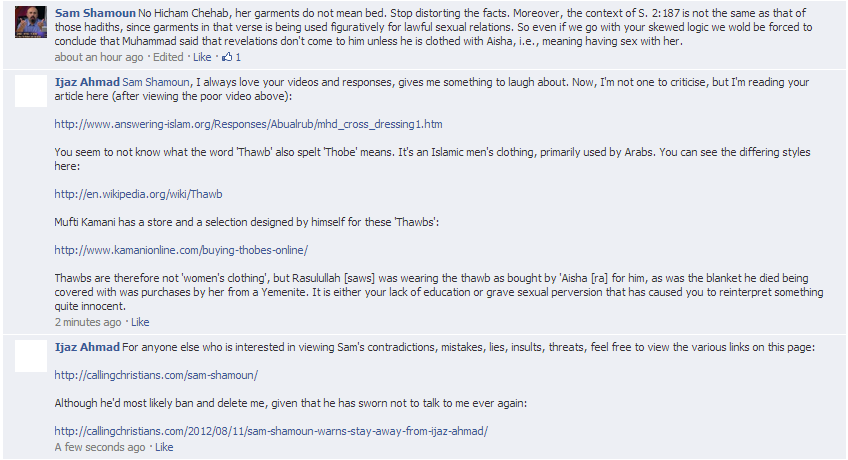
On the morning of Thursday 25th (2012), I decided to peruse Sam’s Facebook page. I then decided to respond to one of Sam’s intellectually devoid posts:
Unfortunately, Sam decided that he preferred not to respond and chose to delete and subsequently block me from commenting on his page. I see Christians who on a daily basis, run to Shamoun for help, they praise and glorify him, but here he is, running from Muslims. In fact, another Muslim (convert from Christianity), Br. Abdul Khaliq (read his apostasy from Christianity and acceptance of Islam here), who also began to comment on this comment thread was also blocked from further commenting. Why is Sam Shamoun afraid of discussing his beliefs and claims with Muslims? What has he to hide?
To the Christians who appeal to him, what does his behaviour demonstrate to you? Is he ‘defending’ the Gospel by running from his critics and detractors? David Wood (Sam’s buddy) who preaches ‘freedom of speech’ and who swears to defend ‘human rights’, why won’t he teach Sam to allow criticism of his uneducated statements? In fact, directly after Sam deleted my comments, he then posted a barrage of insults, abuses, curses which I have chosen not to reproduce. If you would like to see evidence of his lowly character click this link. In all honesty, I do not know Sam personally, but if this is the way he ‘preaches’, it explains why so many Christians who have never heard Muslim arguments, come to our pages and for the first time experience a real discussion. Sam’s gestapo – like tactics can only benefit Muslims, as these same Christians of whom he shelters on his page, try to take his arguments elsewhere and are then soundly debunked, opening their hearts and minds to Islam.
Br. Abdul Khaliq is just one of many Christians who have apostated from that faith, even though they were blocked from Islam by Christian preachers like Sam, but praise be to God who gave them guidance out of the darkness they were enshrouded within. Please do see these links for further responses to Shamoun:
Propaganda is an important part of argumentum ad baculum, essentially you are creating an enemy or attempting to justify some form of harsh tactics against an innocent person or group of persons. This is also a form of appeal to emotion, whereby you appeal to the sensitivities of people, whether that be their fears, likes, dislikes or addictions. In this case presented by Br. Shamiur Rahman, this is exactly what the NYPD has done. They’ve created a fear of threat, based on reasoning that is fallacious. Many right-wing Americans, such as David Wood, Sam Shamoun, James White and Pamela Geller, all owe their popularity to an impending threat of Muslim terrorism. A quick glance at their websites or radio shows, demonstrates clear cut fear mongering. Right wing America needs to foster this fear in order to promote whatever ideological views they seek to spread. For some, it could be votes, for others it is to promote a religion, the use of argumentum ad baculum is expansive. According to an article by the Huffington Post, the NYPD baited Muslims, rather created situations, manipulated Muslims and then prosecuted, spied and charged said Muslims based on their own preparations and planning:
NEW YORK — A paid informant for the New York Police Department’s intelligence unit was under orders to “bait” Muslims into saying inflammatory things as he lived a double life, snapping pictures inside mosques and collecting the names of innocent people attending study groups on Islam, he told The Associated Press.
Shamiur Rahman, a 19-year-old American of Bangladeshi descent who has now denounced his work as an informant, said police told him to embrace a strategy called “create and capture.” He said it involved creating a conversation about jihad or terrorism, then capturing the response to send to the NYPD. For his work, he earned as much as $1,000 a month and goodwill from the police after a string of minor marijuana arrests.
“We need you to pretend to be one of them,” Rahman recalled the police telling him. “It’s street theater.”
Rahman said he now believes his work as an informant against Muslims in New York was “detrimental to the Constitution.” After he disclosed to friends details about his work for the police – and after he told the police that he had been contacted by the AP – he stopped receiving text messages from his NYPD handler, “Steve,” and his handler’s NYPD phone number was disconnected.
Rahman’s account shows how the NYPD unleashed informants on Muslim neighborhoods, often without specific targets or criminal leads. Much of what Rahman said represents a tactic the NYPD has denied using.
The AP corroborated Rahman’s account through arrest records and weeks of text messages between Rahman and his police handler. The AP also reviewed the photos Rahman sent to police. Friends confirmed Rahman was at certain events when he said he was there, and former NYPD officials, while not personally familiar with Rahman, said the tactics he described were used by informants.
Informants like Rahman are a central component of the NYPD’s wide-ranging programs to monitor life in Muslim neighborhoods since the 2001 terrorist attacks. Police officers have eavesdropped inside Muslim businesses, trained video cameras on mosques and collected license plates of worshippers. Informants who trawl the mosques – known informally as “mosque crawlers” – tell police what the imam says at sermons and provide police lists of attendees, even when there’s no evidence they committed a crime.
The programs were built with unprecedented help from the CIA.
Police recruited Rahman in late January, after his third arrest on misdemeanor drug charges, which Rahman believed would lead to serious legal consequences. An NYPD plainclothes officer approached him in a Queens jail and asked whether he wanted to turn his life around.
The next month, Rahman said, he was on the NYPD’s payroll.
NYPD spokesman Paul Browne did not immediately return a message seeking comment on Tuesday. He has denied widespread NYPD spying, saying police only follow leads.
In an Oct. 15 interview with the AP, however, Rahman said he received little training and spied on “everything and anyone.” He took pictures inside the many mosques he visited and eavesdropped on imams. By his own measure, he said he was very good at his job and his handler never once told him he was collecting too much, no matter whom he was spying on.
Rahman said he thought he was doing important work protecting New York City and considered himself a hero.
One of his earliest assignments was to spy on a lecture at the Muslim Student Association at John Jay College of Criminal Justice in Manhattan. The speaker was Ali Abdul Karim, the head of security at the Masjid At-Taqwa mosque in Brooklyn. The NYPD had been concerned about Karim for years and already had infiltrated the mosque, according to NYPD documents obtained by the AP.
Rahman also was instructed to monitor the student group itself, though he wasn’t told to target anyone specifically. His NYPD handler, Steve, told him to take pictures of people at the events, determine who belonged to the student association and identify its leadership.
On Feb. 23, Rahman attended the event with Karim and listened, ready to catch what he called a “speaker’s gaffe.” The NYPD was interested in buzz words such as “jihad” and “revolution,” he said. Any radical rhetoric, the NYPD told him, needed to be reported.
John Jay president Jeremy Travis said Tuesday that police had not told the school about the surveillance. He did not say whether he believed the tactic was appropriate.
“As an academic institution, we are committed to the free expression of ideas and to creating a safe learning environment for all of our students,” he said in a written statement. “We are working closely with our Muslim students to affirm their rights and to reassure them that we support their organization and freedom to assemble.”
Talha Shahbaz, then the vice president of the student group, met Rahman at the event. As Karim was finishing his talk on Malcolm X’s legacy, Rahman told Shahbaz that he wanted to know more about the student group. They had briefly attended the same high school in Queens.
Rahman said he wanted to turn his life around and stop using drugs, and said he believed Islam could provide a purpose in life. In the following days, Rahman friended him on Facebook and the two exchanged phone numbers. Shahbaz, a Pakistani who came to the U.S. more three years ago, introduced Rahman to other Muslims.
“He was telling us how he loved Islam and it’s changing him,” said Asad Dandia, who also became friends with Rahman.
Secretly, Rahman was mining his new friends for details about their lives, taking pictures of them when they ate at restaurants and writing down license plates on the orders of the NYPD.
On the NYPD’s instructions, he went to more events at John Jay, including when Siraj Wahhaj spoke in May. Wahhaj, 62, is a prominent but controversial New York imam who has attracted the attention of authorities for years. Prosecutors included his name on a 3 1/2-page list of people they said “may be alleged as co-conspirators” in the 1993 World Trade Center bombing, though he was never charged. In 2004, the NYPD placed Wahhaj on an internal terrorism watch list and noted: “Political ideology moderately radical and anti-American.”
That evening at John Jay, a friend took a photograph of Wahhaj with a grinning Rahman.
Rahman said he kept an eye on the MSA and used Shahbaz and his friends to facilitate traveling to events organized by the Islamic Circle of North America and Muslim American Society. The society’s annual convention in Hartford, Conn, draws a large number of Muslims and plenty of attention from the NYPD. According to NYPD documents obtained by the AP, the NYPD sent three informants there in 2008 and was keeping tabs on the group’s former president.
Rahman was told to spy on the speakers and collect information. The conference was dubbed “Defending Religious Freedom.” Shahbaz paid Rahman’s travel expenses.
Rahman, who was born in Queens, said he never witnessed any criminal activity or saw anybody do anything wrong.
He said he sometimes intentionally misinterpreted what people had said. For example, Rahman said he would ask people what they thought about the attack on the U.S. Consulate in Libya, knowing the subject was inflammatory. It was easy to take statements out of context, he said. Rahman said he wanted to please his NYPD handler, whom he trusted and liked.
“I was trying to get money,” Rahman said. “I was playing the game.”
Rahman said police never discussed the activities of the people he was assigned to target for spying. He said police told him once, “We don’t think they’re doing anything wrong. We just need to be sure.”
On some days, Rahman’s spent hours and covered miles in his undercover role. On Sept. 16, for example, he made his way in the morning to the Al Farooq Mosque in Brooklyn, snapping photographs of an imam and the sign-up sheet for those attending a regular class on Islamic instruction. He also provided their cell phone numbers to the NYPD. That evening he spied on people at Masjid Al-Ansar, also in Brooklyn.
Text messages on his phone showed that Rahman also took pictures last month of people attending the 27th annual Muslim Day Parade in Manhattan. The parade’s grand marshal was New York City Councilman Robert Jackson.
Rahman said he eventually tired of spying on his friends, noting that at times they delivered food to needy Muslim families. He said he once identified another NYPD informant spying on him. He took $200 more from the NYPD and told them he was done as an informant. He said the NYPD offered him more money, which he declined. He told friends on Facebook in early October that he had been a police spy but had quit. He also traded Facebook messages with Shahbaz, admitting he had spied on students at John Jay.
“I was an informant for the NYPD, for a little while, to investigate terrorism,” he wrote on Oct. 2. He said he no longer thought it was right. Perhaps he had been hunting terrorists, he said, “but I doubt it.”
Shahbaz said he forgave Rahman.
“I hated that I was using people to make money,” Rahman said. “I made a mistake.”
The so-called ‘threat of Muslim terrorism’, is nothing more than propaganda, fostered by state institutions and private entities to fund their own personal gain. The emotion of fear is a powerful tool, when the State uses it to persecute innocents, it can only harbour racism, anti-Semitism and even sexism. Such tactics are referred to as entrapment, and seriously impede on the rights of citizens.
One of Br. Shabir Ally’s most famous arguments is derived from Luke 13:33, you can see him using it in this debate:
Sam Shamoun did a response to it along with a few other responses to Br. Shabir. Today I’d like to examine Sam’s ‘explanation’ and to analyse his statements, judging to see whether he has or has not rectified this theological conundrum. Sam begins by saying:
Shabir thinks that this verse is a contradiction and even proves that Jesus wasn’t killed:
“Nevertheless I must journey on today and tomorrow and the next day; for it cannot be that a prophet would perish outside of Jerusalem.”
Shabir assumes that this text clearly contradicts the fact that Jesus was crucified outside of Jerusalem.
Br. Shabir did not assume, he simply read the verse and utilized it’s clear meaning, for as Jesus allegedly says, “it cannot be that a prophet would perish outside of Jerusalem“. Meaning then, that a Prophet can only die in Jerusalem. Sam tries to answer this by stating:
In the first place, Jesus clearly says that he will be killed outside of Jerusalem:
Clearly then, Jesus contradicts his own words. His response doesn’t begin by refuting Br. Shabir’s argument, he actually initiates his explanation by debunking his own God. Brilliant work Sam. He then cites this verse and uses it as evidence that Jesus allegedly said that he would die outside of Jerusalem:
But when the tenants saw him, they said to themselves, “This is the heir; let us kill him, that the inheritance may be ours.” And they cast him out of the vineyard and killed him. What then will the owner of the vineyard do to them? He will come and destroy those tenants, and give the vineyard to others.’ When they heard this, they said, ‘God forbid!’” Luke 20:9-16
The tenants refer to the Jewish leaders and the vineyard refers to Jerusalem. In this parable, Jesus says that he, as the beloved Son, will be thrown out of the vineyard and then be killed. To put it another way, Jesus was saying that the Jewish leaders would have him killed outside of Jerusalem.
Now, I’m not sure if Sam really thought this explanation through, or if he is actively working to disprove the veracity of Christianity. There are a number of problems with Sam’s referencing and subsequent use of the aforementioned passage. Namely, that according to the parable the “Jews/ Tenants” would kill the “heir/ Jesus” for the “inheritance” and as a cause of this, the “Jews/ Tenants” would be destroyed. If Jesus came to die and the Jews fulfilled this purpose, according to this parable, God would have to kill the people that He sent to kill His son. Which is a problem, if Jesus came to die and the Jews fulfilled this purpose, why would God be angry at them? Secondly, if the “inheritance” here is the “gift of salvation”, shouldn’t God/ the Owner, be happy that they killed His son?
If I were for a moment to neglect Sam’s incompetence of dismantling his own doctrine, and to accept that Jesus predicts his death, according to Luke 13:33, shouldn’t he be killed in Jerusalem? Therefore this verse contradicts Jesus’ own words and presents severe theological faults with Christianity. Since this is the case, a methodological reinterpretation/ reading of Luke 13:33 must be undertaken to mask this scriptural blunder. Sam continues:
Now we anticipate that Shabir will say that this doesn’t resolve the problem and will wish to say that this only contradicts what Jesus said in Luke 13:33. Does it? Let us read the immediate context and see:
“Just at that time some Pharisees approached, saying to Him, “Go away, leave here, for Herod wants to kill You.’ And He said to them, ‘Go and tell that fox, “Behold, I cast out demons and perform cures today and tomorrow, and the third day I reach My goal.” Nevertheless I must journey on today and tomorrow and the next day; for it cannot be that a prophet would perish outside of Jerusalem. O Jerusalem, Jerusalem, the city that kills the prophets and stones those sent to her! How often I wanted to gather your children together, just as a hen gathers her brood under her wings, and you would not have it! Behold, your house is left to you desolate; and I say to you, you will not see Me until the time comes when you say, “BLESSED IS HE WHO COMES IN THE NAME OF THE LORD!”’” Luke 13:31-35
“Jerusalem, Jerusalem, you who kill the prophets and stone those sent to you, how often I have longed to gather your children together, as a hen gathers her chicks under her wings, and you were not willing. 38 Look, your house is left to you desolate. For I tell you, you will not see me again until you say, ‘Blessed is he who comes in the name of the Lord.’”
According to these passages, the Jews of Jerusalem kill the prophets and those sent to them. Yet, Jesus was not killed by Jews or by those of Jerusalem, but by the hands of Romans, another strange predicament (as Sam later admits, Jesus died by the Gentiles and not the Jews). More interestingly, Jesus allegedly predicts that Jerusalem would welcome him as blessed and as one who has come in the Name of the Lord, yet there is no such realization according to any of the Synoptic gospels, therefore Jesus’ death is inconsistent with this prophecy, as it has yet to be fulfilled. Sam continues:
We can glean from the immediate context that Jesus was addressing the Jews who warned him about Herod’s threat. Jesus responds by basically saying that Herod can’t do anything against him since he has a goal to reach Jerusalem, and once there he will die. Now from this context we can see that Jerusalem stands for the Jewish leaders, in contrast to Herod, who will kill Jesus just as they killed the other prophets. Obviously, Jerusalem didn’t literally kill the prophets but its leaders and people did. This serves to affirm that Jesus’ point was that Herod wouldn’t be the one to condemn him to death, but the members of the Sanhedrin who were in Jerusalem.
According to Sam himself, Jesus was to die in Jerusalem and by the hands of the Jews, which he later disagrees with and argues against in his later discussion. Interestingly Sam then tries to validate his eisegesis by appealing to another false prophecy:
This is reiterated in the Matthaean parallel:
“Woe to you, scribes and Pharisees, hypocrites! For you build the tombs of the prophets and decorate the monuments of the righteous, saying, ‘If we had lived in the days of our fathers, we would not have taken part with them in shedding the blood of the prophets.’ Thus you witness against yourselves that you are sons of those who murdered the prophets. Fill up, then, the measure of your fathers. You serpents, you brood of vipers, how are you to escape being sentenced to hell? Therefore I send you prophets and wise men and scribes, some of whom YOU will kill and crucify, and some YOU will flog in your synagogues and persecute from town to town, so that ON YOU may come all the righteous blood shed on earth, from the blood of innocent Abel to the blood of Zechariah the son of Barachiah, whom YOU murdered between the sanctuary and the altar. Truly, I say to you, all these things will come upon this generation. O Jerusalem, Jerusalem, the city that kills the prophets and stones those who are sent to it! How often would I have gathered your children together as a hen gathers her brood under her wings, and you would not! See, your house is left to you desolate. For I tell you, you will not see me again, until you say, ‘Blessed is he who comes in the name of the Lord.’” Matthew 23:29-39
According to Sam’s quote, when Jesus accuses the Pharisees of murdering someone in Jerusalem, they literally killed someone in Jerusalem. That is to say Zechariah, who died within the physical delimitations of Jerusalem. So specific was Jesus’ statement, that he mentions the exact place of murder within Jerusalem, between the sanctuary and the altar:
God’s anger came on Judah and Jerusalem. Although the Lord sent prophets to the people to bring them back to him, and though they testified against them, they would not listen. Then the Spirit of God came on Zechariah son of Jehoiada the priest. He stood before the people and said, “This is what God says: ‘Why do you disobey the Lord’s commands? You will not prosper.Because you have forsaken the Lord, he has forsaken you.’” But they plotted against him, and by order of the king they stoned him to death in the courtyard of the Lord’s temple. – 2 Chronicles 24.
Therefore when Jesus refers to dying in Jerusalem, he is referring to actually being killed within Jerusalem, as he himself states. Sam however, doesn’t realise this and foregoes the mentioning of a physical death within the city itself, instead he meanders off and misapplies the statements of Christ:
What Jesus was basically saying is that he could not be condemned to death by anyone other than the Jewish leaders. Jesus was obviously using Jerusalem as a metaphor for its leaders, personifying the city and blaming it for the bloodshed caused by its people, since the city is being identified with its people, specifically the Sanhedrin.
Sam seems to forget that while the Jews did vote to have Jesus ‘killed’, it was actually Pontius Pilate who accepted their vote (he did not have to) and Jesus himself was not killed by the hands of a single Jew, but by Roman soldiers. It should also be known that Sam emphasises that the city is being identified with its people, the Jews. Yet according to the crucifixion events, no blood was spilled by the Jews themselves, but by outsiders, the Romans, which according to Matthew 23 is a misapplied prophecy, as the previous deaths were literally done by the Jews. Sam then appeals to confirmation bias by running to a commonly used Christian exegesis which he quotes:
As noted Bible expositor John Gill stated:
for it cannot be that a prophet perish out of Jerusalem;
because the great sanhedrim only sat at Jerusalem, to whom it belonged to try and judge a prophet; and if found false, to condemn him, and put him to death; the rule is this;
“they do not judge, neither a tribe, nor a false prophet, nor an high priest, but by the sanhedrim of seventy and one.”
Not but that prophets sometimes perished elsewhere, as John the Baptist in Galilee; but not according to a judicial process, in which way Christ the prophet was to be cut off, nor was it common; instances of this kind were rare, and always in a violent way; and even such as were sentenced to death by the lesser sanhedrim, were brought to Jerusalem, and publicly executed there, whose crimes were of another sort; for so runs the canon;
“they do not put any one to death by the sanhedrim, which is in his city, nor by the sanhedrim in Jabneh; but they bring him to the great, sanhedrim in Jerusalem, and keep him till the feast, and put him to death on a feast day, as it is said (Deuteronomy 17:13) “and all the people shall hear and fear.””
And since Jerusalem was the place where the prophets were usually put to death, …
FOOTNOTES:
F5 Misn. Sanhedrin, c. 1. sect. 5. & T. Bab. Sanhedrin, fol. 18. 2.
F6 Misn. Sanhedrin, c. 10. sect. 4. (Source)
John Gill’s explanation would work if it is that Zechariah’s death occurred outside of Jerusalem, however the citing by Jesus of Zechariah’s death within the city of Jerusalem, draws a parallel between his alleged death and Zechariah’s. Since this is the case, Gill’s explanation ignores this prophecy and negates, or rather, corrects Jesus’ statement. Therefore Sam, has to choose whether Jesus’ parallel with Zechariah’s death in Jerusalem is accurate or it’s inaccurate and Gill’s exposition is superior to his Lords words.
Jesus essentially affirmed this very fact, namely, that the Sanhedrin would condemn him to death, elsewhere in Luke’s Gospel:
“But He warned them and instructed them not to tell this to anyone, saying, ‘The Son of Man must suffer many things and be rejected by the elders and chief priests and scribes, and be killed and be raised up on the third day.’” Luke 9:21-22
It is evident that at this point Sam had lost the plot and began to imagine things. This verse does not foretell that the Sanhedrin would condemn Christ to death, rather it says they would reject him. Unless rejection means death, I am quite certain that Sam is making stuff up. Not that I expected any better from him. He continues:
“Then He took the twelve aside and said to them, ‘Behold, we are going up to Jerusalem, and all things which are written through the prophets about the Son of Man will be accomplished. For He will be HANDED OVER TO the Gentiles, and will be mocked and mistreated and spit upon, and after they have scourged Him, they will kill Him; and the third day He will rise again.’” Luke 18:31-33
The Sanhedrin handed Jesus over to the Gentile rulers who then mocked, mistreated, spat, scourged and killed him by crucifixion. Note the process that takes place. The Sanhedrin condemned Jesus as worthy of death, but since they couldn’t kill him themselves they proceeded to hand him over to those who had the authority to do so.
There are several problems with Sam’s explanation:
According to the parable about the vineyard, Jesus was to be killed by the tenants, i.e. the Jews, yet Sam concedes that this is not the case and Jesus was actually killed by the Romans.
According to the paralleling of Jesus’ life with Zechariah’s, Jesus was to be killed by Jews through the command of a Gentile leader in Jerusalem, rather Sam is saying Jesus was killed by Gentiles through the command of Jews outside of Jerusalem. In other words, he inverts the prediction completely to make it remotely applicable to Christ.
According to Jesus’ own words, Jews were to kill him, i.e. the people of Jerusalem in Matthew 23, however as Sam concedes, this is not the case as the Romans (those not from Jerusalem) killed him instead.
Every evidence that Sam has used to bolster the case for the validity of Luke 13:33 has therefore backfired on him, proving his arguments and by consequence, his scripture, to be unreliable, inconsistent and ridiculous. Sam continues:
It is therefore obvious from the preceding that there is no contradiction in the words of Jesus, but only Shabir’s misunderstanding of what Jesus meant when he referred to not perishing outside of Jerusalem. Jesus wasn’t using Jerusalem to refer to the city, but to its people, specifically to its leaders who condemned him to die.
Mr. Shamoun’s best conclusion and explanation, is to then correct Jesus’ words. Apparently, since Jesus did not say it, Sam has to say what his God could not, that Jesus wasn’t referring to Jerusalem when he said Jerusalem, but to the people of Jerusalem. This presents several problems:
Why didn’t Jesus say that?
If that is the case, why did Jesus say ‘Jerusalem’ and specify the Jews of ‘Jerusalem’ in Matthew 23?
Lastly, those who killed Jesus were Romans, not Jews.
Sam, understanding that he has exhausted all laughable excuses, then proceeds to make one last ditch effort. Apparently ‘Jerusalem’, does not mean Jerusalem. According to Sam, ‘Jerusalem’, means, ‘a couple days distance from Jerusalem’, or in other words, Jerusalem is supposed to mean, ‘not Jerusalem’:
But even if we were to assume that Jesus was referring to the city, and not to its leadership, Shabir still has no case. As we noted, Jesus’ statements are made in a particular context, standing in Galilee, being informed by others about Herod’s intention of killing him, and says he must first go to Jerusalem. That is his purpose, and not even Herod will keep him from getting to Jerusalem and being put on trial there. Jesus isn’t talking about his exact execution place. From the perspective of standing in Galilee, in a different province, several days journey away from Jerusalem, just outside the city wall was still Jerusalem. Moreover, every city always has some land around it that belongs to the city.
Jesus draws a parallel between him and Zechariah. Jesus specifies the exact place of Zechariah’s death in Jerusalem, for which he then condemns the Jews for. Strangely, Sam is saying that Jesus did not specify his exact dying place. Yet Jesus not only explicitly mentions ‘Jerusalem’, he does so more than once and in the one event he drew a parallel, the very story he narrates is of a death within Jerusalem. Therefore Sam’s case has been proven to be inconsistent by Jesus himself. He continues:
Finally, that a text such as Luke 13:33 remains intact within the Holy Bible is an argument for the Scriptures’ veracity. It shows that Christian scribes, for the most part, tried to preserve the Scriptures as best as they could, no matter what difficulties a text may have posed to their theology and understanding.
Sam still has not clarified why Jesus, a prophet, could have died outside of Jerusalem, when he (Jesus) clearly indicated otherwise. Sam’s attempt to redefine, reinterpret and correct his God’s words are not only laughable, but this demonstrates that this is a difficulty of which the Christian faith cannot cope. Sam’s explanations can therefore be summarized as:
Jerusalem does not mean Jerusalem but outside of Jerusalem.
Death by the Jews does not mean ‘death by the Jews’, but by gentiles.
God kills the people for killing the Son which He sent to get killed.
None of these answer the theological conundrum of Jesus’ statement being wrong/ the Bible having a scriptural problem, but rather Sam’s explanation exacerbates the problems of the Christian text and the difficulties associated with answering Luke 13:33.
A recent report detailing boarding school abuse by Christian teachers has caused an uproar in Switzerland. According to the report, the children faced ‘torture’ and ‘sadistic like’ punishments for over 4 decades. Yahoo (NZ) reports:
Thousands of children fell victim to violence and abuse in Catholic boarding schools in Switzerland up until the 1970s, according to a recent study decrying “sadistic” practices resembling “torture”. The former student, whose name was not given, was one of around 50 former boarders at 15 different boarding schools in Lucerne between 1930 and 1970 who in chilling detail testified to their experiences in a report ordered by the canton. “Many boarding school children long felt guilty over the experiences they had. Some managed to move on, others failed and some committed suicide,” said Furrer, who along with two colleagues had spent a year and a half delving into the murky past of these establishments.
Although child sexual abuse is common among Christian preachers, the author of report states that they did not expect to find such a large scale of child sexual abuse. One Punishment known as waterboarding (infamously used by the CIA for torture) was used to punish innocent children for wetting their beds or being noisy by nuns:
Some cases of violence and sexual abuse were already known, he told AFP, but “we were not expecting it to be this large-scale.” When a child was too noisy or wet the bed, the nuns running the schools used cruel punishments like “pushing small children’s heads under water,” Furrer said, comparing the practice to “waterboarding”, a controversial interrogation technique broadly considered to equate to torture. The report of around 100 pages, seen by AFP, details the abuses, hardships and humiliations suffered by the Swiss boarding school students, many of whom had been taken from their poor families and placed there by authorities.
The children also faced hunger, to the extent that almost all of them went hungry and thirsty. Attempting to have a sip of water while being extremely thirsty invoked the wrath of the Christian teachers:
Going without food was commonplace, one of the former boarders recalled. “I cannot remember anyone who wasn’t hungry. Basically everyone was hungry,” he said. Children who tried to have a sip of water in between meals were also harshly dealt with, according to the report. “If someone bent over a faucet to drink, his head would be pushed down so his face hit the faucet,” another former student testified. “The degree of punishment and abuse clearly went well beyond what was admitted to at the time,” according to the study, which points out that some teachers showed “sadistic” tendencies and used practices “close to torture,” including punching or kicking children in the face.
Is this another case of no true scotsman, or will Christendom apologize for the vast amount of child abuse that kids worldwide have had to face?

 Calling Christians
You must be logged in to post a comment.