Category Archives: Muslim and Non-Muslim Dialogue

The Verse of the Sword

بِسۡمِ ٱللهِ ٱلرَّحۡمَـٰنِ ٱلرَّحِيمِ ,

The following commentary was provided by SeekersGuidance:

The Verse of the Sword [9:5] and Abrogation

Imam Suyuti specifically discusses this verse in relation to other verses of peace, patience, and forgiving. He explains that, contrary to what some Imams believed, this is not a case of abrogation but rather of context. In certain situations, the verses of patience and forgiving apply, while in other situations the verse of the sword applies. No verse was completely abolished by another, but rather each has a specific context and applicability.

[Al-Itqan fi Ulum al-Qur’an]

This understanding is reinforced by the eminent jurist and legal theorist Imam Zarkashi in his masterful work on Qur’anic sciences, “Al-Burhan fi Ulum al-Qur’an.” He explains that many commentators of the Qur’an were incorrect in their understanding that the Verse of the Sword abrogated the various verses of patience and forbearance. This is because “abrogation” entails a complete termination of a legal ruling, never again to be implemented. This is definitely not the case with these verses. Rather, each verse entails a particular ruling conjoined to a particular context and situation. As circumstances change, different verses are to applied instead of others. No ruling is permanently terminated though, which is what is entailed by true abrogation.

He concludes his discussion by saying, “The verse of the sword by no means abrogated the verses of peace – rather, each is to be implemented in its appropriate situation.”

[Al-Burhan fi Ulum al-Qur’an]

Read more

Understanding Abrogation in the Qur’aan

بِسۡمِ ٱللهِ ٱلرَّحۡمَـٰنِ ٱلرَّحِيمِ ,

Unfortunately, most Muslims learn of abrogation in the Qur’aan from the wrong persons. This simple explanation was provided by SeekersGuidance:

Abrogation is one of the lengthiest, most complex, and most important topics in both the science of Qur’anic exegesis [tafsir] as well as that of Legal Theory [usul al-fiqh]. Imam Suyuti mentions that a countless number of scholars authored works solely on the topic of abrogation, and that many Imams said, “No one is allowed to give explanation [tafsir] of the Book of Allah until they understand abrogation.” Our Master Ali [may Allah ennoble his face] asked a judge if he knew which verses abrogated others, to which the judge replied that he did not. Imam Ali said, “You are ruined, and you have ruined others.” [Suyuti, Al-Itqan fi Ulum al-Qur’an]

Insha’Allah, the discussion below will serve as a brief overview of abrogation, followed by answers to the various points you bring up in your question. May Allah Most High provide us all clarity with these and related issues.

Abrogation: Definition

According to Hanafi legal theorists, “abrogation” [naskh] is defined as “the removal or annulment of one legal ruling by a subsequent legal ruling.”

Of course, the “change” entailed in abrogation is perceived only by humans. In Allah’s preeternal knowledge, each ruling had its appointed term. Therefore, some Hanafis put forth a more detailed definition as follows:

“A clarification of the end point of one legal ruling, an end point that was preeternally known to Allah Most High yet nevertheless concealed from those addressed by the Sacred Law, such that it appeared to be a lasting ruling from the perspective of humans.” Hence, abrogation entails replacement from our perspective, yet mere clarification from the Divine perspective, i.e., clarification of the termination of a legal ruling and the beginning of a new legal ruling in its place.

[Ibn Malak/Nasafi, Sharh al-Manar; Bazdawi, Usul al-Bazdawi; Ibn ‘Abidin/Haskafi, Nasamat al-Ashar Sharh Ifadat al-Anwar].

The key aspect of these definitions is the concept of “complete annulment or termination of a legal ruling,” that is, such that it is no longer applicable whatsoever [i.e., irrespective of whether abrogation itself is that termination or merely a clarification of that termination]. This basic understanding is shared in the definitions of major legal theorists of other schools as well, such as Imam Baqillani, Imam Ghazali, Imam Amidi, Imam Baydawi, Imam Mahalli, Imam Qarafi, Imam Razi and others.

[Amidi, Ihkam fi Usul al-Ahkam; Ghazali, Mustasfa; Baydawi, Minhaj al-Wusul ila `Ilm al-Usul; Dimyati/Mahalli/Juwayni, Hashiyat ala Sharh al-Waraqat; Qarafi/Razi, Nafa’is al-Usul fi Sharh al-Mahsul].

Abrogation: Differences in Technical Usage

It is important to understand that definitions were formalized later in Islam. Earlier scholars, especially of the first few generations [salaf], might have used similar terms yet with different meanings. One would have to examine the exact intent of an early scholar and how he used the term before arriving at any conclusions.

As Mufti Taqi Usmani (may Allah preserve him) explains in his “An Approach to the Qur’anic Sciences,” the term “abrogation” had a very wide scope in the technical usage of earlier scholars, due to which in their view it included many verses that later scholars did not consider to be abrogation based on the above technical definitions [mustalah]. A common example is if an earlier verse is very general in its wording and then a later verse limits its scope or conditions it in some way – they would deem the earlier verse to be “abrogated” and the later verse to be its “abrogator.” They did not mean that the ruling of the earlier verse was completely replaced or annulled, but rather that it is no longer general but instead limited or contextualized in some way.

An example is the verse, “And marry not polytheist women until they believe.” (2:221) The ruling here is general in that it is unlawful for Muslims to marry any type of polytheist women, whether idol-worshipers or People of the Book.

Yet a later verse states, “[And you may marry] the chaste of those given the Book.” (5:5) This verse serves to limit the general scope of the earlier verse, whereby it is known that the prohibition refers only to polytheist women that are not from the People of the Book.

Earlier scholars would deem this to be a case abrogation: verse (5:5) serves to “abrogate” verse (2:221). However, it is clear that their understanding of abrogation was not a complete annulment of a previous ruling but rather a change in its scope or applicability.

Later scholars, however, would not deem such cases as abrogation, but only cases in which the earlier legal ruling is completely annulled. According to them, therefore, there are far less cases of abrogation in the Qur’an.

Imam Suyuti states that there were many verses that served to give exceptions or limitations to other verses, and “those who considered them as cases of abrogation were incorrect.” [Al-Itqan fi Ulum al-Qur’an].

[Mufti Taqi Usmani, “An Approach to the Qur’anic Sciences;” Muhammad A. Zurqani, Manahil al-Irfan].

Finally, scholars of legal theory mention that limitation or specification of a general verse is not complete annulment but rather can be related to context and circumstances, while abrogation is complete annulment and therefore negates any usage or applicability of the earlier abrogated verse. [Ghazali, Mustasfa].

Further Reading:

Sam Shamoun’s Poor Scholarship Exposed

بِسۡمِ ٱللهِ ٱلرَّحۡمَـٰنِ ٱلرَّحِيمِ ,

A very embarrassing video exposing the ill tempered, foul mouthed, and abusive, Sam Shamoun has been posted by our respectable Br. MuslimByChoice. In a 2000 debate, Dr. Shabbir Ally rightly brought to light, Sam’s petulant and poor decorum. The video produced by Br. MuslimByChoice summarizes why most intelligent persons choose not to engage in a debate with the ignorant and arrogant, Shamoun:

wa Allaahu ‘Alam.

Muhammad (peace be upon him) in the Bible

بِسۡمِ ٱللهِ ٱلرَّحۡمَـٰنِ ٱلرَّحِيمِ ,

A contentious point of endless debate and discussion is examined in an indepth article using simple logic and contextual analysis to aid in understanding the truth about Muhammad (peace and blessings of Allaah be upon him) in the Bible. What verses from the Qur’aan mention him being in the Bible? What do Christian scholars say? What does the Bible say about him, if it says anything at all. Click here and read the article today!

Muhammad [peace be upon him] in the Bible?

بِسۡمِ ٱللهِ ٱلرَّحۡمَـٰنِ ٱلرَّحِيمِ ,

muhammad_peacebe-upon-him_

The Qur’aan states:

“Those who will obey this Noble Messenger (Prophet Mohammed – peace and blessings be upon him), the Herald of the Hidden who is untutored (except by Allah), whom they will find mentioned in the Taurat and the Injeel with them; he will command them to do good and forbid them from wrong, and he will make lawful for them the good clean things and prohibit the foul for them, and he will unburden the loads and the neck chains which were upon them; so those who believe in him, and revere him, and help him, and follow the light which came down with him – it is they who have succeeded.” – 7:157.

The Problems with Understanding this Verse:

  1. The Torah and Injeel no longer exist (with us) in their original forms.
  2. The Qur’aan does not specify the group from amongst the Christians and Jews, with whom their version of the Torah and Injeel mention the Prophet Muhammad (peace be upon him).
  3. The Qur’aan does not mention in which form he is described – is it by name, height, race, faith, geography etc?
  4. The claim of the Qur’aan is that he is mentioned and if we can find one Christian, just one, who acknowledges directly that perhaps he is, in some way or the other – then the Qur’aan’s case is true.

The Solutions to Develop Understanding:

  1. Whether or not they are in their original forms, Allaah’s hikmah (wisdom), is such that He has mentioned that the Prophet Muhammad (peace be upon him) is mentioned in their scriptures and because of this, despite their tampering, canonical controversies and emendations, we will still be able – in some way or the other to find some form of mention about him or the message he was to bring.
  2. Following from the above point, we must confess that perhaps not all renditions of the Bible would convey an accurate mentioning of him, for when we look at the nature and person of Christ in the various writings of the early Christian Churches/ Messianic movements in the Panarion of Epiphanius of Salamis – they are quite contradictory and uncertain. Therefore we must assume that some renditions of the Bible would according to their perception of the one to follow the Christ, either demonize him on one extreme or deify him on another extreme. We see that Christians today do claim that Islam is of Satan and justify this by using Biblical verses, thus implicitly although not ideally;, verifying the Qur’aan’s claim.
  3. The final point to note is that because of the various groups and their renditions of the Prophets, whether it be as warriors as is in Judaism or Spirits and Gods as in Christianity, the multitude of ways the Prophet (peace be upon him) could have been mentioned are endless.
  4. I’ve provided this further below, for now however, let’s see one example of his being mentioned.

Is Muhammad (peace be upon him) mentioned in the Gospels?

I’d say he is strongly referred to in the Gospel attributed to John.  Let’s begin with out narrative as is taken from the Gospel itself:

By this he meant the Spirit, whom those who believed in him were later to receive. Up to that time the Spirit had not been given, since Jesus had not yet been glorified. – John 7:39.

According to this verse, we know that a Spirit is to come later and this cannot be the Holy Spirit which was already known to all:

Then John gave this testimony: “I saw the Spirit come down from heaven as a dove and remain on him. – John 1:32.

The verse qualifies this by saying, “Jesus had not yet been glorified“, which is strange, since in many early chapters of John, Jesus was indeed glorified:

We have seen his glory, the glory of the one and only Son, who came from the Father, full of grace and truth. – John 1:14.

What Jesus did here in Cana of Galilee was the first of the signs through which he revealed his glory; and his disciples believed in him. – John 2:11.

So what does Jesus mean by saying after the Spirit who is to come, arrives, that at this point he’d then be glorified? Jesus gives an answer to this, he says:

“I do not accept glory from human beings” – John 5:41.

So who does Jesus expect this glory from?

How can you believe since you accept glory from one another but do not seek the glory that comes from the only God? – John 5:44.

Jesus replied, “If I glorify myself, my glory means nothing. My Father, whom you claim as your God, is the one who glorifies me. – John 8:54.

How will God glorify the Christ?

“Then will appear the sign of the Son of Man in heaven. And then all the peoples of the earth will mourn when they see the Son of Man coming on the clouds of heaven, with power and great glory. – Matthew 24:30.

Both Muslims and Christians believe that Christ will return as a ruler over the earth, and it is at this point that his glory will be realised, but why at this point? It is because he will rule over the one who is mentioned in John 7:39, he will rule according to the message of the Spirit of John 7:39! Let’s take a quick reminder of what the verse says:

By this he meant the Spirit, whom those who believed in him were later to receive. Up to that time the Spirit had not been given, since Jesus had not yet been glorified. – John 7:39.

In order for the Christ to be glorified by God, the Spirit who is to come later, must arrive first and then Christ would be glorified by God in a way which the believers of the Spirit would come to see (Matthew 24:30). The disciples were to believe in a Spirit which was yet to come, or be seen by them:

The Spirit of truth. The world cannot accept him, because it neither sees him nor knows him. But you know him, for he lives with you and will be in you. – John 14:17.

The world won’t know him, because they can’t see him, and it is only those whom the are the true believers of God, they will be able to know him. If we recall from the Seerah of Muhammad (peace be upon him), a few select Jews and Christians did recognize him, but the believers who understood Jesus’ true message and allowed it to remain intact, free from all external influences, did recognize the Spirit to come. Moving on, Christ did give another piece of advice on recognizing the Spirit to come:

“When the Advocate comes, whom I will send to you from the Father—the Spirit of truth who goes out from the Father—he will testify about me. – John 15:26.

The only Prophet after Christ to testify about Christ’s position as a Messiah and Prophet of God, is Muhammad (peace be upon him). As John 14:17 rightly claims, most of those who claim to follow Christ will not know him, but those who have internalized Christ’s authentic message – forthwith recognize who the Spirit is, thus fulfilling Christ’s prophecy. Christ continues to describe this Spirit to us:

“But when he, the Spirit of truth, comes, he will guide you into all the truth. He will not speak on his own; he will speak only what he hears, and he will tell you what is yet to come.” – John 16:13.

The Spirit to come will testify about Christ, but according to this verse, he’d also testify the truth about all things, which if I’m not mistaken – includes Christ. Why would the Spirit to come testify the truth about Christ if it were already known? Certainly Muhammad (peace be upon him) has testified that the Christ was ‘Aissa ibn Maryam (may Allaah be pleased with him), he testified that the Christ was a Prophet and he testified the truth about Maryam (may Allaah be pleased with her). He spoke the truth about Christ and spoke the truth about those who perverted Christ’s message. The verse also says that he will not speak of his own accord:

“And he does not say anything by his own desire. It is but a divine revelation, which is revealed to him. He has been taught by the Extremely Powerful.” – Qur’aan 53:3-5.

Lastly, the the final portion of John 16:13 mentions that, “he will tell you what is yet to come”. The Prophet Muhammad (peace be upon him) is the only Abrahamic Prophet to describe the afterlife in great detail, the Qur’aan itself in the very first chapter addresses God – the only true God, of being the ‘Master of the Day of Judgment’. The Prophet (peace be upon him) went into great detail as to what the judgement would be like, what happens at death and what happens on the Day of Judgement itself and the pleasures/ punishments to follow thereafter.

Is Muhammad (peace be upon him) mentioned in the Old Testament?

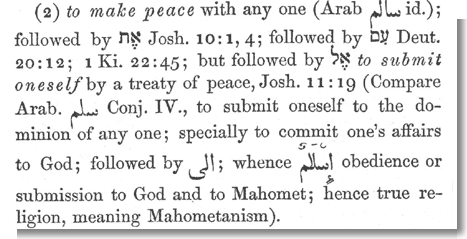
Islam literally means, ‘to gain peace in submitting to God’. If I wanted to describe a baby, I would say, ‘the human which has just exited its mother’s womb’. Similarly we find that Islam is expressed in such a way in Job 22:21, for it reads:

“Submit to God and be at peace with him; in this way prosperity will come to you.” – Job 22:21.

This verse in no uncertain terms has mentioned that we should follow Islam. Let’s see what one Bible commentary states about this verse:

Blue Letter Bible - Lexicon

We find the above to be quite revealing, for even Biblical commentators accept that Islam is the faith which is to be followed. You can see it yourself here in Gesenius’s Lexicon. I think the best part of this quote is where it says, ‘hence true religion, meaning Mahometanism‘. From this, even Christians scholars accept that Muhammad (peace be upon him) is mentioned in some way in the Bible, thus qualifying the Qur’aan’s claim from 7:157.

Lastly, we read:

 I will raise them up a Prophet from among their brethren, like unto thee, and will put my words in his mouth; and he shall speak unto them all that I shall command him. – Deuteronomy 18:18.

The word for brethren is אֲחֵיהֶ֖ם, which meansbrother, cousin, relative, kinsman, reciprocal relationship‘, with certainty we know that the Arabs are the kinsman, the brothers to, the cousins of, the relatives with and the relatives of the Israelites through Ishamael (may God be pleased with him).

Conclusion

The evidence is quite overwhelming, despite the hoops through which Missionaries may jump, they cannot hide the truth of Muhammad (peace be upon him) before foretold of by Christ and in their Prophets.

wa Allaahu ‘Alam.

Jesus Was Not a Trinitarian – Dr. Anthony Buzzard [Free on Amazon]

بِسۡمِ ٱللهِ ٱلرَّحۡمَـٰنِ ٱلرَّحِيمِ ,

Dr. Anthony Buzzard is one of the foremost Biblical Scholars on the Trinitarian dogma. Last year he published a book called, “Jesus was not a Trinitarian”. A Brother notified me that it was available for free download via Amazon.com. My advice would be to get this book while it’s available for free. You can read it via the Free Amazon Kindle App for PC.

cc-2013-buzzardbook

Click here to go to the Amazon link.

wa Allaahu ‘Alam.

Can God have a Son? Can Christ have a Son?

بِسۡمِ ٱللهِ ٱلرَّحۡمَـٰنِ ٱلرَّحِيمِ ,

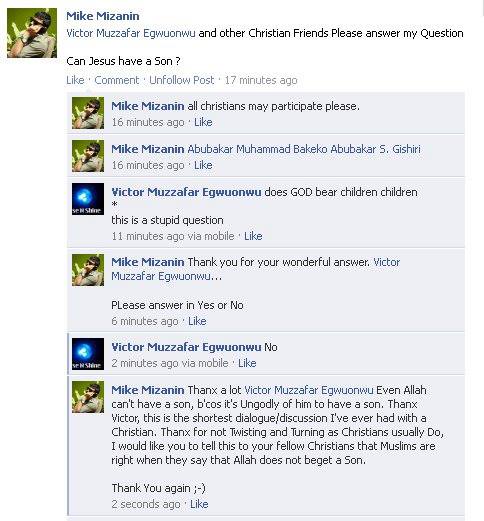
Here are some pretty interesting answers to these questions by some Christians.

cc-2013-godson


I’d like to invite some comments about these answers or some new answers on this question by our Christian brothers and sisters. Lastly, I’d like to thank our Facebook page manager, Sr. Nasrin for procuring this screenshot – yes, we have women who work with us, Alhamdulillah.

wa Allaahu ‘Alam.

An Argument to End Them All

بِسۡمِ ٱللهِ ٱلرَّحۡمَـٰنِ ٱلرَّحِيمِ ,

In other words, ‘how to stop a missionary dead in his tracks’ – (disclaimer it’s a pun, a metaphor, i.e. not literal – we have some crazies on here who love taking things out of context). During a discussion I was having with fellow team member, Sr. Alice, we inadvertently, came up with an argument that I think would shut any missionary up quite quickly.

Missionary: You should accept that Christ died for your sins.

Muslim: I don’t believe the Holy Spirit is God. Is it a blasphemy to say that the Holy Spirit is not God?

Missionary: Yes!

Muslim: Well according to this verse, “but whoever blasphemes against the Holy Spirit never has forgiveness, but is guilty of an eternal sin”. – Mark 3:29.

(Note, you don’t have to repeat what Gill’s exposition is, but you should understand what the verse means, to aid with this, we’ve provided what his exposition says below.)

Gill’s Exposition of the entire bible explains Mark 3:39 as:

“But he that shall blaspheme against the Holy Ghost, Against his person, and the works performed by him, by ascribing them to diabolical power and influence, as the Scribes did, hath never forgiveness: there is no pardon provided in the covenant of grace, nor obtained by the blood of Christ for such persons, or ever applied to them by the Spirit; but is in danger of eternal damnation”

Muslim: Isn’t it true that not even the blood of Christ will wash away the sin of blaspheming the Holy Spirit?

Missionary: ……………………….

Muslim: Doesn’t that mean, whether I accept Christ or not, I’m still going to hell?

In conclusion, as Sr. Alice has said:

Why should we accept Christ as our Lord and Saviour if we as Muslims have already blasphemed against the Holy Spirit? This is a sin that even the blood of Jesus can not wash.

wa Allaahu ‘Alam.

Pamela Geller + Robert Spencer Banned from UK

بِسۡمِ ٱللهِ ٱلرَّحۡمَـٰنِ ٱلرَّحِيمِ ,

Exciting news from London today, when it was announced that the two Islamophobic speakers were prohibited from entering the UK, thus barring their appearance at a provocative EDL sanctioned rally at the site of the Woolwich incident. According to a government spokesperson, their presence in the UK was, “not conducive to the public good“.  The BBC (UK) News had this to report:

“Keith Vaz, chairman of the Home Affairs Select Committee, who had called for the bloggers to be banned from the UK, said: “I welcome the home secretary’s ban on Pamela Geller and Robert Spencer from entering the country. This is the right decision. The UK should never become a stage for inflammatory speakers who promote hate.”

“Anti-fascism campaigners Hope Not Hate had campaigned for the pair to not be allowed into the UK. A researcher with the organisation, Matthew Collins, sa;id it was “delighted” with the decision. “These two are among some of the most extreme anti-Muslim activists in the world. They’ve nothing to contribute to life in this country. “They’re not here to contribute to good community relations. They only wanted to come here and help the EDL stir up more trouble. Britain doesn’t need more hate even just for a few days.”

The exclusion decision from the Home Office cited remarks by both Geller and Spencer which demonstrated their views which may, “foster hatred” and possibly cause “inter-community violence” in the UK.

wa Allaahu ‘Alam.

« Older Entries Recent Entries »