Category Archives: FAQS

A Brief Refutation of the Gharaniq (Satanic Verses) Claim

A Brief Refutation of the Gharaniq (Satanic Verses) Claim by Hamza AA

This topic has been often been used by missionaries and Islamophobes to cast doubts about Islam, as such it merits at least a brief response.

What is the Gharaniq (Satanic Verses) Claim?

According to the fictional story, the Prophet Muhammad (peace be upon him) wished that Allah would reveal verses (of the Qur’an) so that he could have reconciled with his tribe. Satan took this opportunity to manipulate the Prophet Muhammad’s (peace be upon him) mind with certain words, which he mistook for Qur’anic verses, and recited them in praise of pagan idols.

By the Star when it sets, your comrade does not err, nor is he deceived; nor does he speak out of (his own) desire …

and when he came to the words:

Have you thought upon al-Lat and al-Uzza and Manat, the third, the other?

Satan cast on his tongue (because of his desire for reconciliation with his tribe) the words:

These are the high-flying cranes; verily their intercession is accepted with approval

Upon hearing these verses, the Muslims and pagans jointly prostrated in worship. Later, Angel Gabriel appeared to Prophet Muhammad (peace be upon him) and informed him that he (Gabriel) had not revealed those words to him. The Prophet got very upset with himself for having lied about God and falsely promoting the worship of idols. God then comforted him with the claim that such confusion had happened to all Prophets (peace be upon them) in the past:

And We did not send before you any messenger or prophet except that when he spoke [or recited], Satan threw into it [some misunderstanding]. But Allah abolishes that which Satan throws in; then Allah makes precise His verses. And Allah is Knowing and Wise. (22: 52)

The Prophet then publicly retracted the false verse:

He certainly saw of the greatest signs of his Lord. (53:18) So have you considered al-Lat and al-‘Uzza? (53:19)  And Manat, the third – the other one? (53:20)

This in turn angered the pagans who rejected and hated Islam.
An example From Tabari [1192-1193], vol. 6, pp. 108-110 reads:

“Ibn Humayd – Salamah – Muhammad b. Ishaq – Yazid b. Ziyad al-Madani – Muhammad b. Ka’b al-Qurazi: When the Messenger of God saw how his tribe turned their backs on him and was grieved to see them shunning the message he had brought to them from God, he longed in his soul that something would come to him from God which would reconcile him with his tribe. With his love for his tribe and his eagerness for their welfare it would have delighted him if some of the difficulties which they made for him could have been smoothed out, and he debated with himself and fervently desired such an outcome. Then God revealed:

By the Star when it sets, your comrade does not err, nor is he deceived; nor does he speak out of (his own) desire …and when he came to the words:

Have you thought upon al-Lat and al-Uzza and Manat, the third, the other?

Satan cast on his tongue, because of his inner debates and what he desired to bring to his people, the words:

These are the high-flying cranes; verily their intercession is accepted with approval.

When the Quraysh heard this, they rejoiced and were happy and delighted at the way in which he spoke of their gods, and they listened to him, while the Muslims, having complete trust in their Prophet in respect of the messages which he brought from God, did not suspect him of error, illusion, or mistake. When he came to the prostration, having completed the surah, he prostrated himself and the Muslims did likewise, following their Prophet, trusting in the message which he had brought and following his example….The Quraysh left delighted by the mention of their gods which they had heard, saying, ‘Muhammad has mentioned our gods in the most favorable way possible, stating in his recitation that they are the high-flying cranes and that their intercession is received with approval.’

…Then Gabriel came to the Messenger of God and said, ‘Muhammad, what have you done? You have recited to the people that which I did not bring to you from God, and you have said that which was not said to you.’ Then the Messenger of God was much grieved and feared God greatly, but God sent down a revelation to him, for He was merciful to him, consoling him and making the matter light for him, informing him that there had never been a prophet or a messenger before him who desired as he desired and wished as he wished but that Satan had cast words into his recitation, as he had cast words on Muhammad’s tongue. Then God cancelled what Satan had thus cast, and established his verses by telling him that he was like other prophets and messengers, and revealed:

Never did we send a messenger or a prophet before you but that when he recited (the Message) Satan cast words into his recitation (umniyyah). God abrogates what Satan casts. Then God established his verses. God is knower, wise.

Thus God removed the sorrow from his Messenger, reassured him about that which he had feared and cancelled the words which Satan had cast on his tongue … Those two phrases which Satan had cast on the tongue of the Messenger of God were in the mouth of every polytheists …”

Brief Rebuttal:

Although a minority of scholars have adopted the Gharaniq story, such as Tabbari in his exegetical work, Ibn Ishaq, and Al-Wahidi in his renowned classic work Asbab al Nuzul, the vast majority of scholars have rejected it. We should further add that the story neither exists in the Qur’an, nor is it located in any main hadith collection (at least what is considered as Sahih). As for the narration and authors that narrate the story we must ask several questions:

Is the Isnad (Line of Transmission)  and Matn (content) reliable ?

1)  a) It’s absurd to place any source whose accuracy of preservation or narration is not equivalent to that of the Qur’an or as equally credible (muttawatir).

These are the verses of Allah which We recite to you in truth. Then in what statement after Allah and His verses will they believe (Quran  45:6)

b)  In the beginning of Al Tabbari’s work on the History of the Prophet (peace be upon him) he warns the readers of the following:

Let him who examines this book of mine know that I have relied, as regards everything I mention therein which I stipulate to be described by me, solely upon what has been transmitted to me by way of reports which I cite therein and traditions which I ascribe to their narrators, to the exclusion of what may be apprehended by rational argument or deduced by the human mind, except in very few cases. This is because knowledge of the reports of men of the past and of contemporaneous views of men of the present do not reach the one who has not witnessed them nor lived in their times except through the accounts of reporters and the transmission of transmitters, to the exclusion of rational deduction and mental inference. Hence, if I mention in this book a report about some men of the past, which the reader of listener finds objectionable or worthy of censure because he can see no aspect of truth nor any factual substance therein, let him know that this is not to be attributed to us but to those who transmitted it to us and we have merely passed this on as it has been passed on to us  (Source: Abu Ja`far Muhammad bin Jarir al-Tabari, Tarikh al-Tabari: Tarikh al-Umam wal-Muluk, 1997, Volume I, Dar al-Kutub al-‘Ilmiyyah, Beirut (Lebanon), p. 13.)

In other words, Al Tabbari informs us that he gathered informative records as they were passed on to him and if we find any errors, we should disregard those records.

c) Ibn Ishaq has been criticized for the inaccuracies of his work:

– Imam Ahmad Ibn Hanbal was asked about the solitary reports of Ibn Ishaq if they are considered reliable. He said “No!”. See Tahdhib al-Tahdhib, Da’ira Ma’arif Nizamia, Hyderabad, 1326 A.H. vol.9 p.43

– Imam Malik was not the only contemporary of Ibn Ishaq’s to have problems with him. Despite writing the earliest biography of Prophet Muhammad, Scholars such as al-Nisa’I and Yahya b. Kattan did not view Ibn Ishaq as a reliable or authoritative source of Hadith. (Jones, J.M.B. Ibn Ishak. Vol. IV, in Encyclopaedia of Islam, edited by Ch. Pellat, and J. SchachtV.L.M.B. Lewis. London: Luzac & Co., 1971: pages 810-811)

d) It is clear that Waqidi is in fact the senior partner. Ibn Sa’d, known of course as ‘Katib al-Waqidi’, was a secretary-editor of his master and of the materials he had assembled and then amplified. Waqidi was attacked for loose isnad usage by strict practitioners of Hadith. (T. Khalidi, Arabic Historical Thought In The Classical Period, 1994, Cambridge University Press, p. 47 , 48)

2) It is irrational to claim that the Prophet (peace be upon him) would be confused in reciting verses praising idols, whichwould flat out contradict the basic fundamental teaching of Islam, the Tawhid (The oneness of God).

Indeed, Allah does not forgive association with Him, but He forgives what is less than that for whom He wills. And he who associates others with Allah has certainly fabricated a tremendous sin. (Quran 4:48)

Indeed, Allah does not forgive association with Him, but He forgives what is less than that for whom He wills. And he who associates others with Allah has certainly gone far astray.  (Quran 4:116)

And it was already revealed to you and to those before you that if you should associate [anything] with Allah , your work would surely become worthless, and you would surely be among the losers.” (Quran 39:65)

3) Historically the Gharaniq story does not add up. According to the story:

– The Satanic verses were revealed roughly around the Fifth year of the Prophetic call (Eight years before the Prophet made Hijrah [Migration to city of Madinah]).

–  The Gharaniq story states that verses 73-75  of Surah 17 were revealed to reprimand the Prophet (please note: the correct context of these verses is provide in point 4, section C) for reciting the so called satanic verses. Yet, it is known that these verses were not revealed before the Miraj event (when the Prophet [peace be upon him] ascended to heaven). This event is historically dated no earlier than the 10th year of the Prophet’s (peace be upon him) call (in other words at least three years before the Prophet’s Hijrah [Migration) to the city of Madina].

–  The Qur’anic verse 22:52 was revealed the first year of Hijrah.

Taking the above details into consideration, how rational is it that the satanic verses would be revealed in the fifth year before the Prophet’s (peace be upon him) Hijrah and as such, God’s admonishment and rectification of these false narrations would be revealed roughly 5 to 9 years later? Are we to presuppose that the Prophet (peace be upon him) and his Muslim companions would be associating partners with Allah (shirk) for at least 6 years before these verses were nullified and rectified?

4) Had the Gharaniq story been historically true, the Qur’an would have to explicitly address it, while on the contrary:

a) The Qur’an provides assurances that it is divinely protected and impenetrable by falsehood:

Indeed, it is We who sent down the Qur’an and indeed, We will be its guardian. (Quran 15:9)

Indeed, those who disbelieve in the message after it has come to them… And indeed, it is a mighty Book. Falsehood cannot approach it from before it or from behind it; [it is] a revelation from a [Lord who is] Wise and Praiseworthy. (Quran 41:41-42)

b) The Qur’an clearly confirms that had the Prophet (peace be upon him) recited any falsehood he would swiftly be punished:

So I swear by what you see (69:38)  So I swear by what you see (69:39) [That] indeed, the Qur’an is the word of a noble Messenger. (69:40) And it is not the word of a poet; little do you believe. (69:41) Nor the word of a soothsayer; little do you remember. (69:42) [It is] a revelation from the Lord of the worlds. (69:43) And if Muhammad had made up about Us some [false] sayings, (69:44)  We would have seized him by the right hand; (69:45) Then We would have cut from him the aorta. (69:46)  And there is no one of you who could prevent [Us] from him. (69:47)

c) The Qur’an states the Prophet (peace be upon him) was protected from being seduced by the disbelievers. Had he followed the disbelievers, he would have been severely punished:

And indeed, they were about to tempt you away from that which We revealed to you in order to [make] you invent about Us something else; and then they would have taken you as a friend. (17:73) And if We had not strengthened you, you would have almost inclined to them a little. (17:74) Then [if you had], We would have made you taste double [punishment in] life and double [after] death. Then you would not find for yourself against Us a helper. (17: 75)

d) The Qur’an states that when the Prophet (peace be upon him) preached the Qur’anic revelation, he spoke not of his own desires but from that of divine inspiration:

Your friend (Muhammad) was not astray, nor was he deceived. (53:2) Nor was he speaking out of a personal desire.(53:3) It was divine inspiration (53:4)

5) Clarifying the misinterpreted verses in the Gharaniq Story.
a) A closer look at Qur’an 53:18:28 –

He certainly saw of the greatest signs of his Lord. (53:18) So have you considered al-Lat and al-‘Uzza? (53:19) And Manat, the third – the other one? (53:20)  Is the male for you and for Him the female? (53:21) That, then, is an unjust division. (53:22) They are not but [mere] names you have named them – you and your forefathers – for which Allah has sent down no authority. They follow not except assumption and what [their] souls desire, and there has already come to them from their Lord guidance. (53:23) Or is there for man whatever he wishes? (53:24) Rather, to Allah belongs the Hereafter and the first [life]. (53:25) And how many angels there are in the heavens whose intercession will not avail at all except [only] after Allah has permitted [it] to whom He wills and approves. (53:26) Indeed, those who do not believe in the Hereafter name the angels female names, (53:27)  And they have thereof no knowledge. They follow not except assumption, and indeed, assumption avails not against the truth at all. (53:28)

The above verses sarcastically rebuff the pagan idols and it would make no sense to glorify the pagan idols after verses 53:18-20. The Qur’anic verses accuse the pagans of falsely attributing names and authority to idols, basing their belief on nothing but assumptions.

In other words, what kind of divine revelation would in one sentence praise the idols, while later on deprecating them with such vehemence and intensity? How could such a blatant contradiction within two consecutive sentences be explained or justified?

b) A closer  look at Qur’an 22: 52-54 –

And We did not send before you any messenger or prophet except that when he spoke [or recited], Satan threw into it [some misunderstanding]. But Allah abolishes that which Satan throws in; then Allah makes precise His verses. And Allah is Knowing and Wise. (22:52) [That is] so He may make what Satan throws in a trial for those within whose hearts is disease and those hard of heart. And indeed, the wrongdoers are in extreme dissension. (22:53) And so those who were given knowledge may know that it is the truth from your Lord and [therefore] believe in it, and their hearts humbly submit to it. And indeed is Allah the Guide of those who have believed to a straight path. (22:54)

There is no explicit understanding that shows Satan confused the Prophet (peace be upon him) to recite those false verses. On the contrary, whatever malicious words Satan tried to throw in order to confuse the Prophet (peace be upon him) are nullified, the Prophet (peace be upon him) was protected from these temptations, and Allah’s words prevailed.

6) It would be ironic that once the Prophet (peace be upon him) recited these Satanic verses that both the companions of the Prophet (peace be upon him) and pagans without hesitation and defiance would prostrate themselves willingly.

For instance, in a previous historical event the Companions of the Prophet (peace be upon him) grew angry and objected that the Prophet (peace be upon him) signed a certain treaty (The Treaty of Hudaybiah; little did they know it was for their benefit) with the Quraish pagans and agreed not to enter Mecca until the next year. If the companions were willing to object to such an event of less importance, why would they not be willing to rebuke in anger the Prophet’s (peace be upon him) allegedly contradictory words, while prostrating to idols in total submission?

As for the pagans, after years of fighting the Prophet (peace be upon him) and his beliefs (Tawheed), why would they simply bow their heads to verses that were recited without hesitation or questioning.

7) Had the Gharniq story actually happened, the damage would have been irreparable:

a) It would have caused a drastic confusion in regards to the authenticity of what was being revealed (the Qur’an). The believers wouldn’t have known whether the recited words were divine or satanic.

b) If Satan had succeeded to confuse the Prophet (peace be upon him) once, he could have successfully done it several times.

c) Contradictory statements would have lead believers to leave Islam.

d) If the Prophet (peace be upon him) was confused by Satan, what would prevent the same thing from happening to the companions of the Prophet (peace be upon him) upon reciting the Qur’an or anything else?

Conclusion:

Regardless from which perspective we examine this claim, the Satanic Verses allegation fails every test of authenticity, whether historically, chronologically, contextually, and logically. Therefore, this claim should be disregarded without thinking twice.

Should We Address Missionaries Harshly?

Question:

Sometimes in your writings and your discussions you are very stern with missionaries. Is this an approach you advise Muslims to take when debating and discussing inter-faith topics with missionaries?

Answer:

This is not a good trait of my character. I do not advise that a Muslim should address anyone with harsh or stern speech and words. The Qur’an says:

Invite to the way of your Lord with wisdom and good instruction, and argue with them in a way that is best. Indeed, your Lord is most knowing of who has strayed from His way, and He is most knowing of who is [rightly] guided. – Qur’an 16:125.

Thus, Allah exhorts us to be mindful of the way in which we interact with those we disagree with. I have my shortcomings, and one of my many shortcomings is to use a harsh tone when annoyed. I invite the brothers and sisters who read this answer to make du’a that Allah cures me of this negative trait. God willing, all future articles on the website will not contain harsh tones, and I will tread very carefully with my words. I sincerely ask Allah’s forgiveness for any of the Muslims who may have imitated this behaviour of mines and I ask the forgiveness of those whom I have addressed in an unfair manner.

All visitors are welcomed to post a comment under our articles or to send us a message if you believe the tone of a post is out of bounds. As they say, be your brother’s keeper!

and Allah knows best.

Should Christians Appeal to Jesus’s Human Nature to Explain God’s Ignorance or Fallibility?

Question:

When discussing whether Christ was God or a man with Christians, they often explain his “defects” as being due to his human nature. For example, they say if he was hungry, it was due to his human nature, or cursing the fig tree and praying to God, was due to his human nature. What would be your response to this?

Answer:

Assuming that this question refers to interactions with Trinitarian Christians, it is actually a heresy to explain Jesus’s actions exclusively in light of his human nature. In Trinitarianism, Jesus is considered to be both God and man, with his divine nature and his human nature being eternally united, otherwise known as the hypostatic union. In the centuries when the Trinitarian creed was being developed, a popular heresy which existed at that time was to separate these two natures. This was known as Nestorianism. Thus, the Nestorians believed that there were two natures, a divine and human but that they were not joined together in a union.

Trinitarians describe this union as Jesus being one person with two unified natures, sometimes referred to as “fully God and fully man”. Meaning, at all times, he – Christ, was both fully God and fully man. Let’s take the example of Jesus’s crucifixion. If we ask, did the all powerful God suffer, a Christian would say no, as a divine being cannot suffer. Only the human nature suffered. This is the heresy of Nestorianism. They are disuniting the natures, and isolating the human nature from the divine nature. We must remind these Trinitarians of their beliefs, if the human nature suffered, then the divine nature must also have suffered as these natures are eternally united. Modern Trinitarians often use the heresy of Nestorianism when defending the Trinity, without realising it.

Another popular example is Jesus praying. Many Trinitarians would claim that the human nature was praying. This is incorrect, both the divine and the human natures were praying to God, the human nature is eternally united with the divine, at no point can one nature be disunited from the other. When Jesus was hungry, the human nature hungered. This is what Trinitarians claim when we inquire of Jesus’s cursing of the fig tree. Yet, they are once again isolating one of the two natures. We must remind them, both the divine and the human nature hungered, these natures cannot be separated under any circumstances unless one is willing to declare themselves apostates from Trinitarianism and believers in the heresy of Nestorianism. As Dr. James White says in his book, The Forgotten Trinity:

“Instead, the doctrine is misunderstood as well as ignored. It is so misunderstood that a majority of Christians, when asked, give incorrect and at times downright heretical definitions of the Trinity.” – White, James R. (1998-11-01). Forgotten Trinity, The (p. 16). Baker Publishing Group. Kindle Edition.

Interestingly, despite this book claiming to be a defense of the Trinitarian doctrine, Dr. White himself also appeals to the heresy of Nestorianism. In seeking to explain the dual nature of Christ, he says:

“Crucifixion is only meaningful with reference to his human nature (you cannot crucify the divine nature). When Paul speaks of the crucifixion of the Lord of glory, he is speaking of Christ as one person with two natures.” – White, James R. (1998-11-01). Forgotten Trinity, The (p. 160). Baker Publishing Group. Kindle Edition.

In the space of two sentences, a person writing on the very topic of understanding the Trinity, appeals to and accepts Nestorianism. He begins by saying that the crucifixion can only be meaningful in regard to the human nature, yet in the next sentence he states that Paul teaches that the crucifixion is of the person of Christ, the person with two natures. Such a level of confusion and contradiction is rampant throughout Trinitarian teachings. I have previously written about another Trinitarian book that sought to explain the Trinity, which you can read here.

It is interesting that John 14:26 claims that the Spirit would come to explain all things necessary for salvation and to make these things easy to understand, yet all Trinitarians would gladly proclaim that the Trinity is a divine mystery which cannot be understood and that the communication between the two natures (communicatio idiomatum) is a divine mystery. Surely then, the Trinity is not a doctrine of God, and it is something that both Christian scholars and laymen alike, find extreme difficulty in accepting and believing, and it is unfortunate that while they condemn Nestorianism as a heresy, they openly appeal to it in trying to explain Trinitarianism.

and Allah knows best.

Is There Any Early Evidence of the Corruption of the New Testament?

Question:

Muslims often claim that the New Testament was corrupted very early on, is there any proof of this?

Answer:

The Qur’an in Surah 2, Ayah 79 mentions that a people from among the People of the Book forged writings and claimed these writings to be from God:

So woe to those who write the “scripture” with their own hands, then say, “This is from Allah,” in order to exchange it for a small price. Woe to them for what their hands have written and woe to them for what they earn.

In this case, people were forging writings and claiming them to be scripture from God. As per the question being asked, we do have extremely early evidence from Paul (or someone writing in his name), claiming that letters and teachings bearing his name were being falsified by heretics during his lifetime. We read this in 2 Thessalonians 2:1-4:

Concerning the coming of our Lord Jesus Christ and our being gathered to him, we ask you, brothers and sisters, not to become easily unsettled or alarmed by the teaching allegedly from us—whether by a prophecy or by word of mouth or by letter—asserting that the day of the Lord has already come. Don’t let anyone deceive you in any way, for that day will not come until the rebellion occurs and the man of lawlessness is revealed, the man doomed to destruction.

Therefore, Muslims are not making this claim without evidence. This is a Biblically based belief, from one of Christianity’s earliest sources. I hope that this answers your question.

and Allah knows best.

If the Command was Given to Burn the Manuscripts, Why Do So Many Survive?

Question:

If the command was given to burn unauthorized copies of the Qur’an, why do so many early manuscripts exist?

Answer:

This narration must firstly be taken into its historical context. There were generally two types of writing material being used at that time. Papyrus and Vellum (Parchment). Papyrus is a plant based material, which is very delicate. In other words, it can be difficult to preserve and it is damaged somewhat easily. However, it was cheap to produce and attain. This type of material could not be washed or rubbed so that the writing on it could be changed. To the contrary, parchment (vellum) which is animal skin is very robust and it can be washed over or rubbed to have the writing changed. It is also very expensive and at that time, some may say difficult to procure (acquire). In this context, the command to burn, would have meant to burn what could not be changed, which is why we find a number of manuscripts (made with animal skin) with changes, and why papyrus based manuscripts are extremely rare. Therefore, in terms of the historical context of the writing material of that time period, it would make sense that you burn the cheap, mass produced material which could not be changed and you do not burn the expensive, difficult to acquire writing material which could be changed.

Similarly, we have to take into consideration the fact that this narration presupposes that the command be carried out by those who knew how to read. If the command was absolute, then any person who possessed any type of writing in their household, handed down through family tradition or given in trade, would have to destroy all the writing they possessed. However, this would not make sense. Only a person who knew how to read, and in this case, could read the writing of the Qur’an, would know what to burn. Most people at that time would not be able to read, and so we cannot expect that the command meant that every person, whether literate or illiterate, burn their entire libraries when they did not understand what they were burning in the first place. In this way, many manuscripts would have survived. It is not simply a case of burning everything and anything. These narrations do exist within a historical period and we must understand these narrations in light of their historicity.

If we take for an example, the command of a general on a battlefield who says, “kill everyone!” Does he mean to say that his own soldiers should kill each other and himself? Or, if you’re at a restaurant and order something from the menu, that it means you have ordered for everyone? Statements have to be taken into context and we must be careful about taking them absolutely literally, especially when we do not understand the customs and practises of the time period in which they are said to have taken place within.

and Allah knows best.

What Gives a Manuscript Inherent Authority?

Question:

What makes a manuscript authoritative for Christians and Muslims?

Answer:

The question we need to ask ourselves is, what makes a manuscript inherently, or innately authoritative? What is it, what is the criteria we use to determine the authority of a manuscript? Most of the manuscripts that both Christians and Muslims possess, are from unknown scribes. We do not know why they wrote what they wrote, what their level of skills were, for whom they wrote, what their intentions were, what their levels of education were. The only attribute which makes a manuscript authoritative by any criteria of measurement, is that it exists. We cannot assess manuscripts which do not exist, so we are left to examine what remains to this day (extant, still surviving). Does this make the manuscript authoritative though? Naturally, for something to be authoritative, we need to know where it was produced and from whom it was produced. Consider then, the case of a man who goes to a pawn shop to trade a letter he claimed was written to his grandmother by a famous celebrity during her lifetime.

Both the grandmother and the celebrity are dead, and we have very few, if any surviving artifacts from this celebrity. So, how can we validate this letter? We may never be able to do so. The same issues arise with manuscripts. Something’s existence, does not necessitate its authenticity. Many great libraries were sacked and destroyed during the medieval period, with many great codices and manuscripts lost during these tragedies. The fact that something exists, does not mean it is important or authoritative. There are, quite literally, 1001 reasons for any given manuscript to survive to our day. The fact that a particular manuscript happens to survive, does not give it authority. I’ve yet to see anyone, whether a textual critic or otherwise, argue for the authority of unknown documents, based on anything other than the reasoning that they “just happen to exist”. I’m reminded at this point of Lion Vaganay’s, “An Introduction to New Testament textual Criticism,” where he speaks on three false principles that beginners make when giving authority to manuscripts:

Three Defective Principles

In order to choose the correct reading from amongst the different variants, it used to be customary, and indeed it too often still is customary, to appeal to the number, the age and the general character of the witnesses; these are three criteria which, whether taken singly or together, are insufficient to justify a choice of reading.

The Number of Witnesses

A hundred manuscripts which are copies one of another continue but one authority, whereas two independent manuscripts should be reckoned as two. Moreover, even when faced with a real majority, care must be taken not to assume automatically that the majority is right without further examination. All copies do not have the same value. It is the question of the nature of the text which is important, not the quantity of its representatives. Non numerantur sed ponderantur, ‘A fault may be copied as many times as you like, you will never make a correct reading out of it’ (Collomp 1931, p.35). The beginner is naturally inclined to find safety in numbers and needs to be on his guard against this trap. Universal suffrage has no place on textual criticism.

It is, of course, true that the presence of a large number of documents can sometimes be a useful signpost but it can never be adequate on its own for drawing firm conclusions. As will be seen, copies have to be considered as representatives of a group and not as separate witnesses. That immediately weakens any argument based on their number. But there is more to it than that: even when the main manuscript groups agree on a variant, it is still essential to check whether there is not a divergent reading attested by any of the other documents of authority; for it is a simple fact that the original reading may be found in only a few scattered documents while what the majority contain is an early correction.

The Age of the Witnesses

There is no better a guide. A codex of the sixth century may be the copy of a good second century manuscript which has been lost but which was a first-hand copy of the original. A fourth-century codex could be a poor copy of a defective third-century manuscript with a dozen intermediaries separating it from the original. It would therefore be wrong to trust the latter more than the former. Important lessons can be learnt from recent discoveries. For example, there is a reading (1 Peter 2:20) which hitherto was known only from the relatively late uncial (.044) and some miniscules (including 1729, tenth century) and which has now been found in a papyrus (P72) from the beginning of he fourth century, which had previously gone uncontested are now in question. The authority which tends to be attributed to an early codex rests on a foundation which is sometimes deceptive: its nearness to the original. The factors which carry more weight are the number of witnesses, and more especially the quality of the copies made between the original and the manuscript in question. In a word, it is the age of the text and not the age of the manuscript which must be considered, for there are relatively recent manuscripts with a very early text and early manuscripts with a corrupted text.

Of course, the age of a witness is never to be completely overlooked. It would be right to be wary of a variant which does not emerge until the fifteenth or sixteenth century, for example, and to pay more attention to a variant in a papyrus from around AD 200. But, once again, it would be wrong to be hypnotised by the papyri and the uncials. There are miniscules which date from before the uncials. There are even miniscules whose text is better than that of some papyri or uncials. – p. 62.

The process which makes a manuscript authoritative without means of identifying the scribe’s authority is quite a difficult one, and not one underwhich all textual critics agree on, taking information from an unknown source in Islamic scholarship is something which is rejected. In conclusion, something’s existence does not make it authoritative, each manuscript must be judged on its own qualities and both faiths have differing approaches to manuscripts of unknown origin. What works for the New Testament, does not work for the Qur’an, and we should be wary of this difference when we discuss the manuscript histories of either of these works.

and God knows best.

The Role of Scriptural Manuscripts in Islam and Christianity – A Primer

Introduction

Given all the buzz about manuscripts regarding both the scriptures of the Muslims and Christians, I thought it’d be best to write something simple to explain the differences in approach that the Islamic and Christian faiths use when understanding their scriptures. This isn’t meant to be a highly technical article, but by the end of this post you’ll understand why manuscripts are important and to whom they are important.

The main difference in understanding manuscripts in both these faiths can be summed up in one term, “textus receptus vs textus criticus”. Textus receptus refers to the passing of scripture from generation to generation, until present day. Hence the term, “received text”. Textus criticus refers to a reconstructed version of scripture, based on the best manuscript witnesses that are extant (still surviving to our times). Hence the term, “critical text”.

Textus Receptus or Textus Criticus?

Christians today no longer depend on their textus receptus, they opt for textus criticus. In essence, they believe that their scriptural tradition internationally, that their Churches internationally, that for over 2000 years, their collective world of Christendom was unable to accurately preserve the New Testament. We can assign the shift in thinking from textus receptus to textus criticus sometime during the 16th century, when we had Erasmus’s, Cisneros’s and Stephanus’s critical Greek editions of the New Testament. This movement agreed on the principle that the Latin Vulgate, despite being the primary New Testament for centuries, did not accurately represent the “original” readings that the earlier Greek manuscripts contained. Therefore, Christians had to “recover” and “reconstruct” their scripture from the earlier Greek manuscripts, as opposed to relying on the traditional view of depending on the Latin Vulgate which was a translation of some of the Greek, the primary language of the New Testament.

There are however Christians who do disagree with this view that the entire world of Christendom failed to preserve the New Testament, and that the Church tradition did preserve their scripture. This is a minor group known as KJV-Onlyists. It has taken over 500 years for Christendom to propagate the shift from textus receptus to textus criticus. Thus, to modern Christians, manuscripts are extremely important to reconstructing the original words of the New Testament. The problem here is that we have no original manuscripts (autographs) and at best, the critical text of the New Testament today is an approximated “prototype” (vorlage) of the manuscripts, that may have been written in between 200 – 500 CE. In other words, the critical text of the New Testament does not go back to the original manuscripts (autographs) but they can be traced back to a “prototype” from which they may have been copied from at a later date, usually known as an “archetypal text”.

This view of textus criticus is not accepted in Islam. We believe that our scholastic tradition has preserved the Qur’an in its entirety. This is because in Islam, we did not translate the Qur’an from Arabic to English and then only used the English for 1400 years, while forgetting the Arabic and failing to preserve the Arabic Qur’an. We have kept the primary language of the Qur’an alive as well (fusha Arabic), and we’ve kept two separate traditions alive for over 1400 years: Hifz al Qur’an (memorization of the Qur’an) and ‘Ilm al Rasm al Mushaf (the science of the writing of the Qur’an). In essence, Muslims have kept reciting the Qur’an, memorizing it in its entirety, specializing in learning its language, specialized in learning its recital for over 1400 years, to this very day. We’ve also kept the tradition of writing the Qur’an and writing it with the most advanced Arabic styles of calligraphy. These two traditions mean that the Muslims in China are reciting the same Qur’an, in the same way, as the Muslims in the Caribbean, and that they have been doing so for centuries. The fact that Muslims have an entire month each year dedicated to the reciting of the Qur’an, and that we must recite it at a minimum 5 times a day, ensures that the Qur’an is being preserved everyday, all day. The same cannot be said for the New Testament.

This means, that while Christians have great reasons to doubt the preservation of their scripture and have to rely on reconstructing it, us Muslims do not share this problem. We have no reason to doubt our traditions of preservation as we have means to authenticating them. The Christians do not. As mentioned in other articles, we know who our reciters are and where they came from, what their characters were like and what their beliefs were. They are not unknown and we do not take knowledge from unknown persons. Today one would find many Christian scholars trying to search for a “Jesus oral tradition”. They’re trying to find some oral tradition that can link the manuscripts to credible persons who are historically viable to give their manuscripts authority, so that they could validate their reconstructed text. Muslims do not need to find an oral tradition to do so, as ours still exists to this day through our sanad of reciters (Qurra) and memorizers (Huffaz), which must authorize (provide an ijaza) students before they can teach the Qur’an to others. These mechanisms are inherent to the Islamic scriptural tradition, but they are alien to the Christian scriptural tradition.

The Need for Manuscripts

What Christians are doing today, like Jay Smith, Keith Small, Andy Bannister, Samuel Green and Spencer, is trying to get Muslims to reject textus receptus and to create a textus criticus. In essence, they need Muslims to have the same level of doubt about the Qur’an as they do, with the New Testament. Yet, as mentioned previously, our faith’s mechanisms in regard to preserving, teaching and sharing scripture are far more advanced that those of Christianity’s. Thus, when Christians point out that manuscripts have some variants or some differences, they are trying to force Muslims to reject our scriptural tradition. However, we are not in the same position as Christianity. We have no need to reject our scriptural tradition, but Christians do, since their collective world of Christianity was unable to preserve their scriptural tradition as Muslims have. The problem with using manuscripts from unknown authors, from unknown sources is quite obvious. What would happen if Christians found a manuscript of John 1 from the 1st century CE that excluded the Johannine Prologue? By their standards, they would have to give this manuscript authority and remove the prologue from their modern Bibles.

However, Christians are not consistent. They will instead claim that Church tradition has mentioned the prologue as being scripture and thus they will find some excuse to remove authority from that manuscript, despite rejecting their scriptural tradition for the critical method. In other words, Christians seriously doubt the preservation of their scripture and demand that Muslims use their critical methods on the Qur’an, when they themselves do not apply these critical methods consistently. Consider then, the example of the Shepherd of Hermas which is included in our earliest collection of the New Testament from the 4th century CE, Codex Sinaiticus. An entire book is excluded from the modern critical texts because Church tradition did not consider it scripture, yet the critical texts are not supposed to be based on tradition, but on the critical method. If Christians were consistent, they’d have to place the Shepherd of Hermas in their modern day critical edition. Yet, when missionaries see that some obscure manuscript, found in some obscure place may or may not have a different spelling of a word in the Qur’an, they demand that we accept that the Qur’an has changed.

That is strange reasoning. Who wrote this manuscript? We don’t know. What was their level of education? We don’t know. Why did they write it? We don’t know. So, on what basis do we accept an unknowable. unverifiable text, over 1400 years of verifiable, known tradition from chains of historic transmission? There are a hundred and one reasons why a manuscript can contain a variation. The person writing may have been using regional orthography (representation of letters and words) than a standardized style of writing. The scribe may have been using the manuscript to practise writing. The scribe could have been writing while someone was reciting (usually known as an amanuensis) and made an error in haste. The scribe could have been copying the shapes of the letters without knowing what the letters on the manuscript meant, thus if they made an error they would not have known that they changed a word. These are all common reasons that Christian textual critics point out for rejecting the variants found in many New Testament manuscripts.

In other words, Christians themselves reject the notion that all manuscripts are authoritative and for them manuscripts need to be authoritative because their scriptural tradition internationally was unable to preserve their scripture from its earliest days to the present day. This problem is not present in Islam and so we have no need to depend on, unverifiable manuscripts. We don’t need to authorize texts that are historically without authority. Christians have that need, it’s a necessity because their scriptural tradition was insufficient, Islam does not have this problem. So when Christians point out a variant that a scribe may or may not have made in writing the Qur’an, that means nothing to do the Muslim as it is a lone witness, versus a living tradition of witnesses in continuous verification over 1400+ years through daily, monthly and yearly memorization and recitation. However, if there is a variant in a New Testament manuscript, this is a problem for Christianity as not only do they accept that their scriptural tradition needs to be abandoned, they now need to reconstruct what their scripture may or may not have looked like and so they try to attack the Qur’an out of jealousy. While Muslims can be certain about the Qur’an, a Christian simply cannot be certain about anything in the New Testament.

Conclusion

One of the divine signs of Islam is the promise in Qur’an 15:9, which reads:

“Indeed, it is We who sent down the Qur’an and indeed, We will be its guardian.”

From the very start of Islam, the Qur’an was commanded to be recited. It was memorized, taught, recited daily. If God wanted a scripture to be preserved, then the best way to preserve it among humans would have been through continuous and daily recitation. In Islam, we find this with the 5 daily prayers in which the Qur’an must be recited. God included an entire month of the year dedicated to reciting the Qur’an in mass congregation, Ramadhan. God made it compulsory for each community to have a hafiz (memorizer) who needed to know the Qur’an by memory. God made it compulsory for each Muslim to individually carry the responsibility of knowing several chapters (Surahs) of the Qur’an. The God of Islam, it would seem through divine wisdom, knew what was needed for the Qur’an to be preserved among its followers. The same cannot be said about the New Testament or the Graeco-Roman Post-Hasmonaean Jewish Syncretic deity that Christians worship. This deity did not make the New Testament central to the lives of the early Christians. There was no need to memorize what Jesus said and taught, there was no need to recite what God revealed daily, monthly or even yearly. There was no command to preserve the language in which the scripture was given.

There was no need to preserve the New Testament. One must wonder, if there is a God and He wanted us to know Him, wouldn’t He have raised a community of people devoted to the preservation of His scripture? This is what we find in the religion of Islam, but it is not something we can find in the religion of Christianity. Interestingly, this rejection of textus receptus for textus criticus raises a very disturbing problem. If the collective world of Christendom, could not preserve their scripture for over 2000 years and they needed to reconstruct their scripture, what else has their religious tradition failed to preserve? What if their traditional teachings about the Trinity are wrong and need to be recovered. What if their traditional beliefs about Jesus dying for their sins are wrong and need to be recovered? What if…? Islam does not carry with it, such uncertainty, only Christianity can and does. For me, that’s a problem.

and Allah knows best.

Understanding the Birmingham University’s Find of the Oldest Qur’anic Manuscripts

General Information:

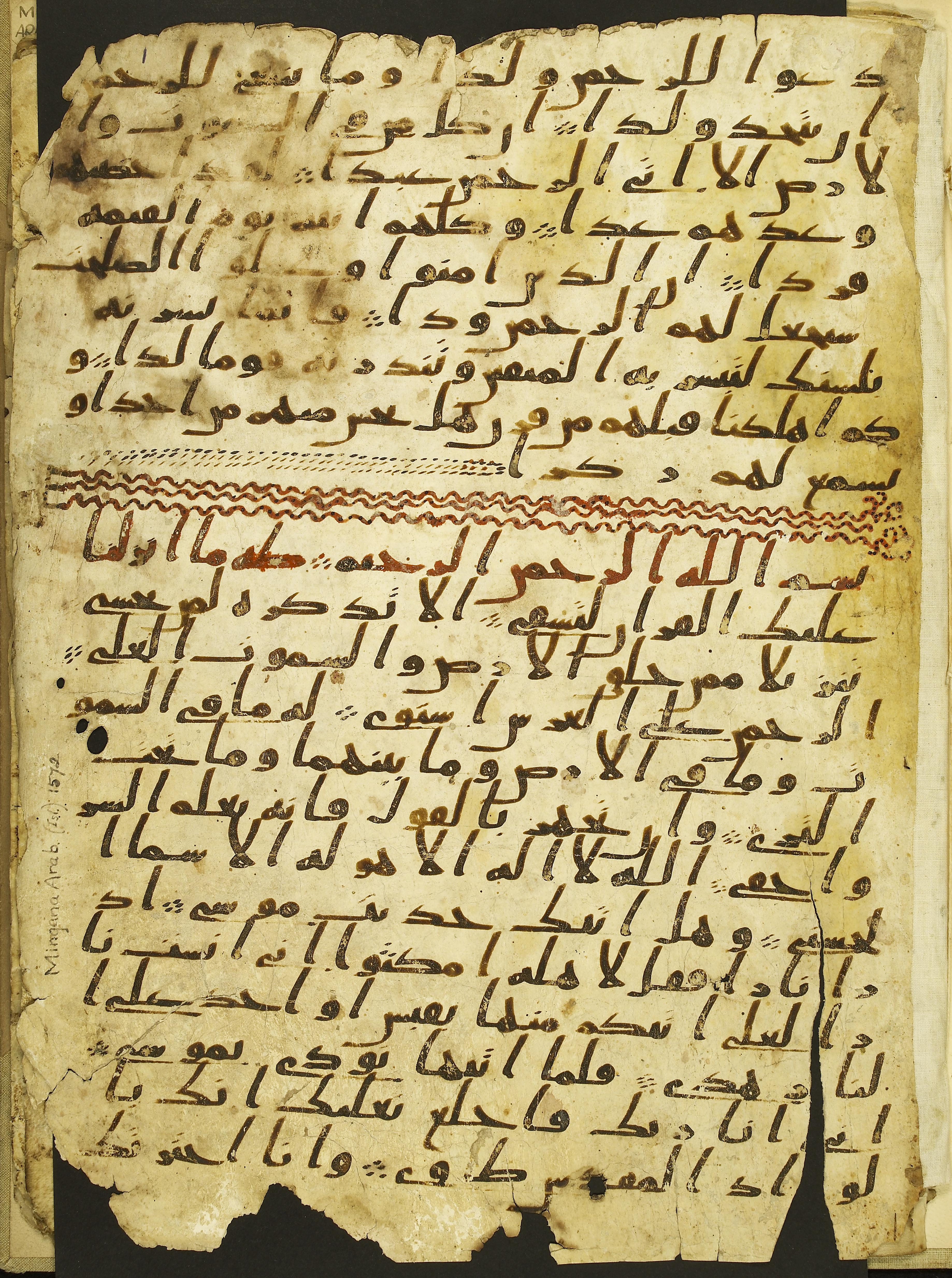
The collection at Birmingham University is known as the Mingana Arabic 1572 collection. It consists of 9 manuscripts (leaves, pages, folios). Earlier today, Birmingham University re-classified the dating of 2 of the manuscripts from the collection. The collection was then split into two classifications: Mingana Arabic 1572a and Mingana Arabic 1572b.

The collection that was carbon dated to between 568 CE and 645 CE with a 95% probability is Mingana Arabic 1572a. This collection can be understood as follows:

  • It consists of 2 manuscripts (pages, leaves, folios).
  • Each manuscript contains writing on its recto (front) and verso (back).
  • The manuscript is made of parchment (goat or sheep skin).
  •  Of the 9 manuscripts, the 2 in this newly classified collection are manuscripts 1 and 7.
  • The style of writing or the script (orthography) is Hijazi (writing originating in the Western Arabic Peninsula).

The manuscripts are readable and its writing is easy to identify, Ilm Feed has produced a wonderful comparison:

cc-2015-ilmfeedminganacomparison

Another person has superimposed the modern text of the Qur’an over the text of one of the manuscripts, the accuracy is incredible:

cc-2015-minganaimposed

Click to Enlarge

Question and Answer:

Does this make it the earliest known Qur’anic manuscript(s)?

Yes, it does. The earliest manuscript before this was the C1 text of the Sana’aa Palimpsest (DAM 01 – 27), which dated to before 671 CE with a probability of 99%, before 661 CE with a probability of 95.5% and a before 646 CE with a probability of 75%. See Behnam Sadeghi, Mohsen Goudarzi, “Sana’aa and the Origins of the Qur’an”, Der Islam (2012), Vol. 87, p. 8.

Do these manuscripts contain vowels?

Yes, there are several dots and verse endings, otherwise known as “diacritical marks”. These however, may not have been written by the original “author” (scribe) and could have been added by a later one seeking to update the text or to make it readable.

What style of Arabic Script is it written in?

It’s written in Hijazi script, which is one of the oldest Arabic scripts known. It’s referred to as Hijazi because it was developed or most prominently used in the Western Arabian Peninsula’s region of the Hijaz (alt: Hejaz), which includes the cities of Makkah and Madina.

Do we know who wrote it?

In regard to the identity of the author or the scribe, or the amanuensis, we may never know their identity. It is equally probable that it was written by a Companion of the Prophet (ﷺ) during or after the Prophet’s lifetime (ﷺ), or by a student of a Companion.

Why split the collection into two different collections?

This is to help palaeographers and textual critics differentiate between the manuscripts they are studying and it is purely done for academic purposes. The other 7 manuscripts, remain dated to within the 1st century of the Hijrah (622 to 722 CE).

What parts of the Qur’an do these manuscripts contain?

Manuscript 1 (Recto/ Front) contains: Qur’an 19:91 – 20:13.

Manuscript 1 (Verso/ Back) contains: Qur’an 20:13 – 20:40.

Manuscript 7 (Recto/ Front) contains: Qur’an 18:17 – 18:23.

Manuscript 7 (Verso/ Back) contains: Qur’an 18:23 – 18:31.

I’ll update this post according to the questions received. If you’d like a question answered, send us a message or post it in the comments section.

and Allah knows best.

‘Oldest’ Qur’an fragments found in Birmingham University

According to a just published BBC News article, a recent re-dating of manuscripts of the Mingana collection at the University of Birmingham (UK), has led to another re-dating that places the manuscripts to between 568 CE and 645 CE with a 95% probability:

Radiocarbon dating found the manuscript to be at least 1,370 years old, making it among the earliest in existence.

The tests, carried out by the Oxford University Radiocarbon Accelerator Unit, showed that the fragments, written on sheep or goat skin, were among the very oldest surviving texts of the Koran.
These tests provide a range of dates, showing that, with a probability of more than 95%, the parchment was from between 568 and 645.

“They could well take us back to within a few years of the actual founding of Islam,” said David Thomas, the university’s professor of Christianity and Islam.

“According to Muslim tradition, the Prophet Muhammad received the revelations that form the Koran, the scripture of Islam, between the years 610 and 632, the year of his death.”

Prof Thomas says the dating of the Birmingham folios would mean it was quite possible that the person who had written them would have been alive at the time of the Prophet Muhammad.

“The person who actually wrote it could well have known the Prophet Muhammad. He would have seen him probably, he would maybe have heard him preach. He may have known him personally – and that really is quite a thought to conjure with,” he says.

The collection consists of 9 folios, they are written in Hijazi script and have been carbon and palaeographically dated.

The collection has been split in two collections, now known as Mingana Arabic 1572a and Mingana Arabic 1572b. The collection that this article is about, is Mingana Arabic 1572a. The University has just updated the collection’s codifiction (classification). The “oldest” manuscripts, are 2 leaves (folios, pages) of the original 9 leaf (folio, page) collection. They have been both carbon and palaeographically dated.

The collection was re-dated several months ago to 1st century Hijri, and this is the second re-dating within a year, confirming it’s early dating.

Mingana Collection at Birmingham Uni. - Folio 1

Mingana Collection at Birmingham Uni. – Folio 1

More Information:

  • Mingana Collection (1572) before today’s latest re-dating can be found on Islamic Awareness.
  • Birmingham University’s scans of the Mingana Collection (1572), without updated information on re-dating, can be found here.
  • Birmingham University has updated the codification/ classification of the collection. The collection we are concerned with is now known as Mingana Arabic 1572a, which can be found here, and the other 7 leaves/ pages/ folios of the original 9 leaf/ page/ folio collection is now known as Mingana Arabic 1572b and can be found here.

I’d like to thank Br. Kaleef from Discover the Truth for bringing the BBC article to my attention, may Allah reward him accordingly, Ameen.

Article in Arabic (Br. Ahmed Shaker):

من جديد أخبار المخطوطات القرآنية المبكرة:

أوراق قرآنية مكتوبة بالخط الحجازي من مجموعة ألفونس منجانا بجامعة برمنجهام تم إخضاعها لفحص الكربوني المشع (C14) في أحد معامل جامعة أوكسفورد فكانت النتيجة أنه من المرجح بنسبة 95% أن تكون هذه الأوراق قد نشأت في الفترة ما بين 568م و645م = 56 قبل الهجرة إلى 24 هجرية.

تعليقات (ديفيد توماس) أستاذ المسيحية والإسلام في جامعة برمنجهام:
هذه الأجزاء من القران التي كتبت على هذه الرقائق، يمكن، وبدرجة من الثقة، إعادة تاريخها إلى أقل من عقدين بعد وفاة النبي محمد. إن الشخص الذي كتب هذه الصفحات لابد أنه عرف النبي محمد، وربما رآه واستمع إلى حديثه، وربما كان مقربا منه، وهذا ما يستحضره هذا المخطوط.

إن هذه الصفحات قريبة جدا من القرآن الذي نقرأه اليوم، وهو ما يدعم فكرة أن القرآن لم يعرف إلا تغييرا طفيفا، أو أنه لم يطرأ عليه أي تغيير، ويمكن اعادة تاريخها الى لحظة زمنية قريبة جدا من الزمن الذي يعتقد بنزوله فيه.

and Allah knows best.

The Bible says God was Imperfect, Ignorant and Disobedient

Theists tend to believe that God is perfect and without flaw, and this is a belief that many Christians share. The New Testament expresses this belief, it mentions:

“Be perfect, therefore, as your heavenly Father is perfect.” – Matthew 5:48.

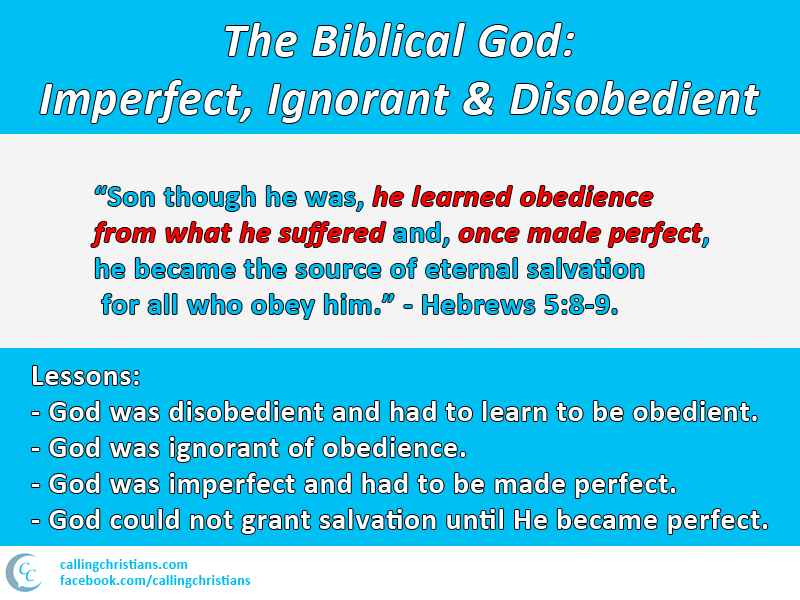
It should be noted that this verse specifies that only one person of the three persons of the Trinity is perfect. I found this to be odd. Why doesn’t the verse say, “as the Son, Holy Spirit and Father are perfect?” Why does the verse only declare the Father to be perfect? Does this mean that the Son, is imperfect? As it turns out, it does mean that. The Bible explicitly teaches that the Son, who is a God, is imperfect and had to be made perfect, God had to become perfect. That’s quite a strange idea. How can God be flawed? When we read Hebrews 5:8-9, this is exactly what it teaches. The passages say:

Son though he was, he learned obedience from what he suffered and, once made perfect, he became the source of eternal salvation for all who obey him.

There are quite a few things we learn from this passage.

  • God the Son, had to learn to be obedient and was thus disobedient at first.
  • God the Son, was imperfect and had to become perfect.
  • God the Son, could not grant salvation until He became perfect.

We should take note, that the passage begins with “Son though he was”, therefore qualifying that despite he is a God, these things happened. The author specifically uses this phrase to denote that the deity is being referred to, and that it is the deity of the Son which had to learn and become perfect. What is problematic is that according to the Trinitarian dogma, each person in the Godhead is co-equal. Therefore, if the Father is perfect, then the Son should be perfect too.

cc-2015-hebrews589

However, as we have just learned, this is not the case. The New Testament explicitly states that the Son was imperfect, had to be made perfect, had to suffer and only when he suffered, then he was able to grant salvation. The New Testament teaches that God could not grant salvation of His own will, because He was flawed and imperfect.

and Allah knows best.

« Older Entries Recent Entries »