Author Archives: Ijaz Ahmad

Refutation: Where Did Jesus Say, “I Am God, Worship Me”? #2

Bismillahir Rahmanir Raheem
بِسۡمِ ٱللهِ ٱلرَّحۡمَـٰنِ ٱلرَّحِيمِ ,

After responding to David Wood’s article, located here, I came across Samuel Green’s addendum. In his presentation, he appealed to the Gospel narrative of Christ before the Sanhedrin located in Matthew 26:62-66, which reads:

“Then the high priest stood up and said to Jesus, “Are you not going to answer? What is this testimony that these men are bringing against you?” But Jesus remained silent. The high priest said to him, “I charge you under oath by the living God: Tell us if you are the Christ, the Son of God.” “Yes, it is as you say,” Jesus replied. “But I say to all of you: In the future you will see the Son of Man sitting at the right hand of the Mighty One and coming on the clouds of heaven.” Then the high priest tore his clothes and said, “He has spoken blasphemy! Why do we need any more witnesses? Look, now you have heard the blasphemy. What do you think?” “He is worthy of death,” they answered.”

Samuel’s point being that Jesus calls himself the son of God and therefore by admission, claims to be God:

“In a recent debate I was told that Jesus never said, “I am God worship me”. At that time I did not answer with the above verses but now I think I should have. The reason is that in these verses Jesus proclaims his divinity and that all people will worship him. First Jesus says he is the Christ/Messiah, the Son of God.”

The problem with this assertion, is that the title, “Son of God” is not a claim of divinity. It’s simple to prove, if we return to the Old Testament, specifically to Bereishit (Genesis), we have the exact phrase being used for the children of Adam:

” When human beings began to increase in number on the earth and daughters were born to them, the sons of God saw that the daughters of humans were beautiful, and they married any of them they chose. ” – Genesis 6:1-2 [NIV, same as Samuel’s version].

If therefore, the claim that anyone who is a son of God, is a God, then Moses, under inspiration from YHWH, when authoring the Book of Genesis claimed all the sons of Adam to be Gods. However, we know that this cannot be the case. Either it is that Samuel Green accepts the phrase, “Son of God” is not a title of divinity, or if he does assert that it is a title of divinity, then he must also bear witness that he worships Adam’s children. The case can even be furthered, if it is that the title, “son of God” is equivalent to being a God, then Samuel’s YHWH, has proclaimed to have many sons and therefore Samuel would have to accept he has many Gods:

“Then say to Pharaoh, ‘This is what the Lord says: Israel is my firstborn son” – Exodus (Shemot) 4:22.

“They will come with weeping;  they will pray as I bring them back. I will lead them beside streams of water  on a level path where they will not stumble, because I am Israel’s father, and Ephraim is my firstborn son.” – Jeremiah (Yirmiyahu) 31:9.

Mr. Green however, has seen it fit to distinguish Jesus’ claim to the son of Godship as something unique and prophesied to mean a divine Son of God. He does this by appealing to a version of Psalms 2:12, which reads:

Kiss the Son, lest he be angry and you be destroyed in your way, for his wrath can flare up in a moment. Blessed are all who take refuge in him.”

The problem with this however is that the phrase, “kiss the son”, is an interpolation, found in the Syriac MSS, however absent from the Septuagint, Masoretic Text, Vulgate, Ethiopic MSS and the Chaldee codices:

It is remarkable that the word son ( bar, a Chaldee word) is not found in any of the versions except the Syriac, nor indeed any thing equivalent to it.

The Chaldee, Vulgate, Septuagint, Arabic, and Ethiopic, have a term which signifies doctrine or discipline: “Embrace discipline, lest the Lord be angry with you,” and especially that in so pure a piece of Hebrew as this poem is, a Chaldeeword should have been found; bar, instead of ben, which adds nothing to the strength of the expression or the elegance of the poetry. I know it is supposed that bar is also pure Hebrew, as well as Chaldee; but as it is taken in the former language in the sense of purifying, the versions probably understood it so here. Embrace that which is pure; namely, the doctrine of God.” – Adam Clarke Biblical Exegesis, Psalms 2:12.

Seeing as that line of evidence for asserting Jesus’ divinity through sonship is faulty, if not wholly fraudulent, and with possibly knowing this, Samuel Green then attempts to qualify his eisegesis by appealing to Daniel 7:13-14, which reads:

“In my vision at night I looked, and there before me was one like a son of man, coming with the clouds of heaven. He approached the Ancient of Days and was led into his presence. He was given authority, glory and sovereign power; all peoples, nations and men of every language worshiped him. His dominion is an everlasting dominion that will not pass away, and his kingdom is one that will never be destroyed.” – Daniel 7:13-14.

Samuel interprets this passage as meaning the son of man (son of God) would be worshipped:

“Then Jesus says he is “the Son of Man sitting at the right hand of the Mighty One and coming on the clouds of heaven.” This language is again from the earlier prophets, the prophet Daniel, and is referring to the divine man who will receive the worship of God.”

The problem is, the word used in Daniel 7:14, doesn’t refer to worship, when we return to the Hebrew we find that the word used is פּלח, which means to revere, serve or minister. That is not to say that it can’t mean worship, but there is a contextual basis for this particular definition. It refers to authority, as persons have to revere, serve or minister to this person. Therefore to present it in a historical context, it is equivalent to the modern use of, “His worship the mayor”. A common term, referring to the respect and authority of a dignitary:

“often Worship Chiefly British Used as a form of address for magistrates, mayors, and certain other dignitaries: Your Worship.” – Dictionary Definition.

There is a distinction between the term used in Daniel, referring to power, authority, reverence and service/ ministering, and with this word שׁחה, which is used when referring to worship of a deity, as demonstrated below:

“Then the man bowed down and worshiped (שׁחה) the Lord” – Genesis 24:26.

 and I bowed down and worshiped (שׁחה) the Lord. I praised the Lord, the God of my master Abraham, who had led me on the right road to get the granddaughter of my master’s brother for his son.” – Genesis 24:48.

With these evidences having been presented, the texts and Hebrew examined, there is no doubt that Samuel Green has grossly misrepresented the Old Testament’s texts, as well as misinterpreting verses to project the view that Jesus is a God. Simple examination of his evidences, have rendered his argument void of any intellectual foundation, solely based on conjecture and most likely can be labelled as an act of gross desperation.

wa Allaahu Alam.
[and God knows best].

Refutation: Where Did Jesus Say, “I Am God, Worship Me”? [Updated]

Bismillahir Rahmanir Raheem
بِسۡمِ ٱللهِ ٱلرَّحۡمَـٰنِ ٱلرَّحِيمِ ,

David Wood of the Answering Muslims blog, has attempted to answer the age old question,”Where did Jesus say, ‘I am God, Worship Me‘?”. I say attempted, because as a person who studies the scriptures and the sciences related to understanding them, I must say that I am a bit bewildered by his methodology. However, before I begin dissecting his arguments I must address one noteworthy point. That is, none of the arguments nor any of the information he provides are new, rather they are oft repeated to the extent that they are void of any intellectual worth. The aim of this response therefore, is to merely provide a series of simple yet sufficient rebuttals to the points made.

The Fallacy of Reading Between the Lines:

From the onset, David relies on this particular fallacy, which can be defined as:

“The unwarranted associative fallacy “occurs when a word or phrase triggers off an associated idea, concept, or experience that bears no close relation to the text at hand, yet is used to interpret the text.”

A simple example would be:

John, a Christian, says he is a contractor.
Ahmad, a Muslim, says he is a contractor.
Ahmad is a Christian because he is a contractor.

This might sound utterly absurd to any remotely familiar with reason and logic. The implication being here, that the conclusion is void of basic comprehension skills. With this in mind, we’re going to up the ante of this argument by applying it to the reasoning from David’s article:

God of Christianity, says in Bible, I am X.
God of Islam, says in Qur’an, I am X.
The God of Islam is a Christian (or validates Christianity) because He says the same as the God of Christianity.

Following through with David’s logic, let’s replace X with “the truth”:

God of Christianity, says in Bible, I am the truth.
God of Islam says in Bible, I am the truth.
Therefore the God of Islam is a Christian (or validates Christianity) because he uses the same title as the God of Christianity.

At this point, one might be skeptical, that David does in fact make such an absurd assertion as the foundation for his response to the aforementioned question, “Where does Jesus say I am God?”. That he would try to prove this by associating the doctrine of one God with another from within two different scriptures and two entirely different religions, to validate his beliefs. Yet, if we read his article, this is exactly as he has done.

Judge by the Gospel?

David opens his argument, with the assertion that Christians, according to the Qur’an, must judge by the Bible or for that matter, the Christian Bible (Septuagint + NT) by referencing an ayah of the Qur’an:

Qur’an 5:47—“Let the people of the Gospel judge by what Allah hath revealed therein. If any do fail to judge by (the light of) what Allah hath revealed, they are (no better than) those who rebel.”

His mistake is clear from the onset, does David Wood truly believe that the God of Islam, Allaah, revealed the Bible, i.e. that it is Kalamullah, or does he subscribe to the belief that the Bible, is an inspired word of God as begotten from the articulated words of men? The latter would be his position, as he associates himself with the doctrine of the Answering Islam team[1].

He then proceeds once more to make another irrational claim, that the Qur’an commands Muslims to believe in the Greco-Roman New Testament and the Judeo-Christian Old Testament, claims which I have aptly refuted here and here. One must take into account, that the Qur’an never commands Muslims to believe in the alleged scripture of the Jews and Christians, which is known as the Bible, which in Arabic would either read, “Majmu ul Kutub”, or “Kitab al Muqaddas”, two terms which never occur in the Qur’an, thus through proof by contradiction, David’s assertion can be easily dismissed. However for a more indepth discussion, please see the two previous links. David then makes this statement:

“However, if Muslims are suggesting that Jesus could only claim to be God by uttering a specific sentence, we may reply by asking, “Where did Jesus say, ‘I am only a prophet, don’t worship me,’ in those exact words?”

We can negate the rationality of this argument, by conversing it.

From:
Where did Jesus say, I am only a prophet, don’t worship me?

To:
Where did Jesus not say, I am not only a prophet, worship me?

That brings us to the original question, where did Jesus claim to be anything more than a Prophet? If so, are we according to David’s logic, supposed to worship a person if they are more than a Prophet. If that is the case, is David Wood a polytheist? Demi-gods, are more than mere mortals who prophesy, would David, by applying his aforementioned reasoning (crossing religious doctrine with his own ideas), then bow to worship the Pagan Greco-Roman Gods? Of course, his answer would be an emphatic no, thus under his own reasoning, his very argument falls apart.

He then sought to summarize his argument, as such:

“Fortunately, we have a simple way to examine what Jesus said about himself. According to both the Bible and the Qur’an, there are certain claims that only God can truly make.”

If we take the above quote and we run it through the Reading Between the Lines Fallacy, as demonstrated above in my opening statement, we see that David arguments crumbles through various inconsistencies. It should be obvious to the reader, that the Qur’an and the Bible expound two clearly different doctrines of God, refer to two completely distinct forms of salvation and are fundamentally two distinct ideologies. However, David is asserting that if he finds two completely different deities making similar statements, then these deities are each other. In other words, if he can prove that Jesus makes a statement that Allaah (God) makes, then Jesus has to be God (Allaah).

With that in mind, let’s settle David’s argument with one final example:

Hercules says he is the son of the God, Zeus.
Jesus says he is the son of the God, YaHWeH.

Since Christians assert that Jesus claimed to be the son of God and Romans believe Hercules is the son of God, then this proves that Jesus is the son of God.

At this point, we can agree that this argument makes no valid sense. Yet, Christians both see Muslims and Roman polytheists as Pagans, yet David, seeks to prove his faith in Christ as a deity by using what he asserts is a pagan deity as evidences for his own God’s existence. We can even further refute his position by asking a simple question:

If Hindus believes that God is one, but represented in many forms and Christians believe God is one, but represented in many forms, does that mean that the Hindu religion is true?

The First and the Last.

Qur’an 57:3.
Isaiah 44:6.
Revelation 1:17.

His first line of evidence is to show that both the Old Testament and the Qur’an claim for God to be The First and The Last. Since both scriptures claim this is a title for God and Jesus “says” he is the First and the Last then,  this proves Jesus is God.

This is problematic for David, when one has read his article, he asserts that Isaiah 44:6, refers to the LORD or YaHWeH, for Christians that would be the Father. It’s a problem because if The Lord is the Father and the Trinitarian Godhead makes it clear that while both the Father and the Son are God, the Father isn’t the Son, nor is the Son the Father. Since this is the case it doesn’t matter what Jesus claims as he cannot be YHWH from Isaiah 44:6. Following from that logic, he also cannot be Allaah from Qur’an 57:3, because of Qur’an 112:3. The final question which begs itself, is this is all a dream from John, as he references the Book of Revelation or the Revelation of John (a dream), therefore I must ask David, if any Christian gets a dream about Jesus claiming something, would he also accept it as the truth? As an example, if I dreamed that Jesus claimed he wasn’t the first or the last, would he also accept it as divinely inspired revelation?

I ask this because David asks if a mere Prophet would claim these divine titles, in response, I am asking, how is Jesus making this claim? It isn’t. It’s a dream someone had, claiming Jesus said these things.

Who Forgives Sins?

Qur’an 3:135.
Psalm 51:4.
Daniel 9:9.
Mark 2:5-7.

From the passage in Mark, Jesus “forgives” a man of his sins. Since God alone can forgive sins, David asserts that Jesus is God. The problem is this, who is doing the forgiving? Is it Jesus, or is it the Lord? We read from Psalms itself:

“Praise the Lord, my soul, and forget not all his benefits—who forgives all your sins.” – Psalms 103:3.

Who forgives all sins? The Lord, or YHWH, or as Christians call him, the Father. Since the Son is not the Father and the Father is not the Son, then we have to conclude that the Father (The Lord, YHWH) is the one who forgives all sins. This is proven by another verse of the Bible:

“Fellow Israelites, listen to this: Jesus of Nazareth was a man accredited by God to you by miracles, wonders and signs, which God did among you through him, as you yourselves know.” – Acts 2:22.

Indeed, it was a miracle that the man was forgiven, but as the Bible rightly says, God alone forgives all sins and God did these acts through the person of Christ.

The Light.

Qur’an 24:35.
Psalm 27:1.
John 8:12.

The Qur’an calls Allaah the light of the heavens and the earth, David calls YHWH (The Father), the Light and Jesus “claims” to be the light in the Gospel.

There again, is another problem here. If the Father is not the Son and the Son is the Father, according to the Trinitarian Godhead that is, then how can the Son claim to have the same title as the Father?

If he has also read the verse of the Qur’an in comparison with the verse from John, how is it that someone who claims to be the light of the earth, is equal to one who is the light of the heavens and earth? Would he therefore claim that if I can light a room, but my brother can light a room and a car, that we are equal? Of course not.

The Truth.

Qur’an 22:6.
Psalm 31:5.
John 14:6.

There again, is another problem here. If the Father is not the Son and the Son is the Father, according to the Trinitarian Godhead that is, then how can the Son claim to have the same title as the Father? The two are distinct, yet David is asserting they are the same person.

I suggest he read James White’s The Forgotten Trinity which makes it clear there are three persons, distinct and co-equal, yet not each other, or one can read James White’s, “A Brief Definition of the Trinity“, wherein he writes:

“There are three eternal Persons described in Scripture – the Father, the Son, and the Spirit. These Persons are never identified with one another – that is, they are carefully differentiated as Persons.”

However, if we do read his example, what’s the context of Jesus’ statement?

“Jesus said to him, “I am the way, and the truth, and the life; no one comes to the Father but through Me.”

Jesus is saying here, that he is the truth, if one wants to come to the Father. In other words, he (Jesus) is the truth of the Father. Something Muslims can identify with, Jesus is indeed a sign of the truth of God, or as we would say, an Ayat ar Rahman (a sign of God).

The Final Judge.

Qur’an 22:56-57.
Psalm 9:7-8.
Matthew 25:31-32.

The problem is the same as above, if from Psalm 9:7-8, it is the Father who is judging and the Father is not the Son, yet the Son is doing the judging in Matthew 25:31-32, we must conclude that the Father is the Son. Which as we know, contradicts the Trinitarian doctrine of the Godhead and once again, David Wood, either displays that he isn’t a Trinitarian Christian or he is wholly ignorant of his very own doctrine. Quite funny, that he seeks to contradict his own faith, to prove Muslims wrong.

This situation of conflicting with the Trinitarian Godhead dogma doctrine, continues to conflict with his other two “evidences” of The Ressurection and God’s Glory.

Further Evidence.

He references Mark 2:28, which states that Jesus is the Lord of the Sabbath, that’s a problem however let’s just quote verse 27 and 28:

“Then he said to them, “The Sabbath was made for man, not man for the Sabbath. So the Son of Man is Lord even of the Sabbath.”

The context of this verse is that man is the master (the Greek word used for Lord is Kurios [κύριος]), which doesn’t refer to a divine being, it refers to a Master or a Sir, someone of authority, the word for a divine authority such as a God would be Theos. So the verse is generally saying that men are masters of the Sabbath because it was made for them. Referencing a Talmudic law, Rabbi Michael Skobac speaks about in this lecture .

Jesus demonstrates that man is the master of Sabbath, by referencing the story of David, wherein David’s men enter the Tabernacle and eat from the Holy Bread. A bread which they are not normally allowed to consume. In fact in the story of David, we read that the men are even called holy:

“The men’s bodies are holy even on missions that are not holy. How much more so today!”  So the priest gave him the consecrated bread, since there was no bread there except the bread of the Presence that had been removed from before the Lord and replaced by hot bread on the day it was taken away.” – 1 Samuel 21.

Therefore his argument that men are the masters of the Sabbath as been soundly defeated. According to Judaic law, certain laws can be broken in order to fulfil other rights of the Israelites, such as in both cases where they are starving. Something which Jesus himself references in Matthew 12:3-5:

 He answered, “Haven’t you read what David did when he and his companions were hungry?  He entered the house of God, and he and his companions ate the consecrated bread—which was not lawful for them to do, but only for the priests. Or haven’t you read in the Law that the priests on Sabbath duty in the temple desecrate the Sabbath and yet are innocent?”

David Wood, then references Matthew 22:41-45 where he claims Jesus is the Lord of David, again the word used here is master and indeed if Jesus was the Christ sent to Israel, then he was the Messiah of Israel, thus he would be also the master of David who was from Israel as well. If we ignore that fact, David Wood must be reminded that Matthew 22:41-45, contradicts Matthew 1:2.

David Wood, then proceeds by stating that Jesus claims to be greater than a temple of God, in Matthew 12:6. Which brings into question his reasoning, did he really believe that a building is holier than a Prophet? Poor reading of the scriptures gives bad study, and clearly he needs to read Malachi 3, which refers to the Messenger of God, the Messenger of the Covenant who will come to purify the Temple.

He then tries to demonstrate that Matthew 11:27 makes Jesus a God, because in this verse it reads, “No one knows the Son except the Father, and no one knows the Father except the Son“, this brings into question David’s understanding of the Trinity, as in verse 25 we read, “ At that time Jesus said, “I praise you, Father, Lord of heaven and earth“. The son therefore, in this scenario isn’t equitable or a co-equal with God, as he is praising (glorifying) the Father and is claiming his knowledge isn’t his own (isn’t God all knowing?), but that his knowledge is from the Lord (Father, YHWH). This verses proves the opposite, Jesus isn’t divine but dependent on God for his knowledge.

David Wood, then appeals to John 14:14, wherein Jesus is said to be able to answer prayers, rather, if we read verse 13, it states, “And I will do whatever you ask in my name, so that the Father may be glorified in the Son.“, a direct references to Acts 2:22, where it states, ““Fellow Israelites, listen to this: Jesus of Nazareth was a man accredited by God to you by miracles, wonders and signs, which God did among you through him, as you yourselves know“.

He then refers to Matthew 28:18 to demonstrate that Jesus is given power over earth and heaven by God, this is a problem for David, as the word used is εξουσία which as we can see refers to jurisdiction or authority. So what was Jesus given the authority to do? To command his disciples to preach to non-Jews, i.e gentiles as the following verses state, “ Therefore go and make disciples of all nations, baptizing them in the name of the Father and of the Son and of the Holy Spirit”, which contradicts Acts 15, wherein this was a debate raging between Paul and the disciples some 14 plus years after Jesus allegedly said those words.

John 5:21-23, is in accordance with Islamic theology, one must honor God and the one who brings God’s message (risalat), the one who brings God’s message is a rasul (messenger), so what does John 5:23 state why we should honor the messenger of God? Well it  says we should honor God by honoring the Messenger of God who was sent by God, “He who does not honor the Son does not honor the Father who sent Him“.

Further on he references areas where Jesus is worshipped in the New Testament in Matthew 2:11, 14:33, 28:17, Luke 24:52 and John 9:38. There is a problem however, the word does not exclusively mean to worship, in fact, it doesn’t mean to worship in the least. The word προσκυνέω as demonstrated in Strong’s Lexicon, means to bow to as the Orientals do to each other, to revere, to kiss or to even lick like a dog licking it’s master’s hand, yet never to worship as a deity. As for John 20:28, it is sufficiently refuted here and here.

Assessment.

As we can see, in all of the claims of David Wood, there are conflicts with his own Trinitarian Godhead doctrine, abuse of the translation of words from the Greek texts and improper reading of the New Testament by David. He has been unable to demonstrate a single case where Jesus himself, in an unequivocal, first person verbatim (Greek: Grapho) statement claims to be God. It is quite contrasting to the God of the Old Testament who had no problem in demonstrating that:

“I am Yahweh your God, who brought you out of the land of Egypt, out of the house of bondage. You shall have no other gods before me. You shall not make for yourselves an idol, nor any image of anything that is in the heavens above, or that is in the earth beneath, or that is in the water under the earth: you shall not bow yourself down to them, nor serve them, for I, Yahweh your God, am a jealous God, visiting the iniquity of the fathers on the children, on the third and on the fourth generation of those who hate me, and showing loving kindness to thousands of those who love me and keep my commandments.” – Exodus 20:2-6.

David Wood is almost giving the impression that the God of the New Testament is a muzzled God, unable to declare His deity. A God who so proudly claimed to be vehemently jealous, suddenly can’t claim his own deity. A God that destroyed entire nations for not worshipping Him, for worshipping the wrong God, suddenly is unable to clearly declare, as he once did, that he was a deity. It is shocking that David would like us to believe in such a timid God, a changed God, a reformed God, who is now meek and not jealous and insistent on declaring his identity.

Postscript: The Islamic Dilemma.

As it has been explicitly demonstrated, if it is that those statements which David chose are to represent the belief that Jesus was a deity, by making him the same person as the Father (YHWH), then he has to accede that the Trinitarian Godhead concept is wrong in that the two persons are not distinct, therefore conceding that he (David) is a Modalist. Something which his ally in Islamophobia, James White should have the guts to address, but then again, I wouldn’t expect either of them to correct each other publicly as it’s bad for business.

The concept that Islam believes that either the Masoretic Text/ LXX or the Greco-Roman New Testament texts are inspired by God and sanctioned by Islam as scripture, have been thoroughly refuted here and here.

wa Allaahu Alam.
[and God knows best.]

[1] – A Series of Answers to Common Questions, The Bible is Inspired but Paul Claimed Otherwise, by Sam Shamoun.

Update:

Derek Adams via the commenting section of Answering Muslim’s website, sought to defend David’s argumentation by supposing the following:

“Yeah you’re rebuttal doesn’t understand basic Christian doctrine. All three persons are LORD(YHVH). YHVH is not an exclusive name for the Father that cannot be applied to the Son.”

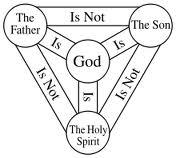
The problem with Derek’s statement, is that he is most likely not well studied in the doctrine of the Trinity, firstly, he should refer to this image which is used by most Evangelical groups to explain the Trinity to Muslims and Christians alike:

Secondly, to correct him:

The Father, The Son and The Holy Spirit are considered to be God (אלהים) in the Trinitarian Godhead. However The Father, The Son and The Holy Spirit are not all considered to be YHWH (יהוה) who is considered to be the Father, I shall qualify this with an example from the Old Testament:

“The Lord  (יהוה)  said to Abram after Lot had parted from him, “Look around from where you are, to the north and south, to the east and west.” – Genesis 13:14.

As opposed to:

“In the beginning God (אלהים) created the heavens and the earth.” – Genesis 1:1.

Wherein according to Christian dogma, The Father, Son and Holy Spirit are being referred to as Creators of the heavens and the earth in this verse. Yet, when YHWH is used it solely refers to the Father in the Old Testament, according to the Christian rendition of the Pentateuch (Greek Septuagint).

His confusion mostly stems from the English misuse of the word God in the Bible. It’s often easy to understand the plight of Christians, as even many Christian apologists have great difficulty in comprehending, if not teaching the dogma of the Godhead. This situation is worsened when the English renditions use the same words to refer to both a person of the Godhead and the Godhead’s unity in itself.

This understanding is qualified by one of Derek’s heroes or so to speak, Sam Shamoun in his article, “Jesus is indeed Yahweh God the Son!“, states:

“Moreover, since the Father can be identified as Yahweh in isolation from the others, the Son can therefore be identified as Yahweh’s Servant.”

Derek Adams then sought to reference that Allaah revealed to the Prophet [peace and blessings be upon him] the knowledge in dreams this therefore allows anyone with dreams to take their dreams as scripture. To correct Derek’s assertion, a Prophet in Islam is a Rasul who is the vessel through which the Risalat (Message) is revealed. So the Rasul can receive the Risalat in a variation of ways, as that is their purpose in this world, to deliver the revelation of God.

However, when it comes to John’s personal revelation (The Book of Revelation), he wasn’t a Prophet or Messenger and Christians acknowledge that in their doctrine, no other message was to come after the Gospel of Christ. Therefore Derek has again defamed himself and completely refuted his own arguments through appeal to ad ignorantium, what I like to commonly refer to as damnant quod non intelligunt, that being, they argue against that, which they do not understand.

wa Allaahu Alam.
[and God knows best.]

Christian Blasphemy Laws

Bismillahir Rahmanir Raheem
بِسۡمِ ٱللهِ ٱلرَّحۡمَـٰنِ ٱلرَّحِيمِ ,

Islamic countries have come under criticism from many Christian missionaries for having laws which protect their religious tenets. In what can only be described as pure hypocrisy, or wilful ignorance, they seemed to have also forgotten that they also use blasphemy laws to their own benefit. Christians in India, apparently angry at a non-believer who disproved a farce of a miracle, encited authorities to detain and charge the man for allegedly, “hurting the religious sentiments of a particular community” or in other words, blaspheming their religion by disproving a false miracle.

Sanal Edamaruku, an Indian skeptic, went to Mumbai and revealed that a “miraculous” weeping cross was really just a bit of statuary located near a leaky drain whose liquid reached it by way of capillary action. The local Catholic Church demanded that he retract his statements, and when he refused, they had him arrested for blasphemy.

Source: Indian Skeptic Charged for “Blasphemy” for revealing secret behind “miracle” of weeping cross.

Please click the above link for the full article, which explains the pains through which the large Christian community in India are endeavouring upon, to hang on to pure desperation and deceit to build their faith.

wa Allaahu Alam.
[and God knows best.]
Egypt ‘necrophilia law’?

Bismillahir Rahmanir Raheem
بِسۡمِ ٱللهِ ٱلرَّحۡمَـٰنِ ٱلرَّحِيمِ ,

Whether done through intentional malice or bad fact/ data checking. A number of Western oriented news websites, inclusive of one Arab website released a news report, indicating that the Muslim Brotherhood of Egypt’s Parliament were in line to bring into law, permission for a husband to have sex with his deceased wife for a period of stipulated time after her death. This act is commonly referred to as necrophilia. The problem is though, as the Christian Science Monitor has indicated, there is no actual factual source for this story. There is nothing indicating that this is a true law or even a concept being discussed by the Muslim Brotherhood:

Today, Egypt’s state-owned Al Ahram newspaper published an opinion piece by Amr Abdul Samea, a past stalwart supporter of the deposed Hosni Mubarak, that contained a bombshell: Egypt’s parliament is considering passing a law that would allow husbands to have sex with their wives after death.

But extreme, not to mention inflammatory claims, need at minimum some evidence (and I’ve read my share of utter nonsense in Al Ahram over the years). The evidence right now? Zero.

Source: The Christian Science Monitor, Egypt ‘Necrophilia Law’?

Please click the above link to be taken to the CSM’s news report that completely refutes, what can only be described as a desperate claim against Islam.

wa Allaahu Alam.
[and God knows best.]

Refutation: Reading Deuteronomy 24:16 and Ezekiel 18:20 in context.

Bismillahir Rahmanir Raheem
بِسۡمِ ٱللهِ ٱلرَّحۡمَـٰنِ ٱلرَّحِيمِ ,

Samuel Green has sought to defend the Christian position of salvation by substitutional sacrifice. That being  that sin can be dispensed of through the death of another human being (Christ as the sacrificial lamb). At first, he references the two verses which negate such a teaching:

Fathers shall not be put to death for their children, nor children put to death for their fathers; each is to die for his own sin. (Deuteronomy 24:16, NIV)

The soul who sins is the one who will die. The son will not share the guilt of the father, nor will the father share the guilt of the son. The righteousness of the righteous man will be credited to him, and the wickedness of the wicked will be charged against him. (Ezekiel 18:20, NIV)

At this point, before I dissect the eisegesis of Samuel, we need to properly lay a foundation of the views which some of the more notable and erudite Christian exegetes themselves have taken, we read from Adam Clarke’s Exegesis the follow excerpt:

“None shall die for another’s crimes, none shall be saved by another’srighteousness. Here is the general judgment relative to the righteousness andunrighteousness of men, and the influence of one man’s state on that of another; particularly in respect to their moral conduct.”

We also read from Matthew Henry’s Complete Commentary on the Entire Bible that the persons who are punished are due to their own sinning brought about by themselves:

But this people that bore the iniquity of their fathers had not done that which is lawful and right, and therefore justly suffered for their own sin and had no reason to complain of God’s proceedings against them as at all unjust, though they had reason to complain of the bad example their fathers had left them as very unkind. “

Seeing as the Torah (Old Testament) is primarily the book of the Jews, it would be inappropriate to leave off their understanding of the verses referenced, we read from Rabbi Rashi’s commentary, the following excerpts from his exegesis of Devarim (Deuteronomy):

“Fathers shall not be put to death because of sons: [I.e.,] by the testimony of [their] sons. But, if you say [that it means that fathers shall not be put to death] because of the sins of their sons, it has already been stated, “each man shall be put to death for his own transgression.”

With these statements in mind, we now have a proper understanding from traditional Christian sources and Judaic sources as to the proper meaning of these verses. Samuel however, sought to circumvent the orthodox interpretations of these verses by claiming that he himself had a proper understanding based on Judaic principles:

“This, however, is not the case because both of these verses are referring to a person living under the covenant of the Torah (the Law of Moses). Deuteronomy 24:16 is part of the Torah itself and Ezekiel 18:20 is addressing the Israelites who were living under the Torah.”

Take note, that he’s claiming that he is representing the orthodox Judaic understanding/ context of the verses, yet nowhere, does he cite, reference or quote a single Rabbinic Judaic source to qualify his statements. It should be understood, that if he is attempting to represent the views of the people who lived under and held to the practise of the Torah, that he should atleast present one authoritative source from among these people to make extant their views. Instead, what he does is continue to quote verses, without referencing the Judaic interpretations. This therefore is a case of intentional decontextualization of a scripture by referencing a group of persons with specific beliefs, yet alienating their positions by transposing his own mendacious ideas about their belief on said scripture. He references the following verses as being representative of his position:

“(H)e must bring as his offering for the sin he committed a female goat without defect. He is to lay his hand on the head of the sin offering and slaughter it at the place of the burnt offering. Then the priest is to take some of the blood with his finger and put it on the horns of the altar of burnt offering and pour out the rest of the blood at the base of the altar. He shall remove all the fat, just as the fat is removed from the fellowship offering, and the priest shall burn it on the altar as an aroma pleasing to the LORD. In this way the priest will make atonement for him, and he will be forgiven. (Leviticus 4:28-31, NIV)

For the life of a creature is in the blood , and I have given it to you to make atonement for yourselves on the altar; it is the blood that makes atonement for one’s life. (Leviticus 17:11, NIV)”

He then interprets this in the following manner:

“This is why a lot of the Torah teaches about priests, sacrifices and the tabernacle/temple where the sacrifices were offered. The Torah teaches individual responsibility and forgiveness through a substitute sacrifice that bears our sin…..hese verses are not saying there is no sacrifice that can bear our sin. Instead they are saying that we are individually responsible for our sins and need to seek forgiveness through God’s provision of a substitute sacrifice that can bear our sin.”

Let’s examine his statements. To begin with, Samuel has mistakenly supposed that the animals bare the sin of the one who is doing the  sacrifice or of the one for whom the sacrifice is done. Recall, that nowhere is this stated in the verses he referenced. Note that the quotes he references makes it quite explicitly known that these sacrifices are an atonement. This is where his first problem begins, his understanding of what an atonement is, has been severely perverted. For example, if we follow through on his logic, then an act of atonement is one in which something bares the sin on behalf of the sinner:

“Make an atonement cover of pure gold—two and a half cubits long and a cubit and a half wide.” – Exodus 25:17.

In this scenario, we have a cloth, a cover becoming a source of atonement for the Jewish peoples. Nothing is being sacrificed, nor is anything perishing, suffering, or being tortured to bear the sin of a sinner. Rather a piece of cloth has become a means through which sins can be forgiven. Don’t take my word on it, Adam Clarke, the Christian exegete confirms this, he says:

“This propitiatory covering, as it might well be translated, was a type of Christ, the great propitiation, whose satisfaction fully answers the demands of the law, covers our transgressions, and comes between us and the curse we deserve. “

Note the conditions that are laid forth. The cloth has to accede to the demands of God’s law (that is, it has to be tailored, or exacted by those who are executing the criteria [law] as commanded by God), when that is done, those acts which fulfill the criteria as sent by God, then covers or atones for the sins of those who carry out the commands of God. From this we then see that the act of properly abiding by God’s command as an act of atonement, delivers us from His divine punishment. If we continue onwards, we read from Exodus (Shemot) 30:11-15, the following:

“Then the LORD said to Moses, “When you take a census of the Israelites to count them, each one must pay the LORD a ransom for his life at the time he is counted. Then no plague will come on them when you number them. Each one who crosses over to those already counted is to give a half shekel, according to the sanctuary shekel, which weighs twenty gerahs. This half shekel is an offering to the LORD. All who cross over, those twenty years old or more, are to give an offering to the LORD. The rich are not to give more than a half shekel and the poor are not to give less when you make the offering to the LORD to atone for your lives.”

In this case, Samuel’s God, is taking money as a form of expiation for sin. Note, no one is suffering, no one is being tortured, no one is being killed for sin. Money is being used as a form of expiation and as it is, in this case, just like the piece of cloth aforementioned, money is like a Christ here as well, being waged for the gift of life.

Where does this therefore leave us? What it does is indicate that Samuel’s understanding of what atonement is defined as, is incorrect. Atonement is not substitutional sacrifices, rather as I have demonstrated, atonement entails enacting certain criteria as set out by God in a way which sanctifies His divine commands. In the first scenario I presented, we see the stringent conditions for the cover, with God specifying what dimensions the cloth and gold have to be. In the second scenario we see that the certain condition to be undertaken is the amount of money to be  collected and from whom, that is, if they wished for their lives to be preserved.

Note, that nothing has to suffer or die, ergo, no blood is spilled, therefore nothing has died for the sins of anyone. Rather atonement as we can see, is not that something has bared the sin of another, but that atonement is a means through which one gains God’s forgiveness and mercy. Just like prayer, or fasting, these are also means of atonement, where we hold true to God’s divine commands, with whichever criteria He denotes as being the measuring stick to qualify our acts of repentance.

In conclusion, Samuel has not provided a strong argument to demonstrate that one object or person, or for the sake of argument, an animal can bear the sin of another. Rather what he has allowed us to demonstrate is that the sacrifices we make, whether with blood or gold, money or otherwise, are means of atonement because God has dictated them and they fulfil His criteria for forgiving us of our acts of inequity (sins).  In order for his point to be valid, he has to demonstrate that the proprietary cloth or the shekels collected by Moses had to suffer and die, blood had to magically spew from them, so that a price of sin was paid, as he clearly alludes to this in his referencing of the commands in Leviticus and with his mentioning of the alleged death of Christ.

wa Allaahu Alam.
[and God knows best.]

Christ and the Law: Based on a Chronic Assessment of the Gospels

Bismillahir Rahmanir Raheem
بِسۡمِ ٱللهِ ٱلرَّحۡمَـٰنِ ٱلرَّحِيمِ ,

At the very foundation of this topic, lies the heart of the Judeo-Christian narrative on the personhood of Christ and the religion of Christianity. For some almost 2000 years, there has always existed a disconnect between the validity of the application of the Torah’s laws and Christ’s ministry. Therefore to establish a basic understanding from which to work, let’s look at the Christian position on the Law as it stands today and then regress into the ministry of Christ and subsequently the period after his ministry. In doing so, we shall develop a holistic comprehension of how the law was used in Christ’s time and how it was observed directly after his time, then we shall contrast it with the modern Christian understanding. What, therefore, is the standard Christian position towards the relevance of  the law?  John Calvin in his, Harmony of the Law, Volume 1, succinctly addresses or rather summarizes and defines the Christian position during his time and that of which almost all Christians have adopted today as their standard position, he states:

“The Last Part shews the end and use of the Law; and thence its usefulness is very extensive. For how would it profit us to be instructed in righteousness of life, unless the perception of our guilt and iniquity induced us to seek after the remedy? But when God allures us so gently and kindly by his promises, and again pursues us with the thunders of his curse, it is partly to render us inexcusable, and partly to shut us up deprived of all confidence in our own righteousness, so that we may learn to embrace his Covenant of Grace, and flee to Christ, who is the end of the law. This is the intention of The Promises, in which he declares that he will be merciful, since there is forgiveness ready for the sinner, and when he offers the spirit of Regeneration. On this depends that sentence of St. Paul, that Christ is the end of the Law Still I do not so distinguish this class from the foregoing, as if it had nothing in common with them. For, before arriving at it, it will be often necessary to refer both to the terrible ruin of the human race, as well as to the peculiar blessing of Adoption, and to that increasing flow of fatherly love which God extends to his people. For all the expiations have no other meaning than that God will be always merciful, as often as the sinner shall flee to the refuge of his pardon. But how needful this division is will be best understood as we proceed.”

With having read this, we come to the understanding that Christians accept the following:

  • The Law (Mitzvot, Shari’ah) are from God.
  • They serve a divine purpose, that being of guidance to God.
  • The Law demonstrates our weakness.
  • It demonstrates our weakness to aid us in turning to Christ.
  • Christ is the end of the Law.

While I as a Muslim would agree with the first two points noted above, I do have to question the third notion which is commonly expressed and those of which are derived from it. If the purpose of the law is to solely demonstrate our weakness, then what happens when the law is put into practise? When obedience and application of the law is being done, does that then render the purpose of the law, invalid? Perhaps, out of God’s reason for giving the law? These questions must be asked, because if it is the Law is there to only demonstrate our weakness, what then occurs if it doesn’t? Using this line of reasoning, the Christian concept of the Law seems rather paradoxical if not, inane.

To circumvent this theological problem of the Christians, let’s examine what the Torah (LXX) actually states in Deuteronomy (Devarim) 4: 1-4 :

“Now, Israel, hear the decrees and laws I am about to teach you. Follow them so that you may live and may go in and take possession of the land the LORD, the God of your ancestors, is giving you. Do not add to what I command you and do not subtract from it, but keep the commands of the LORD your God that I give you. You saw with your own eyes what the LORD did at Baal Peor. The LORD your God destroyed from among you everyone who followed the Baal of Peor, but all of you who held fast to the LORD your God are still alive today.”

Note, in these verses, the purpose of the Law, as explicitly stated isn’t to display man’s weakness (although the Law does that, it can, conversely demonstrate man’s faithfulness and piety as shown in the verses above), but to grant success, meaning then that the Law grants life. It grants life because obedience to God demonstrates piety (in Islam: taqwa) and by extension earns God’s pleasure with his obedient followers/ believers. The same can be seen in the Qur’an, see Surah 2:1-5.

If we were to also follow through on the logic that the Law is supposed to take us to Christ, in the understanding that salvation can only be sought through him, then we also have to question this track of reasoning. If for some 1,500 years before Christ the Law was supposed to lead people to him as their eternal saviour, then therein lies a problem. For 1,500 years no one was lead to the Christ, they followed a Law, which according to Christian reasoning was supposed to lead to someone who wasn’t their. Alas, early converts to Christianity did notice this exception, we find that an answer is given in Luke 16:19-21, wherein those who did good await for Jesus to take them to heaven, which Paul states in his epistle to the Ephesians, was fulfilled, see Chapter 4, Verses 8 – 10. However the problem still persists, if the Law is supposed to lead to Christ as a means of salvation, then law in itself cannot be a means of salvation. This may become confusing, so let’s break this down:

The law exists to lead to Christ.
You are only saved because of Christ.

If we accept that the law leads to Christ then can the law be held against us, i.e sinners aren’t led to Christ?

Or if the Law does lead us to Christ, are we saved because we practised the law or are we saved because of Christ? If we are saved because of Christ, then the law becomes irrelevant, if we are saved because we practised the law, then Christ didn’t actually save anyone.

Lastly, we read that Christ is the end of the Law (mitzvot, shari’ah). This statement leads us into our next section, where we examine this claim in detail. What exactly does this phrase mean? Of what consequence is it? What ideological and theological beliefs can be derived from such a position?

The Law Before Christ’s Mission:

Deuteronomy 4:1-4
“Now, Israel, hear the decrees and laws I am about to teach you. Follow them so that you may live and may go in and take possession of the land the LORD, the God of your ancestors, is giving you. Do not add to what I command you and do not subtract from it, but keep the commands of the LORD your God that I give you. You saw with your own eyes what the LORD did at Baal Peor. The LORD your God destroyed from among you everyone who followed the Baal of Peor, but all of you who held fast to the LORD your God are still alive today.”

Deuteronomy 13:4
It is the LORD your God you must follow, and him you must revere. Keep his commands and obey him; serve him and hold fast to him.

Deuteronomy 28:15
However, if you do not obey the LORD your God and do not carefully follow all his commands and decrees I am giving you today, all these curses will come on you and overtake you:

Deuteronomy 29:31
The secret things belong to the LORD our God, but the things revealed belong to us and to our children forever, that we may follow all the words of this law.

Deuteronomy 30:10
if you obey the LORD your God and keep his commands and decrees that are written in this Book of the Law and turn to the LORD your God with all your heart and with all your soul.

Deuteronomy 30:16
For I command you today to love the LORD your God, to walk in obedience to him, and to keep his commands, decrees and laws; then you will live and increase, and the LORD your God will bless you in the land you are entering to possess.

From these references, we can see the importance of the Mosaic Law (Mitzvot), therefore we can safely assert that before Jesus’ time, the law was held in a high regard, a high esteem that guided the People of Israel and any Prophet that was to come had to preach a message that continued upon the same foundations of the Law, or that Prophet was therefore false and had to be purged from the lands of the believing peoples:

“If a prophet, or one who foretells by dreams, appears among you and announces to you a sign or wonder, and if the sign or wonder spoken of takes place, and the prophet says, “Let us follow other gods” (gods you have not known) “and let us worship them,” you must not listen to the words of that prophet or dreamer. The LORD your God is testing you to find out whether you love him with all your heart and with all your soul. It is the LORD your God you must follow, and him you must revere. Keep his commands and obey him; serve him and hold fast to him.  That prophet or dreamer must be put to death for inciting rebellion against the LORD your God, who brought you out of Egypt and redeemed you from the land of slavery. That prophet or dreamer tried to turn you from the way the LORD your God commanded you to follow. You must purge the evil from among you.” – Bible : Deuteronomy 13: 1-5.

This is also in accordance with Islamic belief of the risalat (message) which is God’s wahy (revelation). That we must believe in the revelation of God’s scriptures.

The Law During Christ’s Mission

From the very onset, the Judaic narrative is clear, the book of Matthew which is the opening for the New Testament, immediately announces Jesus as a descendant from a line of strict Torah observants, and therefore has the noble lineage from which the Messiah was prophesied to have come (Isaiah 11:1-9; Jeremiah 23:5-6, 30:7-10, 33:14-16; Ezekiel 34:11-31, 37:21-28; Hosea 3:4-5). This narrative is consistently pursued in Matthew’s Gospel, almost every chapter links Jesus to some Judaic belief of the Messiah. We read in Chapter 2 he’s labelled the King of the Jews, Chapter 3 that he is announced by by a precursor to his arrival, Chapter 4 that he quotes Deuteronomy 8:3 and so on.

What then does Jesus actually say about the law?

 “Do not think that I have come to abolish the Law or the Prophets; I have not come to abolish them but to fulfill them. For truly I tell you, until heaven and earth disappear, not the smallest letter, not the least stroke of a pen, will by any means disappear from the Law until everything is accomplished. Therefore anyone who sets aside one of the least of these commands and teaches others accordingly will be called least in the kingdom of heaven, but whoever practices and teaches these commands will be called great in the kingdom of heaven. For I tell you that unless your righteousness surpasses that of the Pharisees and the teachers of the law, you will certainly not enter the kingdom of heaven.” – Bible : Matthew 5 : 17 – 20.

μη νομισητε οτι ηλθον καταλυσαι τον νομον η τους προφητας ουκ ηλθον καταλυσαι αλλα πληρωσαι. – Bible : Matthew 5: 17.

This is where the first problem begins. What does Christ mean, assuming he spoke these words, that he came to “fulfill” the Law (mitzvot)? We shall answer this by first examining the standard Christian position, that is from the Geneva Study Bible, which states:

“Christ did not come to bring any new way of righteousness and salvation into the world, but indeed to fulfil that which was shadowed by the figures of the Law, by delivering men through grace from the curse of the Law: and moreover to teach the true use of obedience which the Law appointed, and to engrave in our hearts the power for obedience.”

Now, this presents a paradox, on one end it is stated that Christ did not come to bring a new way of salvation, but that his coming was to deliver men from the curse (punishment) of the Law. This statement is self contradicting, because by stating he is delivering men from punishment, this in itself is Salvation. Salvation’s definition as it is understood, means, “to be free from sin and the punishment of sin”. Therefore the Christian position seems to be a confused one. They state that Christ didn’t come to bring a new form of salvation, yet they say he did bring salvation.

This begs the question, is this form of salvation new? Yes, there is nowhere in the Old Testament which states that one man can account for the sins of all people or for that case, another person. However there is a passage which says the opposite:

 “The one who sins is the one who will die. The child will not share the guilt of the parent, nor will the parent share the guilt of the child. The righteousness of the righteous will be credited to them, and the wickedness of the wicked will be charged against them.” – Ezekiel 18:20.

Foregoing the confused position taken by the Christians, let’s proceed to defining what Christ meant by, “fulfilling” the Law. The word as used in Greek is:

πληρωσαι (pleroo – Strong’s Lexicon 4137)

However, Christian Exegete Adam Clarke, on explaining this verse, makes a rather interesting point:

“It is worthy of observation, that the word gamar, among the rabbins, signifies not only to fulfil, but also to teach; and, consequently, we may infer that our Lord intimated, that the law and the prophets were still to be taught or inculcated by him and his disciples; and this he and they have done in the most pointed manner. See the Gospels and epistles; and see especially this sermon on the mount, the Epistle of James, and the Epistle to the Hebrews. And this meaning of the word gives the clear sense of the apostle’s words, Colossians 1:25Whereof I am made a minister,ης εγενομην εγω διακονος κατα την οικονομιαν του θεου την δοθεισαν μοι εις υμας πληρωσαι τον λογον του θεου , tofulfil the word of God, i.e. to teach the doctrine of God.

With this in mind, we can note that one understanding of Matthew 5:17, is that Christ came to teach the Law (Torah). On further examination, if we compare the words used in Greek in Matthew and Colossions, we find that that are indeed the same term used:

Matthew:
μη νομισητε οτι ηλθον καταλυσαι τον νομον η τους προφητας ουκ ηλθον καταλυσαι αλλα πληρωσαι

Colossians:
ης εγενομην εγω διακονος κατα την οικονομιαν του θεου την δοθεισαν μοι εις υμας πληρωσαι τον λογον του θεου

What we come to see is that the most used translations of this term, are either “complete” or “fulfill”. Recall, we observed above that to fulfill according to the Geneva Study Bible, meant Christ came to bring Salvation from the curse of the Law, however, a more accurate reading from the Greek, demonstrates that Christ actually stated, that he came to proclaim or teach the law. The question begs itself, why then do Christians need to appeal to this word game? On one hand, they contradict themselves if they say fulfill means to bring salvation from the punishment of the Law, whereas if we don’t appeal to their word games, we see that Christ claimed to teach or proclaim the Law:

“Then a teacher of the law came to him and said, “Teacher, I will follow you wherever you go.” – Bible :  Matthew 8: 19.

“When the Pharisees saw this, they asked his disciples, “Why does your teacher eat with tax collectors and sinners?” – Bible : Matthew 9 : 11.

“Then some of the Pharisees and teachers of the law said to him, “Teacher, we want to see a sign from you.” – Bible : Matthew 12 : 38.

Continuing on the topic at hand, if we look at the meaning of the word  πληρωσαι from Strong’s Lexicon, we will never be able to derive the understanding that the term means to bring salvation or deliverance from sin. In fact, the New Testament’s claim that Christ claimed to proclaim or teach the Law can further be proven by first reading how salvation, from the curse (punishment) of the Law can be achieved:

“This is what the Sovereign LORD, the Holy One of Israel, says: “In repentance and rest is your salvation, in quietness and trust is your strength, but you would have none of it.”  – Bible : Isaiah 30: 15.

Something which the New Testament bears witness to Christ preaching:

“From that time on Jesus began to preach, “Repent, for the kingdom of heaven has come near.” – Matthew 4:17.

“Then Jesus began to denounce the towns in which most of his miracles had been performed, because they did not repent.” – Bible : Matthew 11: 20.

“They went out and preached that people should repent.” – Bible : Mark 6 : 12.

“I have not come to call the righteous, but sinners to repentance.” – Bible  : Luke 5: 32.

This therefore, soundly refutes, through proof by contradiction, that Christ himself did not lay to the claim that he will himself deliver salvation from the punishment of the Law, but that he kept with the teaching of Moses and the Prophets, such as Isaiah, that the Law must be kept and that deliverance from sin for the breaking the Laws was to repent. Nothing new from Jesus, he kept the belief as it always had been and this is what he preached.

In fact, as Rabbi Michael Skobac in his discussion on the early Jewish followers of Jesus has stated, we notice that Jesus did in fact keep the practise (Sunnah) of the observant Jewish followers at that time. It’s not noticeable at first, but when one goes to the Greek, the truth becomes quite enlightening or so to speak.

Luke 8:44
” She came up behind him and touched the edge of his cloak, and immediately her bleeding stopped.”

Quite an unassuming story, some woman touching Jesus’ cloak, how does this prove anything? Well let’s turn to the Greek:

προσελθουσα οπισθεν ηψατο του κρασπεδου του ιματιου αυτου και παραχρημα εστη η ρυσις του αιματος αυτης

What does this word: κρασπεδου, mean? From Strong’s Lexicon we read:

  • in the NT a little appendage hanging down from the edge of the mantle or cloak , made of twisted wool.
  • a tassel, tuft: the Jews had such appendages attached to their mantles to remind them of the Law.


A striking revelation, hidden beneath the deception of Christian translators. This is one reason both Muslims and Jews emphasize learning the original language of the Scriptures, so that one can fully understand God’s revelation. What is insightful of this verse, is that Jesus is wearing a cloak that had these tassels attached to them, which only Torah observant teachers wore. If that is the case, then clearly Jesus was practising the Law and not preaching away from it, or that it had come to an end.

The Law Practised in the Final Supper

It would be odd that if Christ did preach salvation through his crufixion, death and ressurection, that towards the end of his mission, he would still be practising the Law, as well as his disciples as Torah observant Jews, yet this is exactly the case we find during the famous, final supper:

“On the first day of the Festival of Unleavened Bread, the disciples came to Jesus and asked, “Where do you want us to make preparations for you to eat the Passover?”…..”When evening came, Jesus was reclining at the table with the Twelve.” – Bible : Matthew 26 : 17, 20.

The Law Practised During Jesus’ Burial

For the sake of argument, let’s assume the Christian position, that Jesus’ death, signalled a new era of salvation. Believe in him having died for your sins and you would be saved. However, we run into another problem. The Disciples of Christ, even at his burial were still observing the Laws of the Torah (Mitzvot):

It was Preparation Day (that is, the day before the Sabbath). So as evening approached, Joseph of Arimathea, a prominent member of the Council, who was himself waiting for the kingdom of God, went boldly to Pilate and asked for Jesus’ body.” – Bible : Mark 15 : 42-43.

Joseph does this to avoid breaking the Torah commandment of the prohibition of a criminal hanging on a tree until sunset:

“What we would call Friday evening. As the law of Moses had ordered that no criminal should continue hanging on a tree or gibbet till the setting of the sun, Joseph, fearing that the body of our Lord might be taken down, and thrown into the common grave with the two robbers, came and earnestly entreated Pilate to deliver it to him, that he might bury it in his own new tomb.” – Adam Clarke’s Commentary.

We even read in John’s Gospel, quite explicitly that his burial was done under Jewish law as well:

“Later, Joseph of Arimathea asked Pilate for the body of Jesus. Now Joseph was a disciple of Jesus, but secretly because he feared the Jewish leaders. With Pilate’s permission, he came and took the body away. He was accompanied by Nicodemus, the man who earlier had visited Jesus at night. Nicodemus brought a mixture of myrrh and aloes, about seventy-five pounds. Taking Jesus’ body, the two of them wrapped it, with the spices, in strips of linen. This was in accordance with Jewish burial customs.” – Bible : John 19 : 38 – 40.

Again, quite odd, we see the disciples, even after the death of Christ which modern day Christians hold to be the event which grants them salvation, the disciples themselves, are nevertheless still found to be practising the Law of the Torah. What’s also clear is that the place of Jesus’ tomb was decided in a rush as to avoid breaking another Torah commandment:

“Because it was the Jewish day of Preparation and since the tomb was nearby, they laid Jesus there.” – Bible : John 19 : 42.

If we for a moment, return to Matthew’s Gospel, we see that they don’t check on Jesus’ tomb throughout the Sabbath as they were observing the Sabbath. After the Sabbath has passed, then they visited his tomb:

After the Sabbath, at dawn on the first day of the week, Mary Magdalene and the other Mary went to look at the tomb.” – Bible : Matthew 28 : 1.

A strange occurrence for a people who allegedly are supposed to have been granted salvation through faith and belief alone (John 3:16) to then be practising the Torah’s laws so stringently.

The Law Practised by the Disciples 14 Years After Jesus

At this point in time, for one to join the group of Messianic Jews of James the Just (the brother of Jesus), they were compelled to continue practising the act of circumcision, so that they could completely enter the faith from being a Gentile to a Jew (note: The disciples considered themselves Jews, they never considered themselves to be Christians, they were Jews who had accepted the coming of the Messiah, Jesus). Under Peter’s stewardship, those who joined their group, had to be circumcised, yet Paul makes the distinction that he himself accepted those who were uncircumcised, that is, in direct contrast to Peter’s criteria:

“On the contrary, they recognized that I had been entrusted with the task of preaching the gospel to the uncircumcised, just as Peter had been to the circumcised.” – Bible : Galatians 2 : 8.

The Law, Disciples and Paul

This is now the first incident we have, some 14 years after Jesus’ ascension, of the disciples being condemned for following the Torah laws, this by someone who never lived with the disciples during the time of Christ’s mission:

“When Cephas came to Antioch, I opposed him to his face, because he stood condemned. For before certain men came from James, he used to eat with the Gentiles. But when they arrived, he began to draw back and separate himself from the Gentiles because he was afraid of those who belonged to the circumcision group. The other Jews joined him in his hypocrisy, so that by their hypocrisy even Barnabas was led astray. When I saw that they were not acting in line with the truth of the gospel, I said to Cephas in front of them all, “You are a Jew, yet you live like a Gentile and not like a Jew. How is it, then, that you force Gentiles to follow Jewish customs?” – Bible : Galatians 2 : 11 – 14.

The Law and James’ Decision

Seeing opposition from someone claiming to have seen Christ and his group of gentile followers, James had a decision to make. Since himself and Peter in Galatians 2:8, were known to only preach this message to the Jews and accept only the Jews, but Paul had included Gentiles into their group, the question begged itself, were these uncircumcised followers of the Christ, valid believers? So for the first time in 14 years, the disciples had to consider whether Gentiles could belong to their faith or not, was Paul’s position invalid? Quite odd, if Christ died for the sins, once for all (John 3:16), then why are the disciples now considering this development some 14 years later? Something is amiss. Nevertheless, let’s examine what James decides in regards to Gentiles who were not circumcised under the law of the Torah being inclusive of their group:

Certain people came down from Judea to Antioch and were teaching the believers: “Unless you are circumcised, according to the custom taught by Moses, you cannot be saved.” This brought Paul and Barnabas into sharp dispute and debate with them. So Paul and Barnabas were appointed, along with some other believers, to go up to Jerusalem to see the apostles and elders about this question.” – Bible : Acts 15 : 1-2.

We see that while on their way to Jerusalem, they continued to meet persons who preached that they can only be saved through the practise of the law, something which Paul found abhorrent:

“Then some of the believers who belonged to the party of the Pharisees stood up and said, “The Gentiles must be circumcised and required to keep the law of Moses.” – Bible : Acts 15 : 5.

Finally, James the brother of Christ, met with them and spoke on his decision:

“It is my judgment, therefore, that we should not make it difficult for the Gentiles who are turning to God. Instead we should write to them, telling them to abstain from food polluted by idols, from sexual immorality, from the meat of strangled animals and from blood. For the law of Moses has been preached in every city from the earliest times and is read in the synagogues on every Sabbath.” – Bible : Acts 15 : 19 – 21.

The final line is striking, that these instructions belong to the Law of Moses, and thus, this is what he commanded the converted gentiles to their Messianic Judaism to believe. In fact, here is Adam Clarke’s Exegesis on this verse:

“The sense of this verse seems to be this: As it was necessary to write to the Gentiles what was strictly necessary to be observed by them, relative to these points, it was not so to the converted Jews; for they had Moses, that is, the law, preached to themin the city, that is, Antioch; and, by the reading of the law in the synagogues every Sabbath day, they were kept in remembrance of those institutions which the Gentiles, who had not the law, could not know. Therefore, James thought that a letter to the converted Gentiles would be sufficient, as the converted Jews had already ample instruction on these points.”

James continues the practise of the law in his verdict and commands it, unlike Paul who says the law is worthless and preaches for the people to forego it, we read in Galatians 3:

“So again I ask, does God give you his Spirit and work miracles among you by the works of the law, or by your believing what you heard?”

“For all who rely on the works of the law are under a curse, as it is written: “Cursed is everyone who does not continue to do everything written in the Book of the Law.” Clearly no one who relies on the law is justified before God, because “the righteous will live by faith.” The law is not based on faith; on the contrary, it says, “The person who does these things will live by them.” Christ redeemed us from the curse of the law by becoming a curse for us, for it is written: “Cursed is everyone who is hung on a pole.

Why, then, was the law given at all? It was added because of transgressions until the Seed to whom the promise referred had come. The law was given through angels and entrusted to a mediator. A mediator, however, implies more than one party; but God is one.”

 So the law was our guardian until Christ came that we might be justified by faith.”

Paul relegates the Law as something to be practised until Jesus came. Yet this was never a belief propagated by Jesus, nor the disciples, even after some 14 years after the ascension. Even James, whose counsel Paul sought, advises that the law of Moses be taught to the Gentiles, if they are converting to their group of Messianic Judaism, those laws being the Noahide laws.

Conclusion

In summation, the law is to be practised and that is the final verdict of James, the brother of Jesus. Paul who after receiving this judgement from James, continued to berate the law, contradicting James and Jesus and then condemning James, Barnabus and Peter as hypocrites. The question therefore begs itself, as a Christian who is more important, Jesus and the twelve disciples or the man who never met Christ, insults the disciples and throws away the law which Christ and the disciples kept?

wa Allaahu Alam.
[and God knows best,]

Shooting Stars and Jinns: ِA Qur’anic Error?

Bismillahir Rahmanir Raheem
بِسۡمِ ٱللهِ ٱلرَّحۡمَـٰنِ ٱلرَّحِيمِ ,

“Verily, We have decorated the nearest sky with an adornment, the stars, And (have made them) a security against every rebellious devil. They cannot listen to the Upper Realm and are hit from every side To be driven off, and for them there is a lasting punishment; However, if one snatches a little bit, he is pursued by a bright flame.” – Qur’an : Surah As Saaffat : Ayat 6 – 10.

These ayat are often mocked by those who don’t comprehend them. There is a wealth of scientific and theological reasoning behind the context of these verses. In this regard, Mufti Ebrahim Desai [db] has released a fatwa which, in my opinion, settles the issue quite clearly with using the latest information (as of this date), to validate and verify the meaning of the ayat in both a scientific view and theological view. However before we begin, there is some history to the opposition of these verses due to popular thought:

“At this place, it should be borne in mind that early Greek scientists believed in meteors being terrestrial substance that rose up with vapours and would burn up when it reached the fire zone. But, the words of the Qur’an, as they appear here, seem to suggest that a meteor is not a terrestrial substance, rather, it is something generated only in the upper atmosphere. At this stage, earlier commentators have been saying all along that the Greek assumption about meteors – that it was some terrestrial substance – was no more than a conjecture.” – Tafsir Maar’iful Qur’an : Mufti Muhammad Shafi [db], pg 428.

What is striking is a quote from the Late Shaykh Tantawi in his Tafsir al Jawahir has said:

“Our forebears and scholars also took it with a heavy heart that the noble Qur’an would say something counter to contemporary astronomy of their time. But, the commentators of the Qur’an did not compromise their position. They did not agree to accept their thinking and surrender the position of the Qur’an. Instead of doing something like that, they bypassed their philosophical assumptions and continued to stay with the Qur’an. After the passage of sometime, it became automatically established that the early Greeks were wrong in their assumptions. Now, if we were to acknowledge that these stars hit, hurt and burn satans, what is there to stop us from believing so? Thus, here we are in our time embracing this statement of the Qur’an as true. And we are faithfully waiting for the future (when science will also confirm it).” – Al Jawahir, Page 14, Volume 8.

The Ulama have been qualified in their statements, with this fatwa from Mufti Ebrahim Desai [db], which answers the question using purely modern day science, using that of quantum physics:

wa Allaahu Alam.
[and God knows best.]

Response to ‘James White says what again?’

Bismillahir Rahmanir Raheem
بِسۡمِ ٱللهِ ٱلرَّحۡمَـٰنِ ٱلرَّحِيمِ ,

James White has released another video, completely missing the mark on our previous video, while misleading his viewership. Note, we released this 40 minute video as a response to, “MuslimByChoice refuted en toto”:

Unfortunately, James decided he didn’t want to respond to the 40 minute video, apparently it was easier to reference a subclip from a 1 minute video based on the 40 minute response we did to him. In this regard, here is our latest response to James White:

I hope that James can hold himself to the same standards that he holds us, it was quite disappointing to see him defrauding his viewership by misleading them with a 1 minute video, whereas purposely neglecting or rather ignoring it’s predecessor under which it was based upon.

wa Allaahu Alam.
[and God knows best].

Easter: Contradictions in the Gospel Narratives

Bismillahir Rahmanir Raheem
بِسۡمِ ٱللهِ ٱلرَّحۡمَـٰنِ ٱلرَّحِيمِ ,

Easter has arrived again, the Christian narrative of Jesus being arrested, crucified, dying and then ascending all occurs from Good Friday to Sunday morning, these few days are the foundation for the Christian religion. The Gospels account for this episode, giving us details which are rather unique and quite puzzling, or so to speak. In this article, I’m not going to try to offend anyone and I do apologize if I do, but as a Muslim, these questions are pertinent to the narrative given to these events by the Christian faith. We need to examine the foundation, for if the foundation is based on falsehood, all that is derived from it, will also have falsehood in contained within. Therefore, in an attempt to seek answers for these dogmatic conundrums, let’s ask some questions that should by now, some 2000 years or so years later, should have answers prepared.

Zombies:
Here we have an account in Matthew 27:51-53, where apparently the dead come back to life, and in their large numbers, roam through the streets of Jerusalem. There’s a slight problem with this claim however.  Dead people have crawled out of graves in Jerusalem, seen by ‘many people’, and yet the only account of it, is some 50 or so years later in a religious scripture from a new faith, fishing for miracles to get converts. So let’s see what the scripture claims:

At that moment the curtain of the temple was torn in two from top to bottom. The earth shook, the rocks split  and the tombs broke open. The bodies of many holy people who had died were raised to life.  They came out of the tombs after Jesus’ resurrection and went into the holy city and appeared to many people.

So dead people came back to life. This is a miracle proving Jesus’ resurrection, this miracle is apparently witnessed by many people and yet we have some serious discrepancies here. No other Gospel of Epistles even references or mentions explicitly, what is arguably the greatest miracle one can observe, dead people returning to life. No Jewish historian or religious figure ever mentions that dead people came back to life and roamed their holiest city’s streets. Not even the Romans, the largest Empire, most powerful nation at that time, records that dead people came back to life and roamed their streets. Yet somehow, a person not from that time, 50 or so years later (33AD, Ascension, Matthew written between 75 AD – 99 AD), mentions this maybe two or three lines and then it turns into a historical fact. Call me skeptical, but I’m needing evidence here. I find it hard to believe, that dead people, came to life and no one at that time, not even heretical early Christian sects, nor Paul who documented the vast prayers, actions and beliefs of the early Church some 14 years later, remotely mentions or references it.

Yet, us Muslims are not to be blamed, a famed Christian Exegete, Adam Clarke in his exegesis on these verses states:

It is difficult to account for the transaction mentioned Matthew 27:52,53. Some have thought that these two verses have been introduced into the text of Matthew from the gospel of the Nazarenes; others think that the simple meaning is this:-by the earthquake several bodies that had been buried were thrown up and exposed to view, and continued above ground till after Christ’s resurrection, and were seen by many persons in the city. Why the graves should be opened on Friday, and the bodies not be raised to life till the following Sunday, is difficult to be conceived. The place is extremely obscure. 

Perhaps there is someone willing to validate, verify this claim or if not, admit it really did not occur and is a fanciful dream of some scribe wanting to give the masses some alleged miracle to convert to Christianity for.

Conflicting Post-Crufiction Narrative:
This question stems from reading the Gospels of Matthew and Mark, evidently, if one picks up a Bible, the New Testament begins with Matthew and then we’re introduced to Mark. The problem here however, stems from an incident that presents a problem. In Matthew 28:5-10, we read:

The angel said to the women, “Do not be afraid, for I know that you are looking for Jesus, who was crucified. He is not here; he has risen, just as he said. Come and see the place where he lay. Then go quickly and tell his disciples: ‘He has risen from the dead and is going ahead of you into Galilee. There you will see him.’ Now I have told you.” So the women hurried away from the tomb, afraid yet filled with joy, and ran to tell his disciples.  Suddenly Jesus met them. “Greetings,” he said. They came to him, clasped his feet and worshiped him. Then Jesus said to them, “Do not be afraid. Go and tell my brothers to go to Galilee; there they will see me.”

So from this, we deduce that:

  • Some women met an angel.
  • They don’t worship the angel.
  • They were afraid, yet they ran to tell the disciples.
  • They meet Jesus who tells them to go to Galilee.

Yet, we read in Mark, a successive Gospel, a completely different story, Mark 16:5-8:

“As they entered the tomb, they saw a young man dressed in a white robe sitting on the right side, and they were alarmed. “Don’t be alarmed,” he said. “You are looking for Jesus the Nazarene, who was crucified. He has risen! He is not here. See the place where they laid him. But go, tell his disciples and Peter, ‘He is going ahead of you into Galilee. There you will see him, just as he told you.’ Trembling and bewildered, the women went out and fled from the tomb. They said nothing to anyone, because they were afraid.

  • Some women met a young man in white clothes and not an angel.
  • They don’t worship the young man.
  • They were afraid and said nothing to anyone.
  • Never met Jesus, instead the angel tells them to go to Galilee.

In fact, if we read the next Gospel in succession, that is, Luke, we have another completely different account. We read from Luke 24:4-8:

 While they were wondering about this, suddenly two men in clothes that gleamed like lightning stood beside them. In their fright the women bowed down with their faces to the ground, but the men said to them, “Why do you look for the living among the dead? He is not here; he has risen! Remember how he told you, while he was still with you in Galilee: The Son of Man must be delivered over to the hands of sinners, be crucified and on the third day be raised again.’ ” Then they remembered his words. When they came back from the tomb, they told all these things to the Eleven and to all the others.

  • Some women did not meet an angel, nor a young man, but instead two men in clothes as bright as lightning.
  • Instead of not worshipping the angel or a young man, they worship two men.
  • They were afraid, but instead of telling no one, they told everyone.
  • Never met Jesus, but instead two men tell them to go to Galilee.

Continuing to the final Gospel, that of John, in Chapter 20, Verses 11-19, we read:

Now Mary stood outside the tomb crying. As she wept, she bent over to look into the tomb and saw two angels in white, seated where Jesus’ body had been, one at the head and the other at the foot. They asked her, “Woman, why are you crying?”  “They have taken my Lord away,” she said, “and I don’t know where they have put him.” At this, she turned around and saw Jesus standing there, but she did not realize that it was Jesus. He asked her, “Woman, why are you crying? Who is it you are looking for?” Thinking he was the gardener, she said, “Sir, if you have carried him away, tell me where you have put him, and I will get him.” Jesus said to her, “Mary.” She turned toward him and cried out in Aramaic, “Rabboni!” (which means “Teacher”). Jesus said, “Do not hold on to me, for I have not yet ascended to the Father. Go instead to my brothers and tell them, ‘I am ascending to my Father and your Father, to my God and your God.’” Mary Magdalene went to the disciples with the news: “I have seen the Lord!” And she told them that he had said these things to her. On the evening of that first day of the week, when the disciples were together, with the doors locked for fear of the Jewish leaders, Jesus came and stood among them and said, “Peace be with you!”

  • One woman, Mary,  did not meet an angel or a young man or two men but instead two angels.
  • She did not worship the two angels.
  • She told everyone what she saw, in contrast to the other Gospels.
  • Met Jesus who does not tell her to go to Galilee. 
  • Jesus does not meet them at Galilee but at a house in/ near Jerusalem.

Some like to say that we’ve misunderstood their scripture, some say we’ve distorted and manipulated the truth, but all we’ve really done is read the Gospels, as they are laid out. Anyone can pick up a Bible and read these contradicting narratives. In fact, I’ve linked all the relevant chapters to a popular Christian Bible website and I do hope that anyone who comes across this article, tries to investigate it for themselves.

In conclusion, I’d like to give a quote which sums up the Muslim perspective of this incident, Mary and the other female disciples go to tell the men what has happened, this quote being from the Gospel of Luke:

It was Mary Magdalene, Joanna, Mary the mother of James, and the others with them who told this to the apostles. 

As is the Muslim view, the men’s response is practically priceless:

But they did not believe the women, because their words seemed to them like nonsense.

As we end, one more relevant quote from the same Gospel:

 Peter, however, got up and ran to the tomb. Bending over, he saw the strips of linen lying by themselves, and he went away, wondering to himself what had happened.

Which fulfills the Islamic narrative, from the Qur’an which states:

“And because they denied and spoke dreadful calumnies of Mary; and for saying: “We killed the Christ, Jesus, son of Mary, who was an apostle of God;” but they neither killed nor crucified him, though it so appeared to them. Those who disagree in the matter are only lost in doubt. They have no knowledge about it other than conjecture, for surely they did not kill him, But God raised him up (in position) and closer to Himself; and God is all-mighty and all-wise.”

wa Allaahu Alam.
[and God knows best.]

When Did Jesus Become a Deity?

Bismillahir Rahmanir Raheem
بِسۡمِ ٱللهِ ٱلرَّحۡمَـٰنِ ٱلرَّحِيمِ ,

This subclip is from the response that James White made to our video, published on Br. MuslimByChoice’s YouTube channel, shows James stating that the belief of Jesus being a deity, originated from the people after the apostles. Note, he doesn’t say from Jesus or from the disciples but from the people after those two groups:

wa Allaahu Alam.
[and God knows best.]

« Older Entries Recent Entries »